30 Edge Computing Platforms
More
Depth: Practitioner
Progress saves as you read. Mark sections complete as you go; your progress appears in the sidebar.
30.1 Start With the Story
This section: Start With the Story — Picture a cold-room gate that must keep checking goods when the wide link is down.
Picture a cold-room gate that must keep checking goods when the wide link is down. It needs a clear local job and a safe way to join the wider service again.
First, name the choice that must happen near the device. Then state what is kept, sent, merged, and checked after the link comes back.
Local work can keep the site moving, but it adds state and update work. Cloud work is easy to share, yet it cannot act through a dead link.
An edge split should follow the trial result, tool limits, and the handoff between device, edge, and cloud owners.
Use the Practitioner sections to test local duty and sync.
Plain check
- Name the local duty. Name the safe state. Name the local owner. Name the cloud owner.
- Mark what stays local. Mark what leaves. Mark what comes back. Mark what can wait.
- Test link loss. Test power loss. Test full storage. Test a state clash.
- Plan safe return. Plan safe updates. Keep the old state. Record each merge rule.
- Use Practitioner to trial. Use deeper state checks. Test the weak handoff. State each bound.
An edge prototype earns its place when the local system must decide, buffer, filter, infer, or control while the cloud is slow, absent, or not allowed to see everything. A gateway that only forwards messages may be useful, but it has not proved local responsibility. The story begins with the behavior that must remain trustworthy near the device.
Read this chapter as a local evidence plan. Define the edge responsibility, test it during normal operation and upstream failure, and record the handoff between device, gateway, cloud, and operator.
30.2 Edge Platforms Prove Local Duty
This section: Edge Platforms Prove Local Duty — An edge platform earns its place when local behavior must continue while a cloud service, WAN link, or upstream workflow is unavailable, too slow, too expensive, or not allowed to receive every raw event.
An edge platform earns its place when local behavior must continue while a cloud service, WAN link, or upstream workflow is unavailable, too slow, too expensive, or not allowed to receive every raw event. The chapter question is not whether a gateway can run software. It is whether local ingestion, buffering, filtering, control, inference, operator visibility, and recovery stay understandable when the system is stressed.
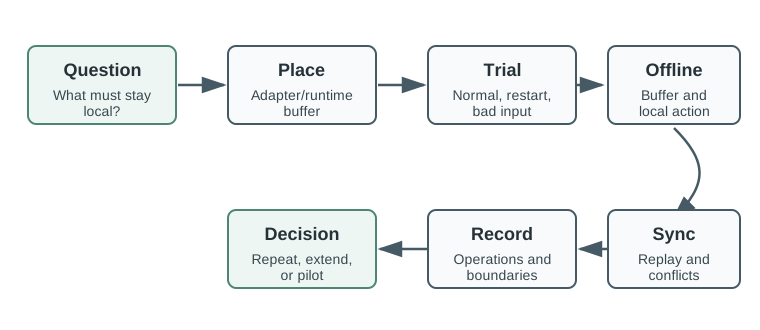
In Figure 30.1, Start with the local responsibility: alarm visibility, command authorization, protocol translation, buffering, image inference, meter aggregation, or offline workflow. Then test that responsibility under normal flow, upstream loss, gateway restart, resource pressure, bad input, and reconnection. A cold-room gateway, for example, should not merely forward temperature readings to the cloud. It should show stale labels, alarm state, acknowledgement records, replay ordering, buffer pressure, and recovery notes while the upstream path is unavailable. A vision gateway should record model version, input window, confidence threshold, accepted and rejected frames, and how a local override or safe fallback is exposed to the operator.
The useful outcome is a boundary decision rather than a polished gateway demo. The review should say which behavior belongs at the edge because latency, privacy, bandwidth, resilience, or local control demands it; which behavior still belongs upstream for fleet history, analytics, reporting, or governance; and which behavior must move to a device-management or application-framework review. If the edge node only works while the original developer watches a terminal, the prototype has not proved the operations boundary yet. A stronger result can be repeated by a support owner from documented runtime version, configuration, logs, health checks, buffer policy, and change conditions.
- Placement question: which behavior must run near the device because latency, safety, bandwidth, privacy, or resilience requires it?
- State question: which local state wins when device data, buffered data, operator actions, and upstream records disagree?
- Operations question: who owns gateway version, service restart, storage pressure, credential rotation, runtime update, and field replacement?
30.3 Pick Edge Stack by Failure Mode
This section: Pick Edge Stack by Failure Mode — Use a small stack that exposes the exact local question.
Use a small stack that exposes the exact local question. Docker Compose, systemd services, containerd, or k3s can prove service packaging and restart behavior. AWS IoT Greengrass, Azure IoT Edge, EdgeX Foundry, Eclipse Kura, Balena, Node-RED, Mosquitto, NATS, Telegraf, Fluent Bit, SQLite, InfluxDB, Redis Streams, and local file queues can prove gateway flows, buffers, adapters, and sync paths. NVIDIA Jetson, Intel NUC, Raspberry Pi Compute Module gateways, Advantech and Moxa gateways, Siemens IOT2050, WAGO controllers, and industrial PCs expose different power, thermal, I/O, and service-management constraints.
Choose the stack from the failure mode, not from the runtime brochure. For a protocol-translation trial, keep the device adapter visible: Modbus register map, OPC UA node, CAN frame, BLE characteristic, LoRaWAN metadata, or MQTT topic should remain traceable to the local output. For a buffering trial, make the queue policy observable with retained count, oldest record, priority rule, discard reason, replay order, duplicate marker, and operator-facing stale-state label. For local control, prove authorization, precondition checks, actuator acknowledgement, rejection reason, and fallback before adding more dashboards. For inference, record model format, runtime, model version, input window, confidence threshold, accelerator use, and override path, then test resource pressure rather than assuming nominal latency will hold in the field.
The best practitioner review is intentionally narrow. Use one gateway type, one device set, one adapter, one local behavior, one buffer policy, one sync path, and one support workflow. Run it through normal operation, WAN outage, service restart, full buffer warning, malformed payload, delayed payload, duplicate payload, local acknowledgement, and reconnection. Capture the same evidence fields every time: input, local decision, operator view, log trace, stored record, sync result, and open risk. That consistency makes the edge result useful to cloud, application, security, and device-management reviewers instead of becoming a one-off bench artifact.
- For protocol edges: record Modbus RTU/TCP, OPC UA, CAN, BLE, LoRaWAN, serial, or MQTT adapter version, input quality, timestamp source, rejected frames, and mapping rules.
- For buffering: record queue depth, write-ahead log or SQLite table, retention policy, priority rule, backpressure signal, discard marker, replay ordering, and duplicate handling.
- For local inference: record model format and runtime such as TensorFlow Lite, ONNX Runtime, OpenVINO, TensorRT, or Edge Impulse, plus input window, model version, confidence threshold, latency, CPU/GPU/NPU load, and override path.
- For operations: record OS image, container tag, config file, secret source, watchdog, service restart policy, log rotation, OTA method, rollback path, and support command set.
30.4 Edge as Distributed State
This section: Edge as Distributed State — The difficult part of edge computing is not installing a runtime.
The difficult part of edge computing is not installing a runtime. It is making state ownership explicit across devices, gateway storage, local UI, cloud ingestion, dashboards, and device-management tools. Every local shortcut creates a distributed-state rule: which timestamp is trusted, which actor can command, which buffer entry is retained, which stale value is shown, which local action is replayed upstream, and which state wins after recovery.
Edge state usually spans several clocks and stores. A device may timestamp a reading before transmission, the gateway may add receipt time, a rule engine may add decision time, the local UI may cache display state, and the cloud may store arrival time. Without a declared ordering rule, a late packet can overwrite a newer local acknowledgement or make an old alarm look current. The review should therefore capture monotonic sequence numbers when available, timestamp source, NTP or PTP health, gateway restart time, buffer commit time, replay marker, and stale-state label.
Command paths need the same discipline. A local command should carry an actor, authorization decision, precondition result, idempotency key, issued action, actuator acknowledgement, rejection reason, and safe fallback. If upstream approval is normally required, the edge prototype must state whether local action is blocked, queued, allowed under a degraded-mode rule, or allowed only for a subset of commands. If local inference triggers action, the model version, input window, confidence threshold, and human override must travel with the event record. Those details keep the edge node from becoming an unexplained control path.
Resource boundaries are part of correctness. CPU saturation, memory pressure, disk fill, log growth, GPU/NPU contention, cellular bandwidth, power loss, and thermal throttling can change which events are processed, delayed, summarized, or discarded. A strong edge prototype names resource budgets and shows what happens at the limit: backpressure, priority retention, lossy summary, service restart, watchdog action, or operator warning. The handoff is acceptable only when a reviewer can explain behavior during normal operation, disconnection, restart, pressure, and recovery from the recorded evidence.
- Clock boundary: record device timestamp, gateway receipt timestamp, monotonic sequence, NTP/PTP state, late arrival rule, and stale-state label.
- Command boundary: define local preconditions, authorization, idempotency key, actuator acknowledgement, rejection reason, safe fallback, and upstream reconciliation.
- Resource boundary: budget CPU, memory, disk, thermal headroom, GPU/NPU use, network bandwidth, cellular data, power loss behavior, and log growth.
- Sync boundary: define retained raw data, aggregated data, alarms, model outputs, local acknowledgements, conflict resolution, deletion policy, and upstream schema version.
A strong edge prototype can lose the WAN, restart the gateway, refill the buffer, reject bad input, recover sync, and still explain what the local actor saw and what the gateway did.
30.5 Learning Objectives
This section: Learning Objectives
By the end of this chapter, you will be able to:
- Define the evidence an edge platform should expose for an IoT prototype.
- Decide when local autonomy, buffering, filtering, control, or inference belongs at the edge.
- Review edge-cloud synchronization without hiding stale data, duplicate messages, or unsafe local behavior.
- Separate edge runtime convenience from gateway operations, data ownership, update workflow, and support responsibility.
- Write an edge platform handoff summary with tested conditions, boundaries, rejected options, and change conditions.
30.6 Edge Platforms as Evidence Paths
This section: Edge Platforms as Evidence Paths — An edge platform places software near the devices so the prototype can keep working when upstream services are slow, unreachable, or not suitable for local decisions.
An edge platform places software near the devices so the prototype can keep working when upstream services are slow, unreachable, or not suitable for local decisions. The platform may run gateway services, filters, rule checks, command handlers, local displays, inference code, or synchronization queues. The important question is not whether the platform can run many services; it is whether it exposes the local behavior the prototype must prove.
Start with one sentence:
The edge platform must prove whether [local behavior] remains visible, recoverable, and safe during [device, gateway, network, or upstream condition] before we choose [next prototype or pilot form].Then choose the evidence type:
If a decision must protect a process, room, device, product, or person while upstream access is unavailable, prove that decision locally. Cloud sync can support review, reporting, and coordination, but it should not be the only path for required local behavior.
30.7 Evidence Roles in the Edge Path
This section: Evidence Roles in the Edge Path — Most edge platform trials touch several roles at once.
Most edge platform trials touch several roles at once. Name the roles before installing services so the review can separate device-facing behavior, local decisions, upstream synchronization, and operations work.
Figure 30.2 makes the local data and decision path visible during upstream loss.
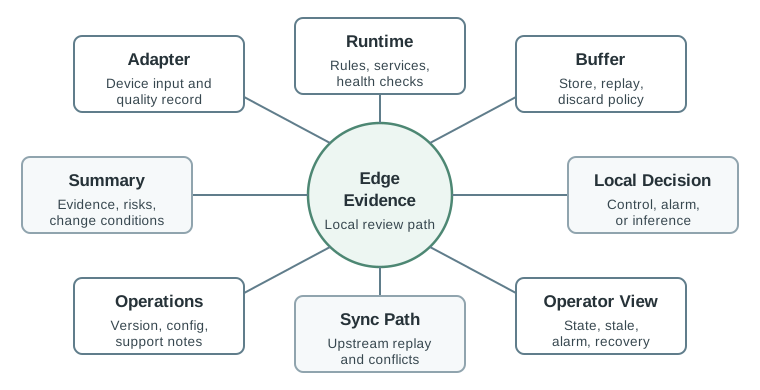
The edge roles in Figure 30.2 keep local behavior visible during upstream loss. An adapter records device input and its quality; the runtime applies rules or inference and reports its own health. The buffer has a retain, replay, and discard policy for readings or commands. Local decisions can then drive control or alarms without waiting for cloud access, while the operator view shows stale state and recovery. The sync path sends evidence upstream later and must handle replay conflicts. Operations keeps version, configuration, and support notes. The handoff states what was proved and which gateway, rule, or data-path change would require another trial.
Use this role checklist:
Putting a small computer near devices does not prove edge behavior. The review must show what the edge node owns, what it forwards, what it rejects, what it stores, and how it recovers.
30.8 Local Autonomy and Buffering Evidence
This section: Local Autonomy and Buffering Evidence — Local autonomy means the prototype can continue the behavior it promised during representative upstream loss, device noise, resource pressure, or gateway restart.
Local autonomy means the prototype can continue the behavior it promised during representative upstream loss, device noise, resource pressure, or gateway restart. Buffering is part of that evidence, but buffering alone is not the same as autonomy.
Review these cases:
Record concrete evidence:
edge_node:
device_set:
local_behavior_required:
upstream_loss_test:
buffer_policy:
restart_evidence:
replay_evidence:
rejected_input_evidence:
operator_visibility:
30.9 Control, Filtering, Inference
This section: Control, Filtering, Inference — Edge platforms often combine filtering, local rules, and inference.
Edge platforms often combine filtering, local rules, and inference. These can make a prototype useful quickly, but they can also hide important assumptions if the review records only the final output.
Figure 30.3 keeps buffer, filter, decision, and sync evidence in one edge trial.
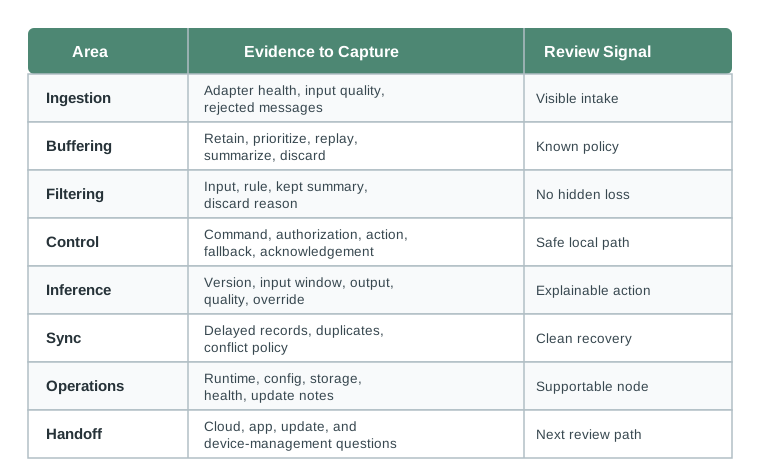
The gateway first needs a device input and quality record so a bad reading is not silently treated as valid. Buffer evidence records what is retained, replayed, or discarded during an upstream gap. Filtering or inference needs the cases and outputs used to judge its behavior; a local alarm or command needs a trace of the rule and observed result. After reconnection, sync evidence shows replay order and any conflict. Keep those artifacts from the same run. A platform such as the named gateway stack can host the flow, but the platform name does not prove its local decisions or recovery behavior.
Use the matrix as a review guide:
An edge decision should leave a review trail: input, local state, rule or model version, decision, action, and sync status. Without that trail, the prototype cannot explain why it acted.
30.10 Cloud Sync and Operations Boundaries
This section: Cloud Sync and Operations Boundaries — The edge-cloud boundary must be explicit.
The edge-cloud boundary must be explicit. Some evidence belongs locally because it affects immediate behavior. Other evidence belongs upstream because it supports review, fleet coordination, history, or user workflows.
Figure 30.4 assigns local alarms and buffering to the edge and longer review to upstream services.
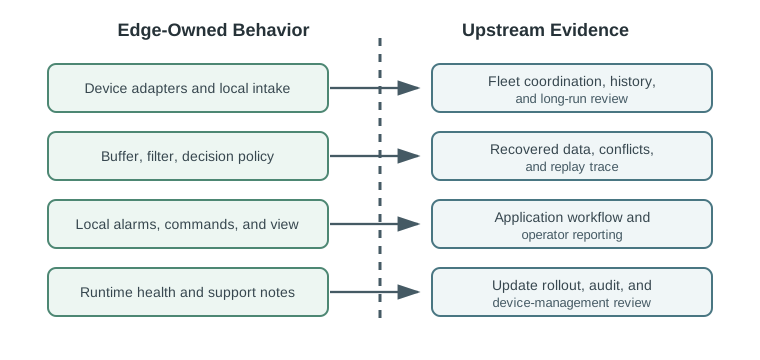
Device adapters bring readings into the local runtime with quality information. The edge owns buffer, filter, and local decision policy, so alarms and commands can continue when the upstream connection fails. The upstream side keeps longer history, operator workflow, and fleet coordination; after recovery it needs a replay trace and conflict record from the edge. A local view should show stale state and runtime health while disconnected. Test the same event during normal and failed links, then compare the local action and later upstream record. That crossing determines whether the architecture can preserve both timely behavior and auditable history.
Review these boundaries before accepting the result:
Sync is not only transport. The prototype must decide what happens when local state, delayed data, upstream state, and operator actions disagree.
30.11 Worked Scenario: Cold-Room Gateway Trial
This section: Worked Scenario: Cold-Room Gateway Trial — A team has already proven cold-room sensor devices and a cloud ingestion path.
A team has already proven cold-room sensor devices and a cloud ingestion path. The next uncertainty is whether a local gateway can keep alarms and state visible while upstream access is unavailable.
30.11.1 Stage 1: Evidence Question
question=can the gateway keep cold-room alarms, stale labels, local acknowledgements, and replay records visible during upstream loss and recovery?
device_evidence=sensor status, payload version, battery status, reading quality, stale flag
edge_evidence=adapter health, buffer status, local rule version, alarm state, acknowledgement log
sync_evidence=replay order, duplicate handling, upstream event trace, conflict notes
operations_evidence=runtime version, configuration version, restart behavior, support notes
30.11.2 Stage 2: Trial Conditions
Run representative devices through normal operation, gateway restart, upstream loss, full buffer warning, malformed payload, delayed payload, duplicate payload, local acknowledgement, and reconnection. Normal operation establishes the local path to compare with disruption. Restart and upstream loss test local visibility and recovery; buffer pressure and bad input expose retention, discard, and rejection behavior. Delayed and duplicate payloads make replay and state ordering part of the review.
Reviewers watch the local operator view while engineers inspect runtime logs and synchronisation records. Capture input, local decision, stored record, operator state, trace, and sync result for each condition. During reconnection, compare local acknowledgements and newer state with replayed records to assess the conflict policy and explain what appeared locally and upstream.
30.11.3 Stage 3: Findings
The edge path is accepted for the next prototype because local alarms remain visible, acknowledgements are recorded, stale state is clear, and replay does not overwrite newer state. The team does not yet accept the edge dashboard as the final operator workflow, and it routes update rollout evidence to the device-management chapter.
30.11.4 Stage 4: Change Conditions
Rerun edge checks when gateway hardware, adapter protocol, local rule, model, buffer policy, operator acknowledgement, or synchronisation conflict policy changes. The trial findings apply to the recorded gateway and behavior. Hardware and protocol changes require renewed runtime and input evidence; rule or model changes require another review of local decisions. Buffer changes need checks of retained, replayed, and discarded data, while acknowledgement and conflict-policy changes require renewed comparison of local actions with recovered upstream records.
Keep these conditions in the edge handoff alongside versions, configuration, logs, and open risks. Repeat the relevant normal, disconnected, restart, pressure, and recovery cases. Record whether alarms, stale-state labels, acknowledgements, and replay remain understandable, then update the next-step decision and any application or device-management handoff.
30.12 Edge Handoff Summary
This section: Edge Handoff Summary — An edge platform handoff summary should make the edge decision repeatable.
An edge platform handoff summary should make the edge decision repeatable. It should capture what the edge path proved, what it only implied, and what would require another run.
Figure 30.5 states the local behavior a gateway must keep under link loss.
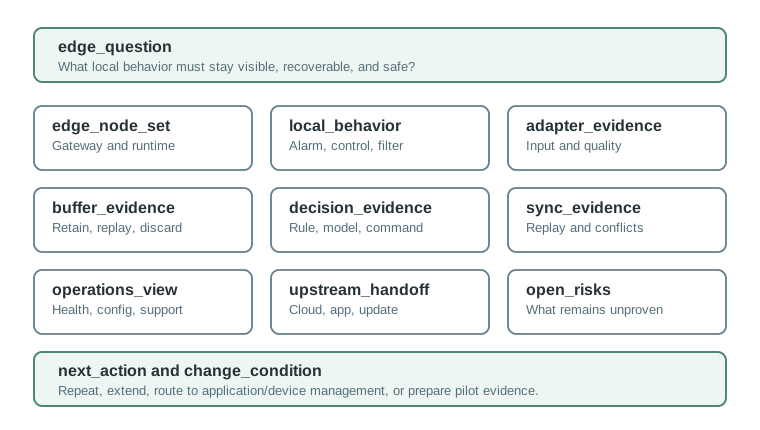
The handoff fields in Figure 30.5 make one local claim repeatable. The edge question names behavior that must remain safe and visible; the node set says which gateway and runtime were used. Adapter evidence shows input quality, buffer evidence shows retained or discarded data, and decision evidence covers the rule, model, or command. Sync evidence records replay and conflicts after reconnection, while the operations view keeps health and configuration. Open risks state what the run did not prove. The next action can repeat, extend, or route work to application or device management when hardware, protocol, rule, buffer, acknowledgement, or conflict policy changes.
Use this template:
prototype:
edge_question:
edge_node_set:
device_set:
local_behavior_required:
adapter_evidence:
buffer_evidence:
filter_or_rule_evidence:
control_or_inference_evidence:
sync_evidence:
operations_view:
upstream_handoff:
hidden_conveniences:
boundary_change_conditions:
open_risks:
next_action:
review_owner:
review_date:
Good records are observable:
30.13 Interaction: Edge Evidence Fit
This section: Interaction: Edge Evidence Fit
30.14 Common Failure Patterns
This section: Common Failure Patterns
A gateway that only forwards messages upstream has not proven edge behavior. Review local ownership: ingestion, buffering, decision, visibility, recovery, and support.
Filtering can reduce noise, but it must not discard the evidence needed to diagnose faults, review decisions, or explain local actions.
Recovered data can be late, duplicated, or older than a local operator action. Define the conflict policy before treating sync as solved.
Local control evidence belongs in the runtime path, not only in the display. Prove authorization, preconditions, action, acknowledgement, rejection, and fallback.
30.15 Summary
This section: Summary — Edge platforms help IoT prototypes prove local ingestion, buffering, filtering, control, inference, synchronization, and operations behavior near devices.
Edge platforms help IoT prototypes prove local ingestion, buffering, filtering, control, inference, synchronization, and operations behavior near devices. Use them deliberately. Start with the local evidence question, test normal and failure states, keep local decisions explainable, record edge-cloud boundaries, and route update, support, or application workflow questions to the next detailed chapter.
30.16 Key Takeaway
This section: Key Takeaway — Edge computing is justified when latency, privacy, bandwidth, resilience, or local control needs outweigh added deployment and operations complexity.
Edge computing is justified when latency, privacy, bandwidth, resilience, or local control needs outweigh added deployment and operations complexity.
30.17 See Also
This section: See Also
30.18 What’s Next
This section: What’s Next — Continue with Application Frameworks when the edge review exposes dashboard workflow, local operator screens, automation authoring, alert acknowledgement, or application-composition questions.
Continue with Application Frameworks when the edge review exposes dashboard workflow, local operator screens, automation authoring, alert acknowledgement, or application-composition questions.
Find help
3 reviewed answers.
Where should I start in a module?
Open the module page from the sidebar to see its chapters in order. Use the module map to return to a topic you need.
Modules and pathsReviewed
What can I try when a project does not work?
Check the symptom, then work through the diagnostic steps. Keep the error message and the smallest example that reproduces it.
When you are stuckReviewed
How do interactive examples work?
Use the interactive guide to check how examples and simulations work before changing your project.
Interactive examples guideReviewed