17 Packet Journey Game: Forwarding Decisions
More
Depth: Practitioner
Progress saves as you read. Mark sections complete as you go; your progress appears in the sidebar.
17.1 Start With the Decision
This section: Start With the Decision — Treat each game move as a real deployment question.
Treat each game move as a real deployment question. Which address is used here?
17.2 Route Overview
This section: Route Overview — This is part 1 of 2.
This is part 1 of 2. Continue with Packet Journey Game: Diagnostic Traces.
17.3 Part Objectives
This section: Part Objectives
- Test packet journey adventure with a concrete scenario and pass criteria.
- Trace packet journey path proof across its components and failure boundaries.
17.4 Start With the Packet as the Player
This section: Start With the Packet as the Player — The packet journey game works because it turns hidden forwarding decisions into visible choices.
The packet journey game works because it turns hidden forwarding decisions into visible choices. A sensor message has to leave its local link, cross devices that make forwarding decisions, and arrive with enough context for the application to understand it.
Treat each game move as a real deployment question. Which address is used here? Which device decides the next hop? What delay or loss did the packet collect? That habit makes the game a rehearsal for debugging.
- Start With the Packet as the Player
- Key Concepts
- In 60 Seconds
- Phoebe’s Field Notes: Why the “Shorter” Mesh Hop Can Be the Worse Hop
- Quick Check: Packet Forwarding Choice
- For Beginners: The Packet Journey Game
- Become a Packet!
- Packet Journey Adventure
- Learn Networking by Adventure
- Putting Numbers to It
- Try It: End-to-End Delay Calculator
- Quick Check: Layer 2 Forwarding
- Checkpoint: Three-Level Route
- Learning Objectives Covered in This Game
- Quick Check: Leaving a 6LoWPAN Mesh
- Packet Delay Budget Analysis
- Checkpoint: Delay Budget
- Match: Game Concept to OSI Layer
- Order Sensor-to-Cloud Packets
- Common Pitfalls
- Review Wrong Game Answers
- 2. Treating a High Game Score as Mastery
- Treat the Game as Required
- Label the Diagram
- Code Challenge
- Knowledge Check
- Packet Journey Path Proof
- Checkpoint: Path Proof
Follow the packet journey from play to proof:
- First use the game to separate LAN switching, WAN policy, and IoT mesh choices.
- Then read the delay examples as evidence that each hop and retry changes the final mission result.
- Next turn the score into a path proof with labels, trace fields, and owner decisions.
- Finally connect the same reasoning to troubleshooting, summary review, and the chapters that follow.
Checkpoints recap the route; collapsed sections and the embedded game carry the extra detail.

17.6 Learning Objectives
This section: Learning Objectives — The setup has named the player and the three levels.
By the end of this chapter, you will be able to:
- Apply networking concepts in an interactive game environment by guiding a packet through LAN, WAN, and IoT mesh levels
- Analyze packet routing decisions across different network types including switched LANs, routed WANs, and 6LoWPAN mesh networks
- Select correct protocols at each OSI layer based on reliability, latency, and energy constraints in real-time scenarios
- Differentiate between Layer 2 and Layer 3 forwarding by explaining when switches use MAC addresses versus when routers use IP addresses
- Evaluate the impact of protocol choices on end-to-end latency by calculating delay budgets across multi-hop paths
- Construct an understanding of packet encapsulation by tracing how headers are added, compressed, and removed at each network boundary
This interactive game lets you experience networking by playing the role of a data packet traveling through a network. You will make decisions about routing, deal with congestion, and learn how real networks work---all through a fun, game-based experience that requires no prior technical knowledge.
“This is so cool---you get to BE a data packet!” exclaimed Temperature Terry. “You travel through the network, hopping from router to router, making decisions at every stop!”
“At each hop, you have to choose the right path,” explained the microcontroller. “Take the wrong route and you might hit congestion, a firewall, or a failed node. It is like a maze where you need to apply everything you know about network layers and routing.”
the LED was already playing. “I just learned that picking UDP instead of TCP at the transport layer makes my packet faster but riskier---no retransmission if I get lost! And at each router, I need to check the routing table to find the next hop.”
“The game has three levels that get harder,” said the battery. “Level 1 is a simple home network, Level 2 is a campus with multiple subnets, and Level 3 is a full internet journey with firewalls and NAT. See how many packets you can deliver without losing any lives!”
The setup has named the player and the three levels. The next question is what the game asks the packet to prove at each boundary.
17.7 Packet Journey Adventure
This section: Packet Journey Adventure
Guide a data packet from source to destination across three increasingly complex network environments. Make correct routing decisions, apply the right protocols at each layer, and overcome network challenges like congestion, failures, and firewalls.
Every routing choice in the game changes end-to-end delay.
Worked example: Suppose a packet crosses 5 hops with per-hop delays of ms and one retry penalty of ms:
If a congested route causes three retries instead, delay becomes:
That 6 ms increase is a 33% latency jump, which is why low-loss paths usually beat “short-looking” but unstable routes.
This section:
This section:
Packet Journey Adventure
Guide one sensor packet through LAN, WAN, and IoT mesh decisions.
This section:
Checkpoint: Three-Level Route
You now know:
- Level 1 asks whether local forwarding uses MAC addresses, routes, and NAT correctly.
- Level 2 adds transport choice, QoS priority, and firewall order.
- Level 3 adds 6LoWPAN compression, RPL energy choice, repair, and border-router decompression.
This section: — The game has made the route visible.
The game has made the route visible. The next question is whether the route still meets a time budget when hops, queues, and retries are counted.
The Packet Journey game reinforces these key networking concepts:
Level 1 - LAN Routing:
- MAC vs IP Addressing: Switches use MAC addresses (Layer 2), routers use IP addresses (Layer 3)
- NAT Traversal: How private IPs are translated to public IPs for internet communication
- Routing Tables: How routers determine next hop based on destination IP
Level 2 - WAN Routing:
- TCP vs UDP: When to use reliable (TCP) vs low-latency (UDP) transport
- QoS Prioritization: How critical traffic gets priority during congestion
- Firewall Rules: How stateful firewalls inspect and filter packets
Level 3 - IoT Mesh Routing:
- 6LoWPAN: Header compression for constrained IPv6 networks
- RPL Routing: Routing for low-power and lossy IPv6 networks; an objective function may consider energy
- Failure Recovery: How mesh networks reroute around failed nodes
- Header Encapsulation/Decapsulation: Protocol processing at border routers
This section:
This section:
Scenario: In this classroom packet-journey simulation, assume a 500 ms message-delay target for a pedestrian-button event. The target and path delays below are illustrative, not a cited traffic-safety standard or proof of a safe crossing controller. A real crossing must keep safety-critical action local and be engineered to its applicable requirements.
Network Path (similar to Game Level 2):
| Step | Network point | Role in the journey |
|---|---|---|
| 1 | Sensor button | Creates the safety message. |
| 2 | Edge router | Forwards the packet out of the local network. |
| 3 | ISP core | Carries the packet across the provider network. |
| 4 | Peering point | Hands traffic between networks; congestion often appears here. |
| 5 | Cloud firewall | Checks whether the packet is allowed. |
| 6 | Traffic controller | Receives the message and changes the crossing state. |
Delay Components from Packet Journey Game:
Hop 1: Sensor to Edge Router (LAN)
- Physical propagation: ~0 ms (100 m at ~2×10^8 m/s in copper ≈ 0.0005 ms, negligible)
- MAC layer (CSMA/CA): 5 ms average (Wi-Fi contention + backoff)
- Processing delay: 2 ms (edge router forwarding + queuing)
- Hop 1 Total: 7 ms
Hop 2: Edge Router to ISP Core
- Propagation: 10 ms (fiber link to ISP, 2,000 km at 2×10^8 m/s)
- Transmission delay: 0.12 ms (1,500 byte packet at 100 Mbps = 12,000 bits ÷ 10^8 bps)
- Queueing delay: 14.88 ms (typical load)
- Hop 2 Total: 25 ms
Hop 3: ISP Core to Peering Point
- Propagation: 20 ms (cross-country fiber)
- QoS decision: 5 ms (Level 2 challenge - classify as “critical alarm”)
- Queueing: 30 ms (congested peering point during evening peak)
- Hop 3 Total: 55 ms
Hop 4: Peering Point to Cloud Firewall
- Propagation: 15 ms
- Firewall inspection: 2 ms (Level 2 challenge - rule matching)
- Hop 4 Total: 17 ms
Hop 5: Cloud Firewall to Traffic Controller
- Propagation: 5 ms (local data center)
- Application processing: 10 ms (TLS decryption + application logic)
- Hop 5 Total: 15 ms
Total End-to-End Delay and Safety Margin:
| Check | Calculation | Result |
|---|---|---|
| Total path delay | 7 + 25 + 55 + 17 + 15 | 119 ms |
| Illustrative delay target | Classroom assumption | 500 ms |
| Remaining margin | 500 - 119 | 381 ms of headroom |
| Example status | 119 ms < 500 ms | Within the assumed one-way delay target; this is no worst-case guarantee |
What If We Made Wrong Protocol Choices?
Bad Decision 1: Skip QoS (treat as best-effort traffic)
- Peering point queueing increases from 30 ms to 200 ms during congestion
- New total: 119 - 30 + 200 = 289 ms (still OK, but margin reduced to 42%)
Case 2: A required message is lost on a UDP path with an application retry
- Assume 5% single-attempt loss and that a successful retry adds an illustrative 200 ms wait
- Conditional mean for these two outcomes: 119 ms × 0.95 + (119 + 200) ms × 0.05 = 129 ms
- Single-loss-and-successful-retry case: 319 ms; repeated loss or failed retries can exceed 500 ms
Case 3: Firewall rule misconfiguration (Game Level 2)
- Packet blocked by default deny rule
- Assume a 1,000 ms timeout before a retry: this exceeds the example’s delay target
- Failed message path: This remote event is not confirmed; actual crossing control must use its local safety behavior
Real-World Lesson from Game Mechanics:
The Packet Journey Game teaches that delay is cumulative and unpredictable:
- Each hop adds latency (sum of all hops)
- Wrong protocol choices (UDP without retries, best-effort QoS) add risk
- Firewall errors cause complete failure, not just delay
Design Rule: Budget for worst-case, not average:
- Average path: 119 ms
- Combined illustrative congestion and one retry: 119 - 30 + 200 + 200 = 489 ms, before any further loss
- Design with a 2× safety margin: a 500 ms requirement means a 250 ms target latency.
Optimizations Applied:
From Game Level 2 Decisions:
- Use TCP (Level 2 choice) - reliability over speed
- Apply QoS Expedited Forwarding (Level 2 challenge) - priority during congestion
- Configure firewall allow rule (Level 2 challenge) - avoid blocks
From Game Level 3 (6LoWPAN mesh):
- If using wireless sensors, avoid multi-hop mesh when latency matters (each hop typically adds 10–50 ms)
- Game shows RPL mesh with 4 hops = 50+ ms total just for mesh routing
- Better for latency: direct Wi-Fi to the edge router (single hop ≈ 7 ms)
Final System Design:
| Segment | Example design choice | Assumed delay |
|---|---|---|
| Sensor to edge router | Direct Wi-Fi, single hop | 7 ms |
| Edge router to ISP core | QoS enabled | 25 ms |
| ISP core to cloud | Expedited Forwarding | 35 ms |
| Cloud to controller | Firewall pre-configured | 32 ms |
| Total | Sum of assumed segment delays | 7 + 25 + 35 + 32 = 99 ms |
| Delay target | Classroom scenario | 500 ms; a worst-case bound still needs measurement |
Key Insight from Game: Protocol decisions at each layer (MAC, transport, network, application) compound across the entire path. The game’s level structure mirrors real network hops, teaching that every decision matters for end-to-end latency.
This section:
Checkpoint: Delay Budget
You now know:
- The illustrative path totals
119 ms, leaving381 msinside its assumed500 msone-way delay target. - Skipping QoS, losing a packet, or blocking at the firewall changes the mission differently.
- A direct Wi-Fi hop can keep the sensor-to-edge segment near
7 ms.
This section: — The timing story is now concrete.
The timing story is now concrete. The next task is to label the packet journey so each decision has a visible place in the trace.
This section:
This section:
This section:
This section:
Common Pitfalls
This section: Common Pitfalls
Replaying a game to improve the score without reading the explanations for wrong answers reinforces incorrect mental models. Fix: read every explanation carefully before attempting the next question, even when the answer was correct.
Game scores measure performance on a specific question set, not broad mastery. Fix: supplement game exercises with worked examples, labs, and scenario problems to confirm genuine understanding.
Interactive games in this module are designed to reveal common misconceptions that text alone may not expose. Fix: attempt every game exercise and use wrong answers as diagnostic information about which concepts need more study.
This section:
This section:
17.8 Knowledge Check
This section: Knowledge Check
17.9 Packet Journey Path Proof
This section: Packet Journey Path Proof — The packet journey game is more than a score.
The packet journey game is more than a score. Each choice asks the learner to prove that a packet can move through one boundary without losing the meaning of the previous boundary. A switch proves local delivery with MAC forwarding, a router proves network delivery with IP next-hop choice, and the end system proves that the application result still arrived.
Read Figure 17.1 as the list of proofs the game asks for, in the order a packet meets them.
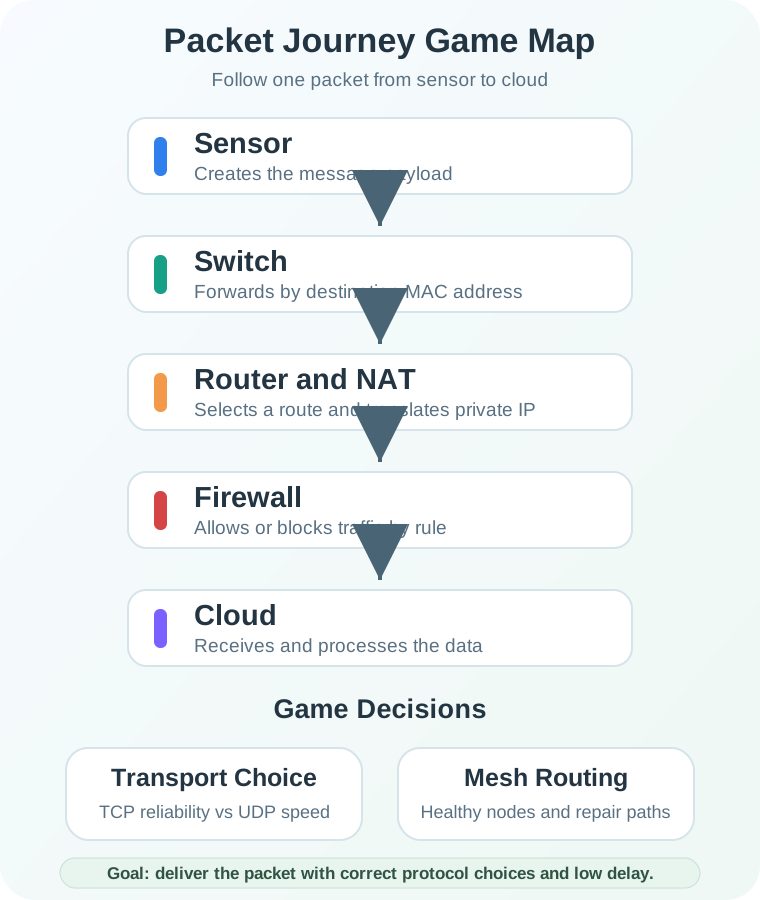
The sensor starts at the top by creating the payload. The switch forwards it by destination MAC address; receiver evidence confirms local delivery. The router selects a route, and NAT may translate a private address; an onward trace confirms whether the packet traversed that boundary. The firewall then allows or blocks it by rule, and the cloud finally receives and processes the data. Two side decisions hang off that path in Figure 17.1: TCP reliability against UDP speed, and a mesh route across healthy nodes with repair paths. Each stop asks a different question, and the score only means something if the packet passed every one of them.
The useful score is not just delivery. It is the evidence trail from payload creation through forwarding, policy, transport choice, and final receiver behavior.
That is the same habit used in real IoT troubleshooting: trace the packet from source intent to link behavior, network route, transport trade-off, security check, and receiver outcome. The game makes the boundary visible because every level asks a different kind of question. A local LAN question asks whether a frame reached the right neighbor. A WAN question asks whether a route, NAT mapping, or firewall rule allowed the flow. A mesh question asks whether the path still works when a low-power node changes parent or needs a repair path.
The important review move is to separate arrival from proof. A packet that eventually reaches the cloud may still be a bad design if it spent too much time in link retries, crossed a fragile NAT state, relied on a firewall exception that is not documented, or consumed a battery-heavy mesh repair. The path proof says what each layer contributed and where the next real test belongs.
When a learner can explain the game route this way, the lesson transfers to commissioning work. The operator does not say only “the packet failed.” The operator asks which boundary was last proven: payload creation, neighbor delivery, routed next hop, transport recovery, security policy, or application processing.
That boundary question keeps the game from becoming memorization; every successful move must leave a clue that would still help during a field failure.
Checkpoint: Path Proof
You now know:
- Arrival is not enough; each boundary needs evidence.
- LAN, WAN, and mesh questions prove different parts of the packet journey.
- A useful score leaves clues about retries, NAT state, firewall policy, and receiver behavior.
The proof explains what happened. The trace record turns that explanation into a short artifact another operator can replay.
17.10 Continue to the Next Part
This section: Continue to the Next Part — Carry this evidence into Packet Journey Game: Diagnostic Traces, which begins with Packet Trace Record.
Carry this evidence into Packet Journey Game: Diagnostic Traces, which begins with Packet Trace Record.
Find help
3 reviewed answers.
Where should I start in a module?
Open the module page from the sidebar to see its chapters in order. Use the module map to return to a topic you need.
Modules and pathsReviewed
What can I try when a project does not work?
Check the symptom, then work through the diagnostic steps. Keep the error message and the smallest example that reproduces it.
When you are stuckReviewed
How do interactive examples work?
Use the interactive guide to check how examples and simulations work before changing your project.
Interactive examples guideReviewed