28 Real-Time ISA-95: Timing Foundations
More
Depth: Practitioner
Progress saves as you read. Mark sections complete as you go; your progress appears in the sidebar.
- Podcast audio coming soon
- Character narration audio coming soon
28.1 Keep the Filling Line on Time
A factory message can be correct and still arrive too late for control. This chapter uses ISA-95 to place industrial decisions at the level that can meet their deadlines and own their consequences. You will distinguish real-time timing classes, map control and data responsibilities across five automation levels, and use those boundaries to choose latency requirements and technologies for an industrial IoT architecture. This is part 1 of 3.
A filling line must close a valve before a bottle overflows. The line controller can act in a fraction of a second. A production system can count finished bottles over minutes, while business planning may work across days. Sending the fast decision upward through every layer would add delay and mix duties that need different owners. A motor loop that misses its 1 ms deadline can damage equipment; an enterprise report delivered a few seconds late may have no operational impact.
Start at the machine and work outward. Keep immediate safe control near the process. Give supervisors current state and a bounded way to change approved settings. Let production planning combine orders, materials, and results, and let business planning use summaries. For each boundary, identify the action that must happen at the machine, the state the operator needs now, the setting a supervisor may change, the work order guiding the shift, and the summary guiding the week.
Commands and reports need separate treatment. Machine state may rise to planning, and a plan may set an approved target, but an old report must not become a live command. Record source, event time, approval time, version, and owner. Reject a value whose age or authority is wrong for its receiving layer. The layers separate decision speed and responsibility; they are not fixed brands or a promise that every factory is arranged alike.
The problem is therefore both timing and authority: who may observe, who may decide, and who may act before a deadline? The approaches below first place each function in the ISA-95 model, then assign a local owner, then examine the complete response path. Choosing the wrong technology can cause equipment damage, safety incidents, or wasted resources; using hard real-time hardware for enterprise reporting can also waste budget.
28.2 Prerequisites
This builds on vertical integration in Industry 4.0 Fundamentals, latency and determinism in Industrial Protocols, and latency, jitter, and network timing in Networking Basics.
KEY CONCEPTS
- Deadline consequence
Hard, firm, and soft timing classes describe what lateness changes.
- Five levels
Place field, control, supervision, operations, and enterprise duties.
- Jitter
Bound cycle-to-cycle variation as well as total latency.
- Control authority
Keep commands with the owner of the deadline and safe fallback.
28.3 Part Objectives
- Distinguish hard, firm, and soft real-time industrial deadlines.
- Map timed data and control responsibilities across ISA-95 levels.
28.4 ISA-95 Timing Boundaries
ISA-95, also published as the IEC 62264 series, defines the interface between enterprise and control systems. It is useful because it prevents one architecture from treating every factory message as the same kind of message. A servo drive, programmable logic controller (PLC) task, human-machine interface (HMI) alarm, manufacturing execution system (MES) work order, and enterprise resource planning (ERP) purchase plan all matter, but they live on different time scales and carry different consequences when they arrive late.
The lower levels are close to the physical process. Level 0 devices sense or actuate. Level 1 controllers run machine logic. Level 2 systems supervise and visualize. Level 3 systems coordinate production operations. Level 4 systems plan the enterprise. IoT designs fail when they move Level 0 or Level 1 control decisions into cloud services, dashboards, or business systems that were never built for deterministic deadlines.
The useful pattern is to separate control authority from information visibility. A cloud dashboard may show a motor-current trend, but it should not close a 1 ms torque loop. MES may issue a production order, but it should not bypass a PLC interlock. ERP may plan inventory, but it should not decide whether a robot can enter a safety zone. Each level can exchange data with the others, but the deadline and safety owner must stay attached to the function.
That separation also keeps industrial IoT projects honest. A machine event may need a local trip, a supervisory control and data acquisition (SCADA) alarm, a historian sample, an MES quality hold, and an ERP maintenance cost update. Those are related records, not one identical message. The lower levels need deterministic response and fail-safe behavior; the upper levels need context, timestamps, ordering, reconciliation, and business meaning.
A hard real-time deadline makes lateness a system failure, even if the answer eventually arrives. A firm real-time result loses its usefulness after its deadline. With soft real-time, delay degrades usefulness but the system can usually continue safely. Best-effort delivery places more emphasis on completeness, ordering, and reconciliation than on millisecond arrival.
Jitter is cycle-to-cycle timing variation. In synchronized motion, bounding it can matter more than average latency. The timing class describes the consequence of lateness; the ISA-95 level locates the function and its responsibility.
Figure 1 assigns a deadline and responsibility to each automation layer.
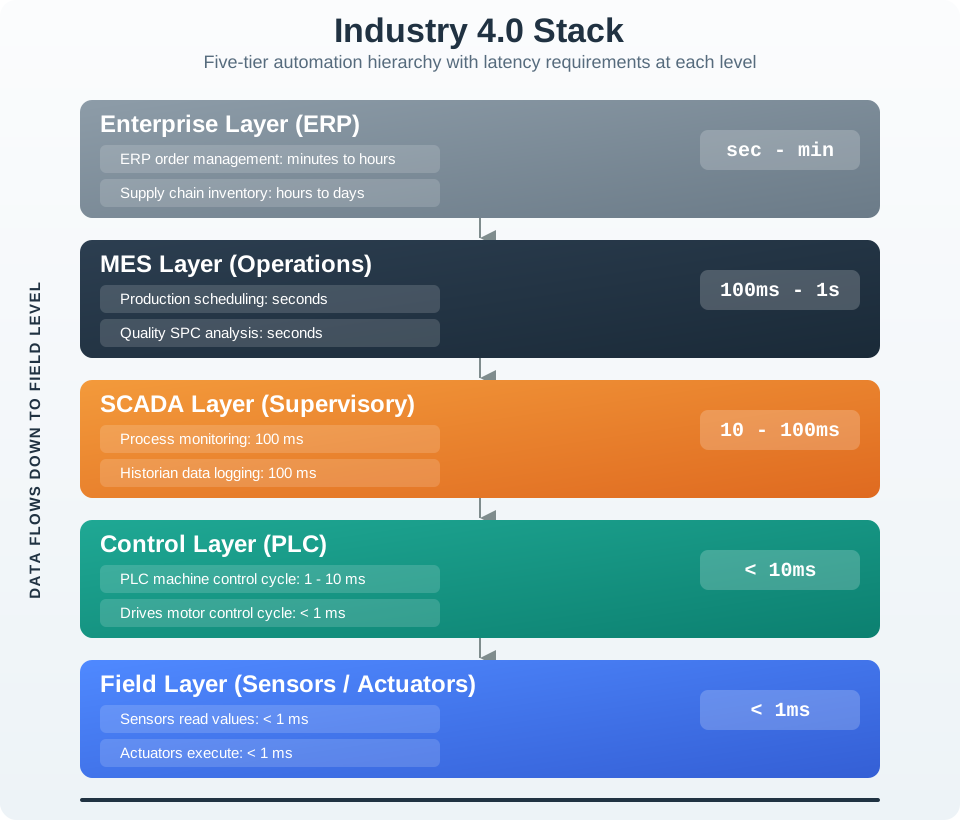
Start Figure 1 with field sensing below a millisecond, then move to PLC control at 1–10 ms. SCADA has 100 ms to one second for supervision, MES works over seconds or minutes, and ERP plans over hours or days. Those windows expose distinct failure modes: a late encoder value can destabilize motion, while a late business plan changes coordination rather than the immediate machine state. Integration technology must respect that difference. Move observations upward for context, but keep deterministic commands and their safety owner inside the boundary that can meet the required time.
28.5 Assign the Deadline and the Owner
With the timing classes clear, a practical ISA-95 design starts with the fastest unsafe or economically damaging event. Emergency stop, light curtain, torque limit, burner management, and motion synchronization belong near certified safety controllers, drives, PLCs, or dedicated real-time hardware. A dashboard can display their state, but it should not be the path that makes them safe.
As timing relaxes, the architecture can move upward. This keeps production coordination and business records connected to the machine without making every consumer responsible for the machine’s next action. SCADA and HMI systems can supervise lines and alarms. Historians can sample process values for trends. MES can handle work orders, batch phases, genealogy, quality checks, and OEE. ERP can plan demand, inventory, purchasing, and finance. Edge gateways and OPC UA servers often bridge the lower levels to these higher consumers without collapsing the timing boundaries.
For each function, write a timing row before selecting protocols. A packaging line may need a 4 ms registration correction, a 50 ms reject confirmation, a 500 ms HMI alarm update, a 5 second quality-hold decision, and a nightly ERP production reconciliation. These numbers point to different owners and paths. Putting them in one table exposes whether a proposed MQTT, REST, OPC UA, PROFINET, EtherCAT, or database path is being used at the right ISA-95 level.
Use gateways as translators, not as hidden control owners. An OPC UA server can expose PLC tags with semantic names and quality codes; a historian can compress and retain process values; an MES connector can attach work-order, batch, operator, and material context. None of those bridges should silently become the only place where a local stop, interlock, or critical fallback is decided.
- Write the deadline. Capture cycle time, maximum latency, jitter tolerance, timeout behavior, and safe fallback for each function.
- Name the owner. Decide whether the function is owned by a sensor/actuator, drive, PLC, safety controller, SCADA, MES, historian, gateway, cloud service, or ERP.
- Choose the path. Use deterministic paths such as PLC scan cycles, EtherCAT distributed clocks, PROFINET IRT, or CIP Sync where deadlines demand them; use OPC UA, MQTT, REST, or database interfaces only where timing allows.
- Define stale-data behavior. Specify when a value becomes stale, who may act on it, and which local action wins if the network or cloud link is unavailable.
28.6 Budget the Complete Response
Assigning an owner is only the start. A real-time guarantee includes sensing delay, input filtering, PLC scan time, task priority, network scheduling, controller execution, output update, actuator response, and mechanical settling. A fast Ethernet link does not fix a slow scan cycle, overloaded gateway, nondeterministic task scheduler, or cloud round trip. That is why control engineers measure end-to-end response, not just bandwidth.
Clocking and scheduling matter. Motion systems may use EtherCAT distributed clocks, PROFINET IRT time slots, CIP Sync with Institute of Electrical and Electronics Engineers (IEEE) 1588 PTP, or TSN mechanisms such as IEEE 802.1AS time synchronization and 802.1Qbv time-aware shaping. Safety functions may rely on certified PLCs, safety relays, safety-rated drives, PROFIsafe, CIP Safety, or International Electrotechnical Commission (IEC) 61508/IEC 61511 engineering practices rather than ordinary application code.
Higher levels have their own correctness rules. MES transactions need sequence, genealogy, batch state, operator action, and quality disposition. Historians need timestamp source, compression, exception/deviation rules, and data quality. ERP integrations need reconciliation and retry. These concerns are different from sub-millisecond determinism, but they are still part of a reliable industrial IoT architecture.
Determinism is normally engineered by bounding every queue and scheduler in the path. A PLC task with a fixed scan period, a drive with synchronized clocks, a switched industrial Ethernet segment with reserved time slots, and a local fail-safe output can be analyzed for worst-case behavior. A Wi-Fi channel, TCP retransmission, broker queue, cloud function, or shared database can still be valuable, but it belongs on a telemetry or coordination path where late data degrades usefulness instead of breaking the machine.
When data crosses levels, preserve both time and authority. A value should carry timestamp source, quality code, equipment mode, work-order or batch context, and source system so that SCADA, historian, MES, and ERP consumers do not mistake an old value for a live control signal. This is why ISA-95 integration is not only a network diagram; it is a contract between real-time behavior, operational semantics, and business records.
Measure the sensor, controller, network, compute, output, and mechanical delays together. Keep certified control and safety functions local; upper layers request, supervise, or record unless engineered for direct control. Preserve timestamp, quality code, equipment state, recipe or work-order context, and source system with data crossing levels.
A 4–20 mA loop across 250 ohms becomes 1.00–5.00 V, a 4.00 V ADC span. At the chapter’s 1 ms sample period, 1 kHz sampling sets a 500 Hz Nyquist limit. A 1.00 kohm, 398 nF low-pass gives the chapter’s illustrative 400 Hz pole and a 0.398 ms time constant, while a 12-bit conversion steps through the span in 0.977 mV increments. Because 400 Hz is 80% of Nyquist, that single pole is not by itself a validated anti-alias filter.

28.7 ISA-95 Automation Pyramid
28.8 Read the Timing Ladder
The response budget now gives the five-level pyramid a practical meaning. Read Figure 2 upward from the physical process toward enterprise planning. The five-millisecond loop belongs near the process, while a 1,000-widget order due Friday belongs to business planning. MES schedules work and SCADA reports current values between those extremes. The arrows carry data, deadline, safety context, and owner; they do not make the levels interchangeable.
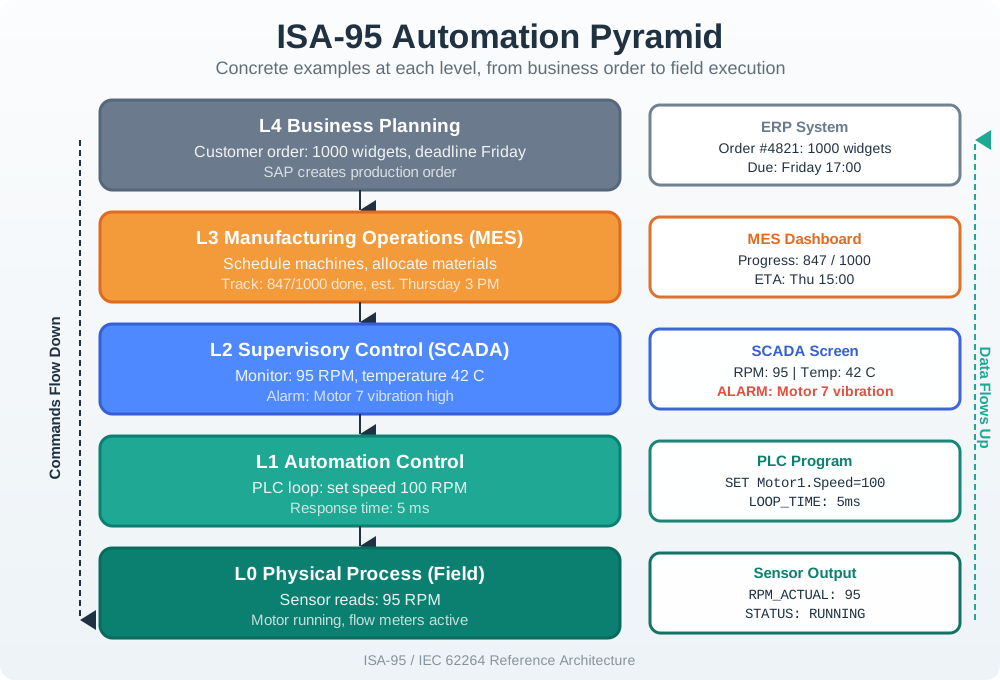
Read upward from Level 0, Physical Process, where sensors and actuators interface with equipment. The figure shows sub-millisecond timing, though the chapter notes that not every field device works that fast. Level 1, Basic Control, places PLC logic at 1–10 ms, with a 5 ms control-loop example. Level 2, Supervisory, uses SCADA and HMI to monitor values and raise alarms at 100 ms–1 s. Level 3, Operations, uses MES to schedule and track progress over seconds to minutes. Level 4, Business Planning, uses ERP over hours to days, illustrated by 1,000 widgets due Friday. Levels exchange data with deadline, safety context and owner. Keep the fastest, most safety-sensitive logic closest to the process.
Level 1: basic control, commonly 1–10 ms. PLCs, programmable automation controllers (PACs), distributed control system (DCS) controllers, safety controllers, and drives execute local control logic. Proportional-integral-derivative (PID) loops maintain setpoints, while safety systems must guarantee their required response times. Examples include motion control at 1 ms, discrete I/O at 10 ms, and slower process control at 100 ms. Deterministic execution cycles, real-time operating systems (RTOS), redundancy for critical functions, and direct I/O to Level 0 devices support this work. The range is a design guide, not a universal deadline for every controller.
Level 2: supervision, typically 100 ms–1 s. SCADA collects data from multiple PLCs, HMIs display process status, and alarms notify operators of abnormal conditions. Examples include data logging at 1 s, trend displays at 5 s, and alarm response at 500 ms. Human interfaces, soft real-time requirements, historical storage in historians, recipes, and batch management belong here. A screen updated every second can serve an operator even though it cannot close a fast machine loop.
Level 3: operations, seconds to minutes. MES manages production schedules and tracks work orders, genealogy, and quality. Batch control coordinates recipes; production-dispatch systems and overall equipment effectiveness (OEE) records support operations. Examples include batch phase transitions at 10 s, reporting at 1 min, and scheduling over hours. Integration with enterprise systems, production workflow coordination, quality management, traceability, resource allocation, and tracking matter alongside timing. Factory managers may plan the next work over minutes and hours.
Level 4: enterprise, hours to days. ERP handles business planning, supply-chain management coordinates materials, and customer relationship management connects customer information. Finance, procurement, and demand planning use corporate-wide visibility and integrated business processes. Examples include daily production planning, weekly demand forecasting, and monthly financial closing. These horizons extend into days and weeks as managers decide which products to build next month; financial and customer data support longer-term decisions.
Think of the ladder as machine speed at Levels 0–1, human supervision speed at Level 2, and planning speed at Levels 3–4. Temperature Terry’s factory-floor analogy treats the five levels as a building. The basement contains robot arms, conveyor belts, and temperature sensors: reacting at machine speed can resemble catching a thrown ball. On Floor 1, PLC “brain boxes” direct the machines, like a goalkeeper reacting to a penalty. Floor 2 provides the screens people watch, like checking a scoreboard. Floor 3 plans the next work, like a coach choosing the next play. Floor 4 looks ahead to future products, like planning next season’s sport. The analogy separates the pace of decisions, while the actual device examples show why each function still needs its own timing row.
The consequence becomes clear in a stop command: if a PLC tells a robot arm to stop but the message takes 5 whole seconds, the robot may already have crashed. Faster functions need engineered delivery paths; slower planning can use ordinary IT infrastructure. A small delay that is acceptable for a display can be a failure for a hard real-time function.
28.9 Keep the Boundary During Failure
Return to the filling line and test both the deadline and the authority. Delay an upper system, send an old setting, remove the business link, and restart the line controller. Queue a report, change a plan, switch shifts, then restore the link. Check that the valve still closes on time, the operator sees local truth, and summaries catch up without rewriting history. The later summary must retain the original event time, and no saved command should repeat.
Test access as well. Let a planner view results without driving the valve, let a supervisor change only an allowed setting, and let a service worker enter a safe repair mode. Ask an unauthorized user to change a limit. Refuse the wrong role and record each accepted change with its time and owner. Local safety must continue through an upper-system loss; stale commands must be refused. This gives evidence of who observed, who decided, and who acted.
28.10 Real-Time Requirements Calculator
One machine event can produce a local trip, SCADA alarm, historian sample, MES quality hold, and ERP cost update. Each record has a different deadline and purpose. Review that timing ladder with the separate calculator: change system type and device count to compare requirements and bandwidth, and notice the orders of magnitude between motion control and enterprise planning.
Summary
ISA-95 places field interaction, basic control, supervision, operations, and enterprise planning at different levels of responsibility. Timing generally relaxes upward, from sub-millisecond field functions and 1–10 ms control through 100 ms–1 s supervision, seconds-to-minutes operations, and hours-to-days enterprise work. Individual functions still need their own deadlines.
Design from the hardest constraint first, usually Level 0–1 safety or motion control. Choose deterministic protocols and RTOS platforms where needed, then relax requirements toward enterprise integration. Measure the entire response path, preserve time and operational context, and keep observation separate from control authority.
Put each decision where its owner can meet the deadline, and verify that safe local control survives slower planning systems and lost links.
Carry this evidence into Real-Time ISA-95: Determinism and Technology Mapping, which begins with Determinism vs. Throughput.