21 IIoT Operations: Legacy Risk and Evidence
More
Depth: Practitioner
Progress saves as you read. Mark sections complete as you go; your progress appears in the sidebar.
- Podcast audio coming soon
- Character narration audio coming soon
21.1 Start With the Motor Decision
A legacy controller can keep production moving and still hide a weak integration path. Industrial Internet of Things (IIoT) connects field evidence to operational decisions; this chapter shows how to identify legacy integration and downtime failure modes, then build an auditable record of who may act on the evidence.
Picture a motor on a factory line. A sensor shows that it is shaking more than usual. The machine may keep running, a worker may inspect it, the line may slow down, or a safety system may stop it at once. Before adding an analytics gateway, the team needs to know what the old programmable logic controller (PLC) supports and what an interruption would cost. Before acting on the vibration, it must name the decision and who or what may make it.
Some choices must happen beside the machine: a distant service must not delay a safety action. A weekly repair plan can use stored history, and a business report can wait longer still. A decision contract records the input, owner, time limit, allowed action and safe response to failure. It also says what the system must never control. The problem is to connect useful evidence without moving authority into a layer that cannot act safely or in time. We will inventory the constraints, price downtime, place the decision and trace its evidence to an accountable action.
This is part 3 of 3, building on IIoT Operations: Signal Trust and Authority. Industry 4.0 Fundamentals introduces cyber-physical systems, digital twins, industrial analytics, ISA-95 levels and brownfield deployment tradeoffs. Here those ideas become a reviewable operational boundary.
KEY CONCEPTS
- Legacy inventory
Controller, protocol and documentation gaps determine integration effort.
- Downtime evidence
Price the interruption, recovery and effects on the rest of the line.
- Decision authority
Give each action an owner, deadline, limit and fallback.
- Signal context
Preserve meaning, quality and operating state along the evidence path.
21.2 Learning Objectives
- Identify legacy integration and downtime failure modes.
- Build an auditable IIoT operations decision record.
21.3 Inventory Before Promising Integration
The motor’s working controller does not establish that a new gateway can safely extract its data. Planning around modern, well-documented equipment hides the decades-old PLCs, proprietary protocols and undocumented configurations on a real factory floor. Projects stall on 1990s-era PLCs with no documentation. Supposedly standard protocols have vendor-specific implementations that do not interoperate. Specialists spend months reverse-engineering systems, budgets overrun, and critical machines may run obsolete operating systems that cannot be patched or connected safely.
Newer pilot equipment creates false confidence because it integrates easily. Vendor demonstrations use modern reference architectures, while information technology (IT) teams unfamiliar with operational technology (OT) may underestimate Modbus RTU, PROFIBUS, DeviceNet and proprietary serial diversity. Documentation may have been lost years ago or never completed.
Start with asset discovery and a network audit before planning the project. Record every PLC model, firmware version and communication protocol, along with documentation gaps and required outage windows. Include OT engineers who know legacy systems. Classify equipment into four integration tiers: (1) modern with standard APIs, (2) legacy with documented protocols, (3) legacy requiring reverse engineering and (4) replacement required. Base timelines on the tier distribution rather than the easiest pilot.
Budget only after that inventory. Plan protocol conversion gateways such as Kepware, Ignition or custom solutions where appropriate, and accept that some equipment requires replacement. Brownfield work adds integration to an existing plant: machines may run for decades, shutdown windows may be short, vendor equipment may be closed, and safety interlocks may already be certified. The plan must respect those constraints before it promises connectivity.
21.4 Price the Whole Production Interruption
Inventory reveals where integration may interrupt production. To judge whether the motor project is worthwhile, the team also needs a consistent definition and cost of downtime. Planned and unplanned outages differ, as do a full stop and degraded performance. Finance may multiply hourly labor cost by hours while manufacturing managers know additional costs but struggle to quantify them. Those differing assumptions produce under-investment or unrealistic return on investment (ROI) expectations.
A labor-only projection omits scrap, rework, expedited shipping and contractual penalties. It also misses the cascade when one machine stoppage halts the entire line. Overpromised savings that never materialize damage credibility for future projects.
Build the model around four kinds of cost. Direct costs include labor, energy and materials in process. Indirect costs include expedited shipping, recovery overtime and quality problems during restart. Opportunity costs include lost sales, customer penalties and damaged relationships. Cascade costs include downstream process starvation and consumed inventory buffers. Validate the model against historical incidents so the business case reflects the plant’s experience.
Use a standardized downtime cost calculator for each production line. Document cost per minute or hour for a single-machine failure, a line-section failure and a full-line failure. Track actual costs after incidents to refine those estimates. Present conservative, validated numbers rather than theoretical maximum savings, with sensitivity analysis showing ROI under different downtime-reduction scenarios. This gives the motor’s inspection or slowdown decision an economic context without assigning it control authority.
21.5 Place the Decision at the Right Layer
Cost explains why an action matters; timing and authority determine where it belongs. Industrial IoT sits inside production, safety, maintenance, quality and compliance workflows. A reading matters when it changes a maintenance work order, production schedule, safety response, quality hold or engineering decision. The stack senses, communicates, analyzes and acts, but a wrong or late action can cost much more than a missed convenience notification.
Industry 4.0 combines five converging elements: cyber-physical systems (CPS), digital twins, AI/ML or statistical analytics, vertical integration across plant systems, and horizontal integration across suppliers and customers. A sensor retrofit becomes Industry 4.0 when real-time analytics, autonomous decision support and system integration change how work happens. The bearing vibration signal needs asset identity, operating state, historian records, spare-parts planning, maintenance procedures and a decision owner able to act safely. Industry 4.0: Technologies and Integration develops that wider setting.
The ISA-95 layers separate these responsibilities. Field devices report process state. PLCs close local control loops. Supervisory control and data acquisition (SCADA) supervises equipment and alarms. A manufacturing execution system (MES) coordinates production execution, quality and scheduling. Enterprise resource planning (ERP) handles business planning, orders, inventory and finance.
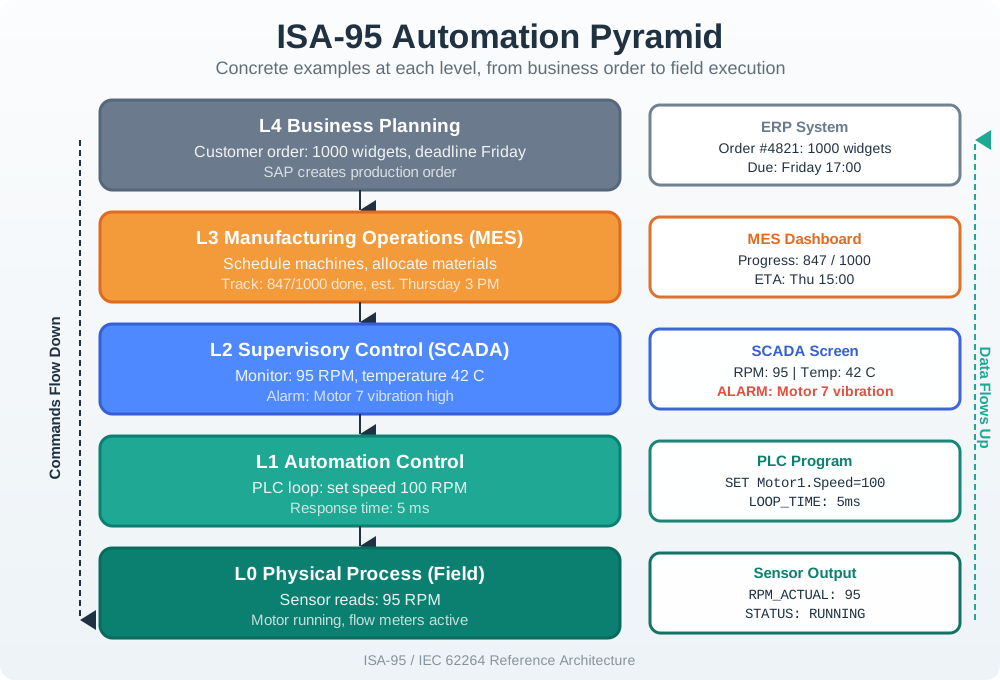
In this example, PLC loops take 1–10 ms, SCADA supervision takes 100 ms to one second, MES coordination takes seconds to minutes, and ERP commitments take hours or days. These are illustrative response windows, not prescribed ISA-95 timing limits. The 1,000-widget order due Friday may change a schedule; it should not command a one-millisecond torque loop. Every cross-layer exchange should retain source, time, quality, safety meaning and the owner allowed to act.
Sending a millisecond control decision through a cloud dashboard is usually wrong. Trapping all production context inside a PLC is also incomplete. Place each decision at the level that can act in time while making useful context available to other systems.
21.6 Trace the Vibration Signal to Work
With the motor’s decision placed, trace one data item from its physical source to the human or automated action. A vibration alert may start at an accelerometer, pass through an IO module or edge computer, publish to a broker, land in a historian, trigger a computerized maintenance management system (CMMS) work order, and reach a technician with enough evidence to decide whether production can continue.
A real plant has shared machines, old equipment, work permits, and several owners.
Start by locating the constraint before choosing a platform. A sub-second machine-control loop may belong near the PLC and should not wait for a cloud round trip. A maintenance trend may be aggregated through an edge gateway. A production key performance indicator (KPI) may belong in MES or ERP after cleaning, timestamping and contextualizing the signal. The same sensor can support all three, but each consumer needs its own latency budget, failure behavior and owner.
Extend the OT inventory to machines, drives, sensors, safety systems, network segments, cabinets, available ports, historian tags, maintenance windows and vendor support constraints. Then state four boundaries for the trace. The asset boundary names the machine, line, cell, process or utility, including tags and operating states. The outcome boundary names the decision: preventing downtime, improving quality, reducing scrap, saving energy, protecting workers or proving traceability. The timing boundary identifies PLC-cycle, SCADA-alarm, MES-production or business-planning response. The integration boundary names the receiving system of record: SCADA, MES, CMMS, historian, dashboard, ERP or alert workflow.
Protocol choices follow those boundaries. Modbus TCP, PROFINET, EtherNet/IP, EtherCAT, IO-Link and vendor fieldbus networks often appear near equipment and automation. OPC UA can expose structured equipment data to SCADA, MES, historians or integration gateways. MQTT Sparkplug B can carry contextualized edge data toward brokers and applications. REST APIs, Kafka, time-series databases, data lakes and enterprise warehouses may support analytics and reporting after the control boundary is protected.
21.7 Preserve Meaning Along the Evidence Path
A successful transfer does not establish what a signal means. The motor’s vibration RMS (root mean square) value needs asset identity, sensor mounting point, sampling window, engineering unit, timestamp, machine state, speed, load and quality flag. A temperature reading needs probe location, calibration status, alarm thresholds, measurement range and whether equipment was idle, ramping, cleaning or producing. Without that context, analytics may learn maintenance schedules, product recipes or operator behavior instead of the physical failure mode.
Semantics is the meaning attached to the data. Attach the asset model, tag name, engineering unit, quality flag, namespace owner and operating context before using a signal for optimization or maintenance. Keep those meanings aligned when equipment, recipes and software versions change.
Modern IIoT stacks devote substantial engineering effort to semantics. OPC UA information models can describe objects, methods, variables, namespaces and data quality. MQTT Sparkplug B birth certificates can advertise edge nodes, devices, metrics, units and online state to a broker.
Historians and time-series databases preserve high-resolution process data. MES, CMMS, ERP and quality systems attach production order, work order, product, batch and maintenance context. These systems contribute different parts of the evidence: a vibration value and its operating state must remain understandable when a technician receives the work order. Contextualized messaging does not replace the systems and owners that schedule, record and act on work.
21.8 Make the Contract Safe to Release
Meaning alone is insufficient if a late, duplicated or missing signal produces the wrong response. Before release, separate monitoring, recommendation and direct control. Monitoring can often use read-only paths; changes to control require formal engineering review. Put logic in the PLC, edge computer, gateway, SCADA, MES, cloud service or human workflow according to its timing and authority, with the fastest and most safety-sensitive logic closest to the process.
Protect production by planning wiring, cabinet space, network segmentation, maintenance windows, rollback steps and operator handoff before adding sensors or gateways. Commission with evidence: record tag mappings, sample rates, alarm thresholds, units, calibration status and acceptance tests. Then prove the action loop. Show who receives the alert, what they can inspect, which system they update and what happens if the alert is false, late, duplicated or missing.
The release record must cover reliability, security and the safety boundary as well as semantics. Define buffering, replay, duplicate handling, clock behavior, quality codes and stale-data rules before analytics consume the stream. Include gateways, brokers, remote access, credentials, certificates and vendor support paths in the industrial risk model. Keep advisory analytics separate from certified control and safety functions unless the whole system is engineered, validated and maintained for that role.
Plants often use Purdue-style zones, firewalls, jump hosts, DMZ brokers, read-only data taps, least-privilege service accounts, certificate rotation and change-control records to keep monitoring projects from weakening control systems. International Electrotechnical Commission (IEC) 62443 practices may guide segmentation, identity, remote access, patching and supplier responsibilities.
Store-and-forward gateways, local alarms, monotonic clocks, sequence numbers, duplicate handling and stale-data rules help keep the plant usable when analytics, cloud links, dashboards or enterprise networks are unavailable. These mechanisms belong in the reliability contract alongside buffering and replay behavior. They do not give an advisory service permission to take over a safety function.
The motor’s contract is reviewable when it names the machine, production state, decision owner, integration system, latency budget, safety boundary and fallback behavior. That record lets operations audit a proposed analytics recommendation before release rather than relying on the model’s name or dashboard appearance.
Summary
Legacy integration begins with an OT inventory and timelines based on the equipment actually present. Downtime evidence includes direct, indirect, opportunity and cascade costs, validated against incidents. Together they support a credible business case for changing the motor’s maintenance workflow.
A decision contract connects the signal’s meaning and quality to an owner, deadline, allowed action and fallback. Preserve context as evidence reaches historians, CMMS, MES or ERP, and keep monitoring and advice within their approved authority. The applications module index places these industrial decisions among the wider application workflows.
Before connecting legacy equipment, prove the integration path and downtime cost; before acting on its data, prove who may act, by when and with what safe fallback.
Carry this decision record into Industry 4.0: Technologies and Integration to examine how the wider plant systems fit together.