9 IoT Go-to-Market: Deployment Strategy
More
Depth: Practitioner
Progress saves as you read. Mark sections complete as you go; your progress appears in the sidebar.
- Podcast audio coming soon
- Character narration audio coming soon
9.1 Sell a Service That Can Be Deployed
A go-to-market (GTM) strategy explains who will buy a product, what they will pay, how it reaches them, and when it is ready to launch. For IoT, that plan must cover installation, connection, operation, support, and expansion. A sale is not a launch when every site still needs new wiring, training, and support.
Picture the chapter’s small leak detector working in a demo. A housing manager likes the warning, but mobile coverage, battery visits, false alarms, staff training, and installation decide whether the service can be bought and kept. The payer and the person who must act may be different people. A technically strong detector still needs a route from buyer pain to a useful result.
Write that full path from first contact to useful warning. Name the buyer, daily user, installer, payer, and support owner, together with the promised outcome, proof period, price, renewal point, and reason to stop. Keep urgent leak response possible at the building when the wider service is late. The sales promise must match the tested operating boundary.
The problem is proving that this path can work repeatedly after the pilot team leaves. A signed trial or an active device alone cannot establish that. The approaches below narrow the first customer segment, give each participant acceptance criteria, connect sales records to operating evidence, and set gates for expansion. You will use those records to map the buyer and support path, compare deployment and service costs, and explain measurable differences that answer buyer objections.
This chapter assumes familiarity with B2B sales cycles, channel management, unit economics, and revenue projections. IoT Business Model Fundamentals explains the value loop; Pricing Strategies helps choose what to charge for; Financial Metrics provides the financial groundwork. Here those ideas become a reviewable deployment plan. The related Launch Gates and Channels route develops the launch sequence and channel decisions further.
KEY CONCEPTS
- First segment
Choose buyers with a repeated problem and a deployment pattern you can support.
- Deployment path
Give buyers, installers, operators, and support owners concrete tasks.
- Launch evidence
Link pilot results, support work, and renewal to the same account.
- Unit economics
Compare customer value with acquisition and service costs before scaling.
9.2 Part Objectives
- Map the buyer, installer, user, and support path.
- Test a go-to-market plan against deployment and service costs.
9.3 Choose a Segment You Can Serve
With the leak detector’s operating promise in view, choose a customer group whose deployment can be repeated. The customer is buying a change to a workflow, site, asset, vehicle, building, device fleet, or production line. The segment must therefore fit the team’s ability to install and support that change.
This makes GTM more constrained than ordinary software launch planning. Hardware lead times, certification, installation access, network approvals, cybersecurity review, procurement, data processing terms, training, field support, and integration with existing systems can all determine whether a customer can actually adopt the product.
What should a launch team prove first, and what can wait? Figure 1 lays out one answer, quarter by quarter.
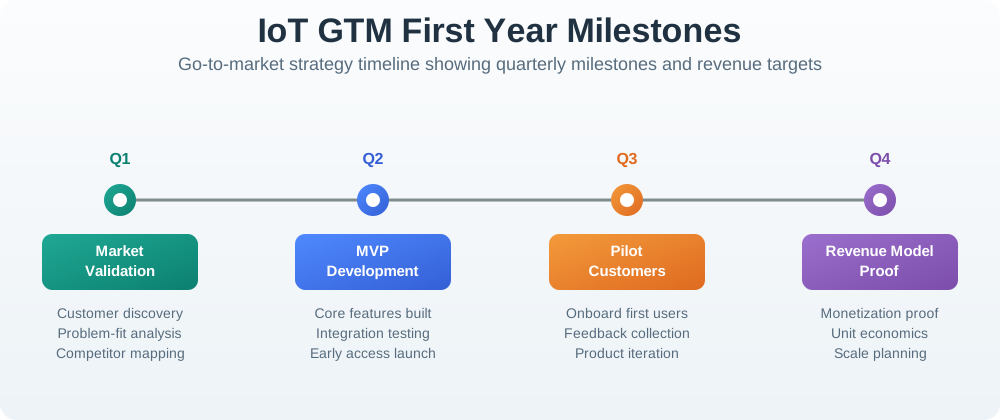
Read the timeline from left to right. The first quarter spends nothing on scale. It asks who has the painful job, using customer discovery, problem-fit work, and a map of rivals. The second quarter builds the core product and tests the integrations, which shows the thing can be installed at all. The third quarter puts real users on it and feeds their complaints back into the product. Only the last block asks about money, through unit economics and a plan to scale. That order is the point of Figure 1. Each quarter buys the right to spend more. A team that jumps to the last block still owns every claim it skipped.
For an industrial vibration-monitoring launch, that means the first market segment is not “all factories.” It might be mid-size plants with recurring pump downtime, LoRaWAN coverage or an approved cellular option, a maintenance owner who can sign a pilot, and enough similar assets to expand after proof. The first offer should make the deployment path concrete: device kit, installation checklist, alert workflow, dashboard owner, data-retention terms, support escalation, renewal trigger, and the success metric that decides whether the account moves from pilot to paid rollout.
The sequence also protects cash. Market validation should prove the buyer and the painful job. MVP work should prove installation and data reliability. Pilot customers should prove workflow adoption and support load. Revenue-model proof should show that paid accounts renew, expand, and cost less to serve than the gross margin they create.
- Segment: Choose a customer group with a repeated problem, reachable buyers, and a deployment pattern the team can support.
- Sales motion: A channel is the path the product takes to reach customers. Decide whether the product needs product-led signup, inside sales, field sales, system integrators, distributors, OEM partners, or a hybrid path.
- Expansion: Plan how a first site, device group, or use case grows into more assets, modules, users, and recurring revenue.
A familiar comparison is opening a restaurant. Families, business lunches, and fine dining imply different customers, just as large factories, small businesses, and homeowners do. Fast food and gourmet prices pose the same kind of choice as a one-time hardware purchase versus a monthly subscription. Walk-ins, delivery apps, and catering correspond to direct sales teams, online stores, and partner distributors. A soft opening followed by a grand opening resembles an alpha test, beta pilot, and full launch.
IoT adds physical obligations to those choices. Customers must install hardware, sensors must integrate with existing systems, subscriptions require continuing value, and technical buyers need evidence that the technology works. Identify segments by pain points, willingness to pay, and sales complexity; then tie the product’s measurable differences to the objections those buyers actually raise.
9.4 Give Each Participant an Acceptance Test
Once the first segment is clear, map the buying committee and the people who must operate the service. The economic buyer may care about return on investment (ROI) and risk. The technical buyer may care about APIs, security, data residency, and integration. The operator may care about setup time, false alarms, mobile workflow, and maintenance. Procurement, legal, facilities, IT, OT, cybersecurity, and finance may each add requirements before a deployment can scale.
Early launches should reduce uncertainty before spending heavily on sales. A pilot can test site access, installation time, cellular or Wi-Fi coverage, gateway reliability, cloud integration, dashboard use, alert response, and support burden. A partner pilot can test whether system integrators or distributors can sell and install the product without the founding team in every room.
A practical plan turns those roles into acceptance criteria. The economic buyer needs a before-and-after baseline such as downtime hours, energy cost, compliance labor, spoilage, or truck rolls. The technical buyer needs a security packet, network ports, data schema, API limits, identity model, and integration owner. The installer needs mounting instructions, power assumptions, gateway placement rules, and rollback steps. The operator needs alert thresholds, escalation timing, mobile access, and false-positive review. When any of those owners lacks a clear task, the launch risk moves from product-market fit into execution friction.
- Define the ICP. Name the ideal customer profile by industry, asset count, site count, pain severity, budget owner, and integration burden.
- Choose the first proof point. Tie the launch story to a measurable outcome such as fewer truck rolls, lower downtime, faster compliance reporting, or energy savings.
- Validate deployment friction. Measure install time, required permissions, network approvals, onboarding steps, support tickets, and time to first useful alert.
- Design the channel mix. Decide when direct sales, value-added resellers, system integrators, distributors, marketplaces, or OEM bundling can lower customer acquisition cost (CAC), the spending needed to acquire a new customer, without losing product learning.
Return to the leak-detector pilot and test a missed alert, a false alert, a hard site, a delayed install, a battery visit, a staff change, and a support call. Count useful outcomes and the work needed to keep them. Ask whether the buyer can explain the gain, the installer can finish at a hard site, the user can act on a warning, and support can close a fault. Record time and cost for each step.
When a buyer says a rival sensor is cheaper, show a measured outcome and the proof period for that buyer: avoided downtime is one example. An innovation claim or an unconnected list of radio features gives no evidence of that gain. Check service cost before offering a permanent discount, because the discount can destroy contribution margin.
9.5 Connect Sales Records to Operating Evidence
Acceptance tests need records that can follow the customer through deployment. Connect customer relationship management (CRM), billing, product telemetry, and support systems. A lead source, segment, sales stage, pilot start, device shipment, activation, first data received, first alert, support ticket, invoice, renewal, expansion, and churn reason should connect to the same customer and account model. Without that link, CAC and lifetime value (LTV), the value attributed to that customer over the relationship, become unreliable by segment.
Security and procurement can be part of the sales motion. Buyers may request SOC 2 reports, International Organization for Standardization (ISO) 27001 posture, SAML/OIDC SSO, SCIM provisioning, data residency, DPA terms, API documentation, penetration-test summaries, International Electrotechnical Commission (IEC) 62443 alignment for industrial settings, or a vendor-risk questionnaire before rollout. Treat these as launch assets, not paperwork after the deal.
Partner channels need operating rules. A system integrator needs installation guides, training, demo hardware, margin structure, escalation paths, and configuration tooling. A distributor needs SKU, inventory, warranty, return, and support boundaries. A marketplace listing needs packaging, metering, billing handoff, and buyer support ownership.
The technical system should preserve those GTM facts as account-level telemetry, not ad hoc spreadsheet notes. A device can report activation, firmware version, signal quality, battery state, and alert volume, while CRM records the buyer, channel, stage, pilot gate, and renewal date. Billing then records plan, discounts, usage overages, and expansion modules. Joining those streams lets the team answer operational questions: which channel produces accounts that activate within 14 days, which segment creates support load, which proof point correlates with renewal, and whether partner-installed deployments reach first value as quickly as direct installations.
- Pipeline data: Track source, segment, buyer role, stage, pilot scope, blocker, partner, expected annual recurring revenue (ARR), the predictable yearly subscription income, and probability.
- Deployment data: Track shipped devices, activated devices, site readiness, install time, connectivity result, integration status, and first value date.
- Expansion data: Track usage depth, account health, support burden, renewal risk, module adoption, referenceability, and net revenue retention (NRR), which tracks whether existing customers spend more or less over time.
The deployment path, participant tests, and account records now form one system map. Use the separate check to test whether its evidence supports the launch decision.
9.6 Let Evidence Control Expansion
The account record makes launch gates reviewable. Move from alpha, a free test, to beta, a paid pilot, and then general availability only when objective metrics are met. In this launch plan, require 3+ reference customers with documented ROI before scaling sales investment. Keep a failed trial beside a good one so the decision includes the conditions that prevented success.
In this launch example, start with 80% direct sales to learn the sales motion and build case studies. By Year 2–3, test 50% direct / 30% system integrators / 20% distributors. These proportions are a plan to test: use channel data to establish whether blended CAC falls and whether partners can deploy successfully without the founding team in every room.
Pricing and channel decisions must survive the service costs already measured. Hybrid pricing combines a hardware purchase with a monthly software-as-a-service (SaaS) subscription, a common B2B IoT approach. Structure both parts using cost analysis and the value captured for the buyer. Compare LTV, CAC, and their ratio across pricing tiers and channel mixes rather than relying on a subscription label as evidence of viability.
A common planning target is LTV:CAC of at least 3:1. If acquisition costs $30,000, that target requires at least $90,000 in LTV. Check gross margin, fixed costs, and cash payback before scaling. Define whether the LTV calculation uses revenue or contribution after service costs, so reviewers can interpret the ratio. Customer churn is the percentage of customers who cancel; renewal and expansion records show whether the continuing service is valuable enough to retain them.
Run the gate again after a price, channel, site, device, app, or support promise changes. Can the buyer name the pain and the user show the gain? Can the team install, teach, and fix the service at the planned price, and sustain that work after the pilot team leaves? If the evidence cannot support those claims, run a smaller test before expanding the sales promise.
For a simpler view of the same decisions, return to the chapter’s Sensor Squad example.
The Sensor Squad’s Smart Plant Pot makes the same choices easier to see. Temperature Terry, the LED, the microcontroller, and the battery have invented a pot that tells people when a plant needs water, sunlight, or food. The LED wants to sell to everyone, but the microcontroller points out that they have enough pots for only 20 customers. They need a target customer: the specific people most likely to buy.
Their possible customers differ. Kids doing science projects find the pot fun and educational; reaching them is easy, but parents decide. Grandmas with gardens want to keep plants alive, though explaining the technology makes the sale moderately hard. Plant shops can help their own customers, but the Squad must visit each shop. Big farms could save many plants, yet selling to them is very hard and takes months.
Sammy chooses plant shops because they already love plants and may order more when customers are happy. Bella suggests $50 for the pot plus $2 a month for the reminder app. Max calculates first-year revenue: $50 + $24 = $74 per customer. Charging only $50 produces $50 and gives the Squad no continuing app relationship. That arithmetic describes revenue; the deployment plan must still account for the work of delivering the service.
The Squad first gives 3 pots to friendly shops for free to obtain reviews, then sells to 10 shops at half price to prove the offer works, and finally offers full-price sales with customer stories. This is a phased launch. A pilot is a small test before selling widely; a channel could be a shop, website, or partner. Together, the target customer, price, channel, and test sequence form the go-to-market plan.
The separate launch game applies those choices to a product of your own, from possible customers to free samples, half-price trials, and full-price sales.
Summary
An IoT deployment strategy connects buyer pain, installation, integration, daily use, support, and expansion. Choose a reachable first segment, give every participant acceptance criteria, and connect pipeline, deployment, billing, and renewal evidence to the same account. Paid pilots and reference customers support launch gates; service costs, channel data, and customer value determine whether expansion is financially credible.
Scale a working service only when customers can show the gain and the team can repeatedly install, teach, and support it at the planned price.
Carry the deployment evidence into IoT Go-to-Market: Pricing and Unit Economics to turn value, LTV, CAC, and payback into measurable approval evidence.