30 Real-Time ISA-95: System Design and Practice
More
Depth: Practitioner
Progress saves as you read. Mark sections complete as you go; your progress appears in the sidebar.
- Podcast audio coming soon
- Character narration audio coming soon
30.1 Design Around the Assembly Line
An assembly line needs a local stop in milliseconds and a plant report in seconds. Real-time system design separates those paths while preserving an auditable data flow. This final chapter in the three-part sequence applies Determinism and Technology Mapping to an automotive assembly line.
The line has 100 robotic arms, each with 6 axes, giving 600 servo motors; 1,000 quality inspection sensors, including vision systems, force sensors and laser scanners; 50 automated guided vehicles (AGVs) delivering parts; and 10 human-machine interface (HMI) operator stations for monitoring and manual intervention.
Robots must synchronize within 1 ms. Quality records need 10-year traceability, AGVs need collision avoidance in <100 ms, operators need current production status, and the enterprise resource planning (ERP) system needs hourly production counts. Predictive maintenance must cover every critical asset.
One shared timing path cannot serve all those requirements. We will assign each subsystem a deadline and owner, select its technology, calculate its data volume, then test the complete response path. The Industry 4.0 overview places these decisions within trusted operations; the applications module index supplies the wider application context.
KEY CONCEPTS
- Deadline consequence
Hard, soft and best effort describe what a late response means.
- Functional levels
ISA-95 separates control, supervision, operations and planning.
- Edge reduction
Extract useful features before sending data beyond the control zone.
- Control authority
Keep local action and upper-level requests under explicit ownership.
30.2 Learning Objectives
- Map assembly-line sensing, control, supervision, and planning to ISA-95.
- Calculate bandwidth and verify end-to-end deadline evidence.
30.3 Classify the Deadline Before Selecting a Network
A real-time system must respond within a specified limit. In hard real-time, missing that deadline is a failure: an illustrative emergency stop required within 10 ms must meet it. Soft real-time tolerates occasional delays with degraded quality, like a bus arriving 2 minutes late. Best effort supplies no timing guarantee. Under-specification risks safety; over-specification wastes budget. Soft real-time can use statistical quality-of-service (QoS) targets while tolerating occasional delays.
For this line, keep the requirements distinct:
| Subsystem | Response target and reason | ISA-95 function |
|---|---|---|
| Robotic motion | <1 ms hard real-time; <1 μs jitter for coordinated six-axis motion | Level 1 basic control |
| Quality sensors | <100 ms soft real-time; vision processing and logging tolerate slight delays | Level 2 supervision |
| AGV collision avoidance | <100 ms hard real-time; deterministic obstacle response with a safety rating | Level 1 control |
| Operator HMIs | <1 s soft real-time; human monitoring needs no motion-cycle update | Level 2 supervision |
| ERP production counts | Hourly batches; no real-time requirement | Level 4 enterprise |
ISA-95, associated with IEC 62264, organizes enterprise–control interfaces across five levels, 0–4. These are functional boundaries: field devices, basic control, supervision, manufacturing operations and enterprise planning. Microseconds, milliseconds, 100 ms, seconds and hours are useful design horizons, not deadlines guaranteed by a level number.
The difference between a local stop and an hourly count is therefore a difference in consequence as well as speed. A late ERP count can delay a business decision; a late obstacle response can leave an AGV moving when it should stop. Assigning both to one generic “real-time” category hides the evidence needed to accept either path. Treat each subsystem as a separate row before choosing a protocol.
Think of hard real-time as a goalkeeper who must save the ball before it crosses the line. Best effort resembles postal mail: arrival has no guaranteed deadline. These comparisons explain the classes, but the machine’s stated requirement must replace the analogy in a release record. For the quality sensors, a tolerable processing delay does not remove the separate obligation to preserve traceability records for 10 years.
30.4 Match Technology to the Required Function
With deadlines explicit, choose computing and networking together. The following are design examples, subject to validation for the actual machine:
| Levels | Example timing and application | Candidate technology | Mismatch to avoid |
|---|---|---|---|
| 0–1 | <1 ms servo control | PLC + EtherCAT | A cloud API taking 200 ms misses the loop deadline |
| 1–2 | 1–10 ms discrete I/O and safety | PLC + appropriate PROFINET and safety system | Wi-Fi + MQTT does not establish bounded safety timing |
| 2 | 100 ms–1 s HMI | Industrial PC + SCADA | A consumer laptop may lack factory-floor ratings |
| 3 | Seconds, MES batch tracking | On-premises server + OPC UA | Check gateway compute capacity before assigning MES |
| 4 | Minutes–hours, ERP planning | Enterprise cloud or data center | A PLC is unsuitable for running SAP |
A programmable logic controller (PLC) or programmable automation controller (PAC) with EtherCAT or PROFINET IRT is a candidate when missed deadlines risk damage or injury. If no such consequence exists but response under 100 ms is needed, consider PLC-based PROFINET IO or EtherNet/IP. The consequence determines the real-time class; the numerical threshold alone does not.
Human visualization points toward Level 2 supervisory control and data acquisition (SCADA), with software such as Ignition or WinCC. Production workflow and quality tracking point toward Level 3 manufacturing execution systems (MES), such as Siemens Opcenter or Rockwell FactoryTalk on suitable servers. Planning, finance and supply chain point toward Level 4 ERP, such as SAP or Oracle.
For robot control, EtherCAT or a comparable deterministic motion network must demonstrate sub-millisecond cycles under the selected controller, drives, topology and load. Validate clock synchronization, task scheduling and diagnostics. Industrial Protocols compares EtherCAT, PROFINET IRT and EtherNet/IP, including EtherCAT distributed clocks, <100 μs cycle examples and <1 μs synchronization. Protocol capability alone guarantees neither machine response nor safety.
ISA-95 can be pictured as five factory floors: the lower floors sense and control machines, while the upper floors plan what to build next month. The useful rule is to fit the tool to the function. A racing car is an expensive furniture-delivery vehicle, and a delivery truck is a poor Formula 1 choice. Likewise, a remote enterprise service cannot be assumed to satisfy this robot’s local motion deadline, and a PLC should not carry the ERP workload.
For the assembly line, that means selecting the robot’s motion network before designing the reporting connection. Tight jitter control enables coordinated axes only when clocks, scheduling and diagnostics support it. For quality inspection, the less stringent timing target makes standard industrial Ethernet a candidate. For IT/OT integration, choose an interface that preserves the meaning of quality records as well as transporting their values. This is why the protocol-selection record needs both a timing argument and an integration argument.
30.5 Reduce Data Without Moving the Control Loop
The network choice does not resolve data volume. Each of 600 motors reports 10 signals—position, velocity, current, temperature and others—every 1 ms. At 1,000 samples per second per signal:
At 4 bytes per sample, a 32-bit float, raw payload is 24 MB/second, or 2.07 TB/day. Edge processing using a fast Fourier transform (FFT), statistical features and event extraction at Level 2 can instead produce 10 features per motor per second:
That is 2.07 GB/day, a 1,000× reduction. Raw control-loop data therefore need not stream unchanged to enterprise analytics. Retention, compression, network path, cloud region, contract terms, and whether data is stored, transferred or queried determine actual cost.
The calculation separates sample count from sample size. Six hundred motors and ten signals give 6,000 signal streams; sampling each every millisecond produces six million samples each second. Multiplying by four bytes gives the raw payload rate. After feature extraction, the calculation counts ten features per motor per second instead of ten raw signals per motor every millisecond. The reduction is a change in what leaves the control zone, rather than evidence that a control deadline has been met.
30.6 Preserve Authority at the Physical Boundary
Data reduction works only if control authority remains clear. Figure 1 follows measurements upward and commands back toward the process.
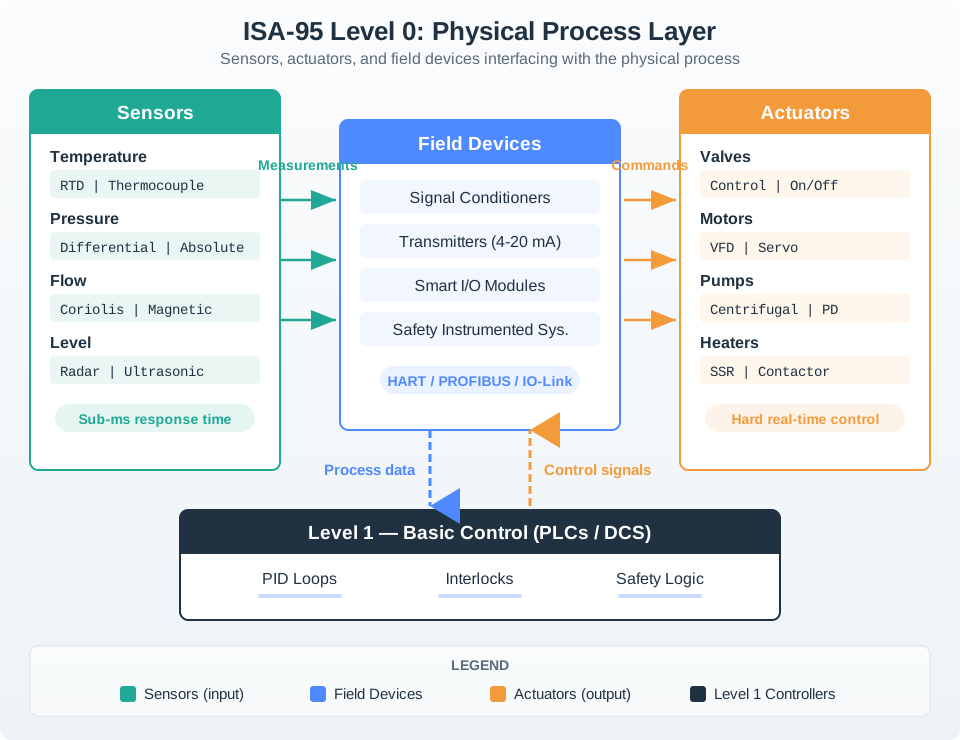
Temperature, pressure, flow and level sensors feed transmitters, signal conditioners, smart I/O and safety systems. These devices normalize and route measurements toward Level 1 PLC or distributed control system (DCS) logic. Commands return to valves, motors, pumps and heaters. In this case, sub-millisecond updates leave little room for a remote service or ambiguous ownership. Preserve timestamps and quality during normalization.
A historian sample, HMI alarm, MES work-order update and drive command differ in deadline and authority. Record each message’s level, owner, deadline, stale-data behavior and consequence. MES, ERP, dashboards and analytics may request, schedule or record; writes into Level 0–1 need explicit ownership, authorization, interlocks and rollback rules.
AGV obstacle detection and stopping must remain local to the vehicle, safety scanner, controller or certified safety system. Wi-Fi, private 5G, OPC UA, MQTT or REST may carry fleet state, dispatch and telemetry while preserving bounded local safety behavior.
The distinction also applies to commands. An upper-level request is not permission to bypass the PLC or safety system. Before accepting a Level 3 or Level 4 write path, reviewers must be able to identify who owns it, who authorizes it, which interlocks govern it and how rollback works. A stale measurement and a misplaced command can both change physical behavior; normalization and integration must preserve the boundary rather than merely connect the systems.
30.7 Prove the Entire Response Path
Local ownership still needs timing evidence. Jitter is variation in message or cycle timing; coordinated axes often depend more on bounded jitter than low average latency. IEEE 1588 Precision Time Protocol (PTP) and EtherCAT distributed clocks can support sub-microsecond synchronization when the implementation is validated.
Include sensor delay, filtering, scan time, task priority, queueing, switch behavior, output update, actuator response and safe fallback. A fast link cannot rescue an unbounded scheduler or queue. The release record needs measured cycle time, jitter, fault response and replacement-device behavior.
An illustrative robot mapping uses EtherCAT servo drives at <100 μs cycles, a safety PLC with a 1 ms PROFINET IRT communication example, an EtherNet/IP HMI at 100 ms, an OPC UA MES update at 10 s and REST ERP inventory orders at 1 hour. A safety PLC requires an appropriate safety design; IRT alone supplies no safety rating.
In this example, the servo drives control arm position, the safety PLC handles the emergency-stop circuit, the HMI touchscreen displays cycle count, the MES server tracks which product variant is running, and the ERP cloud orders more parts when inventory is low.
Real-Time Operating Systems discusses VxWorks, QNX and RTAI for bounded worst-case execution time (WCET). Time-Sensitive Networking introduces IEEE 802.1 TSN extensions for deterministic Ethernet. Both belong in the timing review alongside the network.
For a synchronized six-axis welding cell, one axis receiving its command 5 μs late while the others are on time can alter the weld path. Ample network bandwidth does not establish that those commands arrive consistently. Conversely, asynchronous quality logs after a weld need enough sustained throughput and buffering to clear their backlog; they do not inherit the motion axes’ shared synchronization deadline. This is the practical difference between proving timing consistency and handling data volume.
A successful dashboard feed also supplies no proof of motor-loop timing. Temperature summaries every 30 seconds over managed Wi-Fi can be suitable for MQTT monitoring when normal security and reliability checks are satisfied. A 1 ms motor loop with bounded jitter is a different requirement: Wi-Fi’s variable channel access and TCP retransmissions cannot establish the required bound simply because the same path carries dashboard data successfully.
30.8 Carry Governed Context into Operations
Once the local path is justified, bridge selected values upward. PROFINET or EtherNet/IP can serve less stringent quality-sensor timing. A historian or time-series database handles high-rate values with timestamps, compression and quality rules. A data lake retains raw or summarized records according to quality, compliance and cost requirements, including the line’s 10-year traceability obligation.
An OPC UA server provides a governed namespace and semantic context between PLCs, MES and ERP. The OPC UA Standard chapter develops this Level 2–3 bridge and its security. Use network segmentation, VLANs and OPC UA encryption to separate control and IT networks. REST or MQTT can carry Level 3–4 cloud integration data.
The integration design should let a reviewer follow a selected process value from its timestamped historian record through the OPC UA namespace to its operations or enterprise consumer. The data lake then has a defined retention purpose rather than becoming an unrestricted destination for every raw sample. This keeps the quality, compliance and cost decisions visible alongside the timing design.
Secure the hardest real-time constraint first, then relax timing upward. Using EtherCAT for HMI updates may add engineering and equipment cost without improving the required display response. Keep stale or bad-quality data from upper-level consumers, and block unapproved writes through protected control boundaries.
Summary
The assembly line combines hard real-time motion and collision avoidance, soft real-time supervision, and hourly enterprise reporting. ISA-95 organizes their functions; measured deadlines and consequences determine the required timing guarantees. Edge features reduce the example’s raw payload by 1,000× while local controllers retain authority.
Validate the complete path, bounded jitter, failure behavior and data quality before releasing the design. Governed integration carries production context upward without bypassing control or safety ownership.
Design from the hardest local deadline upward, and require evidence for every timing and authority boundary.