Field access
Registers, device variables, and cyclic I/O near sensors, actuators, drives, and controllers.
Progress saves as you read. Mark sections complete as you go; your progress appears in the sidebar.
This section: Start With the Machine Consequence — Picture a line where one late message stops motion and another only delays a chart.
Picture a line where one late message stops motion and another only delays a chart. Those two paths should not share the same proof.
First, name the real-world result, the time need, and the owner of the link. Then choose the message path that can meet that need.
One common link may ease support, but it can blur safety and time bounds. More than one link adds work, yet it can keep fast control close to the machine.
Select a plant link from the required data exchange and measured behavior, with its failure and ownership record attached.
Use the Practitioner section to build the plant link record. Use Under the Hood to test time, order, fault, and security bounds in more depth.
A protocol is a set of rules that two plant parts use to exchange a message.
Plain check
Imagine a packaging line where one late signal stops a conveyor, another late signal only delays a dashboard, and a third signal tells maintenance which part to replace. Treating those messages as the same “industrial data” hides the real design problem.
Industrial protocol integration starts by naming the consequence of each exchange. Keep control loops local when timing matters, expose plant meaning through a reviewable boundary, and record which protocol owns each proof.
This section: Overview: Industrial Protocols Follow the Physical Process — Industrial IoT protocol choices start with the machine, cell, line, or plant process being connected.
Industrial IoT protocol choices start with the machine, cell, line, or plant process being connected. A dashboard update, a meter read, a PLC scan, and a servo motion loop do not need the same communication behavior. The protocol is only correct when its timing, data model, diagnostics, and security boundary fit the physical consequence of the exchange.
That is why industrial systems often use more than one protocol. A field device may speak Modbus or an industrial Ethernet family to a controller. A controller or gateway may expose structured data through OPC UA. An edge service may publish selected telemetry through MQTT/Sparkplug after the OT boundary. The architecture is normal when each boundary has a clear job.
A defensible landscape diagram therefore separates command paths from observation paths. For example, a packaging cell might keep a 10 ms controller scan and local drive interlocks inside the machine network, translate selected counters and alarm states at an edge gateway, and publish one-second production summaries to a historian. The protocol choice is then tied to consequence: late drive I/O can stop motion, stale alarm context can slow maintenance, and noisy cloud publishing can hide the few variables that operators actually need.
If you only need the intuition, remember this: keep fast control local, expose plant meaning through a reviewable integration layer, and send only selected enterprise telemetry beyond the OT boundary.
A release decision about the “prove the family in the real machine and operations context, not from one marketing claim”–“1 · control behavior” decision needs “timing, jitter, sync”, not a slogan. Inspect Figure 3.1 through “Prove the family in the real machine and operations context, not from one marketing claim” and “1 · Control behavior” to check this claim: Industrial protocol choices start from control timing, topology, device support, boundary evidence, and pilot results.
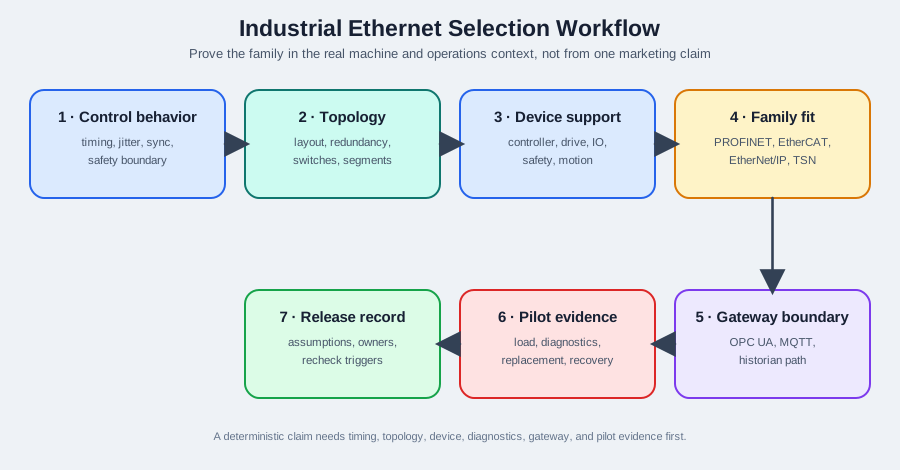
Notice how Figure 3.1 separates “Prove the family in the real machine and operations context, not from one marketing claim” from “1 · Control behavior”. Now move to “timing, jitter, sync” and finish at “safety boundary”; that second step reveals why Industrial protocol choices start from control timing, topology, device support, boundary evidence, and pilot results. Apply the distinction when “safety boundary” closes the record for the “prove the family in the real machine and operations context, not from one marketing claim”–“1 · control behavior” decision.
Registers, device variables, and cyclic I/O near sensors, actuators, drives, and controllers.
Named objects, variables, alarms, events, and relationships for SCADA, historians, MES, and gateways.
Filtered events and state changes sent beyond the plant boundary after ownership, rate, and identity are defined.
Physical processes need documented timing, failure behavior, maintenance access, and security controls.
Inspect Figure 3.2 with one question from the “siemens standard”–“profinet io” decision: how does “Siemens Standard” constrain “PROFINET IO”? The answer supports Protocol families have different jobs; a plant may use several when each boundary is reviewable.
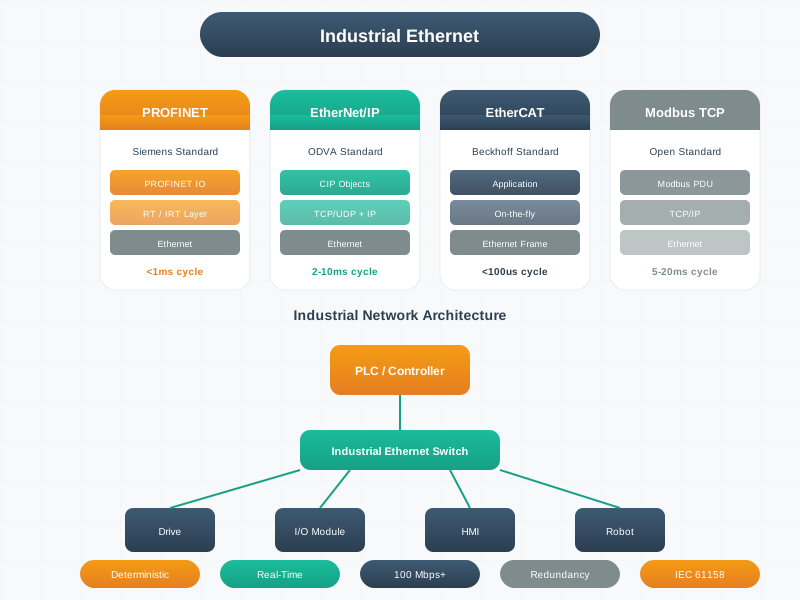
Read Figure 3.2 with “Siemens Standard” as the anchor; treat “PROFINET IO” as the first comparison. Then connect “RT / IRT Layer” with “Ethernet”. Those labels make Protocol families have different jobs; a plant may use several when each boundary is reviewable a traceable part of the “siemens standard”–“profinet io” decision, not an unsupported assertion.
This section: Practitioner: Build the Industrial Protocol Evidence Record — A practical industrial protocol decision is an evidence record.
A practical industrial protocol decision is an evidence record. It states the process, timing class, installed assets, data model, security boundary, diagnostics path, owner, and recheck trigger. This is more useful than a one-line statement such as "use OPC UA" or "use PROFINET" because it tells reviewers what behavior must be proven.
The record also keeps brownfield projects honest. If an existing Modbus loop controls a stable process, the right move may be a gateway overlay that exposes selected data through OPC UA or MQTT/Sparkplug while leaving the local control loop intact. If a new machine cell needs bounded cyclic I/O, the record should justify an industrial Ethernet family with device support and diagnostics evidence.
Before carrying Determinism evidence links timing, topology, device roles, and diagnostics to the release record into the “Timing need” design record, view Figure 3.3. It makes “Timing need” and “control loop, jitter, grouping, safety boundary” separate, inspectable parts of the “timing need”–“control loop, jitter, grouping, safety boundary” decision.
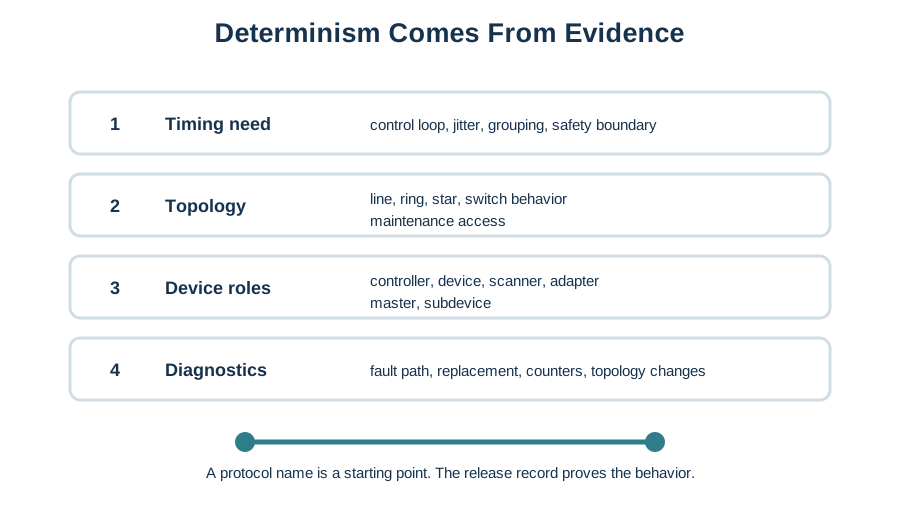
Notice “Timing need” on Figure 3.3 as the condition under review. “control loop, jitter, grouping, safety boundary” marks the adjacent responsibility, while “Topology” leads to “line, ring, star, switch behavior”. Together they explain Determinism evidence links timing, topology, device roles, and diagnostics to the release record; preserve that division when documenting the “timing need”–“control loop, jitter, grouping, safety boundary” decision.
Read the Brownfield Gateway Pattern material as a decision path rather than as isolated entries. First identify the operating condition in each entry and keep its units, timing, source, and assumed system state attached to it. Next compare the entries at the point where responsibility changes between device, gateway, network, analytic service, and operator; that hand-off is where apparently similar choices often produce different outcomes. Then follow the failure case: ask what becomes stale, delayed, unavailable, or unsafe, who detects it, and what evidence permits recovery. Finally connect the result to the chapter's running design record by naming the selected behavior, the rejected alternative, the measurement that justifies the choice, and the condition that forces a recheck. That order turns the examples or comparison into an auditable engineering argument.
This section: Under the Hood: Determinism Is Proven, Not Implied — Industrial determinism is not created by writing "real-time" in a protocol description.
Industrial determinism is not created by writing "real-time" in a protocol description. It comes from the full path: controller cycle, device role, frame scheduling, switch behavior, clock synchronization, topology, load, diagnostics, and replacement procedure. A protocol family can provide mechanisms, but the plant design has to prove the behavior.
TSN is a good example. It is a set of Ethernet timing, scheduling, and reliability capabilities, not a single drop-in field protocol. It can help selected traffic meet bounded latency when endpoints, switches, clocks, traffic classes, schedules, and profiles are engineered together. Without that engineering record, the label does not prove the machine behavior.
A useful acceptance trace records the behavior before and after load is added. Suppose a controller expects fresh I/O every 10 ms and the release budget reserves 2 ms for network transport. The test should capture normal cyclic traffic, add the planned historian or gateway traffic, force a device replacement or link change, and verify that controller timeouts and diagnostics still put the process into a known state. That evidence is stronger than quoting a protocol family because it ties the network, devices, tooling, and operator response to the actual control consequence.
Control loops need bounded update behavior, not only high average throughput.
Line, ring, star, switch path, redundancy, and maintenance access change the timing and failure surface.
Controller, device, scanner, adapter, master, slave, and gateway roles must match the protocol family.
Fault counters, topology changes, replacement behavior, and audit trails are part of the release evidence.
The next choice in the “speed-table choice”–“prove the machine timing evidence” decision depends on “Topology ignored”, a boundary shown in Figure 3.4. Inspect “Speed-table choice”, then set it against “Prove the machine timing evidence”, before judging The risk record keeps control behavior separate from integration convenience.
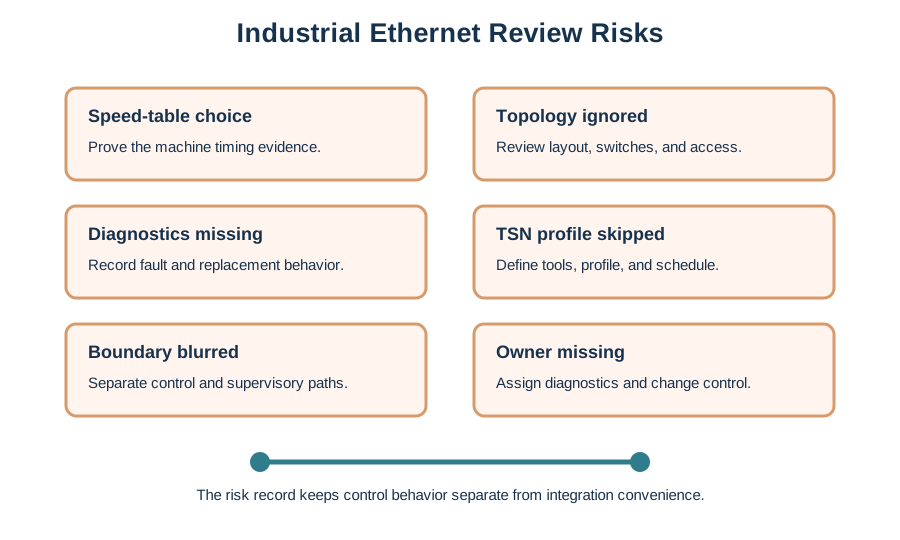
Trace Figure 3.4 by asking what “Speed-table choice” establishes and what “Prove the machine timing evidence” changes. Check “Topology ignored” next, ending at “Review layout, switches, and access”. That progression is the mechanism behind The risk record keeps control behavior separate from integration convenience and the evidence order needed for the “speed-table choice”–“prove the machine timing evidence” decision.
Read the Boundary Rules That Survive Review material as a decision path rather than as isolated entries. First identify the operating condition in each entry and keep its units, timing, source, and assumed system state attached to it. Next compare the entries at the point where responsibility changes between device, gateway, network, analytic service, and operator; that hand-off is where apparently similar choices often produce different outcomes. Then follow the failure case: ask what becomes stale, delayed, unavailable, or unsafe, who detects it, and what evidence permits recovery. Finally connect the result to the chapter's running design record by naming the selected behavior, the rejected alternative, the measurement that justifies the choice, and the condition that forces a recheck. That order turns the examples or comparison into an auditable engineering argument.
Inspect Figure 3.5 to see why an integration cannot infer workload behavior from the label “LPWAN.”

Read Figure 3.5 across Long reach, Tiny, sparse frames, and Short transmit bursts. The integration contract must carry these limits through its gateway and API because Meter and alarm telemetry can succeed under them while Video and closed-loop control cannot.
The spectrum map in Figure 3.6 adds a second reason the review must include deployment context rather than record only a technology name.

Read Figure 3.6 across STAND-ALONE, GUARD-BAND, and IN-BAND: all carry NB-IoT traffic, yet they expose different spectrum owners and neighbours. The PLANNING TRADE-OFF therefore belongs in the integration record alongside the application protocol because it names coverage, coexistence, capacity, and refarming obligations that an endpoint API cannot reveal.
This section: Interoperability Beyond Connection
Make the Receiver Prove the Same Meaning
Picture a medicine fridge that sends one warm alert into a ward system. The sender means air temperature in degrees Celsius at the time of the sample. The receiver treats it as a later wall reading and delays the call. The link worked, yet the shared action became unsafe.
Write one event contract before joining the systems. Name the source, asset, event time, received time, unit, quality mark, schema version, allowed use, and safe response. Make both owners sign off on examples, missing fields, and rejected values.
Test a wrong unit, an old event, a repeated id, a missing quality mark, a changed field, and a receiver restart. Follow the event into the final screen or action. A parsed message is not proof of shared meaning, and a shared meaning is not proof that the action is allowed.
Keep urgent fridge alarms active at the ward when the joined path is late or broken. The shared system can coordinate and retain history, but it must not erase a local safe response.
This opening does not make two whole products interchangeable. Practitioner builds the event and ownership record. Under the Hood separates path, shape, meaning, policy, version change, and the evidence needed at each boundary.
Imagine a freezer alarm that leaves a sensor gateway, reaches a broker, and appears in two dashboards. One dashboard treats the value as cabinet temperature; the other treats it as room temperature. The connection worked, the JSON parsed, and the alert still became unsafe because the receiving systems did not share the same meaning.
That is the story behind interoperability. Start with one event, follow it across the boundary, and ask whether the producer, contract, consumer, and action all agree on what the event means before the downstream system acts.
Interoperability means that independent systems can exchange information and use it correctly for the intended decision. In IoT, that claim is broader than a network connection. A stream can arrive over the expected protocol and still be unsafe to use if the receiver cannot parse the payload, understand the measurement, align the event time, or trust the contract that describes the stream.
The useful review question is simple: can the producer, boundary, and consumer agree on what each event means and what the consumer is allowed to do with it?
Consider a gateway that forwards room readings from one vendor and supply-duct readings from another. Both feeds may authenticate, reach the broker, and use valid JSON. The integration still fails if the dashboard treats those values as the same measurement, ignores stale quality states, or averages event-time readings with gateway-receipt timestamps. Interoperability review keeps those differences visible before a consumer acts on the stream.
If you only need the intuition, this layer is enough: check interoperability in four steps. First prove the event can travel. Then prove the payload can be parsed. Then prove the values mean the same thing to producer and consumer. Finally prove the stream is governed well enough for the downstream workflow.
Inspect Figure 3.7 to see why a reachable endpoint and a parseable payload are only the first half of interoperability.
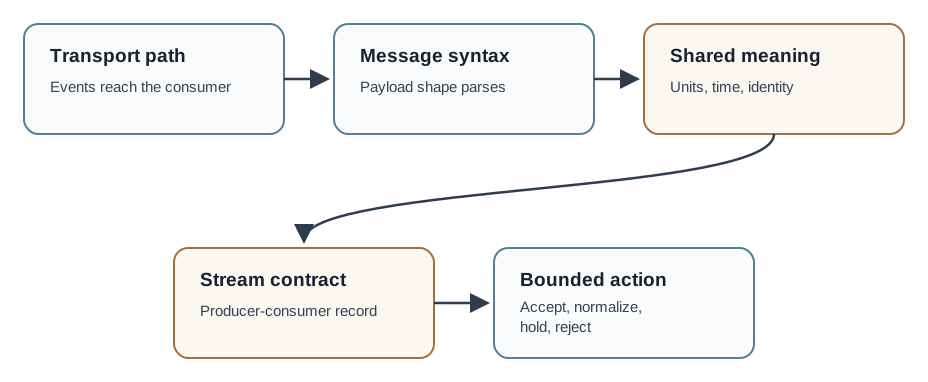
Read Figure 3.7 in four layers. Technical interoperability proves that the event can travel with the expected authentication context and endpoint name. Syntactic review then checks the envelope, types, version, and required fields. Semantic review asks whether both sides agree on units, timestamp basis, identity, quality, and status values; a parsed number can still mean the wrong thing. Operational review governs how the consumer may use the stream and who owns the contract. End with an explicit action—accept, normalize, hold, or reject—plus a validation sample and retest trigger. Each layer depends on the earlier one but establishes a different claim.
The expected path works: network reachability, authentication context, topic or endpoint naming, and delivery to the intended ingestion point.
The receiver can parse the representation: envelope, keys, types, version, required fields, and malformed-message handling.
The receiver understands the same meaning: unit, identifier, timestamp basis, location or asset context, quality state, and status values.
The stream can support the consumer decision: ownership, change process, validation sample, bounded action, and retest trigger are recorded.
Those layers are ordered. A parseable message does not prove a meaningful message. A meaningful sample does not prove that the producer can change safely. A standards name helps only when the implemented profile, mapping, and validation evidence are clear for this stream and this consumer.
A stream contract should show the producer fields, consumer expectation, translation rule, semantic version, rejected-sample behavior, and change that would reopen the integration decision. It does not need to be a large specification; it needs enough detail for a maintainer to replay the boundary decision.
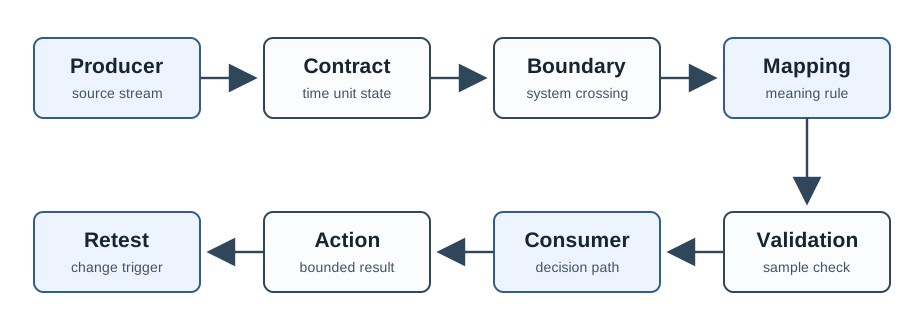
Work from the consumer decision backward. A dashboard that shows current status needs a different contract from a processor that builds windowed averages or a control rule that suppresses alarms. The same event can be adequate for one consumer and insufficient for another.
Use the stream when transport, syntax, meaning, owner, validation, and retest evidence match the consumer decision.
Translate a known boundary while preserving source identity, event time, quality state, and mapping confidence.
Pause only the affected stream path while missing unit, timestamp, identity, or quality-state evidence is clarified.
Reject the affected path when the stream cannot support the consumer decision without unsupported assumptions.
For example, a building gateway may publish temperature readings from two device families through the same broker. The broker connection can work and the messages can parse, but the stream is not interoperable until the contract states which field is the measurement, whether the unit is Celsius or Fahrenheit, which timestamp is event time, whether stale readings are marked, and which consumer is allowed to use the merged output.
Most interoperability failures are boundary failures. A boundary can be a protocol bridge, gateway, cloud service, team interface, data model, standard profile, or adapter. The boundary is useful when it makes a translation explicit. It is dangerous when it hides source identity, quality state, timestamp basis, or mapping confidence.
Under the hood, interoperability is a controlled chain of claims: this producer emitted this event, this boundary transformed it in this way, this consumer interpreted these fields with this meaning, and this evidence shows the path still supports the intended decision.
Helps encode and validate the payload shape. It does not by itself prove that a field has the right physical meaning for a consumer.
Helps align observed properties, units, identifiers, status values, and vocabulary so producer and consumer refer to the same thing.
Helps describe properties, actions, events, operations, forms, and subscriptions, but still needs local validation against the consumer decision.
Helps long-lived cross-team integration when ownership, versioning, rejection behavior, replay evidence, and retest triggers are explicit.
Standards reduce translation work when teams implement the same profile and preserve the same evidence. They do not remove the need to review the implemented path. A receiver still needs to know which profile version applies, which fields are required, how missing or stale data is represented, how extensions are handled, and what should happen when validation fails.
Meaning drift is the slow failure mode. A producer changes a unit, a gateway remaps a location, a schema gains an optional field, a dashboard changes its aggregation, or a rule starts treating a quality flag as authoritative. None of those changes has to break transport or syntax. That is why the retest trigger is part of the contract rather than a project-management afterthought.
The fail-closed action should stay bounded. Rejecting one ambiguous stream should not stop unrelated streams. Normalizing one known unit conversion should not silently rewrite every source from that producer. Holding a stream for clarification should name the missing evidence and the consumer that is affected.
Interoperability fundamentals are about usable meaning across a boundary. A working connection and a parseable payload are necessary, but they do not prove that a receiver can combine, display, alert on, or automate from the event safely.
The practical artifact is a stream contract. It records source identity, event time, message shape, measurement meaning, schema version, consumer expectation, validation evidence, bounded action, and retest trigger. When that evidence is missing, constrain the response to the affected stream path: accept, normalize, hold, or reject based on the consumer decision.
Interoperability is a chain of evidence: transport gets the event there, syntax makes it readable, semantics make it meaningful, and the contract proves the consumer can use it safely.
See how register maps, RTU and TCP paths, and integration boundaries shape interoperability for a widely used industrial protocol.
Review how information models, services, and trust records carry shared meaning across the integration boundary.
Connect interoperability evidence to protocol selection gates, candidate comparison, and decision records.
Carry the same boundary-evidence discipline into OT, gateway, and industrial connectivity reviews.
This section: Summary — Industrial IoT protocols should be selected around physical process consequence, timing, data model, installed assets, security boundary, diagnostics, and operations ownership.
Industrial IoT protocols should be selected around physical process consequence, timing, data model, installed assets, security boundary, diagnostics, and operations ownership. Modbus, industrial Ethernet families, OPC UA, MQTT/Sparkplug, and TSN each solve different parts of the system. A defensible architecture can use several of them when each boundary is named and tested.
The strongest decisions keep fast control local, expose plant meaning through controlled integration points, and send selected enterprise telemetry only after identity, rate, ownership, and failure behavior are documented.
Industrial protocol selection is an evidence problem: prove the control behavior, integration boundary, diagnostics path, and maintenance owner before treating a protocol name as a solution.
This section: See Also
Use this next for information models, services, subscriptions, certificates, and trust records at IT/OT boundaries.
Use this for register maps, RTU and TCP paths, polling behavior, and safe gateway exposure.
Use this for industrial Ethernet family roles, deterministic evidence, and TSN review points.
Use this to turn protocol preferences into requirement gates, evidence comparisons, and recheck triggers.
3 reviewed answers.
Open the module page from the sidebar to see its chapters in order. Use the module map to return to a topic you need.
Modules and pathsReviewed
Check the symptom, then work through the diagnostic steps. Keep the error message and the smallest example that reproduces it.
When you are stuckReviewed
Use the interactive guide to check how examples and simulations work before changing your project.
Interactive examples guideReviewed