11 IoT Interoperability Challenges
More
Depth: Practitioner
Progress saves as you read. Mark sections complete as you go; your progress appears in the sidebar.
Overview: Connecting Is Not Interoperating
Two systems exchanging messages is not proof of interoperability. A bridge can parse a payload, publish a message, and update a dashboard while quietly corrupting the decision that depends on the value. Real interoperability is proved when another reviewer can trace a value from the source device to the target action and confirm that identity, unit, timing, quality, state, permissions, and failure behavior kept their intended meaning the whole way. Until someone can do that trace, "it connects" is a hope, not evidence.
The reason this is hard is that interoperability has levels, and success at a low level says nothing about the higher ones. Two systems can share a radio and move packets cleanly, parse each other's JSON perfectly, and still disagree about what a number means — or about who is allowed to send it, or about what happens when it goes stale. Most painful integration failures live above the network, in the layers where everything looks compatible right up until it is not.
If you only need the intuition, this layer is enough: interoperability is a review discipline, not a connection status. Name the level where the real risk lives, then prove that meaning survived the boundary with evidence a second reviewer can re-check.
Start Simple: Connection Is Only the First Proof
Begin with one exchanged value and climb Figure 11.1 around it. Can the systems connect, parse the payload, agree on unit and state, name the owner of the decision, and recover safely when the value goes stale? A protocol bridge is interoperable only when that whole chain is reviewable, not when the first packet arrives.
To ground the “network/transport”–“syntactic” decision through “Data format” in visible evidence about “Network/Transport”, inspect Figure 11.1. Its named elements “Network/Transport” and “Syntactic” frame the claim that Interoperability has six levels; connecting at the bottom says nothing about meaning, governance, or operations above it.
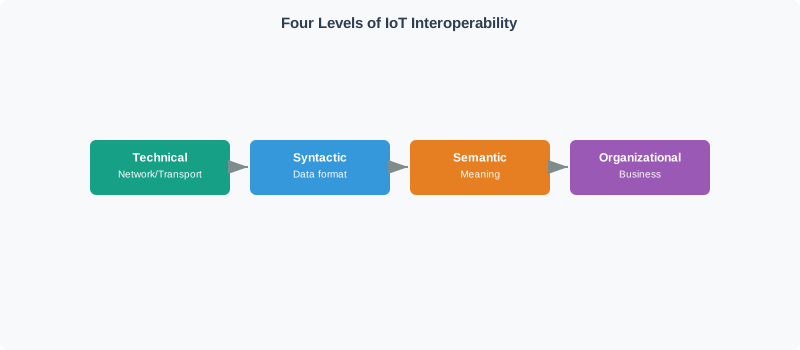
Use “Network/Transport” as the entry point to Figure 11.1. Read “Syntactic” next, with “Data format” as the bridge to “Semantic”. This route gives practical meaning to Interoperability has six levels; connecting at the bottom says nothing about meaning, governance, or operations above it and supplies the review sequence for the “network/transport”–“syntactic” decision.
How Interoperability Silently Fails
The failure pattern is always the same: two systems appear to agree but disagree about a boundary. A numeric field arrives without a unit or scale. A target treats gateway-receipt time as the measurement time. A status value maps to a similar-looking but different state. A stale value is repeated with no quality flag. A device identity changes between provisioning, routing, and reporting. An optional field is accepted without anyone deciding whether it is trustworthy. A release claims support for a standard without recording the profile and feature set that were actually tested.
The One-Minute View: Levels, Meaning, Contracts
Levels, not a switch
Physical, network, syntactic, semantic, organizational, operational — success low down does not imply success higher up.
Meaning is the hard part
Most failures are semantic: unit, time, identity, quality, and state that look compatible but are not.
A standard name is not a contract
Standards allow profiles, options, and versions; the release must record the exact tested feature set.
Beginner Examples
Read the Beginner Examples material as a decision path rather than as isolated entries. First identify the operating condition in each entry and keep its units, timing, source, and assumed system state attached to it. Next compare the entries at the point where responsibility changes between device, gateway, network, analytic service, and operator; that hand-off is where apparently similar choices often produce different outcomes. Then follow the failure case: ask what becomes stale, delayed, unavailable, or unsafe, who detects it, and what evidence permits recovery. Finally connect the result to the chapter's running design record by naming the selected behavior, the rejected alternative, the measurement that justifies the choice, and the condition that forces a recheck. That order turns the examples or comparison into an auditable engineering argument.
- Two systems exchange a field named
temperature; the source means degrees Fahrenheit and the target reads it as Celsius — perfect syntax, broken meaning. - A dashboard shows a reading "received," but the value has no quality flag, so a stale measurement looks like a fresh one.
- "It supports the standard" tells you a family of behavior; "it implements this profile, version, and feature set, tested here" tells you what will actually interoperate.
User and Device Interoperability
A useful interoperability review separates user interoperability from device interoperability. User interoperability asks whether a person can discover, identify, understand, and safely use devices that may come from different owners, languages, locations, and service descriptions. Device interoperability asks whether two devices can exchange commands, events, and state with compatible syntax and compatible meaning. A CCTV example makes the split visible: the user may need one service across cameras in different countries and languages, while the cameras and controllers still need shared identifiers, message formats, and semantic descriptions before discovery and control are reliable.
That older literature also gives concrete evidence fields that still matter: identifiers such as EPC, UPC, URI, or IPv6 address; classification vocabularies such as UNSPSC; syntactic approaches such as service-oriented architecture, web services, REST interfaces, open protocol profiles, and closed protocol bridges; and semantic approaches such as device ontologies, domain ontologies, and collaborative concept records. The modern contract in this chapter should capture those details explicitly rather than treating discovery, parsing, and meaning as one success state.
Overview Knowledge Check
If you can name the level where a failure lives, you have the core idea. Continue to Practitioner for the levels in full, the semantic contract, and the integration strategies.
Practitioner: Levels, the Semantic Contract, and Strategies
The six levels give you a place to put the risk. Physical: can the systems connect at all (radio, cable, power, range)? Network: can packets move (addressing, routing, transport, gateway exits)? Syntactic: can messages be parsed (envelope, serialization, schema, object identifiers)? Semantic: does meaning survive (unit, scale, identity, timestamp meaning, quality, command intent)? Organizational: are responsibilities aligned (ownership, access rules, data-sharing policy, review authority)? Operational: can the integration evolve safely (versioning, deprecation, monitoring, rollback, incident response)? A review starts by naming which level carries the real risk, because that decides what evidence you need.
The Semantic Contract
11.0.0.1 Build a collaborative sign, not an ambiguous label
A compact way to make shared meaning reviewable is to represent each collaborative concept as a four-part tuple:
The fields have separate jobs. is the internal identifier used to refer to the concept without relying on its display name. identifies the natural language used for human-facing labels and definitions. names the context or namespace in which the identifier is interpreted. defines the object and its properties precisely enough for another system to map it. Modern implementations should make a language tag such as en-GB, make a resolvable URI or versioned namespace, and encode as a structured definition rather than an unparsed sentence where possible.
| Tuple field | CCTV security-camera example | Why it cannot be omitted |
|---|---|---|
| : internal identifier | urn:building-a:camera:17 | “Camera 17” may collide with another site’s identifier. |
| : natural language | en-GB | Labels and terms can change meaning across languages and locales. |
| : context | https://example.org/security-video/v2 | “CCTV” could mean a security endpoint, a traffic camera, or a television service. |
| : object definition | {kind: bullet-camera, transport: IP, stream: RTSP, maxPixels: [2048,1536], location: loading-bay} | A name alone does not define capabilities, units, protocol, or place. |
So the worked record is not merely CCTV = camera. It is
Walk the exchange step by step. The source publishes identifier rather than a local screen label. The receiver resolves context and learns that this namespace describes security-video devices. It uses to choose the correct human label, then validates the message against : a streamState event is meaningful for this IP camera, while a broadcastChannel command from a television-domain system is not. Two messages can therefore share valid JSON syntax and even the word “CCTV” while failing semantic interoperability because their and fields disagree.
The tuple complements, rather than replaces, the broader semantic contract below. The cosign establishes which concept is meant; the contract still has to preserve the current value, unit, event time, quality, state, permissions, and transformation evidence. At an integration boundary, keep both records and test three cases: a matching context that maps cleanly, an unknown context that is rejected safely, and a known context whose definition version is incompatible. Those denied cases prove that the bridge distinguishes shared meaning from familiar spelling.
Inspect Figure 11.2 to ask how identity, value, unit, time, quality, state, and evidence survive the move from a raw sample to a shared record.
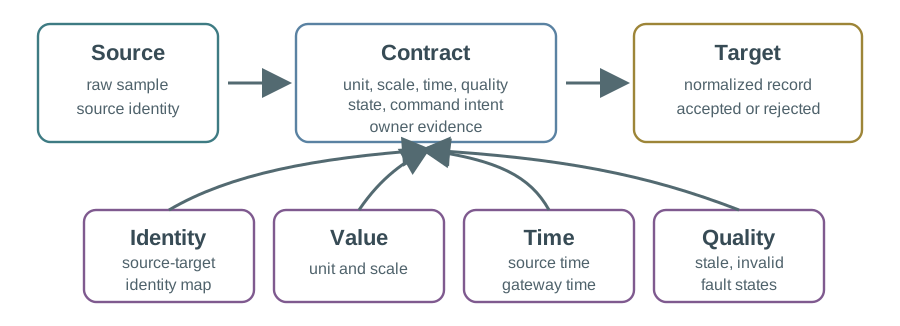
Use “raw sample” as the entry point to Figure 11.2. Read “source identity” next, with “Contract” as the bridge to “unit, scale, time, quality”. This route gives practical meaning to A semantic contract records how the target record was derived: identity, value, unit, time, quality, state, and evidence and supplies the review sequence for the “raw sample”–“source identity” decision.
Choosing an Integration Strategy
No single strategy solves every level; choose the smallest one that makes the release evidence reviewable.
Middleware Bridges and Virtual Device Maps
A middleware bridge is a gateway translation strategy with stronger bookkeeping. A Universal Middleware Bridge style design, for example, uses adaptors to convert local middleware messages into a shared metadata form and a core router to send those messages to the right adaptor. The release evidence should name the local middleware family, the virtual device template, the global device, function, action, event, and parameter identifiers, the routing table, and the request and response traces for both new-device discovery and later control messages. Without those records, a bridge may create a virtual device that is reachable but not actually interoperable.
The smart-home HAN boundary makes this concrete. A bridge does not replace the native Zigbee coordinator, Z-Wave controller, KNX installation, or legacy service registry. It discovers a native device, interprets its description, maps selected behavior into a virtual device, routes commands and events, and keeps both identities correlated for as long as the endpoint is exposed. The bridge must also preserve who is authoritative. A Matter controller may request a new level, but a wired wall switch, safety limit, or native building controller can still be the source of truth for the physical result.
Before looking at Figure 11.3, identify the physical interfaces and ask what still has to be supplied in software. The photograph makes the chapter’s distinction concrete: “gateway” is a functional role, not a promise implied by a box shape.

Walk through Figure 11.3 from the labelled LAN port into the enclosure and then back out toward the building bus or attached adaptor. The ports establish the two physical sides, while the enclosure marks the translation boundary between them. What the photograph cannot show is equally important: which KNX group address becomes which virtual endpoint, whether an “on” command receives physical-state confirmation, or what happens when the IP service restarts. Those mappings, acknowledgements, authority rules, and failure states belong in the bridge ledger, connecting the hardware boundary to the lifecycle record that follows.
Inspect Figure 11.4 to ask what must persist from native-device discovery through virtual-endpoint recovery.

In Figure 11.4, begin by discovering the native device and mapping only the semantics the bridge can support. Exposing the mapped functions as a virtual endpoint creates a contract, not a copy of the device. During operation, commands and native status must travel both ways; assumed success is weaker than confirmed state. If the bridge detects conflict or loss, follow the recovery side: withdraw the endpoint, restore local authority, reconcile real state, retest, and only then republish. The native ID, virtual endpoint, map version, owner, and last state persist across those stages so recovery cannot invent a new identity or hide stale state.
Use the workbench here at the point of translation. Choose Zigbee light bridge, set the native network to Zigbee, device type to On/Off light, and command to Toggle on/off. Step through discovery, mapping, and endpoint exposure. Then change Native status feedback to Assumes success: the warning demonstrates why reachability and a command route are weaker than confirmed interoperability. Record which native diagnostics, offline timing, and local binding behavior the virtual endpoint omits.
Matter bridge narrated tour
Play silently with captions on provisional storyboard timing; narration audio is pending. Production pacing is not protocol time. Choose Reduced motion for a complete still at each beat.
Play the tour to open the workbench. Pause, replay a beat, or read the full transcript below. Beats marked CANNOT SHOW provide captions without changing asset controls; the teaching model cannot demonstrate those claims.
Full transcript — Matter bridge (8 beats)
B1 — Home lighting task
You are setting up smart lighting in a home with existing Zigbee lights. You want a Matter controller to adjust them through a bridge. The stakes are practical: a brightness request has to reach the lights, and the reported state has to match the physical result.
Model caption: Home lighting task: send a brightness request through a Matter bridge to existing Zigbee lights and return their state.
B2 — Expose endpoints
A Matter bridge represents devices that do not speak Matter as Matter endpoints. An endpoint is the representation a controller uses to address a device's mapped functions. The bridge joins Matter as a single node, while the lights keep using their native Zigbee network behind it.
Model caption: One Matter bridge node exposes the lights' mapped functions as endpoints. The lights retain their Zigbee network.
B3 — Three lights, one fabric
Take three dimmable lights, represented by three bridged endpoints. Begin with one Matter fabric: an administrative group with its own credentials and permission rules. Request brightness of sixty percent. That is the requested level in our example, rather than a measurement of the light actually produced.
Model caption: Example: three dimmable lights, three endpoints, one fabric; request sixty percent brightness. Sixty percent is a narrated request only: the asset cannot set or measure that level.
B4 — Permission and translation
The controller's fabric identity and permission rules determine whether it may command the endpoint. After that check, the controller sends the Matter command. The bridge translates the command into Zigbee for the native light. Translation connects the controller's request to the light's own protocol.
Model caption: Fabric identity and permission rules determine access. The Matter command reaches the bridge, which translates it into Zigbee for the light.
B5 — Return state
Status then travels back through the bridge, updating the state available to controllers. Reliable state depends on feedback from the native device or accurate polling. For your lighting setup, the returning state matters just as much as the outgoing brightness request.
Model caption: The bridge returns state to controllers. Reliable state depends on native feedback or accurate polling; the selected feedback model is not a live lamp reading.
B6 — Two fabrics, three endpoints
Now increase the fabric count from one to two. The result is still three bridged endpoints, with access expanded to two administrators. Each fabric has separate credentials and permission rules. The bridge represents the same three lights while belonging to two administrative groups; the native lights still use Zigbee.
Model caption: One fabric becomes two; three endpoints remain three. Each fabric retains separate credentials and permission rules; the lights remain Zigbee devices.
B7 — Bridge and border router
The misconception is that a Thread border router does the bridge's job. A border router forwards Internet Protocol version six packets between Thread and the home network. It does not translate device functions or create bridged endpoints. A product can include both roles, but packet routing alone cannot supply the translation your Zigbee lights need.
Model caption: A product may combine a bridge and a Thread border router. The bridge translates device functions; the border router forwards Internet Protocol version six packets.
B8 — Translation and permission
A bridge translates the lights' commands; a fabric decides whose commands are allowed.
Model caption: A bridge translates the lights' commands; a fabric decides whose commands are allowed.
After the simulation, connect its omission list to release evidence. The correct claim is not “the legacy device is now Matter.” It is “this bridge version exposes these mapped functions as these endpoints, preserves these native fallbacks, reports these quality states, and withdraws or recovers them under these tested failures.” Figure 11.5 widens the view from this one bridge to the other integration choices.
The next choice in the “field-side diversity”–“protocol islands” decision depends on “Each stack keeps its own radio, device model, commissioning flow, and management API”, a boundary shown in Figure 11.5. Inspect “Field-side diversity”, then set it against “Protocol islands”, before judging Strategies scale with scope: direct adapter, gateway translation, canonical model, standards profile, conformance review.
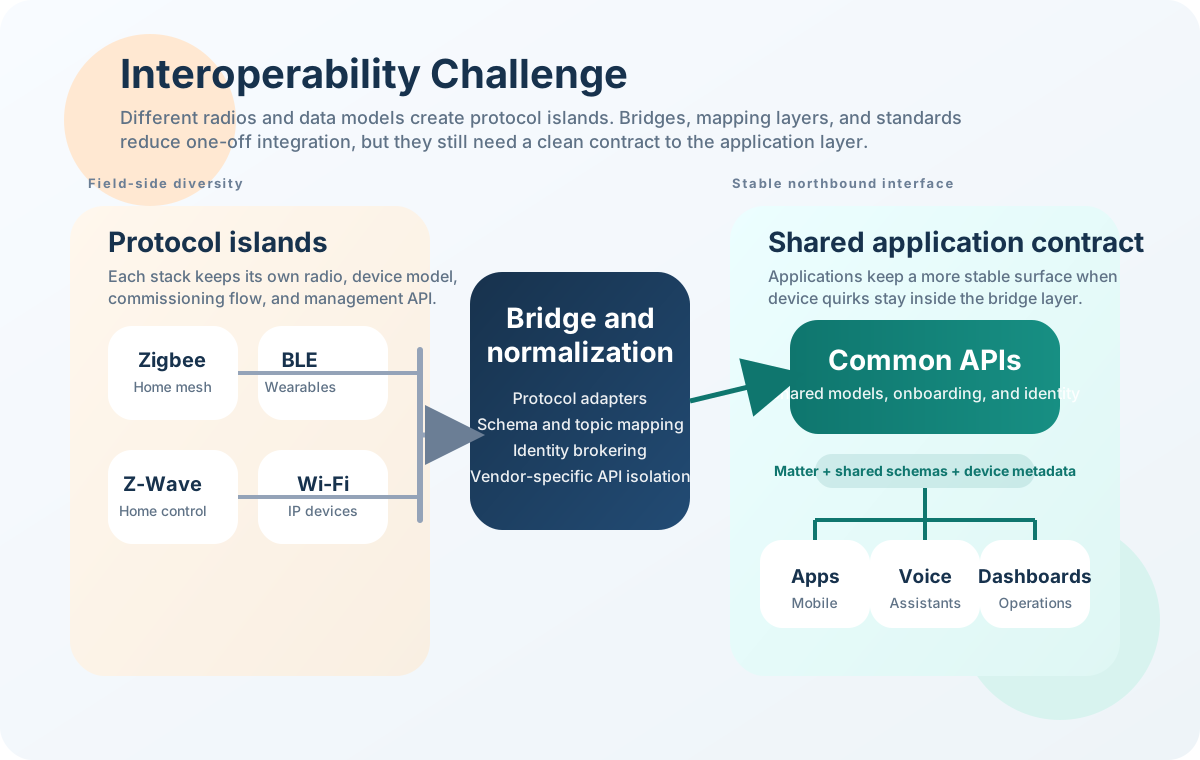
The first useful contrast in Figure 11.5 is “Field-side diversity” versus “Protocol islands”. After resolving it, move from “Each stack keeps its own radio, device model, commissioning flow, and management API” to “Zigbee”. This is how the visual substantiates Strategies scale with scope: direct adapter, gateway translation, canonical model, standards profile, conformance review and reconnects it to the “field-side diversity”–“protocol islands” decision.
Practitioner Knowledge Check
If you can place risk on a level, write the semantic contract, and pick the smallest workable strategy, you can stop here. Continue to Under the Hood for why a standard name is not a contract and why conformance is not interoperability.
Under the Hood: Profiles, Conformance, and Operational Drift
The deeper layer is about the two claims teams most often over-trust: that naming a standard describes a release, and that passing a conformance test means two systems will work together. Both are false, and both cause integrations that pass review and then fail in the field.
A Standard Name Is a Family, Not a Contract
"Supports MQTT," "uses OPC UA," "uses Matter," "is Web-of-Things–ready," or "exports NGSI-LD" each names a family of behavior with options, profiles, extensions, and version differences. None of them is a complete release contract. For any standards claim, record the exact profile, version, or feature set used; the required and optional fields; the security and provisioning assumptions; the device classes, resources, objects, clusters, properties, or information-model nodes in scope; the conformance result or reviewer evidence; the known deviations and accepted limitations; and who owns future updates when the profile changes. This matters most when a gateway translates between a field protocol and a platform model, because the release must prove both sides of the boundary, not just the target message shape.
Conformance Is Not Interoperability
These are two different tests and conflating them is a classic error. Conformance testing checks that an implementation follows the specification's required behavior. Interoperability testing checks that it actually exchanges usable data with another independent implementation of that specification. A device can pass conformance on paper and still fail to interoperate with a particular partner because of optional features one side skipped, version differences, or ambiguous corners of the standard that each side resolved differently. Treat a conformance pass and an interoperability pass as separate pieces of evidence, and test against the specific partners that matter.
Optional Fields and the Operational Layer
Two quieter risks complete Figure 11.6. Optional fields become unsafe when a downstream system assumes they are complete, trustworthy, or current; the contract must say whether each optional field is ignored, validated, transformed, or blocked. And the operational layer is where interoperability decays after launch: a schema revision, a firmware change, a cloud-connector update, or a new standards profile can break an integration months later. That is why operational interoperability needs an assigned owner and a monitoring signal for change review, not just a passing test on release day.
To ground the “standards”–“profile” decision through “version/options” in visible evidence about “Standards”, inspect Figure 11.6. Its named elements “Standards” and “profile” frame the claim that The release record ties the standards profile, semantic contract, gateway evidence, conformance checks, and operational owner to a decision.
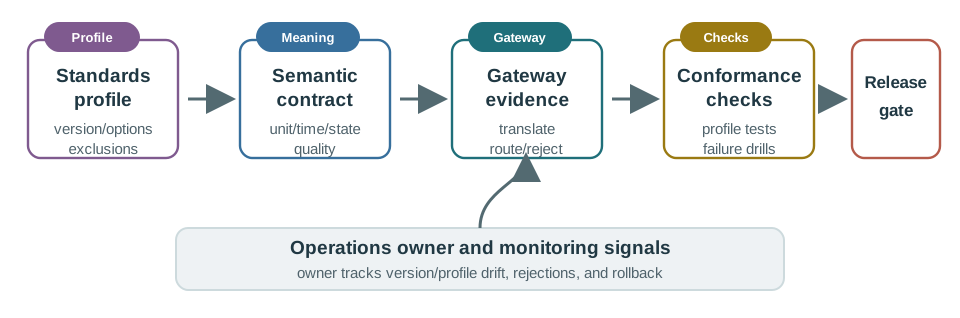
Use “Standards” as the entry point to Figure 11.6. Read “profile” next, with “version/options” as the bridge to “exclusions”. This route gives practical meaning to The release record ties the standards profile, semantic contract, gateway evidence, conformance checks, and operational owner to a decision and supplies the review sequence for the “standards”–“profile” decision.
Evidence by Type
A Release Review in Five Moves
The worked pattern for a multi-source integration — say occupancy, temperature, meter, and access state into one operations dashboard — is: inventory the boundaries (each source protocol, gateway, target route, owner, and data class); capture examples (raw source samples, normalized records, rejected records, command acknowledgements); map meaning (units, time semantics, identity mapping, quality states, allowed substitutions); test failures (stale source, unavailable target, duplicate message, rejected payload, profile mismatch); and approve the release (record the accepted profile, unresolved risks, monitoring signals, and the owner for future version changes). The minimum evidence pack is the boundary inventory, source and normalized examples, the semantic contract, the standards profile or local schema version, the gateway translation and queue policy, the security and provisioning assumptions, the conformance or acceptance results, the failure-drill results, the monitoring signals and owner, and the release decision with its unresolved risks.
Common Pitfalls
Read the Common Pitfalls material as a decision path rather than as isolated entries. First identify the operating condition in each entry and keep its units, timing, source, and assumed system state attached to it. Next compare the entries at the point where responsibility changes between device, gateway, network, analytic service, and operator; that hand-off is where apparently similar choices often produce different outcomes. Then follow the failure case: ask what becomes stale, delayed, unavailable, or unsafe, who detects it, and what evidence permits recovery. Finally connect the result to the chapter's running design record by naming the selected behavior, the rejected alternative, the measurement that justifies the choice, and the condition that forces a recheck. That order turns the examples or comparison into an auditable engineering argument.
- Confusing delivery with interoperability. A successful publish or register read proves communication occurred, not that the target interpreted the record correctly.
- Treating optional fields as harmless. Record whether each is ignored, validated, transformed, or blocked before a downstream system trusts it.
- Accepting a standard name without a profile. Record the exact feature set tested and the deviations accepted.
- Conflating conformance with interoperability. A spec pass does not guarantee a particular partner pairing works.
- Forgetting the operations owner. Assign an owner and a monitoring signal so a later schema or firmware change is caught.
Under-the-Hood Knowledge Check
At this depth, interoperability is a review discipline that does not trust a single gateway, broker, platform, or standards label. It preserves evidence that meaning survives the boundary: source examples, a semantic contract, gateway policy, a pinned standards profile, separate conformance and interoperability results, failure drills, and an operational owner. A trustworthy review asks which level carries the risk, what proves meaning survived, and who keeps it working when the parts change.
Inspect Figure 11.7 to see why a connected server-room sensor still fails when discovery, syntax, semantics, or user intent loses meaning.

Read Figure 11.7 from Room sensor 7 through Find the capability and Parse the message. The decisive hand-off is Interpret the field: it binds Fahrenheit, air temperature, room identity, and freshness to Protect the server room, so a valid JSON number cannot silently become an unsafe command.
The architecture in Figure 11.8 shows how a universal bridge can preserve those contracts without pretending BACnet, Zigbee, and OPC UA are the same native system.

In Figure 11.8, compare Building BACnet with Home Zigbee before following their separate BACnet → UDT and Zigbee → UDT adaptors. Only normalized identity, capability, unit, and route enter One universal namespace; the native protocol assumptions remain behind their adaptor boundaries.
The plug-in sequence in Figure 11.9 is the registration proof that must occur before an application is allowed to use that namespace.

Follow Figure 11.9 from Sensor joins to Native metadata, then inspect UMB adaptor and Core / MRT. The resulting urn:room:2:temperature record proves why discovery is more than hearing a radio announcement: type, units, capability, and native route must validate before App discovery.
After registration, Figure 11.10 closes the loop by tracing translation in both directions rather than stopping at a successful lookup.

Start Figure 11.10 at Setpoint request, then trace Resolve route and Translate into Thermostat. The green return path and Meaning survives translation card make the acceptance condition explicit: native status, normalized value, source time, and failures must all map back into the universal contract.
11.1 Checkpoint: Summary
This section: Checkpoint: Summary — A gateway is a device or service that passes data between unlike systems.
A gateway is a device or service that passes data between unlike systems. Interoperability means those systems can work together while keeping the meaning and rules that the task needs.
Picture one system sending a room value of 20. The next system must know which room, which unit, when it was read, and whether it was sound. A working cable does not prove that any of those facts survived.
Check the path in steps. First prove the parts can connect. Then prove they share a data shape. Next prove each field has the same meaning. Last, prove the people and support teams can run, change, and fix the link.
This Overview uses one clear value to show the six levels below. Real links may map many fields, versions, and optional rules. The deeper guidance shows how to pin a profile, trace each change, and retest after release.
Test one good value, one missing value, one old value, and one bad value. Check what the far side stores and shows. Keep the source and changed record so a second person can trace the path.
- Connecting two systems does not prove interoperability; the proof is a traceable value whose identity, unit, timing, quality, state, permissions, and failure behavior survived the boundary.
- Interoperability has six levels: physical, network, syntactic, semantic, organizational, and operational; success at a low level says nothing about the higher ones.
- Most failures are semantic, where unit, time, identity, quality, and state look compatible but are not; a semantic contract records how the target record was derived, not just its shape.
- Choose the smallest integration strategy that makes evidence reviewable: direct adapter, gateway translation, canonical model, standards profile, or conformance review.
- A standard name points to a family of behavior, so record the exact profile, version, feature set, exclusions, conformance result, and future-change owner.
- Conformance testing (follows the spec) is distinct from interoperability testing (works with a specific other implementation); optional features and version differences break otherwise-conforming pairs.
- Optional fields are unsafe until the contract says whether they are ignored, validated, transformed, or blocked.
- Operational interoperability decays after launch, so assign an owner and a monitoring signal, and keep a release evidence pack from boundary inventory through release decision.
Interoperability is a review discipline, not a connection status. Name the level where the risk lives, write a semantic contract that shows how meaning was derived, pin every standards claim to a tested profile, and keep conformance and interoperability as separate evidence. The integrations that survive supplier changes and schema revisions are the ones whose meaning a second reviewer can re-trace, and whose operational owner is named before release.
11.2 See Also
This section: See Also
Protocol Bridging Fundamentals
Design the translation boundary that semantic interoperability depends on.
Protocol Bridging Examples
See the building, industrial, field, and cloud patterns these contracts review.
Pub/Sub and Topic Routing
Check routing scope, retained state, and subscriber behavior on the target side.
Mobile Phone Gateway Fundamentals
Apply the interoperability review when the gateway is a conditional mobile device.
Find help
3 reviewed answers.
Where should I start in a module?
Open the module page from the sidebar to see its chapters in order. Use the module map to return to a topic you need.
Modules and pathsReviewed
What can I try when a project does not work?
Check the symptom, then work through the diagnostic steps. Keep the error message and the smallest example that reproduces it.
When you are stuckReviewed
How do interactive examples work?
Use the interactive guide to check how examples and simulations work before changing your project.
Interactive examples guideReviewed