2 Choosing an IoT Protocol Stack
More
Depth: Practitioner
Progress saves as you read. Mark sections complete as you go; your progress appears in the sidebar.
2.1 Start With One Message That Has to Survive the Field
This section: Start With One Message That Has to Survive the Field — Picture a tag that follows a shipment from a store room to an outdoor yard.
Picture a tag that follows a shipment from a store room to an outdoor yard. It must send its place and raise an alarm if the load leaves. Several wireless choices seem possible. Each one fails under a different condition.
Follow the shipment tag across the places its message must survive.
-
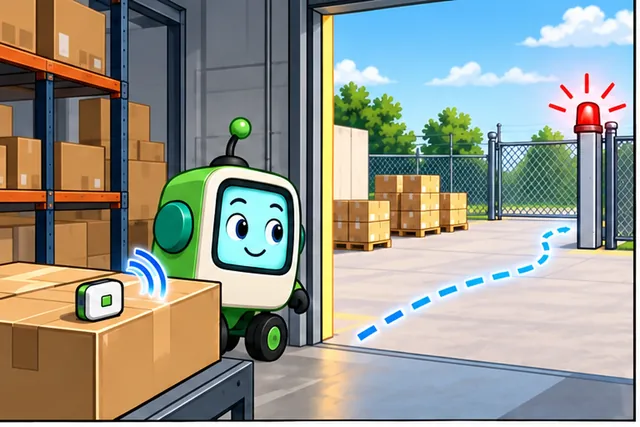
A shipment tag must report indoors, cross a yard, and raise an exit alarm.
-
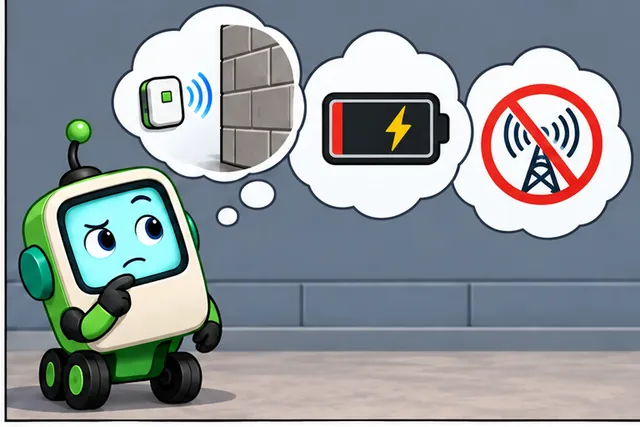
Short reach, high power, or an outage can rule out a wireless path.
-
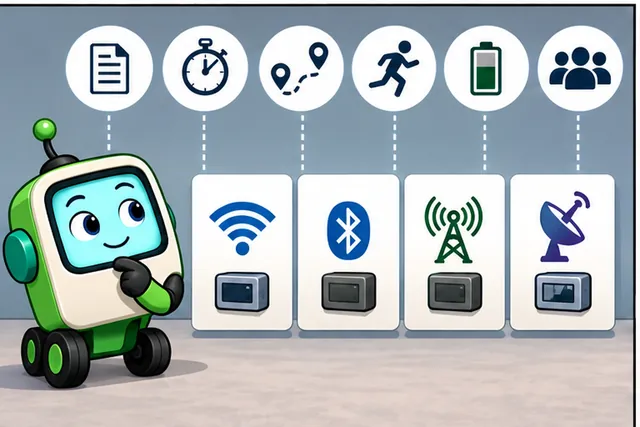
Gate choices by message size, delay, range, movement, battery, and ownership.
-
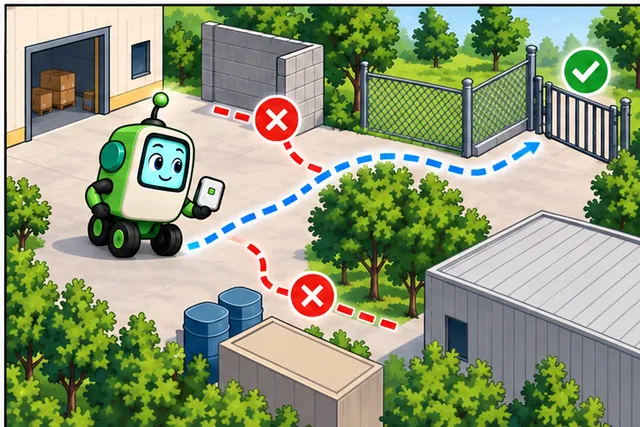
Walk the real route and keep only the paths that pass the field test.
In the illustration, start with the message, not a favorite technology. Record its size. State how soon it must arrive. Mark the farthest place. Note whether the tag moves. Set the battery goal. Name who owns any fixed equipment and monthly service. These facts form hard gates.
A hard gate removes an option that cannot do the job. A short-reach choice fails if no reader covers the yard. A power-hungry choice fails a long battery goal. A distant service fails if the alarm must still work during an outage. Remove such options before comparing nice features.
Test the survivors. Use the final case and antenna. Walk the real route. Create a weak area and a lost connection. Check the alarm at the receiving end. Record who fixes failures and what cost continues after sale.
This first view treats each choice as a single path. Real products can combine local and wide-area links. The Practitioner layer builds the selection record and field trial. Under the Hood examines stack boundaries, security duties, delivery limits, and the changes that should reopen an old decision.
Imagine a battery asset tag that must report position indoors, cross a yard, and still raise an alarm when a shipment leaves the site. MQTT, BLE, Wi-Fi, LoRaWAN, and cellular can all sound plausible until the team names the message size, timing, range, power source, gateway ownership, and failure consequence.
Protocol selection starts with that message story. Pick the path only after the hard gates remove impossible choices and the remaining stacks have evidence for the actual field conditions.
2.2 Overview: Protocol Selection Starts With Gates, Not Favorites
This section: Overview: Protocol Selection Starts With Gates, Not Favorites — IoT protocol selection is the process of matching a complete communication stack to a deployment need.
IoT protocol selection is the process of matching a complete communication stack to a deployment need. The wrong starting question is "Which protocol do we like?" The useful starting question is "What must this message path prove under normal and failure conditions?"
A protocol name by itself is not a decision. A defensible choice names the message pattern, payload shape, timing need, coverage area, power source, gateway boundary, security responsibility, operations owner, and evidence that would trigger a later review.
Think about a portable asset tag used across a warehouse and an outdoor yard. A BLE path may pass the power gate but need enough phones, readers, or gateways to make location evidence useful. Wi-Fi may support richer payloads but miss the battery and roaming gates. LoRaWAN may cover the yard but move responsibility to gateway placement, network-server ownership, downlink limits, and alarm latency. Cellular may simplify reach but add subscription, carrier coverage, credential, and replacement assumptions. The selection task is to remove options that fail hard gates, then compare the surviving stacks as operated systems.
The output should be short but testable. It should say which candidates were removed, which evidence kept the finalists alive, what pilot or field trace proves the primary choice, and what would reopen the decision. That keeps the recommendation useful after rollout, when firmware, coverage, traffic, provider, firewall, or ownership conditions change. A good record makes the next review faster instead of forcing the team to rediscover old assumptions.
If you only need the intuition, this layer is enough: turn hard requirements into gates, remove impossible choices early, compare the remaining stacks with evidence, and write down why the answer should be revisited.
The One-Minute Selection Path
Gate
Remove candidates that cannot satisfy must-have constraints such as coverage, latency, power, payload size, ownership, or security.
Compare
Evaluate the surviving complete stacks against evidence, not slogans: device behavior, gateway behavior, operations, and failure response.
Record
Write the selected stack, rejected alternatives, assumptions, rollout check, and recheck trigger before implementation hides the tradeoffs.
Figure 2.1 follows the wireless choices available to a moving shipment tag.
The tag moves from indoors to a yard and must raise an exit alarm. The columns compare BLE, Wi-Fi, LoRaWAN, and cellular against range, payload timing, battery and movement, and ongoing ownership cost. BLE may need readers across the yard; LoRaWAN needs a proven gateway position; cellular needs carrier coverage and a cost owner. The gate stays open because numeric range, payload bytes, alarm timing, and cost per device are missing. Record those values and walk the real route before choosing a path. That field test matters more than a protocol name: a link that works indoors may fail when the tag reaches the exit.
Beginner Examples
Read the Beginner Examples material as a decision path rather than as isolated entries. First identify the operating condition in each entry and keep its units, timing, source, and assumed system state attached to it. Next compare the entries at the point where responsibility changes between device, gateway, network, analytic service, and operator; that hand-off is where apparently similar choices often produce different outcomes. Then follow the failure case: ask what becomes stale, delayed, unavailable, or unsafe, who detects it, and what evidence permits recovery. Finally connect the result to the chapter's running design record by naming the selected behavior, the rejected alternative, the measurement that justifies the choice, and the condition that forces a recheck. That order turns the examples or comparison into an auditable engineering argument.
- A battery sensor that sends rare telemetry has different needs from a door lock command path, even if both can technically use IP.
- A gateway can make a protocol choice look simpler while moving responsibility for translation, buffering, credentials, and monitoring to a new boundary.
- A protocol that is common in tutorials may still fail a specific deployment gate such as range, firewall traversal, offline behavior, or operations support.
Overview Knowledge Check
If this gives you the selection shape, you can stop here. Continue to Practitioner when you need to write a bounded protocol-selection record.
2.3 Practitioner: Build the Protocol Selection Record
This section: Practitioner: Build the Protocol Selection Record — The practical artifact is a short record that keeps the decision auditable.
The practical artifact is a short record that keeps the decision auditable. It should be specific enough that another engineer can see why one stack survived, why another was rejected, and what evidence would change the recommendation.
Selection Workflow
1. Define the message family. Record telemetry, state, command, alarm, configuration, or maintenance traffic; include payload shape, frequency, freshness, and consequence of loss.
2. Run hard gates. Eliminate candidates that cannot meet must-have coverage, timing, power, mobility, firewall, security, lifecycle, or ownership constraints.
3. Compare complete stacks. Keep application protocol, transport, network, link, security, gateway, and monitoring assumptions together instead of comparing one layer alone.
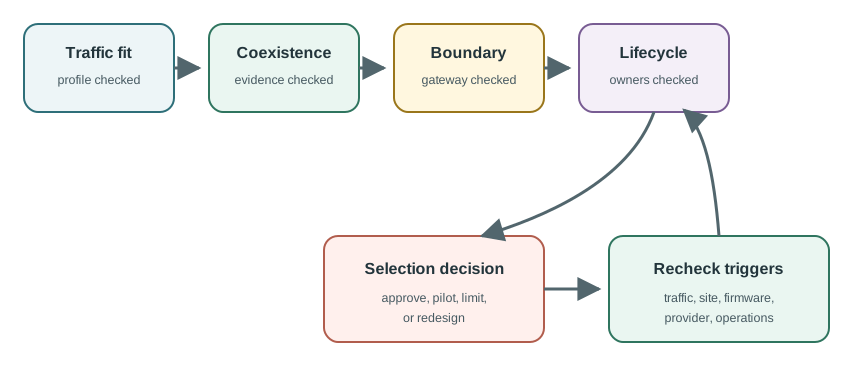
4. Check boundaries. Document where a device, gateway, broker, cloud service, plant network, or operations team takes responsibility.
5. Write the decision brief. State the selected stack, rejected alternatives, pilot check, risk limit, and recheck trigger.
Worked Example: Campus Leak Sensor
A facilities team needs leak sensors in remote utility closets across a campus. Each sensor sends rare telemetry and urgent alarms. Devices are battery-powered, closets have uneven building coverage, and the team wants a gateway-managed path rather than direct device-to-cloud credentials.
This example avoids a common shortcut: selecting a protocol because it appears in an IoT list. The decision is only defensible when the stack meets the deployment gates and the boundary record says who owns the evidence.
Practitioner Knowledge Check
If your job is to make a recommendation, this record is the minimum artifact to keep. Continue to Under the Hood for the assumptions that usually break weak selections.
2.4 Under the Hood: Boundaries, Tradeoffs, and Recheck Triggers
This section: Under the Hood: Boundaries, Tradeoffs, and Recheck Triggers — Protocol selection often fails at boundaries rather than inside the named protocol.
Protocol selection often fails at boundaries rather than inside the named protocol. A gateway may translate identifiers. A broker may change delivery semantics. A cloud service may own credentials that a device team cannot rotate. A plant network may reject traffic that works in a lab. Good selection records expose those assumptions early.
Selection Boundary Ledger
Tradeoff Rules
Read the Tradeoff Rules material as a decision path rather than as isolated entries. First identify the operating condition in each entry and keep its units, timing, source, and assumed system state attached to it. Next compare the entries at the point where responsibility changes between device, gateway, network, analytic service, and operator; that hand-off is where apparently similar choices often produce different outcomes. Then follow the failure case: ask what becomes stale, delayed, unavailable, or unsafe, who detects it, and what evidence permits recovery. Finally connect the result to the chapter's running design record by naming the selected behavior, the rejected alternative, the measurement that justifies the choice, and the condition that forces a recheck. That order turns the examples or comparison into an auditable engineering argument.
- Do not compare one layer alone. MQTT over TCP over Wi-Fi, CoAP over UDP over constrained links, and industrial protocols behind gateways are different system choices.
- Do not confuse reliability with truth. Delivery behavior can move bytes without proving freshness, authorization, or command meaning.
- Do not hide translation. Gateways and protocol adapters are design components with evidence obligations.
- Do not make permanent decisions from temporary evidence. Record the condition that should reopen the selection, such as coverage failure, battery miss, ownership change, or new security constraint.
Common Review Pitfalls
Read the Common Review Pitfalls material as a decision path rather than as isolated entries. First identify the operating condition in each entry and keep its units, timing, source, and assumed system state attached to it. Next compare the entries at the point where responsibility changes between device, gateway, network, analytic service, and operator; that hand-off is where apparently similar choices often produce different outcomes. Then follow the failure case: ask what becomes stale, delayed, unavailable, or unsafe, who detects it, and what evidence permits recovery. Finally connect the result to the chapter's running design record by naming the selected behavior, the rejected alternative, the measurement that justifies the choice, and the condition that forces a recheck. That order turns the examples or comparison into an auditable engineering argument.
- Favorite-protocol selection. A familiar protocol is not automatically suitable for a specific message family.
- Ignoring operations. A stack that no team can monitor, patch, or credential safely is not production-ready.
- Mixing evidence levels. Lab reachability does not prove field coverage, security approval, or long-term maintainability.
- Missing the recheck trigger. If the assumptions change, the protocol decision should reopen before failure becomes normal.
Under-the-Hood Knowledge Check
At this depth, protocol selection is a controlled decision with gates, boundary evidence, and a recheck condition. The chosen stack should be defendable when deployment facts change.
2.5 Checkpoint: Summary
This section: Checkpoint: Summary
- Start protocol selection with deployment gates, not preferred protocol names.
- Compare complete stacks, including application protocol, transport, network, link, security, gateway, and operations assumptions.
- Gateway, broker, cloud, and plant-network boundaries must have explicit ownership and evidence.
- A selected protocol can move messages but still fail freshness, authorization, duplicate-handling, or support requirements.
- A useful decision brief records the winner, rejected alternatives, pilot evidence, rollout limit, and recheck trigger.
Select IoT protocols as evidence-backed stacks: gate impossible choices, compare surviving paths, document the boundary responsibilities, and state what evidence will reopen the decision.
2.6 See Also
This section: See Also
Interoperability Fundamentals
Review how transport, syntax, shared meaning, and stream contracts affect protocol decisions.
Industrial Protocols Overview
Apply selection evidence to OT timing, gateways, industrial Ethernet, OPC UA, and migration paths.
Modbus Protocol
Inspect a register-map protocol where gateway boundaries and security review matter.
OPC UA Fundamentals
Compare information models, services, trust records, and Pub/Sub integration boundaries.
Find help
3 reviewed answers.
Where should I start in a module?
Open the module page from the sidebar to see its chapters in order. Use the module map to return to a topic you need.
Modules and pathsReviewed
What can I try when a project does not work?
Check the symptom, then work through the diagnostic steps. Keep the error message and the smallest example that reproduces it.
When you are stuckReviewed
How do interactive examples work?
Use the interactive guide to check how examples and simulations work before changing your project.
Interactive examples guideReviewed