36 RPL Introduction and Core Concepts
Learning Objectives
By the end of this section, you will be able to:
- Analyze why traditional routing protocols fail for Low-Power and Lossy Networks (LLNs)
- Classify RPL as a distance-vector routing protocol and justify its design for IoT
- Diagram the DODAG (Destination Oriented Directed Acyclic Graph) topology and its single-root structure
- Calculate RANK values using objective functions and demonstrate loop prevention mechanisms
36.1 Prerequisites
Before diving into this chapter, you should be familiar with:
- Routing Fundamentals: Knowledge of basic routing concepts, routing tables, and distance-vector protocols helps you understand RPL’s routing decisions
- 6LoWPAN Fundamentals: RPL typically operates with 6LoWPAN, so familiarity with IPv6 header compression and adaptation layer mechanisms is important
- Wireless Sensor Networks: Understanding WSN energy constraints and multi-hop communication patterns explains RPL’s design choices and optimization strategies
Key Concepts
- RPL Introduction: RPL (RFC 6550) creates an IPv6 mesh routing structure specifically designed for the constraints of IoT LLNs — limited RAM, lossy links, and battery operation.
- DODAG: Destination Oriented Directed Acyclic Graph — RPL’s fundamental routing structure, a directed tree rooted at the border router.
- IoT Traffic Requirements: Most IoT traffic flows from many sensors toward one collection point (MP2P); RPL’s DODAG structure is optimized for this dominant pattern.
- Comparison to Traditional Routing: RPL differs from OSPF/RIP by using proactive DODAG construction rather than flooding-based topology discovery, saving bandwidth on constrained links.
For Beginners: What is RPL?
Imagine a smart building with 500 sensors spread across 20 floors. Sensor data needs to reach a central controller on the ground floor, but not every sensor can communicate directly—wireless signals don’t penetrate all walls and floors. Sensors need to relay messages through other sensors to reach the destination. This is called multi-hop routing.
But here’s the problem: traditional Internet routing protocols (like those used in Wi-Fi routers) assume devices have plenty of battery power, memory, and processing capability. IoT sensors have tiny batteries, minimal memory, and weak processors. Running traditional routing protocols would drain batteries in days.
RPL (Routing Protocol for Low-power and Lossy networks) is designed specifically for this challenge. It creates a tree-like structure where all data flows “upward” toward a central point (called the “root”), like water flowing downhill to a river. This structure is called a DODAG (Destination-Oriented Directed Acyclic Graph)—a fancy way of saying “tree where all paths lead to the root without loops.”
Think of it like an organization chart: employees report to managers, managers report to directors, directors report to the CEO. Messages flow up the hierarchy efficiently without getting stuck in circles. RPL does this for sensors, ensuring data reaches the gateway while conserving precious battery power.
| Term | Simple Explanation |
|---|---|
| RPL | Routing Protocol for Low-power and Lossy networks—designed for IoT |
| Multi-hop | Messages relay through multiple devices to reach destination |
| DODAG | Tree structure where all paths lead to root (like org chart) |
| Root | Central node where all data ultimately flows (gateway/coordinator) |
| RANK | Device’s distance from root—like floors in a building |
| Upward Route | Data flowing from sensors toward root |
| Downward Route | Commands flowing from root toward specific sensors |
| LLN | Low-power and Lossy Network—constrained IoT environment |
Sensor Squad: Why We Need a Special Protocol!
“Why can’t we just use regular internet routing?” asked Sammy the Sensor. “My Wi-Fi router at home works fine!”
“Your home router has unlimited power from the wall socket and a powerful processor,” explained Max the Microcontroller. “But I run on a coin cell battery and have less memory than a calculator. Running OSPF would drain my battery in hours – it floods the network with updates constantly!”
“The real problem is our links are lossy,” added Lila the LED. “In a normal network, maybe one in a million packets gets lost. For us, it is one in ten! Traditional protocols freak out when links are that unreliable – they keep recalculating routes and flooding updates, which wastes even more energy.”
“So the IETF designed RPL just for us,” concluded Bella the Battery. “It builds a tree structure called a DODAG where data flows upward to a root gateway. Each node picks a preferred parent based on RANK – a number that represents path quality, not just hop count. A longer path with reliable links beats a short path with lossy ones every time!”
36.3 Introduction to RPL
RPL (IPv6 Routing Protocol for Low-Power and Lossy Networks) is a distance-vector routing protocol specifically designed for resource-constrained IoT devices operating in challenging network conditions.
IoT routers, like other devices in an IoT environment, are resource constrained. As they operate in Low Power and Lossy Networks (LLN), there are limitations that make it almost impossible to use traditional routing protocols.
Knowledge Check
Test your understanding of these networking concepts.
36.4 RPL Specification
- Standard: RFC 6550 (IETF, March 2012)
- Type: Distance-vector routing protocol
- Network Layer: IPv6 (works with 6LoWPAN)
- Topology: DODAG (Destination Oriented Directed Acyclic Graph)
- Metrics: Flexible (hops, ETX, latency, energy, etc.)
- Use Case: Low-power, lossy networks with many-to-one traffic patterns
36.5 Why Not Use Existing Routing Protocols?
Traditional routing protocols like OSPF, RIP, and AODV were designed for different network characteristics. They don’t work well for IoT because:
36.5.1 Processing, Memory, and Power Constraints
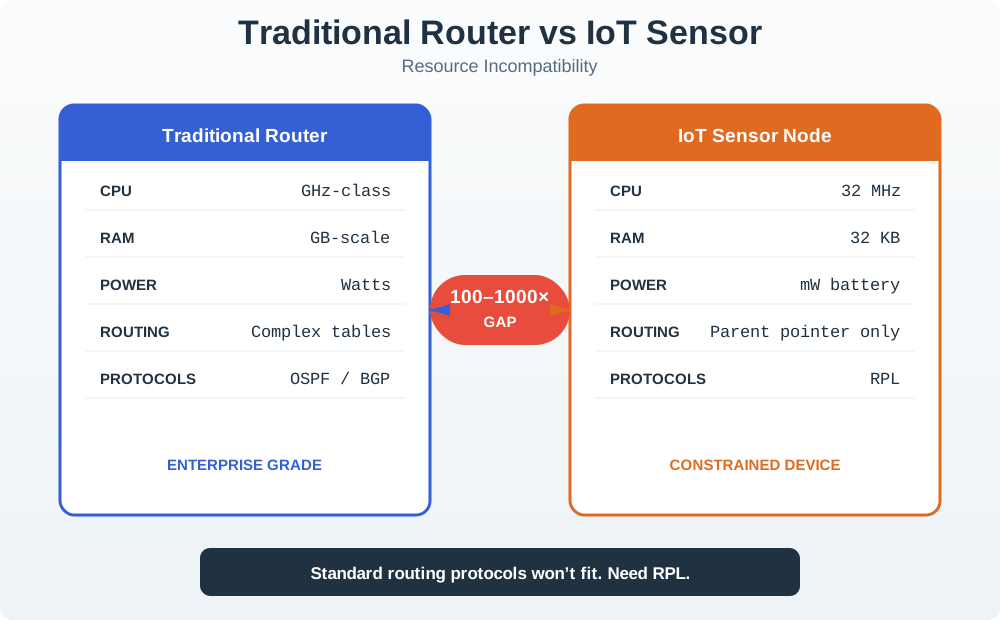
Traditional Protocols Require:
- Complex routing tables: OSPF maintains link-state database of entire network
- Frequent updates: RIP sends entire routing table every 30 seconds
- Heavy processing: Link-state algorithms (Dijkstra’s shortest path)
- Power-hungry: Constant listening and periodic broadcasts
IoT Constraints:
- Microcontroller: 8-32 MHz, single core
- RAM: 10-128 KB (vs GB in traditional routers)
- Flash: 32-512 KB (limited code and data storage)
- Power: Milliwatts (battery-powered, years of operation)
36.5.2 Single Metric Not Always Appropriate
Traditional protocols use single metric:
- RIP: Hop count only
- OSPF: Cost (usually based on bandwidth)
IoT requires multiple, context-dependent metrics:
- Latency: Real-time monitoring (industrial sensors)
- Reliability: Critical data (medical devices)
- Energy: Battery-powered devices (maximize lifetime)
- Bandwidth: Mixed traffic (sensors + actuators)
RPL Solution: Supports objective functions with multiple metrics
36.5.3 Multiple Routing Instances
IoT Scenario: Single physical network, multiple applications
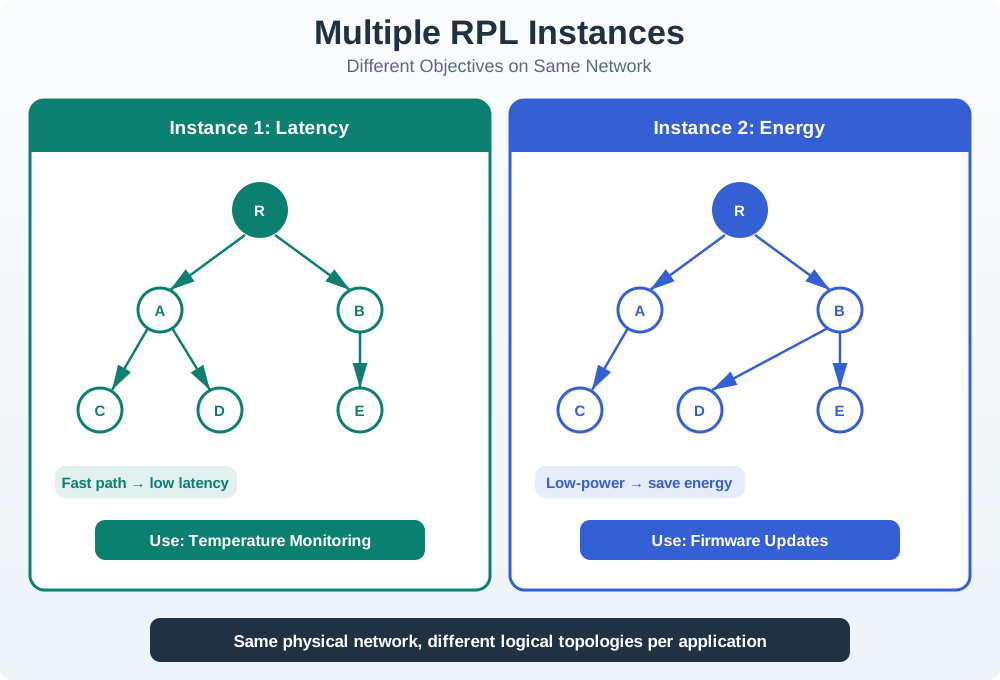
Example:
- Instance 1: Temperature monitoring (minimize latency)
- Instance 2: Firmware updates (minimize energy, can be slower)
- Same devices, different routing decisions based on application
36.5.4 Point-to-Multipoint Traffic Patterns
Traditional networks: Assume peer-to-peer traffic
IoT networks: Predominantly many-to-one traffic - Many sensors -> One gateway (cloud) - Data aggregation at root
RPL Optimization: Optimized for convergent traffic towards root
36.5.5 Lossy Links
Traditional networks: Assume reliable links (wired, enterprise Wi-Fi)
Low-Power and Lossy Networks (LLN):
- High packet loss: 10-40% (vs < 1% wired)
- Variable link quality: Interference, fading, obstacles
- Asymmetric links: A can hear B, but B can’t hear A
- Time-varying: Link quality changes over time
RPL Features for Lossy Networks:
- Trickle timer: Adaptive control message frequency
- ETX metric: Expected Transmission Count (accounts for retransmissions)
- Loop avoidance: RANK prevents routing loops
36.6 RPL Core Concepts
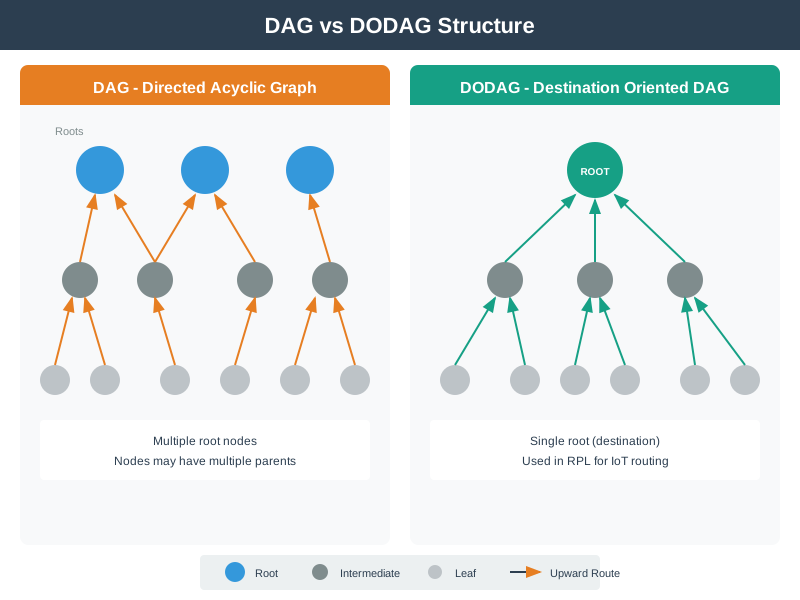
36.6.1 Directed Acyclic Graph (DAG)
DAG = Directed Acyclic Graph
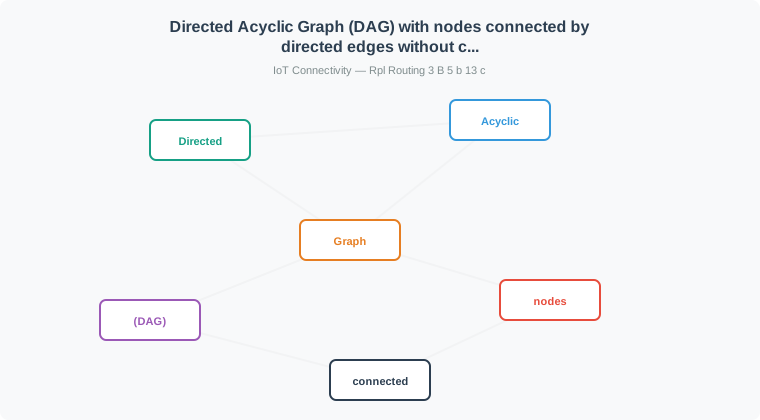
Key Properties:
- Directed: Edges have direction (arrows)
- Acyclic: No cycles (cannot return to same node following edges)
- Graph: Nodes connected by edges
Why DAG?
- Loop-free routing: By definition, no cycles = no routing loops
- Hierarchical structure: Natural parent-child relationships
- Efficient aggregation: Data flows towards root(s)
36.6.2 DODAG (Destination Oriented DAG)
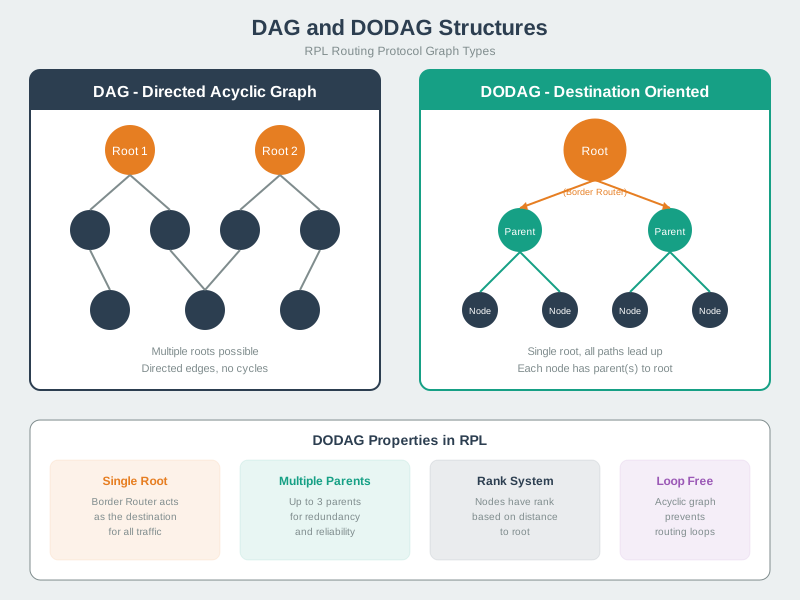
RPL uses DODAG: DAG with single root (destination)
DODAG Properties:
- Single root: One destination (typically border router/gateway)
- Upward routes: All paths lead to root
- RANK: Position in DODAG hierarchy (root = 0, increases going down)
Putting Numbers to It
Quantifying RANK Calculation with ETX Objective Function
For a 4-layer DODAG with varying link quality:
MinHopRankIncrease (RFC 6550 default): \(\text{MinHopRankIncrease} = 256\)
Layer 1 nodes (direct connection to root, ETX 1.0): \(\text{RANK}_{\text{layer 1}} = 0 + 256 \times 1.0 = \mathbf{256}\)
Layer 2 node via good link (ETX 1.0): \(\text{RANK}_{\text{layer 2, good}} = 256 + 256 \times 1.0 = \mathbf{512}\)
Layer 2 node via poor link (ETX 2.5, 60% packet loss): \(\text{RANK}_{\text{layer 2, poor}} = 256 + 256 \times 2.5 = \mathbf{896}\)
Layer 3 node choosing parents: Via good-link node (RANK 512, ETX 1.0): \(\text{RANK}_{\text{option A}} = 512 + 256 \times 1.0 = \mathbf{768}\)
Via poor-link node (RANK 896, ETX 1.0 locally): \(\text{RANK}_{\text{option B}} = 896 + 256 \times 1.0 = \mathbf{1152}\)
Parent selection: Node chooses option A (RANK 768 < 1152), demonstrating how RANK encodes cumulative path quality—not just hop count. A 3-hop path via reliable links beats a 2-hop path with one lossy link.
36.6.3 RANK: Loop Prevention Mechanism
RANK is a scalar representing a node’s position relative to the root.
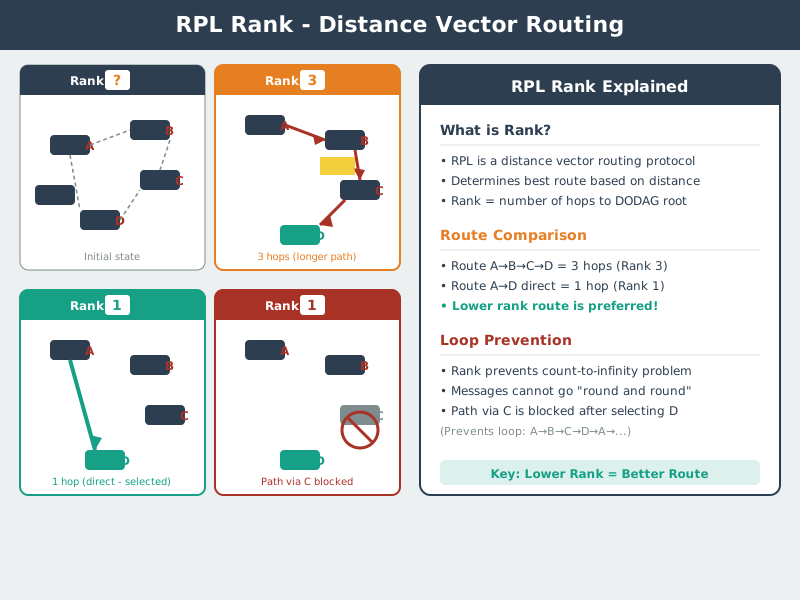
RANK Rules:
- Root has RANK 0 (or minimum RANK)
- RANK increases as you move away from root
- Upward routing: Packets forwarded to nodes with lower RANK
- Loop prevention: Node cannot choose parent with higher RANK
RANK Calculation:
RANK(node) = RANK(parent) + RankIncrease

RankIncrease calculated based on:
- Link cost (ETX, RSSI, etc.)
- Number of hops
- Energy consumed
- Objective functionExample:
ROOT: RANK = 0
Node A (parent: ROOT): RANK = 0 + 100 = 100
Node B (parent: Node A): RANK = 100 + 150 = 250
Node C (parent: Node B): RANK = 250 + 120 = 370
Loop Prevention:
- Node C cannot choose Node A as parent (RANK 100 < 370 is OK)
- Node A cannot choose Node C as parent (RANK 370 > 100 - would create loop)
RANK vs Hop Count
RANK is not the same as Hop Count (although hop count can be a factor)
RANK is calculated using objective function which may consider: - Hop count - Expected Transmission Count (ETX) - Latency - Energy consumption - Link quality (RSSI, LQI)
Example:
- Good link, 1 hop: RANK increase = 100
- Poor link, 1 hop: RANK increase = 300
- Good link, 2 hops: RANK increase = 200
Node may prefer 2 hops via good links (total RANK increase: 200) over 1 hop via poor link (RANK increase: 300).
36.7 How It Works: RPL DODAG Formation and RANK Calculation
RPL builds its routing structure through a step-by-step process that creates a Destination Oriented Directed Acyclic Graph (DODAG):
Step 1: Root Initialization The border router (gateway) initializes the DODAG by setting its RANK to 0 and broadcasting DIO messages containing the DODAG ID and configuration parameters.
Step 2: Neighbor Discovery and Parent Selection When a node receives DIO messages from neighbors, it evaluates each potential parent using the objective function. For example, with MRHOF-ETX: - Node A hears DIO from ROOT (RANK 0, ETX 1.5) → calculated RANK = 0 + (256 × 1.5) = 384 - Node A hears DIO from Node B (RANK 512, ETX 1.2) → calculated RANK = 512 + (256 × 1.2) = 819 - Node A selects ROOT as preferred parent (lower RANK)
Step 3: RANK Calculation and Advertisement After selecting a parent, Node A calculates its own RANK and begins advertising DIOs to downstream neighbors, allowing the DODAG to expand outward from the root in waves.
Step 4: Downward Route Building (Storing Mode) Nodes send DAO messages upward to advertise reachability. When Node E sends DAO to parent D saying “I am reachable,” Node D stores this route and propagates it upward, building complete downward paths.
This process repeats until all nodes have joined the DODAG, creating a loop-free tree structure where all data flows efficiently toward the root.
36.7.1 Interactive: RANK Calculator (MRHOF-ETX)
Use this calculator to compute a node’s RANK given its parent’s RANK, link ETX, and MinHopRankIncrease.
36.8 Real-World Evidence: Why Traditional Protocols Fail in LLNs
36.8.1 Quantified Protocol Failures
A 2018 study by Ericsson Research deployed OSPF, RIPng, and RPL on a 200-node IEEE 802.15.4 testbed (2.4 GHz, CC2650 SoCs, 20 KB RAM) in a three-story office building with 15-25% average packet loss. The results quantified exactly why traditional protocols collapse:
| Protocol | Convergence Time | RAM per Node | Control Overhead | Delivery Ratio |
|---|---|---|---|---|
| OSPF | Did not converge | >64 KB (exceeded RAM) | N/A | 0% |
| RIPng | 47 minutes | 18 KB (for 200 routes) | 28% of bandwidth | 61% |
| RPL (MRHOF) | 3.2 minutes | 1.8 KB | 4.1% of bandwidth | 96.3% |
OSPF could not even fit its link-state database into the CC2650’s 20 KB RAM – it requires storing the complete network topology. RIPng converged but consumed 18 KB for its routing table (200 entries x 90 bytes each) and wasted 28% of available bandwidth broadcasting full tables every 30 seconds. RPL required only a parent pointer (16 bytes), backup parent list, and DODAG metadata – under 2 KB total.
36.8.2 SmartMesh IP: Real-World RPL at Scale
Linear Technology’s (now Analog Devices) SmartMesh IP is the most commercially deployed RPL-based product. As of 2023, over 60,000 networks running SmartMesh IP operate in industrial environments worldwide.
Emerson Process Management refinery deployment (Texas, 2016):
- Scale: 1,200 wireless sensors across a 2 km2 refinery
- Topology: Single DODAG root (SmartMesh gateway), average 6 hops, maximum 12 hops
- Link loss: 20-35% per hop (extreme RF interference from metal structures, rotating equipment)
- RPL configuration: MRHOF with ETX metric, MinHopRankIncrease = 256, trickle timer I_min = 4 seconds, I_max = 20 minutes
- Delivery ratio: 99.999% end-to-end (achieved via ETX-aware parent selection plus MAC-layer retransmissions)
- Battery life: 7+ years on D-cell lithium (Class A: transmit every 30 seconds, RANK-based sleep scheduling)
The key insight from this deployment: RPL’s ETX-based RANK calculation is critical in industrial settings. Hop-count-based routing (OF0) would have selected 2-hop paths through heavily obstructed links (35% loss), resulting in only 42% end-to-end delivery. ETX-based MRHOF instead selected 4-5 hop paths through cleaner links, achieving near-perfect delivery despite the longer path.
Worked Example: Calculating RANK and Detecting Loops
Scenario: A 6-node RPL network with the following link ETX values (Expected Transmission Count, where lower = better quality):
ROOT (RANK 0)
  |-- ETX 1.5 --> Node A
  |-- ETX 2.0 --> Node B

Node A (parent: ROOT)
  |-- ETX 1.2 --> Node C
  |-- ETX 3.5 --> Node D

Node B (parent: ROOT)
  |-- ETX 1.8 --> Node D

Node C (parent: Node A)
  |-- ETX 2.2 --> Node E
Given:
- Objective Function: MRHOF (Minimum Rank Hop-count Objective Function) with ETX metric
- MinHopRankIncrease: 256 (RFC 6550 default)
- ETX scaling: RANK_increase = MinHopRankIncrease × link_ETX
Step 1: Calculate RANK for each node
ROOT: RANK = 0 (by definition)
Node A:
- Parent: ROOT (RANK 0)
- Link ETX: 1.5
- RANK = 0 + (256 × 1.5) = 384
Node B:
- Parent: ROOT (RANK 0)
- Link ETX: 2.0
- RANK = 0 + (256 × 2.0) = 512
Node C:
- Parent: Node A (RANK 384)
- Link ETX: 1.2
- RANK = 384 + (256 × 1.2) = 384 + 307 = 691
Node D has two potential parents:
Option 1 (via Node A): - RANK = 384 + (256 × 3.5) = 384 + 896 = 1280
Option 2 (via Node B): - RANK = 512 + (256 × 1.8) = 512 + 461 = 973
Node D selects Node B (RANK 973 < 1280) - MRHOF picks lower RANK parent
Node E:
- Parent: Node C (RANK 691)
- Link ETX: 2.2
- RANK = 691 + (256 × 2.2) = 691 + 563 = 1254
Step 2: Detect loop prevention
What if Node E tries to select Node C as parent, but Node C tries to select Node E?
- Node C: RANK 691
- Node E: RANK 1254
RPL rule: A node can only select a parent with lower RANK.
- Node C (RANK 691) cannot select Node E (RANK 1254) ✗ (higher RANK)
- Node E (RANK 1254) can select Node C (RANK 691) ✓ (lower RANK)
Loop prevented! Even if both nodes advertise to each other, RANK enforcement prevents cycles.
Final DODAG:
ROOT (0)
├─ A (384)
│  └─ C (691)
│     └─ E (1254)
└─ B (512)
   └─ D (973)
Decision Framework: When to Use RPL vs Alternatives
| Requirement | Use RPL | Use Alternative | Recommended Protocol |
|---|---|---|---|
| Network size: <50 nodes, battery-powered | ✓ | RPL with Non-Storing mode | |
| Network size: >1000 nodes, mains-powered | ✓ | Thread (RPL variant) or industrial WSN | |
| IPv6 addressing required | ✓ | RPL (designed for 6LoWPAN) | |
| Traffic pattern: Many sensors → 1 gateway | ✓ | RPL (optimized for convergent traffic) | |
| Traffic pattern: Peer-to-peer mesh | ✓ | Zigbee or custom flooding | |
| Real-time control: <50ms latency | ✓ | WirelessHART or TSN over 802.15.4e | |
| Memory: Nodes have <8 KB RAM | ✓ | RPL Non-Storing mode (minimal routing state) | |
| Mobility: Nodes move frequently | ✓ | AODV or DSR (reactive routing) | |
| Heterogeneous links: Mix of Wi-Fi, 802.15.4, Ethernet | ✓ | RPL (link-agnostic) | |
| Standard compliance required | ✓ | RPL (IETF RFC 6550) |
Real-world decision case:
Scenario: Smart agriculture with 200 soil moisture sensors across a 10-hectare field. Sensors report every 30 minutes. Gateway is solar-powered at field edge.
Analysis:
- Network size: 200 nodes → RPL can handle
- Traffic: Many sensors → 1 gateway → RPL optimized
- Mobility: Sensors stationary → RPL stable
- Power: Battery sensors, solar gateway → RPL power-efficient
- Memory: nRF52840 (256 KB flash, 64 KB RAM) → Storing Mode feasible
Verdict: Use RPL with Storing Mode and MRHOF-ETX objective function. Expect ~5-7 hop DODAG with average ETX 1.5 per hop.
Alternative considered: Zigbee. Rejected because IPv6 compatibility is required for future cloud integration without protocol translation.
36.9 Concept Relationships
Understanding RPL requires seeing how its core concepts interconnect:
DODAG ↔︎ RANK: The DODAG’s tree structure is enforced by RANK values. RANK strictly increases moving away from the root, making the acyclic property mathematically guaranteed rather than actively policed.
Objective Function → RANK Calculation: The objective function (OF0 vs MRHOF) determines how RANK is calculated from parent RANK and link metrics. Different OFs optimize for different goals (hop count vs reliability vs energy).
DIO Messages → Parent Selection: Nodes receive DIO messages from neighbors advertising their RANK. The objective function evaluates these options and selects the best parent, which then determines the node’s own RANK.
RANK → Loop Prevention: Because nodes can only forward to lower RANK, packets naturally flow toward the root without possibility of cycles. This is RPL’s fundamental advantage over traditional distance-vector protocols that must explicitly detect loops.
Storing Mode ↔︎ DAO Messages: In Storing mode, DAO messages build the downward routing state. Each node maintains routes to its descendants, enabling optimal point-to-point paths without root involvement.
Traffic Pattern → Mode Selection: Many-to-one traffic (most IoT deployments) works identically in both modes. Point-to-point traffic favors Storing mode for optimal paths. This relationship drives the mode selection decision.
36.10 See Also
Related IoT Routing Protocols:
- 6LoWPAN Fundamentals: IPv6 header compression that enables RPL to fit in constrained packets
- Thread Protocol: Uses RPL variant for routing in Thread/Matter networks
- Wireless Sensor Networks: Higher-level WSN concepts where RPL provides routing layer
Security and Performance:
- RPL Security Threats: Attacks against RPL and mitigation strategies
- Energy-Aware Considerations: How RPL’s Trickle timer and mode choice affect battery life
Alternative Approaches:
- Routing Fundamentals: Traditional routing protocols (OSPF, RIP) that don’t work for LLNs
- Mesh Networking: Alternative routing architectures for IoT
Common Mistake: Confusing RANK with Hop Count
The error: Assuming RANK equals hop count multiplied by 256, leading to incorrect parent selection predictions.
Example of the mistake:
A developer debugging an RPL network sees: - ROOT: RANK 0 - Node A: RANK 512 (2 hops from root) - Node B: RANK 768 (3 hops from root)
They conclude: “Node A is 2 hops away because 512 ÷ 256 = 2.”
Why this is wrong:
RANK represents path cost, not hop count. With ETX-based MRHOF:
Actual scenario:
- ROOT → Node A: 1 hop, but link ETX = 2.0 (lossy link through metal wall)
- RANK = 0 + (256 × 2.0) = 512
- ROOT → Relay → Node B: 2 hops, ETX = 1.5 per hop (clear links)
- RANK = 0 + (256 × 1.5) + (256 × 1.5) = 768
Node A is actually 1 hop (not 2), but its RANK is 512 due to poor link quality. Node B is 2 hops with RANK 768 due to good links.
What this means for debugging:
If you see a node with RANK 1024, you cannot assume it’s 4 hops away. Check the objective function and link metrics: - With OF0 (hop count only): RANK 1024 = exactly 4 hops - With MRHOF-ETX: RANK 1024 could be 2 hops (ETX 2.0 each) or 5 hops (ETX 0.8 each)
Correct approach: Always check ip maddr show or Wireshark DIO messages to see the actual parent selection and hop count, not just RANK values.
Common Pitfalls
1. Treating RPL as a Drop-In Replacement for Traditional Routing
RPL has fundamentally different abstractions (RANK instead of cost, DODAG instead of link-state map). Don’t assume knowledge of OSPF or RIP directly translates — RPL requires learning its specific concepts fresh.
2. Not Understanding the Upward/Downward Traffic Asymmetry
RPL’s core design prioritizes upward (MP2P) traffic. Downward traffic requires explicit configuration (Storing Mode or source routing). Many introductory implementations handle upward traffic correctly but fail for downward.
36.11 What’s Next
| If you want to… | Read this |
|---|---|
| Study RPL core concepts in depth | RPL Core Concepts |
| Understand DODAG construction | RPL DODAG Construction |
| Learn RPL message flow | RPL DODAG Message Flow |
| Compare storing vs non-storing modes | RPL Routing Modes |