30 RPL DODAG Visual Construction Guide
30.1 Learning Objectives
After completing this chapter, you will be able to:
- Trace the 5-phase DODAG construction algorithm through visual diagrams
- Analyze the temporal dynamics of DODAG formation across the 7-step process
- Distinguish between DAG and DODAG structures based on root constraints
- Estimate the timing of each formation phase for real-world network deployments
For Beginners: RPL DODAG Visual Guide
A DODAG is the tree-shaped network structure that RPL builds, where data flows upward from sensors to a central collection point (like water flowing downhill to a river). This visual guide uses diagrams to show step-by-step how devices join the tree and choose their parent node, making the abstract routing process easy to follow.
Sensor Squad: Growing the Network Tree!
“Building a DODAG is like watching a tree grow from a seed,” said Sammy the Sensor. “It happens in five phases, and each one builds on the last.”
“Phase one is the root saying ‘I exist!’” explained Max the Microcontroller. “The root gateway sets its RANK to zero and broadcasts a DIO message. Phase two is neighbor discovery – nearby nodes hear the DIO and figure out their own RANK based on how good their link to the root is.”
“Phase three is the most interesting,” added Lila the LED. “Each node picks a preferred parent – the neighbor with the lowest RANK. It is like choosing which friend to pass notes through in class. You pick the one who sits closest to the teacher and has the best handwriting!”
“Then in phase four, everyone sends DAO messages upward so the root knows they exist,” continued Bella the Battery. “And phase five is stabilization – the Trickle timer kicks in and everyone calms down, sending updates less and less often. The whole process takes just seconds in a small network but might take minutes in a network with hundreds of devices!”
30.2 DODAG Construction: Visual Algorithm
This condensed visual sequence shows the 5 key phases of DODAG construction. Each diagram focuses on one step, making the algorithm easy to understand and remember.
30.2.1 Step 1: Root Initialization
What happens: Root broadcasts DIO containing Rank=0, DODAG ID, and objective function. Neighboring nodes receive but haven’t processed yet.
30.2.2 Step 2: First-Hop Join
What happens: Nodes hear DIO, calculate Rank = Parent_Rank + Link_Cost, and select root as parent. Node C has higher Rank (384) due to poorer link quality.
30.2.3 Step 3: Multi-Hop Expansion
What happens: First-hop nodes broadcast their own DIO messages. Second-hop nodes (D, E) join with Rank = 256 + 256 = 512. Process ripples outward hop-by-hop until all nodes join the DODAG.
30.2.4 Step 4: DAO Propagation
What happens: Nodes send DAO (Destination Advertisement Object) messages toward the root to establish downward routes. This enables the root (and intermediate nodes in storing mode) to send data to specific nodes.
30.2.5 Step 5: Steady State
What happens: DODAG complete! Trickle algorithm now maintains consistency with minimal overhead—DIO messages become rare when network is stable. If a node fails, neighbors detect it and repair locally.
Algorithm Summary
| Step | Action | Messages | Result |
|---|---|---|---|
| 1 | Root init | DIO broadcast | DODAG announced |
| 2 | First-hop join | DIO received | Nodes calculate Rank, select parent |
| 3 | Multi-hop expand | DIO ripple outward | All nodes join progressively |
| 4 | Downward routes | DAO toward root | Root learns paths to all nodes |
| 5 | Steady state | Trickle-controlled DIO | Minimal overhead, self-healing |
30.3 DODAG Formation: Step-by-Step Visual Guide
The following sequence shows how a DODAG forms step-by-step in a real network. This progressive visualization helps you understand the temporal dynamics of RPL—not just the final topology, but how nodes discover each other and build the routing structure over time.
Understanding how RPL networks self-organize from chaos to hierarchy is crucial for troubleshooting and optimization. This 7-step visual progression shows the complete DODAG construction process with real timing information.
30.3.1 Understanding DAG vs DODAG First
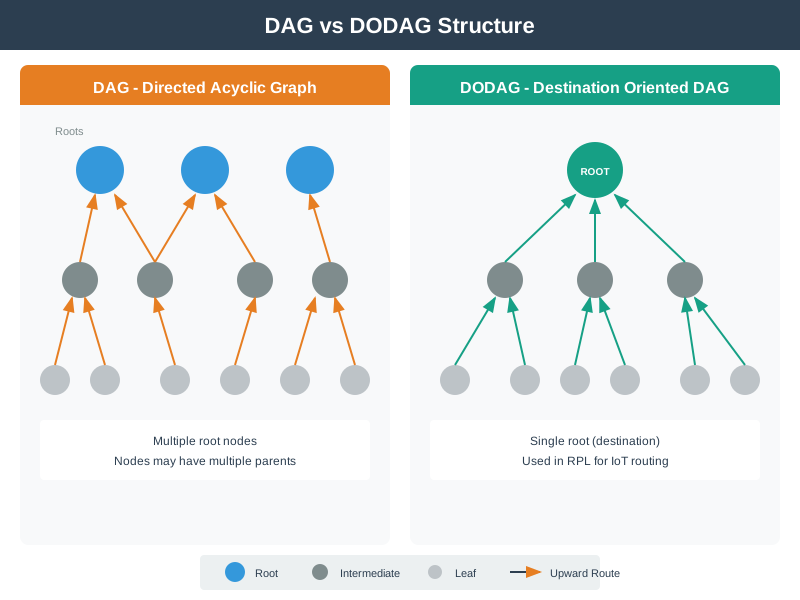
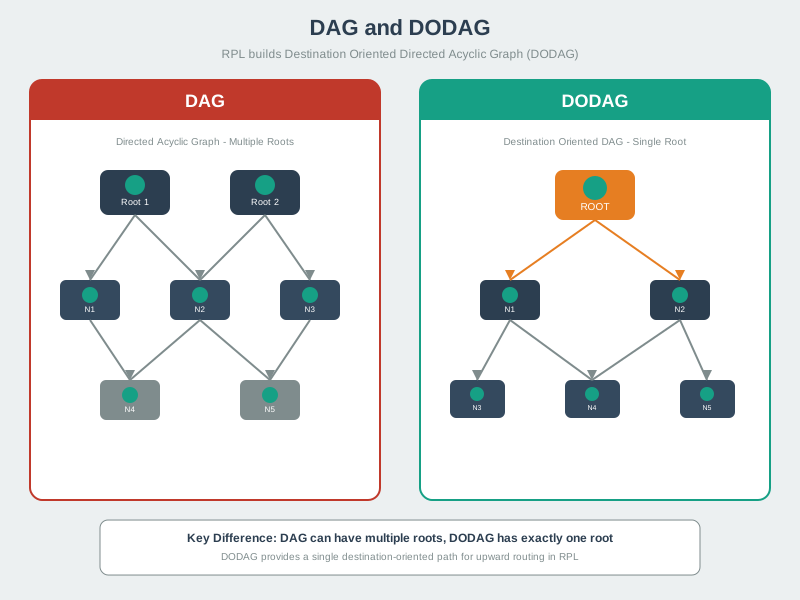
Key Difference: A DAG can have multiple independent trees with separate roots. A DODAG has exactly one root (the gateway/border router) where all paths converge. This single-destination orientation is perfect for IoT’s many-to-one traffic pattern (sensors -> cloud).
30.3.2 The 7-Step DODAG Formation Process
This visual sequence shows how RPL transforms unorganized nodes into a self-healing hierarchical network. Pay attention to the timing and message flow at each step—understanding the process is more important than memorizing the final topology.
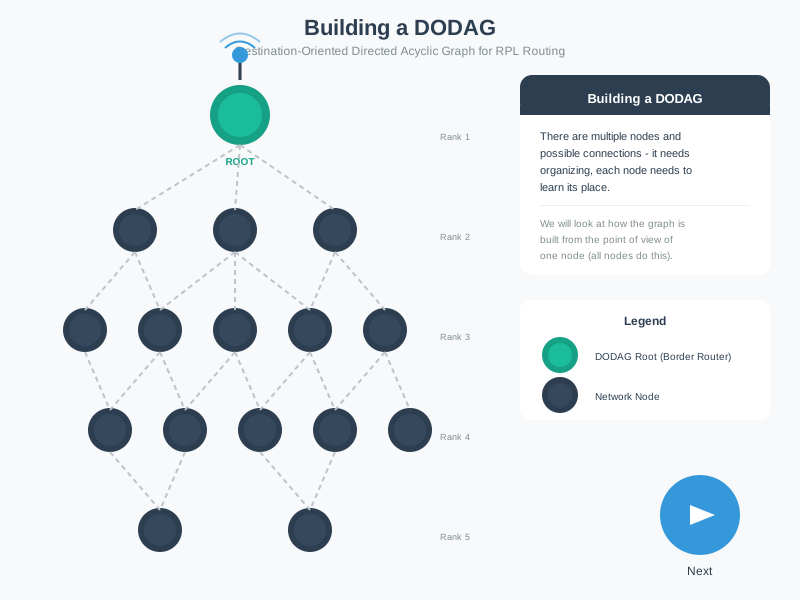
30.3.2.1 Step 1: Initial State - Unorganized Network
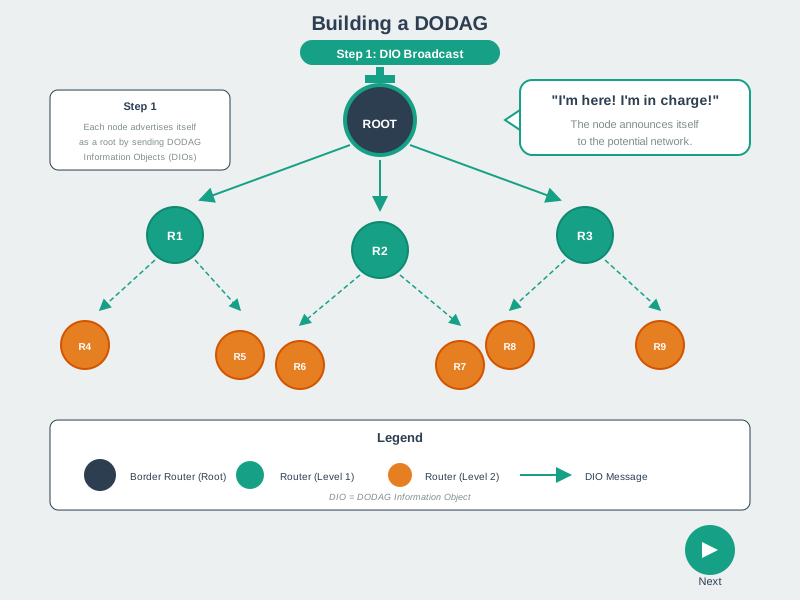
Network State:
- One designated root (border router/gateway) at top
- Multiple sensor nodes powered on and ready
- All connections are potential (dotted lines = physical radio range)
- Nodes don’t know their parents or RANK values yet
- Network needs to self-organize from chaos to hierarchy
What nodes know: Their own address, radio is on, listening for RPL messages
What nodes don’t know: Who is the root, what DODAG to join, which neighbor to use as parent
Real-world timing: This is the state at t=0 seconds when you power on a network
30.3.2.2 Step 2: Root Broadcasts DIO (t = 0-2 seconds)
Root Initiates DODAG (DIO Broadcast)
The root initiates DODAG construction by broadcasting DIO (DODAG Information Object) messages:
- Message content: “I am the root, RANK = 0, DODAG_ID = [IPv6 address], Objective Function = ETX”
- Who receives: All nodes within radio range of root (first-hop neighbors, shown in row 2)
- Propagation: Multicast to all neighbors (efficient broadcast using IPv6 multicast)
- RANK announced: Root advertises RANK = 0
- Analogy: Root announces “I’m here! I’m in charge!” to nearby nodes
First-hop nodes receive DIO:
- Calculate their own RANK:
RANK = 0 + rank_increase(typically 100-256) - Select root as their parent (best option available)
- Store DODAG_ID and configuration
Real-world timing: DIO sent immediately on root startup (t=0-2s), then controlled by trickle timer
Key insight: Only nodes in radio range hear this first DIO. Network expands outward in a “ripple effect” as these nodes forward DIOs in later steps.
30.3.2.3 Step 3: First-Hop Nodes Join & Propagate (t = 2-5 seconds)
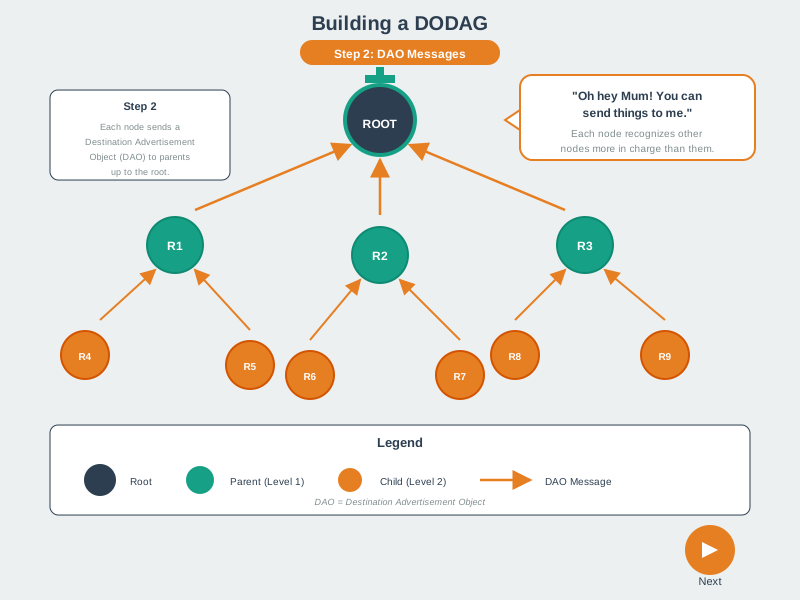
Nodes Join and Send DAO Messages Upward
First-hop nodes (row 2) now participate in DODAG:
- Nodes send DAO (Destination Advertisement Object) messages upward to root:
- Message content: “I am reachable via you, my address is [IPv6]”
- Direction: Child -> Parent (upward toward root)
- Purpose: Build downward routes so root can send commands/updates to specific nodes
- Storing mode: Root stores routing table entry: “Node X reachable via this interface”
- Nodes send own DIOs to their neighbors (row 3):
- Advertise their RANK (e.g., RANK = 256)
- Propagate DODAG information outward
- Enable row 3 nodes to join in next step
- Analogy: “Hey parent! You can send things to me” (DAO upward) + “Hey neighbors! Join this DODAG” (DIO outward)
Real-world timing: DAO sent 1-3 seconds after receiving DIO (in Storing mode)
Ripple effect: Network expands outward as each layer joins and forwards DIOs to the next layer
30.3.2.4 Step 4: DODAG Expands Outward (t = 5-10 seconds)
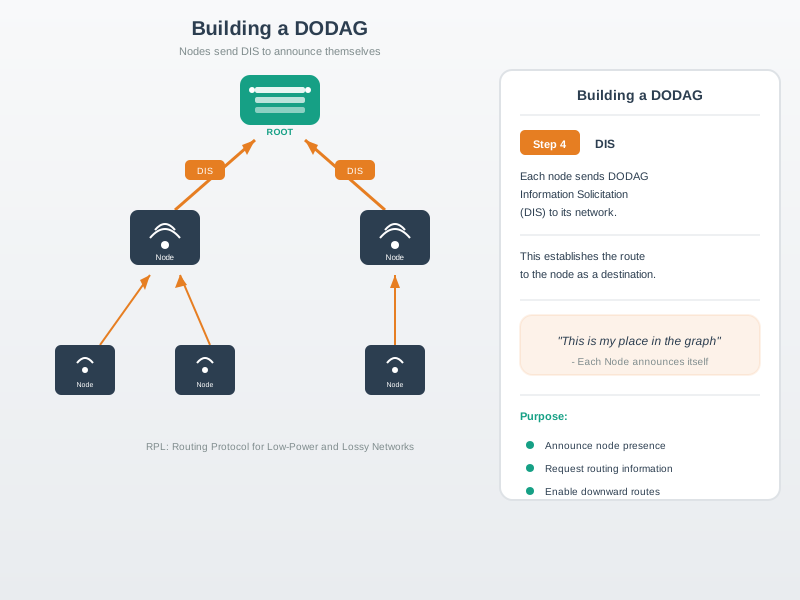
Deeper Nodes Request and Join
Nodes in rows 3 and 4 (farther from root) now join DODAG:
- Some nodes send DIS (DODAG Information Solicitation):
- Message content: “Hello? Is there a DODAG here? Send me DIO!”
- Purpose: Speed up discovery instead of waiting for periodic DIOs
- When sent: New node joining, or node woke from sleep and missed DIOs
- Response: Neighbors immediately reply with DIO messages
- Nodes receive DIOs from row 2 neighbors:
- Calculate their RANK:
RANK = parent_RANK + rank_increase(e.g., 256 + 200 = 456) - Select parent with best metrics (lowest RANK, good link quality)
- May hear DIOs from multiple potential parents
- Calculate their RANK:
- Nodes establish position in DODAG hierarchy:
- Store parent pointer, RANK value, DODAG_ID
- Determine which “floor” they’re on in the building analogy
Real-world timing: DIS accelerates joining from 10-30s (waiting for DIOs) to 2-5s (proactive request)
Trickle timer interaction: DIS resets trickle timer on recipients -> they send DIOs sooner -> faster convergence
30.3.2.5 Step 5: DAO Messages Flow Upward (t = 10-20 seconds)
All Nodes Send DAO to Build Downward Routes
Now that all nodes have joined and selected parents, they advertise their reachability:
- All nodes send DAO upward toward root:
- Leaf nodes send DAO to their parents
- Intermediate nodes aggregate DAOs from children and forward upward
- Storing mode: Each parent stores “Node X reachable via child Y”
- Non-Storing mode: Only root stores complete topology
- DAOs propagate upward hop-by-hop:
- Row 4 -> Row 3 -> Row 2 -> Root
- Each hop adds routing information
- Purpose: Build downward routes so root/parents can send packets to specific nodes
Real-world timing: DAO messages sent every 30-60 seconds (controlled by DAO timer)
Overhead: In 50-node network, ~50 DAO messages total (one per node) over 10-20 seconds
30.3.2.6 Step 6: Root Confirms Routes (t = 20-30 seconds)
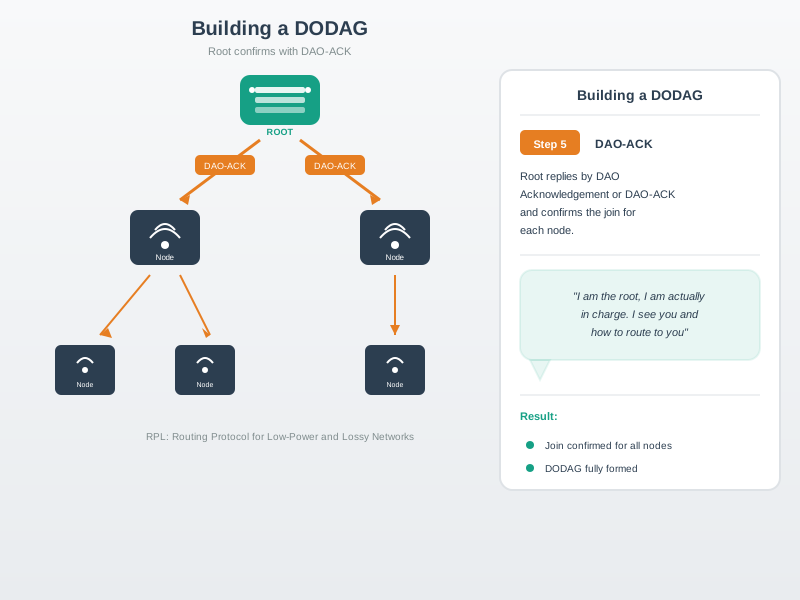
Root Sends DAO-ACK Confirmations
Root (or parents in Storing mode) send DAO-ACK to acknowledge DAO messages:
- Message content: “I received your DAO, I know how to reach you now”
- Direction: Parent -> Child (downward, following the DAO path in reverse)
- Purpose:
- Reliability: Confirm routing table updated successfully
- Error detection: If DAO-ACK doesn’t arrive, node retransmits DAO after timeout
- Root authority: “I am the root, I see you and know how to route to you”
- Optional: DAO-ACK can be disabled in low-reliability networks to reduce overhead
Real-world timing: DAO-ACK sent immediately after receiving DAO (1-2 seconds)
Storing vs Non-Storing: In Storing mode, each parent sends DAO-ACK. In Non-Storing mode, only root sends DAO-ACK (since only root stores routes).
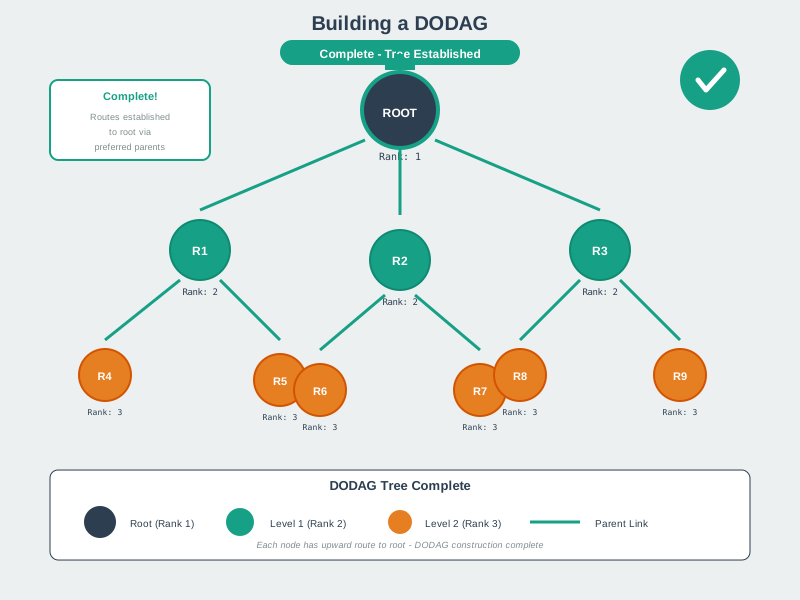
30.3.2.7 Step 7: Steady State - DODAG Complete (t = 30+ seconds)
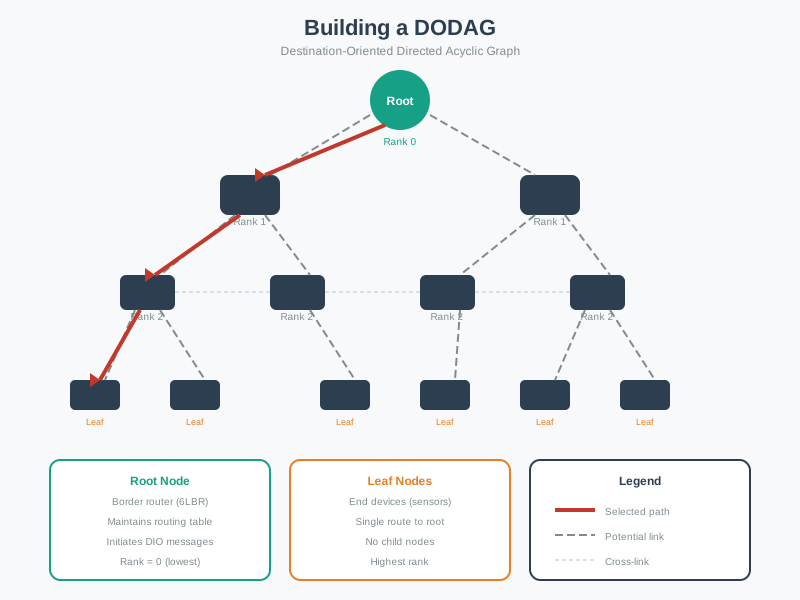
DODAG Formation Complete! Network is now operational with bidirectional routing:
- Upward routes (sensors -> root): Each node knows its parent (parent pointer)
- Leaf nodes have one primary parent (solid line in diagram)
- Intermediate nodes may store backup parents (dotted lines = alternate paths)
- Default route: “Send to parent” (no routing table needed for upward)
- Memory: 4-8 bytes per node (just parent pointer)
- Downward routes (root -> sensors): Built via DAO messages
- Storing mode: Each node has routing table for descendants (10-100 KB total)
- Non-Storing mode: Only root has routing table, uses source routing (root needs 10-100 KB, nodes need 0 bytes)
- Network operational: Data can flow:
- Upward: Sensor readings -> cloud (many-to-one)
- Downward: Commands/firmware -> actuators (one-to-many)
- Point-to-point: Sensor <-> actuator via common ancestor
Key observation: Leaf nodes (bottom row) have one primary route to root, but network maintains alternate paths (dotted lines) for fault tolerance. If primary parent fails, node switches to backup parent instantly (no global reconfiguration needed).
Maintenance overhead: After convergence, trickle timer backs off to 10-60 minute DIO intervals, using <1% of bandwidth
Putting Numbers to It
How does RANK calculation based on ETX create energy-efficient paths? Consider Node D choosing between two parents after receiving their DIOs:
Parent B (Advertised RANK = 384, measured ETX to B = 1.5): \[\text{RANK}_{\text{D via B}} = 384 + (1.5 \times 256) = 384 + 384 = 768\]
Parent A (Advertised RANK = 307, measured ETX to A = 2.8): \[\text{RANK}_{\text{D via A}} = 307 + (2.8 \times 256) = 307 + 717 = 1024\]
Node D selects Parent B (lower cumulative RANK = 768), even though Parent A has better RANK, because the link cost (ETX 1.5 vs 2.8) dominates.
Energy impact (100 packets/day to root): - Via B: \(100 \times 1.5 = 150\) transmissions/day (1.5 expected per packet) - Via A: \(100 \times 2.8 = 280\) transmissions/day (2.8 expected per packet)
Energy cost (50 mW TX for 20 ms = 1 mJ): Via B = 150 mJ/day, Via A = 280 mJ/day
Battery savings: Choosing B saves 130 mJ/day. Over 1 year: \(130 \times 365 = 47.5\text{ kJ}\) saved. A CR2032 cell holds approximately 240 mAh at 3 V ≈ 2.6 Wh ≈ 9.4 kJ — so this routing choice alone extends sensor life by roughly 5 additional CR2032-years of idle energy!
30.4 DODAG Formation Timing Summary
Understanding the temporal progression helps you diagnose network formation issues and optimize convergence time:
| Step | Time | Action | Key Timing Factors |
|---|---|---|---|
| 1. Initial | t=0s | Unorganized network | Power-on, all nodes listening |
| 2. Root DIO | t=0-2s | Root broadcasts first DIO | Immediate on startup |
| 3. First-hop join | t=2-5s | Row 2 joins, sends DAO+DIO | DIO processing + RANK calc |
| 4. Ripple expansion | t=5-10s | Rows 3-4 join via DIS/DIO | DIS accelerates (vs waiting for periodic DIO) |
| 5. DAO upward | t=10-20s | All nodes send DAO to root | DAO timer (30-60s default, can be faster) |
| 6. DAO-ACK confirm | t=20-30s | Root confirms all routes | ACK sent immediately after DAO |
| 7. Steady state | t=30s+ | Network operational | Trickle backs off to 10-60 min DIOs |
Convergence time for 50-node network: Typically 30-120 seconds depending on: - Trickle timer settings: Aggressive (Imin=10ms) vs conservative (Imin=1s) - Network depth: 3-hop network converges faster than 7-hop - DIS usage: Proactive DIS reduces convergence from 120s to 30s - Radio conditions: Packet loss increases retransmissions and delays
Critical applications: Use aggressive timers (10s convergence), accept higher control overhead
Battery-optimized deployments: Tolerate slower formation (2-5 min), minimize DIO/DAO frequency
30.4.1 Interactive: DODAG Convergence Time Estimator
Adjust network parameters to estimate convergence time for your deployment:
30.5 Complete DODAG Formation Overview
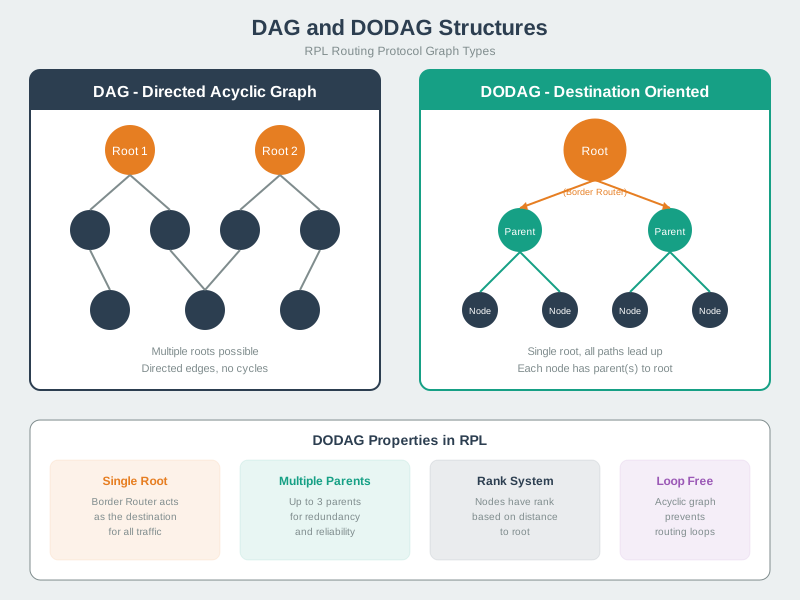
Summary of DODAG Formation:
This comprehensive view shows the complete temporal evolution of RPL DODAG construction:
- Initial chaos -> Unorganized nodes with potential connections
- Root broadcast -> DIO messages establish DODAG identity (RANK 0)
- Upward advertisement -> DAO messages build downward routing paths
- Position discovery -> DIS messages accelerate node integration
- Route confirmation -> DAO-ACK validates routing table entries
- Final hierarchy -> Operational tree with fault-tolerant alternate paths
Key pedagogical insight: Understanding the process (how DODAG forms over time) is more important than memorizing the final topology. When troubleshooting RPL networks, you’ll diagnose issues by observing DIO/DAO/DIS message flows during formation, not by looking at static routing tables.
Real-world timing: In a 50-node sensor network, complete DODAG formation typically takes 30-120 seconds depending on trickle timer settings, radio conditions, and network depth (max hops from root). Critical applications use aggressive timers (10s convergence), while battery-optimized deployments tolerate slower formation (2-5 min) for reduced control overhead.
Decision Framework: Choosing DIS vs Passive Joining
When deploying RPL networks, you must decide whether nodes should actively request DODAG information (DIS) or passively wait for periodic DIOs. This choice significantly impacts network convergence time and energy consumption.
| Factor | Use DIS (Active) | Use Passive Joining |
|---|---|---|
| Network Size | < 50 nodes (DIS burst manageable) | > 100 nodes (avoid DIS storm) |
| Join Latency Requirement | < 10 seconds (DIS enables ~3s join) | > 30 seconds acceptable (wait for DIOs) |
| Node Mobility | High (sensors moving/sleeping) | Low (static infrastructure) |
| Battery Constraint | Mains-powered (DIS TX cost low) | Ultra-low power (avoid DIS overhead) |
| Deployment Scenario | Gradual (adding nodes over days) | Bulk power-on (all at once) |
| Trickle Imin Setting | > 1 second (DIOs infrequent) | < 100 ms (frequent DIOs anyway) |
Example Decision Process:
Scenario A - Smart Factory (200 sensors, static placement, mains power):
- Choose: Passive joining
- Reason: Large network, static, power not constrained. DIS from 200 nodes could cause collision storm. Set Imin = 50ms for fast convergence anyway.
- Expected join time: 5-15 seconds
Scenario B - Wearable Health Monitors (20 devices, mobile patients, battery-powered):
- Choose: DIS with rate limiting
- Reason: Small network, high mobility (patients move between rooms), battery-aware. Configure: max 1 DIS per 5 seconds per node.
- Expected join time: 2-5 seconds
Scenario C - Smart Agriculture (100 sensors, sparse deployment, solar-powered):
- Choose: Hybrid approach
- Reason: Medium network, sensors added gradually over weeks. Use DIS only during initial deployment window (first 48 hours), then disable DIS and rely on passive joining for new nodes.
- Expected join time: 3-8 seconds (DIS), 30-60 seconds (passive)
Implementation Considerations:
- DIS Rate Limiting: Prevent storms by adding random backoff (100-500ms) before sending DIS
- DIS Suppression: If node hears DIO before DIS scheduled, cancel DIS transmission
- Multicast DIS: Use
ff02::1(all nodes) for general discovery, or unicast DIS to specific parent candidate - Energy Cost: DIS + DIO response ≈ 15 mA × 30ms = 0.45 mA-ms vs passive waiting ≈ 5 mA × 10s = 50 mA-ms (DIS is 100× more efficient for fast joining)
Best Practice: Enable DIS during commissioning phase, then disable via configuration update after DODAG stabilizes to save energy during normal operation.
30.6 Concept Relationships
This visual guide connects to the following RPL concepts:
Visualizes:
- RPL DODAG Construction - The 5-phase algorithm shown in graphical form
- RPL DODAG Message Flow - The DIO, DIS, DAO message exchanges depicted visually
Prerequisites:
- RPL Introduction - Understanding RANK and parent selection is essential
- Routing Fundamentals - Basic routing concepts provide context
Leads To:
- RPL DODAG Worked Example - Applies the construction process with actual calculations
- RPL Trickle Algorithm - The timing mechanism that controls DIO frequency
Alternative Views:
- RPL DODAG Construction Overview - Text-based explanation of the same process
30.7 See Also
RPL Documentation:
- RFC 6550 Section 3.2: “DODAG Formation” - Official specification of the construction process
- RFC 6550 Section 6: “Upward Routes” and Section 9: “Downward Routes” - Complete routing architecture
Related Visual Resources:
- RPL DODAG Construction Overview - Detailed message flow diagrams
- RPL Visual Reference Gallery - Additional diagrams and alternative views
Hands-On Learning:
- RPL Labs and Quiz - Design your own DODAG topologies
- Simulations Hub - Interactive DODAG simulators (Cooja, NS-3)
Academic Resources:
- Vasseur & Dunkels “Interconnecting Smart Objects with IP” - Chapter 5 visualizes DODAG formation with real network traces
- Contiki-NG RPL Documentation - Source code comments include formation timing diagrams
Comparison Topics:
- Thread Network Formation - How Thread builds its mesh (different approach)
- Zigbee Tree Routing - Alternative hierarchical routing structure
Key Concepts
- DODAG Visualization: Graphical representation of the RPL routing tree showing RANK values at each node, parent-child relationships, and traffic flow directions.
- Upward Route: A path in the DODAG from a leaf node toward the root (lower RANK); the primary traffic direction for IoT telemetry (MP2P pattern).
- Downward Route: A path in the DODAG from the root toward a leaf node (higher RANK); used for actuation commands and configuration (P2MP pattern); requires Storing Mode or source routing.
- Storing Mode (Mode 2): RPL downward routing where each router stores routes to its subtree descendants; enables efficient downward routing without traversing the root.
- Non-Storing Mode (Mode 1): RPL downward routing where the root maintains all routes and includes source routing headers; simpler nodes but root becomes bottleneck.
Common Pitfalls
1. Confusing RANK Values With Hop Count in Visualizations
DODAG diagrams often show RANK values that look like hop counts but are calculated by the Objective Function, which may use ETX or other metrics. A node 3 hops away may have RANK of 768 while another at 3 hops has RANK of 1200 due to link quality differences.
2. Interpreting DODAG Structure as Static
DODAG visualizations capture a snapshot of a dynamic structure. Parent selections change as link quality varies, nodes join/leave, and repairs occur. A static diagram doesn’t capture the dynamic nature of the actual routing.
3. Not Checking Routing Asymmetry in Visualizations
The DODAG visual shows upward paths but downward paths (Storing Mode) may differ. Always verify downward routing table contents separately from the DODAG structure shown in upward-path visualizations.
30.8 Summary
This chapter covered the visual progression of DODAG construction:
- 5-Phase Algorithm: Root init -> First-hop join -> Multi-hop expand -> DAO propagation -> Steady state
- DAG vs DODAG: DODAG has exactly one root destination, ideal for IoT many-to-one traffic
- 7-Step Formation: Detailed temporal progression from t=0s to steady state at t=30+s
- Timing Factors: Trickle settings, network depth, DIS usage, and radio conditions affect convergence
- Fault Tolerance: Backup parents enable instant failover without global reconfiguration
30.9 Knowledge Check
30.10 What’s Next
| Next | Chapter |
|---|---|
| Trace messages | RPL DODAG Message Flow |
| Calculate | RPL DODAG Worked Example |
| Energy efficiency | RPL Trickle Algorithm |
| Overview | RPL DODAG Construction |