16 RPL Summary Tools
More
Depth: Practitioner
Progress saves as you read. Mark sections complete as you go; your progress appears in the sidebar.
16.1 Start With the Proof You Need
This section: Start With the Proof You Need — Picture a mesh diagram that looks healthy while marked packets never reach the service.
Choose One Tool for One Routing Claim
Picture a mesh diagram that looks healthy while marked packets never reach the service. The picture shows structure, not delivery.
A protocol means shared rules for exchanging messages. Routing Protocol for Low-Power and Lossy Networks, or RPL, organizes routes for constrained device networks. Directed acyclic graph means a one-way structure with no route back to an earlier point. Destination-oriented directed acyclic graph means the form that directs those routes toward a root; it is shortened to DODAG.
State one claim, capture the matching route state and packets, remove a parent, and repeat. Keep node identity, graph version, rank, next hop, message times, delivery, and gaps.
This runway does not prove every RPL behavior from one record. The deeper sections separate topology, control traffic, route state, packet delivery, tool limits, and review decisions.
A routing tool is useful when it proves a specific claim. A packet capture can prove what crossed a link, a route table can prove next-hop state, a DODAG view can prove structure, and a decision record can preserve why the evidence was accepted.
Choose the tool after naming the proof. That habit keeps summaries from becoming a pile of disconnected screenshots and makes the final RPL review easier to defend when the network changes later.
16.2 In 60 Seconds
This section: In 60 Seconds — RPL check tools are useful only when they answer a specific routing assertion.
RPL check tools are useful only when they answer a specific routing assertion. A packet capture can show DIO, DIS, DAO, and DAO-ACK activity. A route-state snapshot can show parent choice, Rank, route entries, and mode-dependent state placement. A traffic test can show whether an upward, downward, or peer path actually carries packets. A summary chapter should keep those record types separate so a learner does not treat one screenshot, log, or topology drawing as proof of every RPL behavior.
This chapter closes the RPL sequence by turning the earlier concepts into a practical check workflow. It does not introduce a new simulator or a production tuning recipe. It gives learners a way to organize records, spot weak assertions, and decide which earlier RPL chapter to revisit.
16.3 Learning Objectives
This section: Learning Objectives
By the end of this chapter, you will be able to:
- choose a record source that matches an RPL assertion
- separate topology, control-message, route-state, and packet-delivery records
- recognize when a tool output is only a snapshot, not a long-term reliability proof
- write a concise decision record that keeps assumptions visible
- route a weak assertion back to the right RPL concept
16.4 Minimum Viable Summary
This section: Minimum Viable Summary
Use this chapter as a final check gate:
- A DODAG drawing supports structure and direction, not delivery by itself.
- Rank and Objective Function records explain parent choice, not application success.
- DIO and DIS records support discovery and maintenance interpretation.
- DAO and DAO-ACK records support downward reachability interpretation.
- A packet test supports delivery only for the tested direction, time, and conditions.
- A decision record should name the assertion, records, boundary, and next action.
16.5 Key Takeaway
This section: Key Takeaway — RPL summary tools should help learners convert protocol vocabulary into design checks, troubleshooting questions, and decision records.
RPL summary tools should help learners convert protocol vocabulary into design checks, troubleshooting questions, and decision records.
16.6 Prerequisites
This section: Prerequisites — If those terms are still unclear, revisit the RPL introduction, DODAG, construction, routing-mode, and production-check chapters before using this summary as a sign-off tool.
You should already be comfortable with:
- the role of a DODAG root
- Rank and Objective Function vocabulary
- DIO, DIS, DAO, and DAO-ACK message roles
- Storing and Non-Storing mode boundaries
- upward, downward, and peer traffic directions
If those terms are still unclear, revisit the RPL introduction, DODAG, construction, routing-mode, and production-check chapters before using this summary as a sign-off tool.
16.7 What Summary Tools Are For
This section: What Summary Tools Are For — Summary tools help learners organize records.
Summary tools help learners organize records. They should not hide the reasoning.
Good RPL check tools answer questions such as:
- Which node is acting as the DODAG root?
- Which parent did this node choose, and what Rank did it advertise?
- Which control messages were observed during construction or repair?
- Where is downward route state expected to live for the selected mode?
- Which traffic direction was tested?
- What assertion is still unsupported?
Weak tool use usually starts when a learner collects data first and invents the assertion afterward. The safer order is to write the assertion, choose the record source, capture the records, and then state the boundary.
To make What Summary Tools Are For reviewable, pause at Figure 16.1. It lays out an RPL record-source stack that maps a named assertion mapped to topology, control-message, route-state, and traffic-test records before a bounded decision record is accepted, so the next decision can be tied to an observable state or transition.
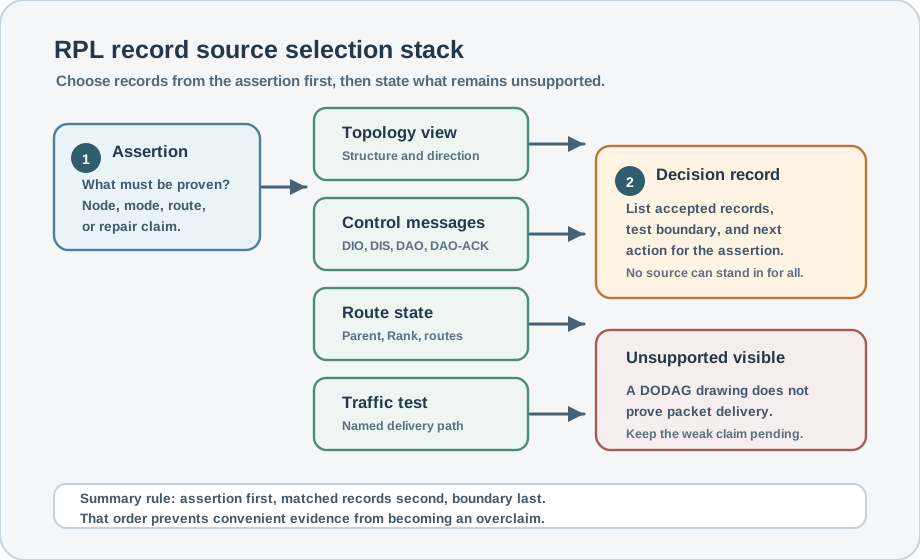
The source stack in Figure 16.1 matches each assertion to topology, control-message, route-state, and traffic-test records. A topology drawing and control capture identify candidates; packet outcomes and a retest trigger bound what the record can claim.
In Figure 16.1, the visual shows rPL record source selection stack showing a named assertion mapped to topology, control-message, route-state, and traffic-test records before a bounded decision record is accepted. If the traffic test is absent, the review should leave delivery pending even when the topology and DIOs look sound.
16.8 Record Sources
This section: Record Sources
16.8.1 Packet Capture
Packet capture is the strongest record for observed protocol messages and tested packet delivery. It can show whether DIO, DIS, DAO, and DAO-ACK messages were seen, and it can show whether a particular packet crossed a particular link during the test.
Packet capture does not automatically prove:
- long-term stability
- every possible downward route
- every node’s selected parent
- energy behavior
- field reliability outside the test conditions
16.8.2 Route-State Snapshot
A route-state snapshot records what a node or root currently believes. Depending on the implementation and mode, it may show preferred parent, Rank, neighbor information, routing entries, source routes, or root-side reachability.
A route-state snapshot is useful because RPL forwarding depends on state. It is limited because it is a point-in-time view. If a learner asserts repair behavior, the snapshot must be paired with before/after records or event logs.
16.8.3 Node Logs
Node logs can explain why a node changed parent, reset a Trickle timer, joined a DODAG, or processed a control message. Logs are valuable for diagnosis because they show the node’s local interpretation.
Logs are not enough by themselves when the assertion is about network-wide delivery. A node may log a parent change while packets still fail for a specific direction.
16.8.4 Traffic Test
A traffic test answers a delivery question for a named direction. The result should say what was sent, from where, to where, under which route state, and whether the test used upward, downward, or peer traffic.
The most common mistake is to run one upward test and then assert downward command delivery. Those are different record questions.
16.8.5 Decision Record
A decision record is the learner’s written summary. It should contain:
- the assertion
- the record source
- the observed result
- the boundary of the assertion
- the unresolved question or next action
The record is often more important than the tool output because it prevents unsupported conclusions from being copied forward.
16.9 Pitfalls And Record Matches
This section: Pitfalls And Record Matches — Many RPL mistakes come from matching the wrong record to the assertion.
Many RPL mistakes come from matching the wrong record to the assertion.
The pitfall map in Figure 16.2 pairs a tempting RPL conclusion with the record that could support or reject it. For each tempting conclusion, ask whether the paired record observes a route decision or a delivered packet.
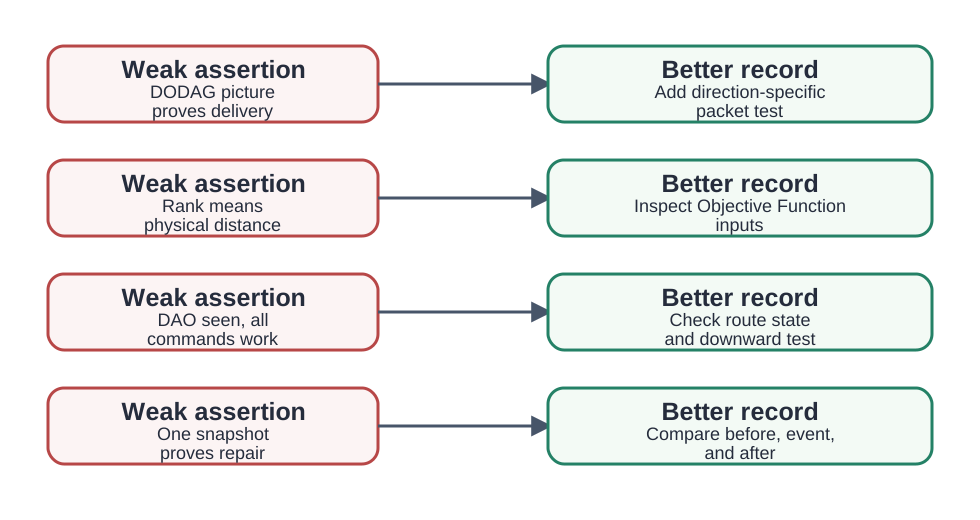
In Figure 16.2, the visual shows common RPL tool pitfalls should be paired with the records that can actually support or reject the assertion. For a parent-choice claim use Rank and parent records; for delivery use the packet path and result.
Use these pairings during checks:
- If the assertion is about parent selection, inspect Rank, Objective Function inputs, and parent-change records.
- If the assertion is about DODAG construction, inspect DIO, DIS, Rank, and parent-state records.
- If the assertion is about downward reachability, inspect mode choice, DAO records, route-state placement, and downward packet tests.
- If the assertion is about repair, compare before/after state and the control messages around the event.
- If the assertion is about production readiness, list the accepted records and the untested conditions instead of turning a lab result into a field assertion.
16.10 Worked Decision Record
This section: Worked Decision Record — The weak record confuses structural records with delivery records.
Assertion:
Downward commands from the root can reach node
N4after the network repairs around a failed parent.
Records needed:
- mode and route-state placement
- before/after parent and Rank state for affected nodes
- DAO or equivalent downward reachability record after repair
- downward packet test from root to
N4 - boundary statement naming the test conditions
Acceptable record:
- The network was operating in a mode where downward route state should be available at the root or intermediate routers.
- Node
N4selected a new preferred parent after the failed parent disappeared. - Downward reachability records were observed after the repair.
- A root-to-
N4packet test succeeded after the new state was installed. - The assertion is limited to the tested topology and time window.
Weak record:
- The DODAG diagram shows
N4under the root, so downward commands are proven.
The weak record confuses structural records with delivery records.
The bounded assertion in Figure 16.3 names its supporting records, limit, and next action. Keep the limit explicit: an accepted upward result cannot be reused as proof of a downward command path.
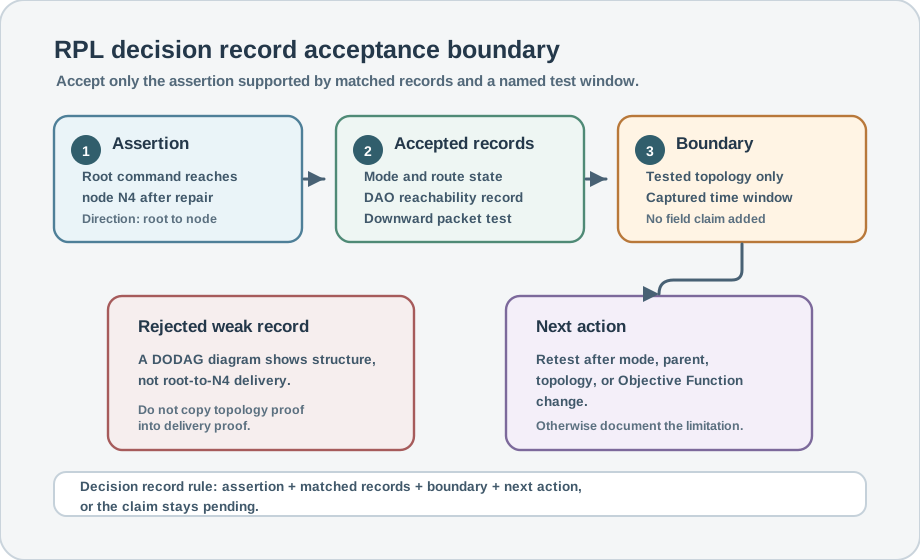
In Figure 16.3, the visual shows a useful RPL decision record accepts only the assertion supported by matched records, a named boundary, and a next action. A decision record should mark an untested downward path as pending rather than promote an upward packet result.
16.11 Tool Selection Checklist
This section: Tool Selection Checklist — If a learner cannot answer those questions, the assertion is not ready for summary acceptance.
Before accepting an RPL assertion, ask:
- What exact behavior is being asserted?
- Is the assertion about structure, control messages, route state, packet delivery, repair, or operations?
- Which traffic direction is involved?
- Which RPL mode is involved?
- What record source directly supports the assertion?
- What record source is missing?
- Does the record show a single moment, a repair event, or a repeated condition?
- Is the conclusion limited to what was tested?
If a learner cannot answer those questions, the assertion is not ready for summary acceptance.
16.12 Common Mistakes
This section: Common Mistakes
-

Wrong: A tree picture proves delivery. Check real packets and link repair.
- Treating a DODAG picture as delivery proof.
- Treating one packet capture as a long-term reliability record.
- Using upward traffic records to accept downward traffic behavior.
- Forgetting that Storing and Non-Storing mode place route state differently.
- Reading Rank as physical distance rather than Objective Function position.
- Copying tool output into a report without writing the record boundary.
- Adding product, vendor, battery, field, or timing assertions that were not measured.
16.13 Knowledge Check
This section: Knowledge Check
16.14 Matching Quiz
This section: Matching Quiz
16.15 Ordering Quiz
This section: Ordering Quiz
The useful question is not "which RPL tool should I use?" The useful question is "which assertion am I trying to prove?" A packet capture, route-state snapshot, node log, traffic test, and decision record each answer a different part of the routing story.
The review stack in Figure 16.4 keeps the claim linked to topology, control, route-state, and traffic evidence. When a route changes, update the record with the new state and traffic result before renewing the old claim.
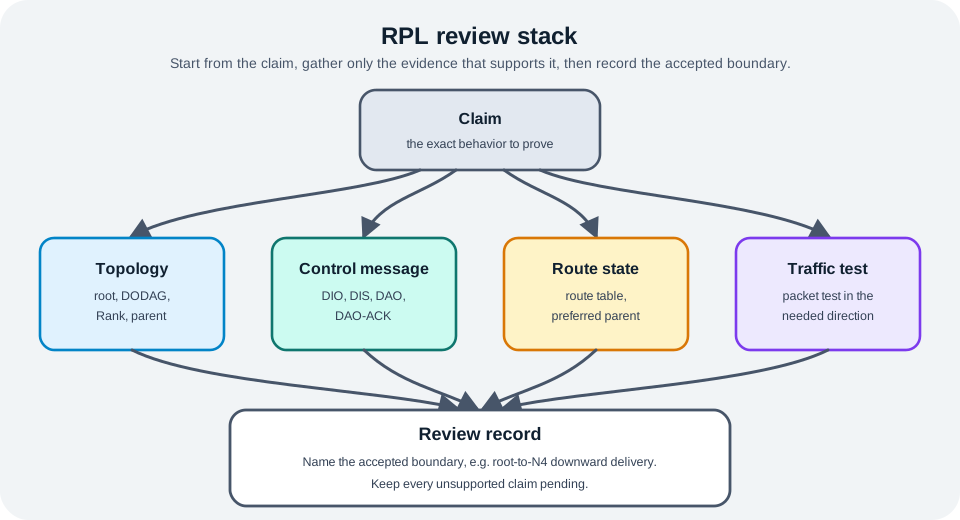
In Figure 16.4, the visual shows rPL review stack showing a claim linked to topology, control-message, route-state, and traffic-test evidence before a bounded review record is accepted. A later route change reopens the claim because the prior packet result belonged to the old state.
Start with the assertion, then choose the record source. A DODAG drawing can support a structure claim. A DAO trace can support a route-state claim. A traffic test can support a delivery claim for one direction under named conditions. A decision record preserves the boundary so the learner does not carry the claim farther than the evidence allows.
The review stack is useful because it slows down the moment where learners usually overstate a result. If the claim is "node N4 can receive a downward command after repair," a topology view is only the first record. The learner still needs mode and route-state evidence, DAO or equivalent downward reachability evidence, and a packet test in the root-to-node direction. If the claim is only "this node joined the DODAG," the required records are narrower.
That separation also makes summary tools reusable across labs. A packet capture is not better or worse than a route-state snapshot in the abstract; it is better or worse for a specific assertion. The summary page should therefore teach the learner to write the claim first, attach the smallest sufficient record set, and keep every unsupported conclusion visible for the next pass. It should also name which missing record would change the answer.
This keeps the tool from becoming a screenshot gallery; every record has to carry a claim, scope, and refresh trigger.
Structure Assertion
Use topology, root, DODAG, Rank, and parent records to show how the routing structure exists.
State Assertion
Use route tables, preferred-parent state, DAO records, or source-route state to show what forwarding state exists now.
Delivery Assertion
Use packet tests for the exact upward, downward, or peer direction the application needs.
Boundary Assertion
Use a decision record to name what the records prove, what they do not prove, and when they expire.
A tool output is evidence only after it is tied to a written assertion, a traffic direction, and a boundary statement.
An evidence packet is the small bundle of records that lets another person check a routing conclusion. It does not need to be large. It needs to be complete enough that the assertion, records, and limits are visible without reinterpreting screenshots from memory.
Write the packet as a reviewer would read it. The first line should name the exact behavior, such as "root-to-N4 downward command delivery after parent repair in Non-Storing mode." The next lines should name the records that can support that behavior: control messages, route-state placement, packet result, timestamp, configuration, and the node set. Anything not recorded stays outside the accepted claim.
This format prevents two common failures. First, it stops a broad result from hiding inside a clean screenshot. A route table can show useful state while still saying nothing about a different traffic direction. Second, it keeps partial acceptance useful. If upward telemetry passed but downward command delivery lacks a fresh packet test, the evidence packet can accept the upward claim and leave the downward claim pending instead of forcing the whole scenario into pass or fail.
Make it narrow enough that a record can prove or reject it, including direction, endpoints, mode, and condition.
Choose capture, state, log, packet test, or decision record because it matches the assertion, not because it is convenient.
Keep timestamps, node ids, configuration ids, traffic direction, and observed result visible beside the claim.
State the condition where the evidence stops being enough and must be refreshed or narrowed.
RPL is adaptive. Parent choice can change, Trickle timers can reset, DAO state can be refreshed or lost, and packet behavior can change when queueing, link quality, security overhead, or route-state placement changes. That makes a routing record time-bound unless the decision record says why it remains valid.
The hidden risk is record drift. A learner captures a clean state, later changes firmware or traffic direction, and still reuses the old conclusion. The tool output may be real, but the assertion has moved. Good summaries prevent that by pairing each record with a freshness rule.
A stale claim is not always caused by a stale file. It can happen when the old record is current for one question but reused for another question. A parent snapshot may still describe the selected parent, while saying nothing about whether the root has downward route state. A packet capture may still show DAO traffic, while saying nothing about application delivery after a queue, security, or payload-size change. The summary tool has to make those boundaries explicit.
Under the hood, the safest rule is to separate evidence freshness from evidence scope. Freshness asks whether the record still describes the current topology, firmware, Objective Function, route mode, and traffic profile. Scope asks whether the record type can prove the claim at all. A fresh DODAG picture is still only structure evidence. An old downward packet test may have the right scope but the wrong freshness after repair.
That distinction changes troubleshooting behavior. Instead of rerunning every possible check, the reviewer reruns the evidence that actually expired or was never in scope. If a topology change affects only a subtree, the affected parent, route-state, and packet records should be refreshed for that subtree. If a claim changes from upward telemetry to downward command delivery, the reviewer should add mode, DAO, route-state, and root-to-node packet records even if the old upward record is fresh.
Good summary tools therefore act like guardrails around claim language. They do not let "observed once" become "works generally," and they do not let "works upward" become "works downward." They keep the learner's conclusion aligned with the records that RPL actually produced.
Temporal Drift
Parent, Rank, route-state, and Trickle observations may change after repair, reboot, or inconsistency.
Directional Drift
A packet test in one direction can be stale or irrelevant for another direction.
Configuration Drift
Firmware, Objective Function, routing mode, security settings, or root placement can invalidate prior records.
Load Drift
Traffic rate, retries, packet size, and queueing can change delivery behavior even when topology still looks familiar.
When the assertion changes, the evidence packet must be refreshed or narrowed. Stronger wording is not a substitute for a current record.
16.16 Summary
This section: Summary
- RPL summary tools are record organizers, not automatic proof.
- Packet captures, route-state snapshots, logs, traffic tests, and decision records answer different questions.
- The strongest check starts with the assertion and then selects the record source.
- Downward, upward, and peer traffic assertions must be checked separately.
- A decision record should preserve the boundary of the records so unsupported assertions do not drift into later chapters.
16.17 Concept Relationships
This section: Concept Relationships
- RPL introduction explains the vocabulary used in this summary.
- DODAG chapters explain structure, roots, Rank, and parent selection.
- Construction chapters explain the control-message records used here.
- Routing-mode chapters explain where downward route state belongs.
- Production-check chapters explain how to decide whether an assertion is ready to carry forward.
16.18 What’s Next
This section: What’s Next — Use this summary as a final local check gate before labs, quizzes, or production-style scenarios.
Use this summary as a final local check gate before labs, quizzes, or production-style scenarios. When an assertion is weak, do not patch it with stronger wording. Send it back to the chapter that teaches the missing records.
Find help
3 reviewed answers.
Where should I start in a module?
Open the module page from the sidebar to see its chapters in order. Use the module map to return to a topic you need.
Modules and pathsReviewed
What can I try when a project does not work?
Check the symptom, then work through the diagnostic steps. Keep the error message and the smallest example that reproduces it.
When you are stuckReviewed
How do interactive examples work?
Use the interactive guide to check how examples and simulations work before changing your project.
Interactive examples guideReviewed