7 Why RPL Exists
More
Depth: Practitioner
Progress saves as you read. Mark sections complete as you go; your progress appears in the sidebar.
7.1 Start With the Mesh That Has Limits
This section: Start With the Mesh That Has Limits — Picture an orchard node that wakes, measures frost risk, and sends one numbered reading through two neighbours.
Follow One Reading Toward the Root
Picture an orchard node that wakes, measures frost risk, and sends one numbered reading through two neighbours. The map may show a path while the node has chosen a stale parent or only one traffic direction works.
A directed acyclic graph is a set of one-way links with no route that loops back to its start. A DODAG is that shape aimed at one destination root. IPv6 means the newer Internet addressing system used by the nodes. Telemetry means measurements and status sent from remote devices for review.
Record the node, root, chosen parent, direction, time, and final receiver state. Weaken a link, remove the parent, repeat the reading, restart the node, and show a clear no-path result when no route exists.
This runway does not prove battery life, delay, or reliable delivery. The deeper sections explain the routing method, rank, parent choice, control timing, route direction, and the evidence needed for each claim.
RPL is not just a mesh label. It is a routing approach for IPv6 low-power and lossy networks where devices may sleep, links vary, memory is small, and a single broadcast-style routing answer would waste energy or fail silently.
Start with those limits. Then the DODAG, Rank, objective function, Trickle behavior, and upward or downward traffic choices become answers to a practical problem: how can constrained nodes keep an auditable route toward the root?
7.2 Overview: RPL Solves a Constrained Routing Problem
RPL exists because many IoT routing domains do not look like enterprise networks. A low-power and lossy network can have sleepy routers, small memory budgets, unstable links, asymmetric neighbors, and a common pattern where many nodes send telemetry toward a border router. Those conditions make broad topology knowledge, frequent full-table updates, or repeated route discovery a poor default assumption.
RPL narrows the problem. It builds a destination-oriented directed acyclic graph, or DODAG, around a root. Each router uses control information from neighbors to choose a preferred parent for upward traffic. The result is not proof that every packet will arrive; it is a reviewable structure for constrained IPv6 routing.
That distinction is the reason to learn RPL early in an IoT networking sequence. The protocol gives names to the evidence a reviewer already needs: root, instance, DODAG, Rank, Objective Function, parent, and routing mode. Once those names are visible, a learner can separate a design-fit claim from a delivery, latency, or reliability claim.
The introduction should therefore stay bounded. It can say why root-oriented constrained routing is useful and what evidence RPL exposes. It should not claim battery life, convergence time, or command reliability without measurements from the actual topology and traffic profile.
That bounded framing makes the rest of the module easier to verify. Later chapters can deepen parent choice, message flow, Trickle timing, and routing modes without asking the learner to accept any unsupported performance promise up front.
It also gives operators a checklist for field questions: identify the root, the selected parent, the intended traffic direction, and the evidence that would prove or reject that direction.
Use Figure 7.1 to identify the DODAG root, Rank direction, and upward path that later route-state and packet checks must prove.
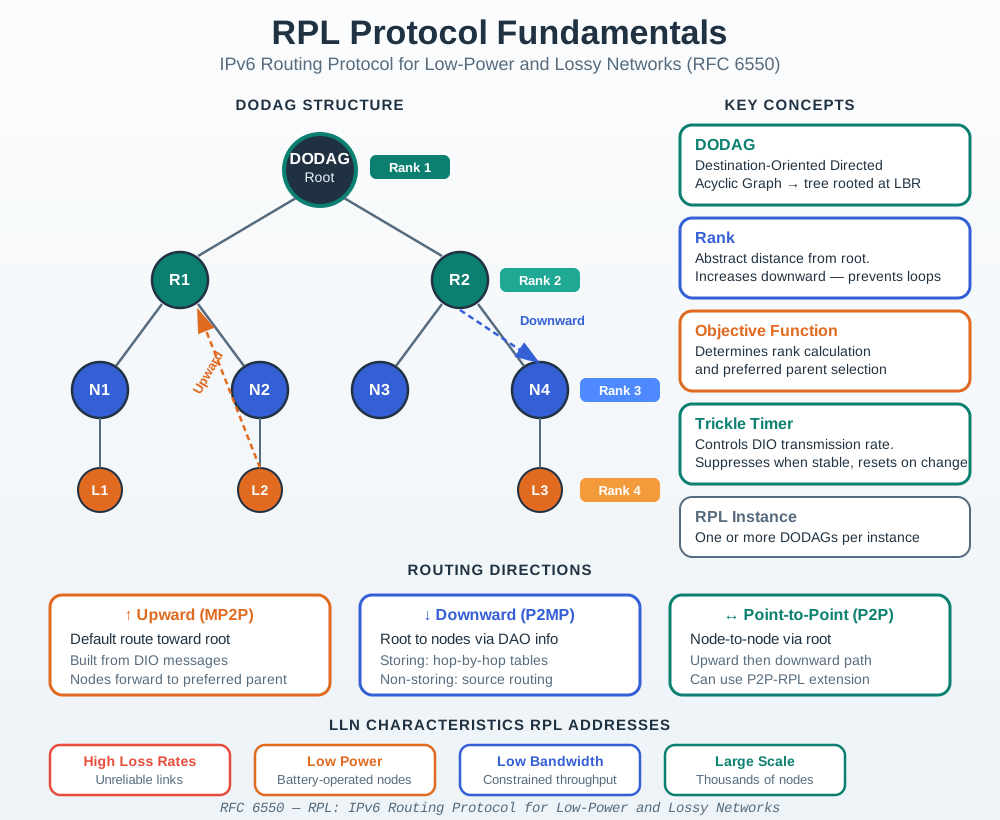
Read Figure 7.1 from the DODAG root down through increasing Rank values, then follow the upward arrows back toward the root. Rank expresses relative position rather than physical distance, so a node’s preferred parent should offer progress toward a lower Rank without creating a loop. The structure establishes the intended constrained path, not successful application delivery. A useful first record names the root, selected parent, node Rank, instance and version context, and one observed packet result. Those fields make later repair and downward-routing claims testable from a defined baseline.
LLN pressure
Routers may need to conserve memory, radio time, and battery while still forwarding IPv6 traffic.
DODAG shape
The root anchors the routing domain, and nodes orient upward through preferred parents.
Local choice
Nodes compare candidate parents using Rank and the Objective Function rather than storing a complete network map.
Evidence boundary
A diagram can explain intended orientation, but delivery and reachability claims still need route-state or packet evidence.
7.3 Practitioner: Review RPL By Its Assumptions
A useful RPL review starts by naming the traffic direction and the evidence needed for that direction. Upward telemetry toward the root is not the same claim as root-to-node command delivery or peer-to-peer forwarding. Mixing those directions is one of the easiest ways to overstate an RPL example.
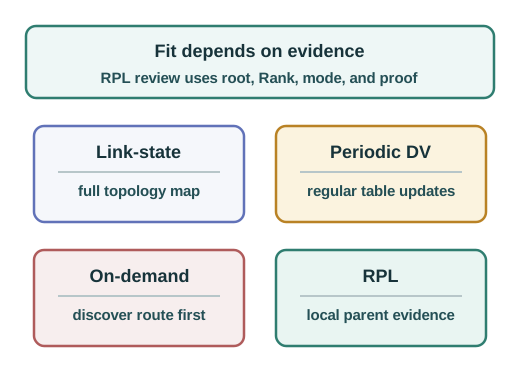
Compare other routing families only to clarify assumptions. Link-state routing expects richer topology knowledge. Periodic distance-vector routing can spend regular control traffic. On-demand discovery fits different ad hoc patterns: the Lightweight On-demand Ad hoc Distance-vector Routing Protocol (LOADng), the reactive option most often set beside RPL for 6LoWPAN mesh routing, only starts a route search once a node has data for a destination, using route-request and route-reply messages instead of RPL's continuous DIO beaconing. That approach can save control traffic when a route is rarely used, but it moves the discovery delay onto the first packet of every flow instead of amortizing it into a steady-state DODAG. RPL is distance-vector-like, but its DODAG, Rank rules, Objective Function, and Trickle behavior are designed for LLN constraints.
Turn that comparison into a short review record. Name the constrained boundary, expected node roles, dominant traffic direction, chosen Objective Function, downward routing mode, and the evidence that would falsify the claim during a pilot.
The falsifier matters. A design-fit statement should name what observation would make RPL the wrong fit, such as unsupported command latency, excessive parent churn, route-state memory pressure, or source-route overhead that no longer fits the traffic.
Use Figure 7.2 to turn the assumptions above into a concrete RPL review. The worked example separates rootward parent links, DIO advertisements, and the storing-mode DAO exchange needed to build downward routing state. It illustrates the mechanism rather than ranking protocol families or reporting measured performance.
Read the left panel of Figure 7.2 from R toward C and D: Rank increases away from the root while preferred-parent arrows point back toward it. The 256-unit increments follow the stated Objective Function Zero settings; Rank is not generally a hop count. C and D cannot use each other as parents at their equal Rank. On the right, DIOs advertise DODAG information, while C’s storing-mode DAO supplies its target to A. A installs C’s route and advertises the target onward in a new DAO, giving the root a next hop through A. For non-storing operation the DAO’s logical destination is the root, not each intermediate parent. The ledger below therefore treats design fit, parent choice, downward route state, and observed delivery as separate claims.
Working rule: if a statement names performance, reachability, convergence, or reliability, it needs evidence beyond the introductory DODAG picture.
7.4 Under the Hood: Direction Determines the Proof
The DODAG is rooted, but traffic claims are directional. Upward traffic moves from a node toward the root through preferred parents. Downward traffic moves from the root or an ancestor toward a node and depends on DAO or mode-specific route state. Peer traffic may travel through a common ancestor or the root, depending on routing mode and implementation behavior.
The control messages also have separate roles. DIO advertises DODAG information. DIS asks for DODAG information. DAO advertises reachability for downward routing. DAO-ACK confirms DAO receipt when that acknowledgement is used. Trickle controls DIO timing, so it helps explain control-plane maintenance, not application packet delivery by itself.
The root cause of many bad explanations is treating those messages as interchangeable. DIO can make a parent visible without proving a command path. DAO can advertise reachability without proving the application receiver processed the command. Trickle can explain why control traffic changed without proving the route recovered.
Mode choice adds another boundary. In Storing mode, downward evidence may live in intermediate routers that keep descendant state. In Non-Storing mode, the root's path knowledge and source-route behavior become central. The same high-level command claim therefore requires different inspection points in the two modes.
Under load, the same boundaries still apply. Larger payloads, security overhead, retransmissions, and sleeping endpoints can change packet behavior without changing the DODAG picture. A learner should therefore avoid moving from "the graph formed" to "the application is reliable" unless the packet evidence is current and matches the real traffic.
When a test fails, preserve the direction that failed. Upward telemetry loss, downward command loss, and peer-flow delay point to different combinations of parent, DAO, mode, route-state, and packet-size evidence.
The practical question in Under the Hood: Direction Determines the Proof is where the proof changes hands. Figure 7.3 answers it by showing how review the traffic direction before deciding which RPL evidence is sufficient and by naming the states the review must distinguish. This diagram tests Under the Hood: Direction Determines the Proof.
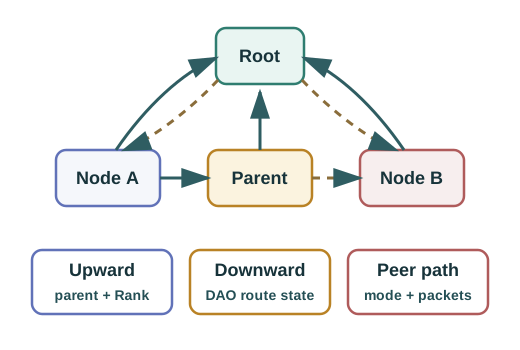
Use Figure 7.3 to finish the earlier C-to-R example. Upward evidence follows C’s preferred parent A toward R. A command in the reverse direction needs current downward state under the chosen mode and a packet result at C. Keep those results separate: a received reading explains one direction, while the command tests the other.
Upward
Check preferred parent, Rank progression, DIO context, and forwarding evidence toward the root.
Downward
Check DAO behavior, Storing or Non-Storing route state, and route entries that support the destination.
Peer
Check the selected routing mode and path evidence before assuming a direct constrained-node path.
Performance
Require measured evidence before accepting exact claims about convergence, lifetime, latency, or delivery.
This is why an RPL introduction should be careful. It can explain why the protocol exists, what its control plane is trying to build, and how to ask better questions. It should not invent precise deployment outcomes that were not measured.
A good under-the-hood conclusion is therefore conditional: this evidence supports the named direction, under this routing mode, for this node set, until a parent change, root change, firmware change, or traffic-profile change requires a new packet and route-state check.
That condition is not a weakness. It is the engineering shape of the problem. Constrained networks change through sleep cycles, repairs, radio loss, payload growth, and gateway moves, so a responsible RPL claim names when the evidence must be refreshed.
The introduction closes when the learner can state that boundary without memorizing every RPL option.
Constrained RPL Derivatives and Underwater CARP
CORPL and CARP solve different constrained-routing problems, so neither should be introduced as a new transport protocol or as a drop-in synonym for base RPL. CORPL keeps RPL's root-oriented DODAG idea but replaces “send to one preferred parent” with opportunistic forwarding through an ordered forwarding set. CARP targets acoustic underwater networks, where long propagation delays, narrow bandwidth, node motion, and strongly time-varying channels make ordinary low-power radio assumptions a poor fit.
CORPL: from one parent to a forwarding set
In base RPL, a node normally selects one preferred parent for ordinary upward forwarding. CORPL lets the control plane advertise enough neighborhood and DODAG information for a sender to keep several eligible next hops. DIO exchanges refresh that candidate set and its priority order. When a packet is broadcast, a higher-priority eligible forwarder takes responsibility while the others suppress duplicate forwarding when they overhear that progress.
- Learn candidates. Receive DIO information, reject neighbors that violate the DODAG direction or policy, and retain a bounded set that offers progress toward the root.
- Order the set. Rank candidates with the chosen objective evidence, which may include route progress, link quality, channel availability, and energy state.
- Transmit once. Put the ordered forwarding-set context in the packet rather than binding the packet to only one next hop.
- Coordinate reception. The best candidate that actually received the packet forwards first; lower-priority candidates cancel when they hear that forward.
- Repair from evidence. Update the set when DIO state, channel conditions, or neighbor reachability changes.
The gain is resilience to an unavailable preferred parent and, in cognitive-radio designs, the ability to exploit whichever candidate has a usable channel. The cost is extra header/state, duplicate-suppression logic, and coordination delay. A forwarding set is therefore not automatically more reliable: a review must measure duplicate rate, candidate-set churn, coordination timeout, delivery ratio, and control airtime.
CARP: initialize, measure, then advance toward the root
An underwater CARP route begins with network initialization. The sink or root broadcasts a HELLO; nodes that hear rootward information establish their hop relationship and propagate initialization so farther nodes can discover a direction toward the sink. Data forwarding then evaluates candidate neighbors using both rootward progress and current channel evidence. The sender chooses a next hop that improves the route while avoiding a link whose recent acoustic behavior predicts expensive loss.
- Root beacon: the sink emits
HELLOand establishes hop zero. - Layer formation: receivers record their rootward distance or hop evidence and repeat the discovery outward.
- Channel probe: before or during forwarding, use recent successful exchange evidence to estimate which neighbor links are currently usable.
- Next-hop choice: prefer a neighbor that makes rootward progress and has acceptable channel cost; do not select on hop count alone.
- Hop-by-hop delivery: repeat the decision until the packet reaches the root, refreshing evidence when mobility or acoustic fading invalidates it.
| Question | Base RPL | CORPL | Underwater CARP |
|---|---|---|---|
| Forwarding choice | Preferred parent | Prioritized forwarding set | Channel-aware next hop toward root |
| Control evidence | DIO/DIS/DAO and objective function | DIO-refreshed candidate set and suppression state | HELLO, hop progress, and acoustic-link observations |
| Main benefit sought | Constrained IPv6 DODAG routing | Opportunistic recovery when one candidate cannot forward | Rootward routing across variable underwater links |
| Failure metric to log | Parent churn and directional reachability | Duplicates, coordination timeout, and set churn | Probe cost, propagation delay, delivery, and channel-estimate age |
The common lesson is bounded state, not a common wire format. CORPL extends the DODAG forwarding decision; CARP creates a separate channel-aware acoustic route. Validate each against its own radio, timing, and control-message evidence.
Test the assumption before naming the route
Use the joined workbench below to hold the two radio candidates fixed while changing only the protocol lens. Begin with the RPL to CORPL flip: RPL chooses one preferred parent from reciprocal delivery evidence, but CORPL orders a forwarding set using explicit channel availability and coordination cost. Then load Acoustic delay to see why CARP names an acoustic next hop rather than borrowing RPL parent language.
Walk the visible evidence table from eligibility to score to decision. In the radio fixture, A wins the RPL calculation while B leads CORPL's ordered set; the set readout keeps the combined availability benefit separate from coordination and suppression cost. In the acoustic preset, compare rootward progress with the normalized propagation-delay term, then use Fresh acoustic evidence to verify that changing only A's measured delay reverses the CARP next hop.
7.5 Summary
This section: Summary — RPL exists because constrained IPv6 networks need routing evidence that fits low-power routers, lossy links, local parent choice, and root-oriented traffic.
RPL exists because constrained IPv6 networks need routing evidence that fits low-power routers, lossy links, local parent choice, and root-oriented traffic. The DODAG, Rank, Objective Function, DIO, DIS, DAO, and Trickle mechanisms create a reviewable control-plane structure. That structure is useful, but it does not remove the need to prove reachability and delivery for each traffic direction.
7.6 Key Takeaway
This section: Key Takeaway
Learn RPL as an evidence model for constrained IPv6 routing: name the root, traffic direction, parent-choice logic, routing mode, and packet proof before accepting a routing claim.
7.7 See Also
This section: See Also
The RPL Routing Model
The RPL Routing Model defines DODAG, Rank, control messages, and routing modes in more detail.
How a DODAG Forms
How a DODAG Forms follows the formation process step by step.
RPL Control Messages: DIO, DIS, DAO
RPL Control Messages: DIO, DIS, DAO connects the control messages to trace evidence.
Storing vs Non-Storing Modes
Storing vs Non-Storing Modes explains how downward route-state evidence changes by mode.
Find help
3 reviewed answers.
Where should I start in a module?
Open the module page from the sidebar to see its chapters in order. Use the module map to return to a topic you need.
Modules and pathsReviewed
What can I try when a project does not work?
Check the symptom, then work through the diagnostic steps. Keep the error message and the smallest example that reproduces it.
When you are stuckReviewed
How do interactive examples work?
Use the interactive guide to check how examples and simulations work before changing your project.
Interactive examples guideReviewed