14 RPL Production Validation
More
Depth: Practitioner
Progress saves as you read. Mark sections complete as you go; your progress appears in the sidebar.
14.1 Start With One Routing Claim
This section: Start With One Routing Claim — Picture thirty soil nodes sending a dry-bed warning toward one root.
Tie the Route Claim to One Field Result
Picture thirty soil nodes sending a dry-bed warning toward one root. A tidy route diagram can remain visible while a changed parent, stale code, or crowded link prevents the warning from reaching the receiver.
RPL means the routing method used by low-power and lossy device networks. A DODAG means the root-oriented, loop-free route shape that its nodes build. Firmware is the stored device code and its version. Telemetry means measurements and status sent from remote devices for review.
Name the node group, root, code version, traffic direction, and expected receiver state. Weaken one link, remove a parent, repeat a numbered warning, restart a node, and retain both route state and packet result. A reachable root does not prove delivery.
This runway does not certify field life, recovery time, or every traffic pattern. The deeper sections turn the bounded claim into configuration, control-state, packet, monitoring, and retest evidence.
A production RPL review should begin with one claim small enough to prove. For example: this firmware version can deliver upward temperature telemetry from this sensor group to this root under these link conditions.
Once the claim is that specific, the framework has something to test. Objective function, routing mode, control-plane observations, packet captures, route-state records, and retest triggers become evidence attached to one bounded routing promise rather than a general feeling of readiness.
14.2 In 60 Seconds
This section: In 60 Seconds — An RPL production framework is not a promise that a network will work in the field.
An RPL production framework is not a promise that a network will work in the field. It is a review structure for deciding what must be configured, observed, tested, and retested before an RPL design is accepted. The framework starts with traffic claims, device constraints, Objective Function choice, routing-mode choice, and DODAG context. It then requires control-plane evidence and packet evidence that match the claim. The strongest review records also define monitoring signals and retest triggers so later changes do not silently invalidate the design.
14.3 Learning Objectives
This section: Learning Objectives
By the end of this chapter, you will be able to:
- Build an RPL production review framework from explicit claims and evidence.
- Decide what evidence is needed before accepting Storing or Non-Storing mode.
- Explain how Objective Function choice affects parent selection and review records.
- Separate control-plane observations from packet-delivery acceptance tests.
- Define retest triggers for topology, firmware, traffic, and radio-condition changes.
- Reject production claims that rely only on diagrams, calculators, or generic defaults.
14.4 Minimum Viable Understanding
This section: Minimum Viable Understanding
- Production review starts with the traffic claim, not with a preferred mode.
- Storing mode and Non-Storing mode are route-state decisions.
- Objective Function choice must match the metric evidence the deployment can collect.
- DIO, DIS, DAO, DAO-ACK, and Trickle evidence each prove different things.
- Packet acceptance tests must cover the traffic directions the application needs.
- A production framework needs retest triggers because the evidence can expire.
14.5 Prerequisites
This section: Prerequisites
- RPL Overview and Introduction: DODAG, Rank, control messages, and evidence boundaries.
- RPL Routing Modes: Storing and Non-Storing route-state behavior.
- RPL DODAG Message Flow: DIO, DIS, DAO, and DAO-ACK trace interpretation.
- RPL Labs and Quiz: practice with evidence-driven review.
14.6 What The Framework Must Prove
This section: What The Framework Must Prove — The framework should turn a broad deployment statement into testable routing claims.
The framework should turn a broad deployment statement into testable routing claims. “RPL is configured” is too weak. A better claim names the traffic direction, the routing mode, the Objective Function, the control-plane evidence, and the packet evidence required for acceptance.
The stack in Figure 14.1 ties a bounded claim to route-state choice, control messages, packet results, and retest triggers. For each acceptance claim, retain the mode and Objective Function alongside a trace showing the packet reached its intended endpoint.
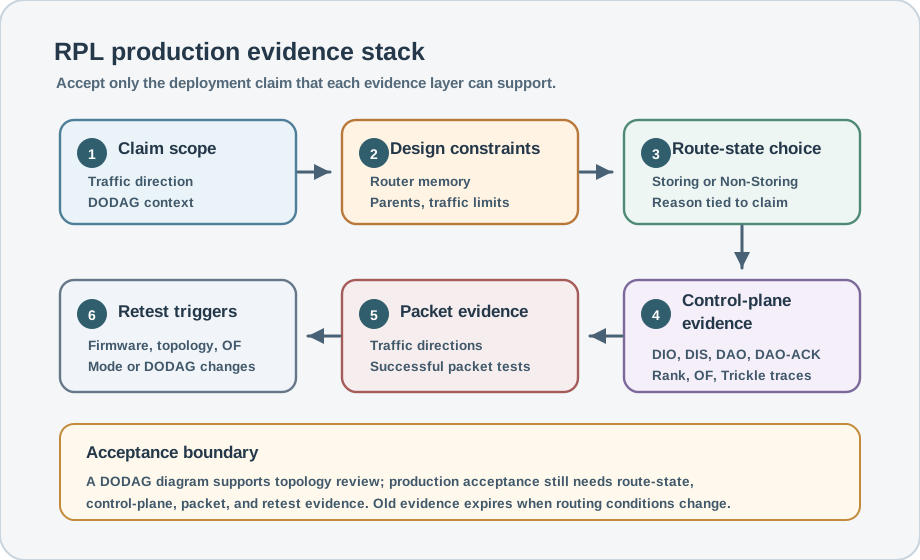
In Figure 14.1, the visual shows rPL production evidence stack showing claim scope, design constraints, route-state choice, control-plane evidence, packet evidence, and retest triggers as the acceptance boundary. A claim about commands needs downward-route evidence as well as the packet test; a topology drawing alone covers neither result.
Use this evidence stack for every production-style review:
- Claim scope: what traffic must work and under which DODAG context.
- Design constraints: router memory, parent candidates, expected traffic directions, and implementation limits.
- Route-state choice: Storing or Non-Storing mode, with a reason tied to the claim.
- Control-plane evidence: DIO, DIS, DAO, DAO-ACK, Rank, Objective Function, and Trickle observations.
- Packet evidence: successful packets for each accepted traffic direction.
- Retest triggers: the changes that make the old evidence no longer enough.
This prevents a common drift in RPL explanations: a diagram shows a DODAG, then the text treats the network as accepted. A DODAG diagram supports topology review. It does not prove downward commands, peer traffic, resilience after repair, or long-term operation.
14.7 Production Operating Loop Addendum
This section: Production Operating Loop Addendum — This loop keeps “RPL is running” from becoming a production claim.
Use the operating loop when moving from design acceptance to production review:
- Name the production claim and the traffic direction it covers.
- Check routing mode, Objective Function, parent-choice evidence, and route-state placement.
- Observe DIO, DIS, DAO, DAO-ACK where relevant, Trickle state, and Rank behavior.
- Run packet acceptance tests for each accepted direction.
- Record monitoring signals for churn, parent instability, missing DAO behavior, packet failure, and retest triggers.
This loop keeps “RPL is running” from becoming a production claim. The accepted claim is only as broad as the evidence stack proves.
14.8 Start With Claims, Not Defaults
This section: Start With Claims, Not Defaults — Do not accept a claim just because it sounds like a reasonable default.
A production framework should describe claims in a form that can be tested:
- Upward telemetry: node-to-root packets follow parent paths and arrive at the root.
- Downward control: root-to-node packets have route-state evidence and packet proof.
- Peer communication: node-to-node traffic has an approved path and measured packet evidence.
- Repair behavior: parent change or local repair occurs without claiming more than the trace proves.
- Monitoring: selected counters or logs can reveal DODAG churn, parent instability, route-state gaps, and packet loss.
Do not accept a claim just because it sounds like a reasonable default. For example, “Non-Storing mode is better for large networks” is incomplete. The review still needs the traffic direction, route-state location, root capability, source-route behavior, DAO evidence, and packet tests for downward traffic.
14.9 Routing Mode Decision
This section: Routing Mode Decision — Storing mode and Non-Storing mode should be reviewed as route-state placement choices.
Storing mode and Non-Storing mode should be reviewed as route-state placement choices. The right question is not “Which mode is faster?” The right question is “Where must the downward route state live for this claim, and can the chosen devices support that state?”
Use Figure 14.2 to choose a mode from traffic direction, route-state location, device constraints, control evidence, and acceptance tests.
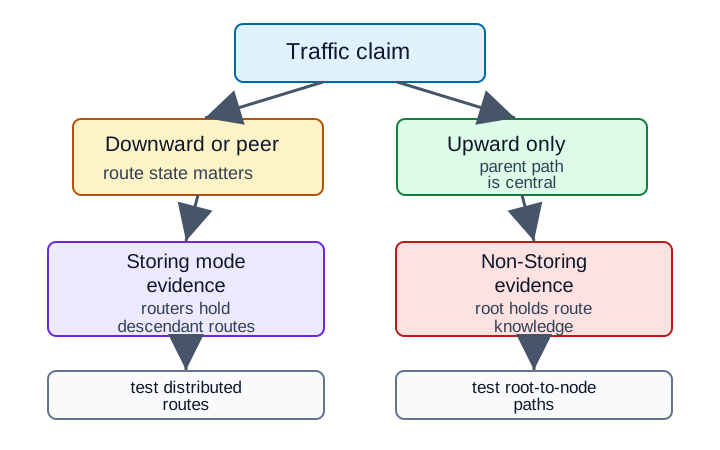
Choose the traffic path first. Then place its route state. Read Figure 14.2 from the traffic direction into the required location of downward route state. Device memory and path-length constraints then separate storing from non-storing candidates. The next gate asks for mode-specific control evidence: intermediate routing entries in storing operation, or root topology and source-route information in non-storing operation. Packet acceptance tests follow in every required direction, including after a parent or root failure. This order keeps the selected label attached to the component that owns state, the resource tradeoff, the observed delivery result, and the event that forces retesting.
Use Storing mode only when the review can defend all of these statements:
- Intermediate routers are expected to hold downward route state.
- The implementation exposes route-table state that can be inspected or tested.
- Router constraints leave enough headroom for routing state, buffers, application state, and maintenance.
- Downward or peer traffic benefits from distributed route state.
- Packet tests cover the downward or peer paths being accepted.
Use Non-Storing mode only when the review can defend these statements:
- The root is expected to hold route knowledge for downward traffic.
- Non-root routers are not required to keep descendant routes.
- DAO behavior and source-route behavior are understood for the implementation.
- Root-to-node acceptance tests cover the downward commands the application needs.
- The design does not hide root dependency or source-route overhead behind a generic “saves memory” claim.
For mostly upward telemetry, both modes can share the same parent-forwarding idea for node-to-root traffic. That does not decide downward behavior. Downward behavior must be reviewed separately.
14.10 Objective Function Decision
This section: Objective Function Decision — The Objective Function is the rule that turns parent evidence into a Rank and preferred-parent decision.
The Objective Function is the rule that turns parent evidence into a Rank and preferred-parent decision. A production framework should record why the selected Objective Function matches the evidence available to the deployment.
Review Objective Function choice with these checks:
- Does the design name the Objective Function or implementation equivalent?
- Does the trace show the metric evidence used for parent choice?
- Does the review distinguish Rank from hop count?
- Does the design explain how parent flapping is avoided or detected?
- Does the acceptance test include a case where the preferred parent is not simply the nearest or shortest path?
OF0-style reasoning is easier to explain when the main evidence is simple path distance or step count toward the root. MRHOF-style reasoning needs link-quality evidence such as ETX and enough stability control to avoid switching parents for tiny metric changes. Either choice can be reasonable. The error is claiming a metric-based decision without metric evidence.
14.11 Control-Plane Evidence
This section: Control-Plane Evidence — The review should say what each observation proves and what it does not prove.
Control-plane observations should be read narrowly:
- DIO evidence supports DODAG advertisement and parent-choice review.
- DIS evidence shows that a node requested DODAG information.
- DAO evidence supports downward reachability or route-state review.
- DAO-ACK, when used, confirms DAO handling at the routing layer; it is not application delivery.
- Trickle evidence supports DIO maintenance and consistency behavior; it is not a general health score.
- Rank evidence supports loop-aware parent direction, but only in the context of the Objective Function.
The review should say what each observation proves and what it does not prove. If the packet claim is root-to-node command delivery, a DIO trace is not enough. If the claim is local repair after a parent fails, a static DODAG picture is not enough.
14.12 Packet And Operations Acceptance
This section: Packet And Operations Acceptance — To distinguish the responsibilities inside Packet And Operations Acceptance, turn to Figure 14.3.
Packet evidence is where the framework moves from “the control plane looks plausible” to “the required traffic was tested.” A production acceptance record should include:
- The DODAG ID or RPL instance being tested.
- The selected routing mode and Objective Function.
- The packet direction being accepted.
- The source, destination, and expected path boundary.
- The control messages that support the path.
- The packet result for the claimed path.
- The monitoring signals that will be watched after acceptance.
- The change events that require retest.
To distinguish the responsibilities inside Packet And Operations Acceptance, turn to Figure 14.3. Its labels show an RPL production acceptance loop linking claim scope, route-state review, control-plane evidence, packet acceptance, monitoring signals, and retest triggers, making it possible to test the claimed relationship in order.
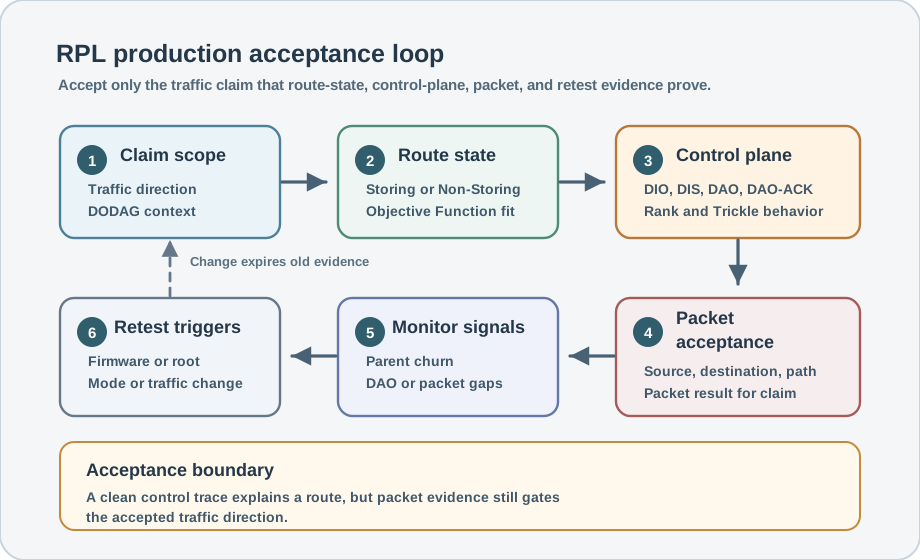
The acceptance loop in Figure 14.3 connects a route-state review to packet acceptance and later monitoring signals. Reopen acceptance when a changed parent, link, or route table makes the earlier packet result inapplicable.
In Figure 14.3, the visual shows rPL production acceptance loop linking claim scope, route-state review, control-plane evidence, packet acceptance, monitoring signals, and retest triggers. A changed parent, failed packet check, or new monitoring signal reopens the specific claim it can affect.
Good retest triggers are concrete:
- Firmware, routing stack, or configuration changes.
- Objective Function or routing-mode changes.
- Border-router or root changes.
- New traffic direction, such as adding root-to-node commands to a telemetry-only design.
- Topology changes that alter parent choices or route-state depth.
- Monitoring evidence of parent churn, repeated local repair, missing DAO behavior, or packet failures.
The framework does not need to predict every future fault. It needs to state when the old evidence no longer proves the current claim.

14.13 Worked Review Record
This section: Worked Review Record — If the evidence only contains DIO advertisements and upward packets, accept only upward telemetry.
Claim: “The design accepts upward telemetry and occasional root-to-node commands.”
Review it as two claims:
- Upward telemetry: check compatible DIO evidence, parent choice, Rank context, Objective Function context, and node-to-root packet results.
- Root-to-node commands: check routing mode, DAO or route-state evidence, source-route or distributed-route behavior, and root-to-node packet results.
If the evidence only contains DIO advertisements and upward packets, accept only upward telemetry. Mark root-to-node commands as unproven until the downward route-state and packet evidence are present.
14.14 Review Checklist
This section: Review Checklist
Before accepting an RPL production framework, confirm that it:
- Names the traffic directions being accepted.
- Names the RPL context, routing mode, and Objective Function.
- Explains where downward route state lives.
- Separates DIO discovery from DAO route-state evidence.
- Requires packet tests for the claimed direction.
- Records what Trickle evidence does and does not prove.
- Avoids exact capacity, battery, timing, vendor, or field-performance claims that were not measured.
- Defines monitoring signals and retest triggers.
- Keeps figures as explanatory aids, not substitutes for evidence.
14.15 Common Mistakes
This section: Common Mistakes
- Selecting Storing or Non-Storing mode from node count alone.
- Claiming downward delivery after reviewing only DIO messages.
- Treating DAO-ACK as application acknowledgment.
- Treating Rank as hop count without naming the Objective Function.
- Treating quiet Trickle behavior as proof that application traffic is healthy.
- Mixing a production framework with unsupported product, field, or long-term battery claims.
- Hiding route-state assumptions inside a generic readiness label.
14.16 Knowledge Check
This section: Knowledge Check
14.17 Matching Quiz
This section: Matching Quiz
14.18 Ordering Quiz
This section: Ordering Quiz
A production RPL review starts after the network can form a DODAG. Formation proves that nodes can hear enough control traffic to join a routing structure. It does not prove that the selected Objective Function is stable, that downward routes exist, that packet paths match the application claim, or that the network can recover after a realistic disturbance.
The gates in Figure 14.4 place parent and control-message evidence before packet acceptance. Only close the gate after a forwarding trace and a failure retest support the same route-state claim.
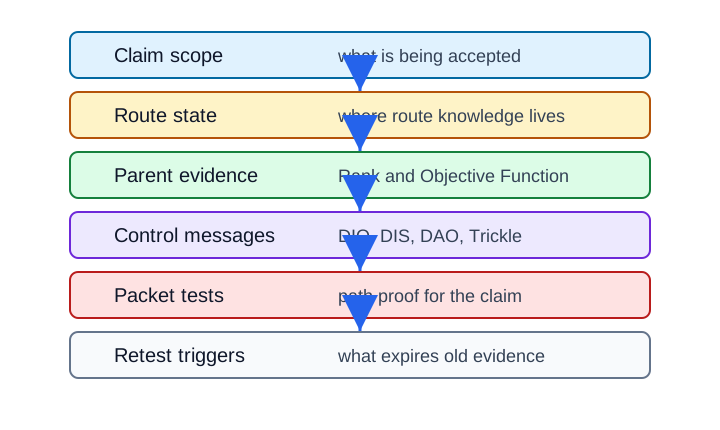
In Figure 14.4, the visual shows rPL production review gates from claim scope through route state, parent evidence, control messages, packet tests, and retest triggers. A packet result closes only the traffic claim tested under that route state; the retest trigger remains in the record.
Use the framework as a claim boundary. Each accepted claim names the traffic direction, routing mode, Objective Function, control evidence, packet proof, and retest trigger. A claim can be narrow and still useful: "upward telemetry from sampled leaf nodes reached the root under this firmware and channel plan" is stronger than a broad statement that "RPL is production ready."
The gates should be read in order. Claim scope says what is being accepted, not what the protocol could theoretically do. Route-state placement says where downward knowledge is expected to live. Parent evidence says why a node selected that path under the chosen Objective Function. Control messages explain how the routing state was built or refreshed. Packet tests prove the accepted direction, and retest triggers say when the old evidence expires.
This ordering keeps the review honest when evidence is partial. If the trace proves DODAG formation and upward telemetry only, the accepted claim stops there. Downward commands, peer paths, repair behavior, and long-running operation remain pending until route-state and packet evidence support them. The framework is therefore not a generic checklist; it is a way to prevent one strong observation from being reused for a different traffic claim.
Formation Evidence
DIO, DIS, Rank, and parent selection can show that nodes entered a DODAG and chose a direction toward the root.
Route-State Evidence
DAO, DAO-ACK, source-route records, and route-table inspection show where downward reachability is expected to live.
Packet Evidence
Application-size packets prove the accepted traffic direction. Upward, downward, and peer paths must be tested separately.
Expiry Evidence
Topology, firmware, Objective Function, traffic, radio, or root changes can expire a previous acceptance record.
Do not let a clean DODAG diagram become a release decision. Accept only the traffic paths and operating conditions that the review record actually proves.
A practical reviewer should also separate evidence from confidence. A clean first run can justify a scoped acceptance note, but it should not erase known limits. Write what was tested, what was not tested, and which change would force the test to run again. That makes the production framework useful both for the first release decision and for later incident review.
A release record is the artifact a reviewer can re-run or challenge. It connects the intended application behavior to routing evidence, then records what would force the team to retest. The record should be short enough to maintain, but specific enough that a future engineer can see why a routing claim was accepted.
Start with one claim per row. Mixing upward telemetry, root-to-node commands, and peer traffic in one row makes the evidence hard to audit because each direction needs different route-state proof. For each row, name the DODAG context, firmware or stack version, Objective Function, routing mode, devices under test, and packet direction. Then attach only the control-plane observations and packet results that actually support that row.
Do not hide uncertainty in a comment field. If the team has DIO evidence but no DAO evidence, the downward claim is pending. If the packet test used a small diagnostic payload while the application sends larger secured messages, the packet evidence is limited. If the parent-choice record does not include the metric used by the Objective Function, the preferred-parent claim needs a follow-up trace. These are not failures by themselves; they are acceptance boundaries.
Write one sentence that names the accepted traffic direction and the operating context.
Show where downward route knowledge lives, or explicitly state that only upward traffic is being accepted.
Use packet sizes, security overhead, retry behavior, and timing that match the application claim.
Name the changes that force a fresh review instead of relying on stale acceptance evidence.
Finally, make the record easy to compare over time. Reuse the same claim names and evidence columns across releases, but do not copy old acceptance results after topology, root, firmware, mode, Objective Function, or traffic direction changes. The value of the record is not paperwork volume; it is the ability to tell exactly which evidence still applies and which evidence must be refreshed.
RPL can look quiet when it is healthy, but quiet traces can also hide stale route state or an untested packet direction. Trickle suppresses repeated DIO messages when the topology appears consistent. That behavior is useful for constrained links, but it means the review must deliberately look for parent churn, version changes, route-state gaps, and packet failures instead of treating low control traffic as a health certificate.
The deeper failure mode is evidence mismatch. A trace can show stable upward parent choice while the root lacks a valid downward route. A DAO-ACK can confirm control-plane handling without proving that the application command reached the device. A preferred parent can look stable until ETX, queueing, or interference changes enough to push the Objective Function into repeated switching.
That mismatch happens because RPL state is directional. DIO and Rank evidence mainly describe how nodes learn and maintain upward orientation toward a root. DAO and source-route or route-table evidence describe how downward reachability is represented. Packet tests describe whether a specific application path worked under the test condition. A production review has to preserve those boundaries because a healthy observation in one layer can coexist with a missing observation in another layer.
Instability is also time-sensitive. A network can pass a packet test before a firmware change, radio layout change, root replacement, or traffic-pattern change, then fail under the new assumption. The old evidence was not false; it was scoped to the older condition. That is why monitoring and retest triggers belong inside the framework instead of being treated as an operations afterthought.
For production acceptance, the reviewer should therefore ask which observation would change the decision. If no observation can overturn the claim, the claim is probably too broad to be audited.
Parent Churn
Track preferred-parent changes with the metric evidence that caused them. A stable Rank number is not enough if the parent keeps changing.
Version Churn
DODAG version changes can be legitimate repairs or signs that the root is repeatedly rebuilding the topology.
Downward Gaps
Check DAO behavior, route tables, source-route state, and root-to-node packet proof before accepting commands.
Energy Drift
Control bursts, retries, and parent flapping can raise current draw even when application traffic volume is unchanged.
When the trace and the packet test disagree, trust the narrower evidence. A control-plane event can explain a packet path, but it does not replace a packet acceptance test for that path.
The safest review habit is to write conclusions at the same width as the evidence. "Parent selection was stable during this observation window" is narrower and more defensible than "routing is stable." "Root-to-node command delivery passed for this actuator group" is narrower than "downward traffic works." Narrow conclusions make defects easier to find because they expose the exact claim that needs a new trace. They also keep monitoring alerts tied to the condition that would actually invalidate acceptance.
14.19 Summary
This section: Summary
- An RPL production framework is an evidence structure, not a deployment guarantee.
- Mode choice is about route-state placement and tested traffic directions.
- Objective Function choice must match the parent-selection evidence the design can collect.
- DIO, DIS, DAO, DAO-ACK, Trickle, Rank, and packet traces support different claims.
- Downward and peer traffic require separate route-state and packet evidence.
- Retest triggers keep acceptance records from being reused after the design changes.
14.20 Key Takeaway
This section: Key Takeaway — A production RPL framework needs objective-function governance, topology monitoring, repair policy, firmware compatibility, and incident runbooks.
A production RPL framework needs objective-function governance, topology monitoring, repair policy, firmware compatibility, and incident runbooks.
14.21 Concept Relationships
This section: Concept Relationships — Place the framework inside RPL Production and Review, then test it against concrete cases in RPL Production Scenarios and consolidate the result in RPL Production Summary.
Place the framework inside RPL Production and Review, then test it against concrete cases in RPL Production Scenarios and consolidate the result in RPL Production Summary. Use RPL Routing Modes for route-state placement and RPL DODAG Message Flow for control-message evidence. RPL Labs and Quiz supplies the practice needed before those records become a production acceptance claim.
14.22 What’s Next
This section: What’s Next — Continue to RPL Production Scenarios to apply the framework to concrete review cases, or return to RPL Routing Modes if the route-state distinction is still unclear.
Continue to RPL Production Scenarios to apply the framework to concrete review cases, or return to RPL Routing Modes if the route-state distinction is still unclear.
Find help
3 reviewed answers.
Where should I start in a module?
Open the module page from the sidebar to see its chapters in order. Use the module map to return to a topic you need.
Modules and pathsReviewed
What can I try when a project does not work?
Check the symptom, then work through the diagnostic steps. Keep the error message and the smallest example that reproduces it.
When you are stuckReviewed
How do interactive examples work?
Use the interactive guide to check how examples and simulations work before changing your project.
Interactive examples guideReviewed