15 RPL Production Case Studies
More
Depth: Practitioner
Progress saves as you read. Mark sections complete as you go; your progress appears in the sidebar.
15.1 Start With the Scenario Evidence
This section: Start With the Scenario Evidence — Picture a dry-bed alarm travelling from a field sensor to a control room while a reset command must travel back.
Prove the Alarm Path in Both Directions
Picture a dry-bed alarm travelling from a field sensor to a control room while a reset command must travel back. A tidy route picture can hide a one-way failure. The scenario must name what proves both paths under stress.
A gateway means a device or service that joins two system paths. RPL means Routing Protocol for Low-Power and Lossy Networks, which builds routes for constrained devices. Telemetry means measurements and status sent for remote use.
Record node identity, parent, route age, packet direction, gateway receipt, and command result. Remove one parent, add traffic, repeat the alarm, send a command, and restart the root. Keep local protection active when the remote route is not proved.
This runway does not prove that one route mode fits every deployment. The deeper scenarios compare route state, objective choices, repair speed, memory, battery cost, and the retest trigger for each operating need.
A production scenario is useful only when it names the evidence that would make the routing decision acceptable. A warehouse sensor, streetlight controller, or field gateway may each need a different balance of repair speed, memory, command reachability, and battery life.
Start by writing the evidence requirement next to the scenario. Then the route mode, objective function, packet test, and retest trigger can be judged against the operating need instead of against a generic RPL preference.
15.2 In 60 Seconds
This section: In 60 Seconds — RPL production scenarios are useful only when they train evidence discipline.
RPL production scenarios are useful only when they train evidence discipline. Each scenario should begin with a claim, identify the traffic direction, state the route-state assumption, name the Objective Function evidence, and then decide which packet tests are required. A scenario answer should not say “use Storing” or “use Non-Storing” as a slogan. It should say which claim is accepted, which claim is still unproven, and what evidence would change the decision.
15.3 Learning Objectives
This section: Learning Objectives
By the end of this chapter, you will be able to:
- Review an RPL scenario without importing unsupported deployment claims.
- Separate upward telemetry acceptance from downward command acceptance.
- Use route-state evidence to defend Storing or Non-Storing mode.
- Use metric evidence to defend Objective Function choice.
- Decide when local repair, Trickle behavior, or route-state changes require retesting.
- Write a scenario review record that is useful for later troubleshooting.
15.4 Minimum Viable Understanding
This section: Minimum Viable Understanding
- A scenario is not accepted until the claim is testable.
- Upward and downward paths need separate evidence.
- Mode choice is about route-state placement, not a generic network-size rule.
- Objective Function choice is about the metric evidence the deployment can observe.
- Control-plane evidence supports routing claims but does not replace packet tests.
- Scenario records should state what remains unproven.
15.5 Prerequisites
This section: Prerequisites
- RPL Production Framework: evidence stack, routing-mode decision, and acceptance loop.
- RPL Routing Modes: route-state placement in Storing and Non-Storing mode.
- RPL DODAG Message Flow: DIO, DIS, DAO, and DAO-ACK evidence.
- RPL Labs and Quiz: practice with evidence review.
15.6 How To Read A Scenario
This section: How To Read A Scenario — If a scenario gives a design decision but no packet evidence, the decision is still a hypothesis.
Read every scenario in this order:
- State the traffic claim.
- Identify the RPL context, root, and DODAG evidence.
- Separate upward, downward, and peer traffic.
- Decide where route state is expected to live.
- Check the Objective Function evidence.
- Match control-plane evidence to the claim.
- Require packet tests for the accepted path.
- Record what would require retest.
If a scenario gives a design decision but no packet evidence, the decision is still a hypothesis. If a scenario gives packet evidence but no routing-mode context, the result may not generalize to the next change.
15.7 Scenario 1: Telemetry With Occasional Commands
This section: Scenario 1: Telemetry With Occasional Commands — The scenario contains two different claims.
Claim: “Nodes report telemetry to the root, and the root can occasionally send commands back to nodes.”
The scenario contains two different claims. Telemetry is upward. Commands are downward. A clean review accepts or rejects each claim separately.
The upward telemetry and downward command columns in Figure 15.1 require different evidence for the same deployment. An upload can pass while a command fails, so exercise both columns and record the destination and return result separately.
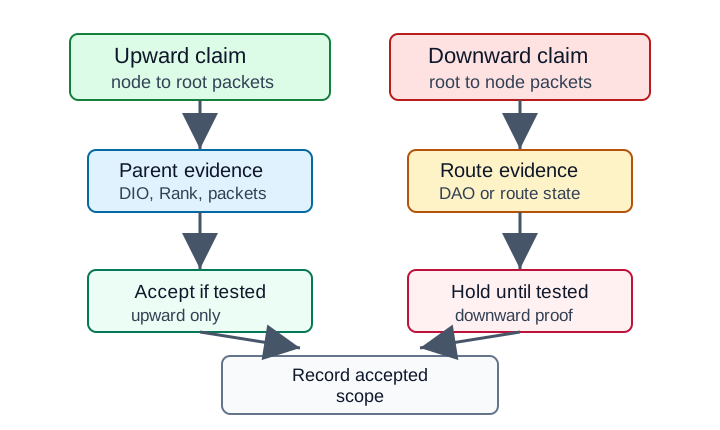
In Figure 15.1, the visual shows rPL scenario mode record showing upward telemetry evidence, downward command evidence, route-state location, and accepted versus unproven claims. An accepted sensor upload cannot stand in for proof that an occasional command can reach the device.
Review the scenario like this:
- Upward telemetry needs DIO evidence, parent choice, Rank context, Objective Function context, and node-to-root packet results.
- Downward commands need routing-mode context, DAO or route-state evidence, root-to-node packet results, and retest triggers.
- Storing mode can be accepted only if intermediate route-state behavior is inspected or tested.
- Non-Storing mode can be accepted only if root-held route knowledge and source-route behavior are tested.
- A successful upward packet does not prove a downward command path.
Scenario decision: accept the upward telemetry claim if the node-to-root packet tests pass. Hold the downward-command claim open until the route-state evidence and root-to-node packet tests are present.
15.8 Scenario 2: Objective Function Under Variable Links
This section: Scenario 2: Objective Function Under Variable Links — This is not a valid claim until the scenario defines “best.” OF0-style reasoning may prefer a simpler path.
Claim: “The preferred parent is production-acceptable because it has the best path.”
This is not a valid claim until the scenario defines “best.” OF0-style reasoning may prefer a simpler path. MRHOF-style reasoning may prefer a path with stronger link-quality evidence and hysteresis. The scenario needs to show the metric evidence, not just the chosen parent.
Before accepting the variable-link scenario, use Figure 15.2 to connect its objective-function choice with observable metric, parent, forwarding, and recovery evidence.
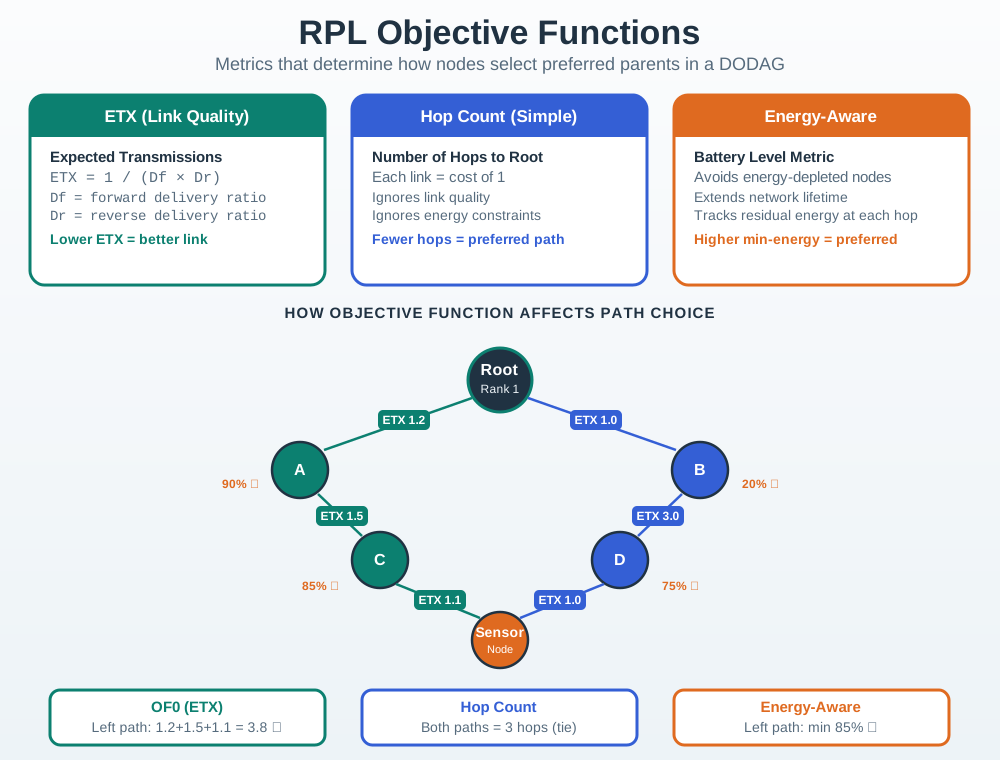
Read Figure 15.2 from the candidate links into the objective function that compares their metrics. For ETX, forward and reverse delivery ratios combine as ETX = 1/(Df × Dr), so either direction can make a link expensive. The preferred-parent output must be checked against advertised Rank and the chosen metric, then verified with packet delivery on the required path. A link-quality change should trigger a bounded switch rather than oscillation. Recording candidates, values, selection, forwarding result, and retest trigger makes “best parent” a reproducible production claim.
Review the Objective Function decision like this:
- Name the Objective Function or implementation equivalent.
- Record the candidate parents and their advertised context.
- Identify the metric evidence actually used by the Objective Function.
- Check that Rank direction remains loop-aware.
- Check that hysteresis or equivalent stability behavior is understood.
- Validate the chosen path with packet evidence that matches the application claim.
Scenario decision: accept the parent choice only for the metric and packet path that were observed. Do not turn one good packet test into a broad claim about all future link conditions.
15.9 Scenario 3: Maintenance Change And Retest
This section: Scenario 3: Maintenance Change And Retest — This claim is often wrong.
Claim: “The RPL design was accepted earlier, so the same acceptance still applies after a local change.”
This claim is often wrong. A previous acceptance record can expire when the design, topology, traffic direction, firmware, root, routing mode, or Objective Function changes.
The maintenance change in Figure 15.3 identifies which old acceptance boundary must be reopened. Retest the affected direction after the change and compare its packet evidence with the earlier accepted boundary.
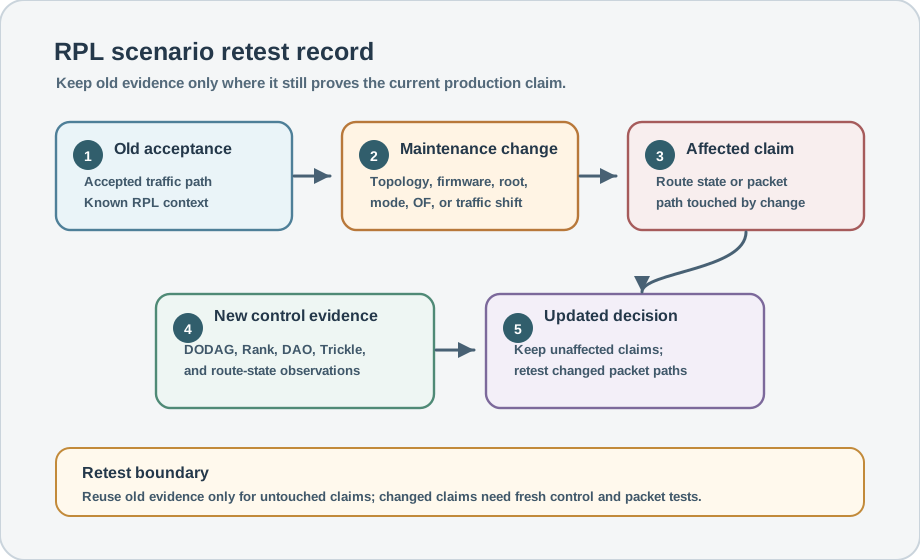
In Figure 15.3, the visual shows rPL scenario retest record showing an old acceptance boundary, maintenance change, affected claim, new control and packet evidence, and the updated acceptance decision. The new control and packet records should test the affected claim before the updated decision replaces the old one.
Review the change like this:
- Identify which old claim the change affects.
- Decide whether the change touches parent choice, route-state location, control messages, packet direction, or monitoring.
- Reuse old evidence only if it still proves the current claim.
- Capture new control-plane evidence when the DODAG, Rank, DAO behavior, or Trickle behavior changes.
- Run new packet tests for every traffic direction affected by the change.
Scenario decision: do not accept the old record wholesale. Keep the unaffected claims, retest the affected claims, and update the monitoring or retest trigger list.
15.10 Scenario Review Record
This section: Scenario Review Record — The handoff in Figure 15.4 separates accepted and pending claims alongside mode, Objective Function, control, and packet evidence.
A useful scenario answer should look like this:
- Claim accepted: the exact traffic path and RPL context that passed.
- Claim not yet accepted: the traffic path or behavior that lacks evidence.
- Mode evidence: where route state lives and how it was observed.
- Objective Function evidence: what metric or rule selected the parent.
- Control evidence: the messages and Rank context that support the claim.
- Packet evidence: the tested source, destination, and direction.
- Retest trigger: the change that would require fresh evidence.
The handoff in Figure 15.4 separates accepted and pending claims alongside mode, Objective Function, control, and packet evidence. Carry the pending path into the next test record with its owner and trigger; do not silently convert it to an accepted claim.
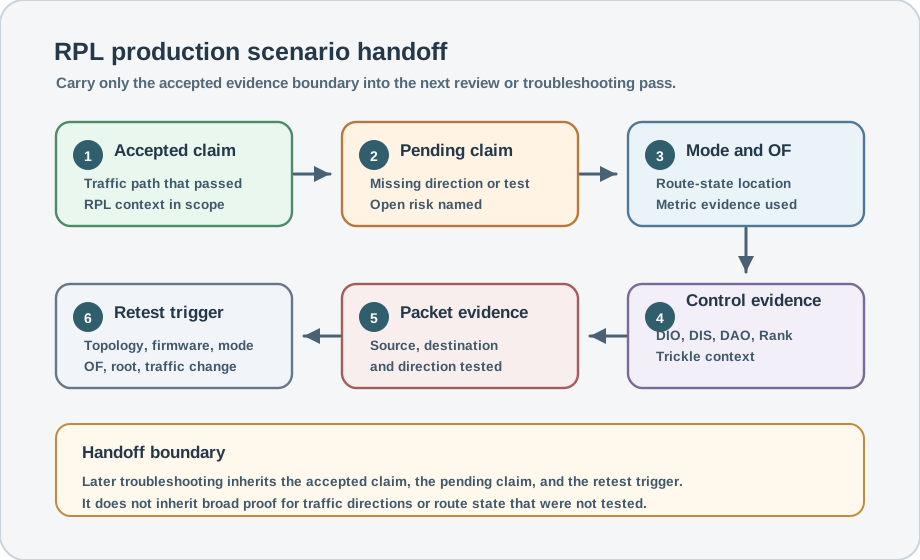
In Figure 15.4, the visual shows rPL production scenario handoff record showing accepted claim, pending claim, mode and Objective Function evidence, control evidence, packet evidence, and retest trigger for later troubleshooting. A later troubleshooter can use the named retest trigger without treating a pending traffic path as accepted. The handoff should retain the pending direction, its owner, and the precise event that starts another packet test.
This record is short, but it prevents future confusion. A later reviewer can see why the decision was made and which claim was intentionally left unproven.
15.11 Review Checklist
This section: Review Checklist
Before accepting a scenario answer, ask:
- Did it state the traffic direction?
- Did it identify the routing mode and route-state location?
- Did it name the Objective Function evidence?
- Did it avoid using a DODAG picture as packet proof?
- Did it separate DIO discovery from DAO route-state evidence?
- Did it require packet tests for downward or peer traffic?
- Did it state which claim remains unproven?
- Did it define retest triggers for changes that affect the claim?
15.12 Common Mistakes
This section: Common Mistakes
- Answering with a mode name but no route-state evidence.
- Accepting downward commands because upward telemetry worked.
- Treating a preferred parent as “best” without naming the Objective Function.
- Treating Trickle reset behavior as a complete health check.
- Reusing an old acceptance record after the traffic direction changes.
- Adding exact capacity, timing, device-life, or product claims that the scenario did not measure.
15.13 Knowledge Check
This section: Knowledge Check
15.14 Matching Quiz
This section: Matching Quiz
15.15 Ordering Quiz
This section: Ordering Quiz
A production scenario is not a story with one correct routing slogan. It is a test of which claim the evidence can support. The same scenario can contain an accepted upward telemetry claim, an unproven downward command claim, and a retest trigger that affects only one part of the design.
Read each case as a set of claim boundaries. The reviewer should ask what traffic direction is being accepted, where route state lives, which Objective Function evidence selected the path, which packet test matches the claim, and what changed since the last acceptance record.
The handoff matters because scenario answers often mix several claims in one paragraph. A telemetry path may be accepted, a command path may be pending, and a maintenance change may require only one fresh packet test. If the answer says only "scenario passed," the next reviewer cannot tell which part passed and which part was never proven.
Use the scenario as a sorting exercise. Accepted claims move to monitoring: what signal should be watched so the team notices when the accepted condition changes? Missing evidence moves to the next chapter or next lab: what trace, route-state record, or packet test would close the gap? Retest triggers move to change control: what future event makes the old answer stale?
This does not make the review slower. It makes the decision narrower and more reusable. A narrow accepted claim can be trusted later because it names its traffic direction, context, evidence, and expiry condition. It also makes rejected or pending claims easier to finish.
Accepted Claim
The exact traffic direction, RPL context, and operating condition that passed both control-plane and packet checks.
Unproven Claim
A plausible behavior that the current evidence does not prove, such as downward commands after only upward telemetry tests.
Changed Assumption
A firmware, topology, route-state, root, metric, or traffic change that can narrow or expire old evidence.
Retest Decision
The reviewer keeps unaffected claims and reruns the tests for only the claims touched by the change.
Write the answer as "accepted, unproven, retest" rather than "choose mode X." That form prevents one clean trace from becoming an unsupported production promise.
The decision record turns a scenario answer into something a maintainer can use later. It should explain why the decision was made, which evidence was attached, and what would force the team to revisit the scenario after a change.
Start by writing the scenario as a table of claims rather than as a paragraph of recommendations. One row can cover upward telemetry, another can cover root-to-node command delivery, and another can cover repair behavior after a parent change. Each row gets its own mode evidence, Objective Function evidence, control-plane evidence, packet evidence, open gap, and retest trigger.
When evidence is missing, write that fact in the row instead of softening the conclusion. "Downward command pending DAO and root-to-node packet test" is a stronger review result than "commands probably work." It tells the next person exactly what to collect and prevents the scenario answer from becoming a production promise. It also keeps a partial pass useful: the accepted telemetry row remains accepted while the command row stays pending.
Separate upward telemetry, downward commands, peer traffic, repair behavior, and monitoring promises.
Pair each claim with the specific control-plane and packet evidence that can prove it.
Write unproven claims explicitly so a later reviewer does not infer more than the test showed.
Connect each change trigger to the smallest fresh test that can re-accept the affected claim.
15.16 Summary
This section: Summary
- Scenario review starts with a testable claim.
- Upward, downward, and peer traffic require separate evidence.
- Mode choice must be defended with route-state evidence.
- Objective Function choice must be defended with metric and stability evidence.
- Control-plane evidence and packet evidence prove different things.
- A useful scenario answer records accepted claims, missing evidence, and retest triggers.
15.17 Key Takeaway
This section: Key Takeaway — Production RPL scenarios should reveal how link loss, parent churn, traffic direction, gateway placement, and maintenance access affect the design.
Production RPL scenarios should reveal how link loss, parent churn, traffic direction, gateway placement, and maintenance access affect the design.
15.18 Concept Relationships
This section: Concept Relationships — Start with the evidence stack in RPL Production Framework, then use RPL Production Summary to consolidate the decision.
Start with the evidence stack in RPL Production Framework, then use RPL Production Summary to consolidate the decision. When a scenario depends on downward state, revisit RPL Routing Modes; when it depends on DIO, DIS, DAO, or DAO-ACK, follow RPL DODAG Message Flow. RPL Labs and Quiz provides the rehearsal before the same reasoning is used for production acceptance.
15.19 What’s Next
This section: What’s Next — Continue to RPL Production Summary for a compact production review synthesis, or return to RPL Production Framework if the evidence stack needs another pass.
Continue to RPL Production Summary for a compact production review synthesis, or return to RPL Production Framework if the evidence stack needs another pass.
Find help
3 reviewed answers.
Where should I start in a module?
Open the module page from the sidebar to see its chapters in order. Use the module map to return to a topic you need.
Modules and pathsReviewed
What can I try when a project does not work?
Check the symptom, then work through the diagnostic steps. Keep the error message and the smallest example that reproduces it.
When you are stuckReviewed
How do interactive examples work?
Use the interactive guide to check how examples and simulations work before changing your project.
Interactive examples guideReviewed