22 SDN Production Case Studies
More
Depth: Practitioner
Progress saves as you read. Mark sections complete as you go; your progress appears in the sidebar.
22.1 Start With the Case Proof
This section: Start With the Case Proof — Picture a factory network carrying safety alarms, camera files, and maintenance checks over the same narrow path.
Transfer the Problem Shape, Not the Headline Result
Picture a factory network carrying safety alarms, camera files, and maintenance checks over the same narrow path. A published case says central rule changes improved service, but the factory owner needs proof that local switches and staff can handle the same change and its failure modes.
Write the local baseline first: traffic groups, busy period, protected path, allowed delay, loss, rule owner, switch limits, receiver proof, and rollback time. Then state the one rule change and the outcome it is meant to improve.
Load the narrow path, stop the controller, delay a rule, apply half a change, restart a switch, move a service, and try traffic that should be blocked. A valid alarm must keep its protected route. An unapproved path must stay closed. Record both results at the switch and receiver.
Software-defined networking, or SDN, separates rule control from packet forwarding. That can make change easier to manage, but it can also add timing, authority, and partial-change risks. A result from another site is only a clue until local proof matches its conditions.
Practitioner builds the case-transfer record. Under the Hood explains rule order, table limits, observation gaps, safe local behavior, and the races hidden by a simple before-and-after chart.
Use this local transfer check:
- Measure the current path first.
- Name the service outcome to protect.
- State the one rule change.
- Mark who may approve it.
- Load the shared path fully.
- Stop the central rule service.
- Apply half a change once.
- Restart one forwarding device.
- Test allowed traffic at receiver.
- Test blocked traffic at receiver.
- Roll back and measure recovery.
- Keep both pass and deny proof.
An SDN case study is useful only when it proves how a pattern behaves under local constraints. Traffic engineering, slicing, and scheduled forwarding all sound promising until the gateway, controller, and receiver evidence are checked.
Start simple: pick one case pattern and state the service outcome, the rule change, the observation, and the rollback. The case survives when those facts still hold under failure and migration pressure.
22.2 Learning Objectives
This section: Learning Objectives
By the end of this chapter, you will be able to:
- Compare production SDN case studies by problem pattern instead of copied deployment results.
- Identify when traffic-engineering, service-slicing, or scheduled-forwarding patterns fit an IoT network.
- Check baseline proof and post-change proof before accepting a case-study lesson.
- Separate transferable architecture lessons from environment-specific implementation details.
- Build a reusable case-study proof record for production SDN decisions.
22.3 Which Case Pattern Survives Local Proof?
This section: Which Case Pattern Survives Local Proof?
22.4 Minimum Viable Understanding
This section: Minimum Viable Understanding — A case study is proof, not a recipe.
A case study is proof, not a recipe. Its value depends on whether the operating conditions match your network.
Use this route:
- State the problem shape: congestion, service isolation, timing, failure handling, or operational drift.
- Check the baseline: current traffic behavior, incident pattern, policy process, and affected service.
- Map the SDN pattern: traffic-engineering, service-slicing, scheduled forwarding, or hybrid control.
- Check guardrails: controller scope, switch capability, security boundary, observability, and rollback.
- Decide transferability: record what applies, what does not apply, and what must be tested locally.
22.5 Prerequisites
This section: Prerequisites
Revisit these chapters as needed:
- SDN Production Framework: production gates and governance.
- SDN Production Best Practices: resilience, flow governance, observability, and drills.
- SDN OpenFlow Protocol: controller-switch proof.
- SDN OpenFlow Challenges: scaling and failure constraints.
22.6 Case-Study Lenses
This section: Case-Study Lenses — Inspect Figure 22.1 as six questions applied to every case.
Inspect Figure 22.1 as six questions applied to every case. Traffic engineering, service slicing, and scheduled forwarding identify the control pattern; baseline proof and operational guardrails test whether it is safe locally; the transfer decision records which assumptions survive the move into the target network.
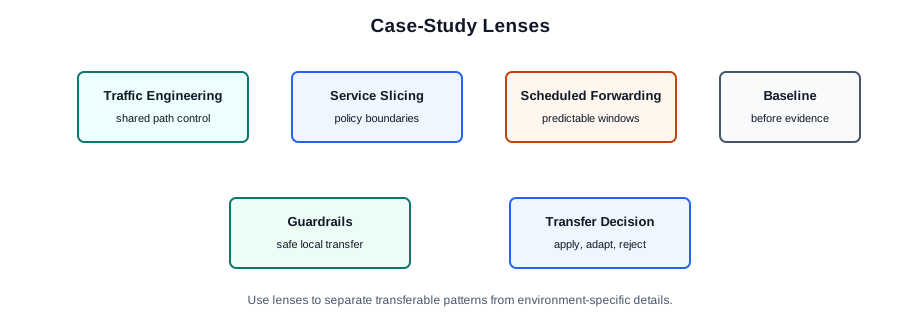
Traffic engineering
Useful when shared paths are unevenly loaded and central policy can steer traffic without breaking service intent.
Service slicing
Useful when different IoT services share infrastructure but need separate policy, priority, or fault boundaries.
Scheduled forwarding
Useful when industrial traffic needs predictable forwarding windows and explicit handling for best-effort traffic.
Baseline proof
Pre-change measurements prove whether the network problem exists and which outcome should improve.
Operational guardrails
Controller role, rule ownership, protected paths, monitoring, and rollback determine whether the pattern can run safely.
Transfer decision
The check should name which lesson transfers, which assumptions do not, and what local test must prove.
The lens diagram in Figure 22.1 prevents a headline result from becoming an architecture decision. A matching pattern without baseline proof is only a hypothesis, and a successful pilot without ownership, rollback, and a transfer boundary is not production evidence.
22.7 Pattern 1: Traffic Engineering
This section: Pattern 1: Traffic Engineering — A traffic-engineering case study starts with uneven path use or congestion risk across shared links.
A traffic-engineering case study starts with uneven path use or congestion risk across shared links.
Read Figure 22.2 from baseline path use through controller policy and path assignment. Congestion counters and receiver outcomes must improve while protected traffic remains inside its boundary; the rollback record identifies the measurement that restores the old path choice.
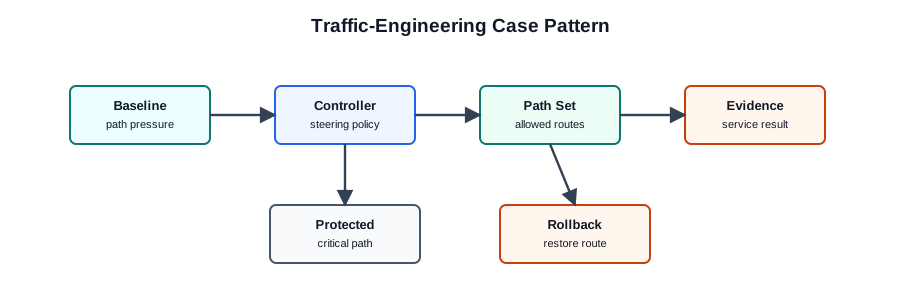
The traffic-engineering diagram in Figure 22.2 keeps protected traffic and rollback beside the optimized path. That placement matters: lower congestion is not an acceptable result if the moved class violates a protected service boundary or if operators cannot restore the previous assignment.
Check questions:
- Is the baseline problem uneven path use, poor failure handling, or policy-blind routing?
- Which traffic classes are allowed to move to alternate paths?
- Which paths are protected for critical traffic?
- Which counters and receiver outcomes prove that steering improved service behavior?
- What rollback condition restores the previous path choice?
Transfer the lesson only if your network has measurable path-choice pressure and enough observability to verify the steering result.
22.8 Pattern 2: Service Slicing
This section: Pattern 2: Service Slicing — A service-slicing case study starts with mixed-priority IoT services sharing the same infrastructure.
A service-slicing case study starts with mixed-priority IoT services sharing the same infrastructure. Inspect the service-slicing figure in Figure 22.3 to see how separate policy domains share the substrate.
In Figure 22.3, shared physical infrastructure carries three policy domains: emergency services receive highest priority and pre-emption, environmental monitoring receives a bounded medium-priority slice, and parking, lighting, tourism, and public Wi-Fi remain best effort. The useful lesson is the isolation and priority contract, not the city name.
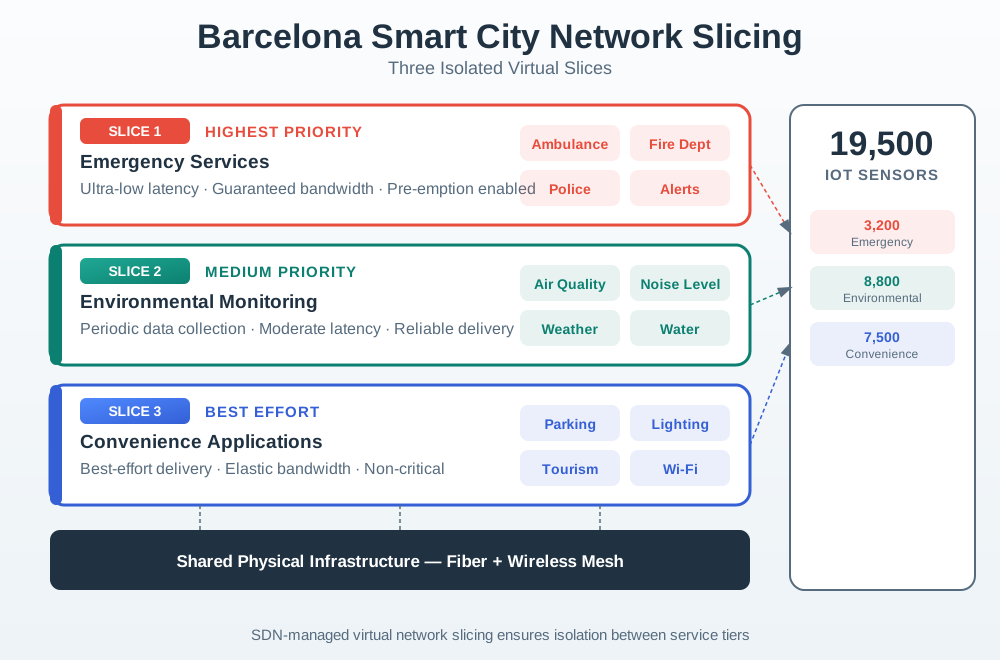
The slicing diagram in Figure 22.3 places those three virtual networks over one physical substrate. Inspect the priority and pre-emption labels on the emergency branch, the bounded monitoring branch, and the best-effort convenience branch; those are the claims a local queue, rule, counter, and receiver test must prove.
Check questions:
- Which services need separate policy boundaries?
- Which service should keep priority during congestion or failure?
- Which traffic must stay isolated even when another service spikes?
- Which switch rules, queues, counters, receiver results, and alerts prove the slice is working?
- Who owns slice changes and cleanup?
Transfer the lesson only if the services have genuinely different risk, priority, or ownership boundaries.
22.9 Pattern 3: Scheduled Forwarding
This section: Pattern 3: Scheduled Forwarding — A scheduled-forwarding case study starts with a control loop or industrial workflow that cannot tolerate unpredictable queuing.
A scheduled-forwarding case study starts with a control loop or industrial workflow that cannot tolerate unpredictable queuing.
Follow Figure 22.4 from the documented timing requirement and verified switch capability into separate windows for control traffic, sensor updates, and best-effort diagnostics. Late packets take an exception path, while protected-service proof and the transfer decision determine whether the schedule is acceptable.
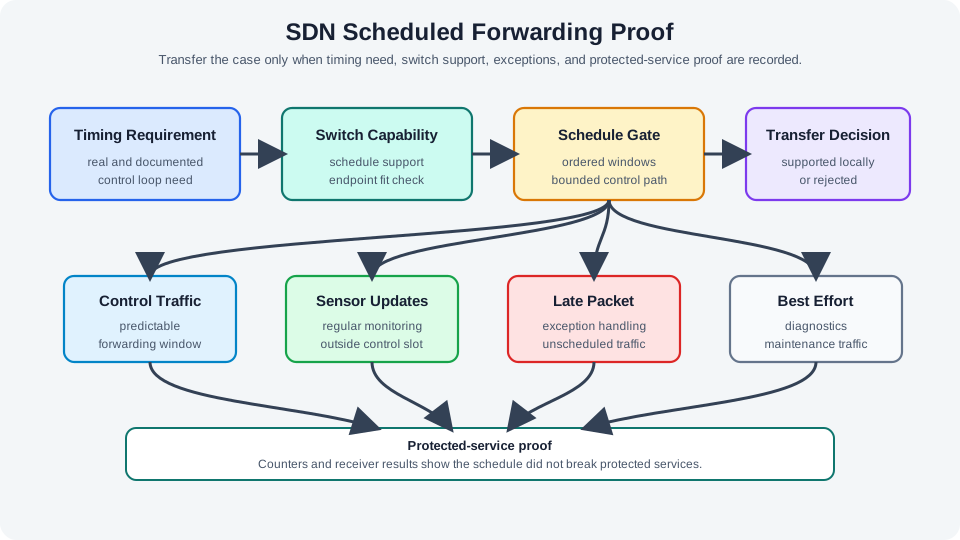
The scheduled-forwarding diagram in Figure 22.4 keeps the late-packet exception beside normal windows. Reviewers should trace an on-time control packet and a late diagnostic packet separately, then use protected-service proof to show the schedule improves predictability without silently starving maintenance traffic.
Check questions:
- Which traffic class needs predictable forwarding rather than best-effort service?
- Which switch and endpoint capabilities are required before scheduling can work?
- Where does ordinary monitoring, diagnostics, or maintenance traffic fit?
- What happens when an unscheduled or late packet appears?
- Which proof shows the schedule did not break protected services?
Transfer the lesson only if the timing requirement is real, documented, and supported by the switching environment.
22.10 Cross-Case Proof Comparison
This section: Cross-Case Proof Comparison — Compare case studies by proof class instead of headline metrics.
Compare case studies by proof class instead of headline metrics.
Inspect Figure 22.5 across the same seven fields for every candidate: problem, baseline, control, service proof, failure behavior, operations owner, and transfer decision. A blank field is visible uncertainty; it cannot be hidden by a larger throughput or latency headline from a different environment.
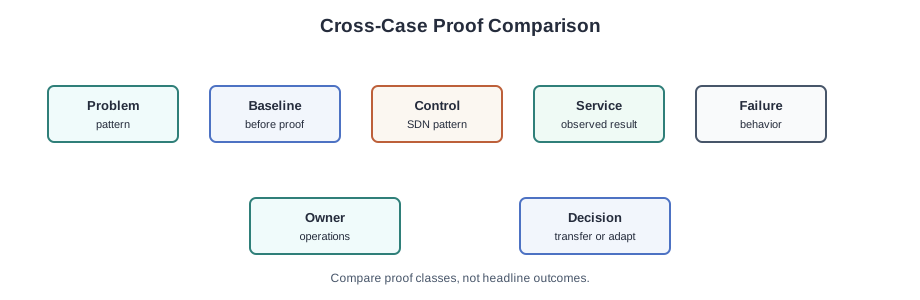
The comparison figure in Figure 22.5 aligns each case on one evidence route. Read across a row from the stated problem to the baseline, chosen control, measured outcome, failure behavior, owner, and transfer decision; do not compare one case’s latency headline with another case’s isolation claim.
Use these comparison fields:
- Problem pattern: congestion, isolation, timing, failure recovery, or operational drift.
- Baseline proof: what was measured before SDN was introduced.
- Control pattern: controller policy, switch rule, queue, schedule, or slice boundary.
- Service proof: counters, receiver result, protected-path behavior, and user-facing outcome.
- Operations proof: alert routing, support owner, rollback, cleanup, and next check trigger.
22.11 Baseline Validation
This section: Baseline Validation — The most common case-study mistake is accepting a pattern before proving the local problem.
The most common case-study mistake is accepting a pattern before proving the local problem.
In Figure 22.6, current service behavior and link or flow measurements establish whether the incident pattern is repeatable. Policy delay is a separate observation. Only after those inputs identify a network-control bottleneck should the team write a falsifiable local test plan for the proposed SDN pattern.
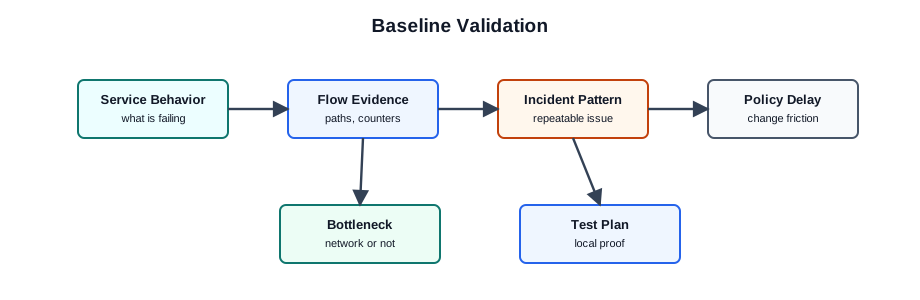
The baseline figure in Figure 22.6 makes the bottleneck decision an output, not an assumption. Current service behavior, link and flow evidence, incident recurrence, and policy delay feed that decision; the resulting test plan must be able to disprove that SDN addresses the observed constraint.
Baseline checks:
- Which service behavior is unsatisfactory today?
- Is the bottleneck path selection, service isolation, timing predictability, operational delay, or something outside the network?
- Which measurement proves the issue is repeatable?
- Which success condition would show improvement after the SDN change?
- Which local test will falsify the case-study assumption?
If the baseline does not show a network-control problem, SDN may not be the right fix.
22.12 Migration Risk Boundaries
This section: Migration Risk Boundaries — Case studies often compress the hard part: migration from a known network to a programmable one.
Case studies often compress the hard part: migration from a known network to a programmable one.
Read Figure 22.7 from the bounded pilot scope into the hybrid boundary and rollback proof. Operations training and monitoring evidence support the acceptance decision; a stop trigger blocks expansion, while a written expansion rule makes broader rollout conditional on the pilot evidence rather than enthusiasm.
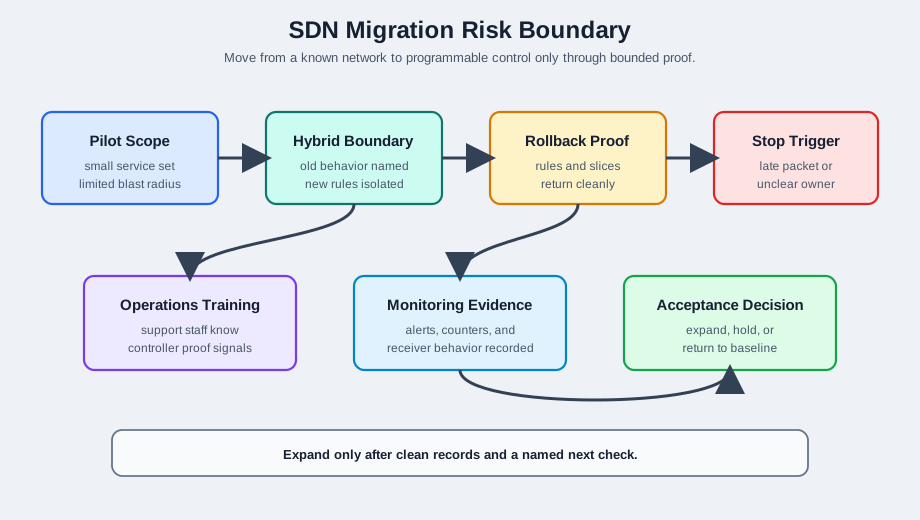
The migration diagram in Figure 22.7 puts acceptance between monitoring evidence and two possible exits. A stop trigger holds or reverses the pilot; only a satisfied expansion rule widens scope. The hybrid boundary and rollback proof remain authoritative throughout both outcomes.
Check migration risk:
- Scope the pilot: choose a small service set that represents the target pattern without broad blast radius.
- Define hybrid boundaries: name where existing network behavior remains authoritative.
- Prepare rollback: record how rules, slices, schedules, and monitoring return to the previous state.
- Train operations: support staff should know the new controller, proof, and failure signals.
- Expand by proof: move from pilot to broader rollout only when acceptance records are clean.
22.13 Operations Handoff
This section: Operations Handoff — A case study is incomplete unless it shows who runs the system after launch.
A case study is incomplete unless it shows who runs the system after launch. Inspect Figure 22.8 to separate controller, network, and service ownership before an alert occurs.
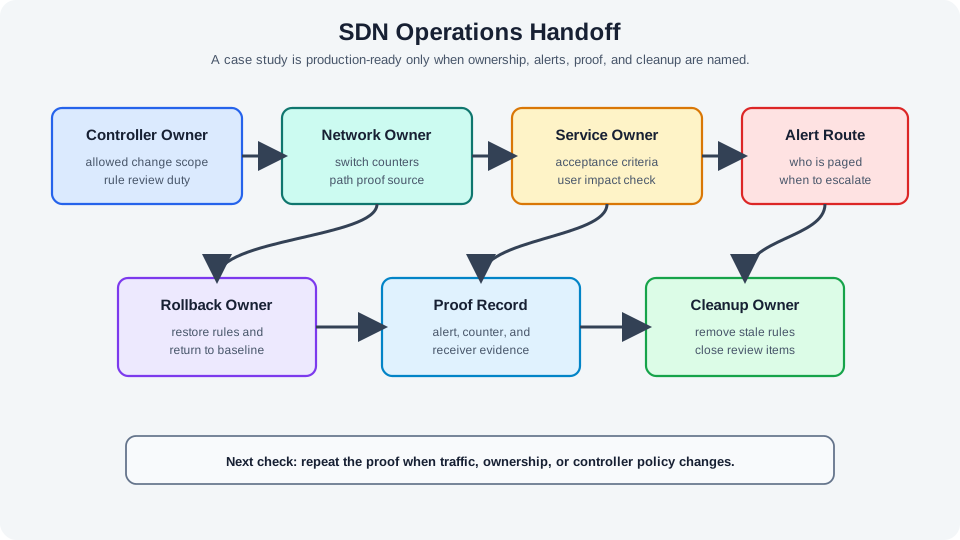
The handoff diagram in Figure 22.8 routes alerts to a named owner, assigns rollback and cleanup separately, and binds each decision to a proof record and next-check trigger. Those links turn a technically successful pilot into work that an operations team can safely inherit.
The handoff should name:
- Controller owner and allowed change scope.
- Network owner and switch proof source.
- Service owner and acceptance criteria.
- Alert route and escalation path.
- Rollback owner and cleanup owner.
- Next check condition.
Case-study results are not production-ready until the operating model is auditable.
22.14 Walkthrough: Choosing a Case Pattern
This section: Walkthrough: Choosing a Case Pattern — An organization wants SDN for a mixed IoT network.
An organization wants SDN for a mixed IoT network. It has shared uplinks, building automation, safety alarms, diagnostic traffic, and a small industrial control zone.
Decision check
- Traffic engineering: use only if shared uplinks show repeatable path pressure and alternate paths have verified capacity.
- Service slicing: use for safety alarms, building automation, diagnostics, and guest or convenience traffic that need separate policy boundaries.
- Scheduled forwarding: reserve for the industrial control zone only if the timing requirement is documented and switch capability is verified.
- Baseline: gather pre-change proof for each pattern instead of assuming one case study solves every problem.
- Handoff: assign owners, alerts, rollback, and cleanup before expanding beyond the pilot.
Case-study proof record
Problem: mixed IoT services share infrastructure with different risk boundaries
Candidate pattern: service slicing for shared infrastructure; scheduled forwarding for control zone
Baseline: current service isolation, incident pattern, path pressure, and timing proof
Guardrails: controller role, switch capability, protected paths, observability, rollback
Pilot: bounded service set with representative traffic and failure drills
Decision: transfer only the pattern proven by local baseline and acceptance proof
22.15 Case-Study Proof Loop
This section: Case-Study Proof Loop — Reusable case-study learning closes the loop from external lesson to local proof.
Reusable case-study learning closes the loop from external lesson to local proof.
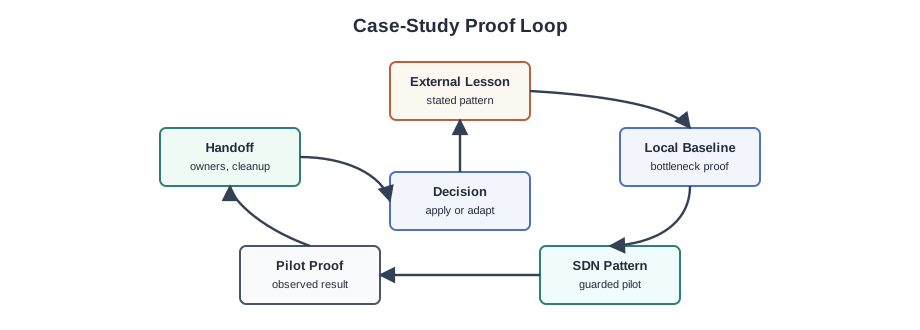
In Figure 22.9, the external lesson is only the entry point. The local baseline selects or rejects the SDN pattern; pilot proof and the operations handoff constrain the transfer decision; and the next check feeds new evidence back into the baseline instead of treating acceptance as permanent.
Capture:
- External problem pattern and stated lesson.
- Local baseline and bottleneck proof.
- Selected SDN control pattern and guardrails.
- Pilot result, protected-path result, and failure behavior.
- Operations handoff, cleanup, and next check trigger.
22.16 Knowledge Check
This section: Knowledge Check
22.17 Check the Case-Study Transfer
This section: Check the Case-Study Transfer
22.18 Match Cases to Decisions
This section: Match Cases to Decisions
22.19 Order a Case-Study Check
This section: Order a Case-Study Check
22.20 Common Pitfalls
This section: Common Pitfalls
- Copying headline results: headline outcomes rarely transfer without the same baseline, constraints, and operations model.
- Skipping baseline measurement: without local proof, teams cannot tell whether SDN solved the actual problem.
- Using one pattern for every problem: traffic-engineering, service-slicing, and scheduled-forwarding patterns solve different issues.
- Ignoring migration risk: pilots, hybrid boundaries, rollback, and training are part of the lesson.
- Forgetting operations handoff: a successful pilot still fails if alerts, ownership, cleanup, and next check are unclear.
22.21 Campus IoT OpenFlow Case
This section: Campus IoT OpenFlow Case — A campus wants central control over a mixed IoT network — cameras, badge readers, HVAC, and guest devices — so it deploys SDN: OpenFlow switches whose forwarding tables are programmed by a central controller.
A campus wants central control over a mixed IoT network — cameras, badge readers, HVAC, and guest devices — so it deploys SDN: OpenFlow switches whose forwarding tables are programmed by a central controller. This decouples the control plane (the policy brain) from the data plane (the switches that just forward), letting the operator push segmentation and QoS policy from one place instead of configuring each switch by hand.
Use Figure 22.10 to keep the adoption decision bounded: start with the campus context and service consequence, demand local evidence, state the architecture choice, and finish with a review record plus an owned next action.
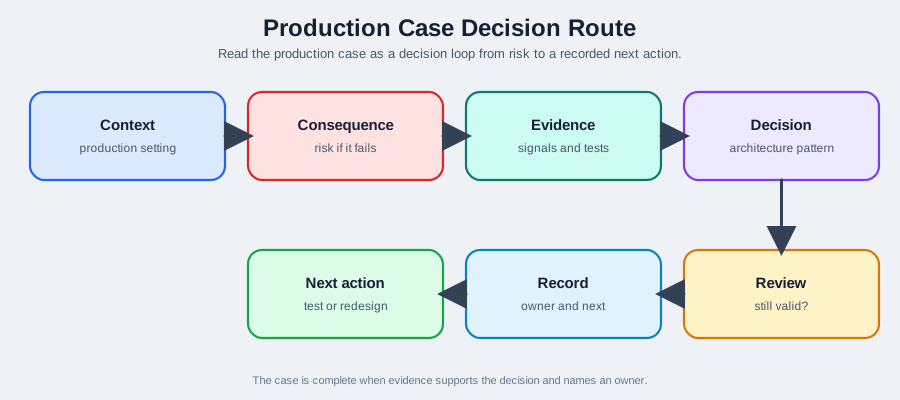
Small-screen read: In Figure 22.10, the case-study route is problem shape, local baseline, SDN pattern, guardrail, transfer decision, and follow-up check. The lesson transfers only when local proof supports the same pattern.
The power is real, but production SDN brings two concrete constraints the case must confront: the switches' forwarding tables are small and live in specialised hardware memory, and the controller is a new dependency whose failure can stop the network. Both shape the design.
For an overview reader, the key move is to translate the published story into a local acceptance question. If the case study says service slicing improved a city deployment, the local question is not whether the city result was impressive. It is whether the campus has the same mix of service priorities, whether the switches can enforce the slice boundary, whether receivers see the intended service result, and whether support staff know the rollback route.
A useful case-study note therefore has two parts: the external lesson and the local proof still missing. Keeping those separate prevents a team from treating a published deployment as permission to skip baseline measurement, failure behavior, security boundary checks, or operations handoff.
SDN splits control from forwarding: a central controller programs OpenFlow switches. The catch is finite flow-table memory and a controller that becomes critical infrastructure.
Overview Knowledge Check
22.22 Flow-Table TCAM Exhaustion
This section: Flow-Table TCAM Exhaustion — OpenFlow rules that match on wildcards and priorities live in TCAM — fast but expensive and physically small.
OpenFlow rules that match on wildcards and priorities live in TCAM — fast but expensive and physically small. A typical hardware switch holds only a few thousand TCAM flow entries (often ~2,000–8,000, sometimes fewer). This is the constraint that breaks naive IoT SDN designs.
Worked example. Suppose the design installs one specific flow rule per device for fine-grained policy, and the campus has 5,000 IoT endpoints. That needs 5,000 TCAM entries — more than a 2,000-entry switch can hold. When TCAM fills, new rules either fail to install or spill to slow software forwarding, and traffic that should be line-rate now crawls or drops. The fix is rule aggregation: match on shared attributes — a VLAN, a subnet, a device class — so one rule covers thousands of devices. Aggregating 5,000 cameras into a handful of class-based rules turns 5,000 entries into ~5.
The practitioner lesson for case-study transfer is to record the scale assumption behind every rule. A paper may describe per-flow steering, but a production pilot should ask how many rules each switch will hold in normal operation, during a failover, and while temporary diagnostic rules are active. The safest transfer pattern is usually class-based: alarm traffic, building automation, cameras, diagnostics, and guest convenience traffic each get rules that are broad enough to fit the hardware but narrow enough to preserve the policy boundary.
That record also needs an owner. If a controller app can install emergency exceptions, the handoff should name who removes them, what counter or alert proves they are still active, and what table-occupancy limit stops the next rollout. Otherwise the case-study pattern can pass a pilot and still decay into stale, high-priority rules that block later changes.
| Approach | TCAM entries for 5,000 devices | Outcome |
|---|---|---|
| Per-device rules | ~5,000 | Overflows a ~2,000-entry switch |
| Per-class / per-subnet rules | a few | Fits easily; scales |
Practitioner Knowledge Check
22.23 Reactive, Proactive, Available
This section: Reactive, Proactive, Available — How rules reach the switch matters.
How rules reach the switch matters. In reactive mode, the switch that meets an unknown flow sends the first packet up to the controller (a packet-in), which computes and installs a rule — flexible, but every new flow pays a controller round-trip in latency, and a burst of new flows (or a spoofing attack fabricating them) can overwhelm the controller. In proactive mode, rules are pre-installed before traffic arrives — no per-flow latency and no packet-in flood, at the cost of less on-the-fly flexibility. Production IoT networks lean proactive precisely because IoT flows are predictable and the packet-in path is a denial-of-service surface.
The second concern is that the controller is now critical infrastructure. If forwarding depends on it and it fails, the network can stop; even where switches keep forwarding on installed rules, no new policy can be applied. So production designs run the controller in a high-availability cluster with failover, and often keep switches able to forward existing flows through a brief controller outage. The convenience of central control is paid for with the discipline of central-control resilience.
Worked example. A camera subnet is put in reactive mode; a misbehaving device forges thousands of new source addresses per second, each generating a packet-in, and the controller's CPU saturates — policy installation stalls network-wide. Switching that subnet to proactive rules (traffic pre-authorised by class) removes the packet-in path, and rate-limiting packet-ins protects the controller elsewhere. Meanwhile a standby controller takes over when the primary is patched. The case shows SDN's centralisation is a strength only when its two costs — table size and controller dependency — are engineered for.
A deeper case-study review should ask which fail-open or fail-closed behavior is being claimed. Existing flows may continue because rules remain in the switch, but table-miss traffic, new devices, expired hard-timeout rules, and controller-originated revocations can behave differently. The acceptance record should therefore test controller loss, packet-in rate limits, rule timeout behavior, stale-rule cleanup, and the alerts that tell an operator which condition happened.
Under-the-Hood Knowledge Check
22.24 Summary
This section: Summary — Production SDN case studies should be read as proof patterns.
Production SDN case studies should be read as proof patterns. The useful question is not “Who deployed this?” but “Which problem shape was solved, what baseline proved it, which control pattern was used, what guardrails made it safe, and what proof showed it could be operated?” When those questions are answered, a case study becomes a practical decision aid instead of a brittle success story.
22.25 Key Takeaway
This section: Key Takeaway — SDN case studies should show the context, controller role, policy model, measured outcome, failure mode, and operational lesson.
SDN case studies should show the context, controller role, policy model, measured outcome, failure mode, and operational lesson.
22.26 See Also
This section: See Also
- SDN Production Best Practices: production guardrails and proof records.
- SDN Production Framework: governance and release gates.
- SDN OpenFlow Protocol: protocol-level proof.
- SDN OpenFlow Challenges: placement, scaling, and failure pressure.
- SDN Analytics and Implementations: using observations to improve operations.
22.27 What’s Next
This section: What’s Next — Continue to SDN Production Framework to connect case-study lessons to release gates and production governance.
Continue to SDN Production Framework to connect case-study lessons to release gates and production governance.
Find help
3 reviewed answers.
Where should I start in a module?
Open the module page from the sidebar to see its chapters in order. Use the module map to return to a topic you need.
Modules and pathsReviewed
What can I try when a project does not work?
Check the symptom, then work through the diagnostic steps. Keep the error message and the smallest example that reproduces it.
When you are stuckReviewed
How do interactive examples work?
Use the interactive guide to check how examples and simulations work before changing your project.
Interactive examples guideReviewed