29 Smart Contracts for IoT
More
Depth: Practitioner
Progress saves as you read. Mark sections complete as you go; your progress appears in the sidebar.
29.1 Start With the Agreement Logic
This section: Start With the Agreement Logic — Picture two firms sharing cold goods.
Keep the Physical Truth Outside the Automatic Rule
Picture two firms sharing cold goods. A temperature sensor reports a warm period, and an automatic agreement may release or hold payment. The rule can apply a clear decision to an accepted record, but it cannot inspect the box, repair a bad sensor, or judge an honest exception by itself.
A smart contract is code that applies agreed rules to records shared on a ledger. Write the event, accepted source, validation step, rule, allowed result, time limit, dispute path, pause control, change owner, and recovery action before writing code.
Send a late record, a repeated one, the wrong unit, a record from an unknown device, a corrected record, and two valid records that disagree. Stop an outside data source and change the rule version. Check that money or ownership does not move from weak evidence and that people can pause and review an exception.
Shared history does not make input true, private, fair, or lawful. Keep raw readings and urgent physical control in suitable normal systems. Put only the narrow record needed by the shared decision on the ledger.
Practitioner builds the readiness and exception record. Under the Hood explains fixed execution, fees, outside-data trust, upgrade control, privacy, and the governance limits behind automatic agreement logic.
Use this rule check before coding:
- State the shared event in plain words.
- Name the source of each fact.
- Reject a record with no owner.
- Reject a record with old time.
- Define the one allowed result.
- Add a clear pause path.
- Add a clear dispute path.
- Name who may change the rule.
- Test a repeated accepted record.
- Test two facts that disagree.
- Keep urgent control off the ledger.
- Review every new rule version.
- Name the human appeal owner.
- Set an end for each rule.
- Test a paused decision path.
- Keep private facts out by default.
A smart contract is useful only when the agreement can be expressed as deterministic logic over accepted records. It cannot rescue bad sensor data, missing governance, or unclear off-ledger evidence.
Start simple: write the event, the rule, the allowed outcome, the exception path, and the recovery owner. If those pieces are not clear in prose, they are not ready to become contract logic.
29.2 Smart Contracts Need IoT Design
This section: Smart Contracts Need IoT Design — They are a poor place for raw telemetry, safety control, subjective judgment, and device health diagnosis.
Smart contracts can help when multiple parties need the same record of an IoT-related decision: a handoff was accepted, a meter period was closed, a device identity action was approved, or an exception was recorded for verification.
They are a poor place for raw telemetry, safety control, subjective judgment, and device health diagnosis. Those jobs belong in normal IoT infrastructure. The smart contract should receive compact, validated records and produce a narrow outcome that every participant can replay later.
The overview depth layer shows the contract boundary that separates physical events, raw telemetry, accepted gateway records, agreement logic, ledger outcomes, and verification workflows.
29.3 Learning Objectives
This section: Learning Objectives
By the end of this chapter, you will be able to:
- Explain why smart contracts need trusted IoT record paths.
- Separate raw telemetry, local control, accepted records, and ledger outcomes.
- Design gateway-mediated patterns for contract-triggered IoT workflows.
- Add exception, pause, replay, and governance behavior before deployment.
- Prepare a readiness record for evaluating smart-contract use in an IoT system.
29.4 Quick Check: Cold-Room Contract Boundary
This section: Quick Check: Cold-Room Contract Boundary
Key Concepts
This section: Key Concepts
- Smart contract: Deterministic agreement logic executed by a ledger network.
- Accepted record: A signed, validated summary that the agreement logic is allowed to evaluate.
- Validation gateway: A gateway or service that receives device events, checks context, signs summaries, buffers during outages, and submits compact records.
- oracle problem: The fact that ledger logic cannot directly observe physical-world data and must rely on a trusted record path.
- Off-ledger telemetry: Raw readings, logs, and files stored in normal operational systems instead of the ledger.
- Trigger condition: The objective rule that determines whether an accepted record changes an agreement state.
- Exception state: A recorded outcome that pauses automation and routes the matter to human or operational verification.
- Proof replay: A later verification that recomputes a fingerprint or verifies a signature chain against the ledger entry.
29.5 What Agreement Logic Can And Cannot Do
This section: What Agreement Logic Can And Cannot Do — Smart contracts are useful when the input is narrow, objective, and already accepted by the system boundary.
Smart contracts are useful when the input is narrow, objective, and already accepted by the system boundary. They are risky when the input is noisy, uncertain, or directly tied to physical safety.
They can:
- Evaluate accepted records using deterministic rules.
- Record a shared outcome that participants can replay.
- Emit workflow events for notification, verification, or service follow-up.
- Enforce membership, signature, and state-transition rules.
- Preserve a durable trail of which records were accepted.
They cannot:
- Prove a sensor was calibrated, placed correctly, or physically honest.
- Decide whether a subjective condition is acceptable without a verification process.
- Replace local safety control at a device, gateway, or edge service.
- Fix bad timestamps, duplicated events, missing packets, or failed batteries after the fact.
- Remove the need for governance over participants, keys, rule changes, and recovery.
29.6 The Accepted Record Path
This section: The Accepted Record Path — The accepted-record path is the most important part of the design.
The accepted-record path is the most important part of the design. If the path is weak, the contract only automates weak assumptions.
A durable path usually has these stages:
- A device observes an event or produces a reading.
- A gateway checks identity, time context, plausibility, and duplication.
- The gateway stores raw telemetry in an operational system.
- The gateway creates a compact signed summary or batch fingerprint.
- The validation service submits the accepted summary to the ledger.
- The agreement logic evaluates the summary and records an outcome.
- A reviewer can replay the proof from off-ledger records and ledger entries.
Use Figure 29.1 to see where an observed device event becomes an accepted record that agreement logic may safely evaluate.
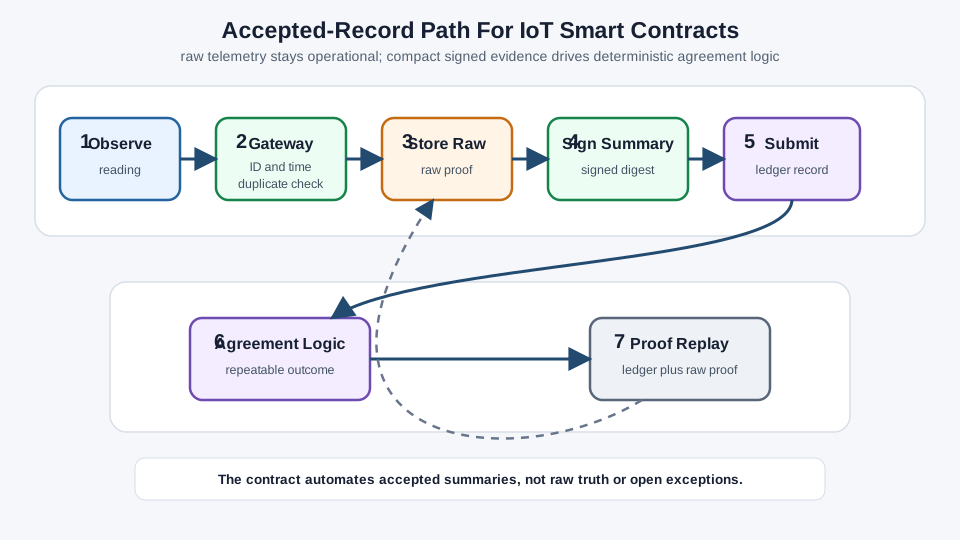
Begin Figure 29.1 with the device event and gateway check. The gateway checks identity, time, whether the event makes sense, and whether it is a repeat. Raw data then stays in the work system as proof. The gateway signs only a short summary or batch mark. The next service accepts that summary into the ledger path, where fixed agreement rules record an outcome. Read the review branch last. A ledger entry is useful only if the saved off-ledger data can recreate its proof. Weak checks would let the contract act on a weak claim more quickly.
29.7 Pattern 1: Validation Bridge
This section: Pattern 1: Validation Bridge — Use a validation bridge when devices cannot or should not interact with the ledger directly.
Use a validation bridge when devices cannot or should not interact with the ledger directly.
The bridge should:
- Accept events only from known devices or trusted local services.
- Normalize timestamps, device identity, and measurement units before submission.
- Reject impossible values and duplicated events before they reach the ledger path.
- Sign compact summaries so later verification can identify the source.
- Buffer records during network outage and mark delayed submissions clearly.
The bridge is not just a relay. It is the part of the architecture that turns noisy device events into records the agreement logic may use.
29.8 Off-Ledger Data, Ledger Outcomes
This section: Off-Ledger Data, Ledger Outcomes — Raw telemetry usually belongs off ledger.
Raw telemetry usually belongs off ledger. The ledger should receive only the part that must be shared across participants.
Keep off ledger:
- High-frequency sensor readings.
- Device diagnostics and gateway logs.
- Large files, images, and maintenance notes.
- Data that may need correction, retention limits, or restricted access.
Put on ledger only when participants need shared proof:
- A batch fingerprint.
- A handoff or identity action.
- An exception summary.
- A state transition approved by agreed rules.
- A reference to governed record storage.
This pattern keeps the ledger small while preserving the ability to replay important decisions.
29.9 Pattern 3: Exception Workflow
This section: Pattern 3: Exception Workflow — Do not let a smart contract automatically treat every unusual reading as final truth.
Do not let a smart contract automatically treat every unusual reading as final truth. IoT systems fail in ordinary ways: sensors drift, batteries weaken, clocks move, gateways reconnect, and packets arrive late.
An exception workflow should include:
- A suspicious-input state for failed gateway checks.
- A verification-required state for disputed or incomplete records.
- A pause rule for high-impact outcomes.
- A replay method that compares the ledger entry with off-ledger records.
- A resolution rule that records the final reviewed outcome.
The best smart-contract IoT designs automate only the parts that are objective and bounded. They route ambiguous cases to verification instead of pretending uncertainty does not exist.
29.10 Upgrade and Recovery Governance
This section: Upgrade and Recovery Governance — Agreement logic needs a way to change safely.
Agreement logic needs a way to change safely. Rule thresholds, participant keys, gateway certificates, record formats, and verification duties may need updates.
Before deployment, decide:
- Who can approve a rule update.
- How a broken gateway key is suspended.
- How duplicate or delayed submissions are handled.
- How a paused outcome is resumed.
- How verifiers prove that off-ledger records still match the ledger record.
- How participants are added, removed, and audited.
The reason to inspect upgrade and recovery governance is concrete. Figure 29.2 depicts: The smart-contract pattern map centers the accepted record and connects it to four safeguards: a validation bridge, off-ledger data retention, an exception workflow, and upgrade governance, with proof replay tying ledger outcomes back to raw records. Distinguish Patterns Around The Accepted Record from raw telemetry and logs.
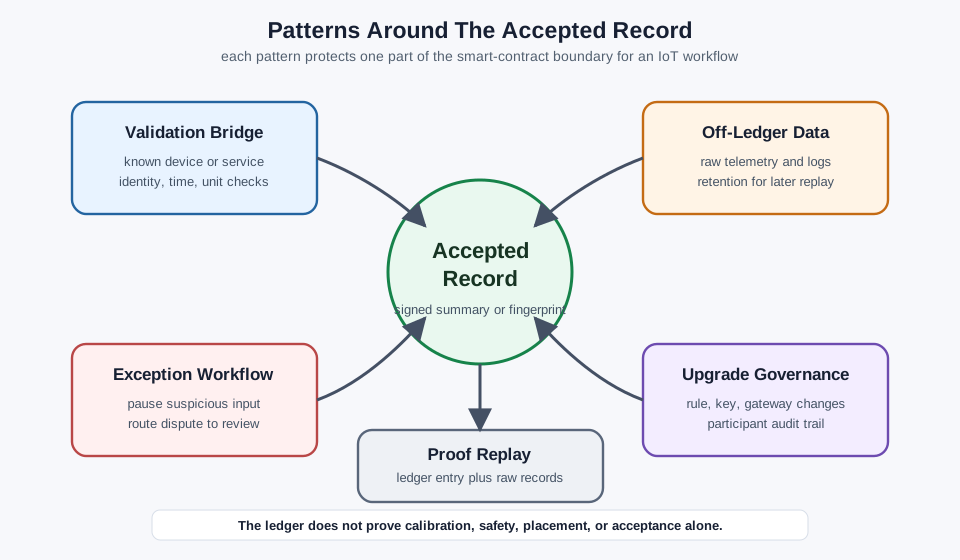
Keep Patterns Around The Accepted Record, raw telemetry and logs, and ledger entry plus raw records separate while reading Figure 29.2. The diagram makes Patterns Around The Accepted Record a visible upgrade and recovery governance cue; its raw telemetry and logs relationship advances the claim: The smart-contract pattern map centers the accepted record and connects it to four safeguards: a validation bridge, off-ledger data retention, an exception workflow, and upgrade governance, with proof replay tying ledger outcomes back to raw records.
29.11 Worked Example: Shared Cold-Room Handoff
This section: Worked Example: Shared Cold-Room Handoff — A campus has several teams using shared cold rooms for temperature-sensitive materials.
A campus has several teams using shared cold rooms for temperature-sensitive materials. The teams want a shared record of handoffs and exceptions, but they do not want every sensor reading replicated to every participant.
29.11.1 Design
The architecture uses these boundaries:
- Room sensors send readings to the local monitoring system.
- The monitoring system keeps raw telemetry and alert history off ledger.
- The handoff gateway summarizes each accepted handoff window.
- The gateway signs a batch fingerprint and an exception summary when needed.
- The smart contract records handoff accepted, exception verification required, verification resolved, or handoff closed.
29.11.2 Trigger Rule
The agreement logic receives a signed summary with:
- Room identity.
- Handoff window.
- Responsible team before and after the handoff.
- Telemetry batch fingerprint.
- Gateway health statement.
- Exception flag and reason category.
If the summary is complete, signed, timely, and inside the agreed operating band, the handoff closes. If the summary is incomplete, delayed, disputed, or outside the band, the outcome moves to exception verification. Raw readings remain in the monitoring system for replay.
29.11.3 Why Not Direct Automation
The contract does not decide whether the physical room was safe by itself. It records which summary was accepted, which rule was applied, and which verification path was chosen. That keeps the ledger useful as a shared record without moving monitoring, control, or judgment into the ledger.
Use Figure 29.3 to follow a cold-room handoff from accepted summary through a disputed exception and human review.
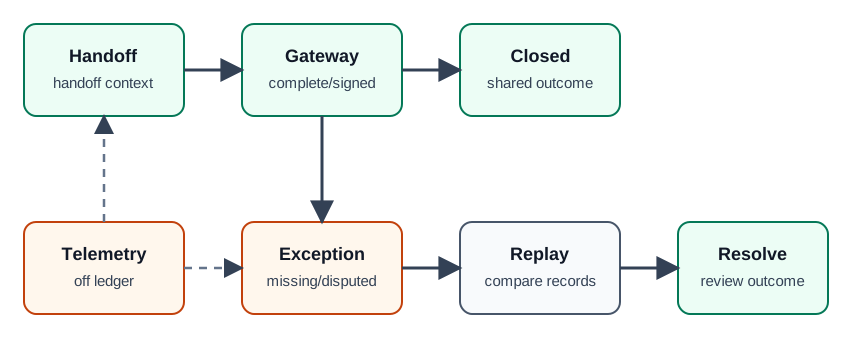
Start Figure 29.3 at the handoff, where the service prepares and signs a summary. The shared ledger can record that accepted handoff, but an incomplete, delayed, disputed, or out-of-band result opens an exception rather than closing the case automatically. The reviewer then compares off-ledger telemetry with the shared record and documents the final reviewed outcome. Follow the close path only after that evidence agrees. The contract proves what accepted records say and when they were recorded; it cannot decide by itself whether the physical cold room was safe.
29.12 Design Readiness Questions
This section: Design Readiness Questions
Use these questions before approving smart contracts for an IoT workflow:
- Fit: Which parties need a shared ledger outcome?
- Accepted record: What exact summary is accepted by the agreement logic?
- Telemetry: Where do raw readings, logs, and files stay off ledger?
- Gateway duty: Who validates, signs, batches, buffers, and retries submissions?
- Trigger rule: Is the rule objective enough for deterministic evaluation?
- Exception handling: What happens when input is missing, delayed, duplicated, or disputed?
- Pause behavior: Which outcomes require verification before they become final?
- Governance: Who changes rules, suspends keys, admits participants, and owns recovery?
- Replay: Can a reviewer recompute the proof from retained records?
29.13 Readiness Record
This section: Readiness Record — A smart-contract IoT design is not ready just because the rule is clear.
A smart-contract IoT design is not ready just because the rule is clear. It is ready when the accepted-record path, operating roles, and recovery behavior are clear.
The readiness packet should include:
- The accepted-record schema and signing method.
- The off-ledger telemetry retention plan.
- Gateway validation and buffering behavior.
- Participant membership and key-management rules.
- Exception states and verification duties.
- Rule update and pause process.
- Proof replay steps and sample records.
- Monitoring signals for failed submission, delayed submission, and mismatched proof.
Figure 29.4 checks whether the accepted-record path and operating roles are defined.
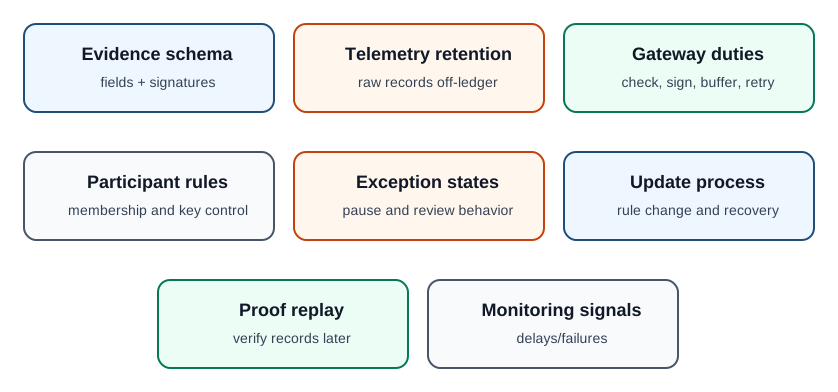
Before making the decision in this section, inspect Figure 29.4. It makes the decision concrete by showing a readiness record gathers record schema, telemetry retention, gateway duties, participant governance, exception states, update process, proof replay, and monitoring signals, so the relationships can be checked before they are turned into a design claim.
The readiness test has three linked questions. What record can be accepted? Who operates and verifies the path? How do exceptions recover? The packet then records the schema, signing method, off-ledger telemetry and retention, exception states, and verification duties among its entries. A smart contract can evaluate a signed summary consistently, but it cannot repair missing device evidence or assign an unowned incident. Cross-check the packet against a normal event and a disputed or repeated event before approving the design. An empty checklist or an agreed contract address is not proof that the full record path is ready.
Common Failure Patterns
This section: Common Failure Patterns
The contract sees submitted records, not the physical world. If the validation bridge is weak, the outcome is weak even when the ledger behaves correctly.
Raw telemetry is high volume, query-heavy, and often needs correction or retention control. Keep it in operational storage and anchor only compact shared records.
Unusual IoT data often needs verification. Suspicious, delayed, or incomplete input should pause the workflow instead of forcing an automatic final result.
Every shared automation path needs governance for rule updates, gateway replacement, participant removal, key suspension, and proof replay.
29.14 Knowledge Check
This section: Knowledge Check
29.15 Knowledge Check
This section: Knowledge Check
29.16 Match The Concepts
This section: Match The Concepts
29.17 Order The Accepted Record Path
This section: Order The Accepted Record Path
29.18 Contracts Evaluate Records
This section: Contracts Evaluate Records — A smart contract is only as trustworthy as the record it receives.
A smart contract is only as trustworthy as the record it receives. The contract can apply the same rule to the same input every time, but it cannot tell whether a freezer door really opened, whether a sensor was calibrated, or whether a gateway skipped a failed reading.
Before making the decision in this section, inspect Figure 29.5. It makes the decision concrete by showing keep the smart contract behind the accepted-record boundary: physical events and raw telemetry stay operational, while signed records feed deterministic agreement and replayable verification, so the relationships can be checked before they are turned into a design claim.Figure 29.5 marks where a physical observation becomes a signed record.
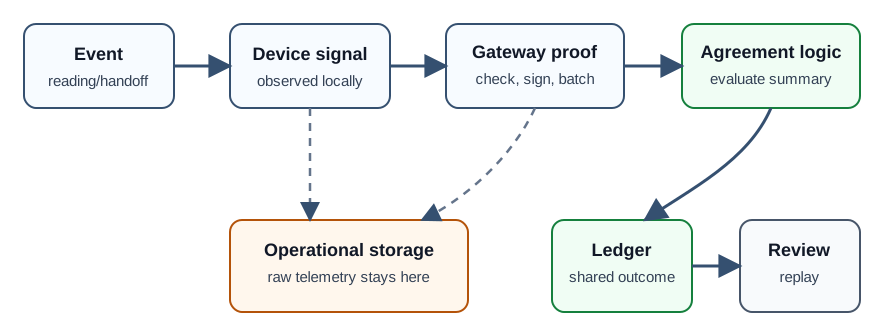
Read Figure 29.5 from the real event to the gateway. Readings, logs, and files stay off the ledger. The gateway checks identity, time, whether the event makes sense, and whether it is a repeat. Only a signed summary that passed those checks crosses the record line. A fixed rule reads that record and writes a shared result; it does not see the room, meter, or door. A later review compares the ledger entry with the saved work data. This split supports replay and keeps a contract result from being mistaken for direct proof of the real event.
The event, raw readings, logs, and files stay available off ledger for later replay. A validation gateway checks identity, time, plausibility, and repeats before signing a summary. Only that accepted summary crosses to the deterministic contract path. Participants can then agree on the submitted record, but that agreement cannot establish whether the sensor was mounted correctly or the physical event really occurred. Keep the gateway checks and raw evidence linked to the accepted record, and test how a rejected or duplicate event is handled. This boundary decides what the smart contract can honestly claim.
Mobile summary: The contract can evaluate accepted records, but gateway checks, off-ledger evidence, exception states, and replay rules make the outcome trustworthy.
That is why the IoT architecture around the contract matters more than the contract code by itself. The design has to name the accepted record, the gateway checks, the off-ledger evidence, the exception path, and the proof replay method before the ledger outcome can be trusted.
For an overview review, sort every proposed contract action into three boxes. The physical box contains readings, door openings, charger states, and alarms. The evidence box contains signed summaries, fingerprints, timestamps, and participant identities. The agreement box contains the rule that changes shared state after an evidence record is accepted. If a proposed contract tries to live in the physical box, it is doing the wrong job. If it lives in the agreement box but the evidence box is vague, the outcome will be hard to defend during a dispute.
A practical smart-contract design therefore starts with a modest promise: make a narrow shared decision replayable. It does not promise that every device is honest, that every packet arrived, or that every late correction can be ignored. The contract records the accepted state transition, while the IoT system keeps enough operational evidence for another participant to check why that transition happened. That separation is what keeps automation useful without pretending software consensus can inspect the physical world.
29.19 Contract Boundary Record
This section: Contract Boundary Record — For each automated outcome, write a boundary record that says exactly what the contract is allowed to decide and what remains outside the ledger.
For each automated outcome, write a boundary record that says exactly what the contract is allowed to decide and what remains outside the ledger. This keeps the implementation from drifting into raw telemetry storage, direct control, or unreviewable judgment.
| Boundary Item | Record It As | Reject If |
|---|---|---|
| Accepted input | A signed summary with schema, source, timestamp, fingerprint, and gateway health statement. | The contract receives whatever raw value arrives first. |
| Validation owner | A named gateway, service, or operator that checks identity, plausibility, duplicates, and delayed data. | The design says "oracle" without assigning checks or failure behavior. |
| Exception state | A pause or verification-required outcome for missing, disputed, stale, or out-of-range input. | Every unusual record is forced into a final accepted or rejected state. |
| Replay evidence | Retained telemetry batch, signature chain, ledger entry, rule version, and reviewer steps. | The ledger has a result but the underlying evidence cannot be reproduced. |
The boundary record should be concrete enough that an implementer can build tests from it. For a cold-room handoff, write the accepted schema fields, the units, the allowed clock skew, the gateway certificate, the batch window, the fingerprint algorithm, and the exact exception codes. Include an idempotency key so a retry cannot close the same handoff twice. Include the rule version so a later review can distinguish an old threshold from a new one.
Then test the bad paths before the contract is trusted. Submit a delayed summary, a duplicate summary, an unsigned summary, a summary with a missing telemetry batch, and a summary signed by a suspended gateway. Each case should land in a predictable state: reject, pause, retry, or require verification. If the only tested path is the successful transaction, the contract may look deterministic while the IoT evidence chain remains fragile.
Keep the boundary record with the architecture decision, not only with the code repository. Operations, compliance, and partner teams need to know who owns gateway recovery, who can pause automation, and which retained records prove an outcome months later.
29.20 Determinism Cannot Verify Input
This section: Determinism Cannot Verify Input — Smart contracts are deterministic so peers can reach the same ledger outcome.
Smart contracts are deterministic so peers can reach the same ledger outcome. Determinism protects agreement about state transitions; it does not validate the physical event that produced the input record.
If a gateway key is compromised, a clock is wrong, a telemetry batch is missing, or a sensor is miscalibrated, the contract may still run perfectly and record the wrong business outcome. The ledger can make that outcome visible and replayable, but the correction has to come from gateway controls, exception workflow, governance, and retained evidence.
Design review should therefore test two chains separately: the contract state chain and the evidence chain. The system is ready only when both chains can fail visibly, pause safely, and be replayed by a participant who did not operate the original device.
The contract state chain should be simple: current state, accepted input, rule version, new state, emitted event, and receipt. Every peer can recompute that transition. The evidence chain is longer: sensor or local service, gateway validation, canonical serialization, signature, off-ledger storage pointer, fingerprint, submission time, ledger transaction, and replay procedure. A weak evidence chain can feed a perfect state transition with bad input.
Canonicalization is a common failure point. If one gateway hashes JSON with fields in insertion order and another verifier sorts fields alphabetically, the replay may fail even when the readings are the same. If timestamps are rounded differently, a batch fingerprint can become unreproducible. Record the serialization rule, time source, rounding rule, hash algorithm, and batch boundary with the accepted record so a later verifier can reproduce the exact proof.
Corrections should also be explicit state transitions. Do not silently edit the off-ledger batch and pretend the old ledger outcome still proves the same thing. Submit a governed correction or reversal record that names the old transaction, the reason, the evidence used, and the rule that allows the correction. That preserves the shared history while still letting the system recover from faulty gateways, bad clocks, or disputed summaries.
29.21 Summary
This section: Summary — Smart contracts for IoT are best understood as agreement logic around trusted records.
Smart contracts for IoT are best understood as agreement logic around trusted records. They should not replace telemetry systems, safety loops, device diagnostics, or governance. A strong design separates physical events from accepted records, keeps raw readings off ledger, uses gateways for validation and signing, records compact shared outcomes, and gives uncertain cases a verification path.
The readiness question is simple: can another participant replay the proof and understand why the agreement logic produced its outcome? If the answer is yes, the smart contract is serving the IoT architecture rather than distorting it.
29.22 Key Takeaway
This section: Key Takeaway — Smart contracts are useful only when the rule, authority boundary, update path, failure mode, and off-chain records are explicit enough to audit.
Smart contracts are useful only when the rule, authority boundary, update path, failure mode, and off-chain records are explicit enough to audit.
29.23 What’s Next?
This section: What’s Next?
Continue with the adjacent blockchain chapters:
- Blockchain Limitations for IoT - stress-test whether a ledger design fits the IoT workload.
- Blockchain Interactive Lab - practice signed events, batching, and replay using a guided lab.
- Blockchain Fundamentals for IoT - revisit ledger concepts that support shared records.
Find help
3 reviewed answers.
Where should I start in a module?
Open the module page from the sidebar to see its chapters in order. Use the module map to return to a topic you need.
Modules and pathsReviewed
What can I try when a project does not work?
Check the symptom, then work through the diagnostic steps. Keep the error message and the smallest example that reproduces it.
When you are stuckReviewed
How do interactive examples work?
Use the interactive guide to check how examples and simulations work before changing your project.
Interactive examples guideReviewed