20 SDN Data Centers and Security
More
Depth: Practitioner
Progress saves as you read. Mark sections complete as you go; your progress appears in the sidebar.
20.1 Start With the Workload Risk
This section: Start With the Workload Risk — Picture a hospital service moving from one host to another during repair.
Prove One Allowed Path and One Blocked Path
Picture a hospital service moving from one host to another during repair. It must still reach its record store. A guest device on the same site must never reach that store. A bright diagram cannot prove either rule.
Choose one important flow. Name the sender, receiver, reason, allowed route, denied peers, and owner. Write what should happen if the central control part is slow or missing. Keep the last safe rule until a checked change is ready.
Run the allowed test from the real work unit. Then try the blocked test from another zone. Save the rule version, time, path, result, and change record. Move the work unit and repeat both tests.
Next, use a false change. Ask for a wider route than the job needs. Check who can approve it, where the request is logged, and whether the old rule can return. A quick response is useful only when it is bounded and can be explained.
Break one control link and one data link. The system should show which view is current and which is old. It should not report a clean state when it cannot see the path. Keep a separate way to inspect and recover the control parts.
Review the evidence with an operator and the owner of the protected work. They should be able to answer what was allowed, why, when it changed, and what happened during the break.
This small proof loop cannot cover every shared host, rule race, or hostile action. Practitioner builds the full segment and response record. Under the Hood follows control protection, observation gaps, and the deeper limits of fast central change.
In an SDN data center, security is a proof loop around workload movement, segmentation, controller protection, telemetry, and response. The risk is not only that traffic reaches the wrong place, but that nobody can prove why.
Start simple: choose one workload path and define allowed peers, denied peers, controller permissions, alerts, and audit evidence. The design is stronger when the proof loop is visible before an incident.
20.2 Security Is A Proof Loop
This section: Security Is A Proof Loop — SDN can improve data-center security when it gives operators precise policy, current traffic observations, bounded response actions, and an audit record that survives the incident.
SDN can improve data-center security when it gives operators precise policy, current traffic observations, bounded response actions, and an audit record that survives the incident. The controller is useful because it can express policy and program forwarding behavior quickly. It is not a security guarantee by itself.
The first design question is the security relationship being proven: which workload, gateway, service, or management path is allowed, which lateral path is denied, which observation proves both outcomes, and which response is safe if the observation changes.
For an IoT data-center zone, make that relationship concrete. Camera gateways might publish event metadata to an MQTT broker on TLS port 8883, write video references to an object-storage API, receive firmware from an HTTPS update service, and allow administration only through a jump host. They should not initiate gateway-to-gateway sessions, reach the time-series database directly, or call the controller API. SDN policy is useful when it can express those relationships at the right boundary: Open vSwitch flows, OVN logical policy, EVPN/VXLAN segmentation, service-mesh policy, or another controller-backed enforcement point that the team can observe.
The proof loop then checks both sides of the boundary. Confirm the allowed broker path works with counters or flow telemetry, attempt a blocked lateral path, verify the denied event carries source group and policy version, and check that service health stays acceptable. If a response action will redirect traffic to inspection, mirror suspicious flows, or quarantine a gateway group, the action needs a blast-radius limit before production traffic depends on it. Record the sample packet, policy version, and operator owner so the result can be repeated during the next change.
The route in Figure 20.1 links a workload to policy, logs, response, and audit proof.
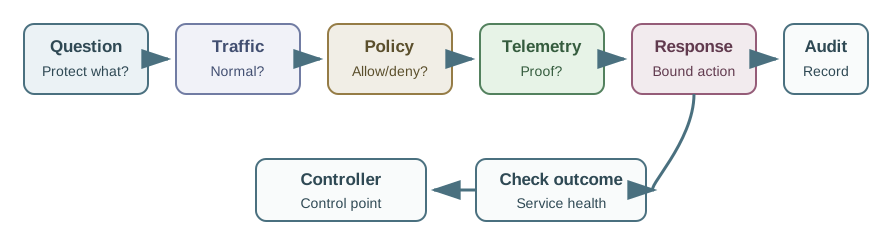
The route in Figure 20.1 begins with the workload relationship to protect. Traffic evidence says which broker, storage, update, or management path is normal, and policy names both allowed and denied paths. Telemetry checks what happened after that policy reached the data plane. A response may block, mirror, redirect, or quarantine, but its scope and rollback rule must be bounded before it is used on production traffic. Audit keeps the policy version, packet or counter, and operator with the result. Service health is the final check, because a security action that stops an approved workload has crossed the intended boundary.
Allowed Path
Approved traffic reaches the intended broker, service, storage layer, or management endpoint through a named path and protocol family.
Denied Path
East-west, management, or lateral movement that should not happen is blocked or logged with enough context to prove the policy.
Response Bound
Block, limit, redirect, mirror, or quarantine actions have a scope, approval rule, rollback path, and post-action service-health check.
Security rule: prove both sides of the policy. Showing that approved telemetry arrived is incomplete unless the denied lateral or management path was also checked.
20.3 Segmentation Record
This section: Segmentation Record — Micro-segmentation is stronger than a subnet label only when it records allowed relationships, denied relationships, rule ownership, and observations from the data plane.
Micro-segmentation is stronger than a subnet label only when it records allowed relationships, denied relationships, rule ownership, and observations from the data plane. For IoT workloads, useful records usually name gateways, brokers, analytics services, storage, update services, operations hosts, and any local fallback path that must continue when the data-center path is degraded.
Build the record from a small number of named flows rather than from a large policy export. A good first row might say: camera-gateway group cam-gw-prod may publish telemetry to broker group mqtt-core on 8883, may fetch updates from fw-update on 443, may send logs to log-ingest, and may be administered only from ops-jump. The denied rows should be just as explicit: no gateway-to-gateway east-west sessions, no direct database writes, no controller API access, and no outbound management tunnel except the approved path.
Collect proof from places that observe different parts of the path. The controller rule diff shows intent. Switch or gateway acknowledgement shows the rule was accepted. IPFIX, sFlow, NetFlow, broker counters, denied-flow logs, and service-health checks show what happened after the rule landed. For a Kubernetes-hosted broker, include the NetworkPolicy or Cilium policy that protects the pod boundary; for an OVN or Open vSwitch path, capture the logical policy, flow-table change, and representative counters. The record should let an operator explain why a policy is safe without opening the controller UI.
Why pause at segmentation record? Beside Gateway group, the diagram Figure 20.2 makes Update service explicit within this relationship: Segmentation proof names groups, allowed relationships, denied relationships, rule ownership, and observed traffic behavior.
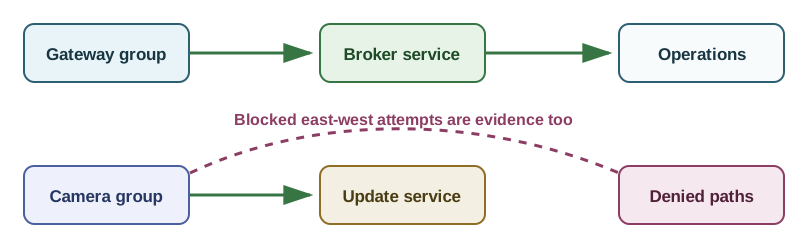
The groups in Figure 20.2 turn a broad zone into named relationships. Camera gateways may reach the broker and update service through approved paths, while operations access follows its own route. Gateway-to-gateway sessions and direct controller access are denied paths, and a blocked east-west attempt is evidence the boundary was enforced. A controller diff shows intent, switch acknowledgement shows installation, and counters or service checks show traffic behavior. Keep the policy version and group owner beside both allowed and denied test results. This makes a later gateway or broker change reviewable without trusting a subnet name as the whole security policy.
Before approving segmentation record, test the depicted proposition in Figure 20.3: Response playbooks should be prebounded before automation changes live forwarding behavior. Read from Signal toward Redirect/mirror.
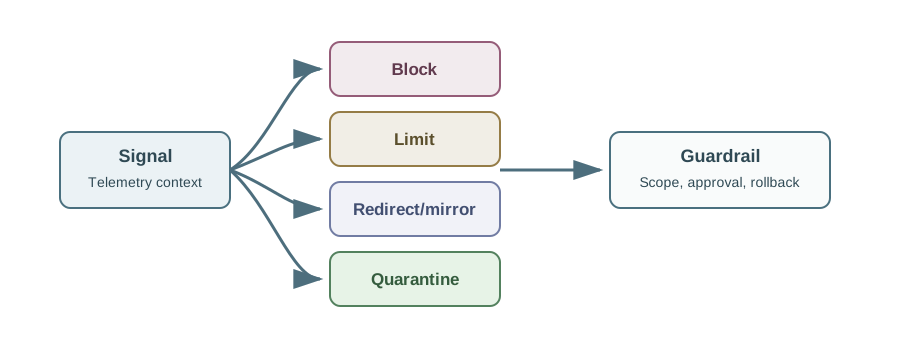
Three concrete diagram labels organize Figure 20.3: Signal, Redirect/mirror, and Scope, approval, rollback. Between them, the segmentation record relationship becomes visible: Response playbooks should be prebounded before automation changes live forwarding behavior.
A useful response playbook states the trigger, scope, action, guardrail, proof, rollback path, and service-health check. The controller may execute the change, but operators still need a record that explains why the change was safe.
20.4 Controller Protection and Telemetry
This section: Controller Protection and Telemetry — The controller has unusual power because it can turn policy into forwarding behavior.
The controller has unusual power because it can turn policy into forwarding behavior. Its API, application permissions, state store, southbound channel, and audit trail must be treated as part of the security boundary. A compromised or confused controller can make an approved-looking rule unsafe.
Protect the control path like a production administration system, not like a monitoring dashboard. API callers should be authenticated, authorized by role, and scoped to workload groups they are allowed to change. Southbound channels should use the controller platform's supported protection, such as TLS where the protocol and device support it, and the state store should be backed up and versioned enough to reconstruct who changed a policy. A break in any of those surfaces can create a rule that looks intentional while bypassing the real approval path.
Practitioner Knowledge Check
Treat controller protection and telemetry as a system decision around Protect the controller before trusting the rule. The visual in Figure 20.4 places State store within this relationship: Controller security checks cover API access, application intent ownership, state-store integrity, protected southbound channels, change approval, and audit reconstruction before a forwarding rule is trusted.
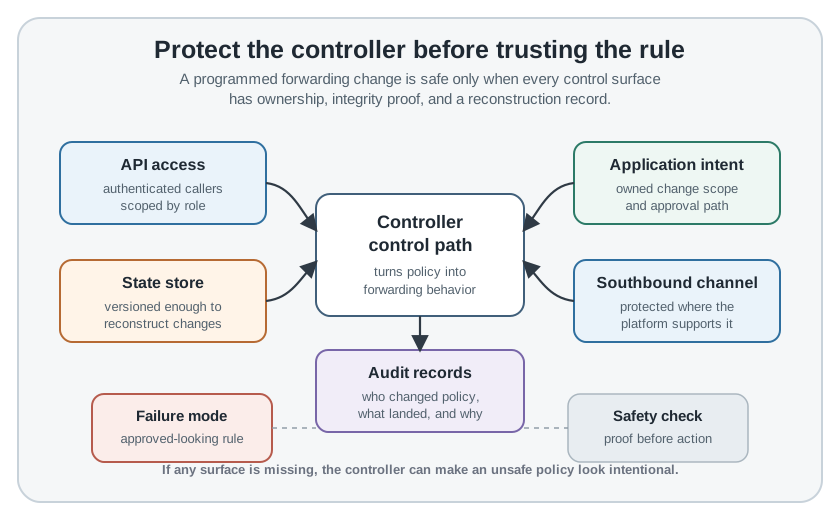
Keep Protect the controller before trusting the rule, State store, and proof before action separate while reading Figure 20.4. The diagram makes Protect the controller before trusting the rule a visible controller protection and telemetry cue; its State store relationship advances the claim: Controller security checks cover API access, application intent ownership, state-store integrity, protected southbound channels, change approval, and audit reconstruction before a forwarding rule is trusted.
Telemetry also needs context. Flow counters, port counters, topology events, rule changes, denied attempts, and service health are raw signals. They become security proof only after the team ties them to a baseline, policy, affected asset, controller action, and post-action observation.
That context is what separates detection from disruption. A denied-attempt counter may mean reconnaissance, a misconfigured gateway image, a broker migration, or a stale group assignment. Before automation quarantines a group, the controller should know the baseline, the policy owner, the affected service, the last rule diff, and the rollback path. The same event should appear in operational logs or the SIEM with enough source, destination, policy, and action detail for an incident responder to decide whether to isolate, rate-limit, mirror, or simply fix inventory.
The safest automated response is usually staged. Mirror or log first when confidence is low, limit or redirect when service health can tolerate it, and quarantine only when the trigger, ownership, and blast radius are proven. A gateway group that carries freezer alarms or access-control events may need local continuity even while its data-center path is restricted. The controller can make the change quickly, but the system is only secure when the resulting traffic, service health, and rollback evidence are visible.
The reason to inspect controller protection and telemetry is concrete. Figure 20.5 depicts: Telemetry is useful when it links the signal, baseline, policy context, affected asset, action, and result. Distinguish Detection from Port counters.
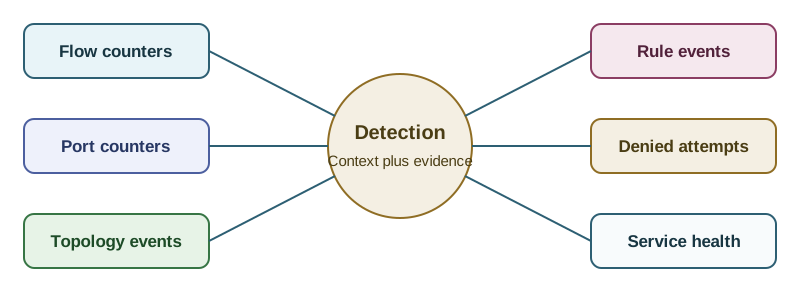
Map Detection to the current requirement in Figure 20.5. Map Port counters to the next duty and Service health to the later proof. This continues controller protection and telemetry: Telemetry is useful when it links the signal, baseline, policy context, affected asset, action, and result.
Unauthorized Intent
API access and application permissions should prevent an unapproved user, service, or app from creating production forwarding rules.
Stale State
Topology, host, group, or path state must be checked before a rule depends on it. Old state can steer traffic into the wrong boundary.
Unsafe Automation
Automation should prove the trigger, affected scope, service impact, rollback option, and incident record before it escalates.
20.5 Summary
This section: Summary — SDN data-center security is useful when policy, forwarding state, telemetry, response, controller protection, and audit records form one proof loop.
SDN data-center security is useful when policy, forwarding state, telemetry, response, controller protection, and audit records form one proof loop. For IoT workloads, the durable checks are gateway paths, broker and management access, denied lateral movement, local continuity, controller authority, and bounded response. A design is trustworthy only when it proves both the allowed behavior and the denied behavior.
20.6 Key Takeaway
This section: Key Takeaway
Treat SDN security as a traceable proof loop: name the workload boundary, prove allowed and denied paths, protect the controller, bound the response, and store the audit record.
20.7 See Also
This section: See Also
Use this next to review controller responsibilities, failure behavior, and policy proof.
SDN APIs and High Availability
Check API contracts, state ownership, controller clustering, and failover evidence.
Connect data-center segmentation to IoT gateways, brokers, mobility, and service assurance.
Turn the security proof loop into release gates, observability, rollback, and operations handoff.
Find help
3 reviewed answers.
Where should I start in a module?
Open the module page from the sidebar to see its chapters in order. Use the module map to return to a topic you need.
Modules and pathsReviewed
What can I try when a project does not work?
Check the symptom, then work through the diagnostic steps. Keep the error message and the smallest example that reproduces it.
When you are stuckReviewed
How do interactive examples work?
Use the interactive guide to check how examples and simulations work before changing your project.
Interactive examples guideReviewed