27 When IoT Needs Blockchain
More
Depth: Practitioner
Progress saves as you read. Mark sections complete as you go; your progress appears in the sidebar.
27.1 Start With the Shared Evidence Problem
This section: Start With the Shared Evidence Problem — Picture a cold shipment passed from a farm to a carrier and then a shop.
Put Only the Shared Proof on the Ledger
Picture a cold shipment passed from a farm to a carrier and then a shop. All three need one durable handover history, but none should be able to rewrite it alone. The architect must decide which compact facts they share and which detailed sensor records stay in normal storage.
Follow the cold shipment through its handoffs. Look for the point where each party needs a shared record it cannot quietly rewrite.
-

A cold shipment passes from a farm to a carrier and a shop.
-
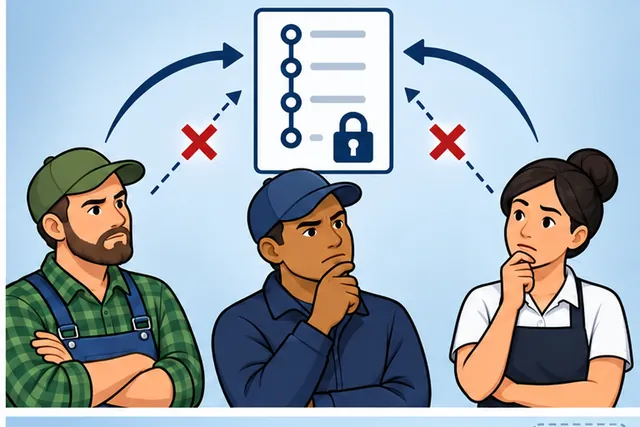
Each party needs shared history, but none should rewrite it alone.
-

Keep signed handoffs on the ledger and raw readings in owned storage.
-
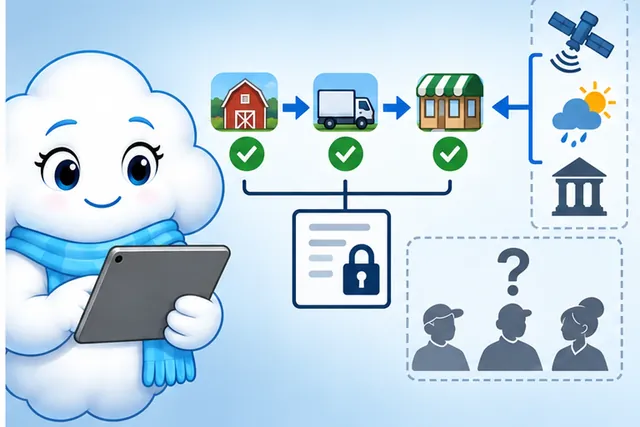
Accept the record only while order, links, and disputes stay reviewable.
The farm, carrier, and shop each handle the same shipment. The next panel shows why trust across those parties is hard. The final panels put signed handoffs in a shared ledger while raw readings stay in owned storage; they still leave order, links, and disputes open to review. The event record below turns that picture into fields.
Write one event record. Name the asset, signer, event time, place, evidence digest, prior event, rule version, and parties allowed to review it. Keep raw readings off the ledger with a stable link and retention owner. State which outside source makes the real-world claim and who can dispute it.
Test a false signer, wrong shipment, late event, repeated event, changed outside data, missing raw record, key loss, rule update, and a dispute between parties. Check that history stays ordered and reviewable without turning a bad physical reading into truth. Reproduce one ledger entry from its off-ledger evidence.
Keep real-time physical control outside the shared ledger path. A slow or unavailable group decision must not block a local safe stop. Shared history can support review and settlement, but it cannot prove that a sensor was mounted or calibrated correctly.
This opening does not choose a chain or settle every legal question. Practitioner builds the fit and reconstruction test. Under the Hood examines agreement, signatures, hashes, outside evidence, privacy, cost, upgrades, and failure limits.
Use this shared proof check:
- Name all the parties.
- Name the shared event.
- Name the true signer.
- Keep raw facts off chain.
- Keep a stable link.
- Try a false signer.
- Try a late event.
- Try a lost record.
- Rebuild one past claim.
- Reopen when rules change.
- Reject a weak fit.
Blockchain belongs in IoT only when several parties need the same durable event history and no single party should silently rewrite it. The ledger is not the sensor database, control loop, or dashboard.
Start simple: name the shared record, the signer, the off-ledger data it summarizes, and the later review that must reproduce it. If that story is weak, a normal IoT architecture is probably stronger.
27.2 Why This Chapter Exists
This section: Why This Chapter Exists — This chapter is the gateway for the blockchain series.
Blockchain appears in many IoT proposals because connected devices create evidence: who measured something, which gateway accepted it, which organization handed over an asset, and which automated agreement ran after a verified event. The architecture challenge is to decide which of those facts deserve a shared ledger and which belong in normal IoT systems.
This chapter is the gateway for the blockchain series. It gives you the fit test, the system placement, and the review questions before the later chapters go deeper into fundamentals, smart contracts, limitations, and the lab.
Do not apply why this chapter exists until its premise is visible near Several parties in Figure 27.1: A blockchain fit route keeps single-owner telemetry and real-time control outside the ledger path while sending shared, tamper-evident events to ledger review. Inspect the span to beats instant control.
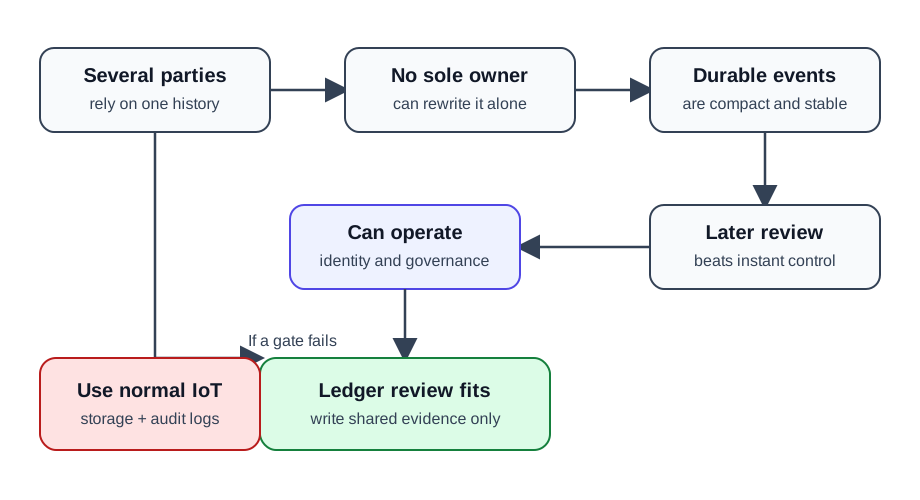
For why this chapter exists, the diagram Figure 27.1 uses Several parties as the entry and beats instant control as a later checkpoint. Finish at If a gate fails. The full reading conveys: A blockchain fit route keeps single-owner telemetry and real-time control outside the ledger path while sending shared, tamper-evident events to ledger review.
27.3 Learning Objectives
This section: Learning Objectives
By the end of this chapter, you will be able to:
- Identify the trust problem that makes a distributed ledger relevant to an IoT system.
- Separate raw telemetry, control actions, shared evidence, and review workflows.
- Explain why gateways usually mediate ledger interaction for constrained devices.
- Choose the most useful chapter path through the blockchain series.
- Prepare evidence for approving or rejecting blockchain in an IoT architecture.
27.4 Quick Check: Blockchain Fit Boundaries
This section: Quick Check: Blockchain Fit Boundaries
Key Concepts
This section: Key Concepts
- Shared evidence: Durable records that several parties must be able to inspect later, such as custody handoffs, meter summaries, identity actions, and agreement outcomes.
- Trust boundary: The point where one organization can no longer be the only owner of the event history.
- Off-ledger telemetry: The operational readings, logs, files, and analytics data kept in normal IoT storage while selected proofs or milestones are written to the ledger.
- Gateway mediation: The pattern where a gateway or service packages device events, signs records, buffers during outages, and submits ledger transactions.
- Consensus set: The participating nodes that agree which ledger records are accepted.
- Finality window: The time after which an accepted record is treated as settled enough for the system purpose.
- Agreement logic: Deterministic rules that evaluate accepted evidence and produce outcomes all parties can review.
- Governance: The rules for joining, writing, reading, recovering, suspending, and changing the shared ledger system.
27.5 The Fit Test
This section: The Fit Test — Blockchain is useful only when the architecture has a real shared-trust problem.
Blockchain is useful only when the architecture has a real shared-trust problem. A normal telemetry platform with signed events, access control, backups, and audit logs is usually better when one organization owns the full system.
The ledger path becomes relevant when all of these statements are true:
- Several parties rely on the same event history.
- No single party should be able to silently rewrite that history.
- The records are compact, durable, and meaningful outside the moment they were created.
- Later verification matters more than immediate control response.
- The project can support identity, key handling, governance, outages, and recovery.
Use a normal IoT architecture when any of these statements are true:
- One organization owns the devices, gateways, storage, and dashboards.
- The data is high-frequency telemetry that needs query, retention, correction, and analytics.
- The action is a safety or control loop that needs predictable local response.
- The record may need routine editing, correction, or deletion.
- The project has not assigned governance for participants, keys, rule changes, and recovery.
27.6 Where Blockchain Fits
This section: Where Blockchain Fits — In a practical IoT architecture, the ledger is not placed at the sensor edge.
In a practical IoT architecture, the ledger is not placed at the sensor edge. It sits beside the operational system as a shared evidence layer.
Devices observe physical events and hold device identity material appropriate to their hardware.
Gateways or edge services validate local input, apply buffering rules, attach signatures, and send compact records onward.
Telemetry stores keep raw readings, event streams, files, and analytics-ready data.
Distributed ledgers store selected evidence records, such as fingerprints, custody events, identity changes, and agreement outcomes.
Verification workflows replay the proof path by comparing off-ledger records with ledger entries.
Use Figure 27.2 to decide which records belong on a shared ledger and which operational work must remain in the ordinary IoT path.
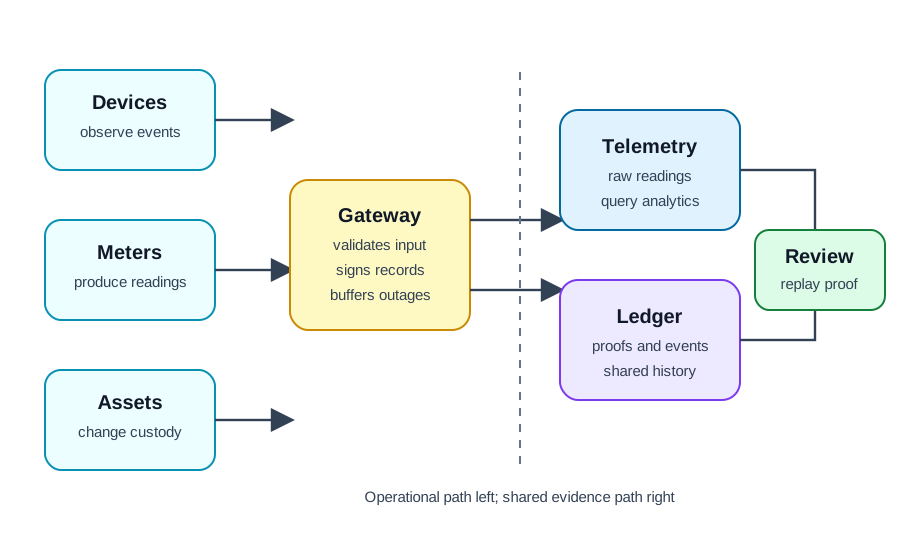
Begin Figure 27.2 with the real event and device identity. Follow both through gateway checks and a queue into the data store. This is the work path. Raw readings, event streams, files, and live control stay off the ledger. Only chosen marks, handoff events, identity changes, or agreed results enter shared history as short signed records. Read the review branch last. A reviewer gets the saved off-ledger data, makes its proof again, and checks it against the ledger entry. The ledger can thus support a shared check without claiming that it sensed or controlled the real process.
27.8 Blockchain Fit Record
This section: Blockchain Fit Record — A fit record prevents a ledger from becoming a vague architecture ornament.
A fit record prevents a ledger from becoming a vague architecture ornament. It names the shared fact, the party boundary, the off-ledger path, and the replay method before implementation starts.
| Question | Good Answer | Reject If |
|---|---|---|
| Who needs the shared history? | Building owner, charger operator, settlement partner, or other named parties. | The design says "transparency" without naming who verifies what. |
| What goes on ledger? | Signed period summaries, custody events, fingerprints, identity changes, and settlement outcomes. | Every raw reading, dashboard update, and control command is proposed as a transaction. |
| Where does raw data live? | In telemetry storage with retention, correction, query, and alerting behavior. | The ledger is treated as the telemetry database. |
| Who submits records? | A gateway or service with signing, batching, buffering, retry, and outage marking duties. | Constrained devices are expected to be full ledger participants. |
| How is proof replayed? | Retrieve the off-ledger batch, recompute the fingerprint, check signature and timestamp, then compare with the ledger entry. | The system keeps a ledger entry but cannot reproduce the underlying evidence. |
For the shared energy example, a usable fit record might say that the gateway signs a 15-minute period summary with its fleet certificate, stores the raw readings in a time-series database, computes a deterministic batch fingerprint, and submits only the summary identifier, fingerprint, signer, period boundary, and settlement state to the ledger. The record should name the canonical serialization used before hashing, such as stable JSON or CBOR, because replay fails if different systems sort fields or round timestamps differently.
The same record also needs failure behavior. Give every submitted summary an idempotency key so a retry does not create a duplicate settlement record. Mark gateway outage windows explicitly instead of pretending the ledger saw live readings. Define who can rotate a gateway certificate, suspend a charger operator, add a settlement participant, or change agreement logic. If the proposal cannot answer those questions, the architecture is not ready for a ledger even if a prototype can write transactions.
A strong practitioner review rejects broad claims such as "transparency" or "trustless IoT" unless the team can point to the exact party that verifies the exact record. It also rejects designs that put personal occupancy traces, raw energy waveforms, or charger-stop commands on chain. Those belong in operational systems with retention, access control, correction, and privacy controls; the ledger should preserve the shared proof needed for later dispute review.
27.9 Finality Is Not a Deadline
This section: Finality Is Not a Deadline — Ledger finality is a settlement concept.
Ledger finality is a settlement concept. It says when the participating nodes treat a record as accepted enough for the system purpose. It is not the same as the deadline for a charger to stop, a valve to close, or a cold-chain alert to fire.
That distinction shapes the architecture. A gateway can submit a signed period summary after collecting readings. A settlement partner can wait for finality before accepting a billing outcome. The charger-control loop still runs locally or at the edge because it must respond on an operational deadline.
In a permissioned system such as Hyperledger Fabric, finality depends on endorsement, ordering, validation, and commitment by the participating peers. That process can be appropriate for accepting an energy-summary record, but it is the wrong place to wait before opening a relay or stopping a charger. A charger command usually travels through a local controller, OCPP service, or gateway policy engine with a deadline measured by the operational risk. The ledger receives evidence after the control path has made the safe decision.
Proof replay is the bridge between those timelines. A reviewer retrieves the off-ledger batch, recomputes the batch fingerprint, verifies the gateway signature, checks the timestamp and sequence range, then compares those facts with the accepted ledger entry. If the raw telemetry was corrected later, the corrected batch needs its own correction record; silently changing the old batch breaks replay. If the gateway was offline, the outage queue should preserve order, mark the offline interval, and submit records with enough metadata to distinguish late evidence from live evidence.
When a proposal mixes control timing, telemetry retention, ledger acceptance, and dispute review into one path, split it into separate lanes before approval: control deadline, telemetry ingestion, ledger finality, proof replay, privacy retention, and governance change. The system is ready only when each lane has an owner, a failure mode, and a testable artifact.
27.10 Chapter Series Map
This section: Chapter Series Map — Use Figure 27.3 to choose the next chapter from the decision you still need to make, rather than reading the sequence as one undifferentiated topic.
Use the rest of the series based on the decision you need to make:
- Blockchain Fundamentals for IoT explains hashing, signatures, consensus, finality, off-ledger anchoring, and ledger pattern selection.
- Smart Contracts and Architectural Patterns explains how agreement logic uses accepted evidence and how gateway, anchoring, and hybrid storage patterns work.
- Blockchain Limitations and Real-World Implementations explains throughput, latency, governance, energy, privacy, and operational limits.
- Blockchain Interactive Lab and Knowledge Check gives hands-on practice with block structure, hash links, validation, and tamper detection.
Use Figure 27.3 to choose the next chapter from the decision you still need to make, rather than reading the sequence as one undifferentiated topic.
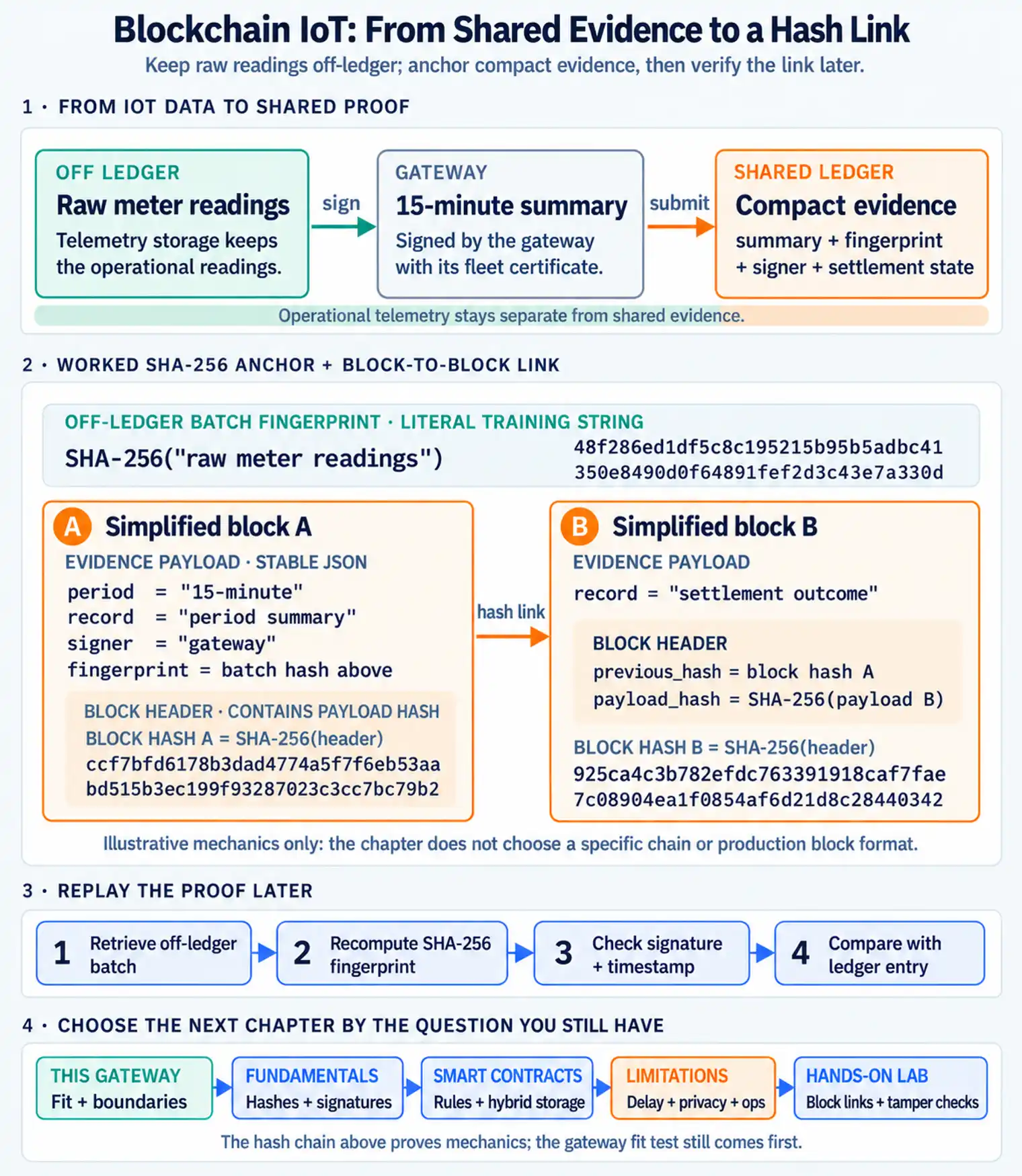
Start at this gateway chapter in Figure 27.3, where the fit test and system boundary come first. Move to fundamentals when hashing, signatures, consensus, finality, or off-ledger anchoring is the missing concept. Choose smart contracts for accepted-record rules and hybrid storage patterns. Use the limitations chapter when throughput, delay, governance, energy, privacy, or operations may overturn the proposed design. The lab comes last because building a block and checking a hash link proves mechanics, not architectural fit. The route keeps each learning step tied to a specific design question.
27.11 Shared Energy Meter Records
This section: Shared Energy Meter Records — Consider a shared energy system with building meters, solar generation, storage units, and charging stations operated by different organizations.
Consider a shared energy system with building meters, solar generation, storage units, and charging stations operated by different organizations. Each operator needs to trust that energy summaries, device ownership changes, and settlement approvals were not rewritten after a disagreement.
The architecture should not write every meter pulse to a ledger. It should keep high-frequency readings in the telemetry platform and use the ledger for durable records that several parties need to inspect later.
27.11.1 Architecture Choice
Keep off ledger:
- Raw meter readings and waveform samples.
- Real-time charger control.
- Device diagnostics and maintenance logs.
- Analytics views that may be recalculated.
Write to ledger:
- Meter identity registration and retirement events.
- Period summaries signed by the responsible gateway.
- Fingerprints of telemetry batches stored elsewhere.
- Ownership or maintenance responsibility changes.
- Approval outcomes from agreed settlement rules.
Verify later:
- Retrieve the relevant telemetry batch.
- Recompute the fingerprint from the stored batch.
- Compare it with the ledger record.
- Confirm the gateway signature and timestamp path.
- Check the agreement outcome and any exception notes.
In Figure 27.4, look for the boundary that lets several energy parties share durable settlement evidence without putting every meter reading on ledger.
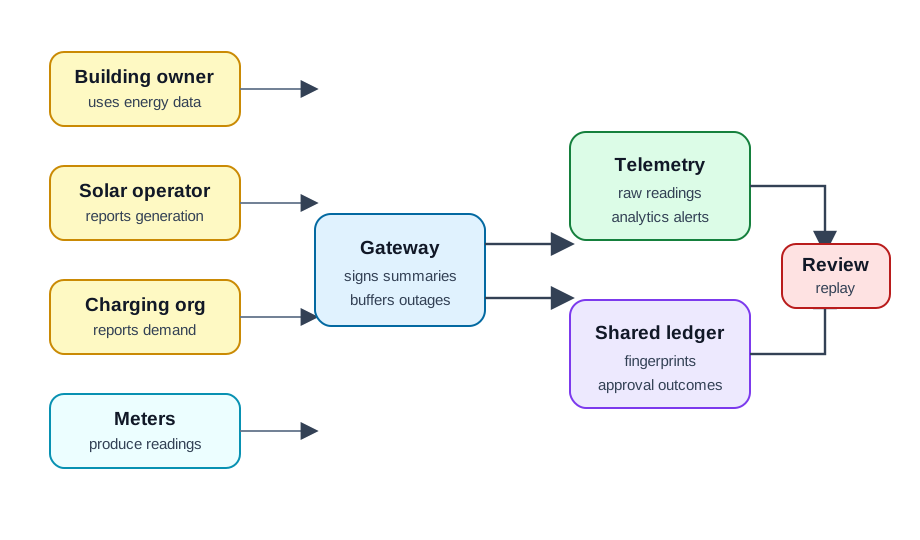
Read Figure 27.4 from the meters, solar plant, store, and car chargers to the gateway. It gathers the readings and signs one summary for each 15-minute span. The raw data stays in the study store. The short summary and its mark enter shared history for the building owner, charge-point firm, and payment partner. Finish at replay. A reviewer gets the same off-ledger span, makes its mark again, and checks it against the signed record. Shared history matters because no one party can change an accepted bill in secret.
27.11.2 Why Not Put Everything on Ledger
The ledger gives the parties a shared history for important facts. The telemetry platform still does the work it is better suited for: ingestion, query, alerting, analytics, and retention. The gateway becomes the boundary where physical observations turn into signed records. That boundary is where architecture review should focus.
27.12 Design Questions Before Approval
This section: Design Questions Before Approval — Do not approve a blockchain design just because it uses a ledger.
Do not approve a blockchain design just because it uses a ledger. Approve it when the project can answer these questions with evidence:
- Which parties rely on the shared history?
- Which records are ledger material, and which stay in normal storage?
- Which device, gateway, or organization signs each record?
- What happens when the gateway, network, or ledger participant is unavailable?
- Can a reviewer reproduce the proof from stored telemetry?
- Who admits participants, changes rules, suspends credentials, and recovers from key loss?
Before approving a ledger design, use Figure 27.5 to check whether every trust, ownership, outage, and replay question has an evidenced answer.
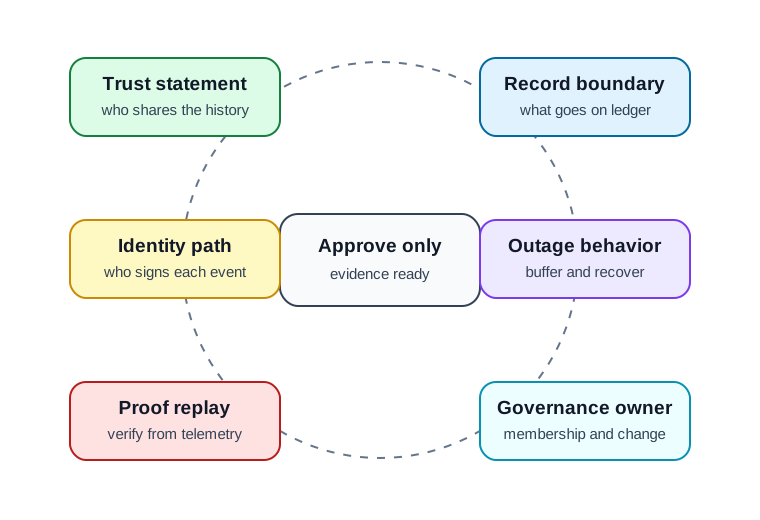
Read the six review questions in Figure 27.5 before the proof sequence. They force the team to name the shared trust statement, the exact record boundary, who signs, what happens offline, who governs membership changes, and how evidence will be replayed. Then follow one replay: retrieve the off-ledger batch, recompute its fingerprint, check signature and timestamp, and compare the result with the ledger entry. Admission, suspension, key recovery, and rule changes also need owners. Approval is justified only when all six questions point to stored evidence rather than an assumed benefit of blockchain.
Common Failure Patterns
This section: Common Failure Patterns
High-frequency telemetry is operational data. Keep it in the telemetry platform and record only compact proofs, summaries, or milestones that several parties must verify later.
Safety and control actions need predictable local behavior. Use the ledger for evidence after the event, not as the path that decides immediate device action.
A ledger can prove that an accepted record exists. It cannot prove that a physical measurement was accurate, calibrated, or tamper resistant. Device security and measurement quality still matter.
A shared ledger is also a shared operating agreement. Membership, permissions, rule changes, participant outages, and recovery must be designed before deployment.
27.13 Knowledge Check
This section: Knowledge Check
27.14 Knowledge Check
This section: Knowledge Check
27.15 Match Concepts To Architecture Roles
This section: Match Concepts To Architecture Roles
27.16 Sequence A Blockchain Fit Decision
This section: Sequence A Blockchain Fit Decision
27.17 Summary
This section: Summary — Blockchain for IoT is a shared evidence pattern, not a general data platform.
Blockchain for IoT is a shared evidence pattern, not a general data platform. It belongs where multiple parties need a tamper-evident history and no single party should own the history alone. Keep raw telemetry, analytics, and control loops in the normal IoT architecture. Use the ledger for compact records that can be verified later, and approve the design only when identity, failure behavior, proof replay, and governance are clear.
27.18 Key Takeaway
This section: Key Takeaway — Use blockchain in IoT only when shared trust, auditability, and multi-party coordination justify the extra complexity, latency, privacy, and operations burden.
Use blockchain in IoT only when shared trust, auditability, and multi-party coordination justify the extra complexity, latency, privacy, and operations burden.
27.19 What’s Next
This section: What’s Next
- Use Blockchain Fundamentals for IoT to understand the ledger mechanics behind this fit test.
- Use Smart Contracts and Architectural Patterns when agreement logic and gateway patterns are the main design question.
- Use Blockchain Limitations and Real-World Implementations when you need to stress-test throughput, privacy, governance, and operational tradeoffs.
- Use Blockchain Interactive Lab and Knowledge Check when you want hands-on practice with blocks, hashes, validation, and tamper detection.
Find help
3 reviewed answers.
Where should I start in a module?
Open the module page from the sidebar to see its chapters in order. Use the module map to return to a topic you need.
Modules and pathsReviewed
What can I try when a project does not work?
Check the symptom, then work through the diagnostic steps. Keep the error message and the smallest example that reproduces it.
When you are stuckReviewed
How do interactive examples work?
Use the interactive guide to check how examples and simulations work before changing your project.
Interactive examples guideReviewed