17 SDN for IoT: Service Paths
More
Depth: Practitioner
Progress saves as you read. Mark sections complete as you go; your progress appears in the sidebar.
17.1 Start With the Decision
This section: Start With the Decision — SDN uses a controller to set how network traffic is forwarded.
SDN uses a controller to set how network traffic is forwarded. A policy is the rule that says which path each kind of traffic may use. A service path is the route from a sender to the system that must act; its limit is the delay or other condition it must meet. A cold-room alarm and a camera stream should not fight for the same network path. SDN policy must keep each service within its limit.
17.2 Route Overview
This section: Route Overview — This is part 1 of 3.
This is part 1 of 3. Continue with SDN for IoT: WSN and Mobile Variants.
17.3 Part Objectives
This section: Part Objectives
- Separate IoT traffic classes with SDN path rules.
- Control gateway, constrained-network, and roaming paths.
17.4 Chapter Roadmap
This section: Chapter Roadmap
- Start With the IoT Service Problem
- Minimum Viable Understanding
- Application Fit Map
- Traffic Class Separation
- Gateway Path Control
- Constrained Sensor Networks
- Mobility and Roaming
17.5 Start With the IoT Service Problem
This section: Start With the IoT Service Problem — Picture a building where fire warnings share links with routine camera traffic.
Change One Path and Watch the Receiver
Picture a building where fire warnings share links with routine camera traffic. During a busy test, the warning arrives late. The team does not need a broad promise that the network is smart. It needs a narrow change, a clear reason, and proof at the receiving service.
Telemetry means readings and status sent by remote devices. A gateway is a device that joins a local device network to another service path. Name the warning source, its gateway, the forwarding points, the final receiver, and the delay limit. Record the rule that may change the path and the person allowed to approve it.
Fill the ordinary path, break one link, send an unapproved request, and restore the old rule. Check the decision record, the forwarding reply, the changed counters, and the receiver result. A successful rule update is not enough if the warning is still late or another service is harmed.
This trial does not prove every controller, switch, or building load. The deeper sections show when coordinated control fits, how policy and rollback work, and which records make the service result auditable.
Do not start with the instruction to use SDN. Start with the service problem: a set of devices needs a path, a policy, an exception rule, and proof that forwarding changed for the right reason.
Start simple: choose one traffic class or gateway behavior and state what should happen when conditions change. SDN earns its place when it can coordinate that behavior and make the result auditable.
17.6 Minimum Viable Understanding
This section: Minimum Viable Understanding — Do not start with “use SDN.” Start with the IoT operating problem: which device group needs which service path, under which policy, with which exceptions, and how the result will be verified.
Do not start with “use SDN.” Start with the IoT operating problem: which device group needs which service path, under which policy, with which exceptions, and how the result will be verified. SDN helps when a controller can coordinate that behavior across forwarding devices and leave a traceable proof trail.
Do not apply minimum viable understanding until its premise is visible near Issue in Figure 17.1: SDN IoT application decision route. Inspect the span to policy.
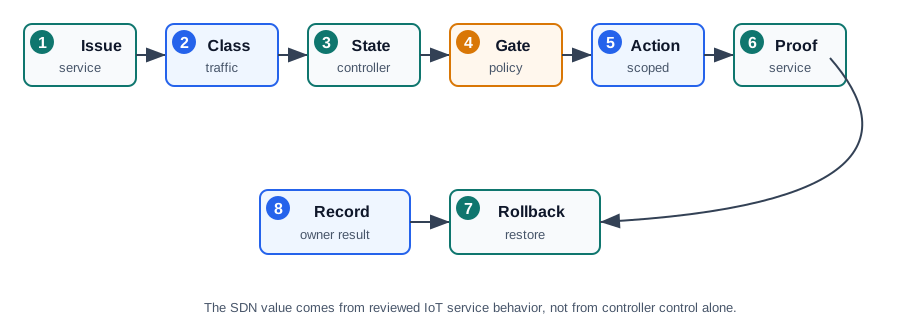
The diagram Figure 17.1 first names Issue, then separates policy from restore. Carry checkpoints policy and restore into minimum viable understanding with Issue. Their combined proposition is: SDN IoT application decision route.
Use this route:
- State the IoT service problem: alert delivery, telemetry path, management access, update window, video pressure, mobility, or containment.
- Classify the traffic: device group, service, direction, urgency, expected destination, and required exceptions.
- Check controller state: topology, gateways, links, hosts, rule ownership, counters, and recent changes.
- Gate the request: policy, service risk, conflicts, exception paths, scope, expiry, and rollback.
- Program narrowly: path, queue, meter, mirror, redirect, or deny behavior only inside the approved scope.
- Verify the result: switch acknowledgement, counter movement, receiver proof, and operator check.
- Record ownership: reason, owner, affected services, rollback, and next check trigger.
17.7 Application Fit Map
This section: Application Fit Map — SDN fits IoT best when the network decision affects multiple forwarding points or needs a shared proof record.
SDN fits IoT best when the network decision affects multiple forwarding points or needs a shared proof record.
Why pause at application fit map? Beside SDN IoT, the diagram Figure 17.2 makes state migration explicit within this relationship: SDN IoT application fit map.
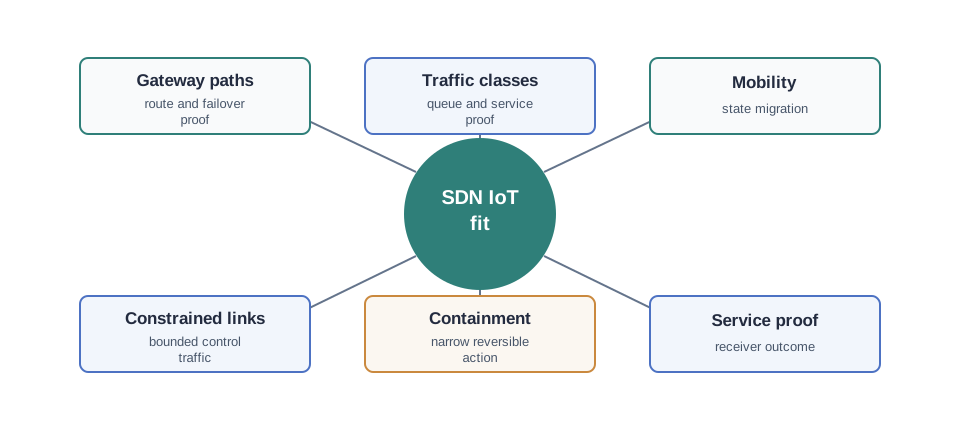
At SDN IoT, the diagram Figure 17.2 establishes one design concern. state migration introduces the next; receiver outcome provides the final application fit map review cue. This receiver outcome sequence supports the claim: SDN IoT application fit map.
Gateway path control
Use SDN when gateways need consistent routing, failover, path separation, or temporary steering during maintenance.
Traffic class separation
Use SDN when alarm, telemetry, management, update, and video traffic need different forwarding and queue behavior.
Constrained networks
Use SDN carefully when sensor nodes or gateways need policy changes without firmware churn, and controller overhead is bounded.
Mobility and roaming
Use SDN when device movement needs path migration, session continuity, or access-point coordination with proof.
Containment
Use SDN when suspicious traffic needs a narrow, reversible response that preserves required management and recovery paths.
Service assurance
Use SDN when counters and receiver outcomes must prove whether a controller-driven change improved the service.
17.8 Traffic Class Separation
This section: Traffic Class Separation — Many IoT networks carry traffic that should not be treated the same way.
Many IoT networks carry traffic that should not be treated the same way.
Do not apply traffic class separation until its premise is visible near Class in Figure 17.3: SDN IoT traffic class separation. Inspect the span to Management.
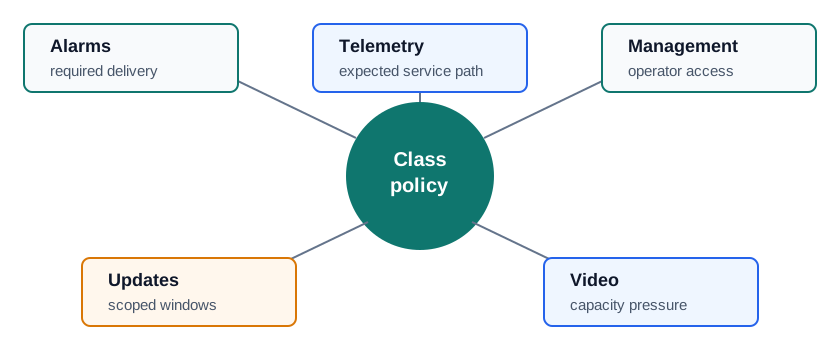
At Class, the diagram Figure 17.3 establishes one design concern. Management introduces the next; capacity pressure provides the final traffic class separation review cue. This capacity pressure sequence supports the claim: SDN IoT traffic class separation.
Check these classes explicitly:
- Alarms: required delivery paths and receiver confirmation.
- Telemetry: expected destinations, sampling behavior, and normal quiet periods.
- Management: operator access paths and recovery exceptions.
- Updates: scoped windows, rollback paths, and temporary shaping.
- Video or bulk data: capacity pressure, queue behavior, and impact on required services.
The goal is not to give every class a fancy policy. The goal is to make the required differences visible, enforceable, and verifiable.
17.9 Gateway Path Control
This section: Gateway Path Control — Gateways are natural SDN check points because they aggregate device traffic and connect local device groups to services.
Gateways are natural SDN check points because they aggregate device traffic and connect local device groups to services.
At gateway path control, Gateway path control needs service proof makes the architecture testable. In Figure 17.4, counter proof frames this claim: SDN IoT gateway path control record. Read it against Gateway path control needs service proof.
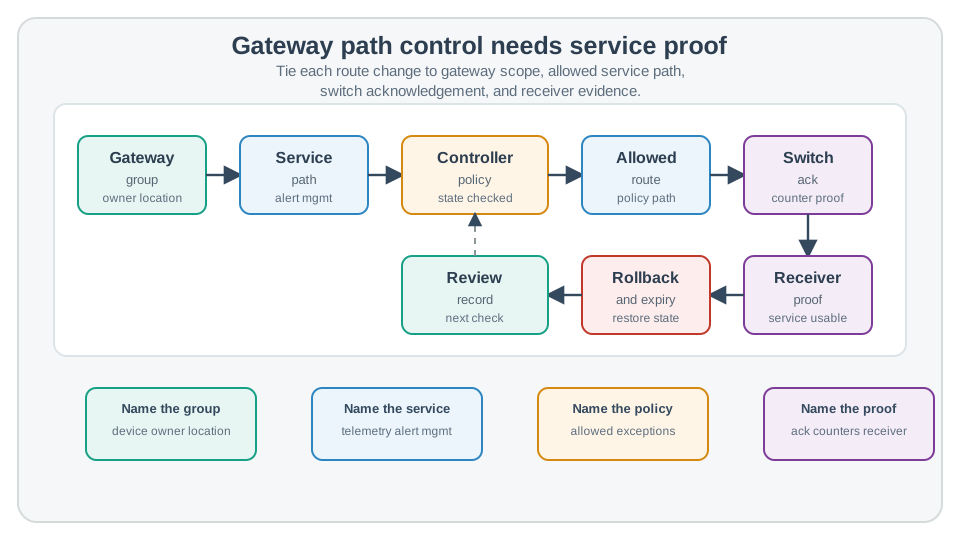
The gateway record in Figure 17.4 starts by naming the device group, owner, and location. It then names the service path, such as an alert or management route, and the controller policy that permits it. An allowed route on paper is not yet a working service: the switch must acknowledge the rule, counters must show the intended traffic, and the receiver must confirm usable delivery. Rollback and expiry limit how long the change can persist. The review record ties that evidence to the next check, so a later operator can tell whether the route served this gateway group without weakening other paths.
Useful gateway check questions:
- Which service path changed? Telemetry, alert, management, update, video, or recovery?
- Which gateway group is affected? Identify device group, owner, location, and required exceptions.
- Which path is allowed? Tie controller state to service policy, not just shortest path.
- What proves success? Switch acknowledgements, counters, receiver proof, and operator check.
- What restores the prior state? Keep rollback and expiry visible before temporary steering is applied.
17.10 Constrained Sensor Networks
This section: Constrained Sensor Networks — SDN ideas can apply to constrained networks, but only when the controller burden and device limitations are respected.
SDN ideas can apply to constrained networks, but only when the controller burden and device limitations are respected.
The boundary in Figure 17.5 puts local policy at the gateway; check fallback when control is late.
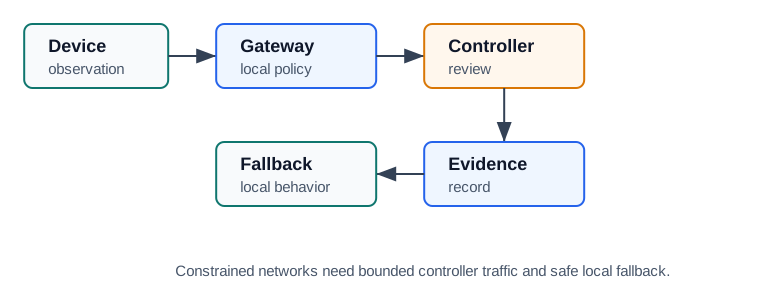
In Figure 17.5, the device reports an observation, but the gateway carries local policy because the sensor cannot hold a large rule table or spend energy on frequent controller traffic. The controller reviews exceptions and policy changes; its decision is then recorded as evidence. Fallback is a separate path, allowing bounded local behavior when the controller link is slow or unavailable. That separation matters for alarms: the absence of a fresh controller reply must not silently erase a safe local forwarding rule. Check both the normal review result and the fallback behavior for the same device group.
Practical constraints include:
- Limited device memory for rule tables.
- Limited energy for control traffic.
- Intermittent links and delayed acknowledgements.
- Need for local fallback behavior when the controller is unreachable.
- Gateway responsibility for translating policy into safe local behavior.
Use SDN to reduce operational friction, not to force tiny devices into a heavy control model.
17.11 Mobility and Roaming
This section: Mobility and Roaming — Mobile IoT devices, portable assets, and roaming gateways need path changes without losing ownership or policy context.
Mobile IoT devices, portable assets, and roaming gateways need path changes without losing ownership or policy context.
The handoff in Figure 17.6 tracks old and new links; check policy, rule receipt, and cleanup.
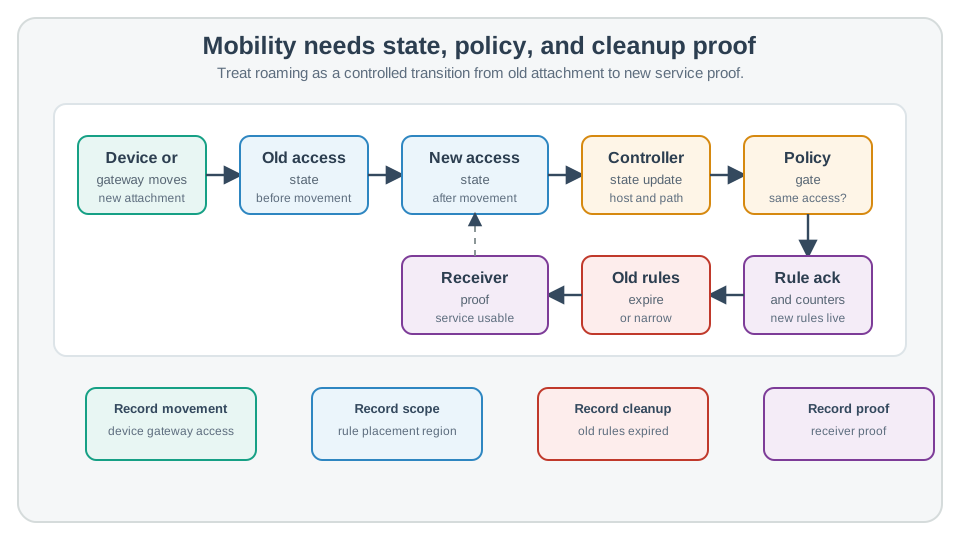
At Mobility needs state, policy, and cleanup proof, the diagram Figure 17.6 establishes one design concern. receiver proof introduces the next; gateway moves provides the final mobility and roaming review cue. This gateway moves sequence supports the claim: SDN IoT mobility handoff proof.
Check mobility as a state transition:
- Device or gateway moves to a new attachment point.
- Controller updates host and path state.
- Policy checks whether the same service access is still allowed.
- Old rules are expired or narrowed.
- New rules are acknowledged.
- Receiver-side proof confirms the service remained usable.
Mobility is not only a handoff problem. It is also a policy, state, and cleanup problem.
17.12 Continue to the Next Part
This section: Continue to the Next Part — Carry this evidence into SDN for IoT: WSN and Mobile Variants, which begins with Named WSN and Mobile SDN Variants.
Carry this evidence into SDN for IoT: WSN and Mobile Variants, which begins with Named WSN and Mobile SDN Variants.
Find help
3 reviewed answers.
Where should I start in a module?
Open the module page from the sidebar to see its chapters in order. Use the module map to return to a topic you need.
Modules and pathsReviewed
What can I try when a project does not work?
Check the symptom, then work through the diagnostic steps. Keep the error message and the smallest example that reproduces it.
When you are stuckReviewed
How do interactive examples work?
Use the interactive guide to check how examples and simulations work before changing your project.
Interactive examples guideReviewed