16 SDN Resilience: Failover Validation
More
Depth: Practitioner
Progress saves as you read. Mark sections complete as you go; your progress appears in the sidebar.
Local survival, takeover, and recovery
Follow warehouse alarms through an upstream outage and controlled replay, then inspect the controller’s current-state gate. Play silently with captions on provisional timing; narration audio is pending. Motion is schematic, and storage and replay values are teaching estimates, not measured recovery guarantees. Choose Reduced motion for a complete still at each beat.
Full transcript — SDN failover (8 beats)
B1 — Upstream outage
You are the engineer keeping a connected warehouse's food safety alarms working during an upstream outage. Door, temperature, and compressor events keep arriving. Local alarms must continue, while the remote dashboard falls behind. Your job is to preserve local action and recover the missing history.
Model caption: Warehouse upstream outage: local food safety alarms must continue; the remote dashboard becomes stale.
B2 — Controller takeover
Failover means another controller takes over when the current controller fails. A controller sets network rules. Recovery requires failure detection, takeover, and proof that the new controller has current network information. Safety-critical local behavior must not wait for a remote controller decision.
Model caption: A controller sets network rules. Failover: failure → takeover → proof of current state. Local safety must not wait for the remote decision.
B3 — Local evidence buffer
The warehouse model illustrates local survival and recovery. During the outage, local alarm rules continue and keep timestamped evidence. The local coordinator cannot send records upstream. Events accumulate in a buffer, a local store that holds them until they can be sent.
Model caption: Local alarm rules run and retain timestamped evidence. The local coordinator cannot send records upstream; the buffer holds events.
B4 — Storage budget
Use eighty events per minute for a ninety-minute outage. Multiplying gives seven thousand two hundred events. Each event occupies six hundred twenty bytes. Including the model's safety factor of one point four, the storage estimate is about six megabytes. A twelve-megabyte local buffer fits that example.
Model caption: 80/min × 90 min = 7,200 events. 7,200 × 620 bytes × 1.4 ÷ 1,048,576 = 5.960083… model MB, displayed as 6.0 MB. A 12 MB buffer fits; no overflow.
B5 — Priority replay
When the connection returns, priority replay sends current critical events first, then summaries, then bulk history. That order protects current alarms before bulk history. The model gives replay forty-five percent of an uplink carrying three hundred eighty-four kilobits per second, leaving the rest outside the replay allowance.
Model caption: Priority replay: current critical events, summaries, bulk history. Replay uses 45% of 384 kbit/s, leaving the rest outside the replay allowance.
B6 — Replay estimate
All seven thousand two hundred stored events contain four million four hundred sixty-four thousand bytes. Multiply by eight to convert bytes to bits, then divide by the replay allowance per minute. The estimated replay takes about three point four minutes. That is a teaching estimate; the model excludes protocol overhead.
Model caption: 7,200 × 620 = 4,464,000 bytes. Replay allowance = 384 × 1,000 × 0.45 × 60 = 10,368,000 bits/min. 4,464,000 × 8 ÷ 10,368,000 = 3.444… min, displayed as 3.4 min. Protocol overhead is excluded.
B7 — Stale state blocks writes
The misconception is that restoring the connection means recovery is complete. The warehouse dashboard stays stale until replay finishes. For controller failover, takeover also requires proof of current state: an owner acting on old network information can write conflicting rules. Stale state blocks risky changes.
Model caption: A restored connection does not complete recovery: the warehouse dashboard remains stale until replay finishes. Controller takeover requires proof of current state; stale state blocks risky writes.
B8 — Reconciled evidence
After replay, the model reaches reconciliation: the cloud view catches up and operators retain evidence. For your warehouse, local alarms and recovered history belong to different phases of the same outage story. Keep local action alive, then recover history with a limit on replay traffic.
Model caption: The cloud view catches up and operators retain evidence. Keep local action alive, then recover history with a limit on replay traffic.
16.1 Start With the Decision
This section: Start With the Decision — Failover means another controller takes over when the current one fails.
Failover means another controller takes over when the current one fails. A controller sets network rules, and an API is the agreed way software requests work from it. A failover sequence check follows the order of failure, takeover, and proof that the new owner has current state. That is why the order matters.
16.2 Route Overview
This section: Route Overview — This is part 2 of 2.
This is part 2 of 2. Review SDN Resilience: API Availability for the preceding evidence.
16.3 Learning Objectives
This section: Learning Objectives
- Test failover sequence checks with a concrete scenario and pass criteria.
- Validate failover needs fresh state with a concrete scenario and pass criteria.
16.4 Chapter Roadmap
This section: Chapter Roadmap
- Failover Sequence Checks
- IoT Availability Fit
- Build Gateway Isolation APIs
- Proof Loop
- Common Pitfalls
- APIs Split Intent and Enforcement
- Availability Record
- Failover Needs Fresh State
- Summary
- Key Takeaway
- See Also
16.5 Failover Sequence Checks
This section: Failover Sequence Checks — Failover design should be checked as a sequence of verifiable events rather than as a single availability promise.
Failover design should be checked as a sequence of verifiable events rather than as a single availability promise.
The reason to inspect failover sequence checks is concrete. Figure 16.1 depicts: SDN controller failover proof sequence. Distinguish Failover is a proof sequence from rule version checked.
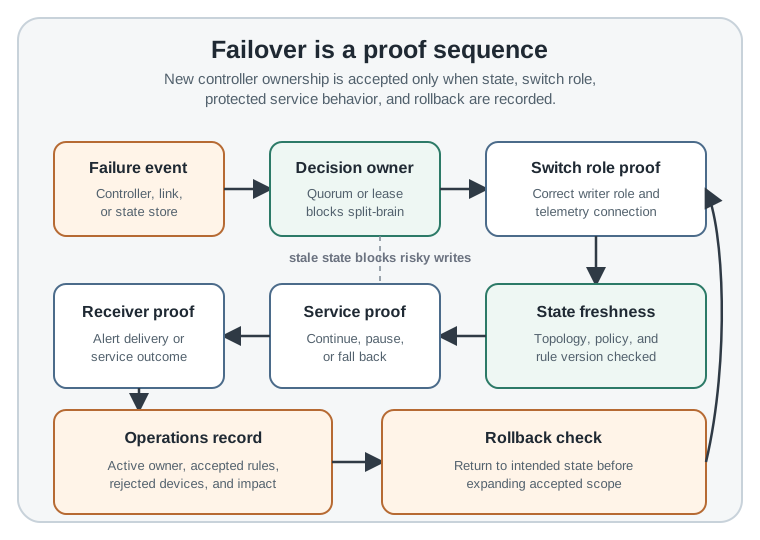
The failover route in Figure 16.1 checks owner and switch state; keep service, receipt, and rollback proof.
Failover sequence to verify:
- A controller, controller link, or state store becomes unavailable.
- Surviving controller instances detect that the decision owner is unavailable.
- The cluster chooses a new decision owner without split-brain writes.
- Switches accept the correct controller role for writes and telemetry.
- The new owner checks state freshness before installing new rules.
- Protected service traffic continues, pauses safely, or follows documented degraded behavior.
- Operations receives proof of the event, impact, and recovery state.
Avoid broad promises such as “failover is instant” or “existing flows always continue.” Flow persistence depends on rule timeout, switch behavior, connection state, and local fallback design. Test the actual path with representative traffic.
16.6 IoT Availability Fit
This section: IoT Availability Fit — SDN API and cluster design is valuable when it reduces operational risk.
SDN API and cluster design is valuable when it reduces operational risk. It is not a substitute for local safety, gateway autonomy, or good protocol design.
The practical risk in iot availability fit needs a diagram. Figure 16.2 summarizes it: SDN API and high availability fit for IoT. Look at IoT beside who changed what.
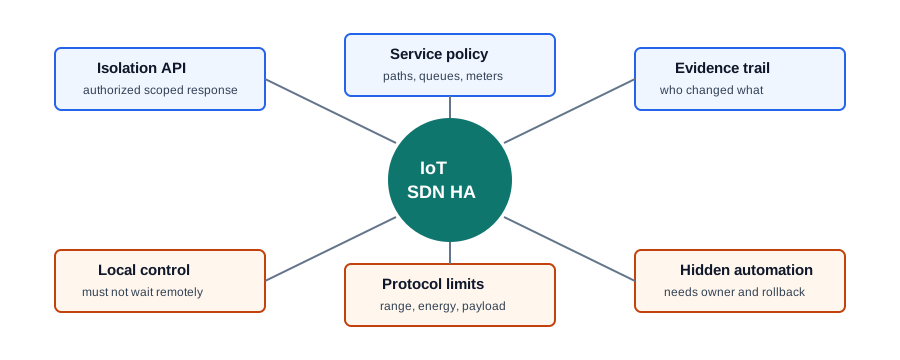
Begin the diagram Figure 16.2 with IoT. Continue through who changed what before checking needs owner and rollback. This path preserves the chapter’s iot availability fit argument: SDN API and high availability fit for IoT.
Good fit: authorized isolation
Use SDN APIs when a gateway, device class, or tenant needs scoped isolation with approval, proof, and rollback.
Good fit: service policy
Use controller policy when traffic classes need different paths, queue treatment, metering, or monitoring across shared infrastructure.
Good fit: operations proof
Use cluster and API records when teams need to know who changed what, which controller owned the decision, and what the receiver observed.
Limit: local control
Do not make safety-critical local behavior wait for a remote controller or cluster decision.
Limit: protocol constraints
SDN can coordinate network behavior, but it does not remove wireless range, energy, payload, gateway, or duty-cycle constraints.
Limit: hidden automation
Fast rule changes are risky when ownership, scope, stale-state handling, and rollback proof are not visible.
16.7 Build Gateway Isolation APIs
This section: Build Gateway Isolation APIs — Scenario: A building network carries access control, environmental telemetry, maintenance laptops, video streams, and background update traffic through shared gateways and switches.
Scenario: A building network carries access control, environmental telemetry, maintenance laptops, video streams, and background update traffic through shared gateways and switches. The team wants an SDN API that can isolate one suspicious gateway while preserving access-control alert delivery.
Decision route:
- Define the API requester: security workflow, operator approval, or incident automation.
- Name the affected scope: gateway identity, traffic classes, protected alert path, and requested duration.
- Validate policy conflict: do not block protected alert traffic, support traffic, or rollback signal paths.
- Translate intent into scoped rules: block or meter only the affected traffic class and attach counters.
- Confirm southbound acceptance: which switches accepted the rule and which did not?
- Verify receiver proof: protected alert receiver still receives expected traffic.
- Record failover behavior: what happens if the controller changes owner during the isolation window?
- Close or revise: remove stale rules, update the record, and review the decision again if the same gateway reappears.
Example decision record:
API intent:
  Isolate gateway class: maintenance-laptop traffic from Gateway G-17.
  Preserve: access-control alerts and operator rollback path.

Northbound contract:
  Requester role, incident id, gateway id, traffic class, duration, proof target.
  Idempotency key for retries during controller failover.

Controller checks:
  Authorization, topology scope, protected traffic conflict, fallback rule, stale-state risk.

Southbound actions:
  Install scoped drop or meter rules, attach counters, confirm device acceptance.

Cluster check:
  Decision owner, state version, failover handling, switch role proof.

Proof:
  Receiver alert path OK, blocked class counters increasing, rollback tested.

Review conditions:
  Controller owner change, topology change, rejected switch update, missing receiver proof.
16.8 Proof Loop
This section: Proof Loop — The API result should not be the only proof.
The API result should not be the only proof. A successful response can still hide partial rule application, stale state, or broken receiver behavior.
Make the proof loop premise visible in the diagram Figure 16.3: SDN API and cluster proof loop. Begin by distinguishing Review from Counters.
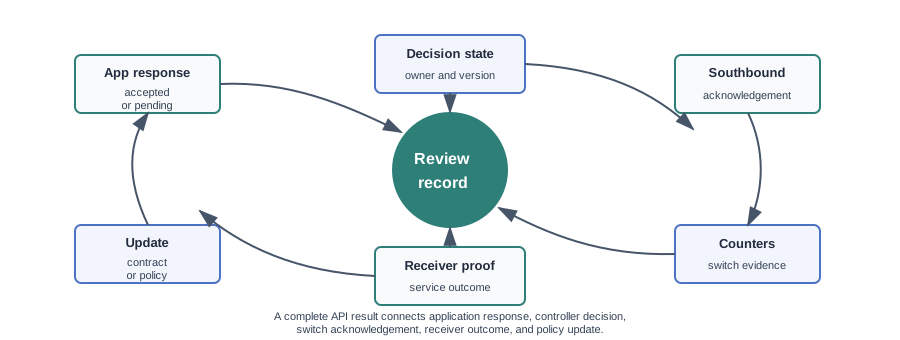
The loop in Figure 16.3 starts with an application response but does not stop there. The controller decision record states the owner, state version, and conflict result. Southbound acknowledgement shows what switches accepted; counters show whether traffic followed the intended rule. Receiver proof checks the service outcome that the requester actually needed. Operations review can then update the API contract or policy and record any rollback. A partial install or stale controller state may be invisible in a simple success response, so retain request identity, rule result, switch evidence, receiver result, and next review condition as one proof chain.
Proof to keep:
- Application request, requester, intent, idempotency key, and response.
- Controller decision record, state version, conflict checks, and selected owner.
- Southbound rule acceptance, rejection, timeout, counter, and barrier proof.
- Switch-controller role and connection event proof.
- Receiver outcome and protected traffic proof.
- Rollback action, closure signal, and next review condition.
16.9 Common Pitfalls
This section: Common Pitfalls
Direct switch programming from apps
Applications should express intent through a checked contract, not bypass controller validation.
API without idempotency
Retries during timeout or failover can create duplicate, stale, or contradictory rule changes.
Cluster as performance shortcut
More controller instances do not automatically improve throughput. Check ownership, state cost, and failure behavior.
No split-brain story
A cluster must prevent disconnected controller instances from committing conflicting changes.
Assumed data-plane survival
Existing forwarding may continue, expire, pause, or degrade depending on rule and switch behavior. Test it.
Missing receiver proof
Southbound acknowledgement does not prove that the intended service still worked.
16.10 APIs Split Intent and Enforcement
This section: APIs Split Intent and Enforcement — An SDN API is useful when it keeps application intent separate from device enforcement.
An SDN API is useful when it keeps application intent separate from device enforcement. The northbound side should describe who is asking, what service behavior is requested, which scope is affected, and what proof is expected. The controller then validates state and policy before translating the request into southbound actions that switches can enforce.
High availability extends that contract across failure. A cluster is not reliable because it has several instances. It is reliable when one decision owner can be identified, state freshness is known, switch roles are tested, split-brain writes are blocked, receiver proof survives failover, and rollback is still possible.
For example, a smart-building access-control system may ask the network to isolate a suspect maintenance gateway while preserving badge-reader alarms and operator rollback access. The northbound API should carry the requester role, incident id, gateway id, protected traffic class, requested duration, idempotency key, and proof target. The controller checks authorization, topology state, policy conflicts, and current cluster owner before translating the request into switch rules, counters, and timeouts. The southbound action is then a device-facing rule update, not a second copy of the application request. The availability claim is proven only when the receiver still sees protected alarm traffic, the controller owner is known, rejected devices are named, and rollback remains possible after a controller role change.
Treat apis split intent and enforcement as a system decision around Review. The visual in Figure 16.3 places Counters within this relationship: The API result is only one part of the evidence loop; receiver proof and operations closure are separate checks.Figure 16.3 separates the API result from receiver proof and operations closure, including counters, switch acknowledgement, receiver outcome, and policy update.
- Northbound contract: requester, intent, scope, idempotency, response shape, proof target, and version.
- Controller decision: authorization, topology, policy conflicts, state freshness, affected devices, and rollback gate.
- Southbound action: rule install, delete, expire, counter query, role change, barrier, or fallback rule.
- Service proof: switch acknowledgement plus receiver behavior, protected traffic, operator record, and closure signal.
16.11 Availability Record
This section: Availability Record — An availability record turns a cluster claim into testable operating evidence.
An availability record turns a cluster claim into testable operating evidence. It should show what request was made, which controller owner accepted it, which state was trusted, which switch actions happened, what the receiver observed, and what would force the decision to be reviewed.
Build the record from an actual change path, not from a vague "HA enabled" checkbox. In a campus sensor network, an operator might approve a northbound request to meter firmware-update traffic for one building while leaving fire-panel telemetry untouched. The record should show the idempotency key used during retries, the controller instance that owned the write lease, the topology and policy version used for conflict checks, and the devices that accepted or rejected each rule. It should also name the protected receiver test, such as MQTT alert delivery to the operations broker, and the rollback owner if the active controller changes mid-window.
Write the record for the smallest useful scope. A gateway-isolation API can be acceptable for one site and still remain unapproved for multi-site failover until the cluster and receiver proof cover that wider scope.
16.12 Failover Needs Fresh State
This section: Failover Needs Fresh State — Failover is a state transition, not a slogan.
Failover is a state transition, not a slogan. When a controller or link fails, the system must decide which owner may write, which topology and policy state are fresh enough, which switch role is active, and which traffic should continue, pause, isolate, or fall back locally.
Before treating controller placement as an availability answer, use the latency budget below to separate the path terms that placement actually removes from queue and compute terms that remain. The preset begins with a local gateway loop and a cloud loop; increase only local queueing to test the counterexample in which the apparently nearer controller path becomes slower.
Use the resulting dominant term and budget margin as evidence in the failover record. A shorter physical path is useful only when ownership transfer, queueing, processing, and return traffic still fit the service deadline.
The data plane may continue forwarding existing rules, expire stale rules, reconnect to another controller, or enter a degraded state depending on device behavior and rule design. That behavior must be tested with representative traffic instead of assumed from the presence of a cluster.
Under the hood, the hardest part is usually not detecting a dead process. It is preventing two controller instances from writing conflicting policy and preventing a stale owner from acting on old topology. Systems such as ONOS or OpenDaylight deployments typically rely on a controller cluster, a replicated state store or distributed ownership service, and explicit switch-controller roles. A write path should prove which instance owns the affected scope, which state version was used, whether a quorum or lease is still valid, and whether switches accepted the role change before new rules are installed.
The southbound protocol also matters. OpenFlow role messages, barrier replies, flow-mod errors, and counter reads provide different evidence than a NETCONF configuration commit or a gNMI telemetry stream. A high-availability design should record those evidence types separately. If a controller failover occurs while an isolation rule is pending, the safe path may be to preserve old local forwarding, reject new risky writes until state freshness is proven, and keep protected alert traffic on a known-safe rule. That is a design choice, not an automatic property of clustering.
Why pause at failover needs fresh state? Beside Failover is a proof sequence, the diagram Figure 16.1 makes rule version checked explicit within this relationship: Failover proof is a recorded sequence: decision owner, switch role, state freshness, protected service behavior, receiver proof, operations record, and rollback.The record in Figure 16.1 follows the failure through role and rule-version checks to receiver outcome; stale state blocks risky writes until the path is safe.
- Quorum and role: prevent disconnected controller instances from accepting conflicting writes.
- Freshness gate: block risky rule changes when topology, policy, or owner state is stale.
- Switch behavior: verify rule timeout, role change, connection loss, counter visibility, and fallback rules.
- External proof: pair switch records with receiver outcome, protected traffic, rollback, and operations closure.
16.13 Summary
This section: Summary — SDN APIs and clustering define how applications request policy, how controllers coordinate state, and how the control plane remains available.
SDN APIs and clustering define how applications request policy, how controllers coordinate state, and how the control plane remains available. A useful design names the API boundary, consistency model, failover behavior, and operational limits.
For IoT deployments, the design should preserve local safety, prove protected receiver behavior, record controller ownership, and keep rollback connected to every API-driven network change.
16.14 Key Takeaway
This section: Key Takeaway
Treat SDN API and high-availability design as a traceable control loop: authorized intent, controller state, southbound enforcement, failover owner, receiver proof, rollback, and a clear review condition.
16.15 See Also
This section: See Also
- SDN Architecture Fundamentals: layer responsibilities and rule lifecycle.
- SDN Controller Architecture: controller components and message flow.
- SDN Controller Selection and Comparison: controller fit, proof records, and lifecycle review conditions.
- SDN Production Readiness: production readiness, ownership, and rollback.
16.16 Continue Your Route
This section: Continue Your Route — This is the last part of this chapter.
This is the last part of this chapter. Return to SDN Resilience: API Availability or continue from the reference-architectures module index.
Find help
3 reviewed answers.
Where should I start in a module?
Open the module page from the sidebar to see its chapters in order. Use the module map to return to a topic you need.
Modules and pathsReviewed
What can I try when a project does not work?
Check the symptom, then work through the diagnostic steps. Keep the error message and the smallest example that reproduces it.
When you are stuckReviewed
How do interactive examples work?
Use the interactive guide to check how examples and simulations work before changing your project.
Interactive examples guideReviewed