33 Production Fleet Management
More
Depth: Practitioner
Progress saves as you read. Mark sections complete as you go; your progress appears in the sidebar.
33.1 Start With the Fleet State Question
This section: Start With the Fleet State Question — Imagine an operator who asks for an update on one hundred pumps.
Imagine an operator who asks for an update on one hundred pumps. The control screen says the job was sent. That does not mean each pump now runs the new code. A fleet needs both the state we want and the state each device reports.
Look across the pump fleet. Which panel shows a sent job, and which shows the state reported by each pump?
-
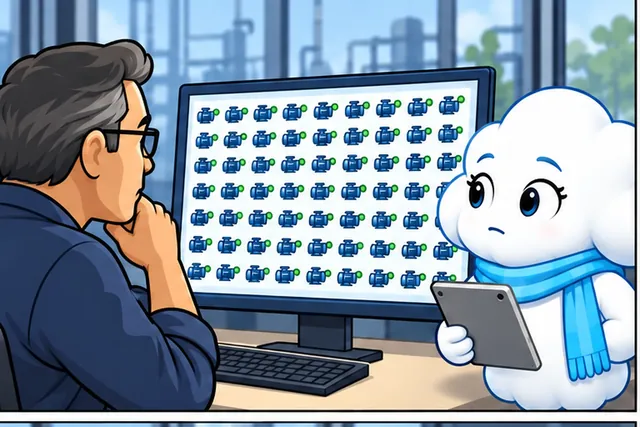
An operator sends new software to one hundred pumps.
-
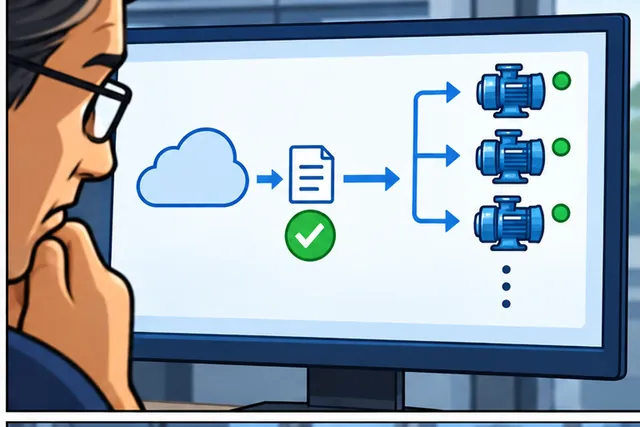
A sent job does not prove that every pump runs the new code.
-
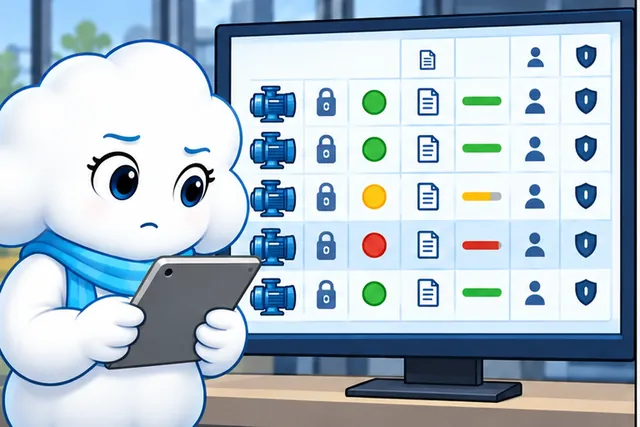
Compare the approved state with fresh reports from each pump.
-
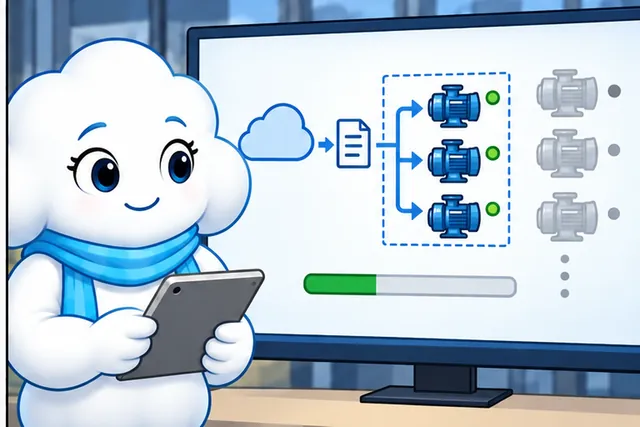
Pause or roll back any group that cannot show a safe result.
The first panel shows the fleet to be updated. The second records a sent job, which cannot prove what every pump runs. The status board then shows differing per-pump reports. The final panel groups the rollout so the operator can review one group before continuing. The record below requires fresh device evidence and a safe pause or rollback plan.
Firmware is the software stored on a device. Start with one small group. Record the approved firmware, settings, owner, and safe fallback. Admit a device only when its identity is known. Mark it as active only when fresh evidence supports that state. If an update fails, keep the old working state or move the device to a known safe state. Never hide a partial rollout inside one green fleet total.
Use this operating path:
- Which devices are in the group?
- What state do we want?
- What state does each device report?
- How fresh is that report?
- Who approved the change?
- Can the change pause safely?
- Can it roll back?
- Which devices are now cut off?
- Who owns the next action?
- What event starts a new review?
The fleet will change after release. Devices fail, sites lose links, settings drift, and owners move on. The record must survive those changes. Practitioner covers entry, update, support, retirement, and proof. Under the Hood explains state drift, staged rollout, and degraded modes. Those deeper controls refine the simple group record. They do not turn a sent request into proof of a completed change.
Retell the fleet loop. A known device enters service. A group gets one approved plan. The owner asks for a change. Each device reports its own state. Fresh proof marks a pass. Old proof stays old. A failed device stays visible. A partial group stays partial. The rollout can pause. A safe state is known. A rollback path is ready. Support owns the next act. A repaired unit reports again. A retired unit loses access. Its data is kept as required. Its secrets are removed. A new site can reopen the plan. A new code build can reopen it. A new owner can reopen it. The record keeps the fleet honest.
Production management begins when the requested state and the reported state can diverge. A fleet may be updated, degraded, isolated, misconfigured, or healthy, and the operator needs proof of which state is real.
Start simple: choose one device cohort and write the desired firmware, configuration, owner, observation, and fallback. The operating model grows from keeping that record true.
33.2 Learning Objectives
This section: Learning Objectives
By the end of this chapter, you will be able to:
- Define the operating boundary for a production IoT architecture.
- Map device lifecycle states to ownership, proof, and action.
- Connect identity, update, observability, fallback, and support responsibilities into one management model.
- Explain why production decisions need records instead of informal assumptions.
- Check a production architecture scenario without drifting into platform-specific implementation details.
33.3 Which State Is The Fleet Actually In?
This section: Which State Is The Fleet Actually In?
Core concept: Production architecture management is an operating model for the fleet, not a drawing of where devices, gateways, and cloud services sit.
Why it matters: A prototype can prove that data flows. A production architecture must prove that the fleet can be admitted, changed, observed, recovered, supported, and retired without relying on memory or extraordinary manual work.
Key takeaway: For every production design choice, ask what proof shows it is operable, who owns the next action, and what condition requires another review.
33.4 Prerequisites
This section: Prerequisites
Use these chapters as needed:
- Production Architecture Management Index: route through the production architecture series.
- IoT Reference Models: architecture layers and system boundaries.
- Cloud Computing for IoT: service placement and remote management responsibilities.
- Edge-Fog Computing: local, gateway, and remote workload split.
- QoS and Service Management: service behavior when latency, priority, and recovery matter.
33.5 Production Management Operating Model
This section: Production Management Operating Model — Production management starts with the operating boundary.
Production management starts with the operating boundary. The boundary names the devices, gateways, remote services, operators, users, and support teams that share responsibility for the live system.
Figure 33.1 separates a requested update from a confirmed fleet state.
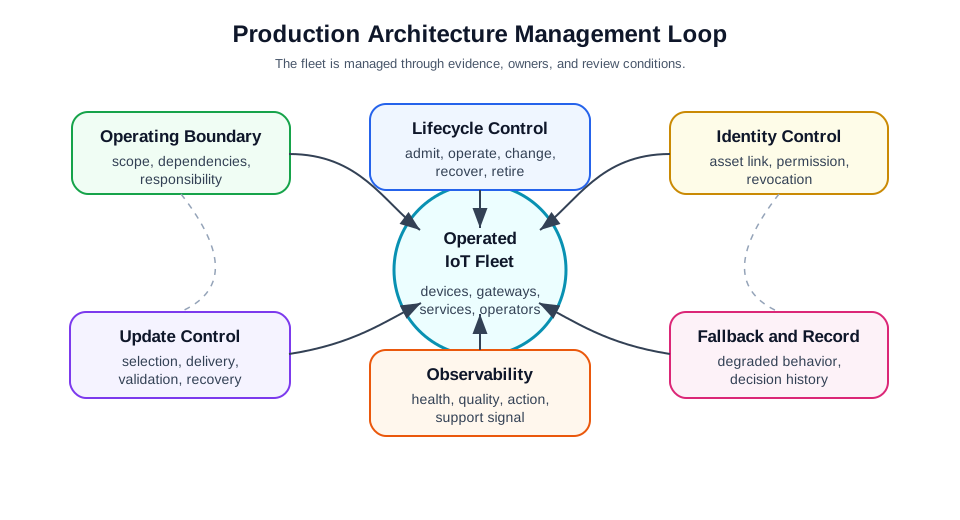
Before making the decision in this section, inspect Figure 33.1. It makes the decision concrete by showing production architecture management operating model showing operating boundary, lifecycle control, identity control, update control, observability, fallback behavior, support ownership, so the relationships can be checked before they are turned into a design claim.
The example requests an update for 500 devices, but 80 sleeping devices have not reported the new version. That gap is 16% of the requested fleet, not proof of failure or success for those units. Gateways may also buffer status, so the operating boundary must include devices, gateways, service records, and owners. Inspect reported versions, contact time, rollout logs, and recovery actions before declaring completion. The diagram lists required checks rather than a recorded incident; a real rollout decision needs observed state and a plan for sleeping or unreachable devices.
Boundary
Name what is inside the fleet, what is outside the fleet, which services are dependencies, and which teams own each operating responsibility.
Lifecycle
Define how assets are admitted, assigned, monitored, changed, serviced, replaced, and removed from service.
Control
Separate identity control, configuration control, command control, and remote update control so each has proof and ownership.
Rollout proof
Record readiness signals, open risks, owners, decisions, and review conditions before rollout or scale decisions proceed.
33.6 Management Domains
This section: Management Domains — A production architecture has multiple management domains.
A production architecture has multiple management domains. They should be checked together because a weakness in one domain often appears as a failure in another.
Use Figure 33.2 to inspect a rollout whose requested update state and reported device state do not yet agree.
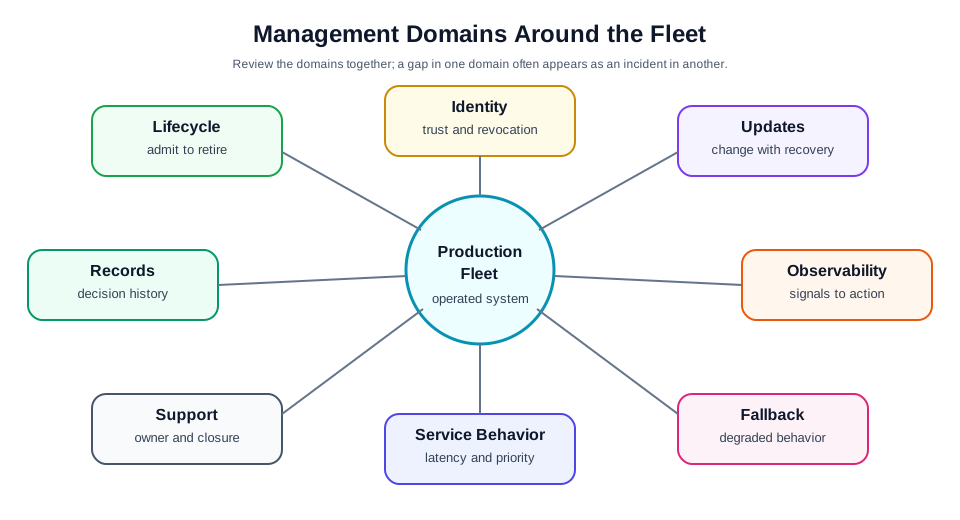
The update case in Figure 33.2 separates a requested action from a finished rollout. The fleet has an update request, but sleeping devices have not reported the new version and some gateways still buffer messages. Observability must compare requested state, reported state, command delivery, buffer state, and support notes before recovery is chosen. A timeout, owner, fallback, escalation rule, and closure proof then handle the mismatch. The figure’s percentage is a worked illustration of how many units remain unconfirmed, not evidence that they failed installation. This is why lifecycle, update, observability, and support duties meet at one fleet record rather than passing silently between teams.
Lifecycle management
Tracks the asset from planned deployment through active service, maintenance, replacement, and retirement.
Identity management
Links each physical asset to a verifiable digital identity, permission scope, audit trail, and revocation path.
Update management
Controls firmware, configuration, policy, and rule changes through selection, staged delivery, validation, pause, and recovery.
Observability management
Combines device health, gateway health, service behavior, command status, data quality, and operator action into a useful view.
Fallback management
Defines local behavior when connectivity, command delivery, service dependency, or measurement trust degrades.
Support management
Names who acts on alerts, what proof closes an issue, and how lessons from incidents update the architecture record.
33.7 Fleet Lifecycle Control
This section: Fleet Lifecycle Control — A production system should know which state each asset is in and which transitions require proof.
A production system should know which state each asset is in and which transitions require proof. Lifecycle control prevents devices from becoming invisible after installation.
At fleet lifecycle control, Fleet Lifecycle Control makes the architecture testable. In Figure 33.3, quality frames this claim: Fleet lifecycle control. Read it against Fleet Lifecycle Control.
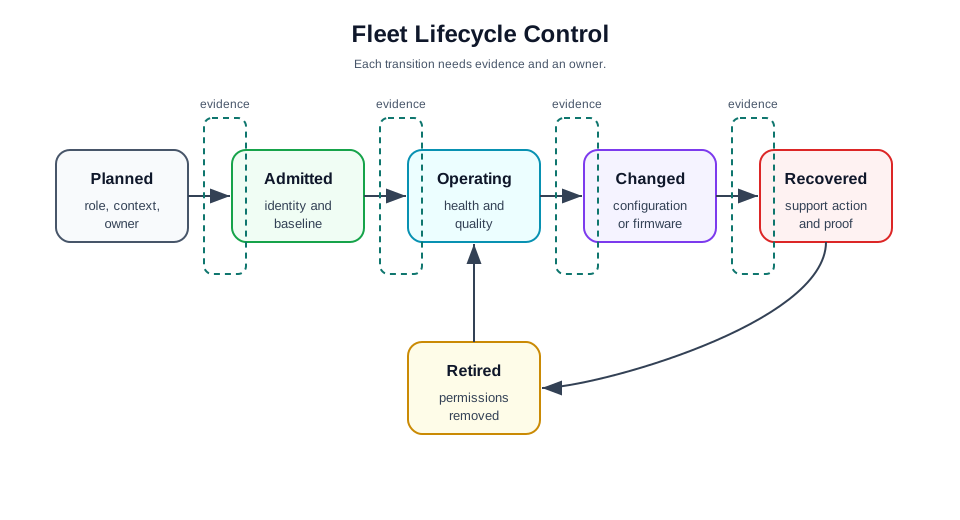
Three concrete diagram labels organize Figure 33.3: Fleet Lifecycle Control, quality, and evidence. Between them, the fleet lifecycle control relationship becomes visible: Fleet lifecycle control.
- Plan the asset: record device role, location context, expected data, owner, support path, and acceptance criteria.
- Admit the asset: verify identity, assign it to the correct fleet scope, apply baseline configuration, and confirm first trusted report.
- Operate the asset: monitor health, measurement trust, command status, local buffer state, and service behavior.
- Change the asset: apply configuration or firmware changes only when selection, delivery, validation, and recovery proof are available.
- Recover the asset: use degraded-mode rules and support records when signals become stale, commands fail, or measurement trust changes.
- Retire the asset: revoke identity, remove permissions, preserve required history, and close the physical-to-digital asset link.
A common production mistake is to treat the last reported value as proof that the device is still in the intended state. Production management separates reported state, requested state, command state, update state, and support state. The architecture should explain how mismatches are detected and who resolves them.
33.8 Update and Configuration Control
This section: Update and Configuration Control — Remote change is part of the production architecture.
Remote change is part of the production architecture. The management model should support small changes, large changes, pause decisions, rollback decisions, and operator communication without relying on a single all-or-nothing release.
Why pause at update and configuration control? Beside Update and Configuration Control, the diagram Figure 33.4 makes delivery proof explicit within this relationship: Update and configuration control.
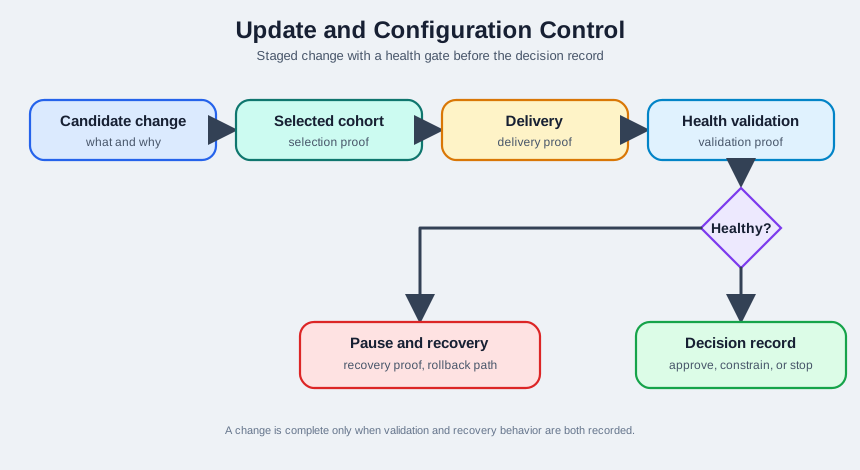
At Update and Configuration Control, the diagram Figure 33.4 establishes one design concern. delivery proof introduces the next; recovery proof, rollback path provides the final update and configuration control review cue. This recovery proof, rollback path sequence supports the claim: Update and configuration control.
Selection proof
Why these devices are included, which devices are excluded, and what dependency or environment facts affect the change.
Delivery proof
Whether the change was received, accepted, rejected, deferred, or expired before the device attempted to apply it.
Validation proof
What post-change signals prove that the device, gateway, service, and operator workflow still behave as expected.
Recovery proof
What happens when the change fails: pause criteria, rollback path, support action, and record update.
33.9 Observability and Degraded Operation
This section: Observability and Degraded Operation — Observability should explain what action to take, not only display many signals.
Observability should explain what action to take, not only display many signals. Degraded operation should define how the system behaves when a signal is missing, stale, conflicting, or untrusted.
Device view
Health, restart reason, identity state, local buffer state, active policy, measurement validity, and last accepted command.
Gateway view
Fleet reachability, local processing status, queue state, rule evaluation, store-and-forward behavior, and dependency health.
Service view
Ingestion behavior, command workflow, update orchestration, alert routing, data quality checks, and operator access.
Operator view
Open alerts, assigned owner, expected action, affected assets, decision history, and the proof needed to close the issue.
Degraded operation should be written as explicit behavior:
- If connectivity is degraded, which local rules continue and which remote actions are paused?
- If data quality is degraded, which consumers are warned and which automated decisions are disabled?
- If command delivery is uncertain, how long is a command valid and what proves it was accepted?
- If identity trust changes, which permissions are suspended and which support process takes over?
- If support ownership is unclear, which escalation path prevents the issue from being ignored?
33.10 Decision Record
This section: Decision Record — Production architecture decisions should leave a record that can be checked after a rollout, update, incident, or ownership change.
Production architecture decisions should leave a record that can be checked after a rollout, update, incident, or ownership change.
Why pause at decision record? Beside Production Architecture Decision Record, the diagram Figure 33.5 makes Proof considered explicit within this relationship: Production architecture decision record.
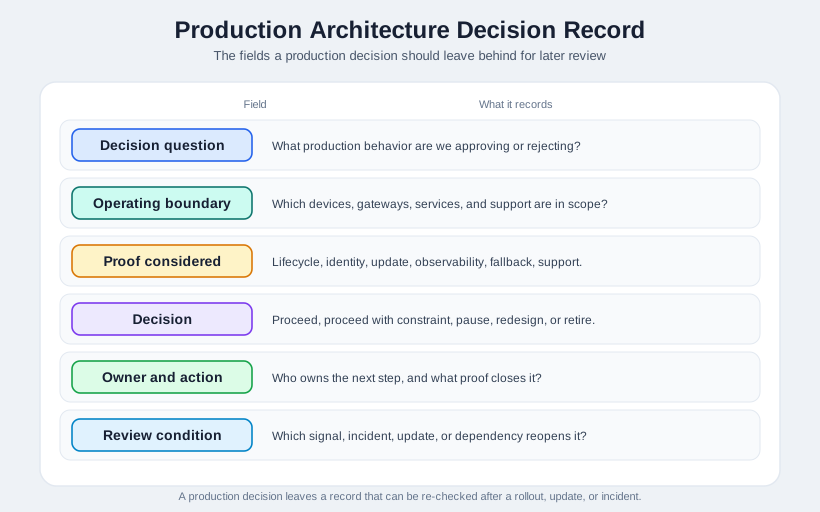
The fields in Figure 33.5 make a production choice checkable after an incident or rollout. The question names which behavior is being approved or rejected; the operating boundary names devices, gateways, services, users, and support teams in scope. Proof considered includes lifecycle, identity, update, observability, fallback, and support results. The decision can proceed, pause, constrain, redesign, or retire, but an owner must have the next action and the proof that closes it. A signal, incident, update, or changed dependency becomes the review condition. Store these fields with the release so a later team can explain why the old choice still applies.
Example record shape:
Decision question:
  What production behavior are we approving or rejecting?

Operating boundary:
  Which devices, gateways, services, users, and support teams are in scope?

Proof considered:
  Lifecycle proof, identity proof, update proof, observability proof,
  fallback proof, and support proof.

Decision:
  Proceed, proceed with constraint, pause, redesign, or retire.

Owner and action:
  Who owns the next step, and what proof closes it?

Review condition:
  Which signal, incident, update, fleet change, or dependency change requires a new check?
33.11 Regional Monitoring Rollout
This section: Regional Monitoring Rollout — A regional monitoring team has a pilot that reports environmental readings through local gateways to a remote service.
A regional monitoring team has a pilot that reports environmental readings through local gateways to a remote service. The pilot is technically successful, but the next rollout will add more sites, more support teams, and more update responsibility.
Use the production management model to check the rollout:
Boundary question
Which assets, gateways, services, dashboards, operators, and support queues are part of the operated system?
Lifecycle question
What record proves that a device was admitted correctly, is still trusted, and can be removed without leaving active permissions behind?
Update question
How does the team select a small group, validate the change, pause rollout, recover affected devices, and update the decision record?
Fallback question
What local behavior continues when remote service access is degraded, and what behavior is paused until trust returns?
Expected decision output:
- A named operating boundary.
- A lifecycle state model for devices and gateways.
- A management-domain checklist with owners.
- An update and configuration-control route.
- Observability signals tied to operator action.
- Degraded-mode behavior for connectivity, data quality, command delivery, and identity trust.
- A decision record with action owner and review condition.
33.12 Production Management Proof
This section: Production Management Proof
33.13 Match: Management Domain to Proof
This section: Match: Management Domain to Proof
33.14 Order: Production Architecture Decision
This section: Order: Production Architecture Decision
33.15 Common Pitfalls
This section: Common Pitfalls
Drawing tiers but not responsibilities
An Edge-Fog-Cloud diagram is not enough. The architecture must name who owns health, updates, identity, fallback, and support action.
Mixing requested and reported state
A requested configuration is not proof that the device applied it. Keep requested, reported, command, update, and support state separate.
Letting updates outrun proof
A change route without validation, pause, and recovery proof can turn a small defect into a fleet issue.
Observing without action
Metrics and logs help only when they route to a support owner with a clear action and closure signal.
Leaving retirement vague
Retired devices should lose active permissions and be disconnected from active fleet decisions.
Skipping review conditions
Every decision needs a condition that brings it back for another check when fleet size, dependency, service behavior, or operating context changes.
33.16 See Also
This section: See Also
- Production Architecture Management Index: route through the production architecture series.
- Production Architecture Case Studies: proof patterns for production decisions.
- Production Architecture Lab: practice production proof checks.
- Production Resources: checks, decision resources, and follow-on routes.
- QoS and Service Management: check latency, priority, and service behavior.
33.17 Production as Living Boundary
This section: Production as Living Boundary — A production architecture is not finished when the first device sends data.
A production architecture is not finished when the first device sends data. It has to keep a live boundary around assets, gateways, services, operators, support queues, update paths, and retirement rules as the fleet changes.
The management question is therefore practical: can the team prove which devices are trusted, which configuration is intended, which state was actually reported, which update is active, which fallback is running, and who owns the next action?
Consider a fleet of water-level monitors that report through site gateways. The prototype question is whether readings arrive. The production question is harder: whether each sensor has a known asset record, credential, firmware version, policy, gateway route, support owner, and retirement path. If a gateway buffers reports during a cellular outage, the boundary must show whether the local flood-safe rule continues, which remote commands are paused, and who reviews the delayed data when the link returns.
That is why production management treats the fleet as a changing operating boundary rather than a static cloud-edge-device diagram. The same architecture must survive cohort updates, credential rotation, stale health reports, service dependency failures, support handoffs, and physical replacement without losing proof of ownership.
Good production evidence is mundane but decisive. It can be an enrollment log that ties serial number to site, a certificate record that shows revocation path, a firmware manifest with rollback package, a gateway queue report with age limits, a health window that defines stale data, and an incident record that names the support queue. Together those artifacts show whether the live fleet is still inside the promised boundary.
If one artifact is missing, the architecture should say which owner must restore it before the fleet change proceeds.
33.18 Fleet Change Record
This section: Fleet Change Record — Every rollout, update, policy change, or retirement should leave a record that joins the technical state to the operating owner.
Every rollout, update, policy change, or retirement should leave a record that joins the technical state to the operating owner. Without that record, production work depends on memory during the exact moments when memory is least reliable.
| Change Moment | Proof To Record | Owner Decision |
|---|---|---|
| Admit device | Identity, location, expected role, baseline configuration, first trusted report, and support path. | Accept, quarantine, rework, or reject from fleet scope. |
| Update cohort | Selected devices, excluded devices, delivery result, post-change health, pause criteria, and rollback path. | Continue rollout, pause, rollback, or gather more proof. |
| Operate degraded | Connectivity state, stale-signal decision, local fallback behavior, paused remote actions, and operator notice. | Continue degraded mode, dispatch support, or suspend service. |
| Retire asset | Permission revocation, data retention status, physical removal, dependency cleanup, and closure signal. | Close, escalate missing proof, or keep the asset quarantined. |
For a firmware rollout, include the exact cohort query, excluded devices, requested version, reported version, delivery result, post-change health window, pause threshold, rollback package, and owner. For a retirement, include identity revocation, inventory closure, permission removal, data-retention decision, and the physical removal record. These fields are boring by design: they prevent a production fleet from depending on chat history or one engineer's memory.
The record should separate the platform state from the field state. A cloud service can say "requested," a gateway can say "queued," a device can say "applied," and support can say "closed." A production decision is reliable only when those states are reconciled or explicitly routed to an owner.
Do the same for degraded operation. Record which local rules continue, which remote commands expire, which dashboards show degraded trust, which customer-facing notices are needed, and which support owner decides when normal service has returned. If those fields are missing, the architecture can operate only while everything is healthy.
33.19 Requested vs Actual State Drift
This section: Requested vs Actual State Drift — Production systems carry several kinds of state at once.
Production systems carry several kinds of state at once. Requested state says what the platform wants. Reported state says what the device last claimed. Command state says whether an action was accepted, expired, rejected, or still pending. Support state says whether an operator has taken responsibility.
These states drift for ordinary reasons: devices sleep, links fail, gateways buffer, update cohorts pause, clocks skew, identities rotate, and support tickets cross team boundaries. Treating the newest dashboard value as the whole truth hides that drift.
A production architecture should make state mismatch visible. When requested and reported state diverge, the system needs a timeout, owner, fallback behavior, escalation rule, and closure proof rather than a silent assumption that the fleet will eventually converge.
The implementation detail can vary, but the invariant is the same. A device-shadow service, MQTT retained state, gateway queue, update orchestrator, and ticket system may each hold a different piece of truth. The architecture should define which source is authoritative for each decision and which mismatches are allowed during sleep, outage, or rollout windows.
Without that separation, recovery actions can make incidents worse. A retry storm can overload gateways, a rollback can target devices that never applied the update, and an operator can close an incident while the local fallback is still active. State drift is normal; unmanaged state drift is the production failure.
Production reviews should therefore ask for invariants rather than screenshots. A command must have an expiry, an update must have a cohort and rollback route, a credential must have a revocation path, a stale health signal must have an owner, and a retired asset must lose active permissions. Those invariants make different platforms comparable without pretending every vendor exposes the same controls.
The review should fail closed when an invariant has no measurable signal or owner.
33.20 Summary
This section: Summary — Production architecture management keeps an IoT system reliable after launch by assigning ownership for deployment, monitoring, updates, incidents, capacity, cost, and lifecycle transitions.
Production architecture management keeps an IoT system reliable after launch by assigning ownership for deployment, monitoring, updates, incidents, capacity, cost, and lifecycle transitions. The architecture is not complete until these operating responsibilities are visible and traceable.
33.21 What’s Next?
This section: What’s Next? — Continue with Production Architecture Case Studies when you need proof patterns for lifecycle, update, identity, observability, and incident-learning decisions.
Continue with Production Architecture Case Studies when you need proof patterns for lifecycle, update, identity, observability, and incident-learning decisions. Use Production Architecture Lab when the next step is a practical rehearsal of state, commands, updates, and recovery.
Find help
3 reviewed answers.
Where should I start in a module?
Open the module page from the sidebar to see its chapters in order. Use the module map to return to a topic you need.
Modules and pathsReviewed
What can I try when a project does not work?
Check the symptom, then work through the diagnostic steps. Keep the error message and the smallest example that reproduces it.
When you are stuckReviewed
How do interactive examples work?
Use the interactive guide to check how examples and simulations work before changing your project.
Interactive examples guideReviewed