14 SDN Controller Selection and Comparison
More
Depth: Practitioner
Progress saves as you read. Mark sections complete as you go; your progress appears in the sidebar.
14.1 Begin With One Change the Network Must Make
This section: Begin With One Change the Network Must Make — A gateway is a node that joins one network to another.
A gateway is a node that joins one network to another. QoS means rules that give some traffic a chosen level of service. Telemetry means records sent from a system so its state can be watched. Picture a clinic link that must keep an alarm path working while a large file moves. A controller may help set and check that rule. Start with the proof the service needs.
Name the devices, links, traffic classes, and safe fallback. Mark which parts the controller can see and change. Then test one rule from request to network state. Break a link. Restart the controller. Send a bad request. Record policy, installed state, measured path, alert, recovery, and the person who owns the result.
A rich controller can make change fast, but it adds state, access, and update duties. A simple tool may be easier to run, but it may lack a needed view or interface. A feature list does not prove site fit. For an SDN controller, build the shortlist, proof matrix, and selection record; check state age, control loss, scale, interface, and life-cycle risks before accepting the result.
Build the first proof with one safe rule. Ask for the rule. Check that it is allowed. Install it on the right parts. Read the parts back. Send matching and non-matching traffic. Check the user result. Remove the rule. Keep each step and time in one record.
Then test loss of control. Keep the last safe state where that is the plan. Reject a stale or bad change. Raise a clear alert. Let a named person take over. When control returns, compare wanted and real state before more change. The network should not hide the gap.
One controller may fit a lab and fail a large site. Another may be strong but hard for the team to run. Score the proof, not the name. Keep “not tested” as a valid result. The open row tells the next trial what to do.
14.2 Start With the Proof a Controller Must Leave
This section: Start With the Proof a Controller Must Leave — Controller selection is easy to fake with feature lists.
Controller selection is easy to fake with feature lists. A real comparison starts with the proof a controller must leave after it changes a gateway, switch, or service path.
Start simple: pick a candidate service and list the request, topology scope, southbound feature, telemetry, local fallback, and rollback owner. A controller fits only if it can make that row true in your environment.
14.3 Controller Selection Decision Route
This section: Controller Selection Decision Route — Use this route to compare controller candidates without turning the chapter into a stale tool table.
Use this route to compare controller candidates without turning the chapter into a stale tool table.
- Name the service intent: isolation, routing control, QoS treatment, traffic monitoring, gateway policy, maintenance access, or tenant separation.
- Define the control scope: lab, site, campus, regional, data-center, or service-provider scale, plus switch and gateway boundaries.
- Classify candidate families: teaching/prototype, single-domain operations, integration-heavy, distributed/high-availability, or managed platform.
- Check interface fit: northbound contracts, southbound protocols, telemetry exports, automation hooks, and identity boundaries.
- Check state ownership: topology, policy, active rules, conflicts, controller roles, rollback gates, and stale-state behavior.
- Capture operations proof: install result, counters, receiver behavior, failover behavior, support model, upgrade process, and revision trigger.
- Pilot before commitment: test the real traffic class, device boundary, failure mode, and rollback path before making the controller the production default.
14.4 Selection Lenses
This section: Selection Lenses — Controller comparison should start with questions, not names.
Controller comparison should start with questions, not names.
Figure 14.1 compares controller choices by service intent and operating duties.
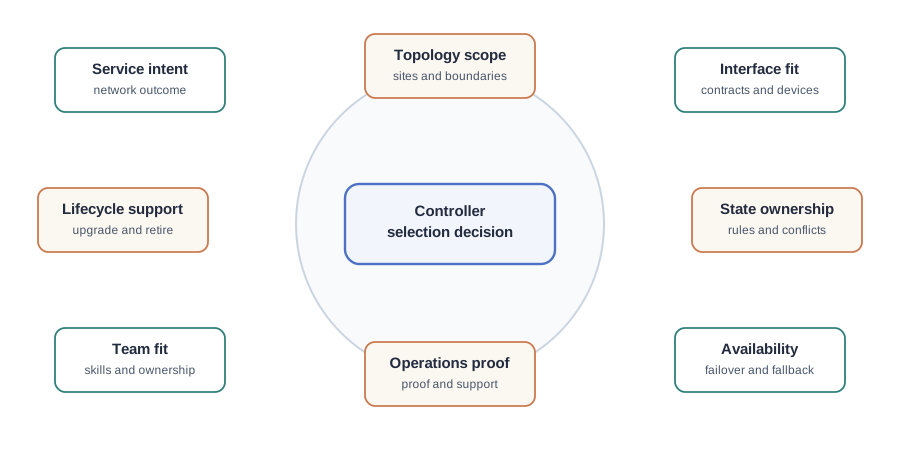
The service intent states the network outcome, while topology scope fixes sites and device boundaries. Interface fit checks northbound contracts, southbound devices, telemetry, and identity. State ownership asks who resolves policy and rule conflicts, and availability asks what happens during controller loss. Operations proof includes installation, counters, receiver results, and support procedures; team fit and lifecycle support cover skills, upgrades, and retirement. A candidate should be tested against the actual service path rather than ranked by feature count. Any unowned rule or fallback remains an architecture risk even if a lab flow succeeds.
Service intent
What outcome does the controller coordinate: isolation, path control, QoS treatment, traffic visibility, or change automation?
Topology scope
Which switches, gateways, sites, tenants, or traffic classes are in scope, and which are explicitly out of scope?
Interface fit
Which northbound, southbound, telemetry, identity, and automation contracts must the controller support?
State ownership
Who owns topology, policy, active rules, conflict decisions, rollback gates, and stale-state handling?
Availability behavior
What continues locally, what pauses, what fails over, and what requires an operator decision?
Lifecycle support
How are upgrades, configuration changes, security updates, support handoff, and decommissioning handled?
14.5 Controller Fit Families
This section: Controller Fit Families — Controller candidates change over time.
Controller candidates change over time. Fit families last longer than specific release promises.
The next controller fit families step needs Shortlist families by proof duty as a visual checkpoint. At Figure 14.2, inventory, workflow supplies the relationship to challenge: SDN controller family shortlist map tying each controller family to the proof it must leave before selection.
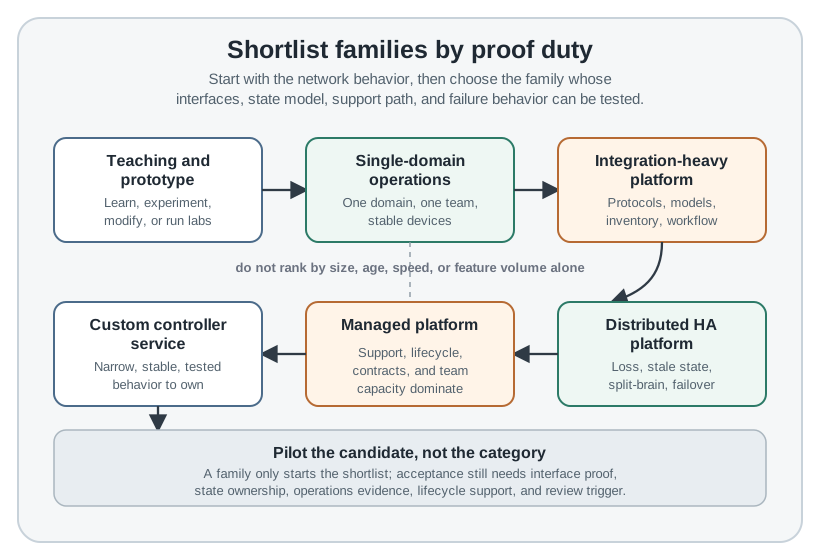
At Shortlist families by proof duty, the diagram Figure 14.2 establishes one design concern. inventory, workflow introduces the next; Pilot the candidate, not the category provides the final controller fit families review cue. This Pilot the candidate, not the category sequence supports the claim: SDN controller family shortlist map tying each controller family to the proof it must leave before selection.
Teaching and prototype
Best when the goal is learning, rapid experiments, custom algorithms, or small controlled labs. Watch for missing production proof.
Single-domain operations
Best when one team manages one well-bounded network domain with stable southbound devices and limited integration needs.
Integration-heavy platform
Best when the controller must coordinate several protocols, models, inventories, service systems, or operations workflows.
Distributed high-availability
Best when controller loss, split-brain writes, stale state, or regional failover would materially affect protected services.
Managed platform
Best when support ownership, lifecycle commitments, contract proof, or operating-team capacity matters more than full source control.
Custom controller service
Best only when the required behavior is narrow, stable, tested, and cheaper to own than adopting a broader controller platform.
A controller family is not automatically better because it is larger, faster, smaller, newer, or easier to code against. The comparison should show the tradeoff that matters for the deployment.
14.6 Proof Matrix
This section: Proof Matrix — Use a proof matrix to compare candidates.
Use a proof matrix to compare candidates. Fill it with verified observations from the candidate documentation, pilot tests, operations rehearsal, and local failure-mode tests.
One relationship governs proof matrix. The diagram Figure 14.3 states it as: Controller evidence matrix for comparing candidate families against interface fit, state ownership, availability behavior, operations proof, lifecycle support, and proof status. Study Evidence beats controller feature lists and What continues, pauses.
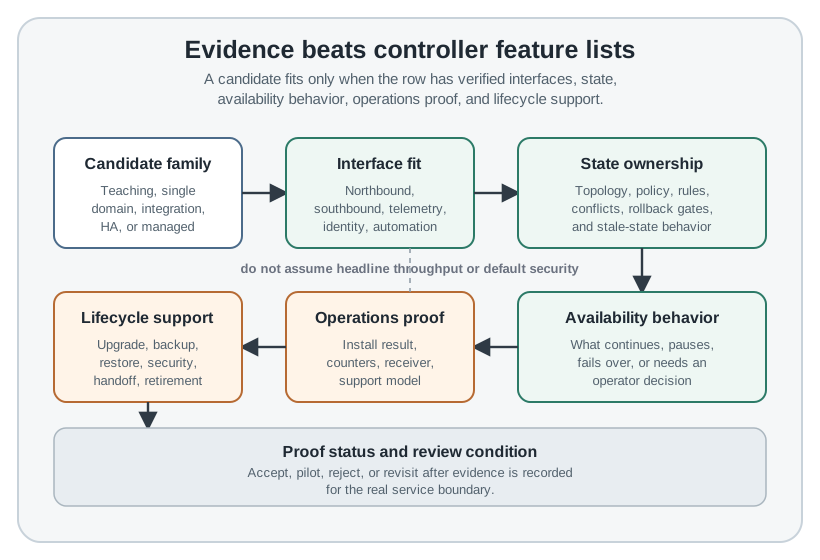
The controller comparison in Figure 14.3 covers interface fit, state ownership, availability behavior, operations proof, lifecycle support, and proof status.
Must prove
Interface compatibility, topology scope, policy conflict handling, rule installation behavior, rollback, and protected-service proof.
Should prove
Upgrade path, backup and restore, observability, support ownership, test automation, and degraded-mode behavior.
May matter
Implementation language, extension style, user interface, community ecosystem, packaging model, and optional integrations.
Do not assume
Headline throughput, default security posture, failover behavior, table capacity, support status, or long-term project health.
Example proof columns:
- Candidate family and verified candidate version.
- Required northbound contract and southbound device support.
- State ownership model and conflict handling.
- Rule-install, delete, expire, counter, and rollback behavior.
- Failover or degraded-mode behavior under representative traffic.
- Operations proof: logs, events, counters, receiver outcomes, and support record.
- Decision: accept, reject, pilot again, or narrow the candidate scope.
14.7 Interface and Integration Fit
This section: Interface and Integration Fit — Many controller-selection mistakes happen at integration boundaries.
Many controller-selection mistakes happen at integration boundaries.
Use Figure 14.4 to test whether a controller exposes every contract and operational integration the application and switches require.
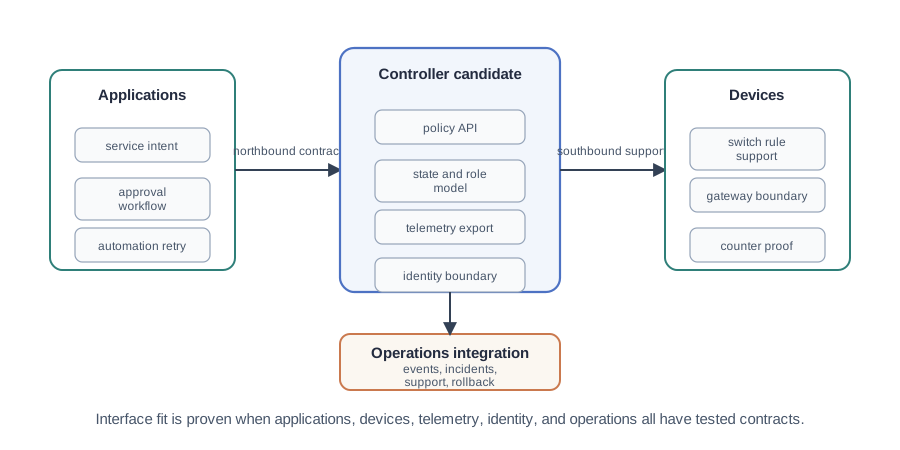
Read Figure 14.4 from allowed applications into the northbound request contract. The API must express the application’s actual intent, scope, retry, timeout, and failover behaviour. Move through controller integration to the southbound protocols and switch features required for enforcement. Telemetry export, identity boundaries, roles, approvals, and automation credentials sit across that path because operations must observe and authorize the same change. Finish with support and rollback. A controller that can compute a rule is still a poor fit if clients cannot request it safely, devices cannot enforce it, or operators cannot prove and reverse it.
Integration questions:
- Which applications are allowed to request network changes?
- Does the controller expose a contract that matches the application intent, or only a raw switch-rule surface?
- Which device protocols and switch features are actually required?
- Does the controller expose telemetry that can be joined with receiver and incident proof?
- How are identities, roles, approvals, and automation credentials managed?
- What happens when an application retries a request during timeout or failover?
Do not choose a controller only because it supports a long list of interfaces. Choose it because the needed interfaces are mature enough for the deployment and can be tested with the real traffic classes.
14.8 Use-Case Boundary Addendum
This section: Use-Case Boundary Addendum — Controller use cases belong in a selection decision when they prove what the controller must own.
Controller use cases belong in a selection decision when they prove what the controller must own. Separate the use case from the product choice:
- Traffic engineering needs path intent, congestion or priority proof, affected devices, and a rollback path.
- Segmentation and containment need scoped rule authority, protected-service exceptions, expiry, and receiver proof.
- Service assurance needs telemetry export, counter-to-service correlation, and an operator who owns the response.
- Application boundary needs a request contract with requester, scope, approval, duration, and expected proof.
- State model needs active-rule ownership, topology freshness, conflict resolution, and behavior during retry or failover.
This prevents a candidate from looking acceptable because it has many APIs while still lacking the specific use-case proof needed for the deployment.
14.9 Availability and Operations Fit
This section: Availability and Operations Fit — Availability is not a checkbox.
Availability is not a checkbox. It is a sequence of behaviors that must be tested.
Before approving availability and operations fit, test the depicted proposition in Figure 14.5: SDN controller availability and operations fit proof route. Read from Availability is tested behavior toward meter, isolate.
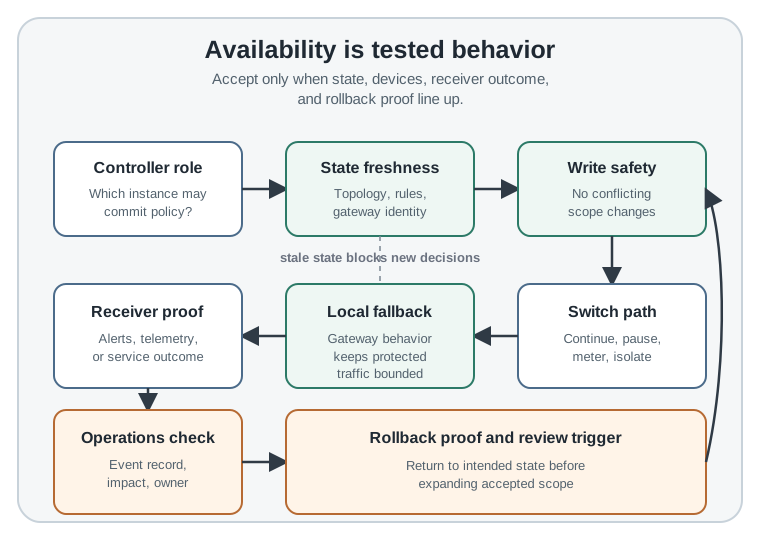
Begin the diagram Figure 14.5 with Availability is tested behavior. Continue through meter, isolate before checking stale state blocks new decisions. This path preserves the chapter’s availability and operations fit argument: SDN controller availability and operations fit proof route.
Availability checks:
- Which controller instance or role can commit a policy decision?
- How does the design prevent conflicting writes for the same scope?
- What state must be fresh before new rules can be installed?
- What rules remain in switches or gateways when controller contact is degraded?
- What traffic classes continue, pause, isolate, meter, or use local fallback?
- How does operations know what changed during the event?
- What rollback proof shows the network returned to the intended state?
For IoT networks, availability checks must include local gateway behavior and protected receiver proof. A controller cluster can coordinate network policy, but it cannot replace local safety behavior or prove receiver outcome by itself.
14.10 IoT Deployment Fit
This section: IoT Deployment Fit — IoT controller selection is constrained by gateways, physical process behavior, device limits, and field operations.
IoT controller selection is constrained by gateways, physical process behavior, device limits, and field operations.
Use Figure 14.6 to test a controller candidate against real gateway traffic, local safety needs, and field-support duties.
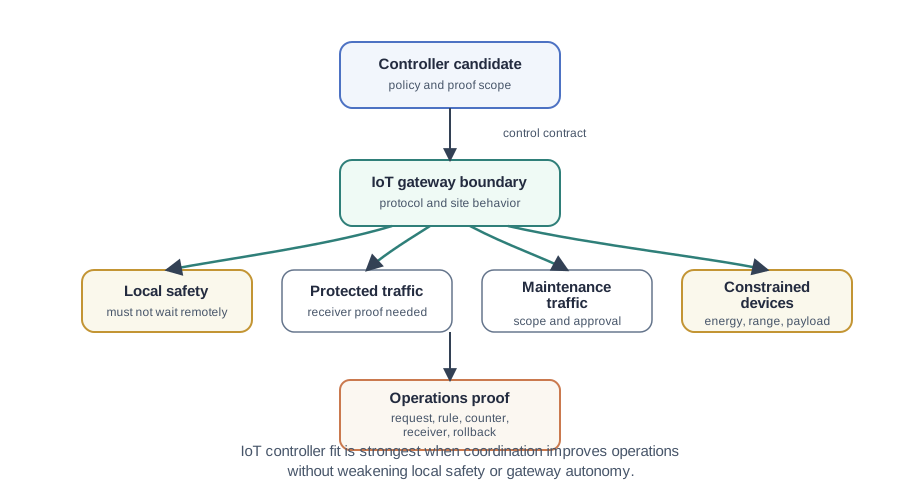
Start Figure 14.6 with the controller choice and the gateway or switch it will guide. Review upkeep, safe, unknown, and suspect traffic on their own. A good fit can split, count, copy, route, or rank shared flows. It should also leave a clear chain from the request to the rule, counter, receiver, and rollback. Then test the IoT limits. Safety, hard stop, and fast control stay local. Small devices still face power, range, packet, and clock limits. Upgrades, logs, and support need named owners, since more control by code can add field risk even when the rule is right.
Good fit: shared gateway policy
A controller can coordinate isolation, metering, mirror, route, or priority decisions across shared gateway and switch paths.
Good fit: auditable changes
Use a controller when network changes need requester, scope, rule, counter, receiver, and rollback proof.
Good fit: exception handling
Unknown, suspicious, or maintenance traffic can be routed through approved controller decisions.
Limit: local safety
Do not require remote controller availability for physical safety, emergency shutoff, or time-critical local loops.
Limit: constrained devices
A controller cannot remove energy, wireless range, payload, clock, or gateway constraints from constrained devices.
Limit: field support
A controller that is difficult to upgrade, observe, or support can increase operational risk even if it works in the lab.
14.11 Network Controller Shortlist
This section: Network Controller Shortlist — Scenario: A building operator wants SDN control over shared switches carrying door-access alerts, environmental telemetry, maintenance laptops, camera streams, and background updates.
Scenario: A building operator wants SDN control over shared switches carrying door-access alerts, environmental telemetry, maintenance laptops, camera streams, and background updates. The team needs gateway isolation, protected alert delivery, receiver proof, and a recovery path if controller contact is degraded.
Decision route:
- Define service intent: isolate or meter maintenance traffic without breaking protected alert delivery.
- Define scope: building switches, gateways, alert receiver, maintenance traffic, and recovery path.
- Classify candidates: lab candidate for practice, single-domain candidate for initial pilot, distributed candidate for high-availability comparison.
- Check interfaces: application request contract, southbound rule support, counters, event export, identity, and operator approval.
- Check state: topology freshness, gateway identity, protected path, active rules, conflict handling, and rollback.
- Test failure behavior: controller process loss, controller-link loss, rejected rule update, stale topology, and receiver outage.
- Decide: accept candidate only if the proof shows service outcome and rollback under representative conditions.
Example selection record:
Controller selection intent:
  Restrict maintenance traffic from selected gateways.
  Preserve door-access alerts and recovery access.

Candidate family:
  Single-domain operations controller for first pilot.
  Distributed option retained for availability comparison.

Required interfaces:
  Northbound request with requester, scope, duration, proof target.
  Southbound rules with scoped match, counter, timeout, and rollback.
  Telemetry export for switch event and receiver proof correlation.

State checks:
  Topology version, gateway identity, protected path,
  policy conflict decision, active rule record, rollback gate.

Pilot proof:
  Rule accepted by target switch. Protected receiver still sees alerts.
  Restricted traffic counter changes. Rollback works after timeout.
  Controller-contact loss follows documented degraded behavior.

Decision:
  Continue pilot only if upgrade, support, and failover proof are also captured.
14.12 Proof Loop
This section: Proof Loop — Selection proof should feed back into the architecture.
Selection proof should feed back into the architecture. A candidate that fails the pilot may still be useful for a smaller scope, but it should not become the default by accident.
Why pause at proof loop? Beside Requirements, the diagram Figure 14.7 makes Operations proof explicit within this relationship: SDN controller selection proof loop connecting requirements, candidate shortlist, pilot test, operations proof, architecture decision, and review condition.
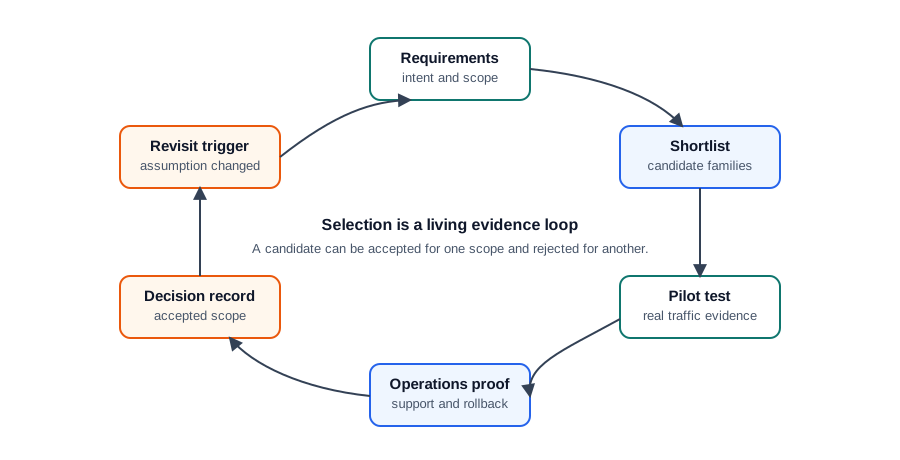
Keep Requirements, Operations proof, and Selection is a living evidence loop separate while reading Figure 14.7. The diagram makes Requirements a visible proof loop cue; its Operations proof relationship advances the claim: SDN controller selection proof loop connecting requirements, candidate shortlist, pilot test, operations proof, architecture decision, and review condition.
Proof to keep:
- Requirements record with service intent, topology scope, traffic classes, and protected paths.
- Candidate shortlist with family classification and versioned source records.
- Pilot results for rule install, rollback, counter, receiver outcome, and degraded behavior.
- Operations proof for upgrade, backup, restore, event visibility, and support ownership.
- Selection record that states accepted scope, rejected scope, unresolved assumptions, and review conditions.
14.13 Common Pitfalls
This section: Common Pitfalls
Ranking by headline throughput
Throughput is only useful after the traffic model, rule churn, controller role, and measurement method are understood.
Ignoring state ownership
Two controller paths that can commit conflicting rules for the same scope create operational risk.
Choosing by language alone
Implementation language affects extension work, but it does not prove availability, integration, or rollback behavior.
Skipping degraded-mode tests
Controller loss, stale topology, rejected rule updates, and receiver outages must be rehearsed with representative traffic.
Assuming lab fit means production fit
A lab-friendly controller can be excellent for learning while still lacking production proof or support ownership.
No review condition
Controller choices should be rechecked after topology changes, new traffic classes, upgraded devices, or missing proof.
14.14 Selection Is Proof Fit
This section: Selection Is Proof Fit — An SDN controller is not selected by ranking names.
An SDN controller is not selected by ranking names. It is selected by proving that a candidate can own the exact service intent, topology scope, interface contracts, state records, failure behavior, and operating lifecycle that the deployment depends on.
Before making the decision in this section, inspect Figure 14.8. It makes the decision concrete by showing choose a controller by following the proof route: name the service intent, set the control scope, shortlist the family, prove interface and state fit, capture operations evidence, so the relationships can be checked before they are turned into a design claim.Figure 14.8 turns a controller choice into a sequence of testable questions.
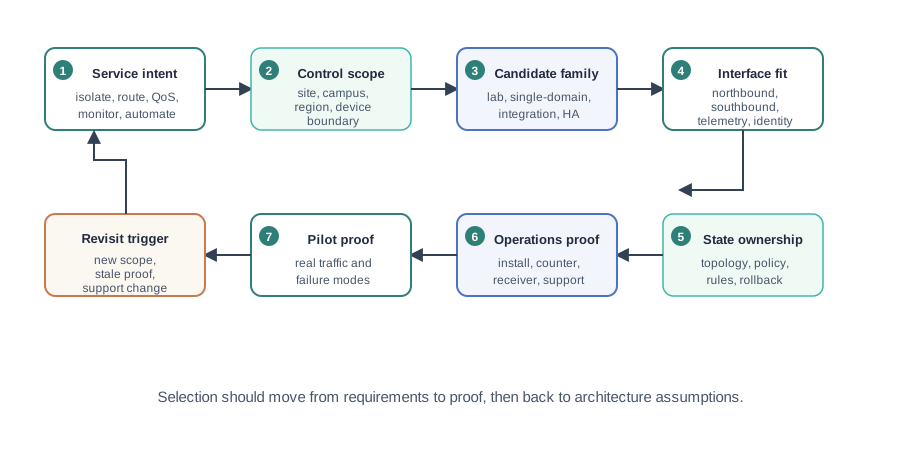
Locate Service intent in the diagram Figure 14.8, then compare telemetry, identity with support change. The three labels prevent a one-box selection is proof fit reading. Their relevance to telemetry, identity is: Choose a controller by following the proof route: name the service intent, set the control scope, shortlist the family, prove interface and state fit, capture operations evidence, pilot the real failure mode, and record the review trigger.
Name the service intent, such as isolating a device group or protecting an alarm path, then limit the control scope to the sites and boundaries involved. Compare candidate families only after checking northbound and southbound interfaces, telemetry, and identity. State ownership must cover topology, policy, rules, and rollback. Operations proof needs installed-rule evidence, counters, receiver behavior, and a support action under failure. The final choice follows those observations. A controller that accepts a rule but cannot show its receiver outcome or recovery path has not proved the intended service.
Small-screen read: Selection moves from service intent and scope to candidate family, interface fit, state ownership, operations proof, pilot proof, and review trigger. A name is not enough.
The useful comparison starts with the network behavior: isolation, QoS treatment, traffic monitoring, gateway policy, maintenance access, tenant separation, or protected-path assurance. Each behavior creates a different controller obligation. A controller that is excellent for a teaching lab may be a poor production default if it cannot expose the right request contract, prove receiver outcomes, or survive the required degraded mode.
For an IoT building network, the controller may be asked to isolate maintenance laptops, preserve door-access alerts, meter camera streams, and keep environmental telemetry visible during a service event. Those jobs share switches, but they do not share the same risk. The first pass should therefore name the protected receivers, the traffic classes allowed to change, the devices that can receive new rules, and the operator who can pause or roll back a change. Without that boundary, a controller choice becomes a preference for a product family rather than proof that the deployment behavior is safe.
A practical selection starts with one representative path. Send a request through the northbound API, install the southbound rule on the intended switch, observe counters and receiver behavior, force a timeout or stale-topology condition, and run the rollback. If the candidate cannot show who owned each state transition, where the evidence landed, and what changed for protected traffic, it is not ready for a wider scope even if the rule install succeeded.
- Service fit: the candidate matches the intended network behavior and traffic class.
- Interface fit: applications, devices, telemetry, identity, and automation use contracts the team can test.
- State fit: topology, policy, active rules, conflicts, stale data, and rollback have clear owners.
- Operations fit: installation, upgrade, support, observability, backup, failover, and decommissioning are owned.
14.15 Controller Selection Record
This section: Controller Selection Record — A controller selection record should be short enough to review and specific enough to test.
A controller selection record should be short enough to review and specific enough to test. It should reject vague claims such as "supports SDN" or "has high availability" until they are connected to the actual devices, traffic classes, controller roles, and receiver outcomes in scope.
Start with a short candidate list such as a lab controller for experiments, a single-domain operations controller for the first site, and a distributed option for high-availability comparison. For each candidate, write the same concrete row: the application request it accepts, the switch or gateway population it may change, the southbound feature required, the telemetry that proves the change worked, the local behavior during controller loss, and the owner who can reverse the change. This keeps the comparison tied to deployment facts instead of feature volume.
Then run one narrow pilot that an operator can repeat. For a maintenance-isolation use case, install a rule with an expiry, confirm maintenance traffic is limited, confirm door-access alerts still arrive, read the affected counters, force controller contact loss, and perform rollback. The accepted scope should say exactly what was proven. Production acceptance should wait if the team has not tested stale topology, cluster-role failover, backup and restore, support handoff, or upgrade behavior.
The record should produce an accepted scope and a rejected scope. That distinction matters: a candidate can be valid for lab training or a single building while still being rejected for multi-site failover or safety-adjacent traffic.
14.16 State Makes Rankings Stale
This section: State Makes Rankings Stale — Controller rankings decay because controller projects, managed services, device firmware, switch pipelines, API contracts, and operating teams change.
Controller rankings decay because controller projects, managed services, device firmware, switch pipelines, API contracts, and operating teams change. The durable part of the decision is the state and lifecycle model: which controller can write which rules, using which topology view, with which conflict owner, and with which recovery path when conditions change.
Stale state is the hidden failure mode. A candidate can look correct while it is using an old topology, an expired gateway identity, a missing receiver signal, or an untested cluster role. High availability does not remove this risk unless the design also prevents conflicting writes and defines what switches or gateways should do while controller contact is degraded.
The implementation detail that matters is the chain between an intent request and the dataplane rule. A northbound call may arrive from an application that has stale inventory, a controller node may have an old topology epoch, a switch may reject a match field, or a gateway may continue with cached policy while the controller is unreachable. Each step needs a freshness check and a visible failure mode. If any step silently accepts old state, the system can install a rule that looks authorized but no longer matches the physical or operational reality.
Lifecycle change creates the same risk over months. A firmware update can alter table capacity or counter behavior. A support contract can change who responds at 02:00. A new tenant or camera stream can widen the scope of a rule that was originally safe for maintenance laptops. The controller decision should therefore carry versioned assumptions and a retest path: topology source, controller role, southbound capability, protected receiver, fallback behavior, rollback command, and owner. When one assumption changes, the accepted scope should shrink until the proof is current again.
- Freshness gate: block new decisions when topology, gateway identity, or controller role is stale.
- Conflict gate: identify the owner when two applications can affect the same traffic scope.
- Fallback gate: define which traffic continues locally, pauses, isolates, meters, or waits for an operator.
- Lifecycle gate: recheck after upgrades, support changes, device changes, topology changes, or new protected services.
14.17 Summary
This section: Summary — SDN controller comparison should be proof-based.
SDN controller comparison should be proof-based. Start with the service intent, topology scope, interface requirements, state ownership, availability behavior, operations proof, and lifecycle needs. Then compare candidate families and run a representative pilot. A durable selection does not depend on fixed product rankings, old performance tables, or assumptions about project status.
For IoT deployments, preserve local safety and gateway autonomy, verify protected receiver behavior, and keep rollback proof connected to every important controller decision.
14.18 Key Takeaway
This section: Key Takeaway
Choose an SDN controller by the behavior it can prove in your scope: service intent, interfaces, state ownership, degraded behavior, receiver outcome, rollback, support ownership, and the trigger that forces a recheck.
14.19 See Also
This section: See Also
- SDN Controller Architecture: controller services, state ownership, and packet-event decisions.
- SDN APIs and High Availability: API contracts, cluster ownership, and failover proof.
- SDN Architecture Fundamentals: SDN responsibility boundaries and rule lifecycle.
- SDN Production Readiness: production readiness, rollback, and operational ownership.
Find help
3 reviewed answers.
Where should I start in a module?
Open the module page from the sidebar to see its chapters in order. Use the module map to return to a topic you need.
Modules and pathsReviewed
What can I try when a project does not work?
Check the symptom, then work through the diagnostic steps. Keep the error message and the smallest example that reproduces it.
When you are stuckReviewed
How do interactive examples work?
Use the interactive guide to check how examples and simulations work before changing your project.
Interactive examples guideReviewed