32 QoS in Real-World IoT Systems
More
Depth: Practitioner
Progress saves as you read. Mark sections complete as you go; your progress appears in the sidebar.
32.1 Start With the Field Constraint
This section: Start With the Field Constraint
32.1.1 Protect the Receiver’s Most Urgent Need
A rural clinic shares one weak link between a medicine-fridge alarm, routine readings, software files, and staff messages. Sending every item with the same treatment can let a large background transfer delay the warning. The clinic owner must state which receiver needs which information, by when, and what harm follows if it is late.
Make a small traffic record. Name the sender, receiver, purpose, acceptable delay, age limit, loss response, duplicate rule, and local fallback. Protect only what the consequence requires. Let routine work wait or shrink when the link is poor. Keep urgent safe action local when a remote path cannot meet the time bound.
Then load and break the shared path. Start a large transfer. Remove the link. Fill the local holding area. Send an old warning and a duplicate. Check arrival time at the receiver, not only departure time. Confirm that stale work expires, urgent work stays visible, and recovery does not flood the clinic with repeated actions.
One class label cannot guarantee service across every field site. The result is bounded by the measured link, equipment, load, and fallback. The deeper sections compare traffic classes, local buffering, shaping, expiry, delivery meaning, receiver proof, and decision records for several real operating settings.
For each flow, ask: Who needs it? What do they do with it? How late is too late? When is old data worse than no data? Can a copy cause repeat work? Can the sender wait? Can the receiver ask again? What safe work stays local? Which measure proves the result at the far end?
Keep the number of classes small. Give each one a clear reason. Test them together under the same load. Show that background work yields when needed. Show that routine work catches up without hiding urgent work. Show that an old item expires. Record the site and date. Reopen the design when the link, traffic mix, receiver, or harm changes.
Real QoS decisions happen in constrained places: intermittent links, shared gateways, battery devices, maintenance windows, and receivers that still need clear evidence. The right service treatment depends on that field context.
Start simple: describe one site, one traffic class, and one failure consequence. Then select the smallest treatment that protects the receiver while keeping other traffic healthy.
32.2 Learning Objectives
This section: Learning Objectives
By the end of this chapter, you will be able to:
- Map real IoT traffic to service objectives without relying on one universal latency or reliability promise.
- Choose domain patterns for buildings, industrial monitoring, constrained field links, mobile assets, and shared gateways.
- Explain how local control, buffering, summarization, expiry, and fallback protect service when connectivity is degraded.
- Match protocol delivery semantics to traffic consequence, acknowledgement scope, duplicate handling, and freshness.
- Build a real-world QoS decision record that connects policy, proof, owner, and revisit trigger.
32.3 Quick Check: Field-Site QoS Proof
This section: Quick Check: Field-Site QoS Proof
Core concept: Real-world QoS is not a table of fixed numbers. It is a decision process that connects traffic consequence, link constraint, local behavior, protocol semantics, and receiver proof.
Why it matters: A message can have the right priority and still fail the system if it arrives stale, is retried too aggressively, blocks a constrained link, or is judged only from sender logs.
Key takeaway: Start with what the receiver must safely know or do. Then choose the smallest service treatment that protects that outcome without starving the rest of the system.
32.4 Prerequisites
This section: Prerequisites
Use these chapters as needed:
- QoS and Service Management: traffic classes, service objectives, and decision records.
- QoS Core Mechanisms: queues, shaping, rate limits, retry, expiry, and proof.
- QoS Policy Lab: practice classifying traffic and collecting proof.
- Communication and Protocol Bridging: gateway boundaries and protocol translation.
- MQTT QoS and Session: application delivery modes and session behavior.
32.5 Real-World QoS Route
This section: Real-World QoS Route — The real-world route starts with operating consequence and moves outward through link constraints, local behavior, protocol semantics, and receiver proof.
The real-world route starts with operating consequence and moves outward through link constraints, local behavior, protocol semantics, and receiver proof.
- Name the consequence: identify what changes if the message is late, missing, duplicated, stale, or delayed behind other traffic.
- Set the service objective: describe freshness, delay, duplicate handling, delivery behavior, and degraded operation for each class.
- Read the constraint: note shared gateways, constrained links, intermittent paths, queue depth, battery limits, and burst behavior.
- Choose local behavior: decide when to act locally, buffer, summarize, drop, expire, retry, or switch to degraded mode.
- Match protocol semantics: select delivery and acknowledgement behavior that supports the objective without creating avoidable load.
- Verify at the receiver: collect proof from the consumer of the message, then record the decision and revisit trigger.
32.6 Domain Patterns
This section: Domain Patterns — Domains do not automatically determine QoS.
Domains do not automatically determine QoS. They provide clues about consequences, operating constraints, and proof signals.
The domain branches in Figure 32.1 are prompts to inspect consequence, not ready-made QoS settings. Building systems separate alarms and access actions from energy telemetry and maintenance. Industrial monitoring needs local protective control even while remote data supports supervision. Field links may summarize or expire work on constrained paths; mobile assets can arrive late or out of order. Shared gateways need limits, queues, and retry rules, while enterprise ingestion needs backpressure and receiver proof. For each path, name the actor, deadline, loss or duplicate tolerance, and action if the link degrades. The domain label helps find the risk; the receiver result decides whether the policy worked.
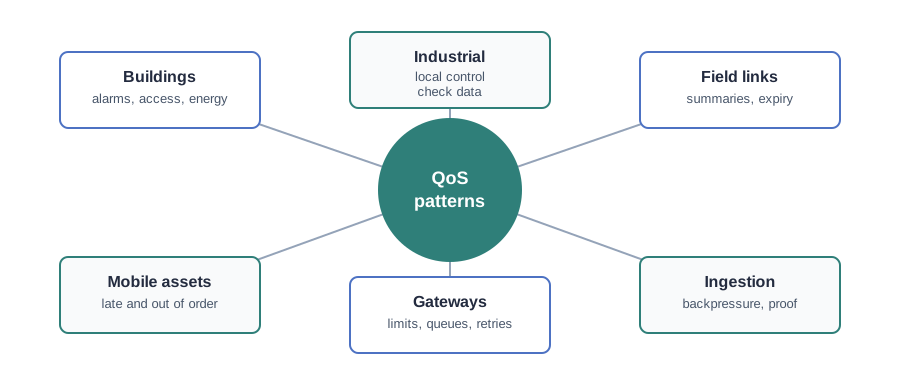
Keep QoS, Field links, and backpressure, proof separate while reading Figure 32.1. The diagram makes QoS a visible domain patterns cue; its Field links relationship advances the claim: QoS domain pattern map.
Building operations
Separate alarms, access actions, comfort control, energy telemetry, maintenance logs, and background updates. Avoid letting bulk maintenance work delay live operations.
Industrial monitoring
Distinguish monitoring proof from local protective control. Remote QoS should support supervision and later checks, while local control handles immediate plant behavior.
Constrained field links
Favor summaries, event thresholds, freshness windows, and scheduled uploads. Not every reading deserves reliable delivery when the link is narrow or intermittent.
Mobile assets
Expect handoff, offline intervals, delayed uploads, duplicates, and out-of-order reports. Receiver logic must decide which observation is still useful.
Shared gateways
Gateways need per-source limits, aggregate limits, queue visibility, retry controls, and a rule for which traffic can enter protected classes.
Service ingestion
Cloud or enterprise ingestion needs backpressure, durable queues where appropriate, deduplication, and support proof when traffic is slowed or rejected.
32.7 Service Treatment Patterns
This section: Service Treatment Patterns — Figure 32.2 compares service treatments by their receiver results.
The useful question is not “which domain is this?” but “what treatment does this traffic need when the system is busy or degraded?”
Figure 32.2 compares service treatments by their receiver results.
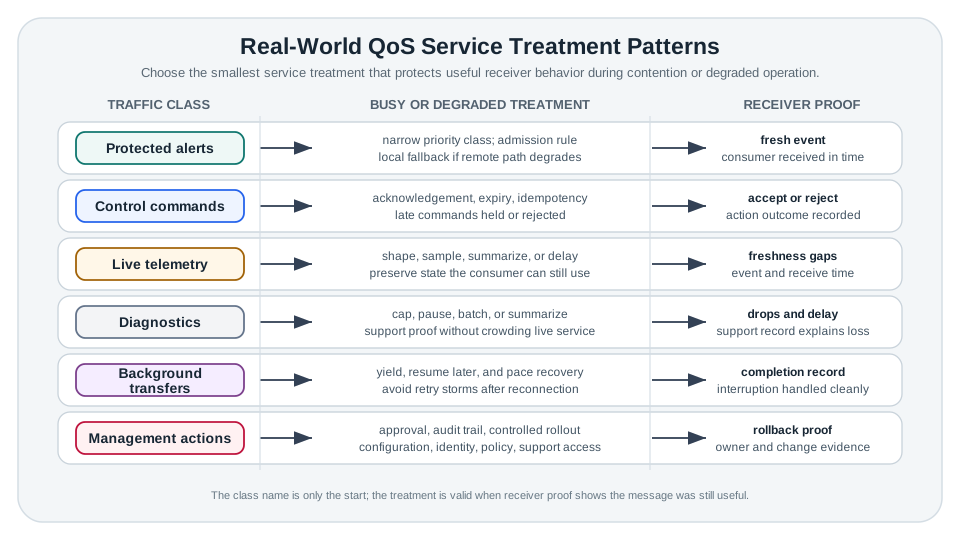
Read Figure 32.2 by service, beginning with protected alerts and control commands. Alerts need a narrow admitted class, local fallback, and receiver freshness proof. Commands add acknowledgement scope, expiry, duplicate handling, and an action record because a late control message can be harmful. Live telemetry may sample, aggregate, or report later while preserving enough current evidence for safe operation. Diagnostics and background transfers can be shaped, paused, or resumed when capacity returns. Management actions remain controlled operations with approval, audit, and rollback. Queue treatment alone never proves the result at the consumer.
Protected alerts need a narrow priority class and a local fallback if the remote path degrades; the receiver proof is a fresh event received in time. Commands need acknowledgment, expiry, and idempotency so a late or duplicate action does not run blindly. Telemetry may be paced or summarized when queues grow, while diagnostics can wait behind work with tighter consequences. Test each class during contention and inspect what arrived, expired, or was rejected. The smallest treatment that preserves useful receiver behavior is preferable to a policy that merely marks every message urgent.
Protected alerts
Use a narrow priority class, explicit admission rules, local fallback, and receiver freshness proof. The class must remain small enough to stay meaningful.
Control commands
Require acknowledgement scope, expiry, duplicate handling, and a receiver action record. Late commands should be blocked or held for action, not silently executed.
Live telemetry
Protect observations that drive near-term decisions. During contention, allow sampling, aggregation, or delayed reporting when the consumer can still operate safely.
Diagnostics
Collect enough support proof without crowding live service traffic. Diagnostics should often be shaped, summarized, or paused during contention.
Background transfers
Move reports, history, and update payloads when capacity is available. Resume cleanly after interruption and avoid retry storms after reconnection.
Management actions
Treat configuration, identity, policy, and support access as controlled operations with approval, audit proof, and rollback behavior.
32.8 Constrained and Intermittent Links
This section: Constrained and Intermittent Links — Real deployments often include links where bandwidth, power, duty cycle, coverage, or gateway capacity is constrained.
Real deployments often include links where bandwidth, power, duty cycle, coverage, or gateway capacity is constrained. QoS on those links is mostly about choosing what not to send immediately.
A constrained link cannot move everything at once, so use Figure 32.3 to decide what moves now, what waits, and what expires.
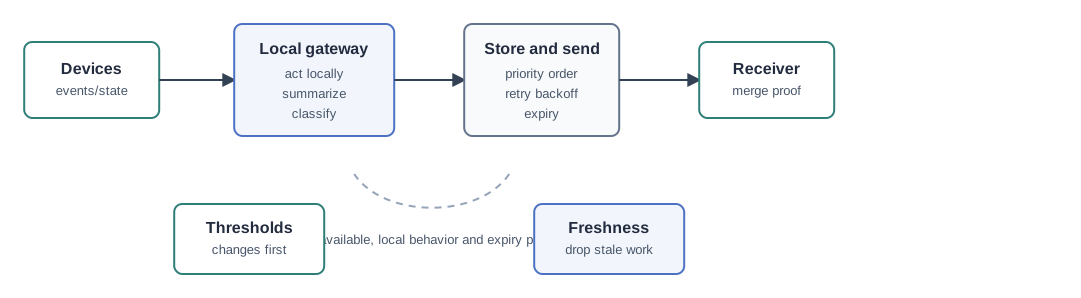
Begin Figure 32.3 at the source, where events and state changes take priority over full raw histories. Local control remains independent of routine reporting, and telemetry is summarized before it reaches the store-and-forward queue. When the link disappears, the gateway keeps deciding locally. After reconnection, retries use backoff so old recovery traffic does not crowd current messages, and stale work expires instead of arriving as if it were fresh. The receiver then merges the remaining history using event time, receive time, source, and sequence or version. Those proof fields preserve the outage rather than hiding it.
Design rules for constrained links:
- Keep local control independent of routine remote reporting.
- Send events and state changes before full raw histories.
- Summarize routine telemetry when the receiver only needs trend or status.
- Mark observations with event time, receive time, source, and sequence or version.
- Expire commands and observations that are no longer safe to act on.
- Pace retries after reconnection so recovery traffic does not crowd current traffic.
- Record what was dropped, summarized, delayed, or handled locally.
32.9 Protocol Delivery Semantics
This section: Protocol Delivery Semantics — Protocol delivery settings are useful only when they match the service objective.
Protocol delivery settings are useful only when they match the service objective. A stronger delivery mode can add acknowledgements, duplicate handling, queue pressure, and delay.
The chapter needs visual evidence for protocol delivery semantics. Figure 32.4 provides it: MQTT QoS 0, QoS 1, and QoS 2 comparison. Examine MQTT QoS Levels at a Glance together with At least once.
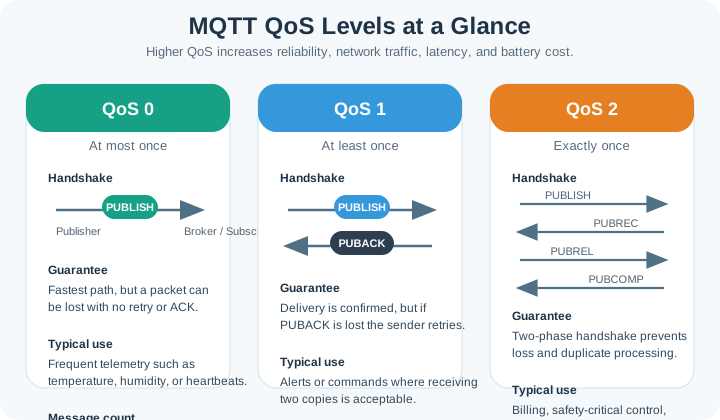
The diagram Figure 32.4 first names MQTT QoS Levels at a Glance, then separates At least once from 4 packets per hop. Carry checkpoints At least once and 4 packets per hop into protocol delivery semantics with MQTT QoS Levels at a Glance. Their combined proposition is: MQTT QoS 0, QoS 1, and QoS 2 comparison.
Routine telemetry
Often fits lightweight delivery with timestamps and later summary. Occasional loss may be acceptable if the next observation replaces the old one.
Alerts
Need an acknowledgement path, a retry policy, and a receiver record. The acknowledgement should prove the right consumer received the event.
Commands
Need command identity, idempotency, expiry, receiver acceptance, and outcome proof. Delivery alone does not prove safe execution.
Request-response
Works well for explicit reads, actions, and confirmations, but timeout and retry behavior must not create duplicate actions.
Streams
Fit ordered observations or state updates where consumers can process a sequence. Backpressure and consumer lag are part of the QoS proof.
Durable queues
Help preserve work when services are unavailable, but they need expiry and priority rules so old work does not block current service.
When using MQTT, CoAP, DDS, AMQP, HTTP, or another protocol, state the acknowledgement scope. Does it prove broker receipt, peer receipt, consumer receipt, action completion, or only packet transfer? The answer determines what additional proof the system needs.
32.10 Scenario Patterns
This section: Scenario Patterns — Use these patterns as decision prompts, not as fixed prescriptions.
Use these patterns as decision prompts, not as fixed prescriptions.
Shared building gateway
Alarms and access actions get protected service. Comfort telemetry and energy readings are shaped during contention. Logs and update payloads wait until the gateway has room.
Industrial monitoring cell
Local control keeps the cell safe. Remote telemetry supports supervision, trend analysis, and support checks. QoS protects status changes and fault proof without pretending remote traffic is the control loop.
Remote field site
The gateway decides locally when the link is unavailable. It sends state changes, summaries, and exception reports first, then reconciles history when capacity returns.
Mobile asset fleet
Reports can arrive late or out of order. Receiver logic merges by asset, event time, confidence, and sequence so stale locations do not replace current state.

32.12 Proof Loop
This section: Proof Loop — QoS is successful only when the receiver or service consumer can prove that the intended outcome was protected.
QoS is successful only when the receiver or service consumer can prove that the intended outcome was protected.
Do not apply proof loop until its premise is visible near Real-World QoS Proof Loop in Figure 32.5: Real-world QoS proof loop. Inspect the span to receive time.
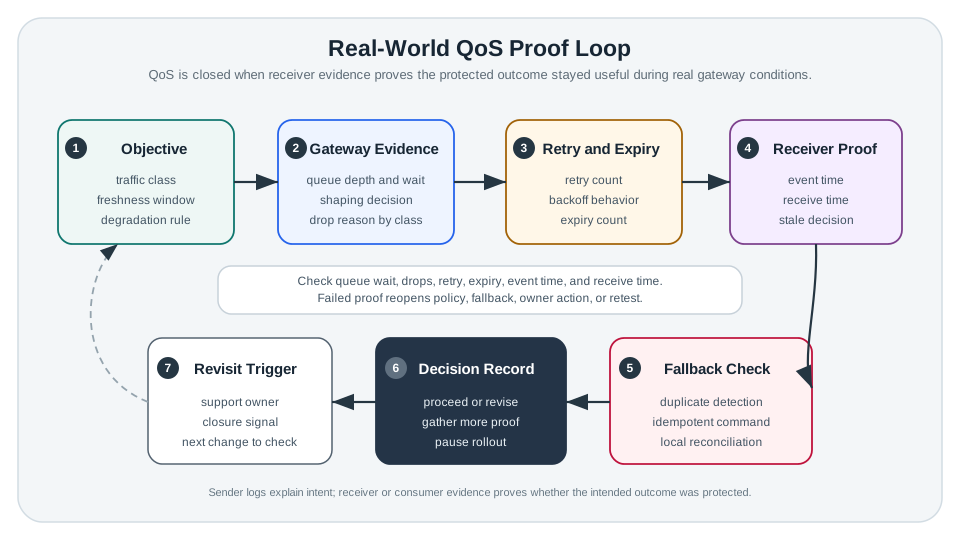
The loop in Figure 32.5 ties queue data to receipt time; failed proof sends the owner back to policy.
Proof to check:
- Traffic class assigned at the source or gateway.
- Queue depth, wait time, shaping decision, and drop reason by class.
- Retry count, backoff behavior, and expiry count.
- Event time, receive time, consumer action time, and stale decision.
- Duplicate detection and idempotent command handling.
- Local fallback state and reconciliation after connectivity returns.
- Support owner, closure signal, and next revisit trigger.
32.13 Knowledge Check: Real-World QoS Fit
This section: Knowledge Check: Real-World QoS Fit
32.14 Match: Pattern to Treatment
This section: Match: Pattern to Treatment
32.15 Order: Real-World QoS Decision
This section: Order: Real-World QoS Decision
32.16 Common Pitfalls
This section: Common Pitfalls
Using fixed numbers without context
QoS targets should come from the receiver outcome and operating consequence, not from a copied table.
Letting recovery traffic dominate
After reconnection, old logs and backfilled history can crowd current state unless the policy has pacing and expiry.
Confusing delivery with action
A broker, queue, or transport acknowledgement may not prove that the intended consumer acted on the message.
Ignoring local control
Remote QoS cannot replace local behavior when connectivity is degraded or a response must happen at the edge.
Overprotecting routine data
Putting every reading into the protected class makes the class useless during real contention.
Missing ownership
A QoS miss needs an owner, proof, decision, support action, and trigger for the next check.
32.17 See Also
This section: See Also
- QoS and Service Management: service-policy route and traffic classes.
- QoS Core Mechanisms: queue scheduling, shaping, rate limits, retry, and expiry.
- QoS Policy Lab: hands-on policy rehearsal and proof collection.
- Production Architecture Management: operating proof and support ownership.
- MQTT QoS and Session: application delivery modes and session behavior.
32.18 Real-World QoS Protects Outcomes
This section: Real-World QoS Protects Outcomes — Real-world QoS starts with the outcome that must stay safe or useful during contention.
Real-world QoS starts with the outcome that must stay safe or useful during contention. A building alarm, access command, freezer alert, diagnostic upload, and maintenance log should not receive the same treatment just because they share a gateway.
Before making the decision in this section, inspect Figure 32.6. It makes the decision concrete by showing apply real-world QoS as a route from receiver consequence to traffic-class objective, link and queue constraint, local behavior, protocol scope, receiver proof, and owner revisit trigger, so the relationships can be checked before they are turned into a design claim.Figure 32.6 begins a QoS choice with the consequence of a late or missing message.
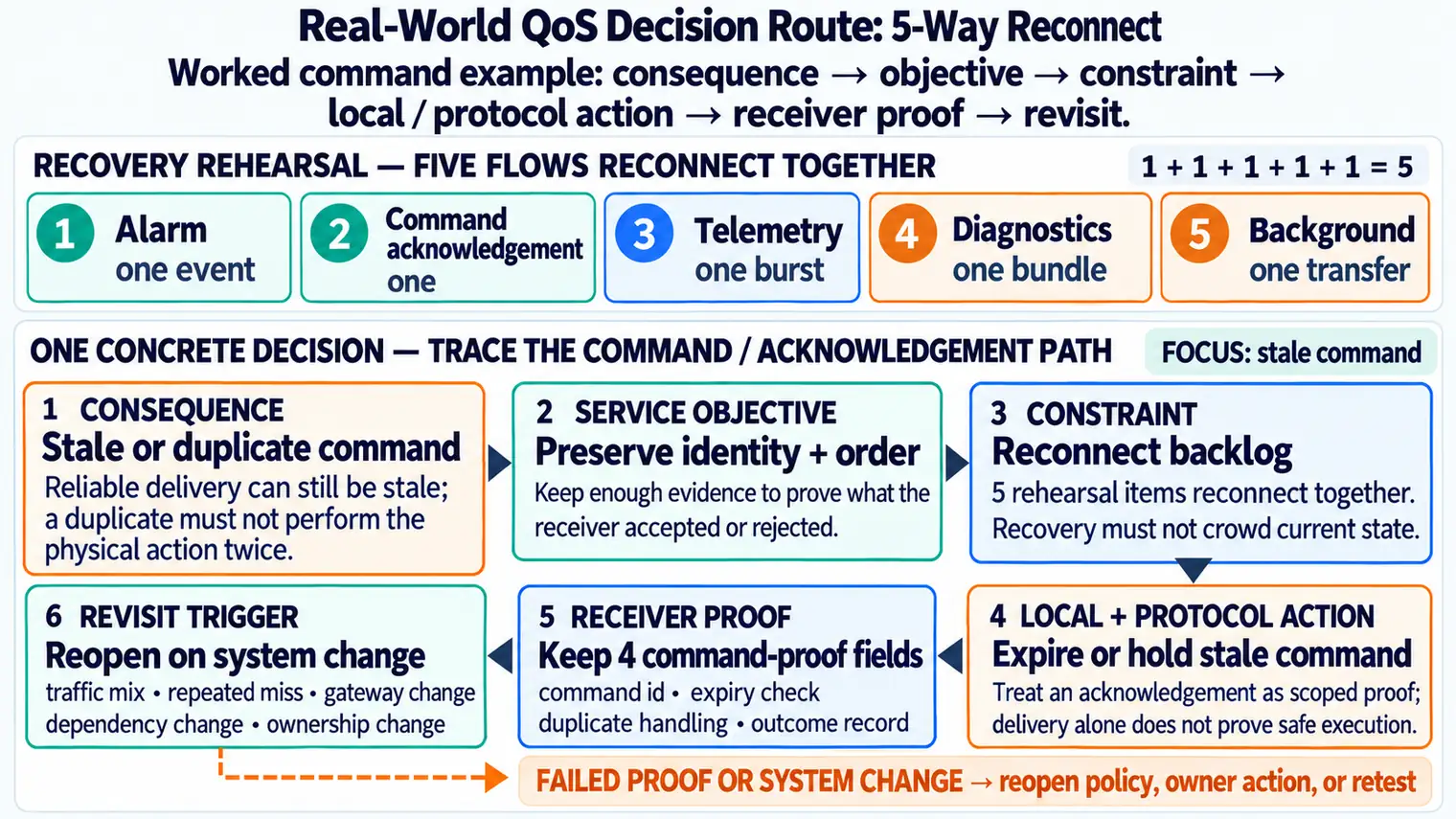
Figure 32.6 links receiver consequence to the traffic-class objective, link and queue constraints, local behavior, protocol scope, receiver proof, and an owner revisit trigger.
State whether the risk is delay, loss, duplication, or staleness, then set a class and freshness target the receiver can verify. Check link budget, queue backlog, and battery limits before choosing mechanisms. The local behavior stage asks whether an edge node should act, a command should expire, or recovery traffic should be paced. Only then choose the protocol delivery scope and test it in a degraded run. A successful broker acknowledgment cannot show that a person or actuator received useful information in time, so keep receiver evidence at the end of the route.
Small-screen read: Start with consequence, then choose the service objective, read the constraint, define local action, match protocol proof, verify at the receiver, and revisit when the system changes.
The same traffic class can need different treatment in different environments. A freezer alarm on a wired building network may rely on broker delivery and receiver freshness. A pump-station alarm on an intermittent cellular link may need local controller action first, then a paced cloud reconciliation after the backhaul returns. The service objective follows the consequence and the constraint, not the protocol name alone.
Use degraded operation as the design test. Ask what happens while the gateway is offline, when it reconnects with a backlog, when a command has expired, and when diagnostic uploads compete with live status. A policy that works only during normal connectivity is not a real-world QoS policy.
Keep the protected class narrow enough to explain in one sentence. If alarms, commands, telemetry, diagnostics, logs, and downloads all use the same priority, the policy has stopped describing consequence and started describing wishful bandwidth.
Receiver proof closes the loop. The system should show which message was current, which message was stale, which work was summarized, which work was dropped, which local action occurred, and who owns the follow-up. That proof is what separates a service policy from a priority label.
The strongest policy names the receiver consequence first, then chooses the smallest mechanism that protects it: priority for narrow urgent classes, expiry for stale commands, shaping for bursts, local fallback for disconnected operation, and paced recovery after outages.
32.19 Recovery Traffic Record
This section: Recovery Traffic Record — Outage recovery is where weak QoS policies usually fail.
Outage recovery is where weak QoS policies usually fail. Backfilled history, retry queues, current state, alerts, acknowledgements, and diagnostics all compete at the same time, so the policy needs a visible recovery order.
Write the record as a time-ordered service decision. Identify the traffic that must be handled during the outage, the traffic that can wait, the traffic that expires, the traffic that is summarized, and the traffic that resumes only after live service has recovered. Include the receiver's event-time and receive-time fields so stale and current work can be separated after reconnect.
A strong recovery record also names the gateway owner, cloud-service owner, support owner, and retest trigger. Without owners, a clean queue graph can still hide the fact that nobody is responsible for expired commands, duplicate reports, missing diagnostics, or local fallback reconciliation.
Run one recovery rehearsal before approving the policy. Disconnect the backhaul, generate one alarm, one command acknowledgement, one telemetry burst, one diagnostic bundle, and one background transfer, then reconnect. The expected result should be written before the test: live service first, stale commands expired or held, telemetry summarized or reconciled, diagnostics paced, and old background work resumed without blocking current state.
| Recovery Traffic | Policy Decision | Proof To Keep |
|---|---|---|
| Current alerts and state changes | Serve first if they are still within the freshness window. | Event time, receive time, action time, and stale decision. |
| Queued command acknowledgements | Preserve identity and order enough to prove what the receiver accepted or rejected. | Command id, expiry check, duplicate handling, and outcome record. |
| Backfilled telemetry | Summarize or pace behind live service unless the receiver needs the full history immediately. | Summary window, dropped or delayed count, and reconciliation status. |
| Diagnostics and logs | Shape behind live traffic and resume with a clear support owner. | Queue age, transfer progress, support closure, and retry budget. |
32.20 Acknowledgements Have Scope
This section: Acknowledgements Have Scope — An acknowledgement is only proof of the thing it actually confirms.
An acknowledgement is only proof of the thing it actually confirms. A radio acknowledgement may prove packet transfer to the next hop. A broker acknowledgement may prove broker receipt. A consumer acknowledgement may prove application receipt. None of those automatically proves that the physical action was safe, current, and completed.
That scope matters during degraded operation. A command can be delivered reliably and still be stale. A telemetry batch can be durably queued and still be too old for a live dashboard. A log upload can complete and still have hidden an alarm by occupying the recovery path.
Idempotency and ordering are part of the same boundary. A duplicated command should not perform the physical action twice, and an older observation should not replace a newer state simply because it arrived later. The receiver needs command identifiers, event times, sequence or version fields, and an explicit merge rule for late data.
Durable queues make the boundary more important, not less important. They preserve work across outages, but they also preserve stale work, duplicate work, and low-value history unless the policy applies expiry, priority, pacing, and receiver-side discard rules. Reliable storage is not the same as useful service.
For stateful assets, the receiver must decide whether an incoming message updates state, confirms a past action, fills history, or becomes audit-only evidence. That decision often uses event time, receive time, sequence number, source confidence, asset version, and current operating mode. Transport delivery cannot make that merge decision for the application.
This is why real-world QoS records should name the acknowledgement scope beside the service objective. The team should be able to say exactly what each acknowledgement proves, what it does not prove, and which receiver-side record closes the remaining gap.
Use acknowledgement scope as an architecture boundary. Pair each protocol-level acknowledgement with receiver freshness, action outcome, idempotency, duplicate handling, and a fallback decision when the acknowledgement is not enough.
32.21 Summary
This section: Summary — Real-world QoS decisions compare how different domains prioritize telemetry, control, safety, video, voice, and maintenance traffic.
Real-world QoS decisions compare how different domains prioritize telemetry, control, safety, video, voice, and maintenance traffic. The goal is to connect protocol features and network policy to operational outcomes, not to apply one priority scheme everywhere.
32.22 What’s Next
This section: What’s Next — Continue to QoS Policy Lab when you want to rehearse these real-world patterns against a concrete scenario, or move to SDN Fundamentals to study programmable network policy.
Continue to QoS Policy Lab when you want to rehearse these real-world patterns against a concrete scenario, or move to SDN Fundamentals to study programmable network policy.
Find help
3 reviewed answers.
Where should I start in a module?
Open the module page from the sidebar to see its chapters in order. Use the module map to return to a topic you need.
Modules and pathsReviewed
What can I try when a project does not work?
Check the symptom, then work through the diagnostic steps. Keep the error message and the smallest example that reproduces it.
When you are stuckReviewed
How do interactive examples work?
Use the interactive guide to check how examples and simulations work before changing your project.
Interactive examples guideReviewed