12 SDN Controllers: Architecture Foundations
More
Depth: Practitioner
Progress saves as you read. Mark sections complete as you go; your progress appears in the sidebar.
12.1 Start With the Decision
This section: Start With the Decision
Trace One Network Change From Request to Proof
12.2 Route Overview
This section: Route Overview — This is part 1 of 2.
This is part 1 of 2. Continue with SDN Controllers: Rule Strategies.
12.3 Part Objectives
This section: Part Objectives
- Test mvu: minimum viable understanding with a concrete scenario and pass criteria.
- Trace message flow: packet event to rule across its components and failure boundaries.
12.4 Chapter Roadmap
This section: Chapter Roadmap
- Start With the Controller Job
- In 60 Seconds
- MVU: Minimum Viable Understanding
- Prerequisites
- Controller Architecture Decision Route
- Responsibilities and Boundaries
- Core Controller Services
- State Model and Ownership
- Controller Event-Loop Addendum
- Message Flow: Packet Event to Rule
12.5 Start With the Controller Job
This section: Start With the Controller Job — Picture a hospital service asking the network to move device traffic away from a failed link.
Trace One Network Change From Request to Proof
Picture a hospital service asking the network to move device traffic away from a failed link. The controller must read current state, choose a rule, install it, and show that the service still works. Telemetry means status and measurements reported by network parts. Latency means the time from the request to the result that matters.
Write one change record. Name the requester, allowed goal, state time, rule owner, affected switches, safe default, deadline, reply, final service check, and rollback point. Keep the request, controller decision, device action, and user result separate.
Test stale state, two requests that conflict, one switch that rejects the rule, a lost controller, a late reply, and a rule that installs but breaks the service. Compare controller records with switch state and the receiving service. An accepted request is not proof of useful forwarding.
Keep essential traffic on a safe local rule when the controller is missing. Central coordination can improve the network, but it should not erase the device’s failure boundary.
This opening does not choose one controller layout or promise instant change. Practitioner maps services, state, and installation. Under the Hood examines event loops, coordination, stale views, partial updates, failover, and proof timing.
Use a short release check. Request one allowed change and one forbidden change. Delay one switch reply and remove the controller before the next request. Staff should see the rule state, service result, owner, and safe fallback without guessing.
Repeat the check after a policy, switch, link, controller service, or state source changes. Save the failed case because it shows which proof or rollback step needs work.
Close with four plain questions. Who asked? What did the network change? Did the real service still work? What safe rule stayed when the controller went away? If staff cannot answer all four from one record, the change path is not ready.
An SDN controller is not just a dashboard. It accepts intent, tracks network state, chooses rule changes, talks to switches, and records whether the forwarding behavior matches the service need.
Start simple: name one service request and the controller responsibility it creates. Then the controller architecture can be judged by state ownership, interface clarity, rule installation, and failure behavior.
12.6 Learning Objectives
This section: Learning Objectives
By the end of this chapter, you will be able to:
- Map the major services inside an SDN controller and explain what each service owns.
- Trace a packet event or application request through validation, policy checks, rule computation, southbound installation, and proof collection.
- Distinguish state that needs strong coordination from state that can be sampled, stale, local, or externally verified.
- Compare proactive, reactive, and hybrid rule installation without relying on unsupported latency promises.
- Evaluate whether a controller architecture fits an IoT network with gateways, constrained devices, local fallback, and operations proof.
Core concept: A controller coordinates network decisions by combining topology, policy, device capability, and telemetry state, then programming switches through a southbound interface.
Why it matters: IoT networks often use shared gateways and switches for traffic with different safety, reliability, privacy, and maintenance needs. A controller can coordinate policy, but only if its services, state ownership, and proof loop are explicit.
Key takeaway: Treat a controller as a decision system: event source, state used, policy check, rule result, device acknowledgement, receiver proof, and rollback condition.
12.7 Prerequisites
This section: Prerequisites
Use these chapters as needed:
SDN layer responsibilities and rule lifecycle.
Controller families and selection criteria.
SDN APIs and High Availability
API contracts, state ownership, and failover behavior.
Southbound rule and message details.
Production readiness, rollback, and operational ownership.
SDN layer responsibilities and rule lifecycle.
Controller families and selection criteria.
SDN APIs and High Availability
API contracts, state ownership, and failover behavior.
Southbound rule and message details.
Production readiness, rollback, and operational ownership.
12.8 Controller Architecture Decision Route
This section: Controller Architecture Decision Route — Use this route when checking how a controller turns an event or request into switch behavior.
Use this route when checking how a controller turns an event or request into switch behavior.
At controller architecture decision route, Service intent makes the architecture testable. In Figure 12.1, conflict, fallback frames this claim: SDN controller architecture decision route. Read it against Service intent.
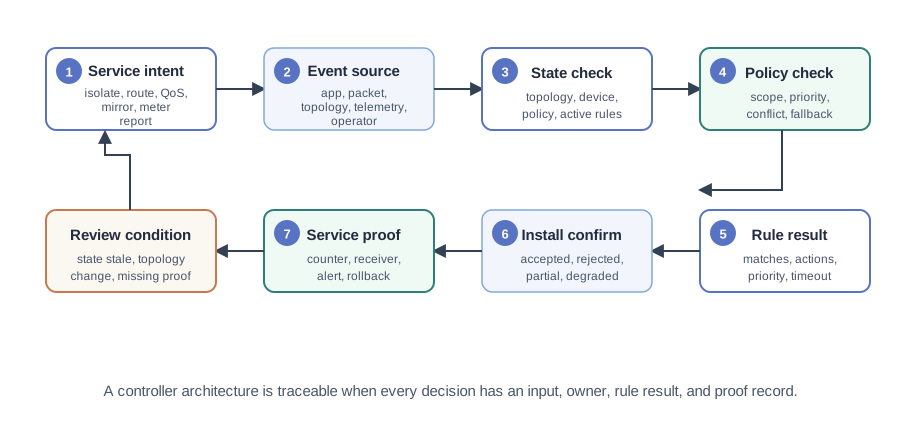
The controller route in Figure 12.1 begins with a service intent such as isolation or QoS and the event that requested it. Before computing rules, the controller checks topology, device capability, current policy, active rules, and state freshness. The policy gate narrows scope, priority, conflicts, and fallback. The rule result then names matches, actions, timeouts, and affected devices; installation can be accepted, rejected, partial, or degraded. Counters, receiver behavior, alerts, and rollback proof close the service check. A topology change or missing proof reopens review, since a controller decision is only as current as the state and outcome it can show.
Begin the decision route by naming the service intent—isolation, routing, QoS treatment, monitoring response, maintenance access, or tenant separation—and the event source, such as an application request, packet event, topology update, device connection, telemetry threshold, or operator action. Check that request against the controller’s topology view, device capability, current policy, active rules, ownership, and state freshness before resolving whether the behaviour is allowed, scoped, prioritised, or rejected.
Only then compute the match fields, actions, priorities, timeouts, counters, and affected devices. Installation is a recorded southbound exchange: capture acknowledgement, rejection, or degraded behaviour rather than assuming success. Close the route by comparing controller records with switch counters, receiver behaviour, alert state, and rollback proof; that final comparison reconnects the controller decision to the service intent that opened the route.
12.9 Responsibilities and Boundaries
This section: Responsibilities and Boundaries — The controller sits between applications and forwarding devices.
The controller sits between applications and forwarding devices. It should not erase the boundary between them.
Use Figure 12.2 to keep an application’s request, the controller’s decision, device enforcement, and operational proof as separate responsibilities.
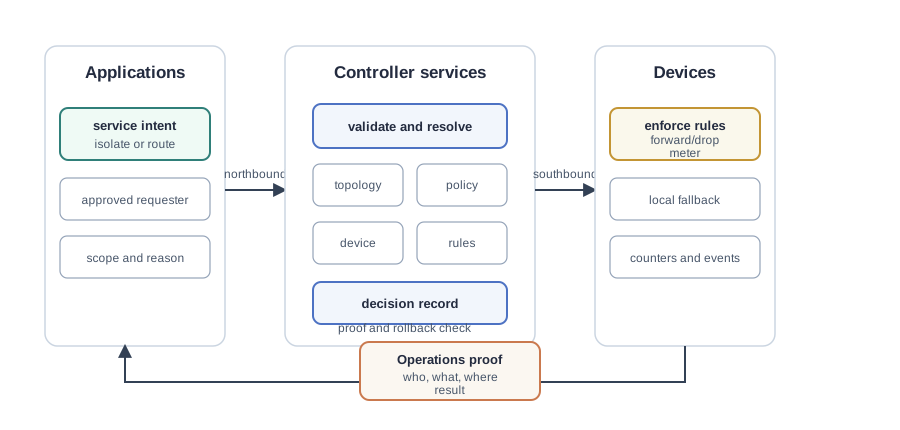
Read Figure 12.2 from the application boundary, where clients request outcomes such as isolation, priority, mirroring, routing, metering, or reporting without direct switch-rule access. The controller validates those requests, combines state, resolves conflicts, computes changes, and records its decision. Switches and gateways then enforce installed behaviour locally, including a safe default when the controller is absent. Operations closes the path by asking who requested the change, what was installed, where it landed, what result appeared, and whether rollback was tested. A controller decision is not proof that the service outcome occurred.
Application boundary
Applications request outcomes such as isolate, prioritize, mirror, route, meter, or report. They should not need direct switch-rule access.
Controller boundary
The controller validates requests, combines state, computes rule changes, resolves conflicts, and records decisions.
Device boundary
Switches and gateways enforce installed behavior locally. They need safe defaults for times when the controller is unavailable.
Operations boundary
Operations needs proof: who asked, what changed, where it was installed, what worked, and how rollback was tested.
The controller should coordinate network behavior, not forward routine packets through software. Routine traffic should stay in the data plane after rules are installed. Controller involvement should be deliberate, observable, and bounded.
12.10 Core Controller Services
This section: Core Controller Services — A controller implementation may use different names, but most designs need the same service responsibilities.
A controller implementation may use different names, but most designs need the same service responsibilities.
The practical risk in core controller services needs a diagram. Figure 12.3 summarizes it: SDN controller decision loop from application intent through observed state and policy to scoped rule installation and evidence. Look at SDN controller: intent → checked rule → installed evidence beside Rule / flow.
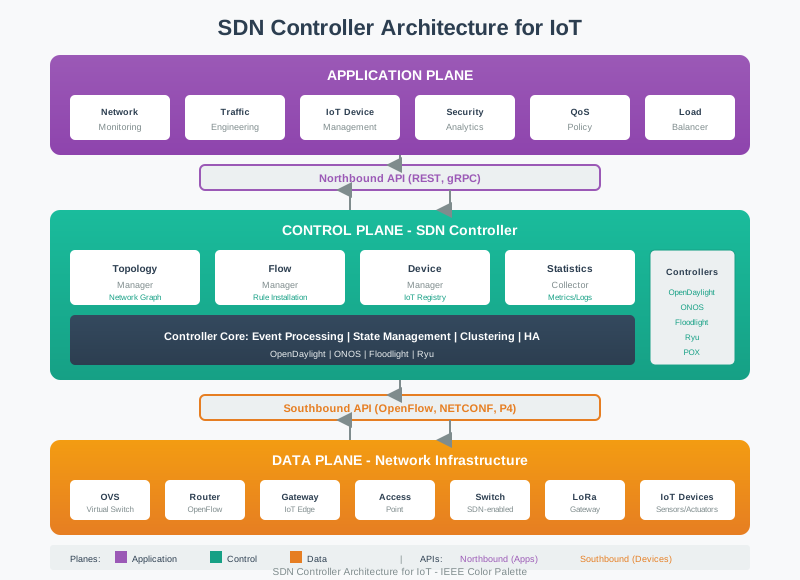
The loop in Figure 12.3 turns intent into a switch rule; check the result and safe defaults on loss.
Topology service
Maintains a graph of switches, links, ports, gateways, and reachable network segments. Other services depend on its freshness and failure handling.
Device manager
Tracks device sessions, capabilities, switch roles, ports, supported actions, and connection changes.
Policy resolver
Checks whether requests conflict with security, service, tenant, maintenance, safety, or protected-path rules.
Rule manager
Translates approved decisions into match-action rules, priorities, timeouts, counters, and install or remove actions.
Telemetry collector
Collects counters, events, and health signals that help prove whether the intended behavior happened.
State coordination
Owns state freshness, leader or owner selection, shared records, replay protection, and failover behavior.
When checking a controller diagram, ask what each service reads, writes, trusts, and exposes. A diagram that lists services but does not show state ownership still leaves important architecture risk hidden.
12.11 State Model and Ownership
This section: State Model and Ownership — Controller state does not all need the same consistency model.
Controller state does not all need the same consistency model. Treating every record as equally urgent creates unnecessary coupling; treating all state as approximate creates unsafe decisions.
One relationship governs state model and ownership. The diagram Figure 12.4 states it as: SDN controller state ownership model. Study Strong owner and Sampled state.
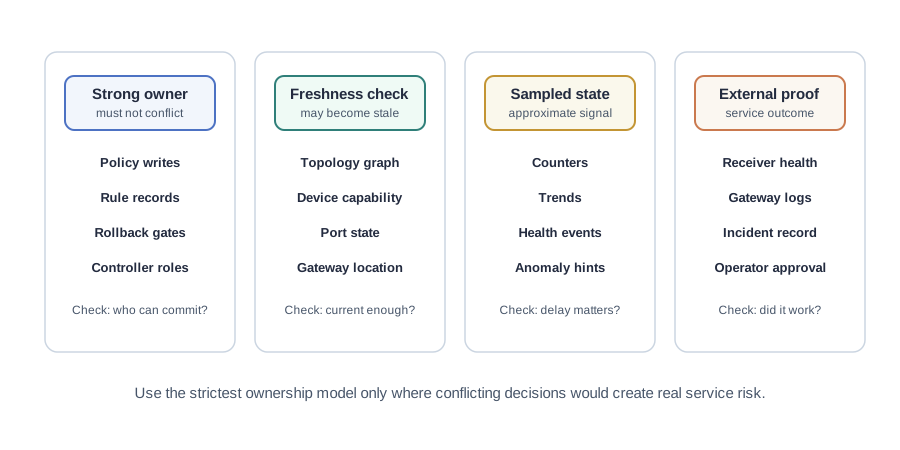
The diagram Figure 12.4 first names Strong owner, then separates Sampled state from Check: did it work?. Carry checkpoints Sampled state and Check: did it work? into state model and ownership with Strong owner. Their combined proposition is: SDN controller state ownership model.
Strongly coordinated state
Policy ownership, conflicting writes, active rule records, rollback gates, and controller role decisions need clear ownership.
Freshness-checked state
Topology and device capability records can change. A controller should know when this state is stale before computing new rules.
Sampled state
Telemetry counters and trends can often be delayed or approximate, as long as decisions account for that delay.
Local device state
Switch tables, buffers, port state, cached rules, and fallback behavior must be verified at the device, not assumed from the controller.
External proof
Receiver health, application acknowledgement, gateway logs, incident records, and operator approval prove the service outcome.
Review condition
Review state ownership after topology changes, controller failover, rejected rule updates, new traffic classes, or missing proof.
The most important decision question is: “Could two controller paths make conflicting decisions for the same scope?” If yes, define a decision owner, idempotency rule, and conflict resolution path before trusting automation.
12.12 Controller Event-Loop Addendum
This section: Controller Event-Loop Addendum — This keeps the controller from becoming an abstract automation box.
When folding controller-basics checks into this architecture chapter, keep the controller role concrete: it observes events, checks state, computes scoped changes, installs rules, and then compares intended state with device and receiver proof.
Use this addendum when a design says “the controller handles it” without naming the loop:
- Event source: application request, packet event, topology change, telemetry threshold, device session, or operator action.
- State check: topology freshness, policy owner, active rule set, device capability, and current controller role.
- Decision boundary: the controller decides policy and rule changes; forwarding devices still enforce packet behavior locally.
- Failure behavior: protected local rules, rollback access, and safe defaults should be documented before controller loss happens.
- Proof closeout: the record should show requested intent, accepted or rejected southbound update, counter behavior, receiver result, and review condition.
This keeps the controller from becoming an abstract automation box. A trustworthy controller architecture names the event, the state it trusts, the rule it changes, and the independent proof that shows the service outcome.
12.13 Message Flow: Packet Event to Rule
This section: Message Flow: Packet Event to Rule — Reactive events are useful when the controller must decide about traffic it has not seen before.
Reactive events are useful when the controller must decide about traffic it has not seen before. They are risky when routine traffic keeps returning to the controller.
Use Figure 12.5 to follow one unmatched packet from a switch event to an installed rule and a checked receiver result.
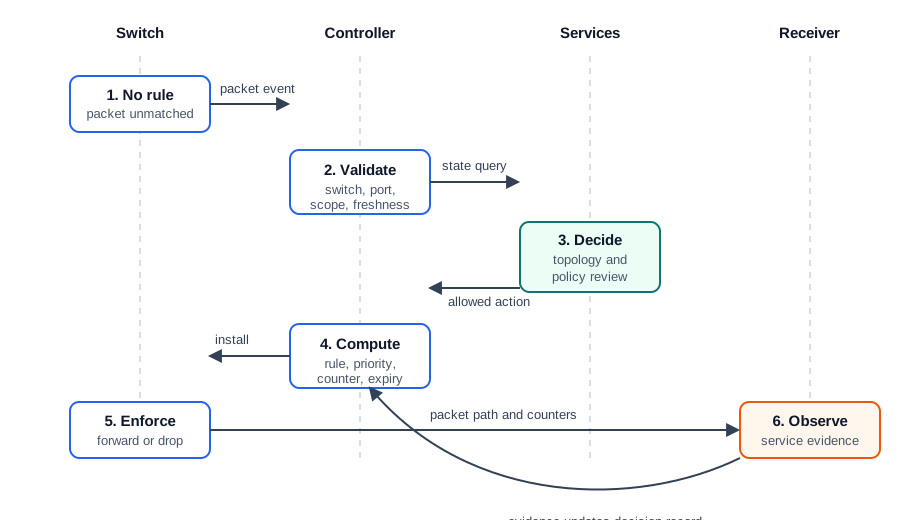
Begin Figure 12.5 when a packet finds no switch rule. The switch sends an event or summary to the controller, which validates switch identity, ingress port, and state freshness before consulting topology and policy. The rule manager computes changes for the current and affected devices, but each switch may accept, reject, partly apply, or defer them. Read proof closeout last. The controller record must combine its decision with switch responses, counter movement, receiver evidence, and rollback state. Because this reactive path adds delay and load, its scope, rate, and fallback behaviour must remain bounded.
Typical packet-event flow:
- A packet arrives at a switch and no existing rule matches the packet headers.
- The switch sends a packet event or summary to the controller according to its southbound protocol behavior.
- The controller validates the event, switch identity, ingress port, and relevant state freshness.
- The topology service and policy resolver decide whether the traffic is allowed and where it may go.
- The rule manager computes actions for the current device and any other affected devices.
- Switches accept, reject, partially apply, or defer the requested update.
- The controller records the decision and compares it with counters, receiver proof, and rollback state.
Reactive design should be bounded by scope, rate, and fallback behavior. Unknown or suspicious traffic can be reactive. Known sensor-to-gateway paths, protected alerts, routine telemetry, and maintenance rollback paths usually need planned rules or local fallback.
12.14 Continue to the Next Part
This section: Continue to the Next Part — Carry this evidence into SDN Controllers: Rule Strategies, which begins with Rule Installation Strategy.
Carry this evidence into SDN Controllers: Rule Strategies, which begins with Rule Installation Strategy.
Find help
3 reviewed answers.
Where should I start in a module?
Open the module page from the sidebar to see its chapters in order. Use the module map to return to a topic you need.
Modules and pathsReviewed
What can I try when a project does not work?
Check the symptom, then work through the diagnostic steps. Keep the error message and the smallest example that reproduces it.
When you are stuckReviewed
How do interactive examples work?
Use the interactive guide to check how examples and simulations work before changing your project.
Interactive examples guideReviewed