10 Production Cloud Deployment for IoT
More
Depth: Practitioner
Progress saves as you read. Mark sections complete as you go; your progress appears in the sidebar.
10.1 Start With the Launch Record
This section: Start With the Launch Record — Picture ten test devices becoming ten thousand real devices.
Prove a Small Launch Can Survive Trouble
Picture ten test devices becoming ten thousand real devices. After a power cut, many reconnect at once. Messages pile up, storage slows, costs rise, and the person who built the first demo is asleep.
Production means the service must keep a safe, useful state under real load and failure. Firmware is the device software stored on the device. Begin with one small launch group. Record device count, message size, normal rate, busy rate, storage life, owners, and limits. Test a mass return, a slow next step, a full queue, an expired secret, and loss of one region.
Run a plain launch drill. Start a small group. Watch each join. Watch each write. Stop the next step. Fill a queue. Slow a store. Return many devices. Rotate one secret. Send one bad version. Stop the rollout. Restore the prior version. Check every record.
Run a plain support drill. Wake the on-call role. Show one clear alert. Find the affected group. Find the first bad time. Apply the safe action. Keep an audit note. Restore the path. Reconcile missed work. Close the event. Review the runbook.
Run a plain life-cycle drill. Add a device. Move its owner. Change its rule set. Update it in a small group. Hold a failed unit. Return that unit. Retire one device. Block its old proof. Keep the final record. Check that no old path remains.
The system needs a safe way to slow, hold, reject, or shed work before it collapses. Operators need clear signs, alerts, and written recovery steps. A release needs health checks, a stop rule, a return path, and proof that old devices can be retired.
Pilot success does not prove production readiness. A clean chart may hide retries, stale state, missing records, or a cost path that grows without bound.
Use Practitioner to build launch and operations records. Use Under the Hood to study recovery, replay, scale, and failure boundaries.
A pilot can survive on helpful people and small numbers. Production has to survive reconnect storms, quota limits, firmware diversity, support handoffs, and audit questions after the original builder is unavailable.
Start simple: write the launch record for one production slice before approving the whole fleet. If that slice names rates, owners, limits, rollback, and proof, the larger deployment has something real to scale from.
10.2 Learning Objectives
This section: Learning Objectives
By the end of this chapter, you will be able to:
- Convert a pilot IoT cloud path into a production readiness plan.
- Identify launch risks from quotas, reconnect storms, storage growth, stale state, and downstream bottlenecks.
- Design observability and back-pressure controls for device ingestion and processing.
- Build rollout, rollback, recovery, and retirement records for a production fleet.
- Produce a production launch record that avoids brittle named-service or fixed-price assumptions.
10.3 Production Readiness Uses Records
This section: Production Readiness Uses Records — Production readiness is not the moment a dashboard looks correct.
Production readiness is not the moment a dashboard looks correct. It is the moment the team can show records that the system behaves acceptably under expected load, abnormal load, partial failure, and operational change.
The overview depth layer shows the production readiness map that links workload evidence, quota checks, back-pressure, observability, recovery drills, cost and rollout controls, and owner signoff around the launch gate.
Use these readiness areas:
- Workload records: device count, connection shape, message rate, payload size, burst behavior, and reconnect pattern.
- Quota and limit records: accepted request rates, connection rates, registry operations, storage writes, query capacity, and downstream write limits.
- Back-pressure: queues, retry policies, dead-letter inspection, rate limiting, load shedding, local buffering, and circuit breakers.
- Observability: metrics, logs, traces, audit events, alerts, dashboards, and on-call runbooks.
- Release control: staged rollout, canary groups, health gates, rollback plans, and version visibility.
- Recovery records: restore tests, failover drills, replay tests, data reconciliation, and manual fallback.
- Cost and retention control: filtering, aggregation, compression, lifecycle rules, query guardrails, and owner checks.
- Ownership: who approves launch, who responds to incidents, and who checks the records after production starts.
10.4 Development To Production Gap
This section: Development To Production Gap — A development system often succeeds because the environment is forgiving.
A development system often succeeds because the environment is forgiving. A production system fails when the same assumptions are scaled without test results.
10.4.1 Pilot Behavior
- Few devices.
- Manual fixes.
- Low retry pressure.
- Short data history.
- One dashboard user.
- Informal credentials.
- Limited outage testing.
10.4.2 Production Behavior
- Many devices and gateways.
- Automated rollout and recovery.
- Reconnect storms after outages.
- Long retention and replay needs.
- Many operators and applications.
- Credential rotation and retirement.
- Incident response under time pressure.
10.4.3 Records Needed
- Load test and replay test.
- Quota check and increase plan.
- Back-pressure drill.
- Dashboard and alert check.
- Runbook rehearsal.
- Rollback and restore proof.
- Cost and retention check.
10.5 Launch Gate Route
This section: Launch Gate Route — Move from prototype to production through explicit gates.
Move from prototype to production through explicit gates. Each gate should have an owner, records, and a fail condition.
One relationship governs launch gate route. The diagram Figure 10.1 states it as: A production launch gate route moves a cold-storage pilot from 20 gateways to a 2,000-gateway fleet through workload model, quota proof, load and replay tests, failure drills, rollout rules, operations checks, and owner signoff. Study Production launch gate route and Drill.
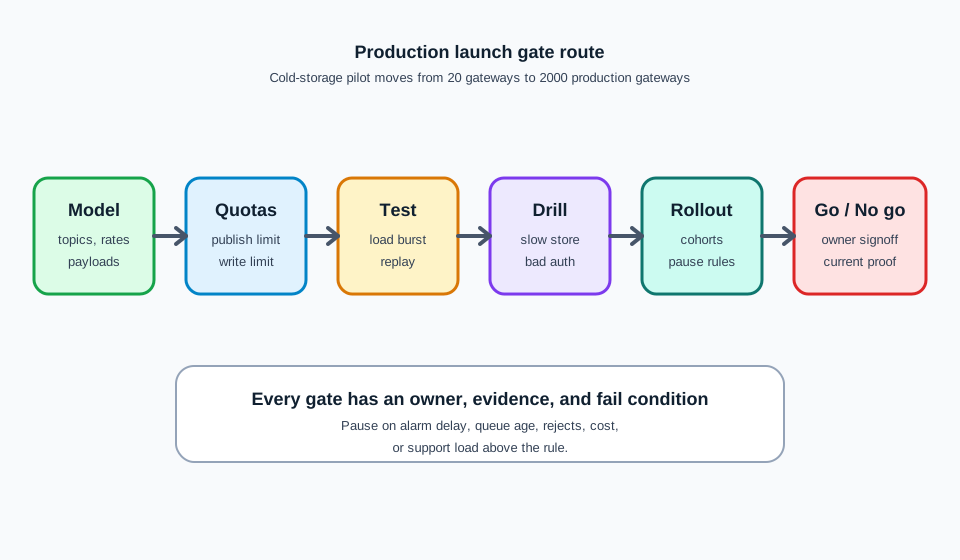
For launch gate route, the diagram Figure 10.1 uses Production launch gate route as the entry and Drill as a later checkpoint. Finish at Cold-storage pilot moves from 20 gateways to 2000 production gateways. The full reading conveys: A production launch gate route moves a cold-storage pilot from 20 gateways to a 2,000-gateway fleet through workload model, quota proof, load and replay tests, failure drills, rollout rules, operations checks, and owner signoff.
Use this route:
- Workload model: document devices, gateways, topics, payload size, message families, and return paths.
- Quota check: compare expected and peak rates with account, service, database, queue, and application limits.
- Load and reconnect test: test peak load, reconnect after outage, command fan-out, and dashboard query load.
- Failure drill: degrade storage, slow consumers, reject credentials, drop network links, and verify back-pressure.
- Rollout plan: define cohorts, rollout pace, health gates, pause criteria, and rollback actions.
- Operations check: confirm dashboards, alerts, runbooks, on-call owners, cost checks, and retirement process.
- Launch decision: approve only when records are current and the fail conditions are understood.
10.6 Quotas, Bursts, And Back-Pressure
This section: Quotas, Bursts, And Back-Pressure — Every cloud path has limits.
Every cloud path has limits. They may appear as request rates, connection rates, registry operation rates, queue throughput, database writes, index updates, or dashboard query limits. Production readiness means knowing which limit fails first and how the system responds.
10.6.1 Rate Limits
Check accepted publishes, command sends, registry changes, auth checks, and API calls.
Launch record: limit inventory, load test, headroom rule, alert threshold, and owner.
10.6.2 Reconnect Storms
When a network returns, many devices may reconnect and replay buffered events together.
Launch record: reconnect test, jitter policy, local buffer limit, deduplication, and catch-up time.
10.6.3 Downstream Slowdown
Storage, analytics, or notification systems may slow before ingestion fails.
Launch record: queue-depth alarm, consumer lag, dead-letter path, circuit breaker, and manual action.
Back-pressure should be deliberate. It is better to queue lower-priority events, summarize locally, or slow noncritical processors than to allow a retry storm to damage the whole platform. Critical alarms need a separate validated path with clear escalation and fallback.
10.7 Observability And Incident Response
This section: Observability And Incident Response — Production observability should answer operational questions quickly.
Production observability should answer operational questions quickly.
Before approving observability and incident response, test the depicted proposition in Figure 10.2: Production observability for a cold-storage fleet links gateway last-seen time, local buffer depth, ingestion rejects, oldest queued message age, processor retries, storage growth, cost per device, alerts, and runbooks. Read from Gateways toward errors, retries.
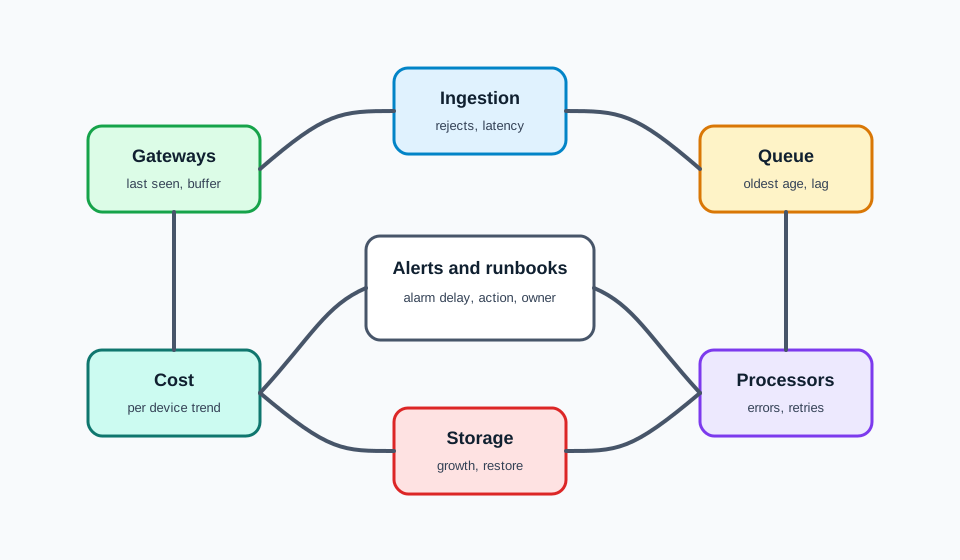
Begin the diagram Figure 10.2 with Gateways. Continue through errors, retries before checking alarm delay, action, owner. This path preserves the chapter’s observability and incident response argument: Production observability for a cold-storage fleet links gateway last-seen time, local buffer depth, ingestion rejects, oldest queued message age, processor retries, storage growth, cost per device, alerts, and runbooks.
At minimum, monitor:
- Device health: connected, last seen, firmware version, credential age, failed auth, and retirement state.
- Ingestion: accepted, rejected, duplicate, malformed, delayed, and dropped events.
- Queue and stream health: depth, lag, retry count, oldest message age, dead-letter rate, and replay progress.
- Processing: error rate, latency, throughput, saturation, downstream write failures, and idempotency conflicts.
- Storage: ingest volume, growth rate, hot/warm/cold distribution, query cost, retention exceptions, and restore status.
- Return path: command intent, delivery, acknowledgment, timeout, rollback, and operator approval.
- Cost signals: daily trend, unexpected service growth, data transfer volume, query spikes, and idle capacity.
Alerts should map to action. A dashboard that says “queue lag high” is incomplete unless the runbook says which workload is affected, what can be paused, what can be replayed, and who owns the decision.
10.8 Cost And Retention Controls
This section: Cost And Retention Controls — Cost overruns often come from unbounded data volume, high-cardinality queries, long hot retention, repeated retries, and exporting raw data when summaries would serve the purpose.
Cost overruns often come from unbounded data volume, high-cardinality queries, long hot retention, repeated retries, and exporting raw data when summaries would serve the purpose.
Before approving cost and retention controls, test the depicted proposition in Figure 10.3: Cost and retention controls reduce production risk by filtering invalid edge samples, aggregating routine telemetry, tiering recent and archived records, capping queries by site and time, and reviewing owners and exceptions. Read from Cost and retention controls before launch toward archive older.
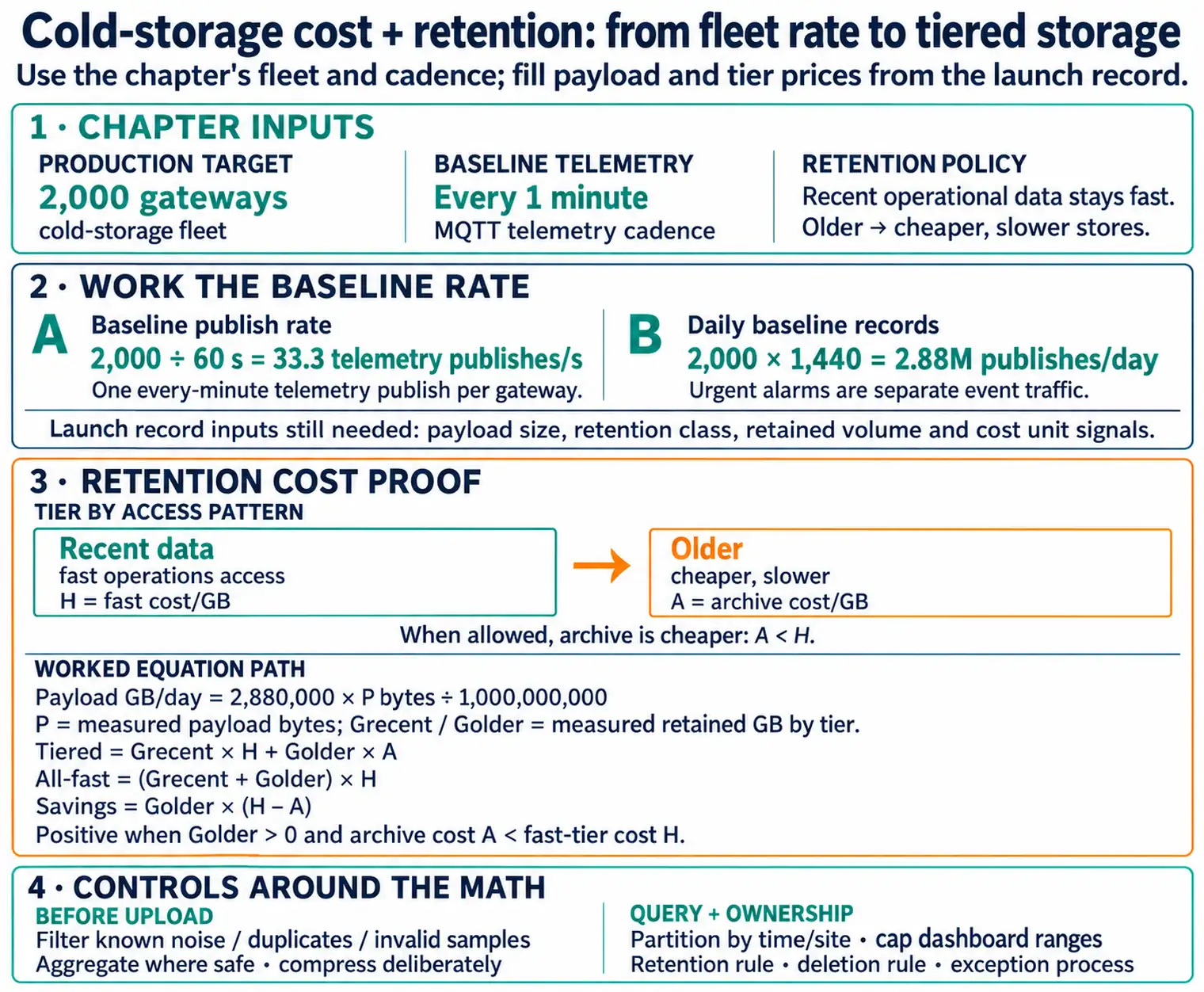
The controls in Figure 10.3 begin before upload. Edge filtering removes known noise, duplicates, and invalid samples; safe aggregation sends summaries when raw detail is not needed for long-term reports. Recent operational records can stay in a fast tier, while older data moves to a slower archive under an allowed retention rule. Query guardrails partition by site and time and cap dashboard ranges so one view does not scan the estate. A data-class owner still needs a deletion and exception process. Track cost per device, message family, and retained record package to see whether the controls work after launch.
Apply these controls before launch:
- Filter at the edge: drop known noise, duplicate readings, and invalid samples before upload.
- Aggregate where safe: send summaries for long-term reporting while retaining raw records only when needed.
- Compress and encode deliberately: choose formats that reduce volume without hiding schema or quality issues.
- Tier by access pattern: keep recent operational data fast; move older records to cheaper and slower stores when allowed.
- Limit query blast radius: partition by time and site, cap dashboard ranges, and inspect high-cost queries.
- Attach retention owners: every data class needs a retention rule, deletion rule, and exception process.
- Check unit signals: track cost per device, cost per message family, and cost per retained record package.
10.9 Rollout, Rollback, And Retirement
This section: Rollout, Rollback, And Retirement — Production deployment is not a single release event.
Production deployment is not a single release event. Devices, gateways, cloud services, schemas, dashboards, and operators all change over time.
Use staged rollout for:
- Firmware or gateway runtime changes.
- Cloud routing and transformation rules.
- Command return-path behavior.
- Schema changes and storage migrations.
- Dashboard and alert threshold changes.
- Model artifacts deployed to gateways or cloud processors.
Each rollout needs:
- Cohorts: pilot, early production, regional groups, high-risk sites, and full fleet.
- Health gates: accepted messages, errors, lag, command acknowledgments, device health, and operator feedback.
- Pause criteria: what metric stops the rollout.
- Rollback action: how to return to the previous working state.
- Audit record: who approved, when it started, what changed, and what record closed it.
- Retirement path: how old devices, credentials, topics, schemas, and dashboards are removed safely.
10.10 Scenario: Cold-Storage Launch
This section: Scenario: Cold-Storage Launch — A cold-storage operator is moving from a 20-gateway pilot to production across many facilities.
A cold-storage operator is moving from a 20-gateway pilot to production across many facilities. Gateways report temperature, door state, power state, compressor health, and alarm events. The platform must support local alarms, central dashboards, maintenance workflows, and event replay.
10.10.1 Production Decisions
Quota and burst plan
- Model normal telemetry, alarm bursts, and reconnect after site network recovery.
- Use jittered reconnects and bounded local replay.
- Keep alarm event handling separate from low-priority telemetry catch-up.
Back-pressure
- Queue maintenance tasks and dashboard updates when processors slow.
- Send malformed events to inspection instead of dropping them silently.
- Defer noncritical reports during incident response.
Observability
- Track gateway last-seen time, local buffer depth, rejected events, queue lag, storage growth, alarm delivery, and command acknowledgments.
- Tie every alert to a runbook and owner.
Rollout
- Start with a small facility cohort.
- Pause if rejected events, lag, alarm delay, or support tickets exceed thresholds.
- Keep rollback and credential rotation steps rehearsed.
Launch approval: Production launch is approved only after reconnect testing, quota check, alarm-path drill, storage lifecycle check, dashboard check, runbook rehearsal, and rollback test are complete. Local alarms continue during cloud outage, and queued records upload after recovery with duplicate detection.
10.11 Production Launch Record
This section: Production Launch Record — The production launch record is the artifact that prevents launch decisions from relying on optimism.
The production launch record is the artifact that prevents launch decisions from relying on optimism.
Figure 10.4 lists the evidence needed for a cold-storage fleet launch.
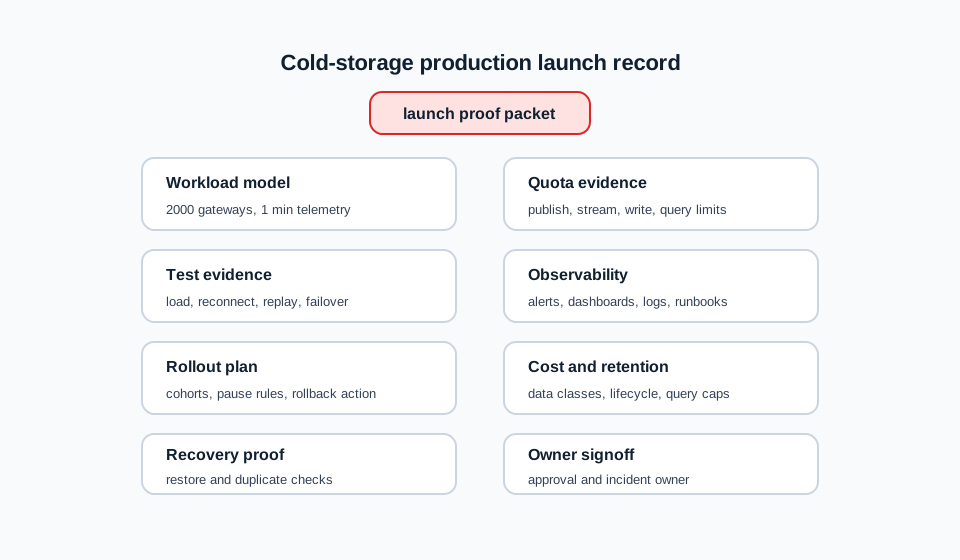
Before making the decision in this section, inspect Figure 10.4. It makes the decision concrete by showing a production launch record for a cold-storage IoT fleet captures the 2,000-gateway workload model, quota records, load and reconnect tests, observability, rollout plan, recovery proof, so the relationships can be checked before they are turned into a design claim.
The workload field states 2,000 gateways and one-minute telemetry, which sets a demand that pilot behavior alone cannot prove. Quota evidence must cover publish, stream, write, and query limits; tests must include load, reconnect, replay, and failover. Observability keeps alerts, dashboards, logs, and runbooks with named owners. The rollout field names cohorts, pause rules, and rollback, while cost and retention fields cover data classes and query caps. Recovery proof checks restore and duplicates. A signoff should follow those artifacts, since the launch record is a decision packet rather than an assurance created by filling boxes.
Include:
- Workload model: devices, message families, rates, payloads, return paths, and retention classes.
- Quota records: current limits, peak assumptions, requested increases, headroom, and owner.
- Test records: load, reconnect, replay, failover, restore, back-pressure, and rollback results.
- Observability: dashboards, alerts, logs, traces, audit events, and runbooks.
- Rollout plan: cohorts, health gates, pause criteria, rollback, and communication.
- Cost and retention: data classes, lifecycle rules, unit signals, query guardrails, and check cadence.
- Operational ownership: launch approver, incident owner, data owner, security owner, and support path.
10.12 Common Pitfalls
This section: Common Pitfalls
A pilot rarely proves quota headroom, reconnect behavior, storage growth, query load, or support readiness. Convert pilot observations into production tests.
Retries without jitter, back-pressure, and dead-letter handling can overload a recovering service. Check retry policy as part of production architecture.
Cloud-side device state may lag behind real equipment. Store timestamps, freshness rules, and direct acknowledgment paths for decisions that affect operations.
Retired devices with active credentials can keep consuming capacity and creating risk. Include credential revocation, inventory status, data retention, and support handoff in the lifecycle.
10.13 Production Failure Boundaries
This section: Production Failure Boundaries — A production IoT cloud launch is ready when expected failures are bounded, visible, recoverable, and owned.
A production IoT cloud launch is ready when expected failures are bounded, visible, recoverable, and owned. A pilot can prove that one path works; production readiness proves what happens when reconnect storms, slow processors, stale state, storage growth, cost spikes, credential changes, and operator handoffs arrive together.
Before making the decision in this section, inspect Figure 10.5. It makes the decision concrete by showing keep the cold-storage launch gate evidence-backed: the 20-gateway pilot, 2,000-gateway production target, one-minute telemetry, urgent alarms, jittered reconnect, bounded replay, oldest-queue-age alerts, so the relationships can be checked before they are turned into a design claim.Figure 10.5 compares the 20-gateway pilot with the proposed 2,000-gateway fleet.
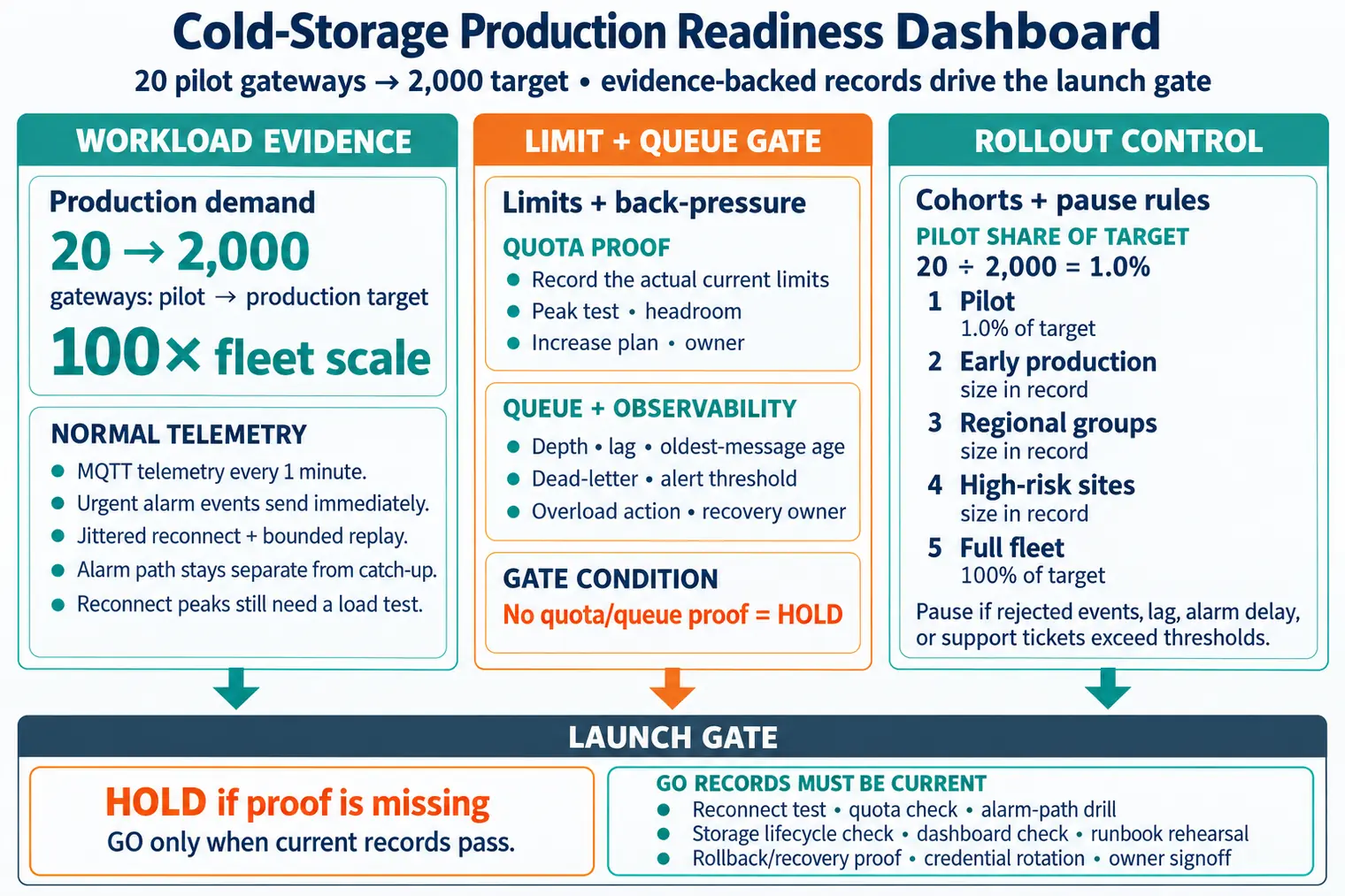
The diagram Figure 10.5 first names Launch gate, then separates jittered reconnect from cohorts, rollback, lifecycle rules. Carry checkpoints jittered reconnect and cohorts, rollback, lifecycle rules into production failure boundaries with Launch gate. Their combined proposition is: Keep the cold-storage launch gate evidence-backed: the 20-gateway pilot, 2,000-gateway production target, one-minute telemetry, urgent alarms, jittered reconnect, bounded replay, oldest-queue-age alerts, rollout pauses, retention rules, recovery drills, and owner signoff all need current records.
One-minute normal telemetry from 2,000 gateways is a different workload from the pilot, and urgent alarms must continue while stored data catches up. Jittered reconnect and bounded replay reduce bursts, but the actual peak still needs a load test against quotas and queues. The launch gate also needs evidence for back-pressure, operator alerts, rollback, and recovery after a failed cohort. The 100-fold fleet count is a scale target derived from the two sizes shown, not a measured capacity result. Keep the measured limit and reconnect traces beside the planned rollout before expanding the fleet.
Mobile summary: Production readiness proves expected failures are bounded, visible, recoverable, and owned before fleet traffic, reconnect storms, queue lag, storage growth, and operator handoffs arrive together.
The launch gate should name the workload, the first limit likely to fail, the back-pressure rule, the observability signal, the rollout pause rule, and the recovery owner.
For example, a cold-storage fleet might have 2,000 gateways that publish MQTT telemetry every minute, send urgent alarm events immediately, and buffer readings during a cellular outage. A normal pilot can look healthy with twenty gateways, one dashboard, and a short data history. Production can fail differently: a regional outage ends, all gateways reconnect, buffered events replay, queue lag grows, dashboard queries compete with alarm processing, and storage lifecycle rules decide which records remain hot enough for operations review.
The production record makes those conditions explicit. It can state that gateways use jittered reconnects, replay no more than a bounded time window per batch, deduplicate with event ids, route alarms through a priority path, place noncritical reports behind queue back-pressure, and alert on oldest-message age rather than only average throughput. It should also name concrete systems such as MQTT brokers, IoT hubs, Kafka or Kinesis streams, object storage lifecycle rules, time-series databases, dashboard query limits, OpenTelemetry traces, CloudWatch or Azure Monitor alerts, and runbooks owned by the on-call team.
That evidence changes the launch question. Instead of asking whether cloud services can scale in general, ask which part fails first, what work is delayed or shed, whether operators can see the failure quickly, and whether urgent device behavior remains safe while the cloud catches up.
Quota
Know the account, service, database, queue, and application limits before production traffic reaches them.
Back-Pressure
Slow, queue, shed, or defer noncritical work before a recovering service creates a second outage.
Observability
Connect device health, ingestion errors, queue lag, cost growth, and command state to named runbooks.
Rollout
Release by cohorts with health gates, pause criteria, rollback actions, and owner signoff.
10.14 Launch Gate Record
This section: Launch Gate Record — Build the launch gate from records, not hope.
Build the launch gate from records, not hope. Each row should say what was tested, which result is acceptable, who owns the control, and what change forces another check.
Start with a single production slice. Suppose a building operator is moving leak sensors from pilot to 600 installed devices. The record should list device firmware versions, gateway models, MQTT topics, payload sizes, normal message rate, alarm message rate, expected reconnect behavior, cloud registry limits, broker publish limits, stream throughput, database write limits, dashboard query ranges, retention classes, and who approves emergency changes. That list gives the team something concrete to test rather than a generic statement that the cloud is elastic.
Then attach evidence to each gate. A quota gate can include load-test output, service-limit screenshots, and requested limit increases. A back-pressure gate can show queue depth, consumer lag, dead-letter inspection, and what happens when an analytics worker slows. An observability gate can link dashboard panels to alert rules and runbook steps. A rollout gate can define pilot, early production, regional, and full-fleet cohorts with pause criteria based on rejected messages, alarm delay, oldest queued message, failed authentications, support tickets, and cost-per-device trend.
Keep the record operational. If a new firmware image changes payload size, the workload model is updated. If a new dashboard queries two years of raw telemetry, query guardrails and storage costs are reviewed. If a facility leaves the service, credentials, topics, dashboards, and retained data follow the retirement path. The launch gate is a living control, but it should remain specific enough that another operator can repeat the checks without guessing.
10.15 Design Recovery Before Outages
This section: Design Recovery Before Outages — Recovery begins at the device and gateway.
Production failure modes are often caused by recovery itself: retries multiply, stale device state looks current, queues hide the oldest message, dashboards query too much history, and retired devices keep credentials alive. Recovery has to be designed before an outage tests it.
Recovery begins at the device and gateway. A gateway should know how much telemetry it can buffer, which events are priority, how it assigns sequence numbers or event ids, how it signs messages after credential rotation, and how it handles a full local queue. The cloud path should know whether replayed records are idempotent, whether command acknowledgments are separated from telemetry catch-up, and whether an operator can distinguish observation time from delivery time. Without those details, a dashboard can show a value that looks current while the underlying event is hours old.
The queue and storage layers need equally explicit behavior. A stream processor may write raw events to object storage, summaries to a time-series database, and alerts to a notification workflow. During recovery, queue lag, oldest-message age, dead-letter count, duplicate rate, downstream write latency, and storage growth all matter. If the platform only watches average latency, it can miss a stuck partition, expensive dashboard query, or retry loop that keeps capacity saturated after the original incident is over.
Retirement and rollback are part of recovery too. Old credentials, schemas, topics, dashboards, and support procedures can keep producing events after devices leave service. A rollback plan should say which firmware or gateway version is restored, which schema version remains accepted, which data is replayed, and which records are preserved under the retention policy. Strong production design keeps recovery from widening permissions, hiding stale state, or turning temporary failure into permanent operational debt.
Retry Storm
Use jitter, caps, priority separation, and dead-letter inspection so recovery traffic does not overload the platform.
Stale State
Attach timestamps, freshness rules, direct acknowledgments, and reconciliation checks to device and command state.
Cost Drift
Control raw upload, high-cardinality queries, hot retention, and repeated exports before they become hidden launch debt.
Retirement Debt
Close credentials, topics, schemas, dashboards, support ownership, and retained data when devices leave service.
10.16 Summary
This section: Summary — Production cloud deployment for IoT requires records across scale, limits, operations, release safety, recovery, and cost control.
Production cloud deployment for IoT requires records across scale, limits, operations, release safety, recovery, and cost control. A launch-ready design has tested quota headroom, back-pressure, observability, staged rollout, rollback, recovery drills, retention controls, and clear ownership. The goal is not to prove that nothing will fail. The goal is to prove that expected failures are bounded, visible, recoverable, and assigned.
10.17 Key Takeaway
This section: Key Takeaway — Production cloud architecture depends on launch records that prove limits, back-pressure, observability, rollout, rollback, recovery, cost controls, retirement, and ownership.
Production cloud architecture depends on launch records that prove limits, back-pressure, observability, rollout, rollback, recovery, cost controls, retirement, and ownership.
10.18 See Also
This section: See Also
Identity, credential rotation, and access boundaries.
Cloud Platforms and Message Queues for IoT
Broker, queue, stream, and platform responsibility choices.
Cloud Deployment Models for IoT
Workload placement and hybrid boundary records.
How responsibility shifts across service abstraction levels.
Find help
3 reviewed answers.
Where should I start in a module?
Open the module page from the sidebar to see its chapters in order. Use the module map to return to a topic you need.
Modules and pathsReviewed
What can I try when a project does not work?
Check the symptom, then work through the diagnostic steps. Keep the error message and the smallest example that reproduces it.
When you are stuckReviewed
How do interactive examples work?
Use the interactive guide to check how examples and simulations work before changing your project.
Interactive examples guideReviewed