11 SDN Architecture Fundamentals
More
Depth: Practitioner
Progress saves as you read. Mark sections complete as you go; your progress appears in the sidebar.
11.1 Trace the Camera Packet
This section: Trace the Camera Packet — Imagine a new camera sends a packet and the network must decide where that packet may go.
Imagine a new camera sends a packet and the network must decide where that packet may go. The team must separate the rule choice from the act of moving the packet. For the camera packet, the application asks for a network outcome, the controller computes a rule, and a switch forwards or blocks the packet. The operator must verify that the installed rule produces the intended receiver result, including after a link or controller fault.
11.1.1 Check Policy and Forwarding
- Who requested the camera traffic change, and for how long?
- Which sender, receiver, and protected traffic does the rule name?
- Did the switch install the intended rule at the right priority?
- What did the receiver observe, and how will the rule be rolled back?
Keep the request, topology snapshot, controller decision, switch state, receiver observation, and rollback owner together. A controller’s intention alone cannot prove delivery or isolation.
11.1.2 When Controller Intent Is Not Enough
Central policy does not remove faults in switches, links, or rule order. The Practitioner depth checks interface authority and field outcomes.
11.2 Start With One Forwarding Decision
This section: Start With One Forwarding Decision — SDN becomes understandable when it is reduced to one forwarding decision: this packet arrived, this policy applies, this rule was installed, and this receiver behavior proves the result.
SDN becomes understandable when it is reduced to one forwarding decision: this packet arrived, this policy applies, this rule was installed, and this receiver behavior proves the result. The controller is important because it changes that decision deliberately.
Follow one packet as a switch applies a software-defined rule. Look for the point where policy becomes a rule in the switch.
-
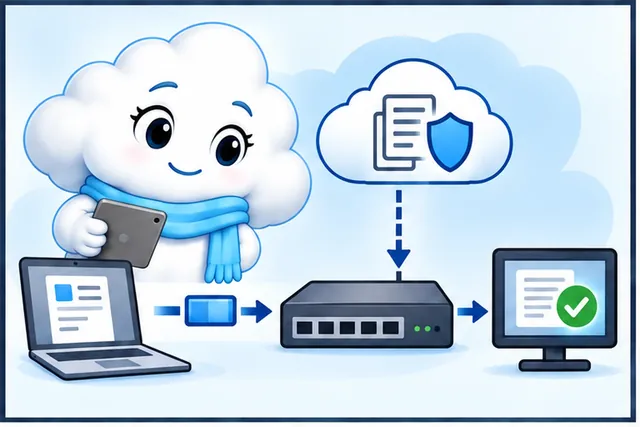
One packet reaches a switch under a software-defined network rule.
-
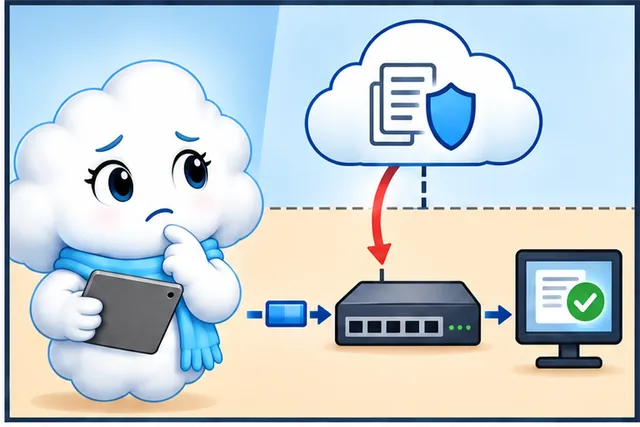
A controller or rule alone does not prove where the packet went.
-

Trace the packet, policy, installed rule, and receiver result.
-
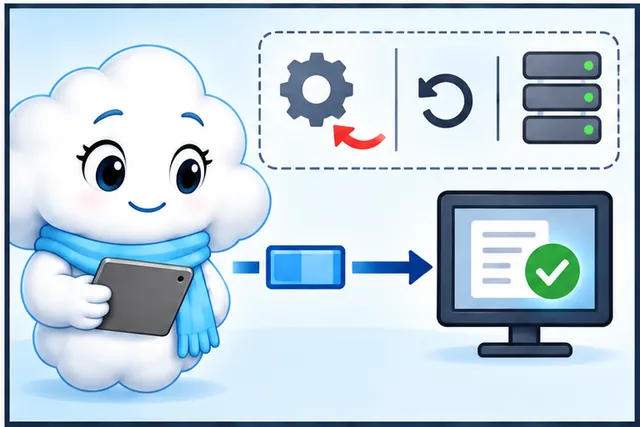
Approve the change only with review, rollback, and path evidence.
The first panel shows the packet arriving at the switch. The second asks whether a controller instruction alone proves where it went. The review panel joins the packet, policy, installed rule, and receiver result; the last keeps rollback and path evidence with the change. That is why the control-plane decision and the packet path need separate proof.
Start simple: separate the policy question from the packet path. Once the control plane and data plane are distinct, resilience, review, and rollback have a place to live.
11.3 SDN Policy vs Packet Forwarding
This section: SDN Policy vs Packet Forwarding — Software-defined networking is an architecture pattern for coordinating network behavior.
Software-defined networking is an architecture pattern for coordinating network behavior. Applications express intent, a controller translates that intent into network state, and forwarding devices apply local match-action rules to packets. The value is not that every packet passes through a controller. The value is that policy can be coordinated, reviewed, changed, and measured from a clear control point.
The move from conventional routed networks to SDN came from a practical limitation: protocols such as OSPF can let switches or routers compute forwarding locally, but each device still carries its own operating system, configuration, failure state, and partial view. When a switch is attacked, overloaded, or misconfigured, the network may need an alternate path, a policy change, or a service-chain decision that local routing alone cannot review globally. Early SDN work answered that gap by separating the controller's decision role from packet-forwarding hardware, with SANE-style centralized security research, OpenFlow match-action rules, and later Open Networking Foundation activity turning the idea into a programmable-network architecture.
For IoT, SDN is useful when gateways, sites, device classes, or service traffic need coordinated isolation, quality treatment, telemetry, or rollback. It is risky when the controller is treated as a substitute for local safety, wireless constraints, or device autonomy.
Consider a refrigerated warehouse with Ethernet cameras, Wi-Fi handhelds, and several MQTT temperature gateways. A security application should not send raw switch commands such as "drop everything from port 14." It should request a scoped intent: isolate gateway gw-17 from the maintenance console, preserve alarm traffic to the broker, and expire the exception after the incident window. The controller translates that request into concrete match-action rules, checks conflicts with safety and operations policies, and records the selected switches, priorities, and timeouts. The data plane then forwards or drops packets locally; ordinary packets do not wait for the controller. Operations judges the architecture by evidence: broker alert delivery, switch counters, gateway health, and a rollback record. That separation is the practical SDN claim.
A quick way to test the claim is to ask what changes when a rule is wrong. In a clean SDN design, the application can narrow the intent, the controller can replace or withdraw the computed rule, the switch can keep known-safe local behavior, and operations can compare the new receiver evidence with the previous record.
Use Figure 11.1 to test the separation between policy and forwarding. The route begins with Intent, but the learner should not accept that request as implemented policy until the application, controller, and switch stages all expose their own decision record.
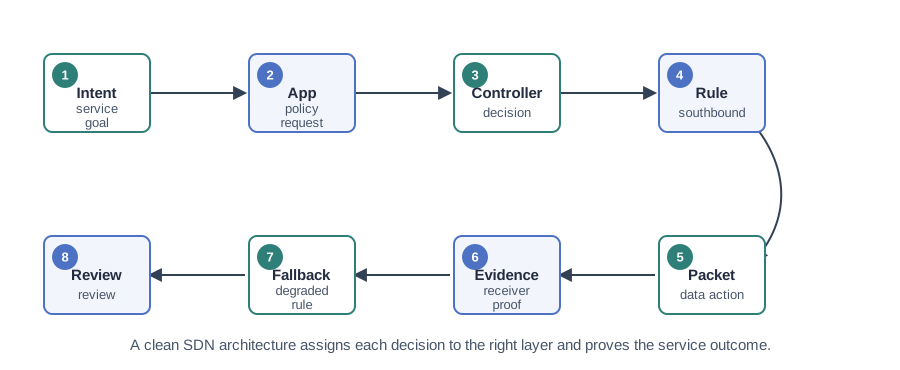
Read Figure 11.1 from Intent through application policy and the controller decision to the installed switch rule. Then follow the Packet branch to its forwarding action and receiver evidence. The closing review condition compares the requested service outcome with counters and delivery, rather than treating a controller acknowledgement as proof. For the warehouse example, that means recording that gw-17 is isolated while alarm traffic still reaches the broker, together with the rule owner, timeout, and rollback trigger.
Inspect Figure 11.2 after the route diagram to place each decision in the enterprise stack. Enterprise SDN Architecture separates orchestration and policy from Clustered SDN Controllers, so application intent does not collapse into device-specific commands.
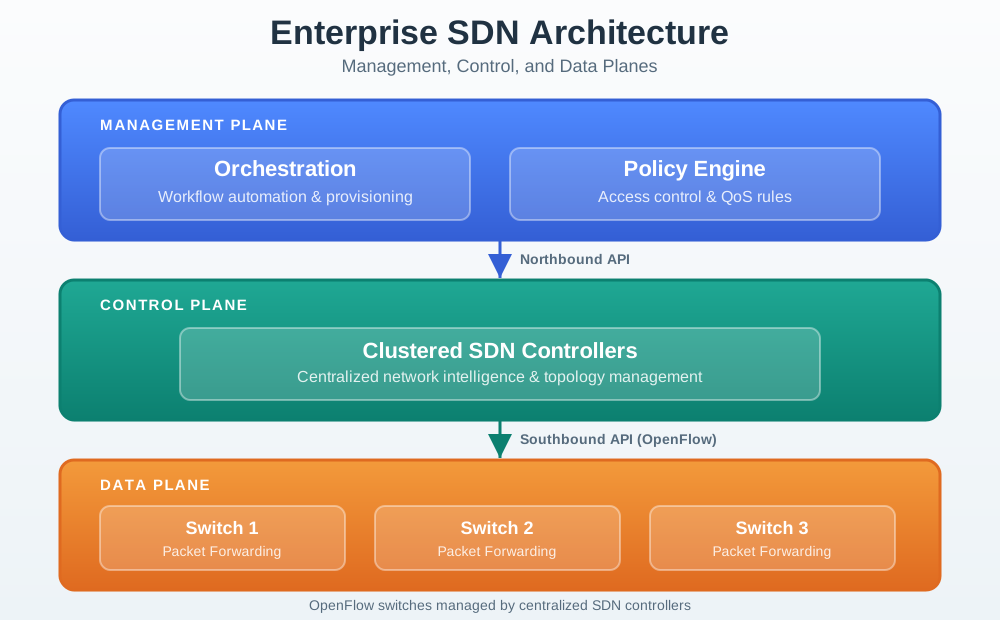
Across Figure 11.2, the northbound API carries policy and orchestration requests into Clustered SDN Controllers; the southbound OpenFlow boundary carries validated rules toward the switches. Finish at OpenFlow switches managed by centralized SDN controllers, where packets take the fast path without consulting the controller on every hop. The arrows make the ownership split explicit: management names intent, the control plane resolves and checks it, and the data plane applies bounded match-action state. Operations must preserve evidence at both APIs and at the receiving service.
Application Layer
Expresses intent: isolation, traffic engineering, QoS, monitoring response, maintenance workflow, or security policy.
Control Layer
Maintains topology and policy state, resolves conflicts, computes rule changes, and records what was installed.
Data Layer
Forwards, drops, meters, mirrors, or tags packets using installed rules. It should not depend on the controller for every ordinary packet.
Operations Boundary
Approves risky changes, reviews evidence, owns rollback, and reviews the architecture decision when conditions change.
Design question: use SDN when coordinated network policy and evidence are worth the controller, interface, and fallback responsibilities.
11.4 Rule and Interface Review
This section: Rule and Interface Review — A useful record is concrete enough for another operator to replay the decision.
A practical SDN design record should explain who is allowed to request a network change, what the controller is allowed to compute, how forwarding devices receive rules, and which evidence proves the receiver or service outcome. Without that record, SDN automation becomes a fast way to distribute unreviewed policy.
A useful record is concrete enough for another operator to replay the decision. For example, a greenhouse monitoring site might allow the maintenance application to quarantine one irrigation gateway, but not the LoRaWAN join server or the safety-alert topic. The northbound request names the requester, ticket, device id, protected traffic classes, and duration. The controller record names the topology snapshot, rule priority, match fields, timeout, and conflict checks. The southbound record names the switch or gateway target and whether the rule was accepted. The operations record captures MQTT delivery, alert latency, switch counters, and the rollback owner. That record makes the interface boundaries reviewable instead of merely automated.
Before physical deployment, Mininet can create a virtual network of OpenFlow-enabled switches and connect them to either a local or remote controller. Because the virtual switch topology and controller placement are explicit, it is a useful place to rehearse the rule-and-interface record below. The emulator result is still pre-deployment evidence: field switches, links, traffic, failover, and receiver outcomes must be verified again on the real network.
Use Figure 11.3 to distinguish three authority boundaries rather than treating every controller interface as equivalent. Begin at Applications, where a northbound request must name the requester, permitted scope, duration, and expected service result.
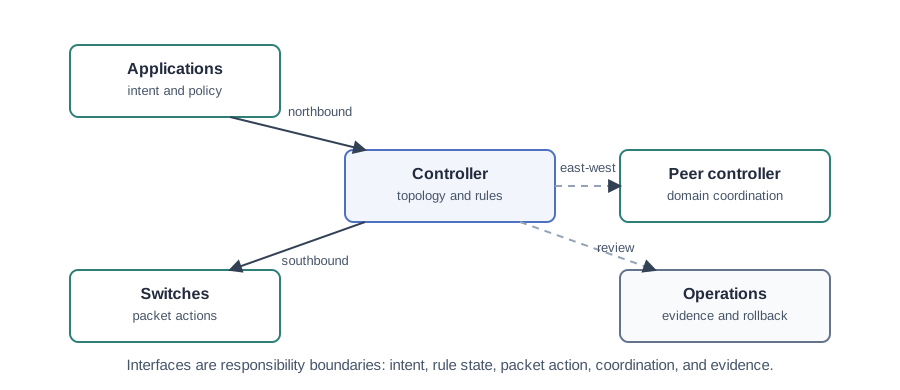
In Figure 11.3, follow the northbound path into controller policy, the southbound path toward the enforcement device, and the east-west domain coordination path between controller authorities. Each connector needs different evidence: authorization and intent at the application edge, rule acceptance and capability at the device edge, and topology plus conflict state across domains. The final review should join those records with MQTT delivery and switch counters so a successful API response cannot conceal a failed service outcome.
Figure 11.4 turns the interface record into a time-bounded control. Start at the Rule lifecycle request and check who authorized its match fields, protected flows, priority, action, and duration before the controller computes device state.
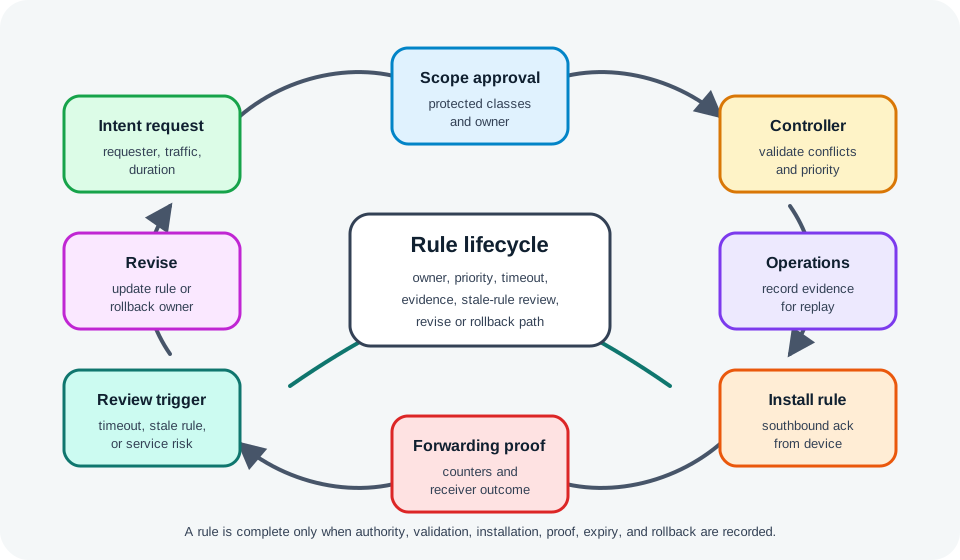
Trace Figure 11.4 past validation and installation to the southbound ack, then continue to forwarding proof and the operations record. The acknowledgement proves only that a device accepted state; counters and receiver results establish whether the intended packets matched and the protected traffic survived. At owner, priority, timeout, decide when the rule expires or is revised, and retain the rollback path. That full loop prevents a temporary quarantine from becoming an unowned permanent policy.
11.4.1 Placement Choices
Proactive Rules
Install before expected traffic arrives when service paths and policies are known enough that first packets should not wait.
Reactive Rules
Let switches ask the controller for new or exceptional flows when the added delay and controller load are acceptable.
Hybrid Rules
Pre-install protected or common behavior, then use reactive decisions for lower-consequence exceptions and diagnostics.
Fallback Rules
Define what continues locally when the controller or control channel is unavailable.
11.5 SDN Data Plane Resilience
This section: SDN Data Plane Resilience — Under the hood, SDN is a control loop.
Under the hood, SDN is a control loop. The controller observes topology and policy state, decides what rules should exist, installs those rules, then relies on counters, events, and receiver evidence to determine whether the rule is still valid. That loop can fail if the controller is unavailable, the southbound channel is partitioned, a switch lacks a needed capability, or stale rules outlive the condition they were meant to handle.
The rule itself is usually more specific than the architecture diagram suggests. In an OpenFlow-style deployment it may include match fields such as VLAN, Ethernet source, IP prefix, TCP or UDP port, priority, timeout, meter, and action. In a gateway-heavy IoT network the same intent may be translated through a controller plugin, NETCONF/gNMI device configuration, or a local policy agent rather than a single OpenFlow switch. The under-the-hood responsibility is the same: know which device accepted which rule, which packets matched it, which counters changed, and which protected flows were intentionally excluded.
Degradation planning is equally technical. Existing flow entries may continue after a controller outage, but new flows, topology changes, and conflict checks may stop. A site therefore needs local defaults for safety alarms, bounded timeouts for incident rules, a controller-cluster health signal, and a stale-rule review path. TCAM or rule-table capacity also matters: a controller can compute a policy that the switch cannot store. The architecture is sound only when installed state, device capability, receiver outcomes, and rollback are part of the same evidence loop.
Use Figure 11.5 to separate controller redundancy from data-plane continuity. A healthy Controller set can recompute policy, but forwarding during a partition depends on the bounded Switch rules already installed and the local behavior permitted for critical traffic.
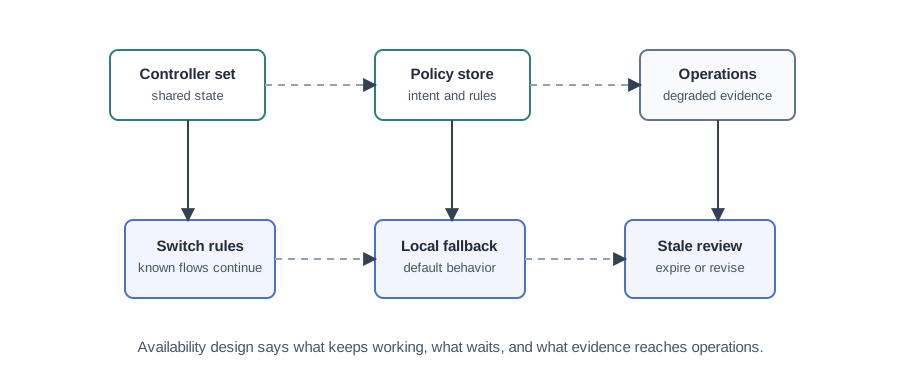
Read Figure 11.5 from Controller set through the control channel to Switch rules and named local fallback. Check which alarm, management, and ordinary flows may continue without fresh authority. Then follow restoration into stale-state review and expire or revise: controller reachability does not make an old incident rule correct. The evidence record therefore needs cluster health, installed-rule age, protected-flow delivery, reconciliation outcome, and the owner who can withdraw unsafe state.
Inspect Figure 11.6 before extending centralized policy into constrained access networks. The IoT SDN side identifies useful coordination points such as isolation, service policy, gateway segmentation, telemetry, and shared counters and rule state.
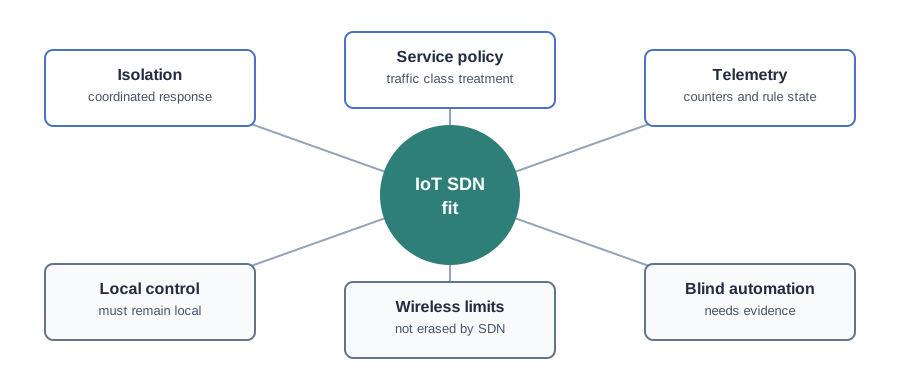
Across Figure 11.6, compare those strong coordination cases with sleeping devices, lossy radios, duty-cycle limits, gateway translation, and safety-critical local control. The latter constraints remain outside a controller’s ability to manufacture connectivity or endpoint capability. The needs evidence boundary asks whether a capable enforcement point actually received the rule and whether receiver behavior changed. SDN is a fit when network-wide state can improve a path; it is not a substitute for device power budgets, radio tests, or local fail-safe logic.
Freshness
Rules need owner, timeout, counter, and condition records so stale policy can be retired instead of silently persisting.
Capability
Switches and gateways may differ in match fields, actions, meters, queues, counters, and event reporting. The controller cannot assume unsupported behavior.
Local Safety
Protected traffic and device safety may require local defaults that continue even when the controller cannot be reached.
Evidence Drift
A rule that worked in one topology can become wrong after traffic changes, gateway replacement, firmware updates, or ownership changes.
Finish with Figure 11.7, which connects the architecture choice back to observed service behavior. Begin at Architecture and the service intent, then follow the application request into controller state plus policy and the installed device rule.
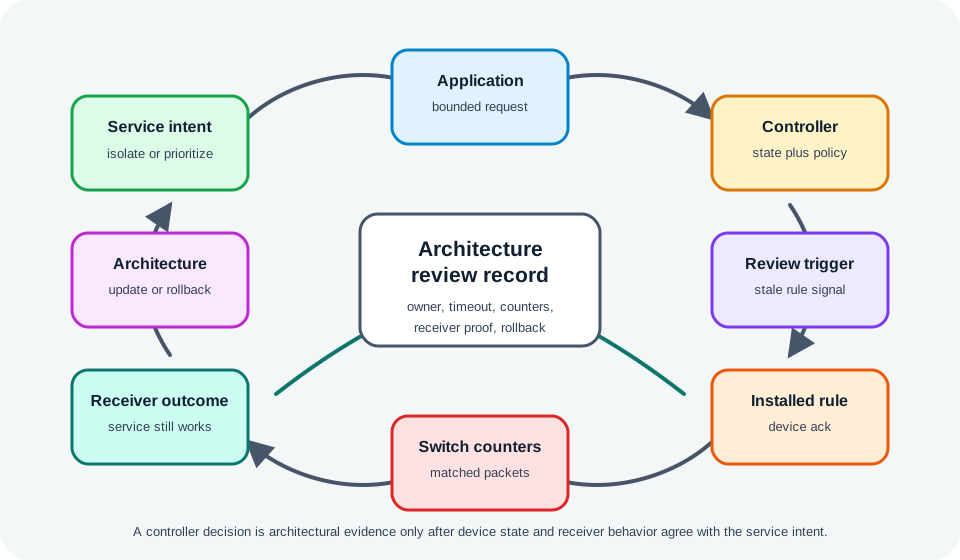
Trace Figure 11.7 beyond installation to switch counters and the receiver outcome. Counters show whether packets matched; broker delivery, alert latency, or endpoint reachability show whether the service intent survived. The stale rule signal then triggers comparison with the owner record, timeout, and rollback condition before the architecture is updated. For the refrigerated warehouse, replay the loop with the quarantine active and withdrawn: compare gw-17 reachability, protected broker alarms, matched-packet counters, controller state, and expiry time in both runs. A mismatch identifies whether policy translation, device installation, forwarding, or receiver behavior broke the intent, and gives the named owner a precise rollback point. This is the closing control loop: centralized policy remains trustworthy only when observed data-plane behavior can revise, expire, or remove the rule that produced it.
Failure mode: treating a successful rule installation as proof of service behavior. The rule may be installed but unmatched, unsupported, stale, too broad, or harmful to a protected flow.
11.6 Summary
This section: Summary — SDN architecture separates application intent, controller decision-making, and data-plane forwarding.
SDN architecture separates application intent, controller decision-making, and data-plane forwarding. That separation helps IoT teams coordinate isolation, quality treatment, telemetry, and policy changes across gateways and switches, but it only works when the design records authority, rule lifecycle, fallback behavior, and evidence.
The controller should coordinate network state; it should not become the ordinary packet path or a substitute for local safety. A strong SDN architecture proves that applications are authorized, controller decisions are scoped, switches enforce the intended behavior, protected traffic survives degradation, and operations can verify and roll back changes.
11.7 Key Takeaway
This section: Key Takeaway
Use SDN when coordinated network policy needs a reviewable control point. Approve it with evidence for intent authority, controller decisions, data-plane enforcement, fallback behavior, receiver outcomes, and rollback.
11.8 See Also
This section: See Also
11.8.1 SDN Controller Architecture
Review controller components, state ownership, and architecture boundaries in more detail.
11.8.2 SDN Controller Selection
Compare controller responsibilities, availability needs, and platform fit.
11.8.3 SDN APIs and Availability
Inspect northbound, southbound, and cluster boundaries for production designs.
11.8.4 SDN Use Cases for IoT
Apply SDN to gateway segmentation, traffic policy, monitoring, and IoT service cases.
Find help
3 reviewed answers.
Where should I start in a module?
Open the module page from the sidebar to see its chapters in order. Use the module map to return to a topic you need.
Modules and pathsReviewed
What can I try when a project does not work?
Check the symptom, then work through the diagnostic steps. Keep the error message and the smallest example that reproduces it.
When you are stuckReviewed
How do interactive examples work?
Use the interactive guide to check how examples and simulations work before changing your project.
Interactive examples guideReviewed