26 SDN Anomaly Detection: Deployment and Proof Loops
More
Depth: Practitioner
Progress saves as you read. Mark sections complete as you go; your progress appears in the sidebar.
26.1 Start With the Decision
This section: Start With the Decision — In software-defined networking (SDN), a controller changes rules that direct traffic.
In software-defined networking (SDN), a controller changes rules that direct traffic. A rule change can stop an attack and also cut off a vital device. Deployment proof must test containment, keeping the attack from spreading, and service recovery, restoring the device’s path.
26.2 Route Overview
This section: Route Overview — This is part 2 of 2.
This is part 2 of 2. Review SDN Anomaly Detection: Signals and Response Logic for the preceding evidence.
26.3 Learning Objectives
This section: Learning Objectives
- Fit anomaly controls to an IoT gateway deployment.
- Build a proof loop for containment and recovery.
26.4 Chapter Roadmap
This section: Chapter Roadmap
- IoT Deployment Fit
- Walkthrough: Gateway Scan Triage
- Proof Loop
- Knowledge Check
- Check the Response Boundary
- Match the Detection Proof
- Order an SDN Anomaly Check
- Common Pitfalls
- An Alert Is Not The Answer
- Write The Response Budget
- Containment Changes Signals
- Summary
- Key Takeaway
- See Also
- What’s Next
26.5 IoT Deployment Fit
This section: IoT Deployment Fit — IoT anomaly detection should preserve required field operation while reducing risk.
IoT anomaly detection should preserve required field operation while reducing risk. This is where SDN can help, because containment can be scoped by device group, path, service class, and rule ownership.
The next iot deployment fit step needs IoT as a visual checkpoint. At Figure 26.1, recovery access supplies the relationship to challenge: SDN anomaly detection fit for IoT containment: device group baseline, gateway path, management exception, service evidence, rollback record, and review update surround scoped IoT containment.
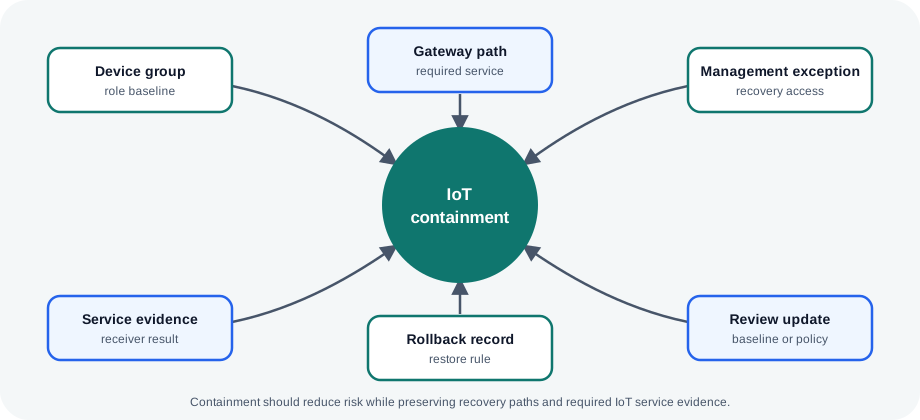
Keep IoT, recovery access, and baseline or policy separate while reading Figure 26.1. The diagram makes IoT a visible iot deployment fit cue; its recovery access relationship advances the claim: SDN anomaly detection fit for IoT containment: device group baseline, gateway path, management exception, service evidence, rollback record, and review update surround scoped IoT containment.
Fit checks:
- Group devices before comparing behavior.
- Keep management and recovery traffic out of broad blocking rules.
- Prefer narrow rate limits or redirects before broad isolation when proof is still developing.
- Check receiver proof at gateways, brokers, applications, or service endpoints.
- Record rule owner, expiry, exception, and rollback for every containment action.
- Recheck the event after recovery so the next baseline is better.
26.6 Walkthrough: Gateway Scan Triage
This section: Walkthrough: Gateway Scan Triage — A building gateway begins contacting many internal destinations that are not part of its normal telemetry path.
A building gateway begins contacting many internal destinations that are not part of its normal telemetry path. The goal is to decide whether the behavior is a scan, a planned management task, a topology change, or a monitoring artifact.
Operating question
Is the gateway initiating unexpected lateral connections, and can the network reduce risk without blocking required telemetry or management recovery?
Signals selected
- Flow counters for new destination count by traffic class.
- Port counters for bursts and drops on the access link.
- Controller state for allowed service paths.
- Topology events for recent path changes.
- Receiver proof showing whether expected telemetry still arrives.
Context record
Device role: building gateway
Expected path: access switch -> aggregation switch -> service edge
Allowed classes: telemetry, management, update
Current signal: new internal destination fan-out
Topology state: no planned path change recorded
Service proof: expected telemetry still arrives
Policy owner: network operations
Rollback path: remove temporary limit and redirect rules
Detection reasoning
The signal is stronger than a single counter spike because several facts agree: the device role has a narrow expected destination set, topology has not changed, the flow counters show destination fan-out, and expected telemetry still has a separate path. The proof supports limiting the unusual class and redirecting a sample for inspection, but it does not yet justify blocking all gateway traffic.
Response
The response gate chooses a temporary rate limit for the unusual internal-destination class and redirects matching traffic for inspection. Telemetry and management exceptions remain explicit. The rule has an owner, expiry, and rollback note.
Proof after action
The response record should show the rule diff, switch acknowledgement, counter reduction for the unusual class, unchanged receiver proof for expected telemetry, and the decision about whether to update the baseline or response gate.
26.7 Proof Loop
This section: Proof Loop — Anomaly detection should improve after every checked event.
Anomaly detection should improve after every checked event. The loop is incomplete until the result updates a baseline, policy note, owner record, or response gate.
Figure 26.2 links an anomaly signal to a bounded response and reviewed learning.
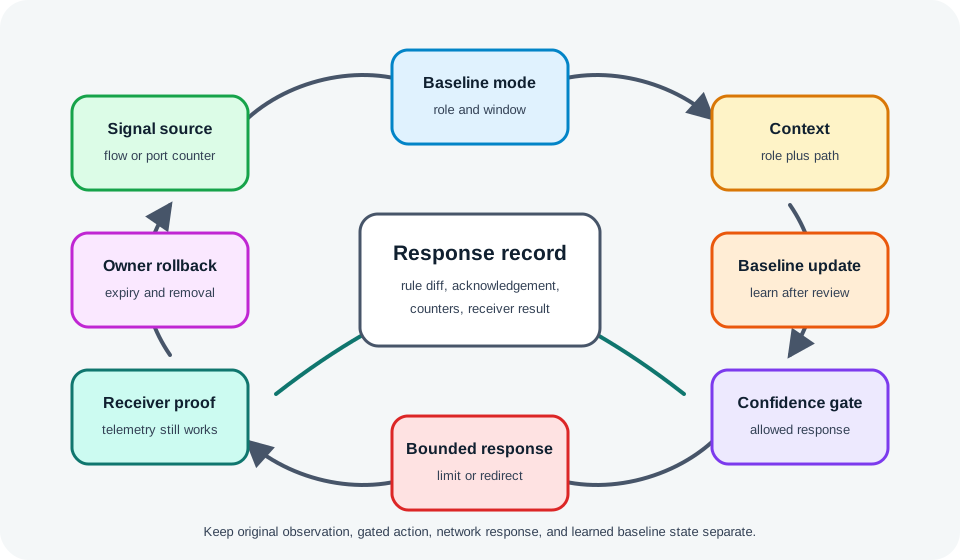
The signal source and operating-mode baseline establish what was unusual before any rule changes traffic. Context and a confidence gate decide whether a limit, redirect, isolate, or block action is allowed. After the controller applies that action, receiver proof checks that expected telemetry still arrives and the owner can roll back if it does not. The response record preserves the original observation, rule diff, start time, and post-response counters separately. Only a reviewed result should change the baseline or policy. This separation matters because counters after containment partly describe the response itself, not the incident that triggered it.
Capture:
- Signal source and raw observation.
- Baseline and operating mode used for comparison.
- Context used to interpret the signal.
- Confidence decision and permitted response.
- Rule change, acknowledgement, owner, expiry, and rollback.
- Receiver proof after the response.
- Final check outcome and baseline update decision.
26.8 Knowledge Check
This section: Knowledge Check
26.9 Check the Response Boundary
This section: Check the Response Boundary
26.10 Match the Detection Proof
This section: Match the Detection Proof
26.11 Order an SDN Anomaly Check
This section: Order an SDN Anomaly Check
26.12 Common Pitfalls
This section: Common Pitfalls
- Using one global threshold: different device roles, traffic classes, paths, and operating modes need different baselines.
- Letting alerts write broad rules: detection should pass through a confidence and service-risk gate before strong action.
- Ignoring expected exceptions: maintenance, updates, recovery, and startup can look unusual if the baseline does not include mode context.
- Confusing containment with remediation: a network rule can reduce risk, but the device and application still need investigation.
- Skipping receiver proof: a response is not proved until the affected service or receiver outcome is checked.
26.13 An Alert Is Not The Answer
This section: An Alert Is Not The Answer — An SDN anomaly alert is a question about behavior, not a verdict.
An SDN anomaly alert is a question about behavior, not a verdict. The useful skill is to ask what changed, which baseline it was compared with, which service could be harmed, and what response can reduce risk without turning the network into the outage.
That keeps anomaly detection practical for IoT. A gateway may show unusual destinations, a sensor group may change rate, or a camera segment may burst traffic. The response should be bounded by proof, service risk, and rollback rather than by alert severity alone.
For a concrete case, imagine a building gateway that normally publishes BACnet or Modbus-derived telemetry through an MQTT broker on TLS port 8883, accepts management only from an operations jump host, and fetches updates from one HTTPS service. A destination-fan-out alert is meaningful only after the detector joins the new internal destinations to that role model. The alert should name the gateway group, the normal broker path, the unusual destination set, the observation window, the topology version, and the service that might be harmed by an SDN response.
The first decision is not "block or ignore." It is whether the evidence is strong enough for a bounded action. OpenFlow flow counters or Open vSwitch rule counters can show the new destination class. Controller state can show whether the path was expected. Broker-side counters can prove whether required telemetry still arrives. A recent firmware rollout, maintenance scan, DHCP change, or topology repair can explain behavior that would otherwise look hostile. Only after those checks agree should the team move from observation to a temporary limit, inspection redirect, or isolation rule.
Good anomaly handling therefore has two promises. It reduces risk from behavior that does not fit the device role, and it protects the traffic the facility still needs. A freezer alarm gateway, door controller, or camera gateway may need telemetry, management recovery, and update paths even while suspicious lateral traffic is contained. The record should preserve the pre-response evidence so a later analyst can tell whether the alert was compromise, misconfiguration, maintenance, or a detector blind spot.
26.14 Write The Response Budget
This section: Write The Response Budget — Before enabling an automated or semi-automated response, define the budget for action.
Before enabling an automated or semi-automated response, define the budget for action. The budget says how much risk the network is allowed to reduce, how much service disruption it may create, and when the rule must be removed or escalated.
| Budget Item | Question To Answer | Release Evidence |
|---|---|---|
| Signal budget | Which counters, events, samples, and receiver checks must agree before action? | Signal list, baseline window, excluded events, and confidence reason. |
| Service budget | Which telemetry, management, alarm, recovery, and update paths must remain open? | Protected exceptions, receiver proof, and service owner approval. |
| Action budget | What is the strongest allowed response at this confidence level? | Observe, alert, limit, redirect, isolate, block, rollback, or recheck decision. |
| Time budget | How long may the response remain active before review or expiry? | Rule owner, timeout, escalation trigger, rollback path, and final record. |
Write the budget as a release artifact, not as a vague monitoring note. For a gateway group such as bldg-gw-prod, the signal budget might require three aligned facts: new internal destination count above the role baseline, no approved topology change in the controller record, and a broker counter showing the normal telemetry path still works. The service budget should list protected classes such as telemetry to mqtt-core, management from ops-jump, firmware fetches from fw-update, and alarm traffic to the local safety service.
The action budget should be just as explicit. At low confidence, log and alert. At medium confidence, mirror packets or redirect a sample to inspection while preserving protected classes. At higher confidence, limit the unusual destination class for a short window. Isolate or block only when the owner, expiry, rollback command, and service proof are already written. In an Open vSwitch or OVN deployment, capture the logical policy diff, the affected port group, the flow-table or policy acknowledgement, and representative counters after the rule lands.
Release evidence should include the exact baseline window, excluded maintenance events, controller application or API caller, change ticket, and rollback owner. If the response touches Kubernetes-hosted brokers or services, include the NetworkPolicy, Cilium policy, or service-mesh policy that protects the pod boundary. If it touches a switch pipeline, include the table, priority, match fields, and timeout. The goal is for an operator on the next shift to know what the SDN system was allowed to do and why it did not break required IoT service paths.
26.15 Containment Changes Signals
This section: Containment Changes Signals — A containment rule does not only reduce traffic; it changes the observation environment.
A containment rule does not only reduce traffic; it changes the observation environment. After a limit, redirect, isolate, or block action, later counters may reflect the response itself rather than the original behavior. That is why the record must preserve the pre-response baseline, the rule diff, the response start time, and the post-response receiver proof.
The detector also needs a feedback rule. A true incident can update a signature, a false positive can update an exclusion, and a maintenance event can update the operating-mode calendar. But none of those updates should happen automatically just because the alert cleared after containment.
The under-the-hood discipline is to separate four states: original observation, gated decision, network response, and learned baseline change. Mixing them makes the next alert harder to interpret.
Implementation details matter because each signal has a different failure mode. A flow counter can rise because a gateway is scanning, because a maintenance tool is discovering devices, or because a rule moved traffic into a different table. A topology event can explain a path change but not prove the broker stayed healthy. A broker metric can prove received messages but not explain unexpected lateral attempts. A useful detector stores enough raw context to reconstruct the event: source group, destination group, port or protocol, controller policy version, rule priority, timeout, baseline id, and receiver result.
Baseline learning should be conservative. If a temporary limit hides the fan-out traffic, the post-response quiet period is not evidence that the new behavior is normal. Preserve the original counters, packet sample hash or metadata, controller diff, service-health observation, and investigation conclusion. Then decide whether to update a signature, add a maintenance exclusion, change a role baseline, or leave the detector unchanged. This separation prevents the SDN system from teaching itself that every successful containment action was a false alarm.
The same separation protects rollback. If the containment rule degrades telemetry, the operator needs to remove the rule or reduce it without losing the incident record. If the rule reduces lateral traffic while the broker remains healthy, the team still needs endpoint or application investigation before changing normal behavior. The control loop is reliable only when detection state, response state, and learned state remain distinct.
26.16 Summary
This section: Summary — SDN anomaly detection is a proof workflow.
SDN anomaly detection is a proof workflow. It starts with a specific anomaly question, selects appropriate signals, compares them with a matching baseline, checks confidence and service risk, applies a bounded response, and verifies the result. The best designs preserve required IoT traffic, keep containment narrow, and turn every checked event into a better baseline or response gate.
26.17 Key Takeaway
This section: Key Takeaway — Anomaly detection is useful only when flow statistics, baselines, response actions, false positives, and operator checks are tied to deployment proof.
Anomaly detection is useful only when flow statistics, baselines, response actions, false positives, and operator checks are tied to deployment proof.
26.18 See Also
This section: See Also
- SDN Analytics Architecture: telemetry, context, response gates, and proof records.
- SDN Analytics with OpenFlow: statistics collection and counter interpretation.
- SDN Controllers and Use Cases: controller responsibilities and application boundaries.
- SDN Data Centers and Security: segmentation, bounded response, and data-center security proof.
- Anomaly Detection Overview: broader detection concepts beyond SDN telemetry.
26.19 What’s Next
This section: What’s Next — Continue to SDN Controllers and Use Cases to check how controller responsibilities and application boundaries shape anomaly detection and response decisions.
Continue to SDN Controllers and Use Cases to check how controller responsibilities and application boundaries shape anomaly detection and response decisions.
26.20 Continue Your Route
This section: Continue Your Route — This is the last part of this chapter.
This is the last part of this chapter. Return to SDN Anomaly Detection: Signals and Response Logic or continue from the cloud-sdn-production module index.
Find help
3 reviewed answers.
Where should I start in a module?
Open the module page from the sidebar to see its chapters in order. Use the module map to return to a topic you need.
Modules and pathsReviewed
What can I try when a project does not work?
Check the symptom, then work through the diagnostic steps. Keep the error message and the smallest example that reproduces it.
When you are stuckReviewed
How do interactive examples work?
Use the interactive guide to check how examples and simulations work before changing your project.
Interactive examples guideReviewed