25 SDN Anomaly Detection: Signals and Response Logic
More
Depth: Practitioner
Progress saves as you read. Mark sections complete as you go; your progress appears in the sidebar.
25.1 Start With the Decision
This section: Start With the Decision — A burst of gateway scans, checks that look for reachable devices or services, may be a fault, an attack, or normal work.
A burst of gateway scans, checks that look for reachable devices or services, may be a fault, an attack, or normal work. Detection needs a signal, the measured sign of trouble, and a threshold, the point that triggers review. A response ladder orders actions from a small check to a stronger block as proof grows.
25.2 Route Overview
This section: Route Overview — This is part 1 of 2.
This is part 1 of 2. Continue with SDN Anomaly Detection: Deployment and Proof Loops.
25.3 Part Objectives
This section: Part Objectives
- Define SDN anomaly signals and decision thresholds.
- Map anomaly severity to safe response actions.
25.4 Chapter Roadmap
This section: Chapter Roadmap
- Start With the Alert Question
- In 60 Seconds
- Quick Check: Gateway Scan Triage Proof
- Minimum Viable Understanding
- Prerequisites
- Detection Role
- Signal Sources
- Baseline Design
- Detection Methods
- Analytics Pipeline Addendum
- Confidence Gate
- Response Ladder
25.5 Start With the Alert Question
This section: Start With the Alert Question — Picture a plant network that sees one device contact many new addresses.
Make the Alert Earn Its Network Action
Picture a plant network that sees one device contact many new addresses. A gateway is a device or service that joins a local network to wider paths. Its records may suggest a scan, but the same shape can come from a planned update or a broken setup.
Write the alert promise before setting a rule. Name the device, normal window, signal, time, rule version, confidence, reviewer, allowed response, deadline, safe fallback, and proof that service still works.
Test known normal change, a slow scan, a short burst, missing records, a changed clock, a repeated alert, and a response that blocks a needed path. Compare the alert with packet and device evidence. Then show what the user received after any rule change. A high score is not proof of cause or safe containment.
Keep urgent plant control on a tested local route. Begin with the smallest reversible response when evidence is weak, and name who may move to a stronger action.
This opening does not choose one detector or automatic response. Practitioner builds signals, thresholds, and a response ladder. Under the Hood examines baselines, feedback after containment, stale state, confidence, evasion, and the records needed for review.
Anomaly detection is not a magic alarm. It is a sequence of signals, baselines, confidence checks, response budgets, and operator decisions around a gateway or network behavior that may be changing.
Start simple: choose one suspicious pattern and ask what normal looks like, which source noticed the change, what confidence is enough, and what response is allowed. The detector is useful only when that path is explicit.
25.6 Learning Objectives
This section: Learning Objectives
By the end of this chapter, you will be able to:
- Define the SDN anomaly-detection loop from question to signal proof.
- Select signal sources that match the anomaly being investigated.
- Build baselines around device role, traffic class, path, and operating mode.
- Compare detection methods without overstating what each method can prove.
- Use confidence and service-risk checks before response actions.
- Design IoT containment that preserves management, recovery, and required telemetry paths.
- Record response proof so the next baseline and policy are better.
25.7 Quick Check: Gateway Scan Triage Proof
This section: Quick Check: Gateway Scan Triage Proof
25.8 Minimum Viable Understanding
This section: Minimum Viable Understanding — An anomaly is not simply “more traffic than usual.” It is a meaningful mismatch between observed behavior and expected behavior for a device, service, path, or policy state.
An anomaly is not simply “more traffic than usual.” It is a meaningful mismatch between observed behavior and expected behavior for a device, service, path, or policy state. SDN helps because the controller can observe and change network behavior, but that power must be gated. Detection and response should stay separate until the proof is strong enough and the rollback path is clear.
Do not apply minimum viable understanding until its premise is visible near Question in Figure 25.1: Decision route from operating question through signal selection, baseline, detection, confidence gate, bounded response, service proof, and baseline update. Inspect the span to Respond.
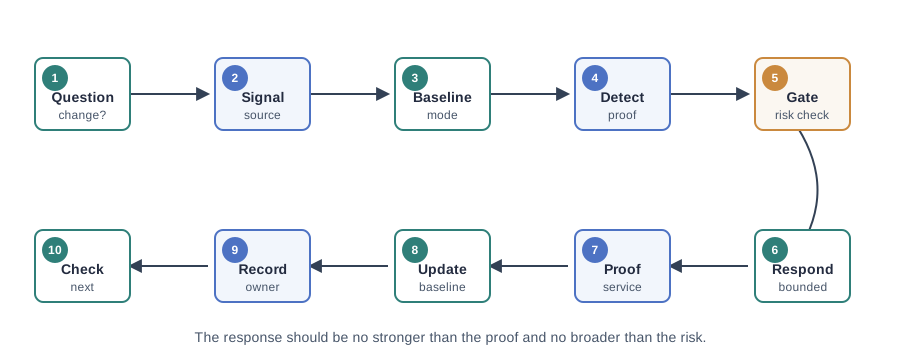
The route in Figure 25.1 starts with a baseline and ends with a bounded action; check service proof.
Use this route:
- Name the anomaly question: suspicious volume, scan behavior, path change, service failure, policy conflict, or unexpected device role behavior.
- Select the signal: choose flow counters, port counters, topology events, controller state, packet samples, or receiver proof.
- Anchor the baseline: compare against a matching device role, traffic class, service path, and operating mode.
- Evaluate detection confidence: combine independent signals before strong action.
- Gate the response: map confidence and service risk to observe, alert, limit, redirect, isolate, or block.
- Prove the outcome: verify rule acknowledgement, counter change, receiver result, and rollback readiness.
- Update the record: adjust baseline, owner notes, suppression rule, or response playbook after the response check.
25.9 Prerequisites
This section: Prerequisites
Use these chapters as needed:
- SDN Analytics Architecture: telemetry sources, context models, response gates, and proof records.
- SDN Analytics with OpenFlow: statistics collection, counters, and polling overhead.
- SDN Fundamentals and OpenFlow: controller decisions, switch rules, and flow-table behavior.
- Threats Introduction: device compromise patterns and network security context.
25.10 Detection Role
This section: Detection Role — The role of SDN anomaly detection is to identify network behavior that deserves investigation and, when justified, to trigger a bounded network response.
The role of SDN anomaly detection is to identify network behavior that deserves investigation and, when justified, to trigger a bounded network response. It is not a replacement for endpoint security, identity management, application logs, or incident response.
SDN anomaly detection is useful when:
- The signal can be observed at switch, controller, topology, or receiver boundaries.
- The expected behavior can be stated by device group or service path.
- The response can be enforced in the network without breaking required traffic.
- The decision can be explained with counters, state, policy, and service proof.
- Operations can roll back or revise the response if the signal was misleading.
It is weak when the design has no baseline, no device role model, no service proof, or no response boundary.
25.11 Signal Sources
This section: Signal Sources — The strongest anomaly checks combine multiple signal types.
The strongest anomaly checks combine multiple signal types. Each source has a useful question and a blind spot.
Treat signal sources as a system decision around Signal source. The visual in Figure 25.2 places did the path change? within this relationship: Signal sources for anomaly detection: flow counters, port counters, topology events, controller state, packet samples, and service proof mapped to questions and limits.
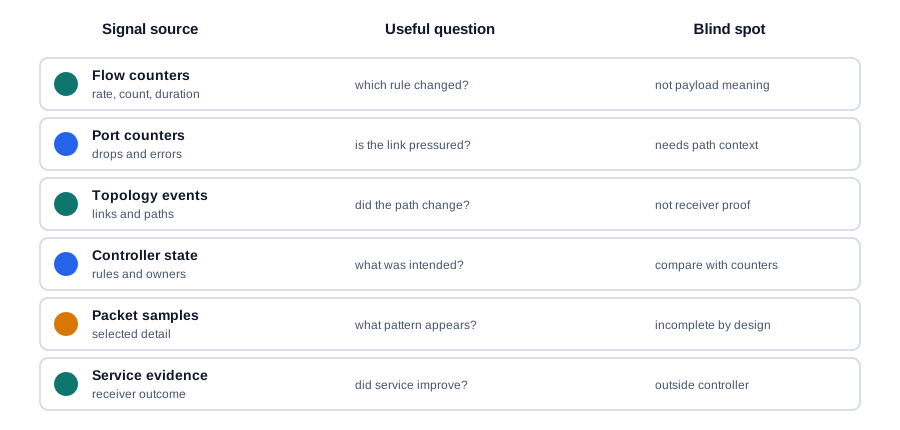
Three concrete diagram labels organize Figure 25.2: Signal source, did the path change?, and outside controller. Between them, the signal sources relationship becomes visible: Signal sources for anomaly detection: flow counters, port counters, topology events, controller state, packet samples, and service proof mapped to questions and limits.
Flow counters
Useful for rate, duration, byte count, flow count, and rule-match changes. They do not explain payload meaning by themselves.
Port counters
Useful for drops, errors, broadcast pressure, and link utilization. They need topology and service context.
Topology events
Useful for path or link change. They do not prove whether the application recovered.
Controller state
Useful for intended rules, ownership, and policy state. It should be checked against switch acknowledgement and counters.
Packet samples
Useful for selected inspection. Sampling is incomplete, so it should support proof rather than replace it.
Service proof
Useful for confirming the effect on gateways, brokers, applications, and receivers.
25.12 Baseline Design
This section: Baseline Design — A baseline should describe normal behavior for the matching situation, not a universal threshold copied across the network.
A baseline should describe normal behavior for the matching situation, not a universal threshold copied across the network.
Treat baseline design as a system decision around Expected. The visual in Figure 25.3 places local or remote within this relationship: Baseline design: device role, traffic class, service path, operating mode, observation window, and exclusion notes feed one statement of expected behavior.
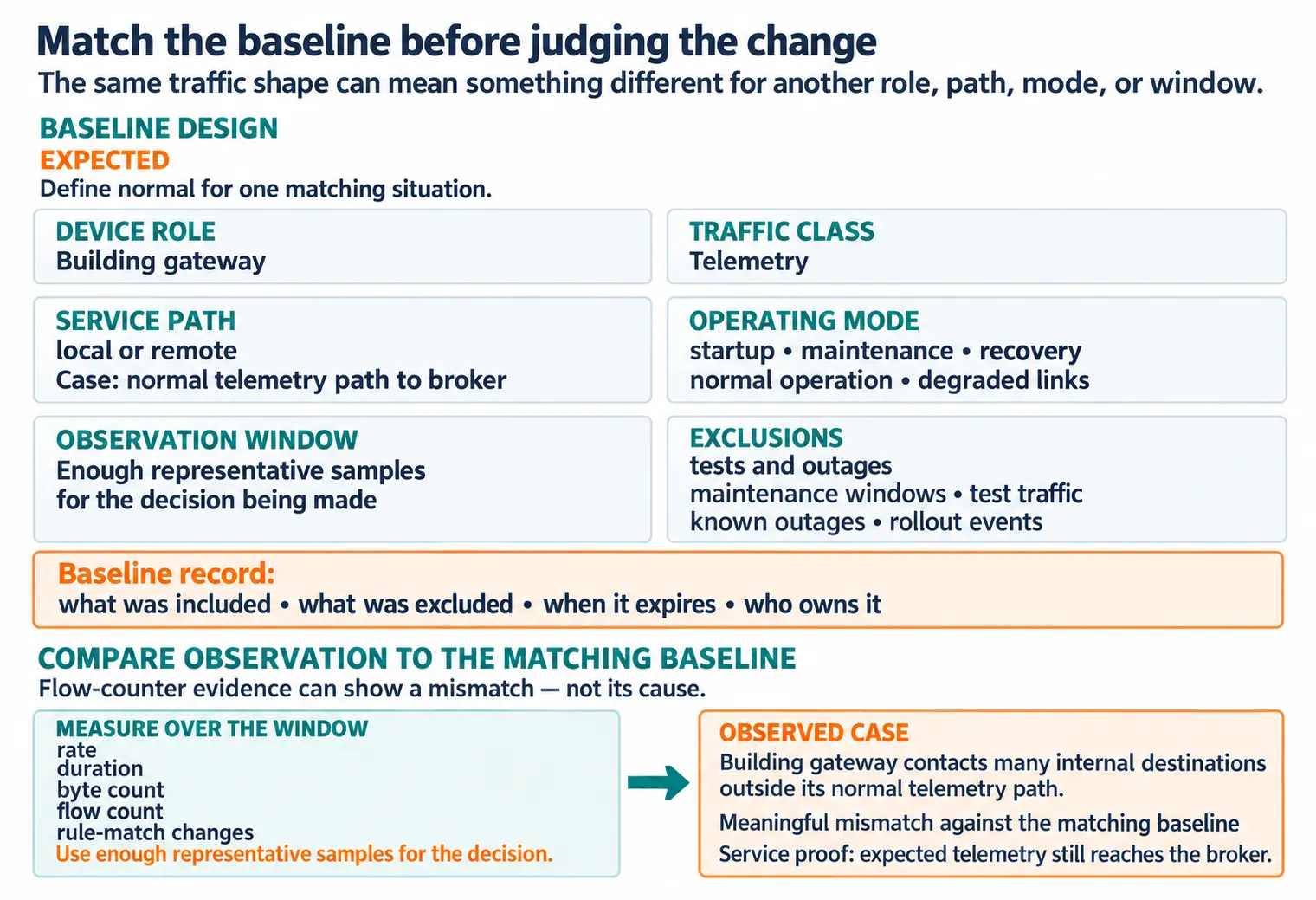
For baseline design, the diagram Figure 25.3 uses Expected as the entry and local or remote as a later checkpoint. Finish at tests and outages. The full reading conveys: Baseline design: device role, traffic class, service path, operating mode, observation window, and exclusion notes feed one statement of expected behavior.
Build baselines around:
- Device role: gateways, sensors, cameras, actuators, controllers, and management hosts behave differently.
- Traffic class: telemetry, management, update, alarm, discovery, and bulk transfer have different patterns.
- Service path: local gateway paths should not be compared blindly with remote service paths.
- Operating mode: startup, maintenance, recovery, normal operation, and degraded links may all have different behavior.
- Observation window: the window should include enough representative samples for the decision being made.
- Exclusions: maintenance windows, test traffic, known outages, and rollout events should not become normal without recheck.
The baseline record should state what was included, what was excluded, when it expires, and who owns it.
Practitioner Knowledge Check
25.13 Detection Methods
This section: Detection Methods — Different detection methods answer different questions.
Different detection methods answer different questions. Use them as signal patterns, not as magic labels.
Figure 25.4 shows how several traffic signals support an anomaly decision.
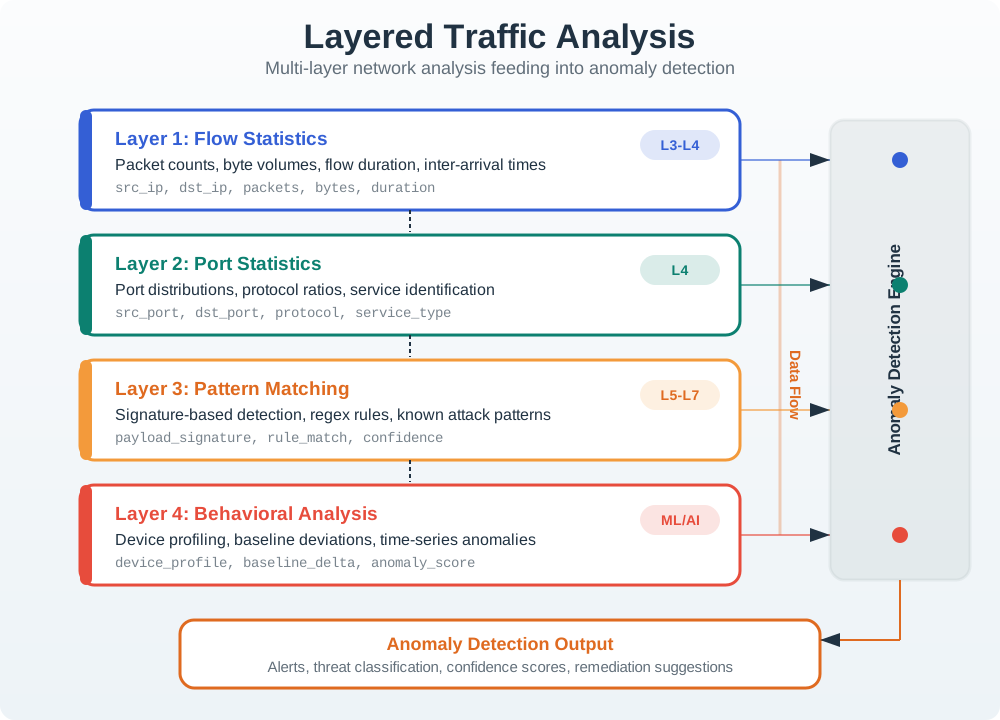
Flow statistics give packet and byte counts, duration, and spacing; port and service statistics add traffic mix and endpoint role. Signature matching checks known patterns, while a behavioral baseline asks whether this device is acting outside its expected mode. The detector combines those observations into a confidence decision before a network response is allowed. A burst alone may be routine maintenance, so keep the operating context and supporting counters with the alert. After any response, confirm that required receiver traffic still works and preserve the pre-response evidence for later review.
Common methods:
- Threshold deviation: a metric moves outside the expected range for a matching baseline.
- Behavior change: a device role uses a new destination class, service class, or traffic shape.
- Signature pattern: a known network pattern appears in counters, samples, or connection attempts.
- Sequence change: an event order changes, such as discovery before unauthorized connection attempts.
- Service mismatch: network signals and receiver proof disagree with the expected result.
The detection record should include the method, the source data, the baseline used, the confidence reason, and the response it is allowed to trigger.
25.14 Analytics Pipeline Addendum
This section: Analytics Pipeline Addendum — An SDN analytics architecture is useful only when the pipeline preserves context from observation to action.
An SDN analytics architecture is useful only when the pipeline preserves context from observation to action. Treat each alert as a chain of proof rather than a single score.
Pipeline check:
- Telemetry contract: record which counters, controller events, topology records, and receiver signals enter the pipeline, plus their sampling interval and blind spots.
- Feature boundary: state which features are derived from raw counters, which depend on topology or device role, and which should not trigger action alone.
- Baseline ownership: assign the owner, validity window, excluded maintenance events, and expiration rule for each baseline.
- Decision gate: require confidence, policy permission, service-risk check, and rollback readiness before containment.
- Response proof: connect the chosen rule to switch acknowledgement, counter movement, protected-path behavior, and final check outcome.
OpenFlow statistics should be treated as network proof, not as service proof by themselves. A byte, packet, error, duration, or flow counter becomes useful when it is joined with ownership, baseline context, receiver behavior, and cleanup records.
25.15 Confidence Gate
This section: Confidence Gate — False positives are not only noisy; they can break real services when the network response is strong.
False positives are not only noisy; they can break real services when the network response is strong. Use a confidence gate before automated action.
Why pause at confidence gate? Beside Signal strength, the diagram Figure 25.5 makes gate explicit within this relationship: Confidence gate combining signal strength, source agreement, baseline quality, policy permission, service risk, and rollback readiness before action.
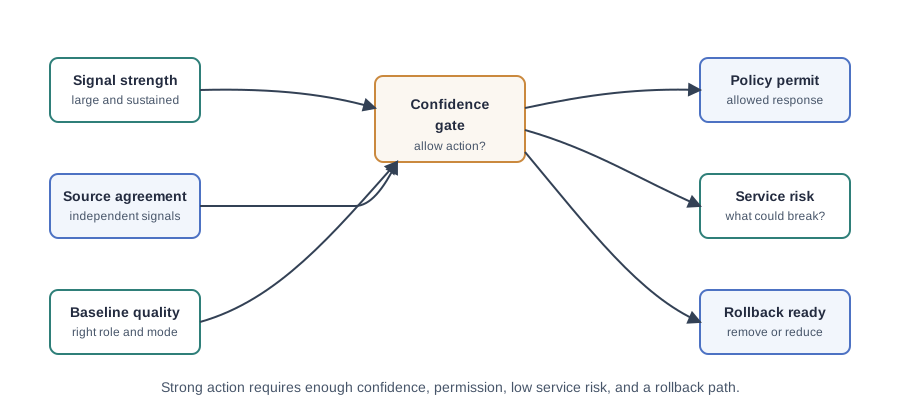
Interrogate Signal strength first, then find gate in Figure 25.5. Apply the gate review question before remove or reduce. Those answers support confidence gate; the figure states: Confidence gate combining signal strength, source agreement, baseline quality, policy permission, service risk, and rollback readiness before action.
Ask:
- Signal strength: is the deviation large enough and sustained enough to matter?
- Source agreement: do independent sources support the same conclusion?
- Baseline quality: does the baseline match this role, path, service, and operating mode?
- Policy permission: is the proposed action allowed for this device group?
- Service risk: could the action break management, recovery, alarm, update, or required telemetry traffic?
- Rollback readiness: can the rule be removed or reduced quickly if service proof gets worse?
25.16 Response Ladder
This section: Response Ladder — The response should match the signal proof.
The response should match the signal proof. Stronger actions need stronger proof, narrower scope, explicit ownership, expiry, and rollback.
Before approving response ladder, test the depicted proposition in Figure 25.6: Response ladder from observe and alert through limit, redirect, isolate, block, rollback, and recheck. Read from Observe toward Isolate.
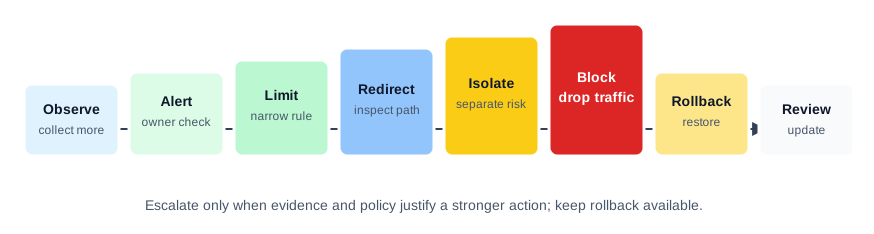
Interrogate Observe first, then find Isolate in Figure 25.6. Apply the Isolate review question before update. Those answers support response ladder; the figure states: Response ladder from observe and alert through limit, redirect, isolate, block, rollback, and recheck.
Graduate the response with the evidence. Observe while the signal is weak, expected, or has no service impact; move to Alert when the signal is credible but still needs an owner. Limit applies when traffic pressure is real and rate control is safer than isolation, whereas Redirect creates an inspection path when containment needs more proof.
Reserve Isolate for a device or group that can be separated without breaking required service, and use Block only when policy permits it, confidence is high, scope is narrow, and rollback is ready. If service degrades or the proof weakens, Rollback restores the safer state. Finally, Recheck feeds the result back into the baseline, suppression rules, and response gates, connecting the ladder to the chapter’s continuing evidence loop.
25.17 Continue to the Next Part
This section: Continue to the Next Part — Carry this evidence into SDN Anomaly Detection: Deployment and Proof Loops, which begins with IoT Deployment Fit.
Carry this evidence into SDN Anomaly Detection: Deployment and Proof Loops, which begins with IoT Deployment Fit.
Find help
3 reviewed answers.
Where should I start in a module?
Open the module page from the sidebar to see its chapters in order. Use the module map to return to a topic you need.
Modules and pathsReviewed
What can I try when a project does not work?
Check the symptom, then work through the diagnostic steps. Keep the error message and the smallest example that reproduces it.
When you are stuckReviewed
How do interactive examples work?
Use the interactive guide to check how examples and simulations work before changing your project.
Interactive examples guideReviewed