31 QoS Core Mechanisms
More
Depth: Practitioner
Progress saves as you read. Mark sections complete as you go; your progress appears in the sidebar.
31.1 Start With the Consequence
This section: Start With the Consequence — Picture a fire alarm waiting behind a large software download.
Deliver the Alarm Before It Becomes Stale
Picture a fire alarm waiting behind a large software download. Both messages eventually arrive, but the alarm is no longer useful when it reaches the receiver.
Latency means the delay from sending to useful receipt. Classify traffic by consequence, not merely by its source or file size.
Send an alarm and a large background transfer together, then add loss and a restart. Record send and receive times, priority, queue, retries, expiry, drops, and receiver action.
This runway does not prove that one policy suits every workload. The deeper sections explain service measures, scheduling, shaping, rate limits, retries, expiry, fairness, and receiver-side proof.
QoS is about consequence before mechanism. A fire alarm, a comfort reading, a firmware download, and a dashboard query do not deserve the same treatment because their late or lost messages cause different harm.
Start simple: name what the receiver must know or do in time. Then choose priority, shaping, retries, expiry, and evidence that protect that outcome without starving the rest of the system.
31.2 Learning Objectives
This section: Learning Objectives
By the end of this chapter, you will be able to:
- Explain latency, jitter, throughput, reliability, loss, freshness, and availability as QoS service metrics.
- Choose between strict priority, weighted fair, round-robin, and weighted round-robin scheduling.
- Compare token-bucket shaping with leaky-bucket smoothing for bursty IoT traffic.
- Set per-source and aggregate rate limits that protect shared services without hiding urgent traffic.
- Define retry, expiry, drop, and fallback behavior so QoS does not deliver stale commands.
- Identify the receiver-side proof needed to show that a service objective was met.
31.3 Quick Check: Alarm Path Proof
This section: Quick Check: Alarm Path Proof
Core concept: QoS is not one mechanism. It is a service policy made of classification, queue behavior, shaping, rate limits, retry control, expiry, monitoring, and proof.
Why it matters: A protected alert can still fail if retries amplify congestion, a command arrives stale, or the team only checks sender logs.
Key takeaway: Start with the service objective, then choose the mechanism. Never start by turning every message into the highest priority class.
31.4 Prerequisites
This section: Prerequisites
Use these chapters as needed:
- QoS and Service Management: traffic classes, service objectives, and policy records.
- QoS Policy Lab: practice classifying traffic and collecting proof.
- Production Architecture Management: ownership, support, and operating proof.
- Communication and Protocol Bridging: protocol translation and gateway boundaries.
- MQTT Fundamentals: application-layer delivery modes and acknowledgement behavior.
31.5 Mechanism Route
This section: Mechanism Route — Use the mechanisms in a deliberate order.
Use the mechanisms in a deliberate order. If the service objective is unclear, queue algorithms and rate-limit values become guesses.
- Name the service metric: latency, jitter, throughput, freshness, reliability, loss, duplicate handling, or availability.
- Classify traffic: protected alerts, control commands, operational telemetry, diagnostics, background transfer, and management actions.
- Select queue behavior: strict priority for the narrowest protected class, fair scheduling for shared classes, and drop rules for low-value bursts.
- Shape and limit: smooth bursty senders, cap aggregate load, and keep retries from creating a second congestion source.
- Set expiry and fallback: stale commands should expire or move to a hold check rather than arrive late as if they were still useful.
- Collect receiver proof: show the protected message arrived fresh enough for the intended action.
31.6 Service Management Addendum
This section: Service Management Addendum — QoS mechanisms are useful only after the operating consequence is clear.
QoS mechanisms are useful only after the operating consequence is clear. Manage the service path from traffic classification through receiver proof and revisit triggers.
| Service-management step | Proof to keep |
|---|---|
| Service question | Which decision, alert, command, or observation depends on timely delivery, and what consequence does delay create? |
| Traffic class | Emergency events, control commands, operational telemetry, diagnostics, background transfers, and management traffic separated by consequence. |
| Objective | Freshness, delay, jitter, loss, duplicate handling, retry behavior, degradation rule, and local fallback expectation per class. |
| Mechanism map | Priority queue, shaping, rate limit, protocol delivery mode, retry and expiry rule, or local fallback applied where it matches the objective. |
| Monitoring loop | Receiver-side delay, stale-message count, queue depth, drops, retry storms, expiry counts, degradation records, and owner action. |
| End-to-end check | Device queue, radio or link behavior, gateway policy, broker or service queue, storage path, application processing, operator notification, and fallback. |
| Revisit trigger | Fleet growth, new traffic class, changed service dependency, repeated missed objective, or changed operating consequence. |
Keep the highest class narrow. A priority mark by itself does not prove the objective; the receiver or consumer must show that the protected message arrived fresh enough for the intended action.
31.7 Service Metrics Before Mechanisms
This section: Service Metrics Before Mechanisms — QoS work starts by naming what must be protected.
QoS work starts by naming what must be protected. A vague statement such as “make this traffic fast” cannot be verified.
The next service metrics before mechanisms step needs Receiver as a visual checkpoint. At Figure 31.1, duplicate state supplies the relationship to challenge: QoS service metric map.
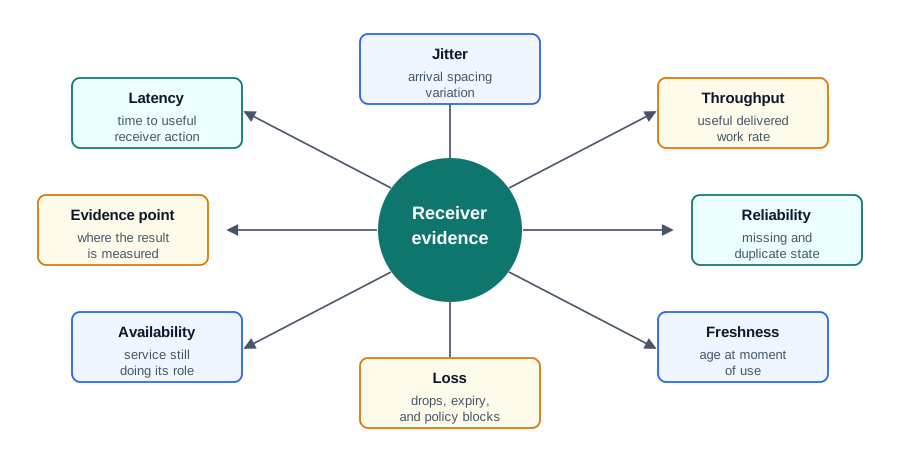
At Receiver, the diagram Figure 31.1 establishes one design concern. duplicate state introduces the next; is measured provides the final service metrics before mechanisms review cue. This is measured sequence supports the claim: QoS service metric map.
Latency
Time from send, ingress, or queue entry to receiver action. State the measurement point, not just the target.
Jitter
Variation in arrival time. Useful when control loops, media streams, or periodic decisions need stable spacing.
Throughput
Useful delivered work per unit time. More throughput is not always better if it crowds protected traffic.
Reliability
Whether messages arrive as required, including duplicates, missing messages, replay, and acknowledgement scope.
Freshness
Whether the message is still useful when consumed. Freshness often matters more than eventual delivery.
Availability
Whether the service can continue enough of its role during busy or degraded operation.
31.8 Traffic Classes
This section: Traffic Classes — Traffic classes describe consequence, not personality.
Traffic classes describe consequence, not personality. A telemetry message can become protected if it drives an immediate action, while a large diagnostic transfer should usually yield during contention.
Protected alerts
Narrow class for events where late arrival changes the operating consequence. Keep this class small.
Control commands
Commands that need acknowledgement, expiry, duplicate handling, and a record of whether the receiver could act.
Operational telemetry
Measurements that support monitoring. During contention they may be delayed, summarized, sampled, or dropped according to policy.
Diagnostics and background
Support logs and bulk transfers should yield to live service classes and resume when capacity returns.
Classification prompts:
- What happens if this message arrives late?
- Can this message be summarized, sampled, delayed, or dropped?
- Does the receiver need acknowledgement or idempotency?
- What proof shows that the message was still fresh?
- Who is allowed to change the class?
31.9 Queue Scheduling
This section: Queue Scheduling — Queues decide which waiting message gets served next.
Queues decide which waiting message gets served next. The mechanism is useful only when it matches the service objective.
Before approving queue scheduling, test the depicted proposition in Figure 31.2: Queue scheduling choices need starvation proof. Read from Queue Scheduling Choices Need Starvation Proof toward Round Robin.
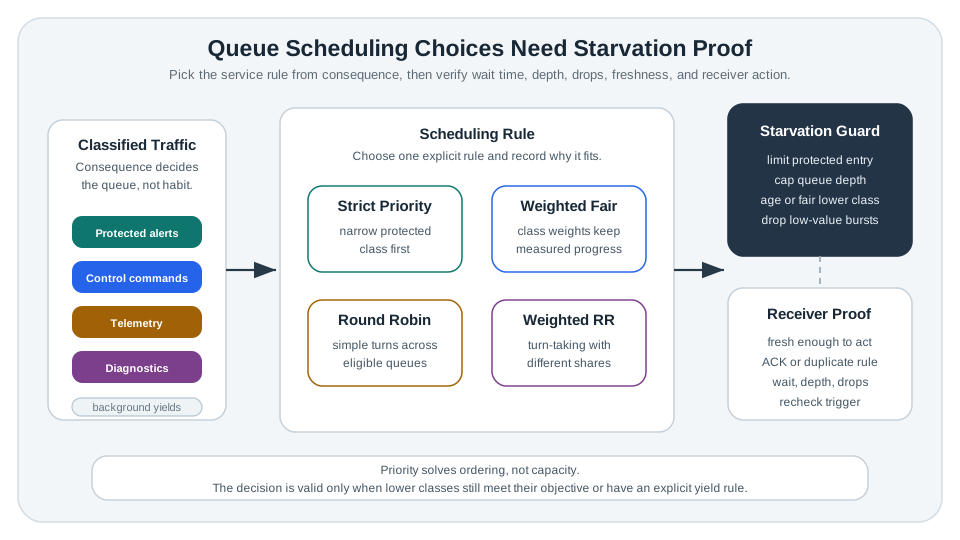
The queue map in Figure 31.2 shows ways to serve traffic; check whether lower priority data gets through.
Strict priority
Always serve the highest class first. Use it only for a narrow protected class because lower classes can starve during sustained load.
Weighted fair scheduling
Shares service across classes according to weights. This protects high classes while still giving lower classes measured progress.
Round robin
Cycles through queues evenly. Useful for fairness, but it may under-protect urgent traffic if used alone.
Weighted round robin
Cycles through queues with different service shares. It is simpler than full fair scheduling and easier to explain in decision records.
Starvation controls:
- Limit how much traffic can enter the protected class.
- Add maximum queue depth and explicit drop rules for routine traffic.
- Use aging or fairness for classes that must eventually complete.
- Monitor how long each class waits, not only how many messages were sent.
- Recheck the policy when a lower class repeatedly misses its objective.
31.9.1 Hierarchical Allocation Across Homes and Devices
A shared access bottleneck can be managed at two levels. The first allocator divides capacity among residential gateways; the second divides each gateway’s share among applications and devices inside the home. Keeping those decisions separate lets the upstream policy protect fairness between households while each household preserves its own priorities for calls, alarms, work, entertainment, updates, and background telemetry.
One decentralised design gives each gateway a credit balance. During congestion, every home receives a protected baseline and can spend credits for a temporary larger share; credits are replenished or redistributed by an explicit rule. The mechanism turns urgency over time into a bounded choice instead of letting the loudest sender win. It also creates strategic behavior: a gateway may save credits for an expected event, spend early, or mispredict demand, so the policy needs balance caps, expiry or replenishment rules, protection against false identities, and transparency about what credits can buy.
For example, four homes sharing an access segment may all stream routine traffic, while one expects a scheduled telehealth call. Its gateway can reserve credits beforehand and spend them during the call, then return to the baseline. Inside that home, the second-level scheduler still protects the call from a console update. Evaluate the design with changing demand across several busy periods: measure each home’s delivered service, minimum share, waiting time, unused capacity, credit trajectory, and the effect of prediction errors. Credits should improve inter-home fairness and choice without replacing receiver-side QoS proof or allowing wealth, device count, or aggressive spending to starve a neighbor.
31.10 Traffic Shaping
This section: Traffic Shaping — Traffic shaping controls how quickly messages leave a sender, gateway, queue, or service boundary.
Traffic shaping controls how quickly messages leave a sender, gateway, queue, or service boundary. It is different from priority: shaping changes rate, while priority changes order.
The next traffic shaping step needs Token bucket as a visual checkpoint. At Figure 31.3, Leaky bucket supplies the relationship to challenge: Token bucket and leaky bucket comparison.
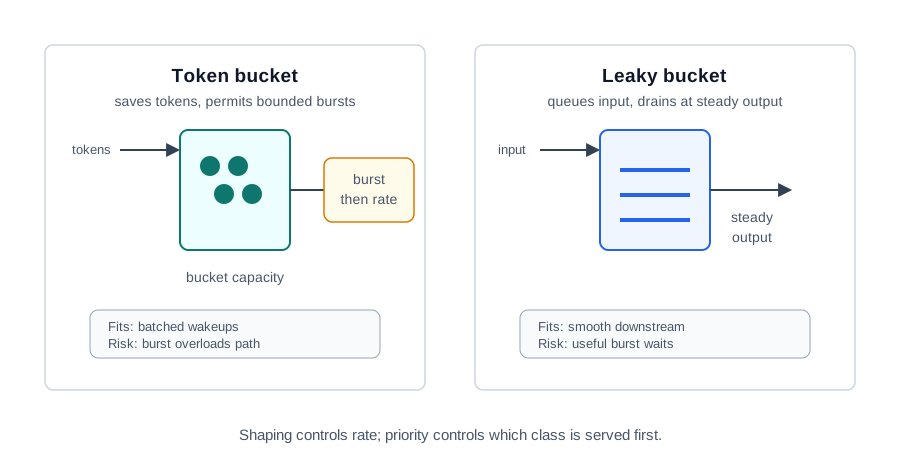
Interrogate Token bucket first, then find Leaky bucket in Figure 31.3. Apply the Leaky bucket review question before Shaping controls rate; priority controls which class is served first. Those answers support traffic shaping; the figure states: Token bucket and leaky bucket comparison.
Token bucket
Tokens accumulate while traffic is quiet. A sender can use saved tokens for a controlled burst, then returns to the sustained rate.
Leaky bucket
Messages drain at a steady rate. This produces smooth output but may delay natural bursts that are still acceptable.
When token bucket fits
Use it when devices normally send in short batches and the service can tolerate bounded bursts.
When leaky bucket fits
Use it when a downstream path needs steady pacing and burst delay is more acceptable than burst arrival.
Useful shaping questions:
- What sustained rate can the shared path absorb?
- How much burst is acceptable before another class is harmed?
- Where should shaping happen: source, gateway, broker, queue, or service boundary?
- What happens when the bucket is empty: wait, drop, summarize, or downgrade?
- Which receiver proof shows the shaped traffic did not harm protected traffic?
31.11 Rate Limits, Retry, and Expiry
This section: Rate Limits, Retry, and Expiry — Rate limits protect shared services.
Rate limits protect shared services. Retry and expiry rules keep protection from turning into a traffic amplifier.
The chapter needs visual evidence for rate limits, retry, and expiry. Figure 31.4 provides it: QoS rate-limit and retry controls. Examine Source A together with Aggregate.
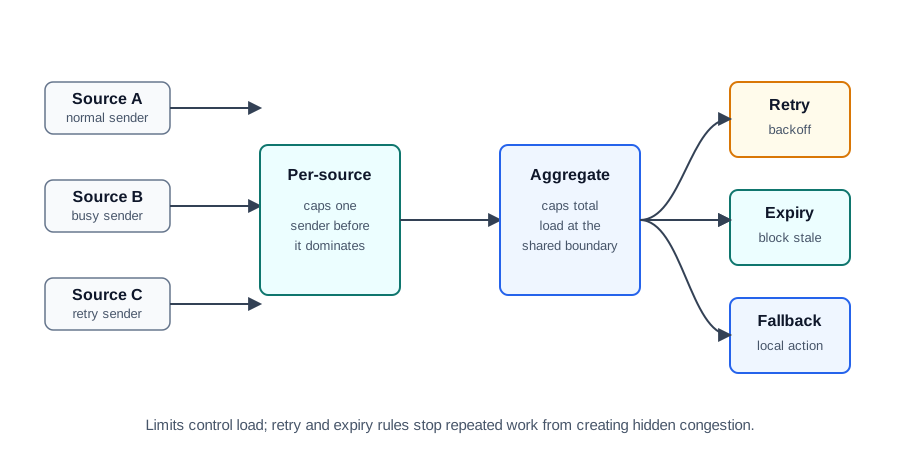
At Source A, the diagram Figure 31.4 establishes one design concern. Aggregate introduces the next; local action provides the final rate limits, retry, and expiry review cue. This local action sequence supports the claim: QoS rate-limit and retry controls.
Per-source limit
Caps one source so a faulty or busy sender cannot consume the whole shared path.
Aggregate limit
Caps total load at a shared boundary so many normal senders cannot overwhelm the service together.
Retry backoff
Spreads retries over time and prevents repeated immediate attempts from becoming the largest load.
Expiry rule
Stops stale commands from arriving as if they were still valid. Expired work should be logged and checked.
Startup and reconnection surges need special care. The policy should allow essential identity, state, and acknowledgement messages to complete, while bulk diagnostics and background transfers wait or resume later.
31.12 Mechanism Selection Scenario
This section: Mechanism Selection Scenario — A shared building gateway carries protected alerts, access commands, operational telemetry, diagnostic logs, and background transfers.
A shared building gateway carries protected alerts, access commands, operational telemetry, diagnostic logs, and background transfers. During busy periods, routine telemetry and diagnostics arrive in bursts while access commands sometimes become stale before the receiver can act.
Use this route:
- Classify protected alerts and access commands separately from telemetry and diagnostics.
- Give protected alerts a narrow strict-priority lane with receiver-side freshness proof.
- Use weighted fair scheduling for control, telemetry, and diagnostics so lower classes still make measured progress.
- Shape diagnostics and background transfers before they enter the shared queue.
- Apply per-source and aggregate rate limits at the gateway boundary.
- Add retry backoff and command expiry so delayed actions do not execute late.
- Record receiver arrival time, stale counts, queue depth, drops, retry counts, and fallback signals.
Practitioner Knowledge Check
31.13 Proof Loop
This section: Proof Loop — QoS is complete only when proof shows the service objective at the receiver or consumer.
QoS is complete only when proof shows the service objective at the receiver or consumer.
Inspect Figure 31.5 before judging proof loop; it depicts: QoS receiver proof loop. Focus first on QoS Proof Ends at the Receiver, then on slow receiver.
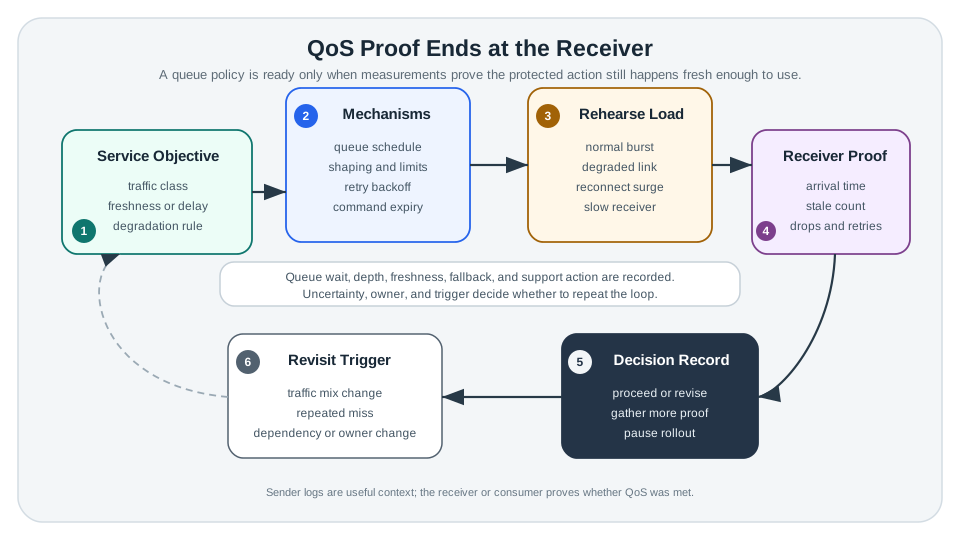
The diagram Figure 31.5 first names QoS Proof Ends at the Receiver, then separates slow receiver from Uncertainty, owner, and trigger decide whether to repeat the loop. Carry checkpoints slow receiver and Uncertainty, owner, and trigger decide whether to repeat the loop into proof loop with QoS Proof Ends at the Receiver. Their combined proposition is: QoS receiver proof loop.
Proof to collect:
- Traffic class and service objective.
- Queue depth and waiting time by class.
- Shaping and rate-limit decisions.
- Retry count, backoff behavior, and expiry count.
- Receiver arrival time and freshness.
- Missing, duplicate, dropped, and stale messages.
- Fallback action and support owner.
- Decision, uncertainty, and revisit trigger.
Example decision record:
Traffic class:
  Protected alert, control command, telemetry, diagnostics, or background.

Objective:
  Freshness, delay, delivery behavior, duplicate handling, and degradation rule.

Mechanisms:
  Queue schedule, shaping rule, rate limit, retry rule, expiry rule, fallback.

Proof:
  Queue wait, receiver arrival, stale count, drops, retries, and support action.

Decision:
  Proceed, revise policy, gather more proof, or pause rollout.

Revisit trigger:
  Traffic mix change, repeated miss, dependency change, or ownership change.
31.14 Knowledge Check: QoS Mechanism Fit
This section: Knowledge Check: QoS Mechanism Fit
31.15 Match: Mechanism to Purpose
This section: Match: Mechanism to Purpose
31.16 Order: QoS Mechanism Design
This section: Order: QoS Mechanism Design
31.17 Common Pitfalls
This section: Common Pitfalls
Protecting everything
If every class gets highest priority, the system has no useful priority.
Using delivery as freshness
A delivered command can still be wrong if it arrives after its useful window.
Ignoring retry load
Retries without backoff and expiry can create more traffic than the original event.
Trusting sender logs only
The receiver or consumer is where the service objective is met or missed.
Missing starvation checks
Strict priority needs queue depth, wait time, and drop proof for lower classes.
Forgetting ownership
A QoS miss needs an owner, decision, closure signal, and revisit trigger.
31.18 See Also
This section: See Also
- QoS and Service Management: service-policy route and decision records.
- QoS Policy Lab: hands-on policy rehearsal and proof collection.
- QoS in Real-World Systems: domain patterns and protocol choices.
- Production Architecture Management: operating proof and support ownership.
- Software-Defined Networking: programmable network policy context.
31.19 QoS Starts With Consequence
This section: QoS Starts With Consequence — QoS is not a request to make every packet faster.
QoS is not a request to make every packet faster. It is a decision about which operating consequence needs protection when the path is busy, lossy, delayed, or recovering from failure.
Before making the decision in this section, inspect Figure 31.6. It makes the decision concrete by showing choose QoS mechanisms after the service objective is clear: name the metric, classify traffic by consequence, select queue behavior, shape bursts, block stale work, and verify receiver proof, so the relationships can be checked before they are turned into a design claim.Figure 31.6 moves from a receiver objective to queue and freshness evidence.
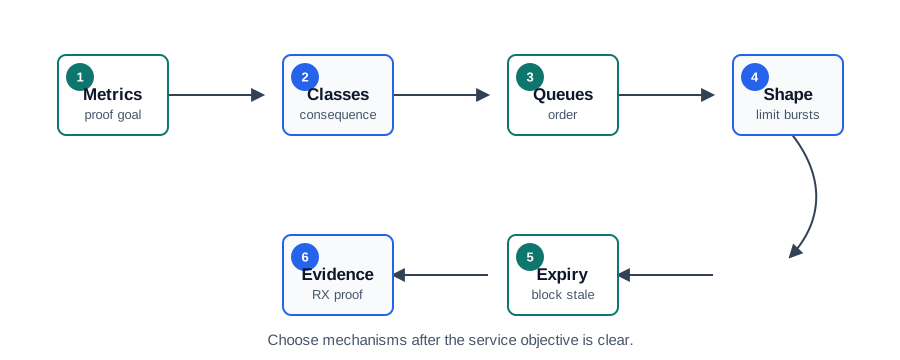
Figure 31.6 puts the service objective before mechanism selection, then covers metrics, traffic classification by consequence, queue behavior, burst shaping, stale work, and receiver proof.
First define the useful receiver result and the metrics that would prove it. Traffic classes then reflect consequences: an alert, control command, telemetry reading, and diagnostic burst do not lose value in the same way. Queues set service order, shaping limits bursts, and expiry prevents stale work from consuming capacity or causing a late action. Finally check what the receiver actually obtained under contention. The route matters because a priority label or delivery mode cannot substitute for a timely, valid result at the application boundary.
Small-screen read: The route is metrics, classes, queues, shaping, expiry, and proof. If the objective is unclear, the mechanism choice is only a guess.
Start by naming the action that would fail: an alarm that arrives too late, an access command that opens after the request is stale, a telemetry burst that hides a fault, or a retry storm that keeps a gateway from recovering. That consequence tells the team which metric matters and where to measure it.
The mechanism should then be narrow. Strict priority belongs to the smallest class that truly changes the operating outcome. Fair scheduling belongs to shared classes that must keep moving. Shaping and rate limits belong at the boundary where bursty senders can harm other work. Expiry belongs wherever a delayed command would be worse than no command.
That is why QoS design usually starts with a mixed-traffic story rather than a router feature list. Name the alarm, command, telemetry stream, diagnostic transfer, and management action, then decide what each class is allowed to do when capacity is scarce.
The last step is receiver proof. Sender logs can show that a packet left a device or gateway, but QoS is met only when the consumer receives the message fresh enough to act, or records that it expired, dropped, retried, or fell back in a controlled way.
For IoT systems, that consequence is usually visible at the receiver: an alert is still fresh enough to act on, a command expires before it can cause a stale action, telemetry is summarized instead of flooding a queue, or diagnostics wait without hiding an incident.
31.20 Receiver Proof Record
This section: Receiver Proof Record — Write the QoS record from the consuming action backward.
Write the QoS record from the consuming action backward. Sender logs are useful, but the receiver proves whether the service objective was actually met.
A useful receiver proof record names the traffic class, service objective, chosen queue rule, shaping rule, retry rule, expiry rule, fallback behavior, measurement points, owner, and retest trigger. Keep the record close to the action. For an alarm, measure arrival-to-action delay and stale-alert count. For a command, measure command age at consumption, duplicate handling, acknowledgement scope, and whether the receiver acted, held, or rejected the command.
Also record what lower classes experienced while the protected class was active. A narrow alert lane is acceptable when telemetry waits and then drains. It is not acceptable when diagnostics and health reports starve so completely that operators lose the evidence needed to understand the incident. The proof record should therefore include queue depth, wait time, drops, retry volume, and recovery time by class.
Run the record under a repeatable load, not only during a quiet demonstration. Include one normal burst, one degraded link, one reconnect surge, and one receiver slowdown. Those rehearsals reveal whether the selected mechanism protects the intended service or simply moves the bottleneck to a later queue.
| Service Question | Mechanism To Check | Receiver Proof |
|---|---|---|
| Will a protected alert still be useful? | Narrow strict-priority class, queue-depth limit, and freshness timestamp. | Arrival-to-action delay, stale-alert count, and lower-class wait time. |
| Can a command arrive too late? | Expiry rule, acknowledgement scope, duplicate handling, and fallback state. | Expired-command count, acted-command age, and hold-or-retry decision record. |
| Will retries create the outage? | Backoff, retry budget, per-source cap, and aggregate limit. | Retry rate, drop reason, queue recovery time, and owner action. |
| Can background work resume safely? | Shaping, weighted service, resume rule, and starvation guard. | Progress by class, waiting time, backlog age, and completion signal. |
31.21 Priority Can Create Failure
This section: Priority Can Create Failure — Priority solves ordering, not capacity.
Priority solves ordering, not capacity. If too many messages enter the protected class, strict priority stops being protection and becomes another congestion source. Lower classes starve, telemetry ages, diagnostics disappear, and operators lose the evidence needed to understand the incident.
Retries can make the same failure worse. A fleet that retries immediately after a gateway outage can generate more traffic during recovery than it generated before the outage. QoS therefore needs retry budgets, backoff, expiry, shaping, and proof that queues drain after the event.
Shaping and scheduling fail in different ways. A token bucket can allow useful bursts, but a bucket that is too large can still swamp a shared queue after a quiet period. A leaky bucket smooths output, but it can delay a burst long enough to make a command stale. Weighted fair scheduling gives every class progress, but a poor weight choice can still miss a protected service target. These settings need measured receiver outcomes, not only configuration review.
The same rule applies across protocol layers. MQTT QoS, TCP retransmission, broker queues, gateway buffers, and application retries can all be correct locally while creating bad end-to-end behavior together. The under-the-hood review should follow one message class through every queue and ask where delay, duplication, expiry, and fallback are decided.
Capacity accounting keeps the policy honest. Estimate the protected class arrival rate, service rate, retry multiplier, queue depth, and expiry window, then compare those values with receiver observations. If the math says the queue cannot drain before commands expire, a priority label cannot make the service objective true.
The under-the-hood check is simple: every priority rule needs a load limit, every retry needs a budget, every command needs an expiry rule, and every protected class needs receiver-side proof that it stayed narrow enough to work.
31.22 Summary
This section: Summary — QoS fundamentals explain how latency, jitter, loss, throughput, priority, and congestion management shape IoT service behavior.
QoS fundamentals explain how latency, jitter, loss, throughput, priority, and congestion management shape IoT service behavior. These concepts matter because each class of traffic needs a measurable service target and a way to detect when the target is missed.
31.23 What’s Next
This section: What’s Next — Continue with QoS in Real-World Systems when you need deployment patterns, or return to QoS Policy Lab to rehearse mechanism choices against a concrete scenario.
Continue with QoS in Real-World Systems when you need deployment patterns, or return to QoS Policy Lab to rehearse mechanism choices against a concrete scenario.
Find help
3 reviewed answers.
Where should I start in a module?
Open the module page from the sidebar to see its chapters in order. Use the module map to return to a topic you need.
Modules and pathsReviewed
What can I try when a project does not work?
Check the symptom, then work through the diagnostic steps. Keep the error message and the smallest example that reproduces it.
When you are stuckReviewed
How do interactive examples work?
Use the interactive guide to check how examples and simulations work before changing your project.
Interactive examples guideReviewed