8 Cloud Security: Identity and Monitoring Controls
More
Depth: Practitioner
Progress saves as you read. Mark sections complete as you go; your progress appears in the sidebar.
8.1 Start With the Decision
This section: Start With the Decision — A gateway passes device data to another service.
A gateway passes device data to another service. A trust zone is a part of the system with its own access rules. Identity says which device or service is acting. A network hop is one handoff along the path; an alert tells staff that a rule or limit needs attention. A cold-store gateway sends data through several cloud trust zones. Each identity, network hop, and alert needs a named control.
8.2 Route Overview
This section: Route Overview — This is part 1 of 2.
This is part 1 of 2. Continue with Cloud Security: Control Records and Failure Modes.
8.3 Part Objectives
This section: Part Objectives
- Trace identity and data controls across a cloud IoT path.
- Select monitoring evidence for ingestion and service failures.
8.4 Chapter Roadmap
This section: Chapter Roadmap
- Start With the Cloud Boundary
- In 60 Seconds
- Minimum Viable Understanding
- Security as Boundary Control
- Responsibility Model
- Provider, Host, And Assessment Checks
- Device Identity Lifecycle
- Least Privilege For IoT Messages
- Data Protection
- Network And Ingestion Controls
- Monitoring And Incident Response
8.5 Start With the Cloud Boundary
This section: Start With the Cloud Boundary — A gateway is a local system that passes device data to other services.
A gateway is a local system that passes device data to other services. A broker is a service that receives named messages and sends them to allowed readers. Picture one freezer sensor sending an alarm through both on its way to a cloud screen.
Start at one crossing point. Name the sender, the receiver, the allowed action, and the record that proves it happened. Give each device its own identity. Give each person and service only the access needed for the job.
Now assume one key, account, rule, or device is lost. Check how far the harm can spread, how access is removed, and how staff learn about the event. Strong locks without logs or recovery still leave a weak system.
This freezer path does not prove the whole cloud is secure. It cannot set data rules, network limits, key life, or response steps for every service. Those choices need owners and tested records.
Use the Practitioner sections to assign control owners and build the security record. Use Under the Hood to inspect removal, spread limits, and recovery. The deeper material extends the boundary check; it does not replace it.
Walk one alarm. Give the sensor one name. Give it one key. Allow one message kind. Deny control. Log the send. Log the receive. Keep the data class. Keep the service owner. Now copy the key. Remove the old key. Watch for its use. Block that device. Keep other devices live. Tell the right team. Restore only with proof. Review who could read. Review who could act. Test the emergency path. Record the final state. Repeat after a staff change. Repeat after a service change. Small checks reveal wide harm.
Cloud security begins when a device message crosses a boundary: from device to gateway, gateway to broker, broker to storage, service to dashboard, or operator to control action. Each boundary needs identity, permission, logging, and recovery evidence.
Start simple: choose one boundary and ask who is allowed through, what they can do, how the action is recorded, and how access is removed. That small check scales into the full responsibility model.
8.6 Learning Objectives
This section: Learning Objectives
By the end of this chapter, you will be able to:
- Map IoT cloud-security responsibilities across device, network, platform, application, data, and operations layers.
- Design per-device identity and credential lifecycle controls for enrollment, rotation, revocation, and retirement.
- Apply least-privilege access boundaries to telemetry, commands, state updates, files, and operator workflows.
- Select data-protection and monitoring records that fit an IoT workload.
- Build a security control record that avoids brittle named-service, fixed-price, or changing policy assumptions.
8.7 Security as Boundary Control
This section: Security as Boundary Control — IoT cloud security is not a single control.
IoT cloud security is not a single control. It is a set of boundaries that must hold when devices fail, gateways are replaced, credentials age, operators change roles, networks recover, and cloud workflows are modified.
The overview depth layer shows the security boundary map that connects device identity, network admission, message authorization, data protection, operator access, monitoring, and response around the IoT cloud workload.
Check these boundaries:
- Device boundary: unique identity, secure enrollment, local secret storage, credential rotation, and revocation.
- Network boundary: encrypted transport, approved endpoints, gateway isolation, firewall rules, and site segmentation.
- Message boundary: topic authorization, schema validation, command approval, replay protection, and duplicate handling.
- Data boundary: classification, encryption, key ownership, retention, deletion, and access checks.
- Operator boundary: role-based access, multifactor authentication, break-glass procedure, and audit trail.
- Operations boundary: monitoring, alert routing, incident runbooks, recovery drills, and post-incident checks.
8.8 Responsibility Model
This section: Responsibility Model — A shared cloud design is secure only when responsibilities are written down.
A shared cloud design is secure only when responsibilities are written down. Avoid vague statements such as “the cloud handles security.” The platform may handle physical facilities and managed-service internals, but the IoT team still owns device trust, application behavior, data choices, and operator access.
8.8.1 Platform Operator
Typically owns physical facilities, base infrastructure, service availability controls, managed runtime internals, and core service patching.
Control record: service boundary statement, support path, availability assumptions, and incident notification route.
8.8.2 IoT Application Team
Owns device identity, message permissions, application code, data classification, dashboards, command approval, and business workflow controls.
Control record: access matrix, data map, topic policy, command policy, and release check.
8.8.3 Operations Team
Owns monitoring, alert triage, credential rotation calendar, incident runbooks, recovery drills, and after-action records.
Control record: dashboards, log retention, on-call route, drill record, and closure checklist.
The responsibility model should show what changes when the deployment style changes. A self-managed broker shifts more patching, backup, clustering, and recovery responsibility to the team. A managed service shifts some runtime operations away from the team, but not device identity, data handling, or application authorization.
8.9 Provider, Host, And Assessment Checks
This section: Provider, Host, And Assessment Checks — A cloud-security review should separate provider assurance from workload proof.
A cloud-security review should separate provider assurance from workload proof. Reputation, published audit standards, and SLA language can screen a provider, but they do not prove this IoT workload is safe. Keep a vendor-risk record with the active SLA, support path, audit or certification scope, incident-notification route, data-location commitments, and any questionnaire answers that were used in the decision.
For IaaS, host security remains visible: guest operating systems, runtime patching, firewall and network policy, application secrets, and customer-controlled keys need owners even when the provider operates the physical facility and hypervisor. Hypervisor isolation failures are rare but high-impact, so record which workloads can share tenancy, which require dedicated hosts or stronger isolation, and how suspicious host or API behavior is monitored. In PaaS and SaaS, the provider owns more platform internals, but the IoT team still owns data classification, access policy, user roles, integration tests, export paths, and incident handoff.
Risk assessment should include both qualitative and quantitative evidence. Useful inputs include threat scenarios, loss impact, service traffic sensitivity, vulnerable API exposure, account-takeover paths, deletion or leakage consequences, data remanence and lineage needs, and availability targets. The result should produce controls that can be tested: IAM and MFA, least privilege, encryption in transit and at rest, segmentation, logging, backup and restore proof, and a clear recheck trigger when the service, tenant model, or workload changes.
The Cloud Security Alliance’s widely-cited threat list is a useful cross-check against this chapter’s boundary map rather than a replacement for it: data breaches and data loss map to the data boundary; weak identity, credential, and access management and account hijacking map to the device and operator boundaries; insecure APIs and system or application vulnerabilities map to the message and network boundaries; and malicious insiders, advanced persistent threats, insufficient due diligence, abuse of cloud services, denial of service, and shared-technology issues map to the operations boundary and the provider-assessment record above. Running the vendor-risk and control records against each of those named categories is a fast way to check that no boundary was skipped.
8.10 Device Identity Lifecycle
This section: Device Identity Lifecycle — The most important IoT cloud-security decision is whether each device has an identity that can be controlled independently.
The most important IoT cloud-security decision is whether each device has an identity that can be controlled independently.
Why pause at device identity lifecycle? Beside Credential lifecycle evidence, the diagram Figure 8.1 makes monitor signals explicit within this relationship: Device identity lifecycle moves from manufacturing enrollment through activation, rotation, normal use, suspected compromise, revocation, replacement, and retirement.
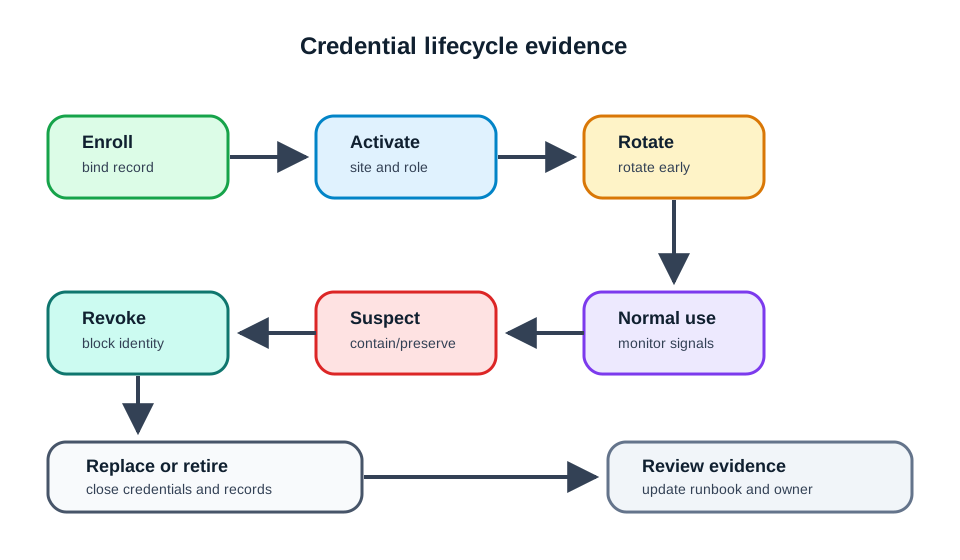
The stages in Figure 8.1 treat a credential as a device record that changes over time. Enrollment binds it to a serial or manufacturing record; activation adds site, owner, and message scope. Rotation prevents an old key from becoming permanent. Normal-use signals include failed authentication and expiry, while suspected compromise calls for paused commands, isolated routes, and preserved logs. Revocation removes one identity without disabling unrelated units. Replacement transfers service context without reusing the old secret, and retirement closes command access and ownership. The runbook and owner must be updated after a compromise so each stage remains testable for one physical device.
Use one identity per device or gateway wherever possible:
- Enrollment: bind the credential to a serial number, hardware root, manufacturing record, or approved field-provisioning record.
- Activation: only activate identities for devices assigned to a site, owner, and intended message scope.
- Rotation: rotate certificates, keys, and tokens before they become operational debt.
- Revocation: remove a compromised or retired identity without disturbing the rest of the fleet.
- Replacement: transfer site assignment and service history without reusing old secrets.
- Retirement: disable credentials, remove command permissions, preserve required records, and close support ownership.
Shared fleet credentials should be treated as an emergency migration target. They make topic permissions, incident triage, and revocation too coarse.
8.11 Least Privilege For IoT Messages
This section: Least Privilege For IoT Messages — Least privilege means that a device can do only what its role requires, in the context where it is deployed.
Least privilege means that a device can do only what its role requires, in the context where it is deployed.
8.11.1 Telemetry Devices
May publish their own telemetry and health events.
Should not subscribe to commands, read other devices, alter registry records, or write operator audit events.
8.11.2 Gateways
May publish for assigned downstream devices and receive approved configuration.
Should not publish for another site, bypass schema validation, or grant new identities.
8.11.3 Actuators
May receive commands for their own role and report command state.
Should require explicit authorization, freshness checks, and a safe fallback state.
8.11.4 Operators
May view, approve, or change resources according to role and site.
Should not use shared accounts, unchecked break-glass access, or broad write permissions.
Policy checks should use message families rather than broad “read” and “write” labels. A temperature sensor, door lock, gateway, dashboard, maintenance tool, and alert processor need different permissions.
8.12 Data Protection
This section: Data Protection — IoT data protection is a lifecycle decision.
IoT data protection is a lifecycle decision. Some readings are operational state, some are safety records, some are personal or site-sensitive, and some are low-value noise.
The eight stages in Figure 8.2 follow one HVAC reading beyond collection. The source record has an id, value, and time; the transit stage protects it with TLS or DTLS. Processing is a data-in-use boundary, while storage encrypts the retained form and ties it to key management. Analysis and sharing need purpose and access rules, and archiving must preserve both evidence and the keys needed to read it. Destruction requires a deletion or crypto-shredding path. The byte examples make the boundary visible, but the design decision is which actor can see, change, retain, or remove each data class at every stage.
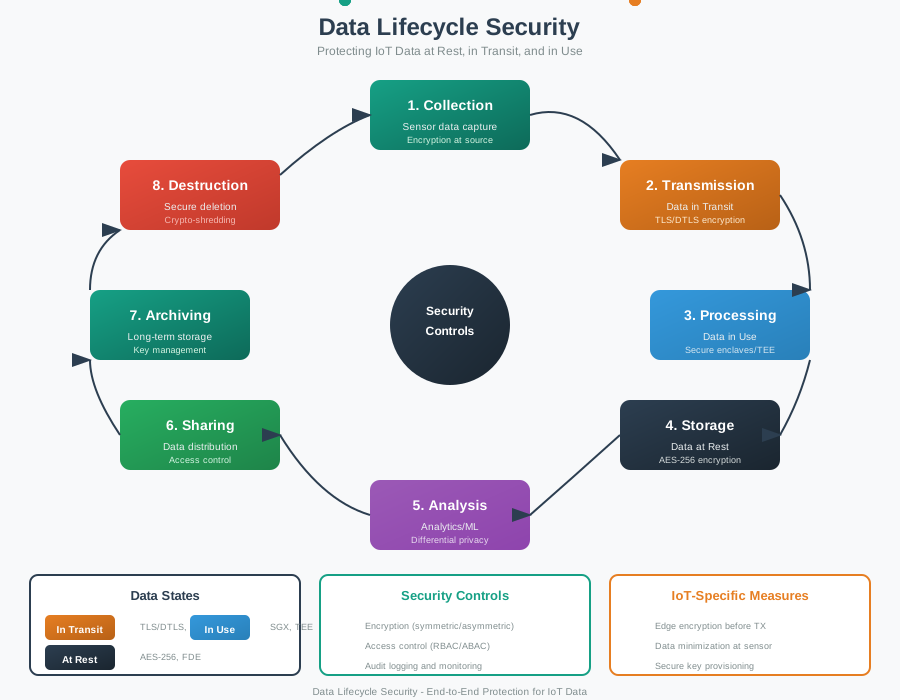
For data protection, the diagram Figure 8.2 uses Data Lifecycle Security as the entry and Key management as a later checkpoint. Finish at Data Lifecycle Security - End-to-End Protection for IoT Data. The full reading conveys: End-to-end IoT data lifecycle security: encrypt at collection, protect data in transit with TLS or DTLS, isolate processing in secure enclaves, encrypt storage at rest, control analysis and sharing, manage keys through archiving, and crypto-shred at destruction.
Check each data class:
- Purpose: why the data is collected and which workflow uses it.
- Sensitivity: operational, safety, financial, personal, location, facility, or diagnostic.
- Transport: encrypted path, endpoint validation, replay protection, and downgrade prevention.
- Storage: encryption, key ownership, access controls, backup behavior, and restore proof.
- Analytics: who can query it, how broad queries are limited, and how derived data is labeled.
- Retention: hot window, archive window, deletion trigger, exception owner, and audit records.
- Sharing: approved exports, downstream processors, support access, and check cadence.
Encryption at rest and in transit should be the baseline. The control record still needs to show key rotation, access checks, restore behavior, and deletion behavior.
8.13 Network And Ingestion Controls
This section: Network And Ingestion Controls — Network security does not replace device identity, but it narrows the paths attackers can use.
Network security does not replace device identity, but it narrows the paths attackers can use.
Use layered controls:
- Approved endpoints: devices and gateways connect only to intended endpoints for their environment.
- Encrypted sessions: reject plaintext management and message paths.
- Gateway segmentation: isolate building, factory, vehicle, or field-site networks from general business networks.
- Ingress validation: reject unknown device identities, malformed payloads, unexpected topics, and stale commands.
- Rate controls: slow repeated auth failures, replay storms, and command bursts.
- Egress control: limit where processed data and support exports can go.
- Admin isolation: separate operator console access from device message paths.
For hybrid deployments, include site-local behavior. Local safety controls should continue when the cloud path is unavailable, and cloud reconnection should not replay unsafe commands.
8.14 Monitoring And Incident Response
This section: Monitoring And Incident Response — Security monitoring should distinguish normal IoT churn from suspicious behavior.
Security monitoring should distinguish normal IoT churn from suspicious behavior. A large fleet always has offline devices, failed updates, bad payloads, and network interruptions. The question is whether the pattern indicates risk.
The loop in Figure 8.3 moves from a signal to a fix; keep the event record.
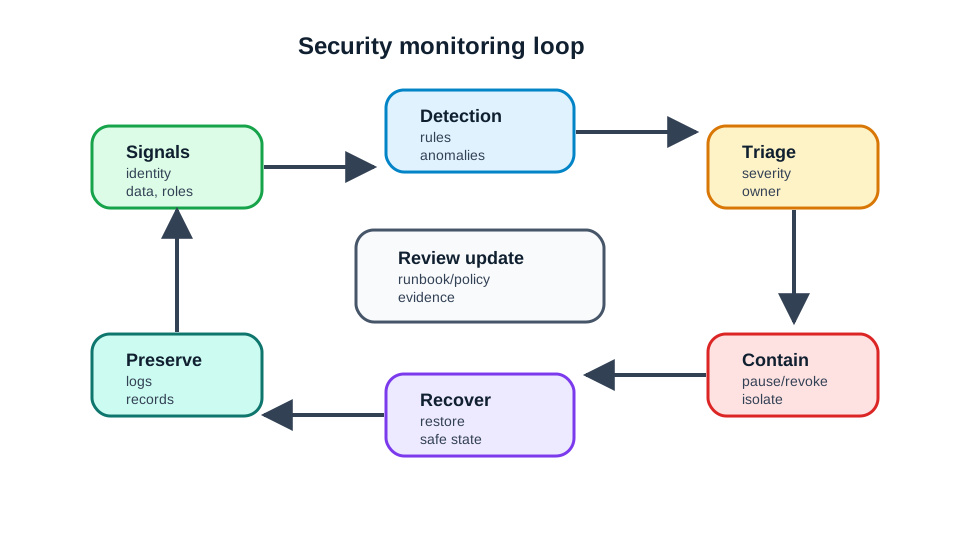
The loop in Figure 8.3 begins with identity, message, data, operator, and infrastructure signals. Detection rules and anomaly checks turn those signals into an event; triage assigns severity and an owner. Containment may pause a command path, revoke one identity, or isolate a route before recovery restores a known-safe state. Logs and records must be preserved so the action can be explained later. Review then updates the runbook or policy with the evidence from the event. This loop helps distinguish ordinary offline churn from a suspicious pattern, and it gives a support team a rehearsed path to contain one affected site without disabling the fleet.
Monitor:
- Identity signals: failed authentication, expired credentials, repeated enrollment attempts, revoked identities still connecting, and identity use from unexpected sites.
- Message signals: topic denial, schema rejection, command replay, duplicate command state, and unusual publish rates.
- Data signals: broad query spikes, unexpected export, retention exception, key-use anomaly, and backup failure.
- Operator signals: privilege changes, break-glass access, failed console logins, bulk downloads, and off-hours changes.
- Infrastructure signals: firewall changes, route changes, service permission changes, lag, queue growth, and log delivery gaps.
Incident response should be rehearsed. At minimum, the team should know how to revoke one identity, revoke a site gateway, pause command delivery, isolate a message route, preserve records, restore a known-good policy, and communicate the operational impact.
8.15 Continue to the Next Part
This section: Continue to the Next Part — Carry this evidence into Cloud Security: Control Records and Failure Modes, which begins with Scenario: Cold-Storage Security Check.
Carry this evidence into Cloud Security: Control Records and Failure Modes, which begins with Scenario: Cold-Storage Security Check.
Find help
3 reviewed answers.
Where should I start in a module?
Open the module page from the sidebar to see its chapters in order. Use the module map to return to a topic you need.
Modules and pathsReviewed
What can I try when a project does not work?
Check the symptom, then work through the diagnostic steps. Keep the error message and the smallest example that reproduces it.
When you are stuckReviewed
How do interactive examples work?
Use the interactive guide to check how examples and simulations work before changing your project.
Interactive examples guideReviewed