6 Unit Testing for IoT Firmware
More
Depth: Practitioner
Progress saves as you read. Mark sections complete as you go; your progress appears in the sidebar.
6.1 Start With the Story: One Rule Before the Board Is Plugged In
This section: Start With the Story: One Rule Before the Board Is Plugged In — Picture a temperature rule that passes every normal value but fails after a device update.
Catch the Bad Update Before It Reaches Hardware
Picture a temperature rule that passes every normal value but fails after a device update.
Name one rule, controlled inputs, expected outputs, replaced hardware touchpoints, and failure message. Test a normal value, each boundary, a bad input, and a past bug.
Keep the test name, inputs, expected and observed results, version, and runtime. This proves one isolated rule, not the physical device; the deeper sections cover test doubles, boundaries, repeatability, coverage, and the testing pyramid.
Before a device is connected to a sensor, radio, or bench harness, there are small rules the firmware already knows how to make: clamp a value, reject a malformed packet, choose a state transition, calculate a timeout. A unit test asks one of those rules a narrow question with controlled inputs and a result that can be checked in seconds.
Start simple: pull one behavior away from the hardware, replace the hardware touchpoints with test doubles, and record the expected and observed result. If that evidence is green, you have not proven the product works. You have proven that one piece of logic is ready to be trusted by the slower tests above it.
6.2 Overview: Checking One Small Behavior in Isolation
This section: Overview: Checking One Small Behavior in Isolation — A unit test checks one small piece of firmware logic on its own, with controlled inputs and a result you can read.
A unit test checks one small piece of firmware logic on its own, with controlled inputs and a result you can read. It is the wide base of the testing pyramid: the cheapest, fastest test to write and run, so you can have thousands of them and run them on every change. The promise is narrow but valuable — a unit test proves that a single decision, transformation, or rule behaves the way it should, before any slower hardware, network, or system test is spent on it.
The word that does the work is isolation. To test firmware logic by itself, you separate it from the things it normally touches: the sensor, the radio, the bus, the clock, the flash. Those are replaced with stand-ins whose behavior the test controls. That is why a well-isolated unit test is usually fast and repeatable. It is also why a unit test cannot, on its own, prove the device works: it proves the logic is right given the inputs the test supplied, not that the real sensor will ever supply them.
If you only need the intuition, this layer is enough: a unit test isolates one firmware behavior, feeds it controlled inputs, and checks a reviewable result. It is fast and repeatable because it does not touch real hardware — and for the same reason, a passing unit test is a claim about logic, not about the physical device.
Think of checking a single gear before assembling a clock. You can confirm the gear has the right number of teeth and turns smoothly in your hand long before the clock exists. That check is fast and certain, but it does not tell you the assembled clock keeps time — that needs the other gears, the spring, and the case. Unit tests are the per-gear checks of firmware. Inspect Figure 6.1 to see exactly where that narrow proof ends.
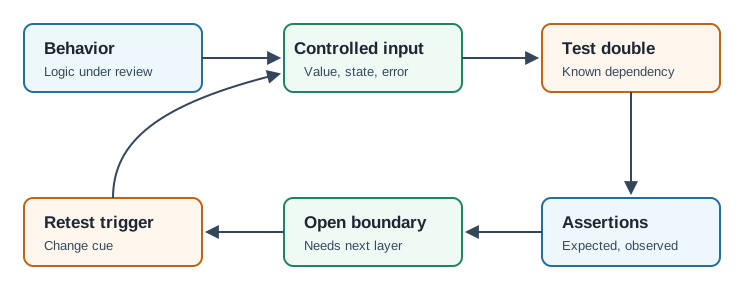
Read Figure 6.1 from the firmware behavior to controlled input, test double, and assertion evidence. Those elements make the run fast and repeatable because the sensor, clock, bus, or radio is represented rather than physically present. Continue to the unresolved boundary and retest trigger: they state what still belongs to integration, hardware, or field testing and when the unit evidence must run again. This boundary keeps a green unit result both valuable and honest.
The One-Minute View
One behavior, isolated
A unit test exercises a single function or decision with the rest of the system stood in for, so a failure points to one place.
Fast and repeatable
Because it avoids real hardware and timing, it runs in milliseconds and gives the same result every run, so it can run on every commit.
Proves logic, not the device
A pass confirms the logic given the test's inputs; the real sensor, bus, and timing still need integration and hardware-aware evidence.
Beginner Examples
- A function that decides whether a temperature reading crosses a warning threshold can be tested with a list of numbers and expected verdicts — no sensor required.
- A parser that turns a byte sequence into a reading can be fed a malformed sequence to confirm it rejects it instead of crashing.
- A retry counter can be tested by calling it repeatedly and checking it stops at the limit, without any real network in the loop.
Overview Knowledge Check
If you can explain isolation and what a pass does and does not claim, you have the core idea. Continue to Practitioner for the seams and test doubles that make firmware testable.
6.3 Practitioner: Seams, Test Doubles, and a Reviewable Record
This section: Practitioner: Seams, Test Doubles, and a Reviewable Record — Firmware is hard to unit-test when logic is welded directly to hardware — reading a register inline, calling a vendor driver, or sleeping on a real timer.
Firmware is hard to unit-test when logic is welded directly to hardware — reading a register inline, calling a vendor driver, or sleeping on a real timer. The enabling move is a seam: a place where you can substitute the real dependency for one the test controls, usually a thin abstraction over the hardware (a hardware abstraction layer), a function pointer, or dependency injection. With a seam in place, the same logic that talks to a real sensor in the field talks to a controlled stand-in on a host machine during the test, and you can run the suite on a laptop in seconds.
The Family of Test Doubles
"Test double" is the umbrella term for anything that replaces a real dependency. The common kinds differ by how much behavior they carry and what they let you check:
- A dummy is a placeholder passed only to satisfy a signature; it is never actually used.
- A stub returns canned values so the code under test gets the input the case needs (for example, "the sensor reads 85").
- A fake is a lightweight working implementation, such as an in-memory store standing in for flash.
- A spy records how it was called so the test can inspect calls afterward.
- A mock is pre-programmed with the calls it expects and fails if they do not happen as specified.
Most firmware unit tests need only stubs and fakes to supply inputs and a couple of spies or mocks to confirm an output call happened. Reach for the simplest double that makes the behavior checkable.
Structure and Properties of a Good Unit Test
A readable test follows arrange–act–assert: set up the inputs and doubles, perform the one action, then assert the result. Useful unit tests also share a set of properties often summarized as fast, isolated, repeatable, self-validating, and timely: they run quickly, do not depend on each other or on outside state, give the same answer every run, report pass or fail without a human reading output, and are written close to the code they cover. A test missing any of these — especially isolation and repeatability — tends to become the flaky test everyone ignores. Inspect Figure 6.2 to connect those properties to review evidence.
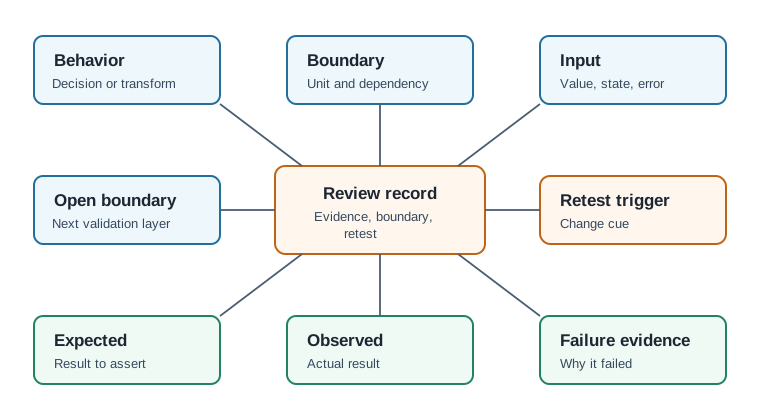
Read Figure 6.2 from the isolated behavior to the open boundary so a green assertion is never mistaken for device validation.
In Figure 6.2, begin with the behavior and boundary so the unit’s scope is explicit. Then compare the chosen input, expected result, and observed result; failure evidence should make any disagreement reproducible. Finish with the open boundary and retest trigger. Those fields admit what mocks, stubs, and isolated code cannot prove and identify the change that invalidates the result. The record connects a fast green test to the wider testing pyramid without overstating it as system validation.
Worked Example: A Sensor Threshold Decision
Consider firmware that takes a sensor reading and decides whether to raise a warning. To unit-test it, the reading comes from a stub instead of a real sensor, so the test can drive any value, including impossible ones. The test then asserts the verdict and, where it matters, that a diagnostic was recorded.
Notice what the suite does not claim: that the physical sensor is calibrated, that the bus delivers the reading in the expected shape, or that the warning reaches a dashboard. Those are integration, hardware-aware, and system questions. The record should say so — a specific handoff such as "confirm the real transport delivers the reading in this shape" is far stronger than "needs integration test."
Practitioner Knowledge Check
If you can place a seam, pick the right double, and write a record that names what stays open, you can stop here. Continue to Under the Hood for why a green unit suite can still mislead.
6.4 Under the Hood: Why a Green Unit Suite Can Still Lie
This section: Under the Hood: Why a Green Unit Suite Can Still Lie — Unit tests fail to protect firmware in three recurring ways: the test double does not match real behavior, the tests are over-coupled to implementation, and coverage is mistaken for quality.
Unit tests fail to protect firmware in three recurring ways: the test double does not match real behavior, the tests are over-coupled to implementation, and coverage is mistaken for quality. Each one produces a green suite that hides a real defect.
A Double Is Only as Good as Its Fidelity
The deepest trap in firmware unit testing is the stand-in that lies. A stub returns a clean reading instantly; the real sensor returns a noisy value after a settling delay, or a status byte the firmware must check first. A fake flash never wears out or fails a write; real flash does. The unit test passes because the logic is correct against the double, yet the device fails because the double never reproduced the messy reality. This is the boundary unit tests cannot cross alone, and it is exactly why a passing unit test routes a specific question to integration and hardware-in-the-loop rather than closing it.
Over-Mocking Makes Brittle, Low-Value Tests
Verifying a result (state) is usually more robust than verifying the exact sequence of internal calls (interaction). When a test asserts every internal call, it breaks on a harmless refactor that did not change behavior, and it can pass even when the behavior is wrong as long as the calls match. Prefer asserting the observable outcome — the returned value, the resulting state, or the one output call that matters — and reserve strict call-order mocks for the few cases where the sequence is the behavior.
Determinism Is Engineered, Not Assumed
"Repeatable" does not happen by accident. The usual sources of flakiness in firmware tests are real time and delays, randomness, uninitialized or shared global state, and order dependence between tests. The fixes are concrete: inject a controllable clock instead of sleeping, seed or stub randomness, reset state in setup, and never let one test rely on another having run first. A test that fails once in fifty runs is not noise to rerun; it is a defect in the test or the code.
Coverage Counts Lines, Not Cases
A coverage percentage tells you which lines executed, not whether the cases that matter were tried. A suite can run most of a parser on well-formed input and report a high number while never feeding it the malformed packet that crashes a field unit. Quality comes from deliberate case design — boundary values, one representative per input class, and negative and error paths — not from chasing the percentage upward with more happy-path inputs.
Common Pitfalls
- Trusting a low-fidelity double. A green test against an unrealistic stub says nothing about the real peripheral.
- Asserting implementation instead of behavior. Over-mocked tests break on refactors and miss real bugs.
- Tolerating flakiness. An intermittent unit-test failure is a defect, not a rerun candidate.
- Reading coverage as quality. Lines executed is not cases tried; design the cases that break things.
- Overstating the result. A unit pass is logic evidence; name the hardware and interface questions it leaves open.
Under-the-Hood Knowledge Check
At this depth, firmware unit testing is a discipline of honest boundaries: isolate one behavior behind a seam, choose the simplest double that makes the result checkable, engineer determinism instead of assuming it, design the cases that matter, and record what the unit left for the layers above. A unit suite earns trust when it shows both what it proved and what it deliberately did not.
6.5 Summary
This section: Summary
- A unit test checks one small firmware behavior in isolation with controlled inputs and a reviewable result; it is the fast, cheap base of the testing pyramid and runs on every change.
- Isolation is what buys speed and determinism: real hardware, network, and time are replaced with test doubles, so a pass is a claim about logic given the test’s inputs, not about the physical device.
- A seam — a hardware abstraction, function pointer, or injected dependency — is what makes firmware logic substitutable and therefore unit-testable on a host.
- Test doubles range from dummy and stub through fake, spy, and mock; reach for the simplest double that makes the behavior checkable, usually a stub for input plus an assertion on the outcome.
- Good unit tests follow arrange–act–assert and stay fast, isolated, repeatable, self-validating, and timely; design boundary, equivalence, and negative cases rather than chasing a coverage number.
- A green suite can still lie through low-fidelity doubles, over-mocking that couples tests to implementation, flakiness from time or shared state, and coverage mistaken for quality.
- A unit-test record names the behavior, boundary, inputs, expected and observed results, the open boundary handed to integration or hardware-in-the-loop, and the change that reopens it.
Unit tests should isolate logic, boundary cases, and error handling behind a seam so firmware changes can be trusted quickly and cheaply before slower layers are spent. They earn that trust only when the double is realistic enough to matter, the assertion checks behavior rather than implementation, and the record states plainly what the unit did not test and what reopens it.
6.6 See Also
This section: See Also
Testing Pyramid & Challenges
See why unit tests form the wide, fast base and what the layers above them add.
Integration Testing for IoT Systems
Test the interface contracts and interactions that unit tests deliberately isolate away.
HIL Testing for IoT
Close the hardware boundary a low-fidelity test double cannot, using real timing and I/O.
Find help
3 reviewed answers.
Where should I start in a module?
Open the module page from the sidebar to see its chapters in order. Use the module map to return to a topic you need.
Modules and pathsReviewed
What can I try when a project does not work?
Check the symptom, then work through the diagnostic steps. Keep the error message and the smallest example that reproduces it.
When you are stuckReviewed
How do interactive examples work?
Use the interactive guide to check how examples and simulations work before changing your project.
Interactive examples guideReviewed