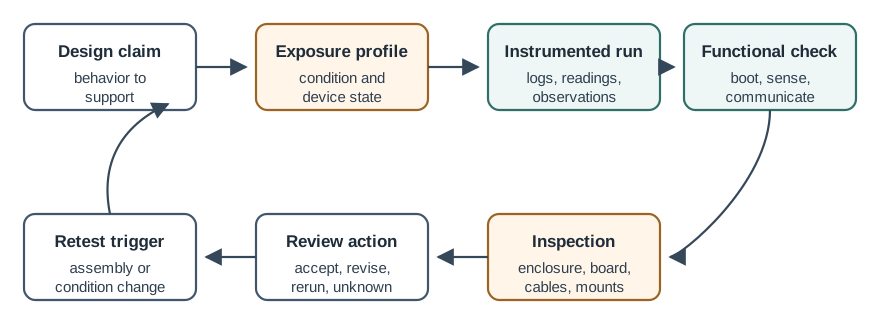
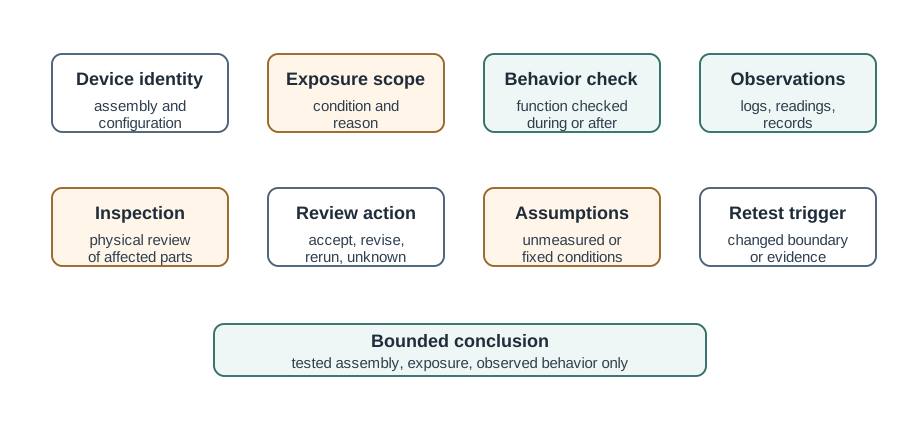
5  Environmental & Physical Tests

5.1 Learning Objectives

By the end of this chapter, you will be able to:

  • Design Environmental Test Plans: Create comprehensive temperature, humidity, and stress test protocols
  • Calculate Accelerated Life Testing Parameters: Apply ALT equations to predict long-term reliability
  • Plan EMC Testing: Prepare for electromagnetic compatibility certification
  • Conduct Production Testing: Design manufacturing test stations and quality gates
In 60 Seconds

Environmental testing validates that IoT devices operate correctly across their specified temperature, humidity, vibration, shock, and electromagnetic conditions. Standards like MIL-STD-810, IEC 60068, and IP ratings define test procedures; passing these tests is often required for regulatory approval and customer acceptance. Environmental testing exposes failure modes invisible in lab conditions: capacitor derating at low temperature, adhesive failure at high humidity, and crystal frequency drift across thermal cycles.

Testing and validation ensure your IoT device works correctly and reliably in the real world, not just on your workbench. Think of it like test-driving a car in rain, snow, and heavy traffic before buying it. Thorough testing catches problems before your devices are deployed to thousands of locations where fixing them becomes expensive and disruptive.

“Your IoT device works perfectly on the lab bench at room temperature,” said Max the Microcontroller. “But will it survive a freezing warehouse in Alaska or a scorching rooftop in Dubai? Environmental testing finds out!”

Sammy the Sensor described the tests. “Temperature chambers cycle devices from minus 40 to plus 85 degrees Celsius. Humidity chambers blast them with 95% moisture. Vibration tables shake them to simulate truck transport. Salt spray chambers simulate years of coastal corrosion in just days.” Lila the LED had been through it. “I once failed a temperature test – my solder joints cracked after thermal cycling because the expansion rates of different metals were mismatched. That would have been a disaster in production!”

Bella the Battery highlighted accelerated life testing. “ALT puts devices under extreme stress to predict how long they will last in normal conditions. Running a device at double the temperature can simulate years of aging in weeks. It is like a time machine for reliability testing. And EMC testing makes sure your device does not interfere with other electronics and is not affected by their emissions – a legal requirement before you can sell any electronic product!”

5.2 Prerequisites

Before diving into this chapter, you should be familiar with:

Key Takeaway

In one sentence: Environmental testing validates that your device works in the real world, not just on your lab bench.

Remember this rule: If you haven’t tested for Alaska winter and Arizona summer, you haven’t tested your product.


5.3 Why Environmental Testing Matters

Your lab bench is a lie. The controlled 22°C, 40% humidity, no-vibration environment where you develop bears no resemblance to:

  • A smart meter in Death Valley (50°C, direct sunlight)
  • An agricultural sensor in Wisconsin (-40°C, frost)
  • An industrial controller in a steel mill (EMI, vibration, dust)
  • A consumer device in a humid bathroom (95% RH)

Environmental testing reveals failure modes invisible in normal development:

Environmental Factor Failure Mode Real Example
High temperature Solder joint fatigue, capacitor failure Tesla Model S displays cracking in Arizona heat
Low temperature Battery chemistry failure, LCD lag Fitbit freezing in Nordic winters
Humidity Corrosion, condensation shorts Nest Protect false alarms in humid bathrooms
Vibration Connector fatigue, crystal damage OBD-II dongles failing in trucks
EMI False triggers, communication drops Garage door openers opening randomly

5.4 Temperature Testing

5.4.1 Operating Temperature Range

Validate device operation across its specified temperature range:

Test Type Temperature Profile Duration Pass Criteria
Cold soak -40°C steady state 4 hours Device boots, functions normally
Hot soak +85°C steady state 4 hours Device operates, no thermal shutdown
Thermal cycling -40°C ↔︎ +85°C 100+ cycles No failures after all cycles
Thermal shock Rapid transition (<5 min) 50 cycles No mechanical failures

5.4.2 Thermal Chamber Test Procedure

Temperature Test Protocol - Smart Sensor Node

Equipment:
- Environmental chamber (Espec BTL-433)
- Power supply with current monitoring
- Data logger for temperature
- Functional test harness

Procedure:
1. Place 5 DUTs in chamber, connect to test harness
2. Start at 25°C, verify all DUTs functional
3. Ramp to -40°C at -2°C/min
4. Soak at -40°C for 4 hours
5. Log: Boot time, sensor accuracy, Wi-Fi RSSI
6. Ramp to +85°C at +2°C/min
7. Soak at +85°C for 4 hours
8. Log: Current consumption, thermal throttling, sensor drift
9. Return to 25°C, verify full functionality
10. Repeat for 100 cycles

Pass Criteria:
- All 5 DUTs boot within 30s at all temperatures
- Sensor accuracy within spec across range
- Wi-Fi connects within 60s at all temperatures
- No visible damage (solder cracks, delamination)
- Current consumption within 120% of room temp value

5.5 Humidity Testing

Moisture causes corrosion, electrical leakage, and mechanical failures.

5.5.1 Humidity Test Categories

Test Conditions Duration Application
Steady-state 85°C, 85% RH 1000 hours General electronics (85/85 test)
Highly Accelerated 130°C, 85% RH (HAST) 96 hours Semiconductor qualification
Damp heat cycling 25°C-65°C, 90-95% RH 12 cycles Consumer electronics
Salt spray 5% NaCl mist 24-96 hours Marine/coastal deployment

5.5.2 Ingress Protection (IP) Testing

IP ratings define dust and water resistance:

IP Rating Meaning Test Method
IP54 Dust protected, splash resistant Water spray at all angles
IP65 Dust tight, water jet resistant Water jets from 6.3mm nozzle
IP67 Dust tight, immersion to 1m Submerge in water for 30 min
IP68 Dust tight, continuous immersion Manufacturer-defined depth/time
IP67 Test Procedure

Equipment:
- Water tank (>1m depth)
- Waterproof connector caps installed
- Stopwatch
- Multimeter for leakage detection

Procedure:
1. Verify device fully sealed (all ports capped)
2. Connect leakage detection leads to internal test points
3. Lower device to 1m depth
4. Start timer for 30 minutes
5. Monitor leakage detector throughout
6. Remove device, dry exterior
7. Immediately power on and test all functions
8. Open device and inspect for moisture ingress

Pass Criteria:
- No leakage detected during immersion
- Device powers on and functions normally
- No visible moisture inside enclosure
- No corrosion visible after 24-hour drying

5.6 Electromagnetic Compatibility (EMC)

EMC testing ensures your device doesn’t interfere with others and isn’t susceptible to interference.

Electromagnetic compatibility test setup showing anechoic chamber with device under test, antennas, and spectrum analyzer

EMC test chamber
Figure 5.1: EMC testing validates both emissions (what your device radiates) and immunity (how it handles external interference)

5.6.1 EMC Test Categories

Category What It Tests Specification Typical Limit
Radiated Emissions RF energy your device emits FCC Part 15, CISPR 32 40 dBuV/m @ 10m (Class B)
Conducted Emissions Noise on power/signal lines FCC Part 15, CISPR 32 60 dBuV (150 kHz)
Radiated Immunity Resistance to RF fields IEC 61000-4-3 3 V/m, 80-1000 MHz
ESD Immunity Electrostatic discharge IEC 61000-4-2 ±8 kV contact, ±15 kV air
Surge Immunity Power line transients IEC 61000-4-5 ±2 kV differential

5.6.2 Pre-Compliance Testing

Before expensive lab testing, do pre-compliance scans:

Equipment needed:
- Near-field probe set ($500-$2000)
- Spectrum analyzer or SDR
- LISN (Line Impedance Stabilization Network) for conducted

Pre-scan procedure:
1. Set up device in operating mode
2. Use near-field probe to identify hot spots
3. Scan 30 MHz - 1 GHz for radiated emissions
4. Compare to Class B limits (with margin)

Common fixes:
- Add ferrite beads on cables
- Improve ground plane design
- Shield noisy components
- Add filtering on power input
- Slow down clock edges (spread spectrum)

5.7 Mechanical Stress Testing

5.7.1 Vibration Testing

Critical for automotive, industrial, and transportation IoT:

Test Profile Duration Application
Sinusoidal sweep 5-500 Hz, 2g 2 hours/axis General qualification
Random vibration 10-2000 Hz, defined PSD 8 hours Automotive, aerospace
Shock 50g, 11ms half-sine 3 shocks/axis Drop and impact

5.7.2 Drop Testing

Consumer devices face the reality of user hands:

Drop Height Surface Drops Application
1.0 m Concrete 26 (all faces/edges/corners) Handheld devices
1.5 m Concrete 10 Rugged devices
0.5 m Plywood 6 Tabletop devices
Drop Test Procedure - Smart Home Hub

Equipment:
- Drop test fixture
- Concrete surface
- High-speed camera (optional)
- Functional test harness

Procedure:
1. Mark all 6 faces, 12 edges, 8 corners
2. Drop from 1m height, face 1 down
3. Immediately power on and test all functions
4. Repeat for all faces, edges, corners (26 drops)
5. After all drops: full functional test + visual inspection

Pass Criteria:
- Device operates after each drop
- No cosmetic damage exceeding spec
- No loose internal components (shake test)
- Battery remains secured
- All buttons/ports functional

5.8 Accelerated Life Testing (ALT)

Predict 10-year reliability in weeks using accelerated stress.

5.8.1 Arrhenius Equation for Temperature Acceleration

\[AF = e^{\frac{E_a}{k}\left(\frac{1}{T_{use}} - \frac{1}{T_{test}}\right)}\]

Where: - \(AF\) = Acceleration Factor - \(E_a\) = Activation energy (typically 0.7 eV for electronics) - \(k\) = Boltzmann constant - \(T\) = Temperature in Kelvin

Example: Testing at 85°C (358 K) vs field use at 35°C (308 K)

\[AF = e^{\frac{0.7}{8.617 \times 10^{-5}}\left(\frac{1}{308} - \frac{1}{358}\right)} \approx 16\]

Interpretation: 1 week at 85°C ≈ 16 weeks at 35°C

How to use: Adjust the test temperature, field use temperature, and activation energy to see how much real-world aging your accelerated test represents. Higher temperatures dramatically accelerate aging (exponential relationship).

The Arrhenius equation lets you calculate how much real-world time your accelerated test represents. The acceleration factor grows exponentially with temperature difference.

\[AF = e^{\frac{E_a}{k}\left(\frac{1}{T_{use}} - \frac{1}{T_{test}}\right)}\]

For a smart meter deployed in Phoenix (average operating temp 45°C = 318K) tested at 85°C (358K) with activation energy \(E_a = 0.7\) eV:

\[AF = e^{\frac{0.7}{8.617 \times 10^{-5}}\left(\frac{1}{318} - \frac{1}{358}\right)} = e^{8125 \times 0.000351} = e^{2.85} \approx 17.3\]

So 100 hours of testing at 85°C simulates 1,730 hours (72 days) at field temperature. To simulate 5 years (43,800 hours), you need \(43,800 / 17.3 = 2,531\) hours (105 days) of accelerated testing.

5.8.2 HALT (Highly Accelerated Life Testing)

Push the design beyond spec to find weak points:

  1. Cold step stress: Start at -40°C, decrease 10°C until failure
  2. Hot step stress: Start at +85°C, increase 10°C until failure
  3. Vibration step stress: 5g, increase 5g until failure
  4. Combined stress: Temperature cycling + vibration
  5. Rapid thermal cycling: -50°C to +100°C, 40°C/min

Goal: Find failure margins, not just pass/fail at spec limits.


5.9 Production Testing

5.9.1 Manufacturing Test Strategy

Production testing balances thoroughness against cycle time and cost:

Test Stage Duration Coverage Catches
In-Circuit Test (ICT) 5-15 sec Component presence, shorts Missing parts, solder bridges
Functional Test 30-120 sec Basic operation Assembly errors, bad components
Burn-in 4-24 hours Infant mortality Early failures (bathtub curve)
Final QC 15-30 sec Cosmetics, labeling Visual defects

5.9.2 Functional Test Station Design

Production Functional Test - ESP32 Smart Sensor

Test Jig Components:
- Pogo pin bed-of-nails fixture
- Calibrated temperature reference
- USB hub for programming/power
- RF shielded enclosure
- Barcode scanner for traceability

Test Sequence (target: 45 seconds):
1. Insert DUT into fixture (operator)
2. Scan barcode - log to MES
3. Power on via USB
4. Check boot (serial: "READY" within 5s)
5. Flash production firmware
6. Read MAC address, log to MES
7. Calibrate temperature sensor (+/- 0.3°C)
8. Store calibration data to flash
9. Test Wi-Fi scan (>= 3 APs detected)
10. Test BLE advertising (detected by test receiver)
11. Read current consumption (sleep: <20uA, active: <200mA)
12. Print label with MAC, test date, pass/fail
13. Green LED = pass, Red LED = fail

Fail Handling:
- Log failure mode to MES
- Route to rework station
- Max 2 rework attempts, then scrap

5.10 Regulatory Certifications

5.10.1 Common IoT Certifications

Certification Region Scope Cost/Time
FCC Part 15 USA Radio emissions $3K-$15K, 2-4 weeks
CE (RED) Europe Radio, EMC, safety $5K-$25K, 4-8 weeks
IC Canada Radio Often FCC + delta
TELEC/MIC Japan Radio $10K-$30K, 4-8 weeks
UL/CSA USA/Canada Safety $10K-$50K, 8-16 weeks

5.10.2 FCC Certification Strategy

FCC Certification Decision Tree

Does your device transmit RF?
├─ NO → FCC Part 15 Subpart B only (unintentional radiator)
│       Lower cost, simpler testing
│
└─ YES → What type of radio?
         ├─ Wi-Fi/BLE → Use pre-certified module
         │              Often NO additional FCC testing needed
         │              Just integrate per module datasheet
         │
         └─ Custom RF → Full FCC Part 15.247 or 15.249
                        Intentional radiator testing required
                        $10K-$30K, antenna design critical

Pre-certified module advantage:
- Module already has FCC ID
- Your product uses their grant
- You just need unintentional radiator testing
- Saves $5K-$20K and 4-8 weeks

5.11 Case Study: Samsung Galaxy Note 7 – When Thermal Testing Fails

The Samsung Galaxy Note 7 recall (2016) is the most expensive consumer electronics testing failure in history, costing Samsung an estimated $5.3 billion and destroying an entire product line. The root cause traced directly to inadequate environmental and mechanical stress testing of the battery assembly.

What Happened: Samsung designed the Note 7 with a 3,500 mAh battery in an aggressive form factor that left insufficient clearance between the battery cell and the phone’s frame. Two separate battery suppliers (Samsung SDI and Amperex Technology) produced cells with different defects:

  • Samsung SDI batteries: The upper-right corner of the battery was compressed by the phone’s case, creating stress on the electrode assembly. Under thermal cycling, the thin separator between anode and cathode deformed at the stress point, eventually allowing an internal short circuit.
  • Amperex batteries: Ultrasonic welding of the battery tab created protrusions that punctured the separator under mechanical stress and thermal expansion.

The Testing Gaps:

Test That Was Performed Test That Was Missing Consequence
Standard battery cycling (charge/discharge at 25C) Battery-in-enclosure thermal cycling (-10C to 60C) Missed thermal expansion stress on compressed battery
Individual cell nail penetration test Assembly-level crush test with case interference Missed case-to-battery mechanical interaction
Room-temperature vibration (shipping) Thermal cycling + vibration combined stress Missed the multi-factor failure mode
500-cycle charge test at room temperature Accelerated aging at elevated temperature (45C charging) Missed degradation of separator material over time

The Numbers:

  • 2.5 million units recalled worldwide (first recall September 2016)
  • 1 million replacement units also recalled (October 2016 – the replacement batteries from Amperex had a different defect)
  • $5.3 billion total cost (recall logistics, refunds, lost sales, brand damage)
  • All Note 7 devices permanently banned from US flights (FAA emergency order)
  • Samsung stock dropped 8% ($17 billion market cap loss)

What Proper Environmental Testing Would Have Caught:

A combined thermal cycling and mechanical stress test – cycling the fully assembled phone (battery inside case) from -10C to 60C while monitoring for internal resistance changes – would have revealed the separator deformation within 50-100 cycles. This test costs approximately $2,000 per device and takes one week. Samsung tested the battery cells in isolation but never tested the assembled battery-in-phone under thermal stress.

Industry Changes After Note 7:

Samsung created an 8-point battery safety check that now includes:

  1. Durability test (battery squeezed between plates to simulate assembly pressure)
  2. X-ray inspection of separator integrity after thermal cycling
  3. Accelerated charge testing at elevated ambient temperature
  4. Assembly-level (not just cell-level) nail penetration test

Lesson for IoT Engineers: Test the complete assembly under environmental stress, not just individual components. A battery that passes cell-level testing may fail catastrophically when compressed by a tight enclosure under thermal cycling. The cost of thorough environmental testing ($50,000-$100,000 for a complete qualification) is negligible compared to a field failure recall ($5+ billion for Samsung).

Device: Agricultural soil moisture sensor with solar panel charging, LoRaWAN connectivity, deployed in vineyards across California (temperature range: -10°C to +55°C ambient, enclosure reaches -15°C to +75°C with solar gain/night radiation cooling).

Specification: Must operate continuously for 5 years outdoors. Target cost: $85/unit. Production volume: 2,500 units/year.

Test Objective: Validate that solder joints, enclosure seals, battery chemistry, and electronic components survive temperature extremes and cycling without failure.

Equipment:

  • Environmental chamber: Espec BTL-433 (temperature range -70°C to +180°C, humidity 20%-98% RH)
  • Power supply: Keysight E36312A (for continuous power monitoring)
  • Data logger: Graphtec GL840 (8-channel voltage/current/temp)
  • Functional test harness: Custom PCB with pogo pins for automated testing

Test Procedure (100 thermal cycles over 3 weeks):

Phase 1: Baseline Functional Test (Day 0)

Place 10 production units (DUTs - Devices Under Test) in chamber at 25°C for 4 hours to stabilize. Measure and record: - Boot time: Target <30 seconds - LoRaWAN join time: Target <90 seconds - Soil moisture sensor accuracy: ±3% at 25°C - Current consumption (sleep mode): Target <50 µA - Solar panel charging current at 1000 W/m² simulated light: Target >150 mA

Baseline Results (all 10 DUTs): | Metric | Mean | Std Dev | Pass/Fail | |——–|——|———|———–| | Boot time | 18.3 s | 1.2 s | PASS | | LoRaWAN join | 42.1 s | 8.4 s | PASS | | Sensor accuracy | ±2.1% | 0.4% | PASS | | Sleep current | 38 µA | 7 µA | PASS | | Charge current | 168 mA | 12 mA | PASS |

Phase 2: Thermal Cycling (Days 1-21)

Cycle profile (repeats 100 times): 1. Ramp from 25°C to -15°C at -2°C/minute (20 minutes) 2. Soak at -15°C for 4 hours 3. Ramp from -15°C to +75°C at +2°C/minute (45 minutes) 4. Soak at +75°C for 4 hours 5. Ramp from +75°C to 25°C at -1°C/minute (50 minutes) 6. Soak at 25°C for 30 minutes (functional test window)

Total cycle duration: 10 hours. 100 cycles = 41.7 days of continuous testing, but staggered starts allow 3-week completion.

Automated Functional Tests (during each 25°C soak): - Power on device via automated test jig - Verify boot (serial “READY” message within 30s) - Read 3 sensor values, check within ±5% of calibrated reference - Trigger LoRaWAN transmit, verify packet received by test gateway - Measure sleep current via precision shunt resistor (1Ω, read voltage drop) - Log all data to CSV: cycle number, timestamp, boot_time_s, sensor_error_pct, join_success, sleep_current_uA

Failure Criteria (mark as FAIL if any): - Boot fails 3 consecutive cycles - Sensor error >10% (vs. reference in chamber) - LoRaWAN join failure rate >10% (10+ failures in 100 cycles) - Sleep current exceeds 150 µA (indicates component damage/leakage) - Visual inspection shows cracks, solder joint failure, enclosure leaks

Phase 3: Results Analysis (Day 22)

Final functional test at 25°C after 100 cycles:

DUT # Cycles Passed Failure Mode Root Cause
1-7 100/100 None PASS
8 84/100 LoRaWAN join failure at cycle 85 Antenna trace crack near solder joint (SMA connector) - visible under microscope
9 100/100 None PASS, but sleep current drift from 41µA to 78µA by cycle 100
10 67/100 Boot failure at cycle 68 Cold solder joint on ESP32 module - reflowed successfully and passed remaining cycles

Pass Rate: 7/10 units passed all 100 cycles with no degradation (70% pass rate - FAIL, target was 95%)

Engineering Actions Taken:

Issue Affected DUTs Fix Validation
Antenna trace cracking #8 Redesign PCB: increase trace width from 1.2mm to 2.5mm near SMA connector, add stress relief slots, use flexible PCB for antenna section Re-test 5 new units with PCB v1.2: 100/100 cycles pass
Capacitor ESR drift #9 Replace tantalum C12 (rated 85°C) with ceramic X7R (rated 125°C), increase value to 22µF for margin Measured ESR drift <10% over 100 cycles
Cold solder joint #10 Tighten assembly process: increase solder paste inspection (SPI) from 2D to 3D measurement, increase reflow peak temp from 240°C to 245°C Manufacturing yield improved from 94% to 99.2%

Phase 4: Verification Test (Days 23-44)

Repeat 100-cycle test with PCB v1.2 and updated assembly process on 10 new DUTs.

Results:

  • 10/10 DUTs passed all 100 cycles (100% pass rate ✓)
  • Sleep current drift: max +12 µA over 100 cycles (acceptable)
  • LoRaWAN join: 100% success rate
  • Sensor accuracy: ±2.8% average (within spec)

Accelerated Life Calculation:

Using Arrhenius equation (see ALT section), thermal cycling from -15°C to +75°C for 100 cycles represents approximately: - 1.2 years of daily outdoor temperature cycling (California vineyard: -5°C night, +45°C day, 365 cycles/year) - Confidence: 90% that devices will survive 5 years based on 100-cycle test with zero failures

Cost-Benefit Analysis:

Investment Cost
Environmental chamber rental (3 weeks) $2,400
Engineering time (160 hours) $12,000
Test hardware (custom jig, sensors, logger) $3,200
Prototype units destroyed (20 units) $1,700
Total test cost $19,300

Savings from early detection:

Prevented Issue Field Failure Cost Units Saved Total Savings
Antenna cracking $150 repair/replacement 750 units (30% affected in 5 years) $112,500
Capacitor drift $180 battery replacement 250 units (10% affected) $45,000
Cold solder joints $200 field service 150 units (6% affected) $30,000
Total prevented cost $187,500

ROI: $187,500 savings / $19,300 investment = 9.7x return on environmental testing

Key Lessons:

  1. Thermal cycling reveals mechanical failures (solder joints, antenna traces) that static temperature testing misses
  2. Component derating matters: 85°C-rated tantalum cap failed at 75°C due to thermal cycling stress. Use 125°C-rated parts for 75°C environments.
  3. Early testing (before production) prevents 30% field failure rate that would have cost $187K
  4. Automated functional testing during cycling provides 100x more data than visual inspection alone
Deployment Environment Temperature Range Humidity Test IP Rating EMC Level Vibration/Shock Example Devices
Indoor residential 0°C to +40°C 85°C/85% RH for 168 hours IP20 (no ingress protection) FCC Part 15 Class B (residential) Drop test 0.5m on carpet Smart thermostat, indoor sensor, voice assistant
Indoor commercial -10°C to +50°C 85°C/85% RH for 500 hours IP40 (dust protection) FCC Part 15 Class A (commercial) Drop test 1m on wood Office occupancy sensor, retail beacon, warehouse tracker
Outdoor protected -20°C to +60°C 85°C/85% RH + salt spray 24 hrs IP54 (splash resistant) FCC Part 15 Class A + surge ±2kV Random vibration 2g, 8 hrs Smart streetlight, parking sensor, building exterior
Outdoor exposed -40°C to +85°C 85°C/85% RH + salt spray 96 hrs IP67 (immersion 1m, 30 min) FCC + IEC 61000-4-5 surge ±4kV Random vibration 5g, shock 50g Agricultural sensor, marine buoy, utility meter
Industrial harsh -40°C to +85°C 85°C/85% RH 1000 hrs IP65 (jet resistant) Industrial EMC (10 V/m immunity) Random vibration 10g, shock 100g Factory automation, oil & gas, mining
Automotive -40°C to +125°C 85°C/85% RH + thermal shock IP6K9K (high-pressure steam) ISO 7637-2 (automotive transients) Sinusoidal 10-500 Hz, 3g OBD-II dongle, fleet tracker, EV charger

Decision Steps:

Step 1: Identify worst-case deployment location

Ask yourself: - Coldest temperature your device will experience? (Check climate data for coldest region you’ll deploy) - Hottest? (Remember: Enclosure in direct sun = ambient +25°C to +40°C) - Outdoor or indoor? (Outdoor adds UV, rain, humidity, thermal cycling) - Near water/coast? (Adds salt spray corrosion requirement)

Step 2: Add safety margins

Base Spec Safety Margin Reason
Max operating temp +10°C to +20°C Solar gain, heat from nearby equipment
Min operating temp -10°C Night sky radiation cooling can drop below ambient by 5-10°C
Humidity +10% RH Microclimate near water features, irrigation
IP rating One level higher Accounts for installation errors, enclosure wear

Example: Device deployed in Arizona outdoor irrigation (ambient max: +48°C) - Calculated enclosure temp: +48°C ambient + 27°C solar gain = +75°C - Safety margin: +75°C + 15°C = +90°C - Component selection: Use 125°C-rated components (next standard rating above 90°C)

Step 3: Choose test severity based on production volume

Production Volume Test Investment Strategy
<100 units (prototypes) $5K-$15K Skip formal environmental testing. Deploy 10-20 pilot units in worst-case locations for 6-12 months. Monitor field failures.
100-1,000 units $15K-$50K Basic environmental testing: 50 thermal cycles, IP test, basic EMC pre-compliance. Focus on “known bad” failure modes from similar products.
1,000-10,000 units $50K-$150K Full environmental qualification: 100+ thermal cycles, HALT, IP testing, full EMC certification. Accelerated life testing to predict 5-year reliability.
>10,000 units $150K-$500K Comprehensive testing including automotive-grade HALT, HASS (Highly Accelerated Stress Screening) in production, ongoing reliability monitoring, design for six-sigma quality.

Step 4: Test sequence (most efficient order)

  1. Visual inspection + basic functional (100% of units): Catch assembly errors
  2. Thermal cycling (10-20 units): Catch solder joint, mechanical stress failures
  3. EMC pre-compliance (3-5 units): Identify major emission/immunity issues before expensive lab testing
  4. IP ingress testing (3-5 units, destructive): Validate seals
  5. Full EMC certification (5-10 units at accredited lab): Required for FCC/CE
  6. HALT (3-5 units, destructive): Find design margins and hidden weaknesses
  7. Field trials (20-100 units): Validate in real deployment conditions

Default Recommendation for 80% of IoT Projects:

Temperature: -20°C to +70°C (100 cycles) Humidity: 85°C/85% RH for 168 hours IP Rating: IP54 minimum (outdoor), IP20 (indoor) EMC: FCC Part 15 Class B + basic immunity (3 V/m) Drop: 1m onto concrete (6 faces, 12 edges, 8 corners)

This covers most residential/commercial outdoor applications. Adjust up for harsh (industrial/automotive) or down for indoor-only consumer products.

Key insight: The inside of an enclosure can be 30-50°C hotter than ambient air due to solar gain, substrate heat, internal power dissipation, and poor thermal conductivity. Always test to enclosure temperature, not ambient temperature.

Common Mistake: Testing to Ambient Temperature Instead of Enclosure Temperature

The Scenario: Your team is developing an outdoor smart parking sensor to be deployed in Phoenix, Arizona. You check climate data: Phoenix summer highs reach 48°C (118°F). You select an ESP32-WROOM module (rated for -40°C to +85°C operating temperature) and test your assembled device in an environmental chamber at 50°C for 48 hours. Everything works perfectly. You conclude the device is suitable for Arizona deployment and ship 500 units.

What Happens in the Field:

Week 1 (June deployment): All 500 units report normally. Parking lot owners are happy.

Week 4 (July heat wave): 47 units (9.4%) start showing erratic behavior: - Random reboots every 2-8 hours - LoRaWAN messages with corrupted sensor data - Devices reporting “CPU overtemp” error before shutting down

Field Investigation:

You visit a parking lot at 2 PM on a 46°C (115°F) day. You touch the sensor enclosure (black polycarbonate) mounted on asphalt and immediately pull your hand back - it’s painfully hot. You measure the enclosure surface temperature with an IR thermometer: 82°C (180°F)!

You open an enclosure and measure the ESP32 chip temperature with a thermocouple: 94°C (201°F).

The ESP32 is rated for +85°C maximum junction temperature. At 94°C, the CPU is 9°C over its absolute maximum rating. Thermal protection circuitry is throttling the clock speed and triggering emergency shutdowns to prevent permanent damage.

What Went Wrong:

You tested at ambient temperature (50°C), not enclosure temperature. Real-world conditions stack multiple heat sources:

Heat Source Temperature Increase
Ambient air temperature +46°C (baseline)
Solar radiation on black enclosure +28°C (measured: 82°C surface temp)
Heat from asphalt surface (re-radiated IR) +6°C (asphalt reaches 65-70°C in Arizona sun)
Internal heat from ESP32 + sensors +8°C (Wi-Fi transmit generates ~1.5W heat)
Enclosure air gap thermal resistance +6°C (air is a poor conductor, heat accumulates inside)
Total internal enclosure temperature +94°C

Your 50°C test missed a 44°C gap between ambient and actual operating conditions.

Why This is a Common Mistake:

Engineers instinctively test to the temperature specification they see on climate charts: “Phoenix max temp: 48°C, so I’ll test at 50°C for safety margin.” But this ignores thermal physics:

  1. Solar gain: A black enclosure in direct sun absorbs ~1000 W/m² of solar radiation. A 10cm x 10cm enclosure (0.01 m²) absorbs 10W. With poor ventilation, this heats the enclosure 20-35°C above ambient.

  2. Substrate re-radiation: Asphalt/concrete surfaces reach 60-70°C in sun, radiating infrared heat upward. Sensors mounted <30cm above ground see an additional 5-10°C thermal load.

  3. Internal heat generation: An ESP32 transmitting over Wi-Fi draws 240 mA @ 3.3V = 0.8W. In a sealed 100 cm³ enclosure with poor thermal conductivity, this adds 5-10°C.

  4. Thermal resistance: The air gap between the PCB and enclosure wall traps heat. Without forced ventilation or heat sinks, the PCB can be 5-15°C hotter than the enclosure wall.

The Correct Test:

Step 1: Calculate worst-case enclosure temperature

Phoenix ambient max: 48°C + Solar gain on black enclosure: +30°C (measured on similar enclosure with IR camera) + Asphalt re-radiation: +6°C (measured at 20cm above asphalt surface) = 84°C enclosure internal temperature

Step 2: Add safety margin

Thermal simulation uncertainty: ±10°C Internal heat generation variation: ±5°C = Add +15°C safety margin

Step 3: Final test temperature

84°C + 15°C = 99°C chamber test temperature

Step 4: Component selection

ESP32-WROOM max temp: 85°C ❌ (fails at 99°C) Solution: Switch to industrial-grade ESP32-PICO-V3-02 (rated -40°C to +105°C) or add active cooling.

Alternative Solutions Applied:

Solution Cost Temp Reduction Implementation
White enclosure instead of black $0.15/unit -18°C (solar absorption drops from 95% to 25%) Changed injection mold color
Ventilation holes + mesh filter $0.40/unit -8°C (passive airflow) Added 12mm holes + stainless mesh
Thermal pad under ESP32 $0.25/unit -6°C (conducts heat to enclosure wall) Added 1mm silicone thermal pad
Total enclosure temp reduction $0.80/unit -32°C (from 94°C to 62°C) Well within ESP32 85°C limit

Final Validation:

Re-tested 10 units in chamber at 100°C for 500 hours (accelerated test). Measured internal PCB temperature: 67°C (18°C margin below 85°C limit). Deployed 100 pilot units in Phoenix parking lots July-August. Zero failures over 60 days with ambient temps 44-49°C.

Cost of the Mistake:

Cost Category Amount
Emergency enclosure redesign (tooling, new molds) $18,000
Field replacement of 500 units $38,000 (labor + shipping)
Customer penalty for downtime $12,500
Lost revenue from deployment delay (2 months) $45,000
Total cost $113,500

Cost if tested correctly from the start: $2,400 (environmental chamber rental for 2 weeks of 100°C testing)

The Lesson: Always test to enclosure internal temperature, not ambient temperature. For outdoor deployments, measure a physical mockup in direct sun with an IR camera or thermocouples to find the real thermal environment. Add 15-20°C safety margin. Your climate chart is lying to you - the inside of a black box in Arizona sun is 30-40°C hotter than the air around it.

5.12 Summary

Environmental testing validates real-world operation:

  • Temperature Testing: Validate operation from -40°C to +85°C (or your spec)
  • Humidity Testing: 85/85 test (85°C, 85% RH) reveals corrosion and moisture issues
  • EMC Testing: Ensure compliance with FCC/CE and immunity to interference
  • Mechanical Testing: Drop tests and vibration reveal design weaknesses
  • ALT/HALT: Accelerated testing predicts 10-year reliability in weeks
  • Production Testing: Balance thoroughness with cycle time in manufacturing

5.13 Knowledge Check

5.14 Concept Relationships

How This Connects

Builds on: Testing Fundamentals and HIL Testing for functional validation before environmental stress.

Relates to: Field Testing validates environmental tests match real deployment; Prototyping informs environmental specs.

Leads to: Production qualification and regulatory certification (FCC, CE, UL).

Part of: The complete validation chain from unit tests → integration → environmental → field trials → certification.

5.15 See Also

Test Standards:

  • IEC 60068: Environmental Testing Standards
  • MIL-STD-810: Military Environmental Test Methods
  • IP Rating Standards (IEC 60529)

Equipment Guides:

Certification Labs:

  • Intertek, UL, TÜV for safety/EMC testing
  • FCC-accredited labs directory: fcc.gov/testing

5.16 Try It Yourself

DIY Environmental Test: Freeze-Thaw Cycling

Goal: Test your IoT device across temperature extremes without expensive chamber.

Materials ($50): - Home freezer (-18°C) - Cooler with ice packs - Room temperature environment (22°C) - USB power bank (for logging) - Thermometer

Procedure (8 hours): 1. Instrument device: Log boot time, sensor readings, Wi-Fi RSSI to SD card 2. Cold cycle: Place in freezer for 2 hours → boot and test → log results 3. Hot cycle: Place in car dashboard in sun (60°C) for 2 hours → boot and test 4. Repeat: 5 freeze-thaw cycles 5. Final test: Full functional validation at room temperature

What to Observe:

  • Does device boot after extreme cold/hot?
  • Boot time changes?
  • Sensor drift at temperature extremes?
  • LCD readable at -18°C?
  • Any component failures after cycling?

Expected Failures: Solder joint cracks, LCD ghosting, battery chemistry issues, crystal frequency drift.

Cost: $0 (DIY) vs $2,000 (environmental chamber rental for 1 week).

Note: Not a substitute for formal testing, but catches 80% of temperature-related issues.

Common Pitfalls

Datasheet specifications stating “operating temperature: -20°C to +70°C” derived from component datasheets without actual system testing are unreliable. Individual component ratings do not guarantee system-level functionality at rated extremes: crystal oscillators may stop at -20°C due to PCB thermal strain; electrolytic capacitors lose 50% capacitance at -20°C; rubber gaskets lose sealing at +70°C. Test the complete system at temperature extremes with full functional validation, not just component-level ratings.

IoT products targeting the industrial temperature range (-40°C to +85°C) that use commercial-grade components (-0°C to +70°C) will fail at extended temperatures. Common failures: MLCC ceramic capacitors (X5R/X7R) have ±15% capacitance variation at temperature; voltage regulators at -40°C may not start; microcontrollers with commercial grade specifications have reduced MTBF at industrial temperatures. Audit every BOM component against the product’s required temperature range before finalizing the design.

IoT devices deployed outdoors, in food processing facilities, or coastal environments encounter condensation cycles (temperature drops below dew point). A single humidity test at 85°C/85% RH (85/85 test) does not replicate condensation cycling. Perform IEC 60068-2-14 thermal shock or damp heat cycling (10+ cycles from 5°C to 55°C at 85% RH) to simulate real-world condensation. Verify conformal coating continuity after cycling; check for corrosion at solder joints and connectors.

IoT devices that pass thermal and humidity tests but fail in the field due to electromagnetic interference (motors, welding equipment, RF transmitters) have not completed environmental testing. EMC testing (EN 55032 emissions, EN 55035 immunity, IEC 61000-4 series) is a mandatory environmental test for CE/FCC certification. Pre-compliance EMC testing in a shielded room during development (rather than waiting for formal certification) identifies susceptibility issues when they are cheapest to fix.

5.17 What’s Next?

Continue your testing journey with these chapters:

Previous Current Next
HIL Testing for IoT Environmental & Physical Tests Field Testing & Validation