16 Retail IoT: Store Value and Smart Shelves
More
Depth: Practitioner
Progress saves as you read. Mark sections complete as you go; your progress appears in the sidebar.
- Podcast audio coming soon
- Character narration audio coming soon
16.1 Make the Shelf Warning Useful
Retail IoT connects shelves, carts, beacons, cameras, and inventory systems to store decisions. Its value depends on timing and trust: sense demand or movement, decide what improves the visit or operation, and avoid collecting data that customers or staff cannot justify. An empty-shelf alert matters only when a worker can find the item and correct the stock record.
A shelf looks empty during the evening rush. A worker sees a warning, checks the stock room, and either refills the shelf or corrects a bad count. The owner needs that whole decision to work. A device noticing movement is only the first step; a colourful display does not prove that the right item was found.
Keep the item, place, event time, confidence, and source together. Let the worker mark a blocked view, misplaced item, late update, or known exception. Show who owns the next check instead of silently changing the count. The problem is to turn an uncertain observation into a bounded action that staff can explain and undo.
This is part 1 of 3. We will compare the five pillars of retail IoT, connect shelf sensing to worker tasks, and examine privacy, recovery, and value evidence. That foundation supports later choices about smart-shelf sensors, beacon personalization, radio-frequency identification (RFID) and computer-vision checkout, and return on investment (ROI). Now consider the approaches: start with the store action, connect its evidence to existing systems, and test the boundaries before widening the pilot.
Estimated study time is 20 minutes; allow about 30 minutes with the linked review material. The chapter is intermediate, but the starting idea needs no electronics background: a shelf sensor measures weight and sends a Wi-Fi message that the shelf may need restocking.
KEY CONCEPTS
- RFID
Radio Frequency Identification reads unique tag IDs without line of sight for rapid bulk counts and item tracking.
- Electronic shelf label
An ESL is a centrally updated wireless e-ink price display that removes manual label replacement labour.
- Shrinkage
Inventory loss from theft, damage, or administrative error must be measured against a local baseline.
- Cold chain monitoring
Continuous temperature and humidity logging from producer to consumer provides evidence of whether perishable goods stayed within safe limits.
- Demand sensing
Real-time point-of-sale (POS) and shelf data update forecasts daily instead of relying on historical weekly patterns.
- Last-mile visibility
Real-time tracking from distribution hub to doorstep enables proactive delay notifications.
- Planogram compliance
Products should occupy their planned shelf positions; sensing flags misplaced or out-of-stock items.
16.2 Part Objectives
- Trace a shelf event from sensing to a bounded worker action.
- Test retail value claims against timing, privacy, and recovery evidence.
16.3 Turn Sensing Into a Store Action
A smart store uses sensors, cameras, and wireless tags to monitor conditions and send alerts instead of relying entirely on employees walking the aisles. The devices are familiar. A self-checkout kiosk combines a scanner, a bagging-area scale, a processor, and a network connection to the payment system. Digital price tags receive wireless changes so thousands of prices can change in minutes. A nearby Bluetooth Low Energy (BLE) beacon can be detected by a shopper’s phone so an opted-in store app can send an offer; range, unit price, and conversion impact depend on the device and campaign.
Weight sensors can flag empty shelves sooner than periodic manual checks. Cameras can count people, while some checkout systems use cameras and sensors to track selected items and charge an account automatically. Refrigeration probes warn of temperature trouble before stock is lost. None of these observations alone proves that the intended action succeeded. A bagging-area weight check, for example, is evidence to assess alongside the scanned item, rather than a guarantee that the right product was placed there.
A connected store is useful when sensing changes a retail operation: replenish a shelf, correct a price, protect a cold case, shorten a queue, reduce shrinkage, or improve an opted-in customer experience. The sensor reading is only the start. The value appears when the event reaches the store associate, POS system, inventory record, loss-prevention workflow, or merchandising decision that can act on it. A shelf weight change, RFID read, freezer temperature drift, or queue-length estimate should therefore be treated as the beginning of a decision loop, not as a standalone dashboard event.
Retail differs from many industrial domains because the physical space is shared by products, employees, visitors, and paying customers. Some signals are low-risk product telemetry, such as an electronic shelf label update or a temperature sensor in a refrigerated case. Others can become sensitive quickly, such as camera analytics, Bluetooth proximity, Wi-Fi probe data, loyalty-app behavior, or checkout exceptions tied to a person. The strongest designs separate product, shelf, and equipment telemetry from personal data unless there is a clear consent path, a clear customer benefit, and a retention rule that store staff can explain.
The practical test is whether the system improves a store action that already matters. A smart shelf should reduce out-of-stock duration, not merely prove that a sensor can measure weight. RFID should improve receiving, cycle counting, or item-level availability, not simply add tag reads. Beacons should help shoppers who opted in, not annoy every passer-by. Checkout automation should reduce friction while keeping assistance, age checks, returns, and payment exceptions understandable. Retail IoT succeeds when the connected store becomes easier to operate and easier to trust.
- Inventory question: which SKU, GTIN, EPC, shelf location, stock state, and replenishment owner does the signal affect?
- Customer question: is the signal anonymous traffic, opted-in app proximity, loyalty-linked purchase behavior, or identifiable video?
- Operations question: does the event become a task, price update, checkout exception, loss-prevention alert, refrigeration response, or supply-chain record?
A good retail IoT proposal states the action, owner, baseline, privacy boundary, and failure mode. If a sensor is offline, the shelf should still have a manual replenishment path. If a beacon campaign misfires, customers should be able to mute it. If an RFID portal misses reads near metal packaging or liquid products, the inventory process needs an exception queue. This keeps the business case tied to store execution instead of to novelty.
16.4 Connect the Shelf to Existing Systems
The action needs a path into the systems staff already use. Retail prototypes usually cross shelf hardware, store networks, POS, inventory, and analytics platforms. Passive ultra-high frequency (UHF) RFID readers from Zebra, Impinj, SICK, or Chainway may read EPC tags from Avery Dennison or other label suppliers. Electronic shelf labels from VusionGroup, Pricer, or SoluM may update price and promotion data. BLE beacons from Kontakt.io or Estimote may support app-based proximity. Cameras, weight sensors, people counters, thermal sensors, and refrigeration probes may feed an edge gateway before data is sent to a cloud, store server, or retail operations platform.
Start with one workflow and instrument it end to end. For smart shelves, pick a small set of high-velocity SKUs, record baseline out-of-stock duration, define the replenishment threshold, and measure whether tasks are accepted and completed faster. For RFID, start with receiving or cycle counting before promising item-level real-time inventory across the entire store. For electronic shelf labels, measure price accuracy, promotion update time, battery replacement, and what happens when the store loses WAN connectivity. For checkout automation, include assistance calls, voids, age-restricted items, payment retries, and customer confusion as first-class metrics.
- For smart shelves: record SKU, GTIN, shelf id, facing count, weight or optical confidence, planogram position, replenishment threshold, task owner, and false-empty reason.
- For RFID inventory: record EPC, read zone, antenna id, received signal strength indicator (RSSI), timestamp, item state, receiving event, sales-floor move, POS reconciliation, and exception path for unreadable metal or liquid products.
- For checkout automation: record basket id, scan source, weight check, vision confidence, age-restricted item handling, payment state, intervention reason, and customer-assistance path.
- For customer analytics: prefer aggregate people counts, dwell zones, queue length, and heat maps; use loyalty, app, Wi-Fi, BLE, or video identity only with consent, data minimization, retention limits, and visible disclosure.
The integration plan should say which system is authoritative for each fact. POS is usually authoritative for sales transactions. ERP or WMS may be authoritative for replenishment and purchase orders. A planogram tool may be authoritative for intended shelf placement. A task-management app may be authoritative for associate work. IoT telemetry is most useful when it updates or challenges those systems with evidence, such as “shelf slot A3 is empty despite ten units on hand,” instead of creating a separate truth that store teams have to reconcile manually.
Before scaling, run a failure review. Walk the store and ask what happens with dead batteries, blocked RFID antennas, misplaced tags, camera occlusion, freezer-door defrost cycles, beacon spam, duplicate events, offline gateways, incorrect prices, and staff turnover. The best pilot report includes ordinary operational messiness, because those details decide whether the system survives beyond a controlled demo.
The original equipment examples offer three useful inspection points. The Library self checkout kiosk (Jeffrey Beall from Denver, Colorado, USA; CC BY-SA 2.0) illustrates a kiosk’s physical interfaces and scale; a library example does not establish retail weight-sensor or vision performance. The RFID Bluetooth Reader for NeoTAG - KTS (Sraleppal; CC BY-SA 4.0) illustrates reader packaging and interfaces. Check mounting and surrounding conditions before treating either example as evidence of deployment fit.
In Jars of Chili, with electronic shelf tags (Franklin Heijnen; CC BY-SA 2.0), small e-paper/LCD price screens repeat along the shelf rail beside the products. A worker can inspect the shown price where the buying decision happens. Placement matters, but the image does not establish that the displayed price matches the store record. The price-correction workflow must test that link; a catalogue label alone cannot establish it.


16.5 Preserve Meaning Across Data Boundaries
Retail IoT joins operational data with commercial systems, so the data model needs strong boundaries. Product events may use GS1 identifiers such as GTIN, SGTIN, EPCIS events, Digital Link URLs, lot numbers, and expiration dates. Store events may use POS transaction ids, planogram versions, shelf zones, associate tasks, queue metrics, and refrigeration HACCP or food-safety records. Customer-linked data must stay separate unless policy, consent, and security controls explicitly allow the join. Treat each event as a claim with identity, location, timestamp, confidence, and downstream authority.
The store architecture traces a typical architecture through devices on store VLANs or segmented Wi-Fi, an edge gateway that normalizes events, a local buffer for outages, and an integration path into message brokers, APIs, POS middleware, inventory systems, and analytics stores. MQTT, HTTPS APIs, Kafka-style streams, EPCIS event repositories, and warehouse tables can all appear in the same program. The design task is not choosing a fashionable pipe; it is keeping event meaning stable as data moves from a sensor to a store action. A shelf event might become an associate task, while the same SKU and shelf zone also feed a forecasting model.
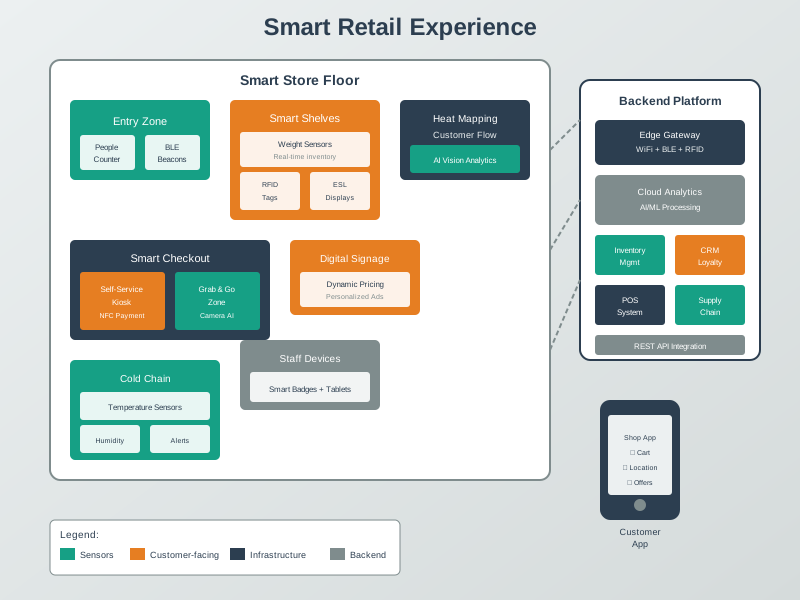
Follow events from beacons, shelves, checkout, and cold probes into the store network. The edge gateway gives events a common form. It also holds them during an outage. Brokers or APIs then pass them to sales, stock, data, or EPCIS tools. Those tools need a clear item ID, place, source, and update time before they create a task or forecast. Keep payment data out of paths that do not need it. Give customer events a purpose and deletion rule. Define offline action for cooling, labels, queues, and checkout faults.
- Product boundary: define item identity, location confidence, inventory truth source, update frequency, exception queue, and reconciliation with POS, ERP, WMS, or order-management systems.
- Payment boundary: keep PCI DSS cardholder-data scope away from shelf sensors and analytics events; store only payment state or transaction references when IoT systems need checkout context.
- Privacy boundary: define GDPR/CCPA purpose, consent state, signage, retention, deletion, aggregation, face blurring, MAC-address handling, and who can export customer-linked data.
- Store-resilience boundary: define offline behavior for ESL updates, RFID cycle counts, refrigeration alerts, queue dashboards, and checkout exceptions when WAN, Wi-Fi, or cloud services are unavailable.
Event quality matters as much as sensor quality. RFID read rates depend on antenna placement, tag orientation, item material, reader power, and anti-collision behavior. Weight sensors drift and need tare values, restock windows, and calibration checks. Computer vision needs lighting, occlusion handling, model confidence, and rules for human review. Refrigeration alerts need hysteresis and defrost-cycle awareness so staff are not flooded with false alarms. Each data product should record missing events, duplicate events, latency, false positives, overrides, and whether the downstream action actually happened.
The technical design is stronger when a retail event can be traced from sensor or tag through store gateway, message broker, inventory/POS system, associate task, customer impact, and measured business outcome without exposing more personal data than the use case needs. That traceability also gives security and operations teams something concrete to audit: which device sent the event, which service transformed it, which system consumed it, which person or process acted on it, and when the data should expire.
Phoebe’s field question is why a beacon keeps broad coverage while an RFID portal concentrates its read zone. Radio Remi’s mathematical comparison uses -55 dBm at 1 m and -65 dBm at 3 m, implying a path-loss exponent of 2.10. Adding 6 dBi of directional gain doubles ideal range but concentrates the same power into about one quarter of the former solid angle. A 3 mm optical aperture at 150 mm has a 33.6 micrometre diffraction limit, nearly ten times finer than a 0.33 mm UPC module. Gain and lenses redistribute energy; neither creates it. These calculations describe ideal tradeoffs, so the store still needs read-zone evidence with its actual products and placements.
16.6 Compare the Five Paths to Store Value
The same decision loop supports five interconnected pillars: inventory intelligence, customer experience, checkout automation, loss prevention, and energy management. Each pairs technology with an operating change before claiming a return. For the evening-rush shelf warning, begin with inventory intelligence, then ask whether another pillar addresses a separate, demonstrated problem.
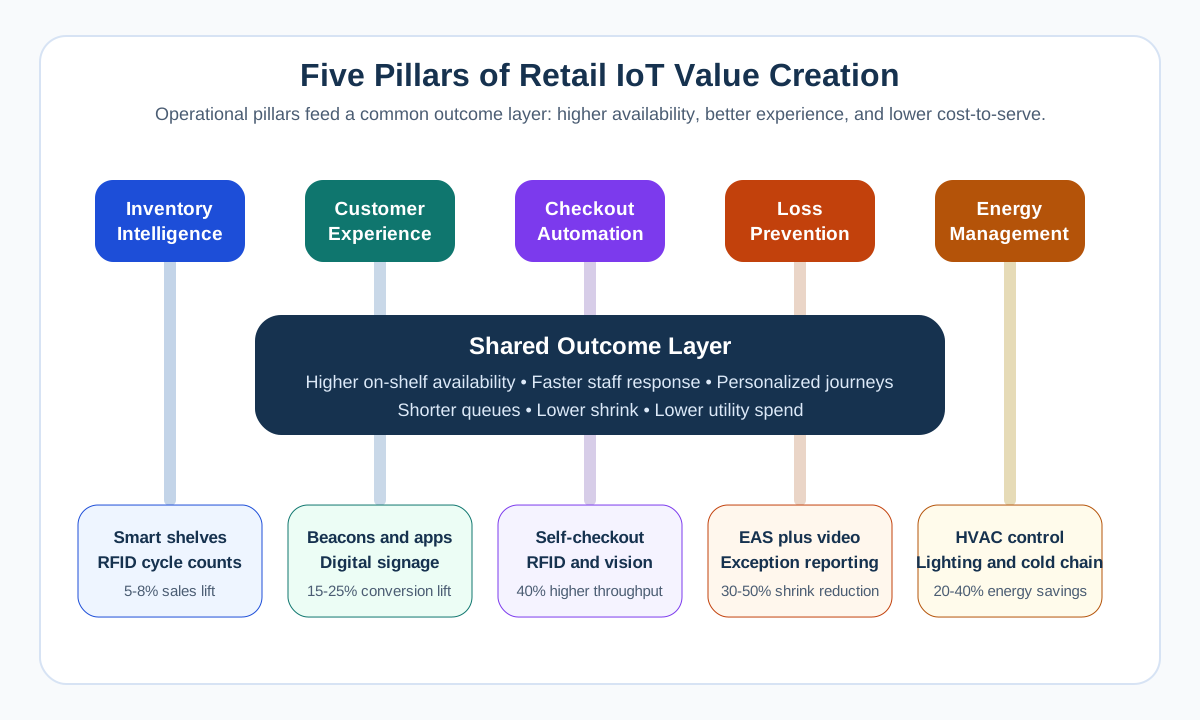
Inventory intelligence combines smart shelves, RFID, and weight sensing to reduce stockouts. In a GS1 Norway apparel case, EPC/RFID stocktaking raised accuracy from about 70% to at least 95%; passive tags enable bulk reads without line of sight. That is evidence from a particular deployment, not a guarantee for every shelf. GS1 case McKinsey reports 1.0–3.5% higher full-price sell-through in researched RFID deployments, with returns depending on deployment costs. RFID research
Customer experience uses beacons, digital signage, and mobile apps to support personalized offers. Conversion and ROI depend on campaign design and uptake. An offer is useful only if it helps the opted-in shopper; consent alone does not establish relevance. Checkout automation uses self-checkout, RFID scanning, and computer vision to shorten queues when lane capacity and shopper use support them. Measure throughput against a local baseline and include assistance, restricted items, returns, and payment exceptions.
Loss prevention brings video analytics, electronic article surveillance (EAS), RFID, and POS evidence together to investigate shrinkage. In a 10-retailer RFID study, one company reported 15% lower shrinkage after deployment; results depend on the store and intervention. RFID study
Energy management combines smart heating, ventilation, and air conditioning (HVAC), LED lighting, and occupancy sensing to lower energy cost while protecting comfort. A DOE modeling study estimated about 41% energy-saving potential from properly tuned controls for stand-alone retail stores; ROI depends on the site. DOE controls study Return depends on the site. Measure the operating effect before claiming sales lift, cost reduction, or return.
16.7 Test the Whole Decision Before Scaling
Summary
Retail IoT creates value when an observation becomes a useful store action. The five pillars organize possible benefits, while the shelf scenario makes the evidence concrete: item identity, place, time, confidence, task owner, and a record of the result. Existing sales, stock, placement, and task systems need clear authority so telemetry can challenge a record without creating an unexplained competing truth.
Product, payment, personal, and resilience data need separate controls. A credible pilot includes false alarms, offline work, assistance, returns, deletion, and full operating costs. Its conclusions stay within the site and conditions actually tested.
Start with the store action and its owner, then preserve enough evidence to explain, correct, and measure the result.
Carry this evidence into Retail IoT: Engagement and Inventory, which begins with Checkpoint: Retail Value Pillars.