11 Attack Scenarios: Defensive Method
More
Depth: Practitioner
Progress saves as you read. Mark sections complete as you go; your progress appears in the sidebar.
11.1 Overview
This section: Overview — This first route defines a defensive scenario review and builds the record structure used to test expected controls.
This first route defines a defensive scenario review and builds the record structure used to test expected controls.
This is part 1 of 2. Continue with Attack Scenarios: Records and Retest for the second focused route.
11.2 Start Simple: Test One Expected Block
This section: Start Simple: Test One Expected Block — Picture a warehouse temperature sensor that may send readings for its own zone.
Write the Refusal Before the Threat Story
Picture a warehouse temperature sensor that may send readings for its own zone. It must not issue a door command or send a reading under another zone’s name. The defensive review begins with those expected refusals, not with a dramatic attacker story.
An actuator is a device that changes the physical world. Telemetry is the device reading or status an attacker may try to change or intercept. A gateway is the device that carries local traffic into another service path. Name the protected record or action, the identity being tested, the boundary, the allowed request, the refused neighbour, and the owner of the rule.
Try the valid reading, a wrong zone, a changed message shape, a repeated old message, a door command, and a rule outage. Keep allowed and denied records. Check that refusal stays closed, the reason is useful, and urgent local safety does not depend on a distant response.
This scenario does not prove every defence or describe misuse steps. The deeper sections add assets, conditions, controls, residual risk, evidence limits, and retest triggers to the bounded review packet.
Start with one expected refusal. A sensor identity should publish telemetry, but it should not change an actuator command route or publish outside its assigned topic. A defensive scenario asks whether that refusal is actually shown by policy, logs, and denied-case evidence.
That is why this chapter treats scenarios as review packets. The scenario does not need a misuse recipe; it needs a condition, a boundary, a control that should respond, evidence for both allowed and denied cases, residual risk, and a retest trigger.
11.3 A Scenario Is a Defensive Review Packet
This section: A Scenario Is a Defensive Review Packet
An attack scenario is useful when it tests whether a threat model is specific enough to act on. It is not a misuse recipe. A good scenario record names the protected asset, the condition that makes harm plausible, the trust boundary involved, the control that should reduce the risk, the evidence that supports the control, and the trigger that requires retest.
The important shift is from narrative to evidence. A dramatic story about an attacker is not a review. A scenario record asks a bounded question: what condition is being reviewed, what evidence would confirm or weaken the control claim, what mitigation fits the condition, and what residual risk remains.
For example, a warehouse gateway might review the condition "an enrolled sensor identity can publish readings outside its assigned zone." The packet names telemetry and the dispatch record as assets, the device-to-gateway publish boundary, the expected topic or route authorization, the schema validation rule, accepted-message evidence, denied out-of-zone evidence, and residual risk if only the gateway enforces the rule. Retest is triggered by a topic change, schema change, gateway rule change, or dispatch-decision change.
If you only need the intuition, this layer is enough: a scenario is a compact defensive packet. It states a plausible condition, marks the boundary, names the expected control, lists the evidence for the allowed and denied cases, and records residual risk and a retest trigger.
Think of a fire drill. The point is not to set a real fire; it is to test whether the alarm sounds, the exits open, and people respond, and to record what failed. A scenario does the same for security controls: it checks whether the expected control and its evidence exist, without performing the attack.
The reader is about to apply A Scenario Is a Defensive Review Packet; first the relevant roles must be distinguishable. Figure 11.1 distinguishes them while showing how “The scenario loop: asset, condition, boundary, expected control, evidence, mitigation decision, residual risk, and retest trigger” is explicit in the diagram.
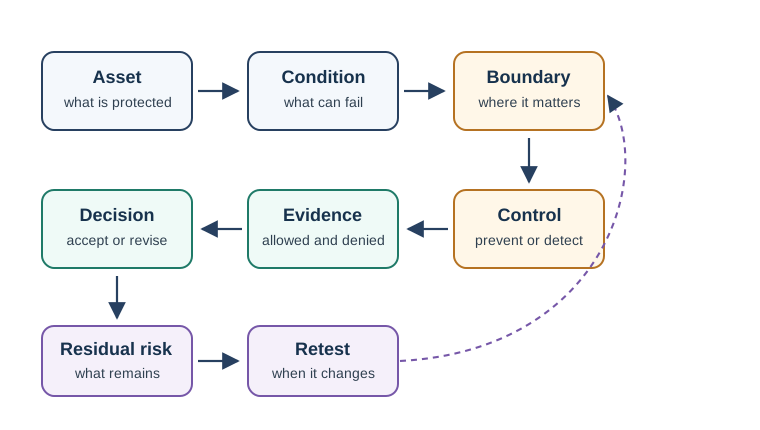
At Figure 11.1, Condition is not interchangeable with allowed and denied, and when it changes shows why the distinction matters. That specific contrast demonstrates “The scenario loop: asset, condition, boundary, expected control, evidence, mitigation decision, residual risk, and retest trigger” is explicit in the diagram. Carry it into A Scenario Is a Defensive Review Packet as the criterion for the next decision.
The One-Minute View
A condition, not a recipe
State the reviewed condition defensively. "An identity can publish outside its assigned topic" is enough to drive review.
Evidence over narrative
The value is the evidence requested at the boundary, not the drama of the story around it.
Denied case and residual risk
A scenario closes only with denied-case evidence, recorded residual risk, and a retest trigger.
Beginner Examples
Taken together, these checks make the section reviewable. That order prevents a control name from being treated as proof and connects the visual to the chapter's evidence-led review sequence.
Overview Knowledge Check
If you can describe a scenario as a defensive evidence packet, you can stop here. Continue to Practitioner to build one and match a mitigation.
11.4 Build a Scenario Record and Match Mitigations
This section: Build a Scenario Record and Match Mitigations
Start with the asset and a reviewed condition stated in defensive terms. Then mark the boundary, name the control expected there, and collect evidence for both the allowed case and the denied case before deciding on a mitigation.
Walkthrough: From Asset to Retest Trigger
Scenario Families and Their Evidence
Scenarios group by the security question they test. The families below are prompts for evidence-bound review, not a list of every possible threat. Select a mitigation because it fits the condition, not because it is generally good.
Availability scenarios include denial-of-service conditions where a service cannot answer legitimate devices or users. In a simple DoS review, one source or path overwhelms capacity or sends malformed traffic that the receiver cannot handle safely. In a DDoS review, many compromised devices send the pressure at once; when those devices are centrally controlled they form a botnet. The Mirai lesson is the defensive pattern: default or weak credentials plus reachable services can turn ordinary IoT devices into attack traffic, so the evidence should cover unique credentials, constrained remote access, rate behavior, monitoring, isolation, and recovery.
Scenario Mechanisms: Entry, Cascade, Concealment, and Power-State Error
Threat names become actionable when the review distinguishes their mechanisms. A protocol vulnerability is normally an entry condition, not the final objective: malformed or unexpected protocol state reaches vulnerable code, and a successful exploit may create a foothold for credential theft, persistence, data access, or a later availability attack. Evidence therefore has two layers—proof that malformed state is rejected or patched, and proof that post-compromise behavior such as new processes, changed firmware, or unusual outbound traffic is detected.
A privileged command path creates a different cascade. The first device accepts a console or management action beyond the caller's authority; its stored credentials, neighbor reachability, or management role can then put peer devices at risk. The denied-case test is not only “does this command fail for an ordinary user?” but also “can one compromised node invoke the same action on another?” Least privilege, per-device credentials, administrative segmentation, and peer-to-peer denial logs break that chain at different boundaries.
A stepping-stone host changes attribution. The intermediary is already compromised and relays later traffic, so the visible source is not necessarily the origin. Review synchronized logs at ingress, egress, identity, and target boundaries; preserve request identifiers or other correlation evidence; and constrain outbound traffic from systems that do not need arbitrary Internet access. The goal is to recover the path and contain the relay, not to trust the nearest source address.
Botnet DDoS separates victim and compromised fleet. Vulnerable IoT devices are recruited first, often automatically, and only later receive a coordinated instruction that floods a different service. This creates two protected assets: the device estate must not become attack infrastructure, and the external or internal target must remain available. Unique credentials, closed management exposure, patching, egress policy, fleet-behavior analytics, rate limits, and target-side capacity controls address different halves of that scenario.
Battery telemetry shows how a small data-integrity failure becomes a control failure. A false-high state suppresses conservation while the real charge falls, so the node can deplete unexpectedly and shut down without completing its final report. A false-low state triggers conservation too early, reducing sample rate, radio duty cycle, actuator availability, or user-facing performance despite adequate energy. Review physical supply access and the software measurement path separately, compare reported charge with voltage/current/coulomb evidence, bound impossible state jumps, and make the application record which degraded mode each threshold activates.
IP Control-Plane and Session Cases
An IoT path often crosses a low-power network, a translating gateway, an enterprise network, and a cloud service. Each boundary changes the available security evidence. The low-power link may have small frames and constrained key management; the gateway terminates one protocol and originates another; enterprise routing decides where packets can travel; and the application layer carries the identity or session that authorizes the final action.
Figure 11.2 sketches that path and pins each of this section’s cases to the boundary it exploits, so the table that follows can be read as a walk from left to right along the same pipeline.

Anchoring matters more than naming in Figure 11.2. SOURCE-ADDRESS SPOOFING hangs off the enterprise network because that is where ingress filtering can catch an impossible prefix, and SESSION-TOKEN REPLAY attaches to the cloud application because no link-layer control can revoke a stolen bearer token. The figure’s footer — review gateway outward — is the same order the closing paragraph of this section prescribes.
| Case | Protocol mechanics | Evidence and control |
|---|---|---|
| ICMP reconnaissance or flooding | ICMP carries a Type, Code, checksum, and type-specific data. Echo messages, Destination Unreachable, and Time Exceeded responses can reveal reachable hosts and path structure; excessive diagnostic traffic can also consume bandwidth or state. | Permit the ICMP functions needed for path MTU discovery and diagnostics, rate-limit where justified, alert on sweeps or abnormal volumes, and avoid the false fix of blocking every ICMP message. |
| ICMP redirect manipulation | An IPv4 Redirect asks a host to use a different next hop. Acceptance can change a host route and create an on-path position; many modern systems disable or tightly scope redirects for this reason. | Disable redirect acceptance where routing is centrally managed, authenticate the network edge, and monitor route-table changes rather than treating a valid checksum as authority. |
| Source-address spoofing | The IP source-address field identifies the claimed sender but does not cryptographically authenticate it. A packet can therefore claim the gateway's address unless the network filters impossible source prefixes. | Use ingress/egress filtering and feasible-path checks, then authenticate the device or message above IP. A familiar source address is routing context, not device identity. |
| Rogue on-path device | A device positioned between peers forwards traffic while reading, delaying, replaying, or altering it. Transparent forwarding can leave endpoints apparently connected. | Mutual authentication and integrity-protected transport expose alteration and impersonation; certificate validation, topology monitoring, and endpoint checks preserve evidence of the peer and route. |
| Application-session hijacking | A valid web or API token represents an already authenticated session. If it is exposed through an unprotected link, script access, logs, or a compromised endpoint, replay can inherit that session's authority. | Use TLS, Secure and HttpOnly cookie attributes where applicable, short lifetimes, rotation after privilege change, CSRF defenses, token-safe logging, and revocation. Test that a copied expired or revoked token is denied. |
The review sequence is gateway outward. Confirm the low-power link's peer and freshness checks, then the gateway's translation and authorization rules, then routing and ICMP policy, and finally the application session. Encrypting only the last hop cannot repair a spoofed field message already accepted by the gateway, while link security alone cannot stop a stolen cloud-session token.
Use Taxonomies to Check Coverage
Threat taxonomies are useful after the scenario family is named because they reveal missing assets or paths. A broad taxonomy may group threats as physical, resource, personnel, and technical conditions. In IoT reviews the technical bucket often expands into credential discovery, privilege escalation, cryptanalysis, denial of service, data capture or manipulation in transit, and application exploitation through code injection, reverse engineering, input manipulation, or API abuse. Those labels are prompts for review evidence; they are not findings until they are tied to a concrete asset and boundary.
An IoT asset pass should cover more than the device. Include infrastructure such as routers, gateways, power supply, firewalls, access brokers, IDS or IPS, and authentication systems; platform and backend services such as web services, cloud infrastructure, data mining, data processing, device management, and usage records; information at rest, in transit, and in use; device hardware, firmware, software, sensors, and actuators; companion ecosystem devices such as phones, tablets, management consoles, and embedded systems; and communications assets such as LAN, WAN, VPN, PAN, Bluetooth LE, Zigbee, Z-Wave, Wi-Fi, MQTT, CoAP, LoRaWAN, 6LoWPAN, and NB-IoT.
A threat pass can then look for nefarious activity or abuse, eavesdropping and hijacking, outages, IT-asset loss, failures or malfunctions, disasters, and physical attacks. Typical rows include malware, exploit kits, targeted attacks, DDoS, counterfeit devices, privacy attacks, information modification, man-in-the-middle paths, IoT communication protocol hijacking, interception, network reconnaissance, session hijacking, replayed messages, software vulnerabilities, third-party failures, device modification, and sabotage. The scenario record should state which affected assets are in scope and which are deliberately out of scope.
For impact ranking, use the scenario wording to keep the review concrete: controller-to-actuator link compromise, sensor value or threshold manipulation, actuator setting sabotage, administration-system takeover, protocol-vulnerability exploitation, privileged command injection through a system console, stepping-stone hosts, botnet DDoS, power-source or battery-reading manipulation, and ransomware. Rank these by the protected action and consequence in the local system; "high" or "crucial" only matters when the evidence shows which people, processes, devices, or services would be affected.
Threat Impact Is a Consequence Claim
A useful impact scale separates consequence from likelihood and detectability. Crucial means the scenario can compromise safety, essential operation, privileged control, or large amounts of sensitive information. High means serious confidentiality or trust damage with bounded operational scope. Medium still requires treatment, but the immediate consequence is narrower or recovery is more practical. The inherited baseline below is a coverage prompt; every project must rerank it against its own assets and operating context.
| Baseline impact | Threat families | Question that confirms or changes the rank |
|---|---|---|
| Crucial | Sensitive-data leakage or modification; malware; exploit kits; weak or default passwords; DDoS | Can this expose protected data, create privileged control, disable an essential service, or cascade across a fleet? |
| High | Privacy attacks; eavesdropping | What people, locations, behaviors, or credentials can be inferred, and can the captured information enable a second attack? |
| Medium | Network outage; advanced persistent threat as a broad label; counterfeit or malicious devices | Is the consequence truly bounded? Promote the rank when the outage is safety-relevant, persistence reaches privileged control, or a counterfeit device crosses a trusted boundary. |
Inspect Figure 11.3 and ask whether local evidence supports the illustrated consequence rank for each threat family.

Read Figure 11.3 by colour before reading it by name. The five CRUCIAL families — Malware, Exploit kits, Weak / default passwords, DDoS, and Data leakage & modification — share one property: each can reach privileged control, essential operation, or bulk sensitive data. The MEDIUM band is the one to challenge hardest; the figure’s own footer says to rerank every family against local assets, which is exactly what the hospital-gateway example below does to an APT label.
The last row illustrates why labels are not universal scores. An advanced persistent compromise of a hospital gateway would not remain “medium” merely because a generic taxonomy placed APT there. Preserve the baseline for traceability, then record the local consequence, affected population, duration, recovery path, and evidence that justified the final rank.
Affected-Assets Matrix: Abuse, Interception, and Hijacking
Read each row from mechanism to asset. A checked category is not proof that every instance is affected; it is a prompt to trace the concrete path and either include that asset in the scenario or state why it is out of scope.
Fourteen prose rows are hard to hold in working memory, so Figure 11.4 compresses the abuse and interception families into one dot grid: a filled dot means the asset class is in scope for that threat, a small grey dot means it usually is not.

Two contrasts in Figure 11.4 carry the section’s argument. Malware fills the Platform / backend column but leaves Comms empty, while On-path relay (MitM) does the opposite — the code-execution threat lives in endpoints and services, the interception threat lives in the channel. And only Protocol hijacking and Message replay reach the Decision-making column: a hijacked session or a replayed authentic message can flip an automated action without damaging any single device.
| Threat | Affected asset classes | Why the mapping matters |
|---|---|---|
| Malware | IoT devices; ecosystem devices; platform/backend | Code can alter endpoint behavior and use its trusted service relationship to reach management or data services. |
| Exploit kits | IoT devices; ecosystem devices; infrastructure | A reusable vulnerability chain turns exposed software into an entry point and may destabilize the target even when privilege gain fails. |
| Targeted attacks | Infrastructure; platform/backend; information | The target is chosen for valuable control or data, so persistence and selective collection matter more than noisy breadth. |
| DDoS | IoT devices; ecosystem devices; platform/backend; infrastructure | Compromised endpoints may be the traffic sources, while shared gateways, brokers, or services absorb the availability loss. |
| Counterfeit or malicious devices | IoT devices; ecosystem devices; infrastructure | An impostor that passes enrollment can introduce false data, backdoors, or attack traffic inside an otherwise trusted segment. |
| Privacy attack | IoT devices; ecosystem devices; platform/backend; information | Device observations become personal information when linked to identity, place, routine, or purpose. |
| Information modification | IoT devices; ecosystem devices; platform/backend; information | The attacker may leave devices apparently healthy while changing the record that decisions consume. |
| On-path relay or alteration | Information; communications; IoT devices | The communications position allows observation, delay, replay, or modification before the endpoint sees the message. |
| IoT protocol-session hijacking | Information; communications; IoT devices; decision-making | Taking over a live protocol context can make malicious messages inherit valid session state and influence an automated action. |
| Interception | Information; communications; IoT devices | Passive capture exposes content and metadata even if the device continues operating normally. |
| Network reconnaissance | Information; communications; IoT devices; infrastructure | Addresses, services, versions, and topology become preparation data for later targeting. |
| Session hijacking | Information; communications; IoT devices | A valid application session token or state is reused to impersonate the established peer. |
| Information gathering | Information; communications; IoT devices | Even non-secret inventory and protocol facts can reveal operating patterns and weak boundaries. |
| Message replay | Information; IoT devices; decision-making | An authentic old message can still be unsafe when freshness is part of the command or measurement meaning. |
Affected-Assets Matrix: Outages, Loss, Failure, Disaster, and Physical Attack
The second matrix family is about reach rather than intent. Figure 11.5 keeps the same seven asset columns and shows how far each outage, malfunction, disaster, or physical attack travels.

The extremes of Figure 11.5 teach the lesson. Device failure fills exactly one column — a local fault with a local fix — while Loss of support services is drawn as a full-width band because identity, DNS, time, power, update, or cloud support can silently underpin every other asset. Between those poles, Third-party failure spans four columns, which is why the rows below ask about propagation paths rather than single points of damage.
| Threat | Affected asset classes | Propagation path to review |
|---|---|---|
| Network outage | Infrastructure; communications | A failed segment or upstream service removes reachability; consequence depends on redundancy, recovery time, and local autonomy. |
| Device failure | IoT devices | A local hardware malfunction can become a system event when no redundant measurement or safe state exists. |
| System or application failure | IoT devices; ecosystem devices; platform/backend | Software or service failure propagates through clients and managed endpoints that depend on it. |
| Loss of support services | All assets | Identity, time, DNS, power, update, logging, or cloud support can be a hidden common dependency across the estate. |
| Sensitive-information leakage | IoT devices; ecosystem devices; platform/backend; information | Data can escape at collection, synchronization, storage, export, support, or disposal. |
| Software vulnerabilities | IoT devices; ecosystem devices; platform/backend; infrastructure; applications/services | The same vulnerable component or default configuration can span device, gateway, management, and service layers. |
| Third-party failure | IoT devices; ecosystem devices; platform/backend; infrastructure; applications/services | A directly connected vendor service or component becomes a transitive dependency whose error crosses the integration boundary. |
| Natural disaster | IoT devices; ecosystem devices; platform/backend; infrastructure | Flood, fire, wind, snow, or landslip can remove both field equipment and its supporting backend or network path. |
| Environmental disaster at deployment | Ecosystem devices; platform/backend; infrastructure | Heat, moisture, contamination, or other site conditions can make shared equipment inoperable without visibly destroying each endpoint. |
| Device modification | Communications; IoT devices | Exposed ports, configuration, or hardware changes alter what the device sends and which paths it trusts. |
| Device destruction or sabotage | IoT devices; ecosystem devices; platform/backend; infrastructure | Theft, vandalism, or deliberate damage removes the component and can also remove the service or evidence it hosted. |
Use the matrices twice. First, sweep across a threat row and confirm every affected asset has an owner, boundary, control, and recovery claim. Then sweep down an asset class and confirm it has scenarios for abuse, interception, outage, failure, and physical loss. Those two directions expose different omissions: a threat with an unowned consequence, or an important asset with no scenario at all.
Inspect Figure 11.6 and ask whether every STRIDE category connects a real boundary to a threatened property and testable mitigation.
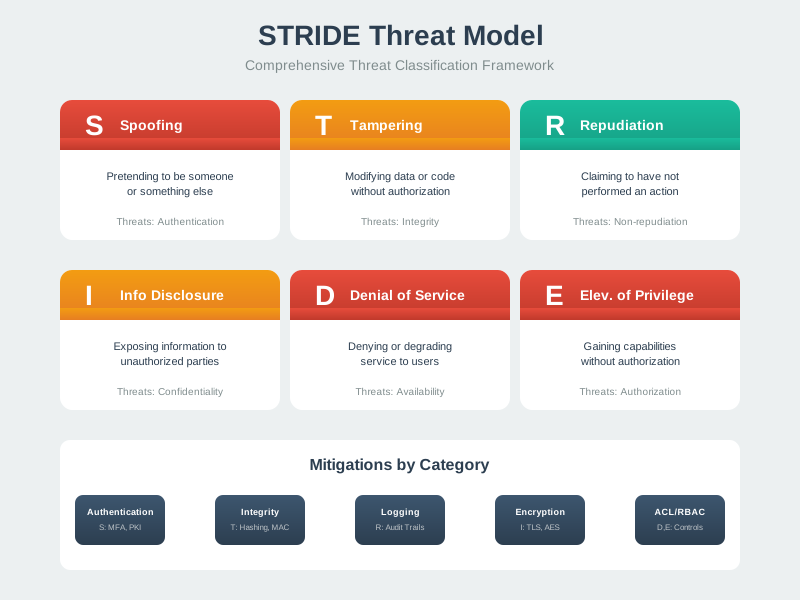
Read Figure 11.6 across the six threat types. For each type, match the harmed property to the first control shown below it. Spoofing attacks identity, while tampering attacks data integrity. Repudiation attacks the audit trail, and disclosure attacks secrecy. Denial of service blocks use. A rise in privilege breaks the limit on allowed acts. MFA, PKI, hashes, MACs, logs, encryption, robust design, and access rules are only starting points. Each pair still needs a real asset, boundary, harm, owner, and test.
11.5 Continue to Part 2
This section: Continue to Part 2 — Continue with Attack Scenarios: Records and Retest.
Continue with Attack Scenarios: Records and Retest.
Find help
3 reviewed answers.
Where should I start in a module?
Open the module page from the sidebar to see its chapters in order. Use the module map to return to a topic you need.
Modules and pathsReviewed
What can I try when a project does not work?
Check the symptom, then work through the diagnostic steps. Keep the error message and the smallest example that reproduces it.
When you are stuckReviewed
How do interactive examples work?
Use the interactive guide to check how examples and simulations work before changing your project.
Interactive examples guideReviewed