IoT Security Fundamentals — Part 2
More
Depth: Practitioner
Progress saves as you read. Mark sections complete as you go; your progress appears in the sidebar.
- Podcast audio coming soon
- Character narration audio coming soon
This is part 2 of 2. Begin with Part 1.
4.1 Build a Security Claim You Can Test
A practical IoT security review does not try to declare a whole system "secure." It takes one narrow claim at a time and shows the evidence behind it. The strongest review names the asset, locates the trust boundary where the claim is enforced, states the threat, maps a control, and records both the allowed and the denied behavior that were observed.
The small build in this layer is a review record: one claim, one asset, one boundary, one control, and one piece of evidence for both success and refusal. Provisioning is the initial setup that assigns a device its owner, identity, and credentials. Use the interactive below to explore that setup before applying the review pattern to a real device.
Turn One Claim Into Evidence
A broker receives messages and passes them to subscribers. A topic is a named channel used to sort those messages. Follow one claim from its asset to a test result. The steps below give another reviewer enough detail to repeat the check.
- State a narrow claim. Replace "the system is secure" with something testable, such as: only gateway identities may publish actuator commands.
- Name the asset. Here the asset is the actuator command path and the safe physical action behind it.
- Locate the trust boundary. The claim is enforced where commands enter the broker and are checked for permission.
- State the threat. A sensor identity, or an unknown peer, sends a command it should not be allowed to send.
- Map the control. Broker authorization rules tie each identity to the topics it may publish.
- Collect allowed and denied evidence. Show a gateway command accepted and a sensor command rejected, with the rejection logged.
- Record the retest trigger. Note what change reopens the review: a new role, a credential rotation, a broker config change, or an incident.
Inspect Five Domains Together
IoT systems mix several domains. A weakness in one can undermine another, so review them together rather than in isolation. Figure 4.1 places the protected assets at the centre so you can trace how every domain contributes to the same claim.
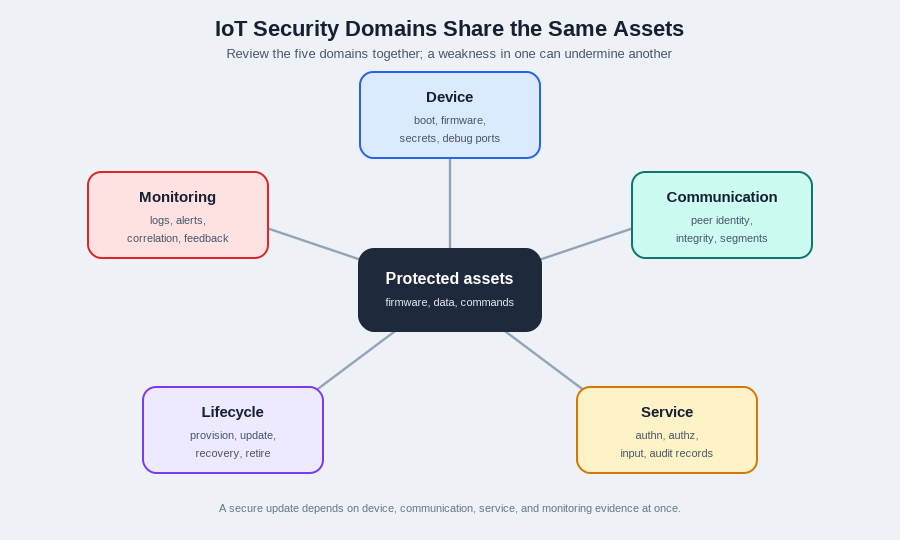
Read Figure 4.1 from the centre outward. Firmware, data, and commands depend on device controls at the hardware edge and communication controls on each link. At a service, authentication means checking who is making a request; authorization decides what that person or device may do. Lifecycle controls govern provisioning, update, and retirement, while monitoring supplies evidence of failures across the other spokes. Following each spoke back to the same assets prevents a strong encrypted link from hiding a weak boot path, cloud role, or decommissioning process.
- Device: boot path, firmware integrity, secret storage, local debug and maintenance interfaces, physical exposure.
- Communication: peer identity, protocol configuration, message integrity, network segmentation.
- Service: authentication, authorization, input handling, stored-data protection, audit records.
- Lifecycle: provisioning, update, configuration change, incident recovery, and decommissioning.
- Monitoring: logs, alerts, correlation, and the feedback that closes the loop.
Residual risk is the chance of harm that remains after controls are applied. In the interactive, follow a device from first owner binding, which links it to its owner’s account, through credential issue, which gives it a secret or certificate to prove its identity, and lifecycle evidence. Keep asking where trust changes hands, which control lives at that boundary, and what risk remains after the control is tested.
Match Controls to Their Proof
Different guards need different tests. Match the intended effect to the result that would show it occurred.
Two preventive controls need plain descriptions: secure boot checks that trusted software is present before the device runs it; input validation checks incoming values before the software uses them.
Notice the pattern: each control type is only convincing when its evidence shows the right thing. A preventive control needs a denied case, not just an allowed one. A detective control needs proof that it actually fires.
Practitioner Knowledge Check
Apply the review record above: choose evidence that tests both the allowed action and the denied action.
If you can scope a claim to its boundary and produce allowed-and-denied evidence, you can run a useful review. Continue to Under the Hood for the concepts that explain why this method works.
4.2 Why Boundaries and Layers Matter
The deeper layer explains why the review pattern works. Three ideas do most of the work: the security properties an asset can have, the trust boundaries where those properties are decided, and the layered defense that keeps one failure from becoming a total failure.
Find Where Trust Changes
In this broker example, the trust boundary is where gateway and sensor messages enter the broker and their permissions are checked. Authentication checks who is sending each message; authorization decides which topics that identity may use. The broker accepts the gateway's actuator command and rejects the sensor's command. Its attack surface includes those message connections and the broker settings that decide which identity may publish to the actuator topic. The logged rejection and accepted command give the reviewer evidence to retest after a role or broker configuration change. A valid identity therefore does not automatically gain permission to send every command.
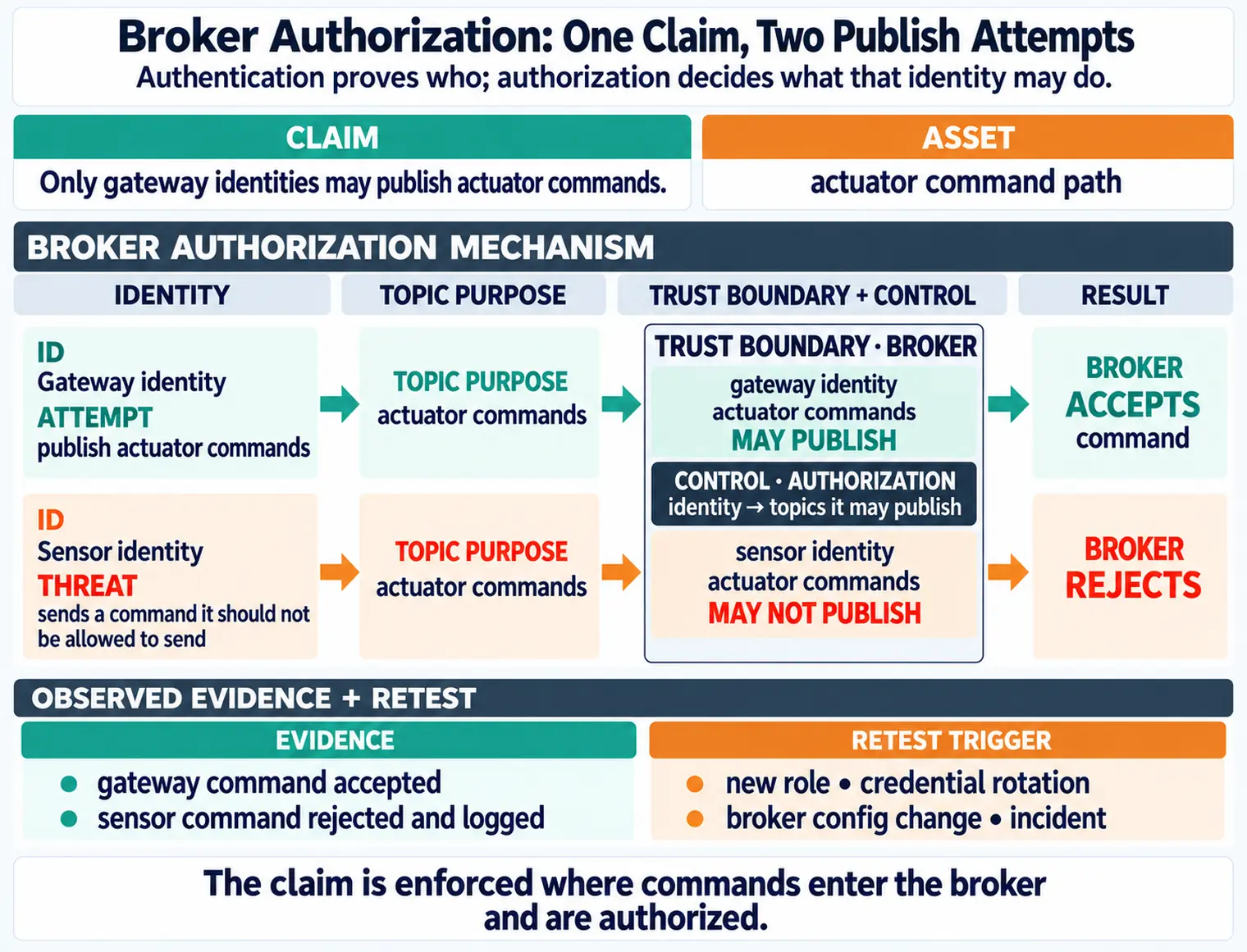
Inspect Figure 4.2 from the narrow claim into the two publish attempts. Both paths present an identity and the same actuator-command topic purpose. At the broker trust boundary, the authorization control maps each identity to the topics it may publish: the gateway may publish, while the sensor may not. The results provide both allowed and denied evidence, and the retest trigger keeps that evidence honest after a relevant change. This durable record joins the chapter's vocabulary to an operational review decision.
Make Defense in Depth Independent
Defense in depth means using independent layers so that the failure of one control does not expose the asset. If device authentication, network segmentation, and service-side authorization are truly independent, an attacker must defeat all three rather than one. The key word is independent: three controls that all rely on the same secret are really one control. After the layers are placed, some residual risk always remains. Naming it honestly is part of the review, because a claim that pretends to remove all risk cannot be trusted.
Keep the Review Record Durable
A record lets the next reviewer see the claim, its test, and when the test must be repeated. Each field below closes a different gap.
Mistakes That Break the Claim
These mistakes turn a narrow test into a broad claim. Look for the missing boundary, decision, or result in each case.
- Confusing encryption with authorization. Protecting a channel does not decide who may act across it.
- Trusting a diagram. Intent on a slide is not the same as a tested boundary.
- Reviewing the device but skipping lifecycle. A hardened device with an unverified update or recovery path still has an open door.
- Stacking dependent layers. Controls that share one secret or one assumption are one control wearing three hats.
- Letting evidence go stale. Without retest triggers, a passing result silently expires after the next change.
Under-the-Hood Knowledge Check
Use the distinctions above to identify which independent layers still limit an attack when one control fails.
At this depth, IoT security is a discipline of naming: name the asset and its properties, name the boundaries where those properties are decided, layer independent controls, and keep a record whose evidence has an expiry. A trustworthy security claim is narrow, tested in both the allowed and denied direction, and tied to the change that would make you check it again.
The layered threat surface in Figure 4.3 makes every transition an explicit control and evidence boundary.

In Figure 4.3, TRUST 1 follows device identity into the Gateway. TRUST 2 comes before Transport; later boundaries protect cloud and application use. Follow one reading across these crossings. Each receiver must know who sent it and whether it is fresh and intact. The dark card also asks how long the reading is kept, what result it drives, and how the system recovers. A protected link alone does not answer those questions.
4.3 Summary
Start with an asset and trace how it can be reached. Test each guard at the point where trust changes, and record what remains at risk.
- IoT security protects assets, the data, commands, credentials, firmware, identity, and records that a connected system depends on.
- IoT expands security from high-compute personal devices into middle- and bottom-tier connected products whose update capacity, manufacturer maturity, and network reach vary widely.
- The CIA triad, plus authentication, authorization, and safety, gives precise language for what a control actually provides.
- A trust boundary is where trust changes; the attack surface is the union of every place an asset can be reached.
- Preventive, detective, and corrective controls each need their own evidence, including a denied case for preventive controls.
- Defense in depth benefits from independent layers; shared dependencies can allow several controls to fail together, and every honest review still names its residual risk.
- A security claim is reviewable only when it ties an asset and boundary to a control, observed allowed-and-denied evidence, and a retest trigger.
4.4 Key Takeaway
[This matters because clear proof helps a team decide whether a device is safe to rely on.]{data-narration=“suspended-until-rerecord”}
A useful claim names the asset, the boundary, and the guard. It records both an allowed and a denied test, as well as the change that calls for a new test.
4.5 See Also
Continue with these pages to apply the same evidence questions to specific controls and threats.

Chapter
Cyber Security Defense in Depth
See how independent control layers combine so one failure does not expose the asset.
Chapter
Threat Modelling and Mitigation
Turn the asset, boundary, and threat questions into a structured modelling pass.
Chapter
IoT Security Secure Boot
Follow the firmware-integrity claim down to the boot chain that enforces it.