17 Sigfox Deployment
More
Depth: Practitioner
Progress saves as you read. Mark sections complete as you go; your progress appears in the sidebar.
17.1 Start With the Story
This section: Start With the Story — Picture a flood gauge beside a river where no technician can watch it each day.
Prove One Field Message From Sensor to Reader
Picture a flood gauge beside a river where no technician can watch it each day. A desk test succeeds, but trees, ground, weather, antenna angle, and service coverage change the real path. The field lead must prove that useful records arrive from the hard locations.
Choose one message and write its full route. Record device identity, event time, send count, data shape, antenna setup, site, service record, callback result, and final reader. Mark the allowed delay, missing-message rule, battery aim, and owner of each hand-off.
Test high and low water states, the weakest site, wet weather, a covered antenna, a lost callback, repeated sends, a changed data shape, and a service outage. Check arrival rate, delay, duplicate handling, decoded values, current use, and recovery. Walk the planned install area rather than proving only one spot.
Keep any urgent local flood warning outside a path that can be absent or delayed. The wide-area service may share and store reports, but it must not be the only safety signal. A quiet record must be marked missing or stale, not assumed safe.
This opening does not guarantee national coverage or final battery life. Practitioner builds the field route and operations log. Under the Hood examines radio limits, message budgets, callbacks, encoding, antennas, energy, and regional service rules.
A Sigfox deployment is proved by messages that arrive from real locations, not by a module that works on a desk. Coverage, callback delivery, payload encoding, antenna placement, and operations evidence all have to line up.
Start simple: validate one field path from device transmission to backend record before scaling the install.

17.2 What This Chapter Covers
This section: What This Chapter Covers — Start by how to convert a Sigfox-style managed-service design into deployment gates.
Start by how to convert a Sigfox-style managed-service design into deployment gates. Then how to collect site evidence that represents the actual device, enclosure, antenna, and mounting position. Next how to verify provisioning, decoding, callbacks, monitoring, and exception ownership before field scale. After that how to roll out in waves without hiding early failures in aggregate statistics. Finally how to prepare operations handoff and recheck triggers for long-lived devices.
17.3 Learning Objectives
This section: Learning Objectives
By the end of this chapter, you will be able to:
- Build a deployment release plan for a Sigfox-style managed-service project.
- Explain why service evidence must come from representative installation conditions.
- Prepare provisioning, payload decoding, callback, and monitoring checks before device rollout.
- Define rollout waves, acceptance rules, rollback actions, and exception records.
- Identify deployment assumptions that should reopen the technology decision.
17.4 Deployment Release Path
This section: Deployment Release Path — Treat deployment as a sequence of evidence gates.
Treat deployment as a sequence of evidence gates. Inspect Figure 17.1 to inspect the whole release path before optimizing any one stage; a project should not move forward because one gate is strong while another is missing.
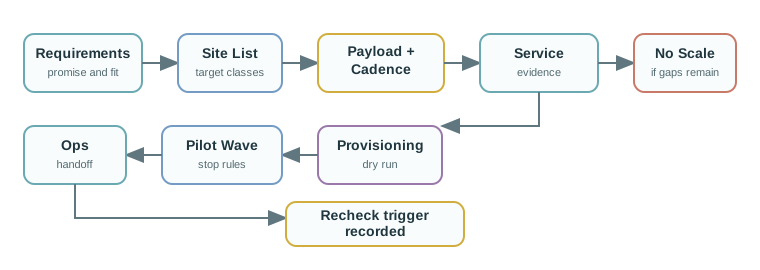
Read Figure 17.1 from requirements and representative sites into the payload-and-cadence contract. Continue through service evidence and the provisioning dry run before entering pilot and wider rollout. Operations handoff and the recheck trigger close the loop rather than ending it. This order connects design assumptions to deployment authority: every gate produces a record, and a missing record stops the next wave even when the radio worked elsewhere.
Deployment release questions:
- Requirements: what telemetry, alarm, latency, downlink, and lifetime promises must the deployment support?
- Site list: which installation environments are represented, and which are still unknown?
- Payload and cadence: what does each message mean, and what happens during alarms, retries, commissioning, and maintenance?
- Service evidence: what records prove messages arrive from the intended conditions?
- Provisioning: how are device identity, activation, decoder, callback, and application ownership verified?
- Pilot rollout: what wave size, monitoring window, stop rule, and rollback action control early scale?
- Operations handoff: who owns missing messages, callback failures, device swaps, service changes, and rechecks?
17.5 Device Management And Operations
This section: Device Management And Operations — Device management starts before installation.
Device management starts before installation. The release packet should make identity, provisioning, decoder configuration, callback ownership, monitoring, device replacement, and retirement visible enough that operations can maintain the estate without rediscovering the pilot assumptions.
Minimum records:
Start by device identifier, firmware, payload version, hardware build, antenna, enclosure, and site assignment. Then provisioning proof for decoder, callback, application owner, and monitoring owner. Next swap and retirement process for failed devices, moved devices, or changed customer ownership. Finally incident route for missing messages, callback failures, stale dashboards, and service changes.
17.6 Payload Cadence And Use-Case Fit
This section: Payload Cadence And Use-Case Fit — Deployment approval should prove that the payload and cadence match the use case.
Deployment approval should prove that the payload and cadence match the use case. A compact telemetry product can fit Sigfox well; a product that needs rich transfer, frequent commands, or low-latency control should reopen the technology decision.
Use the release review to check:
Start by payload versions are documented and can represent normal, alarm, commissioning, and recovery states. Then cadence limits are written for normal operation, exceptional operation, retries, and maintenance. Next downlink dependence is rare, non-urgent, and backed by local fallback behavior. Finally monitoring distinguishes no event, delayed event, rejected callback, and application failure.
17.7 Worked Deployment Examples
This section: Worked Deployment Examples — For an asset tracker, release evidence should show representative mounting positions, expected movement states, message freshness windows, and owner response when updates stop.
For an asset tracker, release evidence should show representative mounting positions, expected movement states, message freshness windows, and owner response when updates stop. For a meter or environmental sensor, the evidence should show payload meaning, site materials, enclosure effects, callback acceptance, and exception handling before scale.
The worked-example habit is to state the promise first, then attach proof:
- Promise: what the user believes the device is reporting.
- Evidence: which records prove device, service, backend, and application behavior.
- Limit: which sites, cadences, alarms, or downlink assumptions remain constrained.
- Owner: who acts when the evidence changes after release.
17.8 No-Hardware Lab Practice
This section: No-Hardware Lab Practice — When hardware is not available, run the deployment review as a table-top lab.
When hardware is not available, run the deployment review as a table-top lab. Build a synthetic payload contract, site list, provisioning checklist, callback test, monitoring rule, and stop rule. The lab should not claim field readiness; it should prove that the team can ask for the right evidence before devices are installed.
Practice prompts:
- Classify a proposed payload as acceptable, version-risky, or too large for the product promise.
- Decide which site classes need representative evidence before rollout.
- Write a stop rule for a pilot wave with missing messages or callback failures.
- Identify the owner for decoder drift, service change, device swap, and stale dashboard incidents.
17.9 Site Evidence Before Scale
This section: Site Evidence Before Scale — Deployment planning starts with a site list, but release approval depends on representative records.
Deployment planning starts with a site list, but release approval depends on representative records. Inspect Figure 17.2 to see how placement, device build, message evidence, failure classification, and mitigation become one scale decision rather than separate field notes.
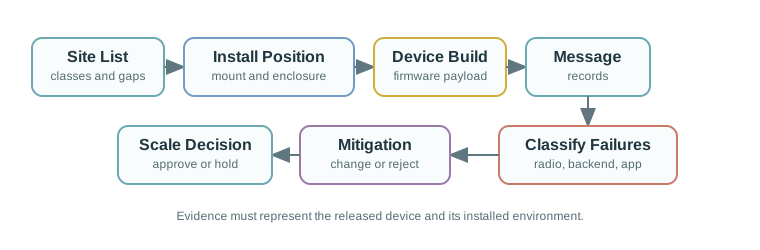
Read Figure 17.2 from the site list and exact installation position into hardware, firmware, payload version, and message records. Classify any failure at the first unsupported boundary, choose a mitigation, then decide whether that site class may scale. This packet connects survey work to release control: a convenient device position or isolated successful message cannot stand in for enclosure, antenna, callback, application, energy, and recovery evidence from production-like conditions.
Evidence to capture:
- Site type, mounting position, enclosure, antenna, orientation, and nearby materials.
- Device firmware, payload version, retry behavior, and reporting cadence.
- Message records that include normal reports, alarms, commissioning events, and service interruptions.
- Callback results, decoder output, application acceptance, and missing-message handling.
- Exceptions and mitigations, such as relocation, antenna change, cadence change, alternative connectivity, or no release for that site class.
17.10 Provisioning and Backend Dry Run
This section: Provisioning and Backend Dry Run — Provisioning is not paperwork after the radio works.
Provisioning is not paperwork after the radio works. It is part of the deployment path. Each device must have an identity record, activation state, payload decoder, callback route, application mapping, monitoring rule, and support owner before it is installed where recovery is expensive.
Record the device
Track device identity, hardware revision, firmware version, payload version, installation site, and owner in one release record.
Prove first message
Do not ship a device until the backend can accept, decode, route, and display a known commissioning message.
Test failure modes
Verify retry, dead-letter, duplicate handling, late messages, and application outage behavior before field installation.
Assign an owner
Every missing-device alert, decoder error, callback failure, and service incident needs a named triage path.
The four cards establish who and what must be prepared; inspect Figure 17.3 to see the transaction that proves those preparations agree before installation. Inspect it from device identity to operational ownership rather than stopping at activation.
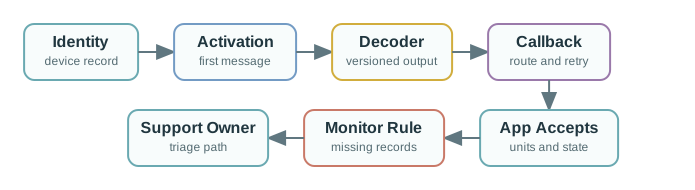
Read Figure 17.3 from the device identity and activation record into the versioned payload decoder, callback route, and application acceptance. Then verify the monitoring rule and named support owner. A known commissioning payload should be traceable at every step with timestamps and expected meaning. This dry run connects inventory to service operations and catches schema, routing, authentication, and ownership defects while the device is still recoverable.
Provisioning dry-run checks:
- A device can be identified from a message without relying on a field technician note.
- Payload decoder output matches the payload contract and application units.
- Callback delivery is observed by the application, not only by the connectivity backend.
- Duplicate, late, missing, malformed, and rejected messages have clear handling rules.
- Device replacement and site reassignment do not lose ownership or history.
17.11 Rollout Waves and Stop Rules
This section: Rollout Waves and Stop Rules — Inspect Figure 17.4 to see how each larger deployment wave depends on evidence from the smaller one and where a stop rule feeds the plan back for correction.
Inspect Figure 17.4 to see how each larger deployment wave depends on evidence from the smaller one and where a stop rule feeds the plan back for correction.
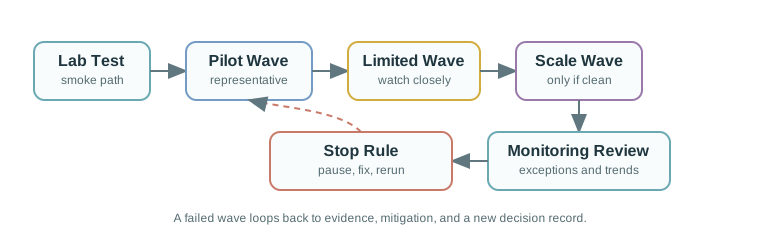
Prove one site first. Expand only after its gate passes. Read Figure 17.4 from the lab smoke test to a representative pilot, then into limited and scale rollout only after the observation gate passes. Monitoring continues across the waves; a stop symptom loops back to correction rather than becoming an undocumented exception. The progression connects sample size to confidence: each wave needs an entry rule, observation window, stop rule, exception log, rollback action, and decision owner.
Good rollout records answer:
- Which site classes, device builds, firmware versions, and payload versions are included in each wave?
- What observation window is long enough to include normal reports, alarms, maintenance actions, and service interruptions?
- What symptoms stop the next wave: missing reports, callback failures, device activation defects, decoder mismatch, installer errors, or customer rejection?
- What is the rollback action: hold shipment, swap antenna, change mounting, revise payload, fix callback, move site class to another technology, or withdraw release?
- Who can approve an exception, and when must the exception be reviewed again?
17.12 Operations Handoff
This section: Operations Handoff — The deployment is not complete when the last device is installed.
The deployment is not complete when the last device is installed. Inspect Figure 17.5 to test whether operations can detect trouble, classify it, act on it, and decide when the technology fit must be reviewed again.
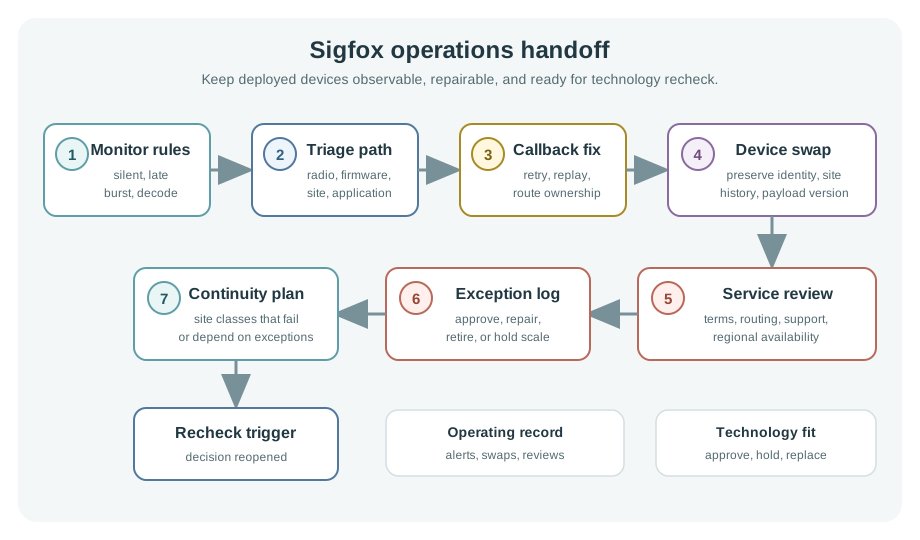
Read Figure 17.5 from monitor rules into incident triage, then branch to the appropriate response: callback repair, device swap, or service-change review. Exception review and the continuity plan determine whether the mitigation remains supportable, while the recheck trigger returns material changes to technology review. This loop connects installation to long-term ownership; alerts without authority, swap records, escalation, and exit criteria are not an operational handoff.
Operations ownership should include:
- Monitoring rules for silent devices, message bursts, decoder errors, callback failures, late data, and application rejection.
- A triage path that separates radio/service symptoms from firmware, provisioning, callback, device damage, site movement, and application defects.
- Device swap and reassignment procedures that preserve identity, site history, and payload version records.
- Service-owner change review: what changes in service terms, backend routing, support process, or regional availability reopen the deployment decision?
- A continuity plan for site classes that fail evidence requirements or become dependent on exceptions.
17.13 Deployment Anti-Patterns to Reject
This section: Deployment Anti-Patterns to Reject
Approving from a planning view
A planning view helps choose pilot locations. It does not prove the released device works inside its enclosure at the intended site.
Hiding site-class failures
A strong overall delivery summary can still hide one failing site class. Review site classes separately.
Leaving callbacks for operations
If the application cannot receive, decode, and alert on data during the dry run, the deployment is not ready.
Ignoring recheck triggers
Managed-service deployments need a written trigger for service, payload, cadence, site, ownership, or product changes.
17.14 Release Readiness Packet
This section: Release Readiness Packet — A useful release packet is short enough to maintain and specific enough to audit.
A useful release packet is short enough to maintain and specific enough to audit.
Include:
- Requirements summary and rejected assumptions.
- Payload contract, decoder version, and cadence budget.
- Representative site evidence with exceptions and mitigations.
- Provisioning dry-run record and callback acceptance evidence.
- Rollout wave plan, stop rules, and rollback actions.
- Operations handoff with named owners and escalation path.
- Recheck triggers and technology-decision reopen rules.
The list names packet contents; inspect Figure 17.6 as release gates. Use it to check that evidence, operating control, and future re-evaluation remain linked rather than filed as independent documents.
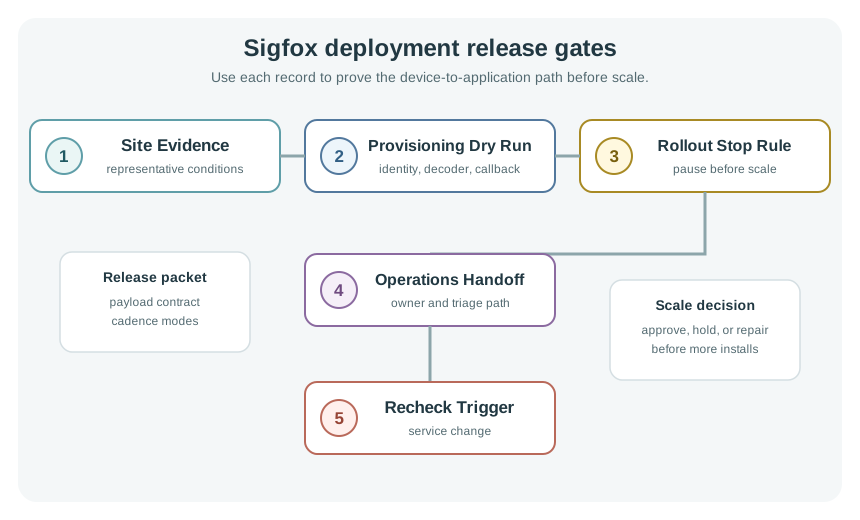
Read Figure 17.6 from representative site evidence to the provisioning dry run, then through rollout stop rules and operations handoff. The final recheck trigger points back to the assumptions that justified release. A packet is ready only when those checkpoints identify their records and owners; completeness is not the number of pages, but whether another reviewer can reproduce the decision, see its limits, and know what change reopens it.
17.15 Deployment Evidence Chain
This section: Deployment Evidence Chain — The deployment risk is not only radio coverage.
A Sigfox-style deployment is ready to scale only when the team can prove messages arrive from representative devices, in representative places, with the final payload, cadence, provisioning path, callback route, and operations owner.
The deployment risk is not only radio coverage. It is the chain from installed antenna to managed service, payload decoder, backend callback, monitoring, incident response, device replacement, and future service changes.
Use Figure 17.7 to locate where a missing record was lost by following its proof from local product meaning through managed reception to operational response.
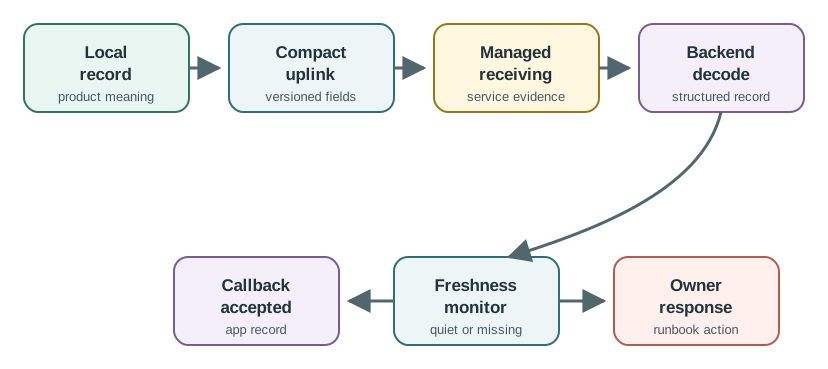
Begin with the claim. Follow its proof to the field. Read Figure 17.7 from the local record, where identity, event time, send count, and data shape establish product meaning, into the compact uplink and managed reception. Backend decode and callback acceptance then prove that the service converted and handed off the record. Freshness monitoring detects a late, missing, or stale result, while the named owner applies the runbook. When evidence disappears, operations work backward across the application, callback, decoder, radio service, and sensor boundaries. That sequence turns silence into a bounded investigation instead of an undifferentiated connectivity fault.
Do not scale from a single successful message
One message proves a narrow path at one moment. A release record proves the deployment can survive variation, faults, operations handoff, and service changes.
The practical test is whether a reviewer can replay the decision from records rather than trust memory. If the pilot succeeds, the reviewer should see why the tested sites represent the rollout. If it fails, the reviewer should see whether the fault was radio loss, payload drift, decoder error, callback rejection, stale monitoring, or unclear ownership. That classification decides whether the next action is antenna change, payload change, backend repair, smaller rollout wave, or technology reassessment.
This evidence-first stance is especially important for managed LPWAN because the project does not directly control every network element. The team can still control what it approves: final device conditions, bounded traffic promises, callback acceptance, observability, stop rules, and recheck triggers.
17.16 Sigfox Release Record
This section: Sigfox Release Record — The release record should make every deployment assumption testable.
The release record should make every deployment assumption testable. It should show which sites were represented, which devices were provisioned, which payloads were decoded, and which owner responds when a message is late or missing.
Start with the promise made to the user, then work backward. If the promise is a daily meter reading, the record needs freshness evidence and a missing-reading response. If the promise is an alarm, it needs worst-case latency, callback failure handling, and a safe local behavior while the device is silent.
Complete the dry run
Provision a pilot device, decode the payload, confirm callbacks, and prove alert visibility before the device is mounted.
Log exceptions
Record late messages, missing messages, duplicate events, decoder errors, callback failures, and device swaps as named exceptions.
Schedule rechecks
Reopen the decision when firmware, payload cadence, mounting, service region, backend endpoint, or operator conditions change.
Keep the record small enough to maintain, but strict enough to stop bad scale. A useful release record normally includes the device list, site classes, payload contract, representative message samples, decoder version, callback test result, monitoring rule, exception log, wave decision, rollback action, and recheck trigger.
Do not let averages hide deployment risk. A high delivery statistic may still fail a site class, enclosure type, backend endpoint, or alarm path that matters. Separate “what passed” from “where this evidence applies” and “what remains outside the approved boundary.”
17.17 Managed Service Ownership Review
This section: Managed Service Ownership Review — Managed LPWAN can simplify network ownership, but it does not remove responsibility for the deployment.
Managed LPWAN can simplify network ownership, but it does not remove responsibility for the deployment. The project still owns device behavior, payload discipline, provisioning correctness, callback resilience, monitoring, and continuity planning.
The useful system spans several asynchronous boundaries. A device may transmit, several base stations may hear it, the managed service may deduplicate it, the cloud may create a callback, the application may accept or reject that callback, and monitoring may decide whether silence is normal or exceptional. A deployment gate must test the whole chain, not just the radio hop.
Those boundaries fail in different ways. Radio trouble looks like weak or absent reception. Payload trouble looks like fields that decode but mean the wrong thing. Callback trouble looks like rejected, duplicated, late, or unactioned records. Monitoring trouble looks like a device that goes quiet without anyone noticing. Ownership trouble looks like an alert that is visible but not assigned to someone with authority to act.
This is why a release gate should include negative tests as well as happy-path messages. Deliberately check what happens when the endpoint rejects a callback, the decoder sees an unknown payload version, the commissioning message arrives late, or the monitor sees silence after installation. The result should be a named exception and response path, not only a failed test note.
Cadence discipline
Payload size, alarm behavior, retry policy, clock drift, battery state, and commissioning traffic all affect service fit.
Callback resilience
Decoder changes, backend downtime, authentication expiry, and monitoring gaps can break the value chain even when radio messages arrive.
Exit readiness
A long-lived deployment needs a recheck and exit plan for service coverage, operator changes, device replacement, and data migration.
Downlink limits make ownership explicit. A design that depends on frequent remote commands, acknowledgements, or live correction will create operational pressure that the service was not meant to absorb. When command traffic is rare and device-initiated, the release record should still show who can request a downlink, when the device listens, what happens if the command is missed, and how the application proves the resulting state.
Provisioning changes are another hidden failure mode. A decoder update can change units, an authentication token can expire, a callback endpoint can reject a schema, or a replacement device can be installed with the wrong identity. The radio evidence may look healthy while the application record is wrong.
17.18 Summary
This section: Summary — Start by prove service from representative installation conditions, not only planning views or lab messages.
Sigfox deployment quality depends on evidence, ownership, and stop rules:
Start by prove service from representative installation conditions, not only planning views or lab messages. Then verify provisioning, decoding, callbacks, monitoring, and application acceptance before field installation. Next roll out in waves with stop rules, exception logs, and rollback actions. After that hand the deployment to operations with clear owners for alerts, incidents, device changes, and service changes. Finally record recheck triggers so long-lived devices are not locked into assumptions that no longer hold.
17.19 What’s Next
This section: What’s Next — Start by Device Management And Operations: device identity, provisioning, monitoring, and lifecycle ownership.
Start by Device Management And Operations: device identity, provisioning, monitoring, and lifecycle ownership. Then Scenario Mistakes And Assessment: evidence-first review questions for managed-service deployments. Finally Payload Cadence And Use-Case Fit: payload discipline, service evidence, downlink restraint, and release readiness.
17.20 Key Takeaway
This section: Key Takeaway — Sigfox deployment planning must check operator coverage, device certification, antenna placement, payload schedule, backend callbacks, message limits, and continuity risk.
Sigfox deployment planning must check operator coverage, device certification, antenna placement, payload schedule, backend callbacks, message limits, and continuity risk.
Find help
3 reviewed answers.
Where should I start in a module?
Open the module page from the sidebar to see its chapters in order. Use the module map to return to a topic you need.
Modules and pathsReviewed
What can I try when a project does not work?
Check the symptom, then work through the diagnostic steps. Keep the error message and the smallest example that reproduces it.
When you are stuckReviewed
How do interactive examples work?
Use the interactive guide to check how examples and simulations work before changing your project.
Interactive examples guideReviewed