19 Smart Contact Lenses: Power, Data, and Safety
More
Depth: Practitioner
Progress saves as you read. Mark sections complete as you go; your progress appears in the sidebar.
- Podcast audio coming soon
- Character narration audio coming soon
19.1 From an On-Eye Reading to a Safe Trend
A smart contact lens can sense and store a reading, yet its tiny power margin and uncertain measurement context limit what an app may show. This chapter follows the reading from the eye through a nearby reader to a clinical data path. It is part 2 of 2; Smart Contact Lenses: Constraints and Architecture establishes the sensing design.
A research team is testing a tear-glucose lens that sends readings through a phone to a study backend. Its wellness app may show “rising,” “falling,” “stable,” or “trend unavailable.” It must not recommend insulin dosing. Even a recent upload may contain a noisy sample or an old measurement.
The problem is therefore twofold: keep sensing and transmission within the on-eye budget, then decide whether the resulting evidence supports the intended trend. We will calculate power, examine tear-glucose delay, and design the relay and reading-release gate. Those approaches keep a working prototype from making a claim its measurements cannot support.
KEY CONCEPTS
- Energy budget
Count bursts and sleep before increasing on-eye power.
- Tear-glucose evidence
A delayed tear signal does not establish a safe insulin dose.
- Relay provenance
Carry calibration, identity, quality, and time with the sample.
- Reading release
Withhold a trend whenever a required check fails.
19.2 Learning Objectives
By the end of this chapter, you will be able to:
- calculate a smart-lens sensing and transmission power budget
- interpret tear-glucose delay and data-quality limits
- design a safe body-area relay and reading-release gate
19.3 Budget the Bursts and the Sleep
The health-monitoring lens uses an illustrative operating budget of 10–50 microwatts (µW), with radio-frequency energy harvesting or biofuel cells among the power approaches. RF harvesting captures energy from a nearby reader. Duty cycling means operating intermittently rather than continuously. Average power, peak radio demand, stored energy, and heating all need separate review.
Follow the team’s measurement cycle: a phone NFC reader emits radio waves that power the lens antenna; the glucose biosensor measures tear fluid in a 150 ms burst; the microcontroller (MCU) processes the reading, adds a timestamp, and stores it locally. A 50 ms NFC transmission sends stored readings to the phone, which uploads encrypted data for clinical trend analysis. Near-field communication (NFC) provides the nearby reader link.
The calculator separates sensing, transmission, and sleep energy over 18 hours of wear. Energy for each burst is power multiplied by duration; multiply that by the number of bursts, add sleep energy, then divide by wear time to obtain average power. MCU sleep power can dominate because sleep lasts far longer than either burst. In this model, reducing sleep power has more effect than shortening a sensor measurement.
The calculation audit, “The 99.2% That Names the Real Design Lever,” re-derives the chapter’s numbers step by step, rounding only at the end. A low average result remains a budget estimate; the full lens and duty cycle still need thermal assessment.
19.4 Separate Tear Delay from Blood-Glucose Evidence
Power determines whether a reading can be captured. Measurement evidence determines what it means. A tear-glucose sensor is not equivalent to a laboratory blood-glucose analyzer: tear-to-blood correlation varies with tear production, ambient humidity, and individual physiology. Validate readings against gold-standard references during development and communicate limitations to users and clinicians.
Tear-glucose lag is a delay between changes in blood glucose and the corresponding tear measurement. The simulator illustrates how blood glucose can already be low while the lens still appears to show a safe value. Its delay and tear/blood relationship are illustrative and variable; the simulation cannot validate insulin dosing.
For this research workflow, the supported output is a qualified rising, falling, or stable trend. Unvalidated tear readings cannot replace fingerstick meters for critical decisions or guide real-time insulin doses. Shifting timestamps can align past observations when delay is known; it cannot supply a blood-glucose change the tear sensor has not yet observed.
The history reinforces the need to separate prototypes from claims: Google/Verily paused glucose work in 2018, Mojo demonstrated an augmented-reality prototype in 2022, and Sensimed received Food and Drug Administration (FDA) permission in 2016 for 24-hour intraocular-pressure (IOP) pattern monitoring. These are different products and evidence paths.
19.5 Carry Context Through the Body-Area Relay
Once the team has a sample, the next problem is carrying its context without loading the lens with internet-facing work. Smart lenses rarely act as independent internet endpoints. A body-area relay is the nearby phone, watch, or dedicated reader that receives short bursts from the constrained sensor. The nearby NFC reader can supply energy while receiving data; some designs use a duty-cycled Bluetooth Low Energy (BLE) relay. Measure actual peak power and thermal behavior for the selected lens.
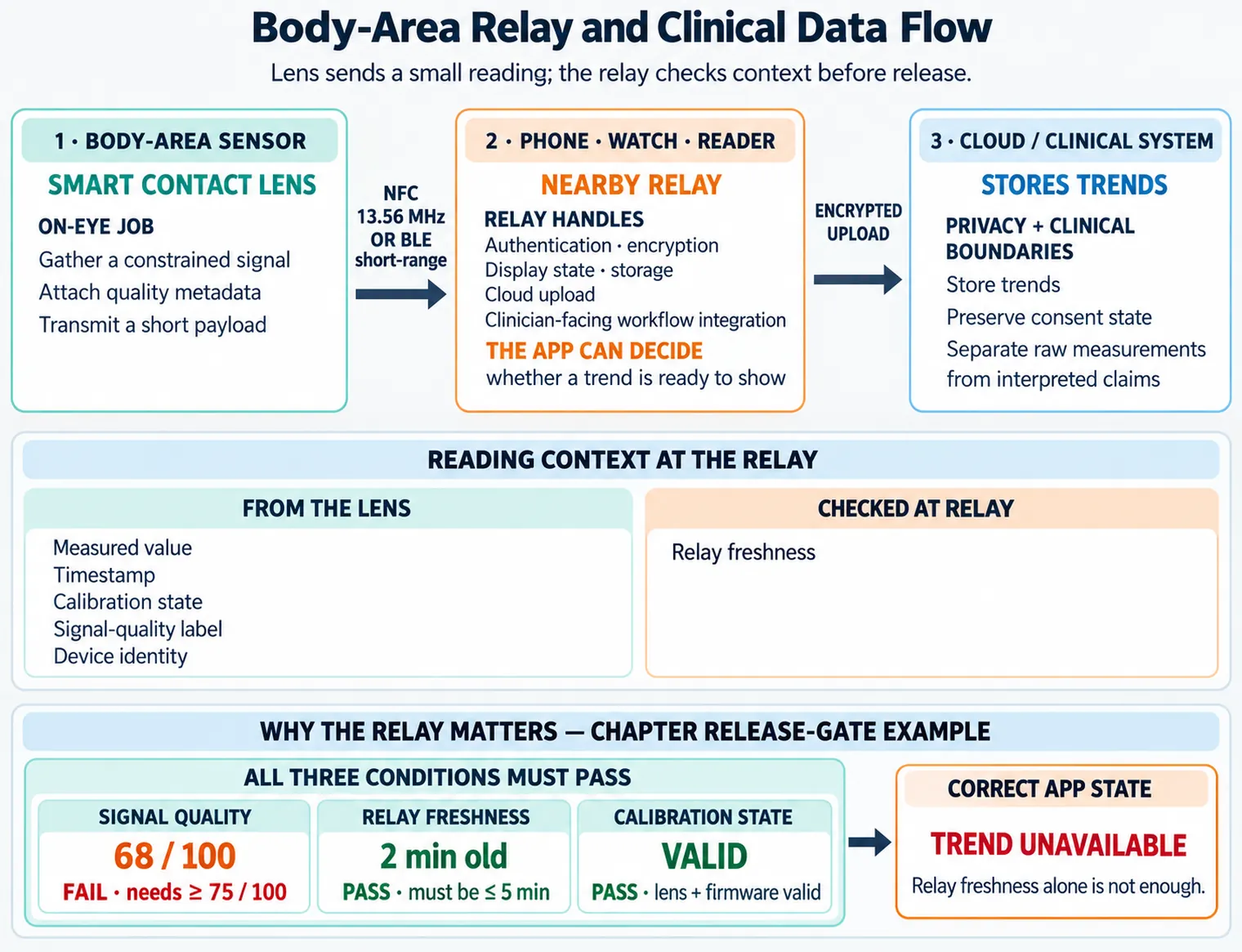
Keep the lens payload small: measured value, timestamp, calibration state, signal-quality label, relay freshness, and device identity. The relay handles authentication, encryption, display state, storage, cloud upload, and clinician-facing integration. It supplies a place to decide whether to show a trend, request another reader session, or mark a sample research-only or low-confidence.
Privacy follows the intended use. A wellness trend, research capture, and clinician-reviewed pressure pattern need distinct access rules. Separate raw measurements from interpreted claims, preserve consent, and expose missing context rather than hiding it in a smooth chart. Provenance is the record of where a measurement came from and the conditions under which it was captured and relayed.
19.6 Release Only a Qualified Trend
The relay makes context available; the reading-release gate applies the rules that decide whether the app may display a trend. In the team’s study, the lens payload contains glucose sensor current, timestamp, signal-quality score, calibration version, lens lot, and firmware version. An NFC reader session passes it through the phone for encrypted upload to the study backend.
The example gate requires signal quality of at least 75 out of 100, a reader session no older than 5 minutes, and a calibration profile valid for the current lens and firmware version. These are the scenario’s controls, not universal clinical thresholds. Store raw readings and quality metadata before deciding what is visible.
Reject samples affected by blink artifact, low tear volume, unstable sensor current, or expired calibration. Then check freshness: a fresh cloud upload does not make an old on-eye measurement fresh. Keep device id and version, lens lot, firmware version, calibration version and state, timestamp source, signal quality, relay id, and consent state with the reading.
For signal quality 68, relay age 2 minutes, and valid calibration, the result is still trend unavailable. A repeat reader session may be requested; smoothing must not turn that noisy sample into a confident trend. If all checks pass, show only the supported trend, with timestamp and quality provenance. Passing the gate does not authorize dosing advice.
Keep raw measurement, quality metadata, relay state, and product claim separate in the interface. Data-quality labels are safety controls: a small chart can look authoritative even when its evidence is stale or outside the claim. UX Design for IoT provides context for making these states understandable.
19.7 Choose the Form Factor Around the Claim
A gate cannot make an unsuitable form factor worthwhile. The lens should win only when the intended signal or display experience depends on the eye. Compare the burden before selecting sensors.
| Criterion | Smart Contact Lens | Wrist-Based Wearable | Design Implication |
|---|---|---|---|
| Signal source | Tear film, ocular pressure proxy, or on-eye display | PPG, motion, temperature, and user interaction | Choose the lens only when the eye-specific signal matters. |
| Power model | Harvested or tightly duty-cycled on-eye energy | Rechargeable battery with larger thermal margin | Move heavy compute and storage to the relay. |
| Wear burden | Insertion, cleaning, comfort, and eye-safety constraints | Familiar daily wear with simpler charging | Reserve lenses for benefits that justify the burden. |
| Claim risk | Material safety plus health or display claims | Consumer or medical claims depending on use | Write the intended claim before selecting sensors. |
| Data path | Short lens-to-reader sessions with provenance | Phone sync or watch-to-cloud telemetry | Show relay freshness and quality state separately. |
Use lenses for eye-specific pressure patterns, tear-fluid research measurements, or on-eye display concepts. Use a wrist or phone when it can achieve the same outcome. PPG in the table means photoplethysmography, an optical pulse measurement. The product question is whether eye-specific value justifies insertion, cleaning, comfort, safety, evidence, and workflow demands.
Augmented-reality (AR) display lenses need milliwatt-class display power and remain in research and development. AR display concepts deliver imagery to the retina through the eye’s optics; direct retinal projection depends on the optical design. Their power, thermal, optical, validation, privacy, and failure constraints differ from health-monitoring lenses. A visual-cue prototype does not establish a clinical measurement; a low-power sensor does not establish display capability. Keep each claim, evidence plan, and interface separate. Application Domains Overview places these choices alongside other connected applications.
19.8 Check the Complete Lens Before Raising Power
Form-factor decisions return the team to the eye itself. High oxygen permeability matters because the covered cornea needs oxygen during wear. Oxygen transmissibility (Dk/t) combines material permeability with full-lens thickness. Review the complete materials and thickness against the applicable intended-wear standard and clinical safety evidence.
The chapter’s thermal design constraint is a temperature rise below 2 °C above body temperature. Treat that as a design limit to verify for the intended lens, rather than proof of safety from a nominal power budget. Heat-dissipating voltage regulators, high-frequency oscillators, and continuous-wave RF transmitters can conflict with that constraint. Perform thermal simulation before selecting on-eye or on-skin components, then measure the complete lens under its intended wear and duty cycle.
Prototyping Essentials supports the next design steps. A prototype must preserve oxygen delivery, optical function, comfort, and thermal safety while producing evidence that supports its particular claim.
Summary
Health-monitoring lenses use an illustrative 10–50 µW budget, with RF harvesting or biofuel cells among the power approaches. Tear-fluid research includes glucose, lactate, and cortisol; glaucoma-related IOP pattern monitoring follows a different measurement path, represented by the FDA-cleared Sensimed Triggerfish workflow. AR display lenses remain a separate, milliwatt-class research category.
Keep on-eye electronics minimal and move heavy computation, storage, authentication, and workflow integration to the relay and cloud. Tear-to-blood relationships, oxygen delivery, heat, and privacy constrain the design. Signal quality, timestamp, calibration, device version, relay identity, and consent context must accompany readings. Noisy, stale, or uncalibrated samples become unavailable states rather than confident trends.
A received reading becomes a displayable trend only when its quality, freshness, calibration, and intended claim all pass review.
Continue to Application Domains Overview to compare where this constrained sensing pattern creates value.