6 Wearable IoT: Privacy and Power Constraints
More
Depth: Practitioner
Progress saves as you read. Mark sections complete as you go; your progress appears in the sidebar.
- Podcast audio coming soon
- Character narration audio coming soon
6.1 Keep the Watch Useful and Its Data Bounded
Body data can expose health or routine long after a wearer removes the device. A wearable needs limits on measurement claims, data access, and daily power use. This is part 2 of 2; Wearable IoT: Placement and Adoption Evidence supplies the preceding evidence.
Follow the chapter’s watch: its processor, display, optical heart-rate sensor, and radio share a battery. Its measurements pass through firmware, a phone app, and possibly a cloud service. It needs trustworthy readings, permission to share them, and a sustainable wear routine.
The problem is to support the intended decision within privacy and power limits. Start with data boundaries, then processing responsibilities, watch charge and rail limits, placement, and adoption.
KEY CONCEPTS
- Purpose and consent
Define who may see body data, why, and for how long.
- Signal evidence
Placement and context determine what a metric can support.
- Charge and rail limits
Daily charge and peak voltage need separate checks.
- Sustained wear
Comfort, setup, integration, and utility shape adoption.
6.2 Learning Objectives
- Set privacy boundaries for wearable body data.
- Estimate battery and rail limits for a wearable device.
6.3 Set Boundaries Before Sharing Body Data
For the watch, start by naming the decision and the people allowed to use its evidence. Wearables collect intimate, longitudinal signals. The architecture should keep raw sensor data, derived metrics, coaching messages, emergency alerts, and clinical claims separate. A step trend, stress score, arrhythmia notification, glucose alarm, and workplace fatigue alert need different validation and governance.
The signal pipeline should preserve enough context to explain every metric. A photoplethysmography (PPG) heart-rate value is more trustworthy when it carries timestamp source, LED configuration, sample window, contact quality, motion artifact score, firmware version, algorithm version, and whether the user was resting, sleeping, exercising, or in an unknown state. An inertial measurement unit (IMU) event may need sampling rate, placement, orientation, activity class, fall-detection confidence, and whether a confirmation prompt was answered. A glucose event may need sensor age, calibration status, trend arrow, alarm state, and delivery path.
- Signal boundary: define sensor placement, sampling schedule, filtering, artifact rejection, calibration, firmware version, missing-data behavior, and whether processing runs on-device, phone, or cloud.
- Power boundary: define battery capacity, charging routine, always-on display cost, GPS duty cycle, PPG duty cycle, Bluetooth Low Energy (BLE) sync interval, low-power mode, and what features degrade first.
- Privacy boundary: define biometric retention, location sharing, employer or insurer access, research consent, deletion, export, account recovery, and child or dependent-user handling.
- Regulatory boundary: define whether Food and Drug Administration (FDA), SaMD, International Organization for Standardization (ISO) 14971 risk management, International Electrotechnical Commission (IEC) 62304 software lifecycle, Health Insurance Portability and Accountability Act (HIPAA), General Data Protection Regulation (GDPR), or local medical-device rules apply before marketing a health claim.
The strongest wearable design can trace a metric from body signal through firmware, phone app, model, uncertainty label, user action, and support or clinical workflow without pretending that a convenient sensor is automatically a clinical instrument.
Workplace wearables need a bring-your-own-wearable (BYOW) or bring-your-own-device (BYOD) policy before the pilot scales. A watch, band, badge, camera, or smart-glasses device can create value for fatigue, safety, access, or workflow support, but it also raises security threats, data privacy, identity and access management, ownership of data outside IT, compliance requirements, physical-safety exposure, repairability, and user-benefit concerns. Treat the policy as part of the technical release evidence: who owns the device, who may see worker data, how the user opts out, what happens when the device is lost, and which safety decisions are never delegated to an unmanaged wearable.
The engineering discipline is to keep wellness, safety, and clinical paths from blurring. A wellness score can tolerate uncertainty if the app communicates trends and confidence. A fall alert needs conservative escalation and cancellation behavior. A medical-device feature needs validation, traceability, risk management, and post-market monitoring. Keeping those paths separate lets one wearable platform support multiple features without overclaiming what the body signal can prove.
6.4 Preserve Evidence Across Device, Phone, and Cloud
Those boundaries must survive every processing step. Edge and cloud split the work. On-device processing protects latency and privacy for simple classification, artifact detection, and immediate alerts, but it is limited by battery, compute, memory, and thermal budget. A phone can handle richer user interaction, buffering, secure sync, and local notifications. Cloud services can support longitudinal analytics, population-level model improvement, clinician portals, and research exports, but they increase privacy, security, availability, and consent obligations. The architecture should show which layer owns each decision and what happens when BLE, cellular, or cloud access is unavailable.
Security is also harder because the device is close to the body but often controlled through a phone and cloud account. Pairing, account recovery, firmware signing, secure boot where available, encrypted storage, key rotation, and revocation must be tested against lost phones, second-hand device resale, caregiver access, and shared household devices. If a user deletes an account, the product needs a clear rule for raw samples, derived metrics, backups, research exports, and records already shared with a healthcare provider or study.
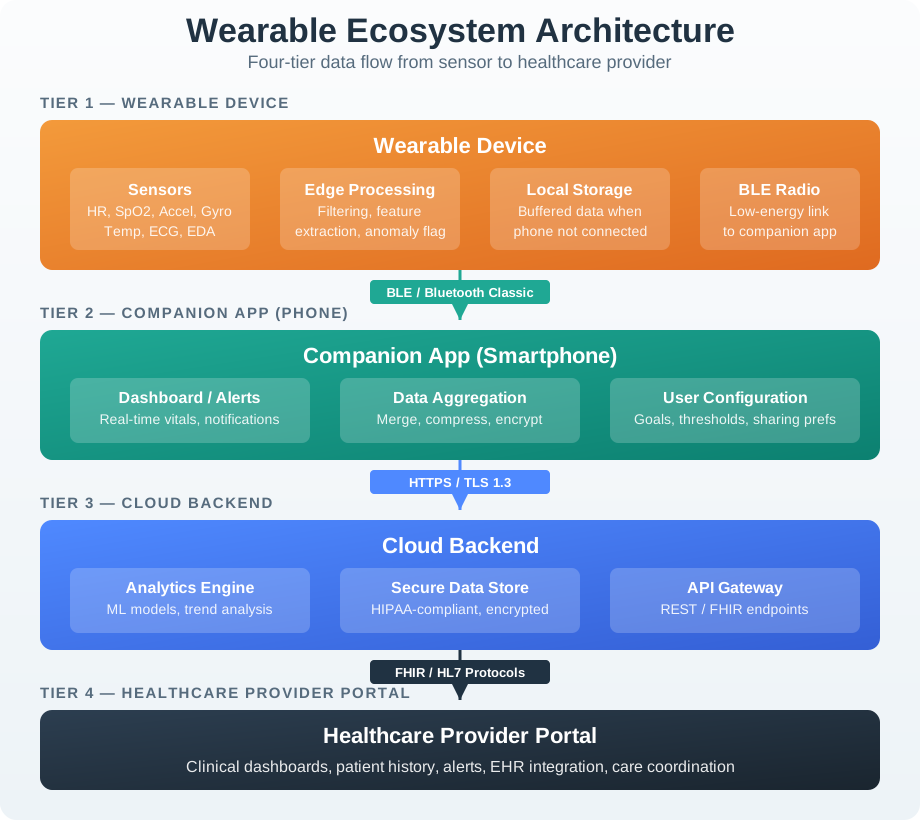
Follow the data from left to right through four tiers. The device itself does more than sense, because it filters, flags, and buffers readings for the times the phone is out of range, and that buffering is a power decision as much as a storage one. The phone tier merges, compresses, and encrypts before anything leaves the user’s hands, and it is also where sharing is configured. The cloud tier adds models and a store with clinical obligations attached. Only the fourth tier reaches a clinician, over health-record protocols. Notice the named links between tiers in Figure 1, because each hop is a place where battery life, encryption, and consent are decided at once.
Other body-area devices expose different validation boundaries.
Named body-area examples are useful because they expose different boundaries. A dance-sensing garment or body-area network node has to prove placement, motion artifact handling, short-range relay behavior, and whether the phone or tablet receives enough quality metadata to interpret the movement. A battery-free miniature radio tag, such as the Stanford/Berkeley class of self-contained 24/60 GHz research motes with roughly a 50 cm read range, shifts the review toward reader proximity, harvested energy, antenna orientation, and what happens when the reader is absent. An on-eye glucose lens shifts the same pattern toward tear-to-blood lag, biocompatibility, and clinical claim limits, while an epicardial flexible cardiac sensor sheath shifts it toward surgical placement, pH or temperature calibration, arrhythmia evidence, and the escalation owner for a high-risk alert.
Medical body-area networks add a pipeline boundary. A blood-pressure cuff, pulse oximeter, EEG patch, and inertial sensor may feed a phone, laptop, or decision management unit that collects, filters, analyzes, and decides before anything reaches a physician dashboard, medical information database, or emergency workflow. The review should keep raw vital signs, filtered features, decision rules, alert routing, and remote-access permissions separate so a monitoring system does not confuse a local wellness display with clinical escalation.
Respiratory wearables show why validation evidence must name the reference signal. A tri-axial accelerometer on the ribcage or abdomen can estimate respiratory rate and flow waveform, but the claim should say whether it was compared against cannula pressure, an Orient-style respiration trace, VO2 or activity correlation, or another reference. The useful evidence is not just “breathing detected”; it is placement, sample rate, filtering, correlation window, motion artifact state, and the conditions where the respiratory-rate estimate is withheld.
6.5 Budget Daily Charge and Test the Rail
The watch’s processing choices also have a physical cost. A charge budget adds each operating state’s current multiplied by its daily duration. A rail sag is a drop in supply voltage under load. The first estimates runtime; the second asks whether a current pulse leaves enough voltage for the device to operate.
Assume a baseline of 115.4 mAh/day for the microcontroller (MCU), active display, PPG, and BLE; the individual state currents and durations are not specified, so this baseline cannot be reconstructed here. It gives 2.60 ideal days from 300 mAh. Keeping a 3 mA always-on display active for the other 21 hours raises the ledger to 178.4 mAh/day and cuts it to 1.68 days; assuming one GPS hour adds 25 mAh, the total reaches 203.4 mAh/day and 1.47 days. A worst-case 54.5 mA pulse through 0.2 ohm sags only 10.9 mV, so charge—not pulse delivery—dominates this illustrative watch.
Record both ideal runtime and pulse delivery. Runtime cannot excuse a rail below its minimum voltage. Display and GPS costs explain why charging routines and feature-degradation rules belong beside the feature list.
6.6 Match Placement to the Decision
A sound battery ledger cannot rescue a poor measurement location. Wearable accuracy depends as much on placement as on the sensor itself:
- Wrist PPG is convenient but vulnerable to motion artifact, loose straps, skin tone variation, tattoos, and cold-weather perfusion changes. It is best for trends and resting heart rate rather than high-intensity clinical decisions.
- Chest electrocardiography (ECG) straps and patches capture cleaner cardiac signals because they measure electrical activity near the heart, but they trade away comfort and daily wearability.
- Rings and ear-worn sensors can improve optical contact for some users, while shoes and insoles are stronger for gait, load, and posture signals.
Design the form factor around the decision the device must support. A comfortable wrist tracker may be enough for wellness trends; medication titration, arrhythmia diagnosis, or fall-risk scoring needs a placement and validation strategy that matches the clinical claim.
Market scale and consumer preference are separate evidence questions. The source names an ABI Research historical baseline of 485 million annual shipments, but gives no year or category scope. Before stating a market-size opportunity, cite a source with year, geography, and included product categories. Placement-preference percentages likewise need a named survey, sample, year, and whether respondents could select multiple form factors. Leave such percentages out until that evidence is available.
6.7 Put Today’s Wearable Choices in Context
Placement choices sit within a longer history of body-worn tools and computing. These milestones show how the category expanded beyond a device on the wrist:
- 1268 AD — Roger Bacon’s lenses: An early lens-based example of wearable augmentation.
- 1970-1980 — Calculator watches: Casio and HP bring computing to the wrist.
- 1997 — Steve Mann’s research: Pioneered the concept of a “shrinking computer” for body-worn systems.
- 2007 — iPhone launch: Created the Bluetooth accessory ecosystem that enabled modern wearables.
- 2013 — Smartwatch wave: Pebble, Samsung Gear, and Fitbit Force brought wearables mainstream.
- 2015 — Apple Watch: Premium smartwatch established health tracking as a primary value.
- 2020s — Medical-grade wearables: electrocardiogram (ECG), SpO2, and CGM features reach consumer devices; FDA authorization depends on the feature and its claim.
The ecosystem in Figure 1 extends beyond the enclosure: companion apps, processing services, and care interfaces shape both experience and evidence.
6.8 Design for Continued Wear
The watch must fit a routine as well as a wrist. Research by Endeavour Partners analyzing wearable abandonment rates identified nine critical design principles:
- Selectable/Adoptable: Give users choice in features and customization. Example: Fitbit lets users choose which metrics to track.
- Aesthetic Design: Visual appeal and fashion compatibility matter. Example: Withings designs look like premium fashion, not medical devices.
- Out-of-Box Setup: The first-time experience must be easy and short. Example: The source example targets Fitbit Bluetooth pairing in under 2 minutes; verify the model and test conditions.
- Comfortable Fit: Long-term wearability cannot cause irritation. Example: Whoop uses soft fabric bands.
- Robust Quality: Wearables must survive water, sweat, and impacts. Example: Apple Watch water resistance; verify the model-specific rating rather than assuming a blanket IP68 waterproof claim.
- Intuitive UX: Interaction should be simple without a manual. Example: Tap to wake and swipe to navigate.
- Integratable API: A strong developer ecosystem improves data portability. Example: The source example associates Fitbit and Apple Health APIs with 100,000+ apps; that count needs a dated source and a defined ecosystem.
- Lifestyle Compatible: The device must fit daily routines without disruption. Example: Multi-day battery and automatic activity detection.
- Overall Utility: Users must understand the value proposition quickly. Example: “Optimize sleep and recovery” is clear.
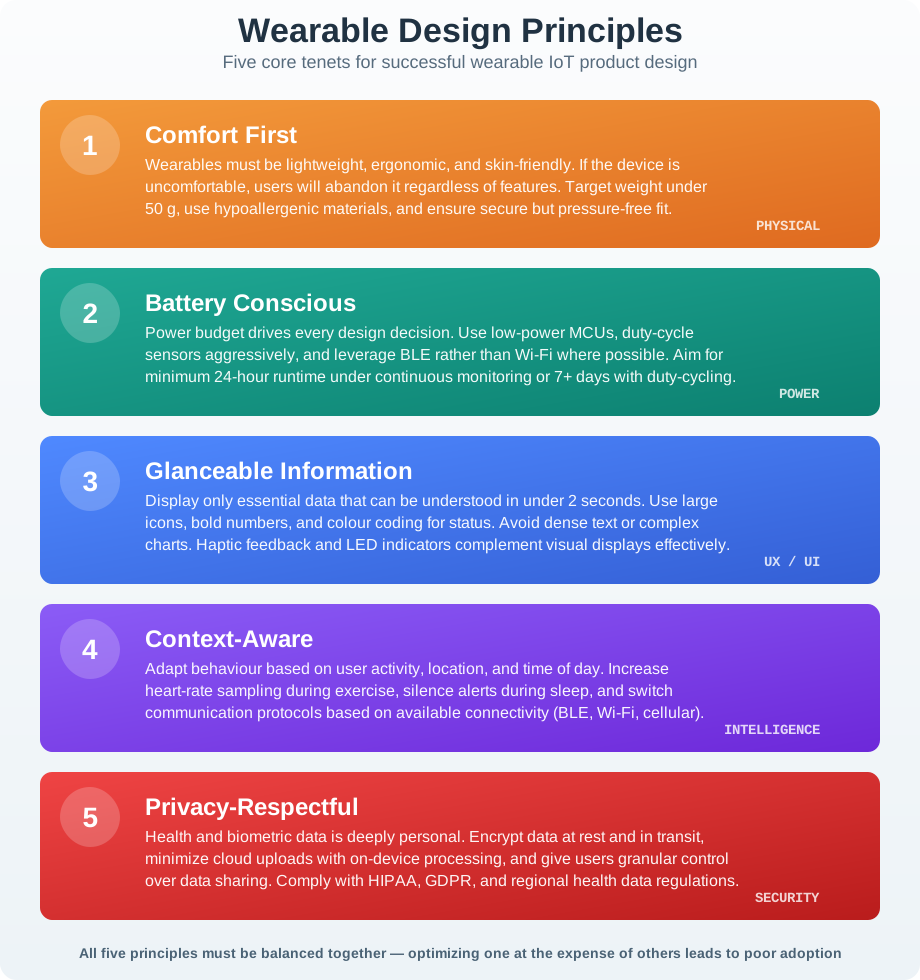
Read Figure 2 in three groups. Choice, appearance, and a short out-of-box setup determine whether someone adopts the device. Comfort, robust quality, and intuitive interaction determine whether it remains wearable through sweat, impacts, and daily use. An integratable API, compatibility with routines, and an obvious benefit determine whether its data belongs in a wider life or care workflow. Examples such as soft bands, water resistance, simple gestures, and multi-day battery make each risk concrete. A strong sensor cannot rescue a product that irritates, confuses, isolates, or offers no understood value.
6.9 Why Pebble Succeeded
Pebble provides a concrete comparison of these trade-offs:
Pebble’s Design Principle Adherence:
- 7-day battery life (Lifestyle Compatible) vs. competitors’ 1-day
- E-paper display readable in sunlight (Robust Quality)
- Affordable $150 price (Adoptable) vs. $300+ competitors
- Open API with 6,000+ apps (Integratable)
- Simple 4-button interface (Intuitive UX)
Result: Pebble raised funds through Kickstarter and reportedly sold about two million devices across all channels before Fitbit acquired certain assets in 2016. (Fitbit)
These battery, price, and app figures need model and date sources when reused. They describe design trade-offs; they do not by themselves establish what caused sales. Within the wider applications module, use the same discipline: connect a claimed benefit to evidence about the user’s daily task.
6.10 Summary
A wearable review connects body-signal quality to the decision it supports. Signal, power, privacy, and regulatory boundaries keep wellness trends, safety alerts, and clinical claims distinct. Device, phone, and cloud responsibilities must remain clear through disconnection, account recovery, sharing, and deletion.
The watch’s daily charge budget estimates ideal runtime, while a peak-load rail test checks whether it can deliver a current pulse safely. Placement and validation determine whether its measurements support the claim. Comfort, setup, robustness, integration, and a clear benefit determine whether someone keeps wearing it.
Review the measurement, permission, battery, and wear routine together: the wearable must support the intended decision and remain usable long enough to provide the evidence.