3 Healthcare IoT: Safety and Clinical Integration
3.1 Start With the Decision
A late or wrong vital sign can change a care choice. Safety, privacy, and data exchange must match the level of need.
3.2 Route Overview
This is part 2 of 2. Review Healthcare IoT: Care Workflows and Device Roles for the preceding evidence.
3.3 Learning Objectives
- Assess safety and privacy risks in clinical data flows.
- Match device integration controls to urgency tiers.
3.4 Chapter Roadmap
- Safety, Privacy, Interoperability
- Checkpoint: Care Workflow
- Clinical Urgency Tiers
- Healthcare Compliance Checker
- Trace Healthcare Alert First
- Quick Check: Healthcare Constraints
- Consumer vs. Clinical-Grade Devices
- Remote Monitoring Business Model Check
- Checkpoint: Clinical Grade Claims
- FDA Clearance Timeline and Cost
- Sleep Monitoring: Beyond the Wrist
- Ingestible Sensors for Adherence
- Putting Numbers to It
- Checkpoint: Adherence Economics
- Continue to Part 2
3.5 Safety, Privacy, Interoperability
Healthcare IoT fails when the device path, clinical workflow, privacy model, and regulatory evidence are designed separately. A prototype should expose those boundaries early so the team can decide whether it is building a wellness feature, a clinical decision support path, a regulated medical-device function, or an operational hospital tool. The boundary is not only legal; it affects telemetry retention, alarm priority, labeling, validation data, cybersecurity controls, and support staffing.
At the data layer, every observation needs provenance. A FHIR Observation should carry the subject, device, code, unit, effective time, status, performer or source, and interpretation when appropriate. The system also needs to preserve quality flags such as motion artifact, low battery, stale reading, disconnected lead, calibration due, or patient-entered value. Downstream clinical logic should be able to distinguish a confirmed abnormal measurement from a missing or low-confidence signal.
Inspect Figure 3.1 to follow one pilot observation from sensing to follow-up while preserving its clinical quality flags.
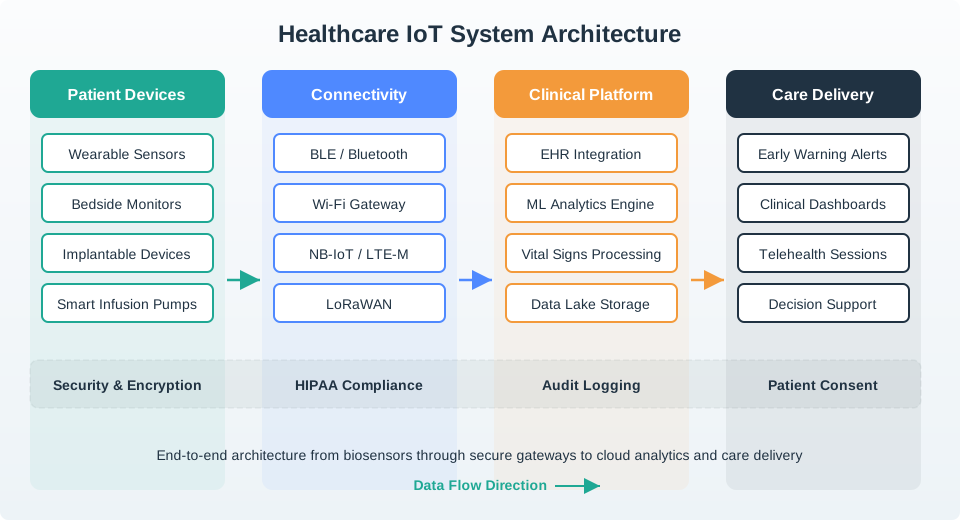
Begin Figure 3.1 with a bedside or home-monitoring observation and its unit, effective time, status, and source. Those fields and any quality flags must survive the route into FHIR rather than being flattened into an unqualified number. Rules may then create an alert, but the next boxes expose two failure points: patient matching can fail, and a noisy rule can overwhelm staff. The path closes only when an owned action produces follow-up. Shared identity, consent, security, and audit controls protect the whole chain, not a single interface.
- Safety boundary: define intended use, hazard, severity, alarm priority, false-positive cost, false-negative cost, human confirmation, and fallback action.
- Privacy boundary: define PHI fields, consent state, minimum necessary access, encryption, retention, deletion, secondary-use limits, and breach-response owner.
- Regulatory boundary: identify whether FDA 510(k), SaMD expectations, IEC 62304 software lifecycle, IEC 62366 usability engineering, ISO 14971 risk management, or cybersecurity documentation may apply.
- Interoperability boundary: version FHIR resources, device codes, units, patient matching, timestamp source, provenance, correction flow, and downstream notification behavior.
Security design has to match the clinical risk. Device identity, secure boot, signed updates, encrypted transport, access logs, least-privilege OAuth scopes, network segmentation, and incident response are not extras when the data can alter care. Availability also matters: local alarms, store-and-forward queues, gateway health checks, and downtime procedures must be tested because cloud availability does not guarantee bedside reliability.
The design is stronger when a reviewer can trace one abnormal measurement from device capture through edge processing, privacy control, EHR integration, clinician action, and patient follow-up without relying on a standalone dashboard. That trace should show why the alert exists, why it is safe to act on, why it is allowed to be shared, how it can be corrected, and what happens if the system is wrong.
 Checkpoint: Care Workflow
You now know:
- A healthcare IoT proposal starts with the care action, not the radio protocol.
- Every observation needs patient, device, timestamp, quality, consent, and escalation context before it can be trusted downstream.
- Edge response, cloud review, and batch analysis are different clinical commitments, so each needs its own owner and fallback path.
The next question is whether the device itself is allowed to carry that clinical role.
3.6 Clinical Urgency Tiers
Healthcare IoT systems should route data through different processing tiers based on the response window:
- Edge response: fall detection, infusion-pump faults, and critical arrhythmia flags need local scoring and immediate alarms because cloud latency or internet outages can delay care.
- Cloud review: deteriorating vital-sign trends, medication adherence gaps, and remote patient monitoring dashboards can use cloud analytics when a clinician can respond in minutes or hours.
- Batch analysis: population health, utilization review, and long-term therapy adherence are better handled as audited summaries rather than continuous alerts.
The ecosystem architecture should make the escalation path explicit: patient sensors feed an edge gateway for urgent triage, cloud analytics for trend detection, and clinical workflows that identify who acts on each alert.
3.7 Healthcare Compliance Checker
3.8 Trace Healthcare Alert First
Before choosing sensors or dashboards, write a one-row evidence record for a single alert.
- Patient state: what observable condition makes the alert clinically relevant, and what data proves it?
- Processing tier: does the decision need edge response, cloud review, or batch analysis?
- Clinical owner: which role receives it, and what action is expected within the response window?
- Noise control: what threshold, second signal, or review rule prevents routine variation from becoming an alarm?
- Fallback: what happens if the device, gateway, network, or EHR connection is unavailable?
Accept the design only when the row names a responsible role, a response time, evidence that supports the alert, and a fallback path. If any column is blank, the system is not ready for implementation.
3.9 Quick Check: Healthcare Constraints
3.10 Consumer vs. Clinical-Grade Devices
- Measurement performance: set and validate accuracy criteria for the device’s intended use and applicable standard; there is no single accuracy threshold for all health measurements.
- Regulatory pathway: determine classification and premarket requirements from the product’s intended use and product code; a clinical claim alone does not establish Class II or 510(k) status.
- Privacy compliance: consumer and clinical products must follow applicable privacy law; HIPAA applies when the data is handled by a covered entity or business associate.
- Uptime requirement: consumer products are best effort; clinical devices usually target 99.9% or better availability.
- Liability: consumer products carry product-support risk; clinical devices can enter medical-malpractice risk.
- Development cost and timeline: estimate these for the specific product, intended use, validation evidence, and regulatory pathway.
- Typical price: consumer devices often sell for USD 50-200; clinical devices often cost USD 500-2,000 or more.
Figure 3.2 answers what the phrase clinical grade actually commits a product to.
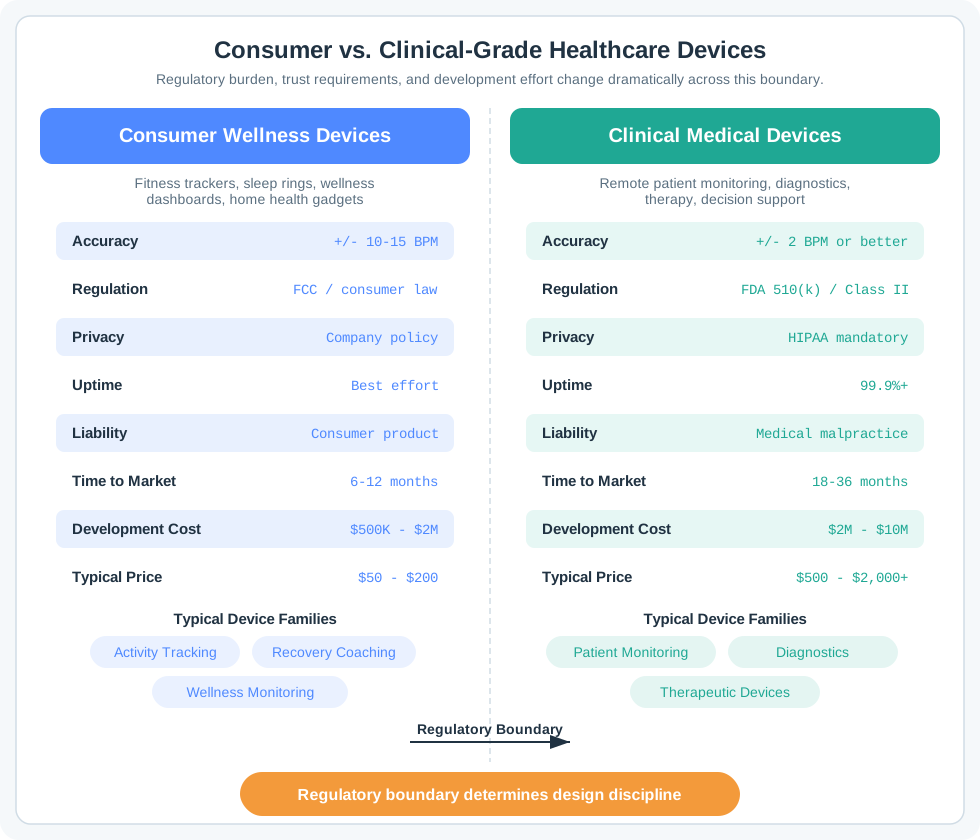
Read Figure 3.2 down the centre column, because that is where the requirement names sit. Accuracy criteria depend on the measurement and intended use; the figure’s examples should not be treated as universal limits. Privacy, availability, safety, and liability obligations also depend on the product and workflow. A team must define its clinical claim and validate the device against the applicable evidence requirements.
3.11 Remote Monitoring Business Model Check
Healthcare IoT economics depend on who pays for the workflow, not only on the sensor cost. A consumer wellness device may be funded by a subscription. A remote patient monitoring service may be funded by reimbursement codes, care-management contracts, or payer programs. A hospital platform may be funded by enterprise contracts, integration services, and support commitments.
Use a one-page business check before launch:
- Covered population: the number of eligible patients, inclusion criteria, and expected enrollment rate.
- Clinical value: the avoidable admissions, faster interventions, improved adherence, or staff-time savings the system can credibly affect.
- Operating cost: device replacement, connectivity, support calls, clinician review time, EHR integration, security monitoring, and compliance evidence.
- Payment path: reimbursement, payer contract, employer benefit, hospital budget, or patient subscription.
- Failure cost: false alarms, missed readings, patient churn, clinician fatigue, and integration downtime.
The safest business model is the one whose economics reinforce the care workflow. If revenue depends on collecting more low-value signals while clinicians are trying to reduce alert noise, the model will fight the clinical design.
Checkpoint: Clinical Grade Claims
You now know:
- Set measurement performance criteria for the intended use and validate them against applicable standards; there is no single heart-rate accuracy target for all clinical devices.
- Determine the regulatory pathway from intended use and product code. Cost and timeline estimates depend on the specific product, evidence needs, and pathway.
- Uptime, privacy, liability, and payment path are part of the architecture because healthcare value depends on the workflow staying usable.
Once the intended use and evidence needs are clear, the regulatory and financial plan can be scoped.
3.12 Scope a Regulatory Pathway
Before estimating cost or delivery time, record:
- The product’s intended use, user, patient population, and claims.
- Its likely FDA product code and classification, confirmed with the appropriate regulatory expertise.
- Whether a premarket submission applies and what evidence the pathway requires.
- Validation, usability, cybersecurity, and clinical evidence needed for the specific claims.
Classification, submission route, evidence, cost, and timing depend on the actual product and intended use. A device complexity label alone cannot determine a 510(k) requirement or produce a reliable estimate.
3.13 Sleep Monitoring: Beyond the Wrist
Traditional fitness trackers measure sleep from the wrist, but advanced sleep monitoring uses under-mattress sensors that detect:
Figure 3.3 shows what an under-mattress sensor has to look like before it can work at all.

The device in Figure 3.3 is a flat, featureless disc, and the shape is the design argument. It has to be thin enough to slide under a mattress without the sleeper feeling a ridge. Nothing on it invites daily handling either: two small buttons and a charging port on the rim, no display, no strap. What it senses reaches it through the mattress, as the pressure and vibration changes made by breathing, heartbeat, and movement. That is why the measures listed below need no electrodes and no wrist device, and also why placing it under the sleeper’s torso matters more than any setting in the app.
- Sleep stages: body micro-movements and breathing patterns identify sleep disorders and help optimize rest.
- Heart rate: ballistocardiography detects irregularities without electrodes.
- Breathing rate: chest movement patterns help identify sleep apnea episodes.
- Snoring: audio and vibration analysis correlate snoring with oxygen levels.
- Sleep efficiency: time asleep versus time in bed tracks improvement over time.
Why Under-Mattress vs. Wrist?
- No device to wear or charge daily
- More accurate heart/breathing detection (closer to torso)
- Captures partner’s data separately
- Works for patients who can’t wear wristbands
3.14 Ingestible Sensors for Adherence
The Problem: WHO reports average adherence to long-term therapies of about 50%; this describes patients, not the fraction of purchased doses discarded. The estimate does not establish a dose-waste rate or savings for an ingestible sensor.
The Solution: Ingestible sensors embedded in pills that confirm medication was actually swallowed.
How It Works:
- Sensor composition: Tiny chip made of copper, magnesium, and silicon (all safe, naturally occurring in food)
- Activation: Stomach acid creates a battery effect between metals, powering the sensor
- Signal transmission: Low-power signal passes through body to wearable patch
- Confirmation: Timestamp recorded, patient and provider notified
- Elimination: Sensor passes through digestive system harmlessly
Figure 3.4 answers how a swallowed pill can prove it was taken, and where that proof could break.
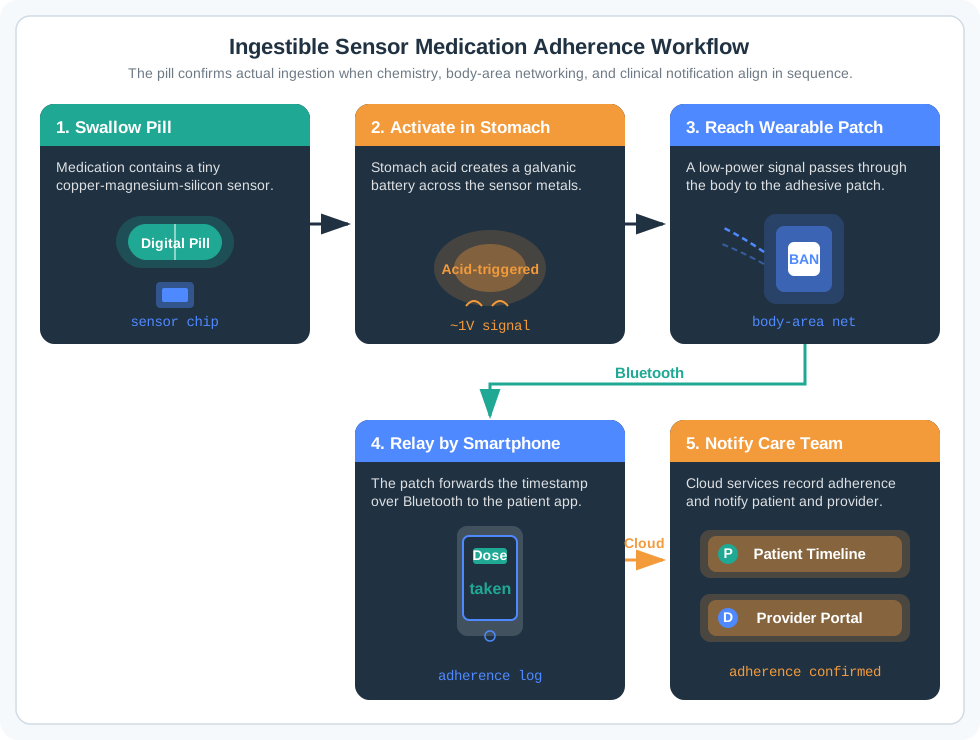
Figure 3.4 runs in five steps, and each one changes what carries the signal. The pill holds a tiny sensor made from metals that do nothing until stomach acid reaches them, and the acid then acts as the battery, which is why no charge is stored on board. The weak signal travels through the body itself to an adhesive patch, and only at the patch does the event become a timestamp. Bluetooth carries that timestamp to a phone, and the cloud step turns it into a record a patient and a clinician both see. Follow the chain and the failure modes appear with it. A missing patch, a flat phone or a lost upload breaks the proof, not the dose.
Clinical Impact:
- Used for psychiatric medications, HIV treatment, heart failure drugs
- Proves actual ingestion (not just prescription filled)
- Enables “pay for adherence” insurance models
- The FDA-approved Abilify MyCite label states that its ability to improve patient compliance has not been established.
3.15 Putting Numbers to It
The economics of medication non-adherence reveal why ingestible sensors matter:
Scenario assumptions: For this example only, assume that half of an already-purchased prescription is discarded and a validated intervention reduces the discarded share to 15%; these are not general adherence or product-efficacy findings.
For a hypothetical USD 200/month prescription already purchased, suppose 50% of doses are discarded and a validated intervention reduces discarded doses to 15%:
- Baseline waste: USD 200 x 0.50 = USD 100 per patient-month.
- Waste with sensors: USD 200 x 0.15 = USD 30 per patient-month.
- Net savings: USD 100 - USD 30 = USD 70/month before avoided hospitalizations.
If those assumptions held for a health plan covering 10,000 patients, the arithmetic would be USD 8.4M annual savings before avoided hospitalizations; this is a conditional scenario, not demonstrated savings.
Checkpoint: Adherence Economics
You now know:
- WHO’s roughly 50% average adherence estimate does not specify the share of doses discarded.
- In the worked example, 50% and 15% are hypothetical discarded-dose assumptions for a prescription already purchased; the intervention’s efficacy must be validated.
- Under those assumptions, 10,000 patients would yield a conditional USD 8.4M annual savings estimate before avoided hospitalizations.
Adherence shows why healthcare IoT can be valuable, but weak signals are dangerous.
3.16 Continue to Part 2
Continue with Healthcare IoT: Value, Alerts, and Adoption.
3.17 Continue Your Route
This final part closes the route from Safety, Privacy, Interoperability through Continue to Part 2. Return to Healthcare IoT: Care Workflows and Device Roles or continue from the applications module index.