9 Medication IoT: Adherence Evidence and Verification
More
Depth: Practitioner
Progress saves as you read. Mark sections complete as you go; your progress appears in the sidebar.
- Podcast audio coming soon
- Character narration audio coming soon
9.1 From a Bottle Event to a Care Decision
A lid-open event is not the same as a swallowed dose. Medication IoT helps only when the care record shows what the device observed, how the observation reached the team, and what remains unknown. This chapter follows that evidence from sensor to record, then asks what stronger verification and continuous monitoring add. It builds on Medication IoT: Device and Workflow Boundaries, the preceding part of this two-part route.
Grandpa Joe takes three medicines each day: one in the morning, one at lunch, and one at bedtime. He sometimes forgets a dose and sometimes takes the morning pill twice because he cannot remember taking it. His family gets him a smart pill bottle. Its weight sensor detects changes in the pills’ combined weight. The Bluetooth chip sends observations to his phone; a blue light and phone notification remind him when a scheduled change has not appeared. The memory chip keeps a diary of lid openings, times, and sensor evidence about pill removal.
The diary reveals a pattern: lunch doses appear to be skipped while morning and bedtime doses are regular. The doctor discusses the pattern with Grandpa Joe and learns that the lunch medicine causes a side effect. Changing that medicine helps him feel better. Reminders can help people remember, while a reviewable history helps doctors investigate why doses are missed. The sensor alone cannot establish the reason.
Medication adherence means taking medicine as prescribed, in the right amount and at the right time. A smart dispenser stores pills, senses access or removal, and can send reminders. An ingestible sensor is a tiny chip carried inside a pill whose activation in the stomach supplies more direct ingestion evidence. None of these observations alone establishes treatment benefit.
The problem is therefore both practical and evidential: help Joe follow his regimen without turning missing telemetry into a claim that he missed medicine. The approaches below connect reminders to specific barriers, preserve provenance through the care workflow, and distinguish bottle evidence from ingestible signals and longer-term symptom monitoring.
KEY CONCEPTS
- Evidence boundaries
An opened lid, a removed pill and an ingestion signal support different claims.
- Provenance
Keep the source, time and reconciliation history of each observation.
- Consent and care
Carry permission and responsibility through every relay.
- Monitoring coverage
Background sensing reveals variation between appointments.
9.2 Learning Objectives
- Trace adherence data from sensor event to care record.
- Design verification checks for medication claims.
9.3 Match the Adherence Barrier to the Help
Joe’s lunch medicine shows why reminders are only one approach. Forgetfulness, uncertainty about effectiveness, fear of side effects, regimen complexity, and cost concerns need different responses. IoT devices can remind, collect verification evidence, and report medication-taking patterns, but the best device is the one that fits the existing clinical workflow and gets useful information to the doctor.
The scale makes that workflow consequential. The source estimates below need their stated scope; they should not become a universal claim about every prescription or patient.
| Statistic | Value | Source |
|---|---|---|
| US healthcare spending on chronic conditions | 84% of total | Johns Hopkins University |
| Average adherence to long-term therapy among patients with chronic disease in developed countries | About 50% | WHO (2003), report on failure to take prescribed medicine |
| Reported US cost of non-adherence | Varies by study; identify the original year, US scope, and cost categories before stating a figure | Original cost study required |
| Hospital admissions due to non-adherence | Nonadherence contributes to some admissions; estimates require a defined study and hospital-admission denominator | Study-specific |
Smart dispensers with alerts and wearable reminders address forgetfulness. Connected monitoring can show health changes when a patient is unsure whether treatment helps, while real-time tracking can help a team investigate adverse reactions. Automated sorting, timing, and dosing address regimen complexity. For cost concerns, evidence of value can support an insurance-coverage justification; collecting data does not itself guarantee coverage.
The simplest connected bottle detects a lid opening and sends that event to a phone app or doctor’s system. More elaborate systems add removal checks or ingestible signals. Before choosing among them, follow how an observation becomes a care record: a technically impressive device with an isolated dashboard can be less useful than a simple EHR-connected bottle.
9.4 Preserve the Evidence Through Reconciliation
For Joe’s doctor to interpret the diary, each entry needs provenance: its source and the history needed to understand the observation. A smart dispenser can combine load cells, lid switches, beam-break sensors, RFID/NFC tray identity, motor encoders, real-time clocks, tamper switches, local storage, and battery state. It may send events through BLE to a phone, Wi-Fi to a home router, cellular for independent operation, or MQTT/HTTPS over TLS to a cloud service. Each event needs a device id, compartment id, medication id, schedule version, timestamp source, sequence number, confidence, and offline-sync status.
Ingestible systems add another chain: sensor-enabled pill, body-worn patch, mobile app, cloud service, clinician portal, and optional EHR update. Missing patch contact, delayed activation, phone offline state, patient refusal, duplicate ingestion signals, and portal acknowledgement are different states. Record them separately rather than silently converting them into adherence or non-adherence. If a patch loses contact and no new signal appears, ingestion remains unverified; the contact failure does not establish what Joe swallowed.
An electronic health record (EHR) is the digital clinical record used by the care team. Integration is a reconciliation problem: a FHIR or HL7 interface must match device events to the current order, patient identity, encounter context, and clinician workflow. OAuth 2.0 or SMART on FHIR authorization, audit logs, role-based access, business-associate agreements when HIPAA applies, minimum-necessary data fields, and clear provenance help keep telemetry from becoming an untrusted side dashboard.
A practical review traces the same observation all the way from the sensor event to the care record. Start with what the sensor measured, identify the schedule it was compared against, and keep the upload state separate from the event time. Then identify the patient and current order before deciding what the care team should see. This is how the system can support a correction without making its earlier uncertainty disappear. It also explains why a simple connected bottle can be more useful than a 15-sensor silo: the team needs actionable evidence in its workflow.
The record must keep three kinds of state distinguishable. Device state includes battery, clock drift, compartment inventory, motor fault, sensor calibration, tamper flag, firmware version, and last successful sync. Adherence state includes due, reminded, snoozed, dispensed, removed, ingestion-signal received, patient-corrected, missed, escalated, reviewed, and reconciled. Clinical-data state includes active or discontinued order, pharmacy fill, FHIR resource id, source system, consent scope, audit event, and provenance record. A reminder, access event, removal, caregiver follow-up, and clinician review each says something different about the care loop.
The event store should be append-only and idempotent: processing a repeated upload should not create another medication action. A dispenser reconnecting after a weekend offline may upload stale reminders, duplicate door-open events, and a corrected patient note. Deduplicate by device id, sequence number, schedule version, and event timestamp while keeping the original observation for audit. Distinct source events remain distinct even when they arrive in one batch.
Analytics should use reconciled views such as “dose likely taken,” “dose uncertain,” “device fault,” and “order changed,” rather than raw sensor events alone. The correction and its source context must remain reviewable.
Security and privacy belong in that data model. Use device certificates or provisioned keys for hardware identity, TLS for transport, short-lived OAuth tokens for app access, and role-based authorization for caregiver and clinician views. Retention policies should allow deletion of dose-level data without destroying the clinical summary. If a cloud queue or stream processor is used, preserve source, consent scope, and processing version through every derived adherence score.
These distinctions let the team investigate an uncertain dose without confusing a failed device, a changed prescription, and a patient’s choice. Check those boundaries before comparing stronger sensors.
9.5 Choose What the Dispenser Can Observe
A dispenser improves the care loop by making its observations explicit. In Figure 1, the hardware produces facts about the opened tray, weight removed, carousel movement, and prompts. The encrypted link carries those facts to cloud functions that maintain a schedule, identify adherence patterns, and apply an alarm rule.
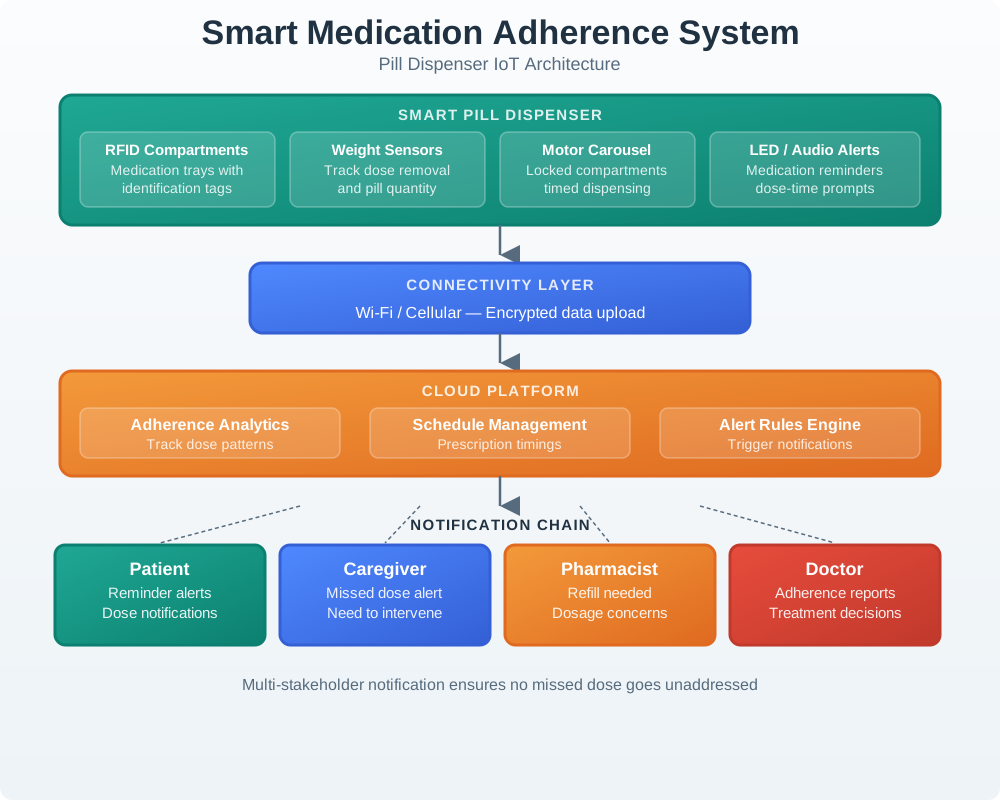
RFID-tagged trays and weight sensors organize medications by day and time. Locked compartments or a motor-driven carousel control access to the correct pills. Audio alarms, LEDs, and phone notifications prompt the patient when a dose is due; beam-break, weight-change, or camera-based checks provide evidence of removal. Events can reach the cloud over Wi-Fi, cellular, or LoRaWAN. Local storage, battery support, and an offline mode keep the dispenser operating during outages.
The last stage carries responsibility as well as data: patient, caregiver, pharmacist, and doctor may each need a different response to the same missed-dose event. The architecture can support evidence that a pill left the machine. Swallowing remains outside that observation. For Joe, the useful question is whether the available evidence supports a reminder, a follow-up conversation, or clinician review, rather than whether the device has the largest sensor count.
9.6 Add Ingestion Evidence Without Overstating It
An ingestible sensor addresses the gap between bottle access and ingestion. Figure 2 follows the swallowed pill through activation in stomach fluid, which acts as the electrolyte for a tiny battery. A low-power body signal reaches a wearable patch; a phone relays the timestamp through the cloud to a provider dashboard.
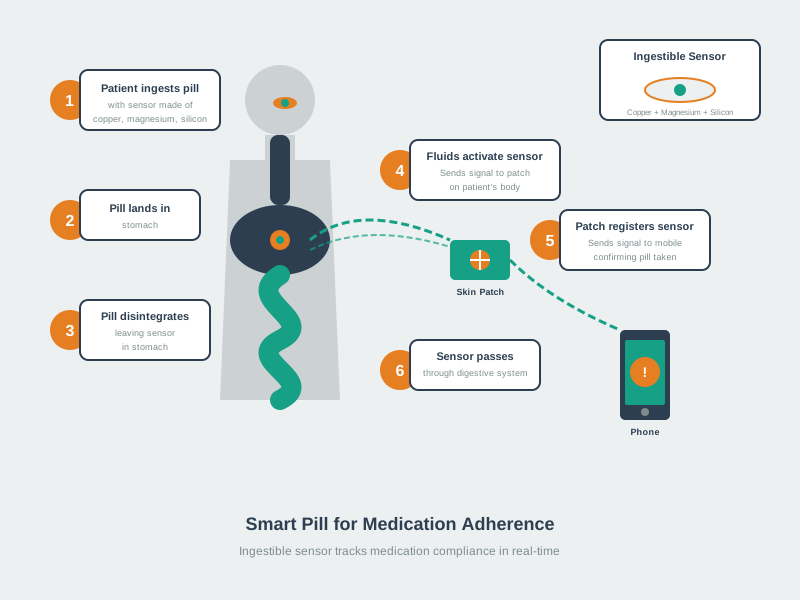
The Proteus Digital Health system architecture in Figure 3 makes that mechanism concrete. Its 1 mm chip uses copper, magnesium, and silicon, described here as edible materials already found in multivitamins. When the pill dissolves, stomach acid acts as electrolyte and produces about one volt for a brief low-power signal. The signal travels through body tissue to the patch, then through smartphone and cloud service to the healthcare-provider dashboard.
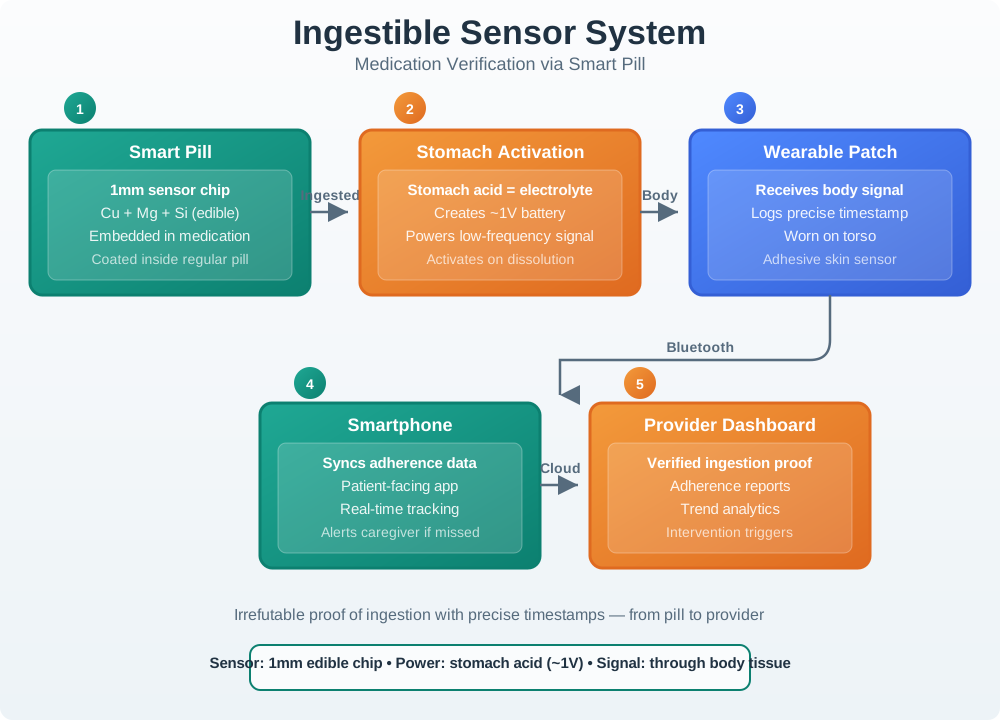
A recorded signal is more direct evidence of an ingestion event and its time than an opened bottle or reminder. It does not prove absorption, actual drug exposure, or the intended therapeutic effect. Every relay still requires validation: a valid patch signal and an absent signal during failed patch contact support different conclusions. Precise timestamps do not remove uncertainty about missing observations.
Potential uses include clinical trials seeking evidence beyond dispensing, value-based insurance contracts tied to adherence, and monitoring high-stakes medicines such as transplant anti-rejection drugs, HIV antiretrovirals, and psychiatric medications. Opioid monitoring likewise seeks evidence about appropriate use in pain management. In each case, the recorded event needs interpretation within the care workflow rather than an automatic claim of clinical success.
Exact ingestion tracking also raises surveillance concerns. Clear patient consent and data-ownership policies must balance clinical benefit against privacy risks. Consent, usability, and responsibility remain part of the architecture even when the sensor supplies stronger evidence.
9.7 Evaluate the Avoided-Cost Case
Stronger evidence also has to justify a program’s full cost. Evaluate adherence programs on avoided-cost economics rather than device price alone. In the chapter’s model, annual savings equal patient count multiplied by adherence improvement and avoidable cost per patient. Express the change in adherence percentage points as a fraction before multiplying.
For 5,000 chronic-care patients, improving adherence from 52% to 72% is a 20-percentage-point improvement, or 0.20. At an estimated avoidable cost of $1,200 per patient-year, annual savings are 5,000 × 0.20 × $1,200 = $1,200,000. A full program costing $420,000/year leaves a net benefit of $780,000. Using the tool’s program-cost-to-annual-net-benefit calculation gives approximately 6.5 months; that figure depends on the stated model and assumptions.
The separate tool lets you vary those assumptions and compare savings, net benefit, and the modeled payback period.
9.8 Observe Symptoms Between Appointments
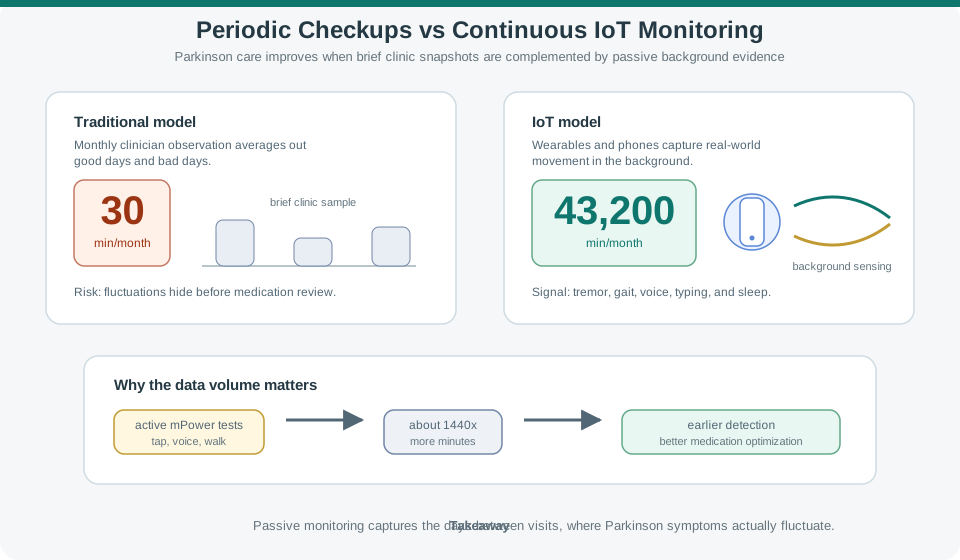
Dispenser and ingestible evidence concern medication events. Chronic monitoring asks a further question: what happens between those events and between appointments? A chronic disease lasts months or years and needs ongoing care. Patients with chronic neurological conditions such as Parkinson’s disease experience daily symptom fluctuations that a monthly visit cannot fully capture. Good and bad days can average together, making medication optimization difficult.
The chapter’s scale estimates put prevalence among people over 60 at 1 in 100. The Parkinson’s Foundation reports about 1.1 million US patients and more than 10 million worldwide (Foundation statistics). The chapter also gives about 60,000 new US diagnoses each year. Historical dopamine-neuron-loss estimates at diagnosis vary across methods; 60–80% should not be treated as a fixed clinical threshold.
The observation comparison is 30 minutes/month in the traditional model versus 43,200 minutes/month of continuous, 24/7 data in the IoT model. Figure 4 shows that roughly 1,440-fold difference in coverage. Extra minutes create opportunities to observe fluctuations; they do not automatically make a measurement more accurate or establish a diagnosis.
Different sensors expose different patterns. A 3-axis accelerometer measures tremor frequency to estimate symptom severity; Parkinsonian tremor often falls in the 4–6 Hz range. An inertial measurement unit (IMU) plus GPS can characterize gait, including freezing episodes and shuffling. A microphone captures voice changes such as hypophonia and monotone speech. Touchscreen typing rhythm can reveal fine-motor decline, while a bed sensor can identify movement patterns associated with REM sleep behavior disorder.
The Parkinson’s mPower app shows how smartphone tasks can contribute assessment evidence. Its spatial memory test measures pattern recall and repetition to track cognitive decline. The tapping interval test measures finger-tap speed and rhythm to quantify bradykinesia. Sustained “Aaaah” phonation in the voice test surfaces hypophonia, vocal tremor, and breath-control changes. The walking test uses the accelerometer to reveal gait patterns such as shuffling and freezing episodes.
Those are active tests: the patient deliberately performs a requested task and must remember to do it. Passive monitoring instead collects background observations during ordinary routines. It can capture real-world behavior between planned tests, rather than only behavior under test conditions. Movement, voice, typing, and sleep extend the observation window, but collection still needs consent and a clear care purpose.
For the medication care loop, this returns us to the distinction that mattered for Joe: an observation helps a clinician investigate a pattern. Neither an adherence score nor continuous symptom data removes the need to interpret evidence and decide who follows up. The applications module index places this case alongside other connected-care uses; the separate check asks you to compare their evidence boundaries.
Summary
Medication IoT connects reminders, sensor observations, and clinical review. Joe’s bottle can reveal patterns of access or removal; a clinician’s conversation establishes why his lunch regimen is troublesome. Provenance keeps those observations tied to their source, time, schedule, and consent. Reconciliation separates duplicate uploads, device faults, patient corrections, and changed orders before an adherence judgment reaches the care record.
Ingestible signals add timestamped ingestion evidence without proving absorption or treatment effect. Continuous monitoring extends coverage between visits, while active tests and passive observations answer different questions. Both need validation and a usable clinical workflow. Program economics should use explicit adherence and avoided-cost assumptions alongside those evidence boundaries.
Record what the sensor observed, preserve what remains uncertain, and connect each claim to a responsible care decision.
Carry these evidence boundaries into Medication IoT: Integration, Evidence, and Safety.