8 Medication IoT: Device and Workflow Boundaries
More
Depth: Practitioner
Progress saves as you read. Mark sections complete as you go; your progress appears in the sidebar.
- Podcast audio coming soon
- Character narration audio coming soon
8.1 Start With a Missed Dose
A smart dispenser cannot prove that a patient took a dose. Medication IoT connects observations to a care workflow, so its first job is to keep device events separate from clinical claims. This chapter maps devices to care roles and sets boundaries for dispense and adherence evidence. Dispenser architecture, ingestible verification, and chronic monitoring all depend on those boundaries.
Picture a patient who misses a dose. The bottle records a lid opening after a reminder, but that clue alone cannot establish that the medicine was taken. A missed dose may look small to the device and still matter greatly to the patient, caregiver, or clinician. The care goal is timely evidence and humane escalation: reduce false assumptions, protect privacy, and support care without turning reminders into noise.
Follow this patient through one care loop. A valid order identifies the patient and planned dose time. The device gives a reminder; the patient may act; the sensor records a limited clue with its source and time. A missing clue starts a safe check. Before choosing a sensor, name the care goal, what the device can observe, what it cannot know, and who owns the final care choice. Decide how soon evidence must arrive, what counts as an exception, and who checks a missed event. The patient needs a way to correct mistakes, and the workflow needs a manual path during a link gap.
Three communication terms help make those decisions concrete. Latency is the time from an event to the result that needs it. Bandwidth is the data capacity available on a link. A protocol is an agreed set of rules for exchanging data. These describe the data path; the care plan must still say what a received event means and who may act on it.
The problem is therefore larger than sensing pill activity. Now we can compare the approaches: preserve each event’s evidence limit, connect it to the active order, and give exceptions an accountable human response.
KEY CONCEPTS
- Dose event
A dispenser opening does not by itself prove ingestion.
- Identity check
Device and person must match the prescription workflow.
- Escalation
A missed or uncertain dose needs a named care owner.
8.2 Part Objectives
- Map medication devices to care-workflow roles.
- Set claim boundaries for dispense and adherence events.
8.3 Preserve the Event’s Evidence Limit
With the missed dose in mind, trace what the bottle can contribute before deciding what anyone should do.
A medication-adherence system has to distinguish several different events: a dose is scheduled, a reminder is delivered, a compartment is opened, a pill is removed, ingestion is inferred or confirmed, a missed-dose pattern is reviewed, and a clinician or caregiver decides whether action is needed. A phone notification alone only covers one part of that workflow.
The design boundary matters because adherence data can easily become surveillance. A smart bottle may know that the lid opened or the weight changed, but it does not know with certainty that the patient swallowed the medication. An ingestible sensor can provide stronger ingestion evidence, but it also raises consent, privacy, usability, and clinical-workflow burdens. The system must present these limits honestly.
Inspect Figure 1 to see how a dispenser event keeps its evidence limit while moving toward an accountable care decision.
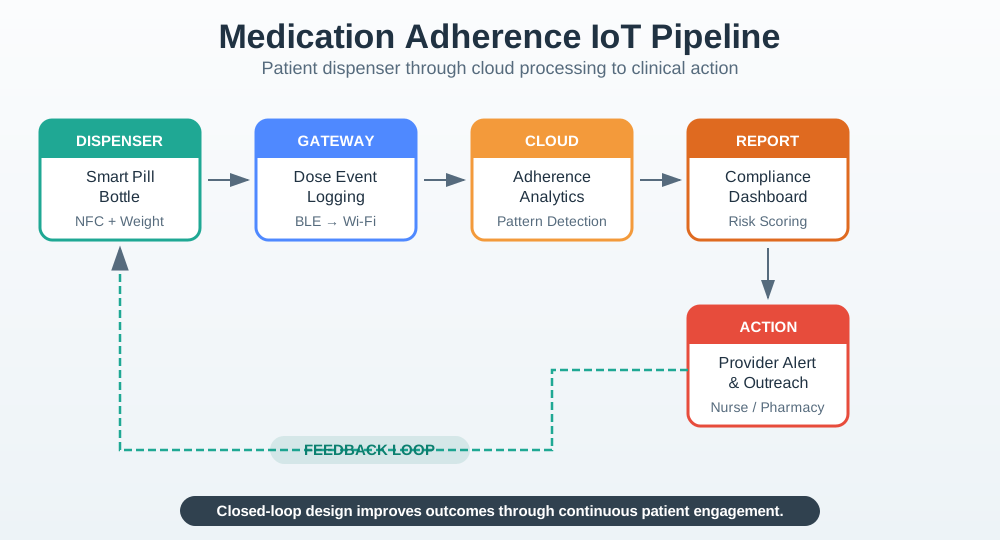
Follow Figure 1 from a reminder, lid opening, weight change, or removal event. Preserve its source and time, then keep late, repeated, or missing context visible as the event becomes an adherence summary. The clinical report must link to the current prescription and defined care plan before a clinician or caregiver decides whether to act. Outcome feedback then returns to the patient workflow. The evidence boundary remains explicit throughout: an observed bottle event is not confirmed swallowing, so the system must not collapse every signal into a single “taken” flag.
A useful design therefore asks what evidence level is appropriate for the medication and harm model. A low-risk vitamin reminder may only need a local notification and a patient-edited history. A transplant immunosuppressant, tuberculosis course, antipsychotic depot program, or high-risk clinical trial may justify stronger verification, faster escalation, and tighter audit trails. In every case, the product should state whether it observed access, removal, ingestion-linked activation, or patient self-report.
The user experience also has to protect dignity. Missed doses can reflect side effects, cost, confusion, dexterity limits, travel, depression, or distrust of monitoring. Good systems make corrections easy, separate supportive nudges from punitive reporting, and summarize patterns so care teams can discuss barriers instead of treating every exception as noncompliance.
The event boundary separates reminder, access, removal, ingestion signal, patient correction, caregiver follow-up, and clinician review instead of collapsing them into one “taken” flag. The workflow boundary routes adherence summaries into the care workflow only when they are actionable, attributable, and tied to the current medication order. The autonomy boundary preserves patient consent, snooze, correction, sharing, retention, and opt-out controls so monitoring supports care rather than punishment.
8.4 Assign Roles, Orders, and Exceptions
The evidence limit tells us what happened; the active order and care plan determine the next step.
The practical question is not “Can the device sense pill activity?” It is “Who needs to know, how soon, and what can they safely do with the information?” A self-managed hypertension regimen, caregiver-assisted dementia support, post-discharge antibiotic course, tuberculosis directly observed therapy program, opioid dispensing lockbox, and insulin-management workflow all have different roles, risk levels, and escalation rules.
Design the adherence path around patient, prescriber, pharmacist, caregiver, payer, and support-team responsibilities. The device should not change medication dosing on its own. It should record what it observed, let the patient correct the record, compare events to the active prescription, and escalate only according to a defined care plan. Integration should use existing clinical data models where possible through Fast Healthcare Interoperability Resources (FHIR): FHIR MedicationRequest for the order, MedicationStatement or Observation for patient-reported and device-reported events, Device for hardware identity, and Provenance for source and timestamp context.
Before choosing hardware, write a scenario matrix. For each medication, list the dose timing tolerance, likely failure mode, available human responder, and consequence of a false positive or false negative. A weekly pill organizer for an independent older adult may prioritize refill visibility and caregiver summary reports. A lockable opioid dispenser may prioritize tamper evidence, local access control, and pharmacy reconciliation. A connected insulin workflow must separate adherence telemetry from dosing advice, because continuous glucose monitoring (CGM) error, meal timing, insulin-on-board calculations, and pump safety limits make automated action riskier than simple reminders.
- Model the medication order. Capture drug, dose, route, schedule, start/end date, prescriber, pharmacy fill, substitutions, and discontinued orders before interpreting adherence.
- Classify the event type. Distinguish lid-open, compartment-unlocked, weight-change, pill-drop, camera-confirmed removal, patch-confirmed ingestion signal, and patient self-report.
- Set escalation rules. Define when the system reminds the patient, notifies a caregiver, queues a pharmacist call, creates a clinician summary, or stays silent.
- Keep consent visible. Show who can see dose-level events, who receives summaries, how long data is retained, and how corrections or revocations are handled.
Plan the handoff points explicitly: app notification to patient, SMS or push summary to caregiver, pharmacy refill call, clinician inbox message, electronic health record (EHR) flowsheet update, or trial-monitoring dashboard. Each handoff needs throttling, acknowledgement, and a downtime rule so the system does not create alarm fatigue or invisible work.
8.5 Keep the Care Path Usable and Reviewable
Those handoffs depend on the patient, the device, and the data path continuing to work together. For the patient in our scenario, a reminder must be clear and its sound must not shame. The patient can ask for help and correct an error. A carer sees only needed data, while a clinician sees the right care record. Each alert has one owner, repeated alerts can stop, and a manual path remains available. Consent, snooze, sharing, retention, and opt-out controls are part of that daily workflow.
The device needs equally explicit support rules. Check the sensor’s known limits, clock, and battery. Its link can fail, so saved events must keep their original times. A replacement must remain assigned to the right owner; a lost device must lose access. False events stay visible for review. Maintenance needs a clear rule, and support must be able to distinguish silence from a device fault. Otherwise, a missing report can be mistaken for a missed dose.
Across the data path, send only needed facts and protect private information for the stated care job. Systems must agree on identity, and the care record must preserve the event’s source. Late events remain identifiable as late, repeated events remain recognizable, and missing events remain missing. A human must be able to review the trail. Give each system connection an owner and each failed join a fallback, rather than leaving the patient or care team to discover the gap.
Integration with an EHR is a central adoption concern. Consider a simple weight-sensor pill bottle connected to Epic through FHIR versus a 15-sensor device that creates another data silo: usable clinical integration can deliver more value than extra sensing. FHIR provides clinical data models for that exchange, including the order and event resources used above. Medication IoT: Integration, Evidence, and Safety develops the integration, privacy, regulation, and return measures that constrain a service claim.
Treat a 30–40% cost and 6–18 month reserve only as an example planning allowance. Estimate Food and Drug Administration (FDA) review, Health Insurance Portability and Accountability Act (HIPAA) work, and CMS billing requirements separately for the applicable pathway. Older US estimates of medication non-adherence costs are method-dependent: retain the original year and method when using them. IoT may address only part of the problem, after efficacy has been demonstrated. A cost result needs stated inputs, and an avoided hospital stay is not guaranteed.
Sensor accuracy also limits the claim. For CGM, mean absolute relative difference (MARD) summarizes average error across matched measurements. It does not bound an individual reading or determine an alert threshold. Alerting, confirmation, and dosing guardrails must follow approved device labeling and be validated for the intended population and clinical workflow. A body sensor still has limits, a symptom score needs context, and a reminder aid is not a diagnosis.
Before release, check that the goal is clear, the aid is bounded, and the patient and care team can use and support it. Privacy must fit the job; faults need owners; benefits need evidence; harm needs a stop rule; and the next review date must be known. A small trial supports a limited scope. A new care group needs new evidence, and a new rule needs fresh review. None of these checks turns a lid event into proof that a dose reached the patient.
Summary
Medication IoT supports care by preserving what each device actually observed. Keep reminders, access, removal, ingestion signals, and self-reports distinguishable. Connect those observations to the current prescription, patient identity, and care plan before routing an actionable summary to a responsible person.
Patient correction, consent, downtime rules, device support, and clinical integration make that path usable. Accuracy, cost, and trial evidence limit the claims a service can make, even when its data arrives successfully.
Report the observed event with its source, time, and limits. A safe care decision also needs the active order, context, and a named human owner.
Carry this evidence into Medication IoT: Adherence Evidence and Verification, which begins with Adherence Data Provenance.