4 Healthcare IoT: Value, Alerts, and Adoption
4.1 Start With the Story
A clinical device can produce a trustworthy reading, but that does not prove the service is affordable or that staff can act on every alert. The team must price the clinical outcome, budget operating work, and prevent false alarms from overwhelming the care pathway.
4.2 Overview
This route connects clinical value to ROI, alert burden, adoption, worked decisions, platform choices, privacy, and safe device operation.
This is part 2 of 2. Review Healthcare IoT: Workflows and Clinical Devices when you need the first route.
4.3 Learning Objectives
By the end of this chapter, you will be able to:
- price a healthcare IoT service from clinical value
- calculate alert and remote-monitoring operating costs
- evaluate adoption, privacy, and connected-device risks
4.4 Chapter Roadmap
Follow the original sections below in order. They begin at the reviewed split boundary and keep every worked example, figure, check, and supporting banner with the section that owns it.
4.5 Price by Clinical Value
Value-based pricing can fit healthcare IoT only when the value claim is measurable and clinically owned. A device that reduces readmissions, prevents missed medication doses, or saves nurse review time can support a stronger price than a device sold only as hardware. But the claim must survive evidence review.
A practical pricing packet should state:
- Baseline cost: current admissions, medication waste, manual follow-up time, or avoidable clinic visits.
- Measured improvement: the expected reduction in that cost, with pilot evidence or published assumptions.
- Customer share: the portion of first-year value captured by the vendor while the provider or payer keeps a clear net benefit.
- Risk adjustment: exclusions for patients who cannot use the device, poor connectivity, low adherence, or workflow rejection.
- Audit path: how outcomes, false positives, device downtime, and support burden will be measured after launch.
The price is defensible when the buyer can trace the fee to avoided clinical or operational cost. It is weak when it only multiplies manufacturing cost by a markup or copies consumer subscription logic into a regulated care setting.
4.6 Medication Adherence ROI
Calculate the return on investment for ingestible sensor medication adherence systems.
Key Insight: The $300 billion annual cost of medication non-adherence motivates testing ingestible sensors for chronic conditions, but their ability to improve adherence and produce savings must be established for each use.
4.7 The “Worried Well” Problem
4.7.1 The “Worried Well” Problem
When fitness trackers and health monitors flag potential issues (irregular heartbeat, abnormal sleep patterns, suspicious readings), users may seek clinical follow-up:
- Consumer health device alerts can prompt clinical follow-up among healthy users.
- Quantify the effect and cost for a documented population before making broader claims.
- The most health-conscious users (who buy devices) may be less likely to have serious conditions.
Design Lesson: “Integration-first” beats “innovation-first.” A simple device that sends data directly to your EHR may be more valuable than a sophisticated device that doesn’t.
Figure 4.1 answers the practical version of the false alarm problem: what has to happen to a raw monitor feed before a nurse should be asked to look at it?
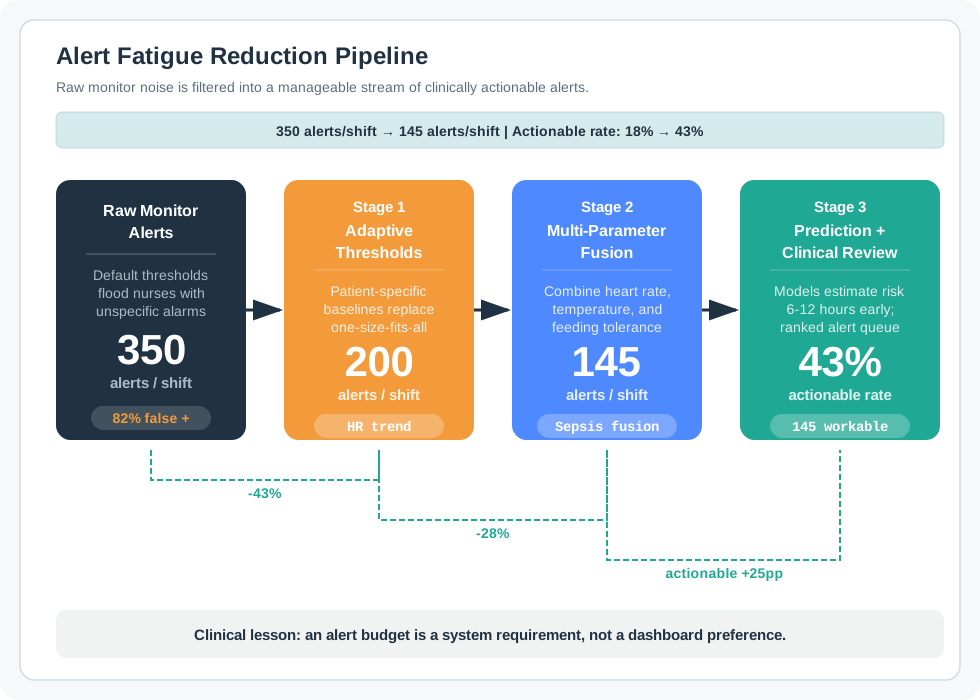
The left column of Figure 4.1 is the starting state, with about 350 alerts a shift and most of them false. The first stage swaps fixed limits for baselines set per patient, and the count drops to roughly 200. The second stage refuses to fire on one number alone. It combines heart rate, temperature and feeding tolerance, leaving about 145. Only then does a model rank what is left and hand clinicians a queue. Follow the second row of figures rather than the first: the useful share rises from 18 to 43 percent. That is the chapter’s point about the worried well. Fewer alerts are worth less than alerts a nurse can act on.
4.8 Remote Monitoring Operating Cost Check
Healthcare monitoring programs do not break even because the app has many users. They break even when the program can review the right patients, suppress noise, and fund the staff and integration work needed to act on the data.
Before scaling, estimate the operating load:
- Patient pool: enrolled patients, expected active-device rate, and missed-reading rate.
- Review burden: alerts per patient per week, minutes per alert, escalation rate, and clinician role.
- Support burden: device setup calls, battery or connectivity failures, replacement logistics, and patient training.
- Integration burden: FHIR mapping, patient matching, writeback failures, identity management, audit logging, and downtime procedures.
- Payment coverage: reimbursement, payer contract, or hospital budget that covers both devices and ongoing operations.
A monitoring program is viable when the payment path covers device cost, support cost, and clinician review time while keeping alert volume inside the workflow budget. Tiny conversion-rate math from consumer freemium products is the wrong model for clinical IoT.
4.9 Alert Fatigue Impact
Model the impact of alert reduction strategies on clinical outcomes and nurse workload.
Clinical Impact: Reducing alerts from baseline while improving actionable percentage allows nurses to respond meaningfully. Research shows this can reduce NICU sepsis mortality by 20-40%.
4.10 Healthcare IoT Adoption Challenges
- EHR integration gap: many IoT devices do not connect to Electronic Health Records, creating data silos where doctors cannot see patient-collected data.
- Data security concerns: HIPAA compliance, breach liability, and ransomware risks make hospitals cautious about adding connected devices.
- Missing integration-first mindset: startups often build impressive gadgets rather than clinical tools, so products do not fit real workflows.
- False positive problem: consumer devices can generate anxiety-inducing alerts, overwhelming doctors with worried-but-healthy patients.
4.11 Worked Examples
4.12 Arrhythmia Detection Tradeoff
Scenario: A medical device company is developing an FDA Class II wearable ECG patch for detecting atrial fibrillation (AFib) in high-risk patients.
Given:
- Target population: 50,000 patients with history of stroke or TIA
- AFib prevalence in population: 15%
- Clinical consequence of missed AFib: 5x increased stroke risk without anticoagulation
- Clinical consequence of false positive: Unnecessary anticoagulation (bleeding risk 2-3%/year)
- Worked-example design targets: Sensitivity >95%, Specificity >90%
Steps:
-
Calculate baseline detection requirements:
- True AFib patients: 50,000 x 15% = 7,500 patients
- Non-AFib patients: 50,000 x 85% = 42,500 patients
- At 95% sensitivity: 7,125 true positives, 375 missed AFib cases
- At 90% specificity: 4,250 false positives
-
Calculate clinical impact:
- Missed AFib strokes: cannot be calculated from the 375 missed cases without an absolute annual stroke risk for this population
- Stroke and bleeding events cannot be compared from these inputs alone; provide absolute untreated stroke risk, treatment benefit, bleeding risk and harm weighting before a net-harm conclusion.
-
Design multi-stage detection algorithm:
- Stage 1 (high sensitivity): Edge processing, flag suspicious rhythms
- Stage 2 (high specificity): Cloud ML reviews flagged segments
- Stage 3 (physician confirmation): Cardiologist reviews before diagnosis
- Combined performance: 98% sensitivity, 99.5% specificity
-
Calculate Positive Predictive Value:
- PPV = 97.2% (when device reports AFib, 97.2% truly have it)
Result: At the stated 15% AFib prevalence, the proposed multi-stage algorithm has a PPV of about 97.2%; FDA clearance still requires an applicable submission and evidence for the intended use. The key insight is that medical IoT must optimize for clinical outcomes, not just detection accuracy metrics.
4.13 Neonatal ICU Alert Thresholds
Scenario: A Level IV NICU is implementing an IoT-based early warning system to detect clinical deterioration in extremely preterm infants (<28 weeks gestational age).
Given:
- 45 NICU beds, average 30 extremely preterm infants
- Current alert volume: 350 alerts/nurse/12-hour shift (causes alert fatigue)
- Target: <50 actionable alerts/nurse/shift
- Clinical outcome target: Reduce late-onset sepsis mortality by 25%
Problem: 82% of current alerts are false positives or clinically insignificant.
IoT Solution:
- Implement adaptive thresholds: Calculate patient-specific baselines rather than absolute thresholds
- Multi-parameter fusion for sepsis detection: Combine HR increase + temperature instability + feeding intolerance
- ML model: Predicts sepsis 6-12 hours before clinical diagnosis
Results:
- Alert volume: 350 to 145 alerts/shift (59% reduction)
- Actionable alerts: 18% to 43%
- Sepsis detection: 12 hours earlier on average
- Mortality reduction: 20% to 12% (saving ~7 lives/year)
Key Insight: Healthcare IoT alert systems must be designed with explicit alert fatigue budgets. A NICU nurse cannot meaningfully respond to 350 alerts per shift - the system must intelligently filter and prioritize.
 Checkpoint: Alert Fatigue
You now know:
- A raw alert stream of 350 alerts per nurse per 12-hour shift is a workflow failure, even if each sensor is technically working.
- In the NICU example, adaptive thresholds, multi-parameter fusion, and ML prediction reduce alerts from 350 to 145 while raising actionable alerts from 18% to 43%.
- The target is clinical response quality: fewer false positives, clearer ownership, and escalation rules that fit the unit’s staffing reality.
With the alert path under control, the last design layer is scale.
Inspect Figure 4.2 to see where bedside readings become clinical decisions and where protected data crosses an owned boundary.
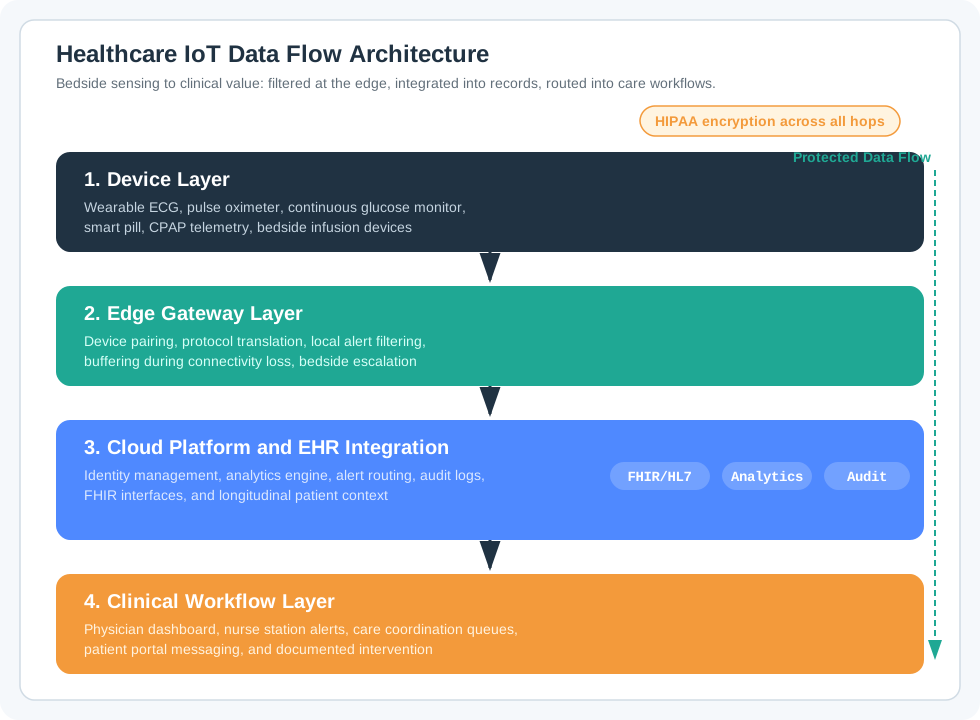
Follow Figure 4.2 from bedside and wearable devices into the edge gateway. That gateway is the first place to normalize signals and make latency-critical decisions without waiting for the cloud. The cloud layer then integrates observations with the EHR through FHIR or HL7, applies alert rules, and keeps audit controls. Finally, the result reaches physician dashboards, nurse stations, or patient portals. Protection must continue across every hop, but the purpose of the path is clinical action; a secure reading that never reaches the right workflow still fails.
4.14 Philips HealthSuite Platform Shift
Philips transformed from a medical device manufacturer into an IoT-connected healthcare platform company. Their journey illustrates both the potential and the challenges of healthcare IoT at enterprise scale.
The Business Transformation
Philips announced native FHIR support for healthcare-data integration through HealthSuite. The announcement describes an integration capability; it does not establish the specific commercial or clinical outcomes listed in unsupported secondary figures.
What Worked
- Integration-first approach: HealthSuite announced native FHIR support for healthcare-data integration; each deployment still needs evidence about its connected systems and workflow outcomes.
- Edge processing for latency-critical decisions: Local processing can keep time-sensitive analysis near patient monitors while sending trend data to cloud services.
- Tiered alert management: Alert thresholds should be evaluated against measured clinical performance and workload.
What Went Wrong
- 2021 recall: Philips recalled certain CPAP, BiPAP, and ventilator devices because PE-PUR sound-abatement foam could break down — a failure that the monitoring discussed here would not detect.
- Interoperability gaps: Despite HL7 FHIR support, integrations with specific EHR systems may require custom middleware and deployment-specific validation.
- Cybersecurity incidents: Multiple CVEs discovered in patient monitoring firmware, including one (CVE-2021-39244) that could allow unauthorized modification of monitoring parameters
Key Lesson: Healthcare IoT success requires solving the “last mile” problem — connecting device data to the EHR system where clinicians actually make decisions. The best sensor in the world is worthless if its data sits in a standalone app that nobody checks.
4.15 Connected Medical Devices
Connected CPAP Machines: Over 8 million connected units monitor sleep apnea treatment worldwide. These devices achieve 95%+ compliance verification accuracy and enable physicians to remotely adjust therapy settings, reducing in-clinic visits by 60%.
Continuous Glucose Monitors (CGM): Real-time glucose readings every few minutes, eliminating painful finger pricks. Predictive alerts warn before dangerous glucose levels are reached.
Flexible heart sensor sheath: A sensor-laden flexible sheath wrapped around the heart can monitor irregular rhythm, pH changes during restricted blood supply, and temperature fluctuations caused by localized burns. This form factor shows how one connected medical device can observe electrical, chemical, and thermal changes at the organ surface.
Figure 4.3 is worth studying for scale, because almost all of the device is the part that has to stay stuck to a person.

Look first at the flat round pad in Figure 4.3. Most of the device is that pad, and its only job is to stay on skin, so wear time and skin tolerance are design limits before any software question. At the centre sits a small moulded carrier. Rising from it is a filament thinner than a hair, and that thread is the only part which reaches tissue. It sets both the reading quality and how often the sensor must be replaced. Nothing visible here looks like a radio or a battery, yet both have to fit under that shell for days. The hard engineering is the part the patient never sees.
Remote Patient Monitoring (RPM): Post-discharge monitoring for heart failure, COPD, diabetes reduces hospital readmissions by 30-50% by detecting deterioration before crisis.
4.16 Privacy and Security Considerations
Healthcare IoT faces the highest privacy stakes:
- HIPAA violations: Penalties depend on the violation and current statutory tiers
- Ransomware targeting: Hospitals are frequent targets due to life-critical systems
- Data sensitivity: Health data can be valuable to criminals
- Patient autonomy: Questions about continuous monitoring and surveillance
Best Practices:
- End-to-end encryption for all health data
- Local processing when possible (edge computing)
- Explicit patient consent with granular control
- Regular security audits and penetration testing
The checks now become concrete. The questions below ask whether you can distinguish consumer accuracy from clinical accuracy, suppress noise without losing urgent events, explain the ingestion sensor signal path, and recognize the worried-well failure mode.
4.17 Knowledge Check: Healthcare IoT
4.18 Quiz: Healthcare IoT Concepts
4.19 Quiz: Healthcare Certification
Common Pitfalls
4.20 Consumer Accuracy in Clinics
Consumer fitness trackers are designed for wellness use and may not have evidence for a clinical claim. Using an unvalidated device for treatment decisions can lead to missed diagnoses or incorrect treatment. Document the intended use, validation evidence, and regulatory status appropriate to the specific clinical application.
4.21 Alert Fatigue in Design
Deploying a monitoring system without modelling the alert rate exposes clinical staff to hundreds of daily alarms, causing them to ignore all alerts including genuine emergencies. Define an explicit alert budget (e.g. <5 actionable alerts per nurse per shift) and engineer the alert logic to meet it before launch.
4.22 EHR Integration Before Silos
Creating a separate monitoring platform that does not connect to the Electronic Health Record forces clinicians to switch systems, increases workload, and creates transcription errors. Treat EHR integration as a first-order requirement and validate the HL7/FHIR interface with hospital IT before development begins.
4.23 Label the Diagram
4.24 Code Challenge
4.25 Summary
Healthcare IoT offers transformative potential but faces unique challenges that distinguish it from all other IoT domains:
Key Concepts Covered:
- Clinical validation: Accuracy criteria depend on the measurement and intended use; products need evidence against applicable requirements rather than a universal consumer-versus-clinical threshold
- Regulatory Pathway: Determine classification, submission route, evidence, and post-market obligations for the product’s intended use and product code
- Alert Fatigue: The single biggest threat to healthcare IoT adoption — a NICU nurse receiving 350 alerts per shift cannot respond meaningfully; systems must use adaptive thresholds, multi-parameter fusion, and ML filtering to keep actionable alerts under 50 per shift
- Ingestible Sensors: Ingestible sensors can record some ingestion events, but improved adherence or savings have not been established for ABILIFY MYCITE.
- The “Worried Well” Problem: False-positive consumer alerts can drive unnecessary clinical follow-up; quantify the effect only for a documented population.
- EHR Integration: The “integration-first” mindset separates successful healthcare IoT from expensive gadgets — devices that connect to Electronic Health Records deliver far more clinical value than standalone innovations
- Privacy and Security: Assess applicable HIPAA duties and health-data risks; encryption and edge processing can reduce exposure but do not alone establish compliance
Bottom Line: Healthcare IoT success requires designing for clinical workflows and outcomes first, with technology innovation as a means to that end — not the other way around.
4.26 Concept Relationships: Healthcare IoT
- Clinical accuracy and regulatory pathway: accuracy criteria and submission requirements depend on the measurement, intended use, and product code; validate the product and scope estimates to the applicable pathway.
- Alert fatigue relates to false positive rate: more than 5% false positives can cause clinicians to ignore alerts; multi-parameter fusion can reduce false alarms by 60-70%.
- Ingestible sensors relate to medication adherence: they can record some ingestion events, but improved adherence or savings have not been established for ABILIFY MYCITE.
- EHR integration relates to clinical workflow: devices that write directly to Electronic Health Records deliver more clinical value than standalone devices.
- The worried-well problem relates to unnecessary follow-up: false-positive consumer alerts can drive clinical follow-up; quantify the effect only for a documented population.
Cross-module connection: Healthcare IoT requires BLE wearables (Module 4), edge AI for alert filtering (Module 5), and risk-based health-data security (Module 7). See Privacy and Compliance.
4.27 See Also
- Bluetooth LE for Wearables — BLE profiles for health device communication
- Edge AI and ML — On-device processing for privacy and alert filtering
- HIPAA Compliance for IoT — Health data privacy requirements
4.28 In 60 Seconds
Healthcare IoT connects clinical-grade wearables and monitoring devices to care workflows, enabling continuous patient observation and early detection of deterioration while navigating strict FDA accuracy and HIPAA privacy requirements.
4.29 What’s Next
- Wearable IoT: consumer health devices, biometric sensing, and design principles.
- Smart Manufacturing: quality control and compliance parallels with healthcare.
- Privacy and Security: HIPAA compliance and health data protection strategies.
4.30 Key Takeaway
Healthcare IoT must be designed around trust, workflow, privacy, and clinical consequence. The device is only one part of the system; integration with caregivers, records, alerts, and compliance determines whether the data can improve care safely.