41  Fog Resource Allocation

In 60 Seconds

Fog resource allocation borrows from TCP congestion control: AIMD (Additive Increase Multiplicative Decrease) distributes fog workloads with provable fairness, achieving Nash equilibrium in 5-15 iterations. Game-theoretic approaches show that selfish fog nodes cause a Price of Anarchy of 1.3-2.0x, meaning uncoordinated allocation wastes 30-100% more resources than optimal cooperative strategies.

Key Concepts
  • Resource Allocation: Assignment of CPU, memory, network bandwidth, and storage to competing workloads on a fog node based on priority and QoS requirements
  • Quality of Service (QoS): Guaranteed performance levels (maximum latency, minimum throughput) negotiated for specific IoT workloads running on shared fog infrastructure
  • Work Stealing: Dynamic load-balancing technique where underloaded fog nodes pull tasks from overloaded neighbors, maximizing cluster utilization
  • Priority Queuing: Task scheduling where safety-critical events (fire alarm, motor fault) preempt lower-priority tasks (telemetry aggregation) immediately
  • Resource Reservation: Pre-allocating a fraction of fog node capacity for latency-sensitive workloads, preventing best-effort tasks from causing deadline misses
  • Bin Packing: Optimization algorithm maximizing the number of containerized workloads that fit on available fog hardware while meeting resource constraints
  • Elasticity at Edge: Ability to scale workloads up or down on fog nodes in response to demand changes, limited by physical hardware constraints unlike cloud
  • SLA Violation: Event where a fog workload fails to meet its contracted response time or throughput, potentially triggering failover or escalation to cloud resources

41.1 Learning Objectives

By the end of this chapter, you will be able to:

  • Apply TCP Principles: Adapt proven TCP congestion control mechanisms to fog resource management
  • Analyze Game Theory: Distinguish Nash equilibrium, Pareto efficiency, and Price of Anarchy in fog contexts
  • Design Resource Allocation: Create multi-objective optimization strategies for fog deployments
  • Implement AIMD: Apply Additive Increase Multiplicative Decrease for distributed fog load balancing
  • Evaluate Fairness Metrics: Compare max-min fairness, proportional fairness, and weighted allocation schemes
  • Identify Common Pitfalls: Diagnose and avoid resource allocation anti-patterns in fog deployments

41.2 Prerequisites

Before diving into this chapter, you should be familiar with:

Minimum Viable Understanding (MVU)

If you are short on time, focus on these three core concepts:

  1. AIMD for Fog (Section 2): The Additive Increase / Multiplicative Decrease algorithm from TCP enables distributed, fair resource sharing in fog without central coordination. Devices slowly increase demands (+1) and cut sharply (x0.5) when overload is detected.

  2. Nash Equilibrium vs. Pareto Efficiency (Section 3): Selfish device behavior converges to a Nash equilibrium that is often worse than the cooperative optimum (Pareto-efficient). The gap between them is the “Price of Anarchy.”

  3. Network Class Choice Matters (Section 3.3): Contention-based networks (Class-1, Wi-Fi) have unbounded inefficiency from selfish behavior; scheduled networks (Class-2, TDMA) bound inefficiency to at most 2x optimal. This directly impacts fog network design.

These three ideas underpin nearly all fog resource allocation decisions in practice.

Imagine a popular restaurant with limited seating. How do you decide who gets tables? First-come-first-served? Reservations? Priority for VIPs? Each approach has trade-offs between efficiency and fairness.

Fog computing faces the same challenge: thousands of IoT devices want to use limited fog resources (CPU, memory, bandwidth). Without smart allocation, some devices hog resources while others starve. The solutions come from two surprising sources:

  1. TCP Internet protocols - Solved this problem for internet traffic in the 1980s
  2. Game theory - Mathematical framework for analyzing strategic decisions
Term Simple Explanation
AIMD Additive Increase, Multiplicative Decrease - slowly request more, quickly back off if overloaded
Nash Equilibrium Stable state where no one can improve by changing strategy alone
Pareto Efficiency Optimal allocation where you can’t help one device without hurting another
Price of Anarchy How much worse is selfish behavior compared to coordinated sharing?

Hey Sensor Squad! Imagine your school has ONE amazing playground with slides, swings, and monkey bars. At recess, ALL the kids want to play at the same time!

Sammy the Sensor says: “I figured it out! Each kid slowly walks toward the playground. If it gets too crowded, you step back fast and wait. That way, everyone gets a turn!”

That is exactly what AIMD does! Devices slowly ask for more (walk toward playground) and quickly back off (step back) when things get crowded.

Lila the LED adds: “But what if one kid is a bully and hogs the swings?” That is the Nash Equilibrium problem – everyone playing selfishly. The solution? Make fair rules (like taking turns), just like fog computing uses scheduling and quotas!

Max the Microcontroller reminds us: “The best playground is one where everyone gets equal time and nobody has to wait too long. That is Pareto Efficiency!”

41.3 Introduction

Resource allocation in fog computing addresses one of the most fundamental challenges in distributed systems: how do thousands of autonomous IoT devices share limited computational resources fairly and efficiently, without a central coordinator dictating every decision?

This chapter draws on two powerful theoretical foundations. First, TCP congestion control – a family of algorithms refined over 35+ years that enable billions of internet devices to share bandwidth without coordination. Second, game theory – the mathematical study of strategic interactions that reveals when selfish behavior leads to poor outcomes and how mechanism design can align individual incentives with collective good.

Understanding these foundations is essential for designing fog systems that remain stable under load, fair across heterogeneous devices, and efficient as deployments scale from tens to tens of thousands of nodes.

41.4 Fog Computing Optimization Strategies

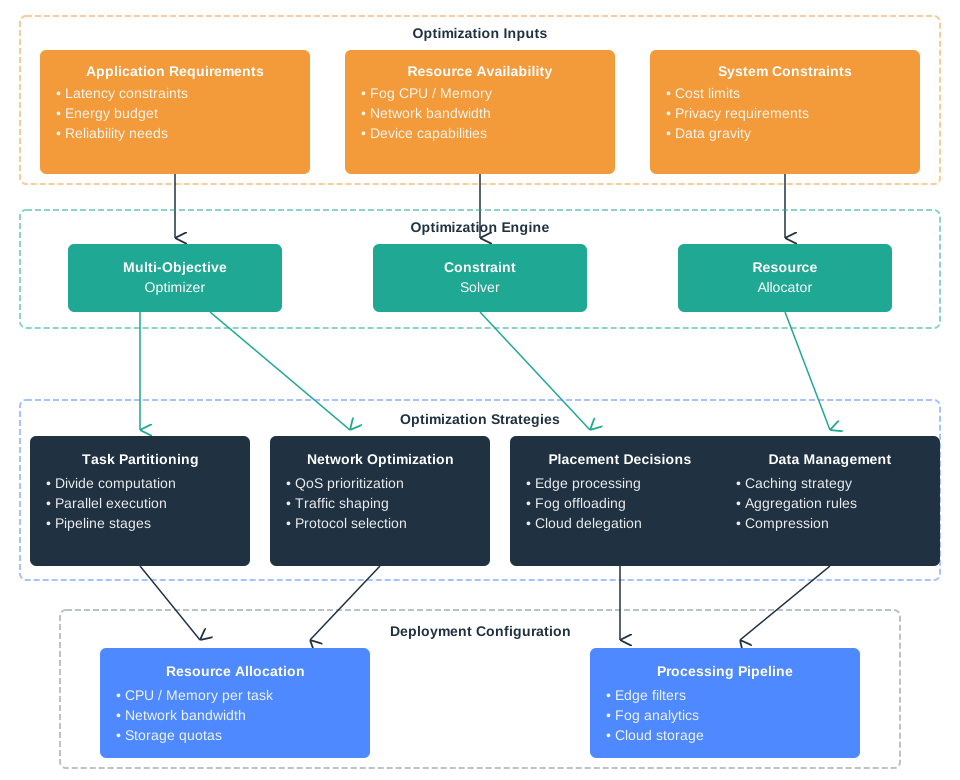
Fog computing optimization strategies involve balancing multiple competing objectives – latency, energy, bandwidth, cost – through intelligent resource allocation, task partitioning, and placement decisions across the edge-fog-cloud continuum. The optimization process flows from inputs through an engine to deployment configurations.

Flowchart showing fog computing optimization pipeline: three input categories (application requirements with latency, energy, reliability; resource availability with CPU, memory, bandwidth; system constraints with cost, privacy, data gravity) feed into an optimization engine containing multi-objective optimizer, constraint solver, and resource allocator, which produces four strategy outputs (task partitioning, placement decisions, data management, network optimization) that generate deployment configurations for edge filters, fog analytics, and cloud storage.

The following table summarizes the four stages, their components, and specific details for each optimization strategy:

Stage Components Details
Optimization Inputs Application Requirements Latency constraints, Energy budget, Reliability needs
Resource Availability Fog CPU/Memory, Network bandwidth, Device capabilities
System Constraints Cost limits, Privacy requirements, Data gravity
Optimization Engine Multi-Objective Optimizer Balance competing goals
Constraint Solver Respect system limits
Resource Allocator Distribute resources
Optimization Strategies Task Partitioning Divide computation, Parallel execution, Pipeline stages
Placement Decisions Edge processing, Fog offloading, Cloud delegation
Data Management Caching strategy, Aggregation rules, Compression
Network Optimization QoS prioritization, Traffic shaping, Protocol selection
Deployment Configuration Resource Allocation CPU/Memory per task, Network bandwidth, Storage quotas
Processing Pipeline Edge filters, Fog analytics, Cloud storage

41.5 Alternative View: Fog Optimization Strategies Visualization

Fog computing optimization framework diagram with four layers: optimization inputs (application requirements, resource availability, system constraints) feeding into an optimization engine (multi-objective optimizer, constraint solver, resource allocator), which produces four strategy categories (task partitioning, placement decisions, data management, network optimization), culminating in deployment configurations that distribute processing across edge filters, fog analytics, and cloud storage tiers.

Fog optimization framework diagram showing inputs flowing through optimization engine to strategy outputs and deployment configuration
Figure 41.1: Fog computing optimization framework showing how application requirements and resource availability feed into optimization engines (multi-objective optimizer, constraint solver, resource allocator) that determine task partitioning, placement decisions, data management, and network optimization strategies, ultimately creating deployment configurations that distribute processing across edge, fog, and cloud tiers.

41.6 TCP Congestion Principles Applied to Fog

Fog computing resource allocation can learn from decades of TCP congestion control research. Five fundamental TCP principles apply directly to fog resource management. The mapping between TCP mechanisms and fog resource management is remarkably direct, because both face the same core problem: distributed agents sharing limited resources without central coordination.

41.6.1 Five TCP Principles for Fog Computing

Diagram mapping five TCP congestion control principles to fog computing equivalents: (1) End-point control maps to edge device offloading adjustment, (2) Sliding window maps to dynamic resource quotas, (3) AIMD maps to gradual task increase with sharp overload cutback, (4) Loss and delay detection maps to queue length and response time monitoring, (5) RTT-based timers map to edge-to-fog latency estimation. Shows the evolution timeline from TCP Tahoe 1988 through Reno 1990, NewReno 1999, to CUBIC 2005.

41.7 Alternative View: TCP Principles for Fog

Five TCP congestion control principles applied to fog computing: (1) End-point control via negative feedback where edge devices adjust offloading rate based on fog acceptance or rejection, (2) Sliding window mechanism providing dynamic resource quotas per client, (3) AIMD algorithm enabling gradual load increase with sharp overload cuts, (4) Congestion detection via loss or delay using queue length and response time, (5) RTT-based estimation for latency monitoring and adaptive offloading, with TCP evolution timeline from Tahoe 1988 through Reno 1990, NewReno 1999, to CUBIC 2005 informing fog resource algorithms.

Diagram of five TCP principles mapped to fog computing resource management strategies
Figure 41.2: Five TCP congestion control principles applied to fog computing resource management.

This variant visualizes how AIMD (Additive Increase Multiplicative Decrease) works over time, showing the characteristic “sawtooth” pattern that enables fair, distributed resource sharing.

AIMD behavior timeline visualization showing the characteristic sawtooth pattern where resource usage gradually increases additively over time then drops sharply by half when congestion is detected, demonstrating how multiple independent devices converge to equal resource shares through this asymmetric adjustment pattern.

AIMD sawtooth pattern over time showing gradual additive increase followed by sharp multiplicative decrease on congestion detection, with multiple devices converging to fair shares

Key Insight: AIMD’s brilliance is that it achieves fair resource allocation without coordination. Each device independently increases slowly and decreases sharply based only on local observations (latency, rejections), yet the system converges to equitable sharing.

1. End-point Control via Negative Feedback

  • TCP: Sender adjusts transmission rate based on receiver ACKs/NACKs
  • Fog: Edge devices adjust offloading rate based on fog node acceptance/rejection signals

2. Sliding Window Mechanism

  • TCP: Dynamic buffer size controls how much data in-flight
  • Fog: Dynamic resource quotas (CPU/memory/bandwidth) per client control how many tasks in-flight

3. Additive Increase / Multiplicative Decrease (AIMD)

  • TCP: Slowly increase sending rate (+1 per RTT), cut sharply on loss (x0.5)
  • Fog: Gradually increase task offloading, cut sharply when fog node signals overload
  • Why it works: AIMD converges to fair, efficient resource sharing without central coordination

4. Inferring Congestion by Loss or Delay

  • TCP: Packet loss or increasing RTT signals network congestion
  • Fog: Task queue length or response time increases signal fog node overload

5. RTT-based Timers and Estimation

  • TCP: Adaptive retransmission timers based on measured round-trip time
  • Fog: Adaptive offloading decisions based on measured edge-to-fog latency

TCP (Transmission Control Protocol) solved a hard problem in the 1980s: How do thousands of computers share the internet fairly without a central coordinator telling everyone when to send data?

The Breakthrough: Each computer independently measures how well things are going (are my packets arriving? how long do they take?) and adjusts its behavior accordingly. If packets get lost, slow down sharply. If everything’s working, speed up gradually.

Fog Connection: Fog computing faces the same challenge. Thousands of IoT devices want to offload tasks to fog nodes. No central coordinator. Each device must independently decide: “Should I send my next task to the fog node, or process it locally?” TCP’s 35+ years of proven algorithms (AIMD, congestion detection, adaptive timers) provide battle-tested solutions.

Real Example: Smart city with 10,000 sensors, 50 fog nodes. Each sensor independently monitors: “When I send tasks to Fog Node #7, how long until I get results?” If latency increases from 5ms to 50ms, the sensor infers overload and reduces offloading (AIMD multiplicative decrease). If latency stays low, gradually increase offloading (AIMD additive increase). Result: Automatic load balancing without complex coordination protocols.

41.7.1 AIMD Pseudocode for Fog Resource Allocation

The following pseudocode shows how a fog-aware IoT device implements AIMD-based task offloading:

# AIMD-based Fog Task Offloading
# Each device runs this independently - no central coordinator needed

INITIAL_RATE = 1          # Start with 1 task per interval
ADDITIVE_INCREMENT = 1    # Increase by 1 task per successful interval
MULTIPLICATIVE_FACTOR = 0.5  # Cut rate in half on overload
LATENCY_THRESHOLD_MS = 50    # Overload signal threshold
MIN_RATE = 1
MAX_RATE = 100

offload_rate = INITIAL_RATE

while device_is_active:
    # Send 'offload_rate' tasks to fog node this interval
    results = fog_node.submit_tasks(offload_rate)

    # Measure round-trip latency (like TCP measures RTT)
    measured_latency = results.average_latency_ms
    rejection_count = results.rejected_tasks

    # Congestion detection (like TCP loss/delay detection)
    if measured_latency > LATENCY_THRESHOLD_MS or rejection_count > 0:
        # MULTIPLICATIVE DECREASE: cut sharply
        offload_rate = max(MIN_RATE,
                          int(offload_rate * MULTIPLICATIVE_FACTOR))
        log(f"Overload detected! Rate: {offload_rate}")
    else:
        # ADDITIVE INCREASE: grow slowly
        offload_rate = min(MAX_RATE,
                          offload_rate + ADDITIVE_INCREMENT)
        log(f"Capacity available. Rate: {offload_rate}")

    wait(interval_duration)

Why this works: When multiple devices run this algorithm independently, they converge to equal shares of fog resources. The asymmetry between slow increase and fast decrease is mathematically proven to achieve fairness – devices that temporarily use more than their fair share lose resources faster than they gain them.

41.7.2 TCP Variants Evolution and Fog Implications

TCP Variant Year Key Innovation Fog Computing Lesson
TCP Tahoe 1988 Slow start + congestion avoidance Start conservatively, probe for capacity
TCP Reno 1990 Fast retransmit/recovery Quick recovery from temporary overload
TCP NewReno 1999 Multiple loss handling Handle multiple simultaneous fog failures
TCP CUBIC 2005 Cubic growth for high-speed networks Aggressive scaling for high-capacity fog tiers

Key Takeaway: Fog resource allocation doesn’t need to reinvent congestion control—adapt proven TCP principles to task offloading, resource quotas, and distributed coordination.

Try It: AIMD Fog Resource Simulator

Adjust the AIMD parameters below and watch how multiple fog devices converge to fair resource shares over time. Notice how the additive increment and multiplicative factor affect convergence speed and stability.

Cross-Reference: Transport Layer Fundamentals

For deeper understanding of TCP congestion control mechanisms, see: - Transport Fundamentals - TCP flow control and congestion avoidance - Transport Optimizations - Modern TCP variants and performance tuning

41.8 Game Theory for Resource Allocation

Fog computing resource allocation is a multi-player game where devices (players) compete for shared fog resources (bandwidth, CPU, memory). Game theory provides mathematical frameworks for understanding equilibria and fairness. Understanding these frameworks helps system designers predict how devices will behave and design mechanisms that produce desirable outcomes even when each device acts selfishly.

41.8.1 Network Access Classes and Throughput Dependence

Consider two classes of network access technologies commonly used in fog deployments:

Class-1: 802.11 DCF (Distributed Coordination Function)

  • Throughput of each user depends on all users in the network
  • Contention-based: All devices compete for channel access
  • Example: Wi-Fi in crowded environments

Class-2: TDMA (Time Division Multiple Access)

  • Throughput depends only on number of users (N)
  • Each user gets fixed time slot: Throughput = Total_Bandwidth / N
  • Example: Cellular networks with scheduled access

Comparison diagram of two network access classes for fog computing: Class-1 (802.11 DCF contention-based) where each user's throughput depends on all other users' behavior with unbounded Price of Anarchy, versus Class-2 (TDMA scheduled) where throughput equals Total Bandwidth divided by N users with Price of Anarchy bounded at 2. Shows that Class-1 offers higher peak throughput but unpredictable fairness, while Class-2 provides guaranteed fairness with lower peak throughput. Recommends hybrid approach using TDMA for critical IoT traffic and Wi-Fi for best-effort data.

41.9 Alternative View: Game Theory Network Classes

Game theory framework for fog resource allocation comparing Class-1 802.11 DCF Wi-Fi contention-based access where throughput depends on all users behavior with complex interdependence and unbounded Price of Anarchy versus Class-2 TDMA cellular scheduled access where throughput equals Total Bandwidth divided by N depending only on user count with Price of Anarchy bounded at 2, showing Nash equilibrium concepts, Pareto efficiency goals, and fog implications for network design including hybrid approaches combining guaranteed TDMA for critical IoT traffic with best-effort Wi-Fi.

Game theory framework comparing Class-1 contention and Class-2 scheduled network access for fog resource allocation
Figure 41.3: Game theory framework comparing contention-based and scheduled access for fog resource allocation.

What is Game Theory? The mathematical study of strategic decision-making when multiple players interact. Each player wants the best outcome for themselves, but their actions affect everyone.

The Classic Example - Tragedy of the Commons: Imagine a shared pasture (the “commons”) where 10 farmers graze sheep. Each farmer thinks: “If I add one more sheep, I get 100% of the profit from that sheep, but the cost of overgrazing is shared among all 10 farmers (I only pay 10% of the cost).” Result: Everyone adds too many sheep, the pasture is destroyed, everyone loses.

Fog Computing Connection: Shared fog resources (bandwidth, CPU, memory) are the “commons.” Each IoT device wants to offload as many tasks as possible to the fog (benefit: save battery, get fast results). But if everyone offloads aggressively, the fog node becomes overloaded and everyone’s performance degrades.

Nash Equilibrium: The stable state where no device can improve its performance by changing its offloading strategy alone (given what others are doing). Problem: The Nash equilibrium is often inefficient – everyone would be better off if they collectively reduced offloading, but no individual has incentive to do so alone.

Pareto Efficiency: An allocation is Pareto-efficient if you can’t improve one device’s performance without hurting another. This is the “fair and efficient” goal.

Price of Anarchy (PoA): How much worse is the Nash equilibrium (selfish behavior) compared to the Pareto-efficient optimum (coordinated behavior)?

  • Class-1 (Wi-Fi): PoA can be unbounded (very bad – selfish behavior can collapse the system)
  • Class-2 (TDMA): PoA is less than or equal to 2 (at worst, selfish behavior is twice as bad as optimal – much better!)

41.9.1 Nash Equilibrium and Pareto Efficiency

Nash Equilibrium: A strategy profile where no player can improve their outcome by unilaterally changing their strategy (given others’ strategies remain fixed).

Problem: Nash equilibria can be inefficient – all players might achieve better outcomes through cooperation, but individual incentives prevent it.

Pareto Efficiency: An allocation is Pareto-efficient if no player can be made better off without making another player worse off.

Goal: Design fog resource allocation mechanisms that drive selfish devices toward Pareto-efficient Nash equilibria.

Quadrant diagram showing the relationship between Nash Equilibrium and Pareto Efficiency in fog resource allocation. The upper-right quadrant (both Nash and Pareto efficient) is the ideal design target. The lower-right quadrant (Nash but not Pareto) represents the common problem where selfish equilibrium is inefficient. The upper-left (Pareto but not Nash) is unstable because devices have incentive to deviate. The lower-left (neither) is the worst case. An arrow labeled 'Mechanism Design Goal' points from the lower-right problem quadrant to the upper-right ideal quadrant.

41.9.2 Price of Anarchy (PoA) Bounds

The Price of Anarchy measures how much system performance degrades due to selfish behavior compared to optimal coordinated allocation.

Class-1 Networks (802.11 DCF):

  • PoA: Unbounded (in worst case)
  • Meaning: Selfish behavior can arbitrarily degrade system performance
  • Real example: One aggressive Wi-Fi device using 90% airtime can reduce everyone else to 10% total

Class-2 Networks (TDMA):

  • PoA is less than or equal to 2 (best case) or (N+M)/N (general bound, where N = number of players, M = number of resources)
  • Meaning: Even with selfish behavior, system achieves at least 50% of optimal efficiency
  • Real example: 10 devices sharing TDMA slots selfishly still achieve reasonable fairness
Metric Class-1 (Contention) Class-2 (Scheduled)
Price of Anarchy Unbounded PoA <= 2
Worst-case efficiency Can reach 0% At least 50% of optimal
Predictability Low under load High under any load
Peak throughput Higher (when uncontested) Lower (overhead)
Fairness guarantee None Guaranteed
Best for Low-load, bursty traffic Critical, time-sensitive IoT

The Price of Anarchy bounds quantify inefficiency from selfish behavior:

Class-2 TDMA: With \(N = 10\) devices sharing bandwidth \(B = 100 \text{ Mbps}\), optimal allocation gives each \(\frac{100}{10} = 10 \text{ Mbps}\). Selfish Nash equilibrium: each device requests maximum, causing system to allocate \(\frac{100}{10} = 10 \text{ Mbps}\) anyway. PoA = \(\frac{\text{Optimal}}{\text{Nash}} = \frac{100}{100} = 1\) (no degradation — TDMA enforces fairness).

Class-1 Wi-Fi: One selfish device using CSMA/CA aggressively can capture 60% of airtime, leaving 40% for 9 others. Nash throughput = \(60 + 9(40/9) = 100\) total, but distribution is \((60, 4.4, 4.4, \ldots)\). PoA for fairness = \(\frac{10}{4.4} \approx 2.27\) for victims — unbounded PoA means one device can drive others to near-zero throughput.

Try It: Price of Anarchy Explorer

Compare how selfish behavior affects Class-1 (contention-based) and Class-2 (scheduled) fog networks. Adjust the number of devices and the aggression level to see how the Price of Anarchy changes.

41.9.3 Worked Example: Fog Resource Game

Scenario:

  • 5 IoT devices (players) competing for 1 fog node with 100 units of CPU capacity
  • Each device chooses offloading intensity: Low (10 units), Medium (20 units), High (30 units)
  • If total demand exceeds 100 units, fog node rejects tasks probabilistically

Payoff Matrix (for two representative devices, simplified):

Device B: Low (10) Device B: Medium (20) Device B: High (30)
Device A: Low (10) (10, 10) - both safe (10, 20) - B gains (10, 30) - B gains more
Device A: Medium (20) (20, 10) - A gains (20, 20) - Pareto optimal (20, 25) - slight overload
Device A: High (30) (30, 10) - A gains more (25, 20) - slight overload (20, 20) - heavy overload, both lose

Values represent effective throughput after accounting for rejection probability.

Strategies:

  • Cooperative (Pareto-efficient): Each device uses Medium (20 units) -> Total = 100 units, no rejection, everyone happy
  • Nash Equilibrium (selfish): Each device independently chooses High (30 units) because “more for me!” -> Total = 150 units -> 33% rejection rate -> Everyone worse off than cooperative case

Price of Anarchy: PoA = Performance_Cooperative / Performance_Nash = 100% success / 67% success which is approximately 1.5

Design Lesson: Without coordination mechanisms (pricing, quotas, feedback), selfish devices create inefficient Nash equilibria. Solutions: admission control, backpressure signals (like TCP), or fair scheduling (Class-2 TDMA-style).

Try It: Fog Resource Game Simulator

Choose offloading strategies for 5 IoT devices competing for a shared fog node. See how cooperative vs. selfish choices affect rejection rates and the Price of Anarchy in real time.

41.9.4 Fairness Metrics for Fog Allocation

Beyond Nash equilibrium and Pareto efficiency, fog system designers must choose a specific fairness criterion that determines how resources are divided. Different fairness definitions lead to different optimal allocations.

Fairness Metric Definition Fog Example When to Use
Max-Min Fairness Maximize the minimum allocation across all devices Ensure every sensor gets at least X ms of fog CPU Safety-critical systems where no device can be starved
Proportional Fairness Maximize the product of all allocations (log-sum) Higher-priority devices get proportionally more fog time Mixed-priority deployments (medical vs. environmental sensors)
Weighted Fairness Each device gets shares proportional to assigned weights Industrial robots: weight 10; environmental sensors: weight 1 Known device priority hierarchies
Jain’s Fairness Index Measures equality of allocation: J = (sum(x_i))^2 / (n * sum(x_i^2)) J = 1.0 means perfectly equal; J = 1/n means maximally unfair Evaluating and comparing allocation schemes

Jain’s Fairness Index in Practice:

For a system with N devices receiving allocations x_1, x_2, …, x_N:

  • J(x) = (sum of x_i)^2 / (N * sum of x_i^2)
  • Range: 1/N (worst case: one device gets everything) to 1.0 (best case: all devices equal)
  • Threshold: J > 0.9 is generally considered “fair” in practice

Example: 4 fog clients with CPU allocations [25, 25, 25, 25] yields J = 1.0 (perfectly fair). Allocations [90, 5, 3, 2] yields J = 0.30 (highly unfair).

Try It: Jain’s Fairness Index Calculator

Enter resource allocations for up to 8 fog devices and see how Jain’s Fairness Index responds. Experiment with equal vs. skewed distributions to build intuition about what “fair” looks like quantitatively.

41.10 Common Pitfalls in Fog Resource Allocation

Resource Allocation Anti-Patterns

Avoid these common design mistakes when implementing fog resource allocation:

1. Static Allocation (the “Set and Forget” trap)

  • Mistake: Assigning fixed CPU/memory quotas to each device at deployment time
  • Why it fails: IoT workloads are bursty and time-varying. A sensor that needs 50% CPU during peak hours and 2% at night wastes resources with a fixed 25% allocation
  • Fix: Use dynamic allocation with AIMD or feedback-based adjustment

2. Ignoring Heterogeneity

  • Mistake: Treating all IoT devices identically in the allocation scheme
  • Why it fails: A medical sensor with 10ms latency requirements and an environmental logger with 60s tolerance have fundamentally different needs
  • Fix: Use weighted fairness or priority classes with differentiated service levels

3. Centralized Bottleneck

  • Mistake: Routing all allocation decisions through a single coordinator
  • Why it fails: Single point of failure; does not scale beyond hundreds of devices; coordinator itself becomes a resource bottleneck
  • Fix: Use distributed algorithms (AIMD, local game-theoretic strategies) where each device makes independent decisions

4. Optimizing the Wrong Metric

  • Mistake: Maximizing total throughput when the application needs minimum latency
  • Why it fails: A system can have high aggregate throughput while individual safety-critical devices experience unacceptable delays
  • Fix: Define clear optimization objectives tied to application requirements before selecting an allocation strategy

5. Ignoring Price of Anarchy

  • Mistake: Assuming devices will cooperate without incentive mechanisms
  • Why it fails: In Class-1 networks, unbounded PoA means one misbehaving device can collapse performance for all
  • Fix: Design mechanisms (pricing, quotas, backpressure) that align selfish incentives with system-wide efficiency

41.11 Knowledge Check

Test your understanding of resource allocation concepts.

Scenario: A fog node serves 4 IoT devices (A, B, C, D) competing for 100 units of CPU capacity. Each device independently runs AIMD (Additive Increase, Multiplicative Decrease) without coordination.

AIMD Parameters:

  • Additive increase: +5 units per interval (when no overload detected)
  • Multiplicative decrease: ×0.5 (when overload detected)
  • Overload threshold: Total demand > 100 units

Initial State (t=0):

  • Device A: 10 units, Device B: 20 units, Device C: 30 units, Device D: 40 units
  • Total: 100 units (at capacity, no overload yet)

Iteration 1 (t=1):

  • All devices increase: A=15, B=25, C=35, D=45
  • Total: 120 units > 100overload detected
  • All devices cut in half: A=7.5, B=12.5, C=17.5, D=22.5
  • Total: 60 units (under capacity)

Iteration 2 (t=2):

  • All devices increase: A=12.5, B=17.5, C=22.5, D=27.5
  • Total: 80 units (OK, no overload)

Iteration 3 (t=3):

  • All increase: A=17.5, B=22.5, C=27.5, D=32.5
  • Total: 100 units (OK, at capacity)

Iteration 4 (t=4):

  • All increase: A=22.5, B=27.5, C=32.5, D=37.5
  • Total: 120 units > 100overload
  • All cut: A=11.25, B=13.75, C=16.25, D=18.75
  • Total: 60 units

Iteration 5 (t=5):

  • All increase: A=16.25, B=18.75, C=21.25, D=23.75
  • Total: 80 units (OK)

Iteration 6 (t=6):

  • All increase: A=21.25, B=23.75, C=26.25, D=28.75
  • Total: 100 units (OK, at capacity)

Observation: By iteration 6, allocations are converging toward equal shares (25 units each). The system oscillates around 100 units capacity, with devices gradually approaching fair allocation.

Mathematical Proof of Convergence:

  • Let \(x_i(t)\) be device \(i\)’s allocation at time \(t\)
  • AIMD dynamics: \(x_i(t+1) = x_i(t) + \alpha\) if no overload, \(x_i(t+1) = \beta \cdot x_i(t)\) if overload
  • At equilibrium: \(\sum x_i = C\) (capacity), and all devices have equal allocation (Chiu-Jain theorem, 1989)

Convergence Time Estimate:

  • From unequal start (10, 20, 30, 40) to near-equal (23, 24, 25, 28): approximately 10-15 AIMD iterations
  • If interval = 5 seconds, convergence time = 50-75 seconds

Key Insight: AIMD achieves fair resource sharing without coordination. No central controller. No inter-device communication. Each device measures only local signals (overload yes/no) and adjusts independently. The asymmetry (slow increase +1, fast decrease ×0.5) is what drives convergence to fairness.

Application Context Use Max-Min Fairness Use Proportional Fairness Use Weighted Fairness
All devices have equal priority ✓ Best choice Alternative if easier to implement Not needed
Devices have different priorities (medical > environmental) ✗ Wastes resources on low-priority ✗ Doesn’t respect priorities ✓ Best choice
Bottleneck resource (CPU, bandwidth) ✓ Guarantees minimum for all ~ Balances min guarantee + efficiency ✓ With weights=priority
Maximize total throughput ✗ Sacrifices throughput for fairness ✓ Balances fairness + throughput ~ Depends on weight choice
Prevent device starvation ✓ Strongest guarantee ✓ Prevents starvation (log penalty) ✓ If weights > 0 for all

Formulas:

Max-Min Fairness: Maximize \(\min(x_1, x_2, ..., x_n)\) subject to \(\sum x_i \leq C\) - Result: All devices get equal share (or their max demand, whichever is smaller) - Example: 4 devices, 100 units capacity → each gets 25 units

Proportional Fairness: Maximize \(\sum \log(x_i)\) subject to \(\sum x_i \leq C\) - Result: Devices get shares proportional to their demand (within capacity limits) - Example: Demands (10, 20, 30, 40), capacity 80 → allocations (8, 16, 24, 32)

Weighted Fairness: Maximize \(\sum w_i \log(x_i)\) subject to \(\sum x_i \leq C\) - Result: Devices get shares proportional to their weights - Example: Weights (1, 2, 3, 4), capacity 100 → allocations (10, 20, 30, 40)

Key Decision Rule:

  • Equal-priority devices? → Max-min fairness (simplest, most fair)
  • Want to maximize total system utility? → Proportional fairness (balances fairness + efficiency)
  • Devices have explicit priority levels? → Weighted fairness with weights = priority

Common Mistake: Using max-min fairness when devices have wildly different demands (e.g., video camera needing 100× more bandwidth than temperature sensor). This wastes resources giving the temperature sensor bandwidth it cannot use. Use proportional or weighted fairness instead.

Common Mistake: Ignoring Price of Anarchy in Class-1 Networks (Wi-Fi)

The Mistake: Deploying fog gateways on shared Wi-Fi (Class-1 network with contention-based access) and assuming all devices will cooperate fairly. One selfish device aggressively transmits without backoff, monopolizing the channel.

Real-World Example: A smart office deployed 500 occupancy sensors on shared Wi-Fi. One poorly configured sensor had a firmware bug causing it to retry failed transmissions with zero backoff (violating 802.11 CSMA/CA). This single device consumed 60% of airtime, reducing bandwidth for the other 499 sensors to 40% shared.

Why This Happens (Price of Anarchy):

  • Class-1 networks (Wi-Fi): Each device’s throughput depends on all other devices’ behavior (contention-based MAC)
  • Nash equilibrium: Each device maximizes its own throughput → everyone transmits aggressively → collisions → throughput collapse
  • Price of Anarchy (PoA): Ratio of optimal throughput to selfish throughput = unbounded for Class-1 networks

Proof by Example:

  • Cooperative: 10 devices, equal share → 10 Mbps each, total 100 Mbps system throughput
  • Selfish: Each device transmits at max rate → collisions → 1 Mbps each, total 10 Mbps system throughput
  • PoA: 100 Mbps / 10 Mbps = 10× (90% efficiency loss due to selfishness!)

How to Avoid:

1. Use Class-2 networks (TDMA/scheduled access) for critical fog traffic:

  • Cellular (4G/5G): Scheduled uplink slots, PoA bounded at 2× (50% worst-case efficiency)
  • Proprietary IoT (Zigbee, Thread): Coordinator-managed time slots
  • Ethernet with switch QoS: Not truly scheduled, but flow control limits PoA

2. Enforce admission control on Class-1 networks:

# Limit number of devices per Wi-Fi AP to prevent overload
if device_count_on_ap > 50:
    reject_new_device()
    # Force device to connect to different AP

3. Use 802.11e QoS (WMM) to prioritize critical traffic:

  • AC_VO (Voice): Fog node control messages, safety-critical sensors
  • AC_VI (Video): Cameras, real-time streams
  • AC_BE (Best Effort): Bulk telemetry, non-urgent data

4. Monitor for selfish devices:

# Detect devices consuming disproportionate airtime
if device_airtime_percent > 2 * fair_share:
    flag_as_selfish(device)
    rate_limit(device, fair_share * 1.5)  # Enforce cap

Key Numbers:

  • Fair share: 1 / (number of devices) of total airtime
  • Selfish threshold: Device consuming > 2× fair share for > 60 seconds
  • PoA for Class-1: Unbounded (can approach infinity with adversarial behavior)
  • PoA for Class-2: Bounded at 2× (worst case is 50% efficiency)

Decision Rule: For fog deployments with > 50 devices or any safety-critical traffic, avoid Class-1 networks (Wi-Fi) or use strict admission control + QoS. Prefer Class-2 scheduled access (cellular, proprietary IoT) where PoA is provably bounded.

41.12 Summary

41.12.1 Key Takeaways

This chapter covered fog resource allocation strategies using two powerful theoretical foundations:

Concept Key Insight Practical Application
Optimization Framework Balance latency, energy, bandwidth, and cost through multi-objective optimization Use the four-stage pipeline: inputs, engine, strategies, deployment configuration
TCP Principles for Fog Five proven congestion control principles map directly to fog resource management Implement AIMD-based task offloading without needing a central coordinator
AIMD Algorithm Slow additive increase + fast multiplicative decrease = fair convergence Each device independently adjusts offloading rate based on local latency/rejection signals
Game Theory Selfish devices converge to Nash equilibria that are often inefficient Design mechanisms (pricing, quotas, feedback) to align selfish incentives with system efficiency
Network Classes Class-1 (contention) has unbounded PoA; Class-2 (scheduled) bounds PoA to 2 Use TDMA for critical IoT traffic, Wi-Fi for best-effort data; hybrid recommended
Fairness Metrics Max-min, proportional, and weighted fairness serve different deployment needs Choose fairness metric based on device heterogeneity and application requirements
Common Pitfalls Static allocation, ignoring heterogeneity, and centralized bottlenecks are frequent errors Use dynamic, distributed, priority-aware allocation with appropriate incentive mechanisms

41.12.2 Design Decision Checklist

When designing a fog resource allocation system, consider:

  1. Do devices need guaranteed minimum resources? Use max-min fairness or TDMA scheduling
  2. Are device priorities heterogeneous? Use weighted fairness with differentiated service classes
  3. Is central coordination feasible? If not, use distributed AIMD-based approaches
  4. What is the acceptable Price of Anarchy? Choose network class accordingly (Class-2 for bounded PoA)
  5. How bursty is the workload? Dynamic allocation (AIMD) outperforms static quotas for variable loads
Cross-Reference: Related Topics

41.13 How It Works: AIMD Convergence to Fair Allocation

Let’s trace how AIMD achieves fair resource allocation through a step-by-step example with 3 competing fog clients:

Setup: Fog node with 100 CPU units. Three devices (A, B, C) start with unequal allocations: A=10, B=30, C=50 (total 90 units).

Iteration 1 - Additive Increase Phase:

Initial: A=10, B=30, C=50 (total 90, under capacity)
All devices increase by +5: A=15, B=35, C=55 (total 105)
Overload detected! (105 > 100)

Iteration 2 - Multiplicative Decrease:

All devices cut by ×0.5: A=7.5, B=17.5, C=27.5 (total 52.5)
Under capacity, increase: A=12.5, B=22.5, C=32.5 (total 67.5)

Iteration 3-5 - Sawtooth Pattern Emerges:

Iteration 3: A=17.5, B=27.5, C=37.5 (total 82.5) → increase
Iteration 4: A=22.5, B=32.5, C=42.5 (total 97.5) → increase
Iteration 5: A=27.5, B=37.5, C=47.5 (total 112.5) → OVERLOAD
    Cut: A=13.75, B=18.75, C=23.75 (total 56.25)

Convergence (after ~10-15 iterations):

All devices converge to approximately equal shares:
A ≈ 33, B ≈ 33, C ≈ 34 (total 100)

Why This Works:

  1. Additive increase (+5) probes for capacity slowly, preventing wild oscillations
  2. Multiplicative decrease (×0.5) quickly backs off when overload detected
  3. Asymmetry (slow up, fast down) causes devices with larger allocations to lose more during cuts
  4. No coordination - each device measures only local signals (acceptance/rejection)
  5. Converges to fairness - mathematically proven by Chiu-Jain theorem (1989)

Real-World Timing: With 5-second intervals, convergence takes 50-75 seconds from arbitrary start to near-equal shares.

41.14 Incremental Examples

41.14.1 Example 1: Single Device AIMD (Basic)

Scenario: One edge device offloading tasks to fog node.

Code:

offload_rate = 1  # Start conservative
for interval in range(20):
    latency = fog_node.submit_tasks(offload_rate).latency_ms
    if latency > 50:  # Overload threshold
        offload_rate = max(1, int(offload_rate * 0.5))  # Cut
        print(f"Overload! Reduce to {offload_rate}")
    else:
        offload_rate = min(100, offload_rate + 1)  # Increase
        print(f"Capacity available, increase to {offload_rate}")

Result: Device probes fog capacity, backing off when congested.

41.14.2 Example 2: Multi-Device Competition (Intermediate)

Scenario: 5 devices compete for shared fog resources.

Behavior:

  • Devices A-E start at rates: [5, 10, 15, 20, 25]
  • Total capacity: 100 tasks/interval
  • Initial total: 75 (under capacity)

Evolution:

Interval 1: All increase → [6,11,16,21,26] = 80 (OK)
Interval 2: All increase → [7,12,17,22,27] = 85 (OK)
...
Interval 5: [10,15,20,25,30] = 100 (at limit)
Interval 6: [11,16,21,26,31] = 105 (OVERLOAD)
    Cut all: [5,8,10,13,15] = 51
Interval 7-15: Gradual increase with periodic cuts
Final state: All converge to ~20 tasks each

Key Insight: Despite different starting points, AIMD drives toward equal shares.

41.14.3 Example 3: Weighted Fairness with Priorities (Advanced)

Scenario: Medical sensors (priority 3) and environmental sensors (priority 1) share fog node.

Modified AIMD:

def weighted_aimd(priority):
    increment = priority * 1  # High priority increases faster
    multiplicative_factor = 0.5  # Same decrease for all

    if overload:
        rate *= multiplicative_factor  # Same cut
    else:
        rate += increment  # Weighted increase

Result: Medical sensors converge to 3× allocation of environmental sensors (proportional fairness).

41.15 Concept Check

41.16 Try It Yourself

Exercise 1: AIMD Simulation

Implement a simple AIMD simulator for 3 devices competing for 100 CPU units:

# Fog Resource AIMD Simulator
devices = [10, 20, 30]  # Starting rates
capacity = 100
history = []

for iteration in range(20):
    total = sum(devices)
    history.append(devices.copy())

    if total > capacity:
        # Multiplicative decrease
        devices = [max(1, int(d * 0.5)) for d in devices]
        print(f"Iter {iteration}: OVERLOAD {total} > {capacity}{devices}")
    else:
        # Additive increase
        devices = [min(50, d + 5) for d in devices]
        print(f"Iter {iteration}: OK {total}{capacity}{devices}")

# Plot history to see convergence pattern

Expected Output: Devices converge to approximately equal shares (33 each) after 10-15 iterations.

Exercise 2: Calculate Jain’s Fairness Index

Given allocations [40, 30, 20, 10], compute fairness:

def jains_fairness_index(allocations):
    n = len(allocations)
    sum_x = sum(allocations)
    sum_x_squared = sum(x**2 for x in allocations)
    return (sum_x**2) / (n * sum_x_squared)

allocations = [40, 30, 20, 10]
J = jains_fairness_index(allocations)
print(f"Jain's Index: {J:.3f}")
# Should output ~0.833 (below 0.9 fairness threshold)

Exercise 3: Compare Class-1 vs Class-2 PoA

Research question: For a fog deployment with 50 devices, calculate worst-case throughput under selfish behavior for: - Class-1 (Wi-Fi contention) - Class-2 (TDMA scheduled)

Use the PoA bounds from this chapter to quantify the difference.

41.17 Concept Relationships

Concept Builds On Enables Common Confusion
AIMD Algorithm TCP congestion control principles Distributed fair resource sharing without coordination Thinking symmetric increase/decrease would work (asymmetry is essential)
Nash Equilibrium Game theory foundations Predicting stable states under selfish behavior Confusing Nash equilibrium (stable) with Pareto efficiency (optimal)
Price of Anarchy Nash equilibrium, Pareto efficiency Network class selection (Class-1 vs Class-2) Assuming all networks have bounded PoA (Class-1 Wi-Fi is unbounded)
Jain’s Fairness Index Allocation fairness metrics Evaluating and comparing resource allocation schemes Treating J=0.8 as “fair” (threshold is 0.9+)
Weighted Fairness Proportional fairness, device priorities Priority-aware fog resource allocation Using max-min fairness when devices have different priorities

41.18 See Also

41.19 What’s Next

Topic Chapter Description
Fog Energy-Latency Trade-offs Fog Energy and Latency Energy-latency optimization, hierarchical bandwidth allocation, and proximity benefits for battery-powered fog networks
Fog Network Selection Fog Network Selection HetNet selection algorithms that determine which network classes are available for resource allocation
Transport Fundamentals Transport Fundamentals Deep dive into TCP congestion control mechanisms underlying the AIMD fog allocation principles