46  Fog Production: Understanding Checks

In 60 Seconds

Fog deployment decisions hinge on three factors: latency requirements (edge for under 10 ms safety-critical, fog for 10-100 ms analytics, cloud for 100+ ms batch processing), compute needs (edge handles simple thresholds, fog runs ML inference, cloud trains models), and network independence (edge must function during outages, fog needs local connectivity, cloud requires WAN). The most common mistake is over-centralizing: sending raw video to the cloud when edge motion detection would eliminate 95% of irrelevant frames.

Key Concepts
  • Understanding Check: Assessment activity (quiz, calculation exercise, design problem) verifying learner comprehension of fog production concepts before deployment responsibilities
  • Performance Calculation: Numerical problem requiring application of latency budget, bandwidth savings, or TCO formulas to verify quantitative understanding
  • Trade-off Analysis: Exercise comparing architectural alternatives across multiple criteria to develop systematic decision-making for fog deployments
  • Failure Scenario Walkthrough: Step-by-step trace of system behavior during a specific failure event, verifying knowledge of expected fog responses
  • Configuration Validation: Process of verifying that fog node configuration matches specifications and that no drift has occurred from the desired state
  • SLA Verification: Confirming through load testing or analysis that a proposed fog architecture meets contracted performance guarantees under peak conditions
  • Security Hardening Check: Validation that fog nodes have minimum attack surface — disabled unnecessary services, updated firmware, rotated credentials, enforced network segmentation
  • Operational Readiness Test: Simulated production exercise (fire drill) verifying that operations team can execute key procedures (failover, rollback, scaling) within target time

46.1 Fog Production Understanding Checks

This chapter provides scenario-based understanding checks that help you apply fog computing concepts to real-world deployment decisions. Each scenario presents a realistic situation requiring analysis of edge, fog, and cloud processing trade-offs.

Minimum Viable Understanding (MVU)

Before working through these scenarios, make sure you can answer these three questions:

  1. What determines processing placement? – Latency requirements, compute needs, data volume, and network independence dictate whether a workload belongs at edge, fog, or cloud tier.
  2. Why is fog the “Goldilocks zone”? – Fog provides moderate compute (100-1,000 MIPS) at local-area latency (10-100ms), bridging the gap between resource-constrained edge devices and high-latency cloud datacenters.
  3. When do bandwidth savings alone NOT justify fog? – When sensor data volumes are small (KB/s per sensor), the annual bandwidth cost may be minimal, making fog ROI dependent on resilience, compliance, and latency determinism instead.

If any of these are unclear, review Fog Production Framework before continuing.

46.2 Learning Objectives

By the end of this chapter, you will be able to:

  • Analyze Processing Placement: Determine optimal tier (edge/fog/cloud) for different workload types
  • Calculate Cost Trade-offs: Evaluate bandwidth, hardware, and operational costs for fog deployments
  • Design Multi-Tier Solutions: Architect systems that leverage appropriate tiers for each function
  • Apply Latency Constraints: Make processing placement decisions based on timing requirements
  • Evaluate ROI Beyond Bandwidth: Identify non-cost factors (resilience, compliance, determinism) that justify fog investment

46.3 Prerequisites

Required Chapters:

Technical Background:

  • Edge vs fog vs cloud latency characteristics
  • Bandwidth cost models
  • Processing capability at each tier

Understanding checks are scenario-based exercises that test whether you can apply concepts to real situations – not just recall definitions. Think of them like word problems in math class:

  • Recall question: “What is fog computing latency?” (10-100ms)
  • Understanding check: “A factory needs 100ms anomaly detection across 500 sensors. Which tier handles this and why?”

The second question requires you to reason about trade-offs, not just remember facts. That is the skill that distinguishes engineers who can design systems from those who only know terminology.

How to use this chapter: For each scenario, try to answer the “Think about” questions before reading the Key Insight. Write down your reasoning, then compare with the provided analysis.

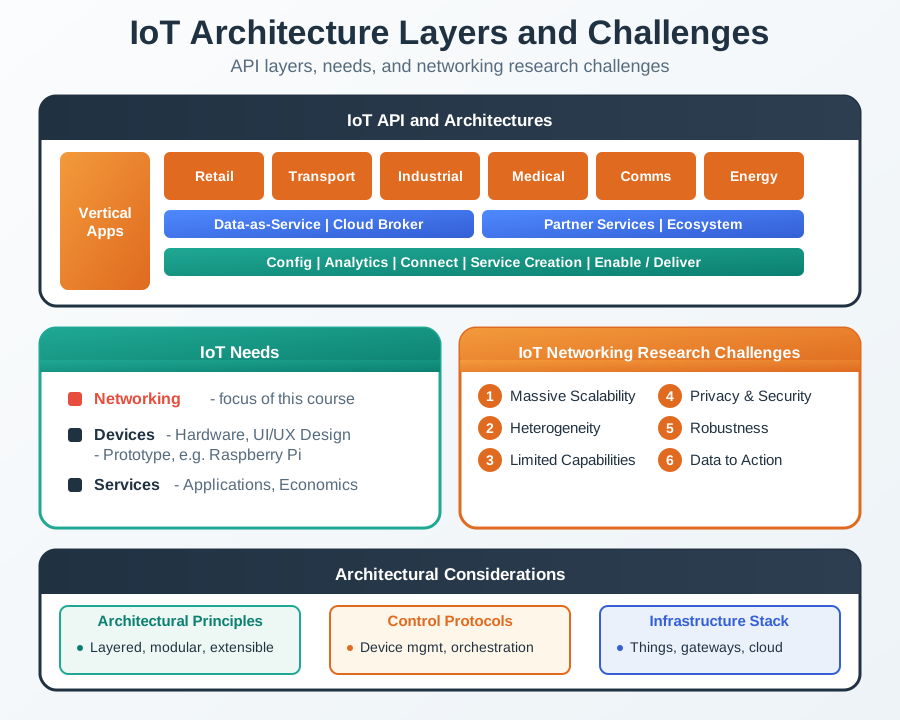
Three-panel diagram showing IoT layered architecture (devices, services, applications), IoT needs (networking, devices, services), and six key IoT networking research challenges including scalability, heterogeneity, device limitations, privacy/security, robustness, and data-to-action conversion

IoT architecture layers showing vertical stacks: IoT Devices and Network (Things, Gateways, Network Infrastructure, Cloud Infrastructure), Core IoT Services (Config & Manage, Analytics, Connect & Protect, Rapid Service Creation, Enable & Deliver), and Services Creation Layer (Retail, Transportation, Industrial, Medical, Communications, Energy) at the application level. Below lists IoT networking research challenges: massive scalability, high heterogeneity and interoperability, limited capabilities on certain things, privacy and security, robustness and resilience, and going from data to action.

Source: Princeton University, Coursera Fog Networks for IoT (Prof. Mung Chiang)

46.4 Processing Placement Decision Map

Before diving into scenarios, this decision flowchart helps you determine which tier should handle a given workload:

Processing placement decision flowchart for fog computing workloads. Edge tier in orange handles ultra-low latency and autonomous operation. Fog tier in teal handles cross-device correlation and moderate data volumes. Cloud tier in navy handles massive storage and historical analysis. Processing placement decision flowchart. Edge (orange) handles ultra-low latency and autonomous operation. Fog (teal) handles cross-device correlation and moderate data volumes. Cloud (navy) handles massive storage and historical analysis.

46.5 Scenario 1: Industrial Control Processing Placement

Scenario: You are designing a smart factory with 500 sensors monitoring assembly line equipment. Each sensor generates 1KB/sec of vibration and temperature data. You need to detect anomalies within 100ms and coordinate responses across multiple machines.

Think about:

  1. Why would cloud-only processing fail for emergency shutdowns even with gigabit connectivity?
  2. What processing tasks belong at edge vs fog vs cloud layers?
  3. How do you balance real-time control with long-term predictive maintenance?

Key Insight: Fog layer processes 50 MIPS control loops in 20ms round-trip (10ms up + 10ms down), meeting 100ms budget with headroom. Edge devices (10 MIPS) cannot handle complex correlation across sensors. Cloud (80ms+ latency) misses deadline. The fog “Goldilocks zone” provides sufficient compute (1,000 MIPS) at local latency – critical for industrial control, AR/VR, and autonomous vehicles where milliseconds matter.

46.5.1 Worked Example: Factory Tier Assignment

Here is how an engineer would assign workloads for the factory scenario:

Workload Tier Latency Budget Reasoning
Emergency shutdown on overpressure Edge (PLC) <5ms Must work without network; safety-critical
Cross-machine vibration correlation Fog (gateway) <100ms Needs data from 50+ sensors; moderate compute
Operator dashboard (20 key metrics) Fog (local server) <1s Aggregates 500 sensors to 20 metrics
Predictive maintenance ML training Cloud Hours Requires 2+ years historical data, GPU clusters
Firmware OTA updates Cloud to Fog Minutes Staged rollout; not time-critical

Smart factory three-tier architecture showing data flow from 500 sensors through fog gateway with 90 percent data reduction to cloud for ML training, with safety-critical edge processing operating independently Smart factory three-tier architecture showing data flow from 500 sensors through fog gateway (90% data reduction) to cloud for ML training, with safety-critical edge processing operating independently.

46.6 Scenario 2: Agricultural IoT Cost Optimization

Scenario: 1,000-acre farm deploys soil moisture sensors every 50 feet (17,424 sensors total). Each sensor transmits 1KB readings every 5 minutes. Cloud costs: $0.15/GB bandwidth + $0.05/GB storage. Adjacent sensors in same irrigation zone show 90% identical readings.

Think about:

  1. Calculate annual costs: cloud-only vs fog-enabled (90% data reduction)
  2. What if real-time irrigation control requires <5 second response times?
  3. How does fog computing affect decision-making during network outages?

Key Insight: Cloud-only: 1,788 GB/year x ($0.15 + $0.05) = $357/year bandwidth/storage. But fog enables local irrigation decisions during connectivity loss, adds $50-100K upfront gateway cost, reduces cloud dependency 90%. Real benefit is not cost savings alone – it is autonomous operation during storms when cellular drops but crops still need water. Fog enables resilient agriculture IoT.

46.6.1 Cost Calculation Breakdown

Metric Cloud-Only Fog-Enabled Difference
Sensors 17,424 17,424 Same
Data per sensor/day 288 KB 288 KB Same
Total data/year 1,788 GB 179 GB (90% filtered) -1,609 GB
Bandwidth cost/year $268 $27 -$241
Storage cost/year $89 $9 -$80
Total annual cloud cost $357 $36 -$321
Fog gateway (one-time) $0 $50,000-100,000 +$50K-100K
Payback (cost only) 156-312 years Not viable

The critical lesson: Fog ROI in agriculture is NOT about bandwidth savings. It is about:

  1. Autonomous irrigation during cellular outages (storms, rural dead zones)
  2. <5 second response for frost protection (cloud round-trip: 2-10 seconds + jitter)
  3. Data sovereignty – sensor data stays on-farm for competitive reasons
  4. Deterministic operation – no cloud jitter affecting irrigation timing

46.7 Scenario 3: Oil Refinery Multi-Tier Architecture

Scenario: Oil refinery monitors 500 sensors (pressure, temperature, flow, vibration) across distributed equipment. Need: (1) <10ms emergency shutdown for overpressure, (2) Real-time operator dashboards, (3) Predictive maintenance ML models requiring 2+ years historical data.

Think about:

  1. Which processing tier handles emergency shutdowns and why?
  2. How does fog layer aggregate 500 sensors without overwhelming operators?
  3. Why can edge devices alone not handle predictive maintenance?

Key Insight: Three-tier separation: Edge (local PLCs) = <10ms safety shutdowns, network-independent. Fog (on-site servers) = aggregate 500 sensors to 20 key metrics on operator HMI, detect cross-sensor correlations (e.g., pressure spike + temperature rise = leak), <1 second queries. Cloud = 1TB+ historical data for ML training (predict equipment failures 30 days ahead), deploy updated models back to fog weekly. Single-layer fails: edge-only lacks ML compute, cloud-only has dangerous latency, fog-only cannot store petabytes. Refineries need all three layers working together.

Oil refinery three-tier architecture showing edge PLCs for safety shutdowns, fog servers for operator dashboards aggregating 500 sensors to 20 metrics, and cloud for ML-based predictive maintenance using years of historical data Oil refinery three-tier architecture: Safety layer operates independently via hardwired PLCs, operations layer aggregates 500 sensors to 20 metrics for operators, and analytics layer trains ML models on years of historical data for 30-day failure predictions.

46.8 Scenario 4: Autonomous Vehicle Fleet Decision Latency

Scenario: Autonomous vehicle traveling 60 mph (27 m/s) detects pedestrian stepping off curb. Three processing options: (A) Vehicle edge computer (5ms detection + 10ms processing), (B) Nearby fog node (25ms network + 10ms processing), (C) Cloud datacenter (150ms network + 10ms processing).

Think about:

  1. Calculate distance traveled during each option’s total latency
  2. At what speed does fog-based processing become unsafe for collision avoidance?
  3. Why do autonomous vehicles need edge processing even with 5G networks?

Key Insight: Distance = speed x latency: Edge (15ms total) = 0.4m, Fog (35ms) = 0.9m, Cloud (160ms) = 4.3m. The vehicle travels 4.3 meters before cloud processing completes – far too late for emergency braking! Even “low latency” 5G (20ms) adds 0.5m stopping distance. Life-safety decisions must happen at edge. Fog layer coordinates multi-vehicle awareness (“pedestrian at intersection X” broadcast), cloud trains improved detection models. This demonstrates why autonomous vehicles, industrial robotics, and medical devices require edge computing – network latency is physics, not engineering.

Calculate the minimum safe stopping distance for each processing tier at highway speeds.

Vehicle Parameters:

  • Speed: 60 mph = 26.8 m/s
  • Human brake reaction time: 1.5 seconds (average driver)
  • Automated system reaction time: processing latency only
  • Deceleration: 0.7g (emergency braking on dry pavement)

Stopping Distance Formula:

\[D_{\text{stop}} = v \times t_{\text{processing}} + \frac{v^2}{2a}\]

where \(v\) = velocity, \(t_{\text{processing}}\) = processing latency, \(a\) = deceleration (0.7g = 6.87 m/s²)

Braking-Only Distance (assumes instant detection):

\[D_{\text{brake}} = \frac{(26.8)^2}{2 \times 6.87} = \frac{718.24}{13.74} = 52.3 \text{ m}\]

Total Stopping Distance by Tier:

Edge (15ms):

\[D_{\text{edge}} = 26.8 \times 0.015 + 52.3 = 0.4 + 52.3 = 52.7 \text{ m}\]

Fog (35ms):

\[D_{\text{fog}} = 26.8 \times 0.035 + 52.3 = 0.94 + 52.3 = 53.2 \text{ m}\]

Cloud (160ms):

\[D_{\text{cloud}} = 26.8 \times 0.160 + 52.3 = 4.3 + 52.3 = 56.6 \text{ m}\]

Safety Analysis:

  • Edge processing adds 0.4m to minimum stopping distance (negligible)
  • Fog processing adds 0.9m (acceptable for highway spacing but dangerous in urban environments)
  • Cloud processing adds 4.3m — equivalent to one car length of additional stopping distance

At 80 mph (35.8 m/s), cloud latency adds 5.7m — making collision unavoidable in many scenarios. This quantifies why life-safety systems MUST use edge processing.

46.8.1 Latency vs Distance Analysis

Autonomous vehicle latency comparison chart showing distance traveled during processing at edge (0.4 meters), fog (0.9 meters), and cloud (4.3 meters) tiers, demonstrating why life-safety braking decisions must use edge computing Latency comparison for autonomous vehicle braking decision: Edge processing (0.4m traveled) is the only safe option for collision avoidance. Cloud processing (4.3m traveled) is dangerously late. Fog is appropriate for multi-vehicle coordination, not life-safety decisions.

Speed sensitivity analysis – at what speed does each tier become unsafe?

Processing Tier Total Latency Safe at 30 mph? Safe at 60 mph? Safe at 80 mph?
Edge (15ms) 15ms 0.2m – Safe 0.4m – Safe 0.5m – Safe
Fog (35ms) 35ms 0.5m – Safe 0.9m – Marginal 1.3m – Unsafe
Cloud (160ms) 160ms 2.1m – Unsafe 4.3m – Dangerous 5.7m – Fatal
5G Best Case (30ms) 30ms 0.4m – Safe 0.8m – Marginal 1.1m – Unsafe

Note: “Safe” assumes 1m minimum stopping margin. Even 5G becomes marginal above 60 mph.

46.9 Scenario 5: Smart Factory Bandwidth Economics

Scenario: Factory deploys 1,000 sensors at 100 bytes/second each. Cloud bandwidth costs $0.10/GB. Without fog: all data streams to cloud. With fog: local processing filters 95% redundant data (e.g., “temperature stable at 20C” does not need continuous reporting).

Think about:

  1. Calculate annual bandwidth costs for both architectures
  2. What is the payback period for $50K fog gateway investment?
  3. Beyond cost savings, what operational benefits does fog provide?

Key Insight: Data volume: 1,000 sensors x 100 bytes/sec = 100KB/sec = 8.64GB/day = 3,154GB/year. Cloud-only: $315/year bandwidth. Fog-enabled (95% filtered): $16/year. Savings: $299/year. Payback period = $50K / $299/year = 167 years! Wrong metric. Real benefits: (1) Local analytics continue during WAN outages, (2) <100ms response for equipment coordination vs 200ms cloud round-trip, (3) GDPR compliance (sensor data never leaves factory), (4) Predictable latency (cloud has 50-500ms jitter). Fog value is not bandwidth savings – it is operational resilience, data sovereignty, and deterministic performance.

46.9.1 The Fog ROI Trap

Many engineering teams make the mistake of justifying fog computing purely through bandwidth cost savings. This analysis reveals why that approach fails:

Fog computing ROI quadrant chart showing four pillars: bandwidth savings (easy to calculate, low impact), compliance (hard to quantify, moderate impact), latency determinism (moderate difficulty, high impact), and operational resilience (hardest to quantify, highest impact) Fog computing ROI quadrant chart: Bandwidth savings (bottom-right) are easy to calculate but low impact. The highest-impact factors – operational resilience and latency determinism (top-left) – are hardest to quantify, which is why naive ROI calculations undervalue fog.

The correct fog ROI framework evaluates four pillars:

ROI Pillar Value Driver Example Metric Quantifiable?
Resilience Operations continue during WAN outage Avoided downtime: $10K-100K/hour Moderate
Determinism Predictable latency (no cloud jitter) Reduced reject rate: 0.1% to 0.01% High
Compliance Data sovereignty (GDPR, HIPAA) Avoided fines: $10M+ potential Low (probability)
Bandwidth Reduced cloud transfer costs $299/year savings High (but small)

46.9.2 Interactive: Fog ROI Calculator

Explore why bandwidth savings alone rarely justify fog investment.

46.10 Processing Placement Decision Framework

Based on the understanding checks above, use this framework for deciding where to process each workload:

Requirement Edge Fog Cloud
Latency <10ms Required Not feasible Not feasible
Latency 10-100ms Possible Optimal Not feasible
Latency 100ms+ Possible Possible Acceptable
Cross-device correlation Limited Optimal Capable
Historical analysis (years) Not feasible Limited Required
ML model training Not feasible Not feasible Required
Network independence Required Partial Not possible
Privacy/compliance Optimal Good Review needed
Real-time safety Required Backup only Not acceptable
Fleet coordination Not feasible Optimal Too slow

46.10.1 Common Placement Mistakes

Pitfall: Over-Centralizing to Cloud

Mistake: “Cloud has unlimited compute, so process everything there.”

Why it fails: Cloud latency (100-500ms) is a physics constraint, not an engineering one. No amount of cloud optimization can make light travel faster through fiber. Systems requiring <100ms response MUST use edge or fog.

Real-world consequence: The autonomous vehicle case study showed that a 450ms cloud delay during network congestion nearly caused a pedestrian collision. The entire fleet architecture was redesigned because of this single incident.

Pitfall: Fog ROI Based on Bandwidth Alone

Mistake: “Fog gateway costs $50K but only saves $300/year in bandwidth – ROI is 167 years.”

Why it fails: This ignores resilience ($10K-100K/hour downtime cost), compliance (potential $10M+ GDPR fines), and latency determinism (reduced defect rates). The correct analysis considers all four ROI pillars.

Rule of thumb: If your fog ROI calculation shows >10 year payback, you are measuring the wrong benefits.

Imagine a really tall building where data lives:

Ground Floor (Edge) – This is like the front door. When someone rings the doorbell, you open it RIGHT AWAY. You do not call someone on the top floor to ask “should I open the door?” That would take too long! Emergency things happen here.

Middle Floor (Fog) – This is like the office where people work together. If five friends all say “it is raining outside,” the office person says “OK, it is raining” just once, instead of sending five separate messages upstairs. The middle floor makes things simpler.

Top Floor (Cloud) – This is like the big library with ALL the books. If you want to know “what was the weather like for the last 5 years?” you go to the top floor because they keep everything forever. But it takes a while to walk all the way up there!

The key idea: Fast decisions happen downstairs (edge). Smart combining happens in the middle (fog). Big research happens upstairs (cloud). A good building uses ALL the floors!

46.11 Knowledge Check

Scenario: An autonomous vehicle fleet uses edge-fog-cloud architecture for object detection. Calculate the maximum allowable processing latency at each tier to maintain safety.

Given:

  • Vehicle speed: 60 mph (26.8 m/s)
  • Safe stopping distance: 40 m
  • Mechanical braking delay: 200 ms
  • Sensor detection time: 30 ms
  • Required decision time before braking: Calculate

Step 1: Calculate time available for decision:

Distance = Speed × Time
40m = 26.8 m/s × Time
Time = 40 / 26.8 = 1.49 seconds total budget

Step 2: Subtract fixed delays:

Total budget: 1,490 ms
- Mechanical braking: 200 ms
- Sensor detection: 30 ms
Remaining for processing: 1,260 ms

Step 3: Evaluate each tier against budget:

Tier Latency Distance Traveled Meets Budget? Safe?
Edge (on-vehicle) 5 ms processing + 5 ms routing = 10 ms 0.27 m ✓ Yes (10 << 1,260 ms) SAFE
Fog (roadside unit) 20 ms network + 30 ms processing = 50 ms 1.34 m ✓ Yes (50 << 1,260 ms) SAFE
Cloud 120 ms network + 40 ms processing = 160 ms 4.29 m ✓ Yes (160 << 1,260 ms) SAFE

Step 4: Add network jitter and worst-case analysis:

Best-case latencies don’t account for congestion and packet loss. Real-world 95th percentile latencies:

Tier Best Case 95th Percentile Worst Case Distance @ 95th Safe?
Edge 10 ms 15 ms 25 ms 0.40 m SAFE
Fog 50 ms 120 ms 300 ms 3.22 m MARGINAL
Cloud 160 ms 450 ms 1,200 ms 12.06 m UNSAFE

Step 5: Final tier assignment for safety-critical braking:

Tier: EDGE (on-vehicle processing)
Rationale:
- Worst-case latency (25 ms) << budget (1,260 ms) with 50x safety margin
- No network dependency — functions during connectivity loss
- 95th percentile: vehicle travels only 0.40m during processing (well within 40m budget)

Fog and Cloud roles:
- Fog: Multi-vehicle coordination ("vehicle ahead braking")
- Cloud: ML model training and fleet-wide analytics
- Neither handles life-safety braking decisions

Real-World Validation: In 2019, a major autonomous vehicle developer experienced a near-miss incident when a 450ms cloud API delay during network congestion prevented timely pedestrian detection. Post-incident analysis shifted all safety-critical decisions to edge processing, using fog only for non-critical coordination.

Key Lesson: Always calculate 95th percentile latency, not average latency, for safety decisions. The 95th percentile fog latency (120ms) is 2.4x the best-case (50ms) — this gap can mean the difference between a safe stop and a collision.
Use this framework to assign each workload to the correct tier:

Workload Type Latency Req Compute Need Network Independence Tier Assignment
Emergency shutdown <10 ms Low (threshold rules) Required Edge (PLCs, local compute)
Real-time anomaly detection 10-100 ms Medium (correlation, filtering) Preferred Fog (local server, gateway)
Cross-sensor analytics 100-500 ms Medium-High (aggregation, ML inference) Optional Fog or Cloud
Historical reporting >1 second Low (queries) No Cloud (database, dashboards)
ML model training Hours Very High (GPU clusters) No Cloud (batch processing)

Decision Algorithm:

def assign_tier(latency_ms, compute_complexity, safety_critical):
    if safety_critical or latency_ms < 10:
        return "EDGE"
    elif latency_ms < 100:
        if compute_complexity == "LOW":
            return "EDGE"
        else:
            return "FOG"
    elif latency_ms < 500:
        return "FOG or CLOUD (cost optimization)"
    else:
        return "CLOUD"

Hybrid Strategies:

  • Edge + Fog: Edge detects, fog confirms (reduces false positives)
  • Fog + Cloud: Fog for real-time, cloud for batch analysis
  • Edge + Cloud: Edge for control, cloud for monitoring (fog skipped for simplicity)
Common Mistake: Ignoring Network Jitter in Latency Calculations

The Trap: “Our fog node has 30ms average latency, well within the 100ms requirement.”

Why This Fails: Average latency hides the distribution. Real-world latency is not constant:

Percentile Fog Latency Cloud Latency
50th (median) 30 ms 120 ms
90th 65 ms 280 ms
95th 120 ms 450 ms
99th 350 ms 1,200 ms

A system designed for 30ms average latency will experience 350ms latency 1% of the time (99th percentile). For a factory processing 100 decisions/second, 1% means 1 decision/second exceeds the latency budget.

Real-World Example: A smart grid deployed fog nodes for load balancing with a “100ms requirement.” During peak load (evening), the 95th percentile fog latency spiked to 180ms due to radio congestion, causing grid instability. The team had designed for average latency (45ms), not 95th percentile.

The Corrected Approach:

  • Design for 95th percentile latency, not average
  • Add 2x safety margin to requirements (50ms requirement → design for 25ms)
  • Monitor latency distributions, not just averages — alert on 95th percentile degradation
  • Use dedicated fog networks (wired Ethernet, not shared Wi-Fi) for latency-sensitive applications

Rule of Thumb: If your requirement is “100ms,” your design target should be “50ms average with 80ms 95th percentile.” Never design to the requirement boundary.

46.12 Summary

46.12.1 Key Takeaways

This chapter provided five scenario-based understanding checks demonstrating how to apply fog computing concepts to real deployment decisions:

  1. Industrial Control (Scenario 1): Fog provides the “Goldilocks zone” – sufficient compute (1,000 MIPS) at local latency (10-100ms) for cross-sensor anomaly detection across 500 sensors. Edge handles safety shutdowns; cloud handles ML training.

  2. Agricultural IoT (Scenario 2): Fog value is autonomous operation during connectivity loss, NOT bandwidth savings. The $50K gateway has a 156-312 year payback on bandwidth alone, but crops need water even when cellular fails during storms.

  3. Oil Refinery (Scenario 3): Three-tier separation is essential and non-negotiable. Edge for <10ms safety shutdowns (hardwired, network-independent), fog for operator dashboards (500 sensors aggregated to 20 metrics), cloud for ML training on years of historical data.

  4. Autonomous Vehicles (Scenario 4): Physics drives architecture. At 27 m/s with 160ms cloud latency, a vehicle travels 4.3m before receiving a braking command – dangerously late. Life-safety decisions must happen at the edge tier. Even 5G becomes marginal above 60 mph.

  5. Bandwidth Economics (Scenario 5): Never justify fog through bandwidth savings alone. The four-pillar ROI framework evaluates resilience, determinism, compliance, and bandwidth together. The highest-impact factors are the hardest to quantify.

46.12.2 Decision Rules

  • Latency <10ms – Edge only (physics constraint, not engineering)
  • Cross-device correlation <100ms – Fog optimal (sufficient compute at local latency)
  • Historical analysis >30 days – Cloud required (storage at scale)
  • Network-independent operation – Edge or fog with local autonomy
  • ML model training – Cloud required (GPU clusters + massive datasets)

Common Pitfalls

Understanding checks have value only when you can explain why an answer is correct, not just select it. If you can answer a multiple-choice question but cannot explain the underlying principle to someone else, you have surface-level knowledge that will fail in novel situations. For each question, articulate the reasoning before checking answers.

Fog performance calculations (latency budgets, bandwidth savings, TCO) are tools for reasoning about real systems, not formulas to memorize. Understanding when and why to apply each calculation, and what assumptions it makes, is more valuable than the formula itself. Practice by creating your own scenarios and solving them.

Understanding checks often have a single correct answer for the given scenario. The deeper question is: what would change in the scenario to make a different answer correct? This “what would change” analysis builds the contextual judgment needed for real-world fog deployment decisions where scenarios never match textbook examples exactly.

46.13 What’s Next

Continue with the production case study and related topics:

Topic Chapter Description
Case Study Fog Production Case Study Autonomous vehicle fleet management demonstrating production fog deployment at scale
Core Concepts Fog Fundamentals Review core fog computing concepts and edge-fog-cloud continuum
Architecture Fog Production Framework Architecture patterns and deployment tiers for fog production
Assessment Fog Production Review Comprehensive review with worked calculations and knowledge checks