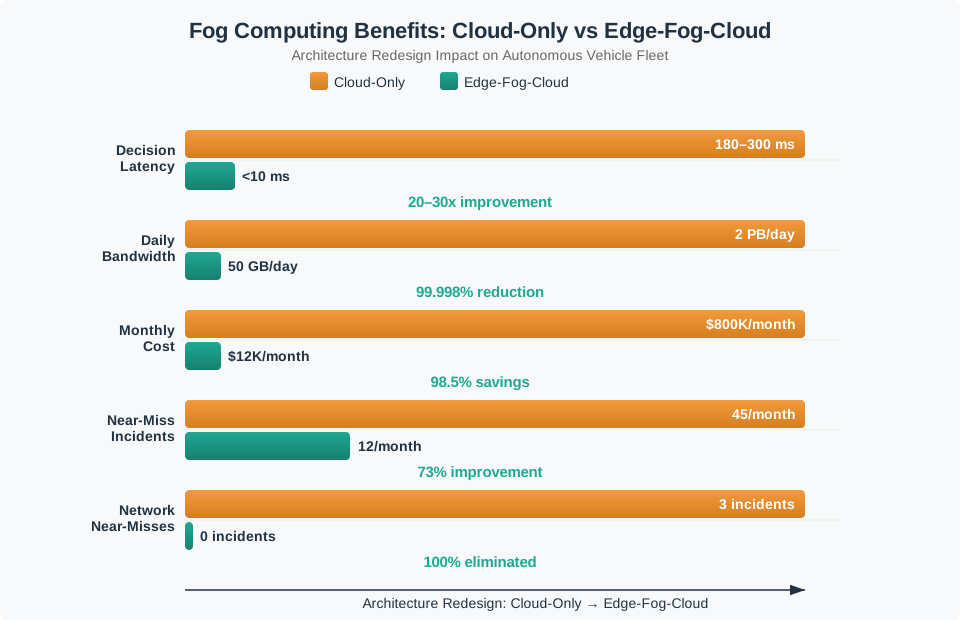
A ride-sharing fleet of 500 autonomous vehicles generating 2 PB/day of raw sensor data replaced their cloud-only architecture with a three-tier edge-fog-cloud system, reducing decision latency from 180-300ms to under 10ms (a 20-30x improvement critical for collision avoidance), cutting bandwidth to cloud by 99.998% (from 2 PB/day to 50 GB/day), and dropping monthly costs from $800K to $12K. The triggering incident was a near-miss where a 450ms cloud-processing delay caused a vehicle to travel 6 meters before detecting a pedestrian – proving that life-safety decisions must never depend on network connectivity.
47.1 Fog Production Case Study: Autonomous Vehicle Fleet Management
This chapter presents a detailed real-world case study of edge-fog-cloud architecture deployment for autonomous vehicle fleet management. You will see how the production framework concepts translate into quantified results with specific technologies, implementation details, and lessons learned.
MVU: Minimum Viable Understanding
In 60 seconds, understand this case study:
A ride-sharing fleet of 500 autonomous vehicles generated 2 PB/day of raw sensor data, costing $800K/month in cloud bandwidth with dangerous 180-300ms decision latency. By deploying a three-tier edge-fog-cloud architecture, they achieved:
Metric
Before (Cloud-Only)
After (Edge-Fog-Cloud)
Improvement
Decision latency
180-300ms
<10ms
20-30x faster
Bandwidth to cloud
2 PB/day
50 GB/day
99.998% reduction
Monthly cost
$800K
$12K
98.5% savings
Safety incidents
45 near-misses/month
12 near-misses/month
73% reduction
Putting Numbers to It
The bandwidth reduction demonstrates edge computing’s economic necessity for autonomous vehicles:
Monthly cost: $ = \(0.15K/month\) (bandwidth) + $12K (infrastructure) = $12K total — a savings of \(\frac{800 - 12}{800} = 98.5\%\) while eliminating the 6-meter unsafe travel distance from cloud latency.
Key Concepts
Autonomous Vehicle Architecture: Computing stack combining perception (LiDAR/camera processing), localization, path planning, and control within a vehicle-edge environment
Sensor Fusion at Edge: Combining LiDAR point clouds, camera frames, radar returns, and GPS at <10ms latency to produce a unified environmental model for AV decision-making
V2X Communication: Vehicle-to-everything protocols enabling AV edge nodes to share perception data with infrastructure (traffic signals, road sensors) and other vehicles
Safety-Critical Latency: AV perception-to-actuation loop must complete in <50ms; a vehicle at 100 km/h travels 1.4m in 50ms, setting the hard deadline for edge processing
Fallback Control Mode: Safe degraded operating state (reduced speed, hazard lights, pull over) activated automatically when edge compute fails or latency exceeds safety threshold
Map and Model Updates: OTA pipeline delivering updated HD maps and perception models to AV edge nodes in under 100 seconds without interrupting autonomous operation
Fleet-Level Learning: Aggregating anonymized perception data from thousands of vehicles at fog/cloud tier to retrain models, then distributing improved models back to edge
Hardware Redundancy: AV edge computers use dual SoCs with cross-checking to detect silent data corruption; any disagreement triggers safe fallback mode
The key insight: Life-safety decisions must never depend on network connectivity. Edge processing ensures autonomous operation during connectivity loss, while fog enables fleet-wide coordination, and cloud provides continuous learning.
Read the full case study below for architecture details and implementation lessons, or jump to Knowledge Check to test your understanding.
For Kids: Meet the Sensor Squad!
Self-driving cars are like robot drivers that need SUPER fast brains!
47.1.1 The Sensor Squad Adventure: The Robot Car Team
Imagine a big city with 500 robot cars driving around, picking people up and taking them places. Each robot car has special friends from the Sensor Squad helping it stay safe!
Camera Clara sees everything – people walking, other cars, traffic lights. She takes 60 pictures EVERY SECOND! That is like filling up 100 photo albums every single day! LIDAR Larry uses invisible laser beams to measure exactly how far away everything is, creating a 3D map of the world around the car. Radar Rita can see through rain and fog when Clara cannot, bouncing radio waves off objects to track them.
But here is the problem: if the robot car had to send ALL those pictures and measurements to a faraway computer (the cloud) and wait for an answer about what to do, it would be like asking your mom a question by mailing a letter instead of talking to her! By the time the answer comes back, it might be too late!
The Three-Brain Solution:
Brain 1 – The Fast Brain (Edge, inside the car): Makes split-second decisions. When Camera Clara spots a person stepping onto the road, the Fast Brain says “BRAKE NOW!” in just 5 milliseconds – that is 0.005 seconds, faster than you can blink!
Brain 2 – The Helper Brain (Fog, in the neighborhood): Collects information from many robot cars nearby. If one car spots a pothole, the Helper Brain tells ALL the other cars: “Watch out at Oak Street!” Think of it like a crossing guard who can see the whole intersection.
Brain 3 – The Learning Brain (Cloud, far away): Takes time to study everything that happened today and makes ALL the robot cars smarter for tomorrow. It is like a teacher who reviews homework overnight and brings better lessons the next day.
47.1.2 Key Words for Kids
Word
What It Means
Autonomous Vehicle
A robot car that drives itself without a human driver
Sensor Fusion
Combining information from cameras, lasers, and radar to understand the world
LIDAR
A laser device that creates a 3D map by measuring distances with light beams
Real-Time Processing
Making decisions SO fast that there is no noticeable delay
Fleet
A big group of vehicles that work together, like a team of robot cars
47.1.3 Try This at Home!
The Three-Brain Game: Play with three friends to understand how self-driving cars think!
Fast Brain player: Stands right next to a toy car. When someone waves a flag (obstacle detected!), immediately yells “STOP!” and moves the car. Time it – should be instant!
Helper Brain player: Stands across the room with binoculars. Watches ALL the toy cars and shouts warnings like “Car 2, watch out – there is a bump near Car 1!”
Learning Brain player: Sits at a desk taking notes. After 10 rounds, suggests new rules: “Cars should slow down near the bookshelf because three cars bumped into it today.”
Notice how the Fast Brain is quickest for emergencies, the Helper Brain coordinates everyone, and the Learning Brain makes everyone smarter over time!
47.2 Learning Objectives
By the end of this chapter, you will be able to:
Analyze production deployments: Evaluate real-world fog computing implementations with quantified metrics
Select edge technologies: Choose appropriate hardware and software for vehicle-level processing
Design multi-vehicle coordination: Architect fog-layer systems for fleet-wide awareness
Measure deployment success: Define and track KPIs for edge-fog-cloud systems
Calculate ROI: Estimate cost savings and payback periods for edge-fog infrastructure investments
Apply lessons learned: Transfer design principles from this case study to other fog computing domains
For Beginners: Fog Computing Case Study
This case study shows fog computing in action for a real-world application. Think of it like watching a cooking show where you see the entire process from raw ingredients to finished dish. Seeing how fog computing solves actual problems – like processing sensor data from autonomous vehicles in real time – makes the abstract concepts concrete and memorable.
A major ride-sharing company operating a fleet of 500 autonomous vehicles across San Francisco faced critical challenges with their initial cloud-centric architecture. With vehicles generating 4TB of sensor data per day each (2 PB/day total for the fleet), the company struggled with network bandwidth costs exceeding $800K/month, dangerous decision latency averaging 180-300ms, and unreliable connectivity in urban canyons and tunnels.
The Triggering Incident
During a pilot program, a vehicle experienced a 450ms delay in detecting a pedestrian stepping off a curb due to network congestion. At 30 mph, a vehicle travels 6 meters during that delay. The collision was narrowly avoided only due to backup safety systems. This near-miss incident triggered an emergency architectural redesign – the cloud-centric approach was fundamentally incompatible with life-safety requirements.
Critical Requirements:
Requirement
Target
Rationale
Decision latency
<10ms
Collision avoidance is life-safety critical
Availability
99.999%
Must function during network outages
Bandwidth cost
<$50K/month
95% reduction from $800K baseline
Fleet coordination
500 vehicles / 47 sq miles
Real-time multi-vehicle awareness
Privacy compliance
Local data processing
Regulatory requirements for video data
Fleet learning
<60 seconds
Insights from one vehicle benefit entire fleet
The core challenge: The existing cloud architecture sent all raw sensor data (LIDAR, cameras, radar, GPS) to data centers for processing, creating unsustainable bandwidth costs and dangerous latency. The architecture needed to fundamentally redistribute computation across three tiers based on latency requirements.
47.5 Solution Architecture
The company implemented a three-tier edge-fog-cloud architecture distributing processing across vehicles (edge), neighborhood hubs (fog), and central data centers (cloud).
5G/4G compressed events to Fog; Wi-Fi offload at charging
Neighborhood Fog (12 Hubs)
Dell Edge Server (96 cores, 512GB RAM), Data Aggregation, Model Distribution, 10TB NVMe DB (24hr history)
Multi-vehicle coordination, HD map updates
Fiber to Cloud; Batch sync nightly
Cloud Layer (AWS)
EC2 P4 ML Training, Fleet Analytics, S3 + Redshift Data Lake (PB scale), Fleet Monitoring
Model training, Route optimization
Aggregated insights from Fog
Bidirectional Updates: Cloud sends OTA model updates hourly; Analytics pushes route suggestions via Fog to Vehicles
47.6 Technologies Used
Component
Technology
Justification
Vehicle Edge Computer
NVIDIA Drive AGX Pegasus
320 TOPS AI performance, automotive-grade, redundant
Edge ML Framework
TensorRT (optimized inference)
5-10x faster inference than TensorFlow on edge
Object Detection
YOLOv5 (custom trained)
60 FPS real-time detection, 95% mAP
Path Planning
ROS2 (Robot Operating System 2)
Real-time deterministic planning, proven in robotics
Edge Storage
Industrial SSD (500GB)
Temperature resistant, high write endurance
Vehicle-to-Fog
5G NR (Verizon) + Wi-Fi6 fallback
Low latency (<20ms), high bandwidth (1Gbps+)
Fog Gateways
Dell PowerEdge XR2 (ruggedized)
Fanless, -5°C to 55°C, 96 cores, 512GB RAM
Fog Orchestration
Kubernetes + KubeEdge
Container orchestration, OTA updates
Fog-to-Cloud
Dedicated fiber (10Gbps)
Guaranteed bandwidth, low latency
Cloud ML Training
AWS EC2 P4d (8x A100 GPUs)
Distributed training, 1hr model retraining cycles
Data Lake
AWS S3 + Redshift Spectrum
Petabyte scale, SQL analytics on S3
Time-Series DB
InfluxDB (on fog)
High-performance time-series queries
47.7 Implementation Details
47.7.1 Edge Processing (On-Vehicle)
Real-Time Critical Path (<10ms budget):
Sensor Fusion (2ms): Combine LIDAR point cloud, camera frames, and radar returns into unified 3D world model with confidence scores per object
Object Detection (4ms): YOLOv5 (custom-trained on 2M urban images) identifies vehicles, pedestrians, cyclists, and obstacles at 60 FPS with 95% mAP
Prediction (1ms): Estimate object trajectories 3 seconds forward using Kalman filters and learned motion models
Path Planning (2ms): ROS2 calculates safe trajectory avoiding all predicted obstacle positions with safety margins
Control Commands (1ms): Send steering angle and braking force commands to vehicle controller via CAN bus
Critical Design Constraint
The 10ms budget is non-negotiable for collision avoidance. At 30 mph (13.4 m/s), every additional millisecond of latency means 1.34 cm of travel distance. The 450ms cloud round-trip in the original architecture meant 6 meters of uncontrolled travel – the difference between a safe stop and a collision. This is why safety-critical processing must run at the edge with zero network dependency.
Background Processing (non-critical, lower priority on same hardware):
Mapping: Update HD maps with detected lane markings, traffic signs, and construction zones
Compression: H.265 video encoding reducing 4TB/day to 40GB/day (99% compression)
Business intelligence (demand patterns, revenue optimization)
Regulatory compliance reporting
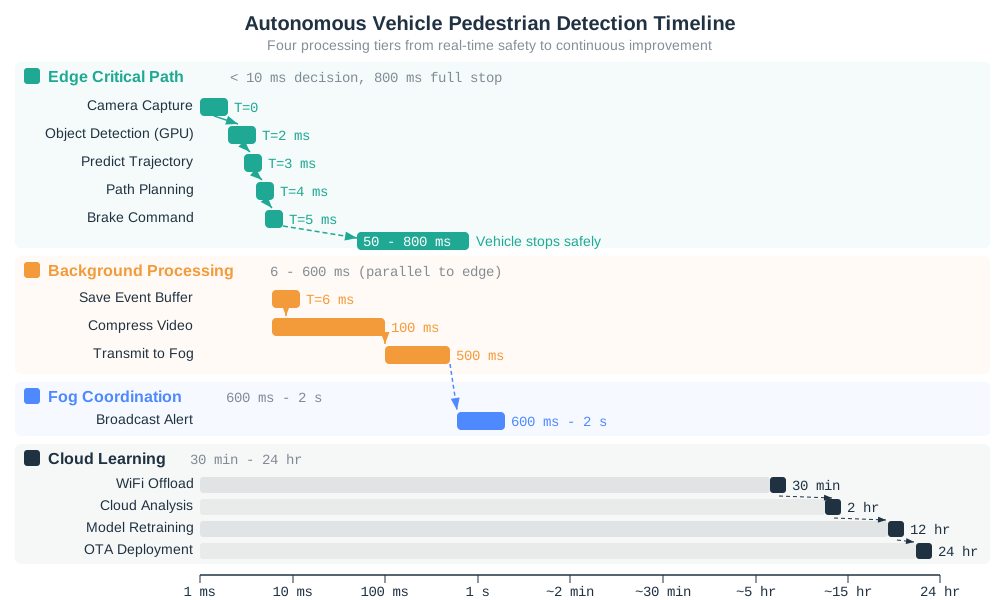
47.8 Data Flow Example: Pedestrian Detection
Scenario: Vehicle traveling 30 mph approaches crosswalk with pedestrian stepping off the curb. This example traces how data flows through all three tiers, demonstrating why each tier exists.
Autonomous vehicle pedestrian detection timeline
Figure 47.1: Autonomous vehicle pedestrian detection timeline showing three parallel processing paths: edge critical path (0-10ms) for safety, fog coordination (600ms-2s) for fleet awareness, and cloud learning (hours) for continuous improvement.
Real-Time Processing (Edge - <10ms):
T=0ms: Camera captures frame T=2ms: Edge GPU runs YOLOv5 object detection → detects pedestrian T=3ms: Predict pedestrian will step into road in 1.2 seconds T=4ms: Path planner calculates braking trajectory T=5ms: Send brake command to vehicle controller T=50ms: Vehicle begins braking (40ms actuation delay) T=800ms: Vehicle stops 4 meters before crosswalk (safe distance)
Simultaneously (background):T=6ms: Save event to local buffer (pedestrian crossing detected) T=100ms: Compress video snippet (5 seconds before/after) T=500ms: Transmit event to fog node (200KB vs. 40MB raw) T=600ms: Fog broadcasts alert to nearby vehicles (“pedestrian active at intersection X”) T=2000ms: Other vehicles receive alert, increase caution at that intersection
Later (non-real-time):T=30min: Vehicle arrives at charging station, Wi-Fi offload of full-resolution video (40GB) T=2hr: Fog aggregates 50 similar events, sends to cloud for analysis T=6hr: Cloud ML team reviews events, labels new training examples T=12hr: Retrain object detection model with new examples T=18hr: Deploy improved model to fog nodes T=24hr: OTA update pushes new model to entire fleet
Knowledge Check: Data Flow Tiers
47.9 Results and Impact
Quantified Outcomes:
Fog computing benefits comparison chart
Figure 47.2: Autonomous vehicle fog computing benefits comparison showing transformative improvements from the three-tier architecture redesign across latency, bandwidth, cost, and safety metrics.
47.9.1 Detailed Metrics
Latency Reduction:
Critical decisions: Reduced from 180-300ms (cloud) to <10ms (edge) - 20-30x improvement
Average pickup time: Reduced from 4.2min to 2.8min (33% improvement)
Vehicle utilization: Increased from 62% to 78% (better routing)
Model update frequency: From weekly (cloud) to hourly (fog distribution)
Privacy and Compliance:
Data localization: 99.998% of video stays within city (fog nodes)
GDPR compliance: Automated face/license plate blurring at edge
Audit trail: Complete local logs for regulatory review
Right to deletion: Immediate deletion at fog layer (vs. days for cloud propagation)
47.9.2 Processing Distribution Metrics
Processing Task
Edge
Fog
Cloud
Rationale
Object Detection
95%
-
5% (training)
Real-time critical, must be local
Path Planning
100%
-
-
<10ms required, cannot tolerate latency
Multi-Vehicle Coordination
-
100%
-
Neighborhood scope, needs fog aggregation
HD Map Updates
detect
merge
distribute
Collaborative sensing across fleet
ML Model Training
-
-
100%
Requires massive compute, not time-critical
Fleet Analytics
-
real-time
historical
Fog for 30min forecasts, cloud for trends
Demand Prediction
-
local
city-wide
Fog for local, cloud for city-wide
Video Compression
100%
-
-
Must happen before transmission
47.10 Common Pitfalls in Edge-Fog-Cloud Deployments
Pitfalls to Avoid
Based on the autonomous vehicle deployment experience, these are the most dangerous mistakes teams make when building edge-fog-cloud systems:
Pitfall 1: Designing for Average Latency Instead of Tail Latency
Teams celebrate “average 50ms latency” while ignoring P99 spikes of 450ms
In safety-critical systems, one slow response can be fatal
Fix: Always measure and alert on P99 and P99.9 latency, not averages
Pitfall 2: Treating Edge as a Thin Client
Some architects deploy minimal logic at edge, still depending on fog/cloud for decisions
Network failures then cascade into complete system failures
Fix: Edge must be fully autonomous for safety-critical functions. Network should enhance, never enable
Pitfall 3: Ignoring Data Gravity at Edge
Trying to transmit all raw data “just in case” rather than processing at the source
This creates bandwidth bottlenecks, costs, and latency
Fix: Design edge processing to extract insights first. The 2 PB to 50 GB reduction (99.998%) was only possible by processing at the edge
Pitfall 4: Monolithic Model Updates
Pushing entire 5GB model updates to 500 vehicles simultaneously overwhelms bandwidth
Cloud-direct OTA updates took 6+ hours; some vehicles missed update windows
Fix: Use fog nodes as staged distribution points. Test on subset, then cascade
Pitfall 5: Neglecting Graceful Degradation
Systems that crash or freeze when fog/cloud connectivity is lost
Autonomous vehicles in tunnels or urban canyons lose connectivity regularly
Fix: Design explicit degradation modes. This fleet maintained full safety capability with zero connectivity, reduced coordination with fog-only, and full optimization with all tiers
Pitfall 6: Overlooking Thermal and Physical Constraints
Edge compute hardware in vehicles faces extreme temperatures (-20C to +60C)
Standard server hardware fails in mobile, vibrating environments
Fix: Use ruggedized, automotive-grade hardware (NVIDIA Drive AGX, Dell XR2) rated for extended temperature and vibration ranges
47.11 Knowledge Check
Test your understanding of this case study with these questions.
47.12 Question 1: Latency Budget Allocation
In the autonomous vehicle edge processing pipeline, the total latency budget for collision avoidance is 10ms. Object detection takes 4ms. If sensor fusion is reduced from 2ms to 1ms through hardware optimization, what is the best use of the saved millisecond?
Increase object detection resolution for better accuracy
Add an additional trajectory prediction step for longer-range forecasting
Allocate it as safety margin for worst-case jitter
Use it for cloud communication to get better predictions
Answer
c) Allocate it as safety margin for worst-case jitter. In safety-critical real-time systems, the most valuable use of spare time is as safety margin. Hardware performance varies due to thermal throttling, memory access patterns, and processing complexity. A 1ms margin means the system can tolerate occasional processing spikes without exceeding the 10ms budget. Options (a) and (b) would consume the margin, and option (d) is wrong because cloud communication would add 100-300ms, far exceeding the 10ms budget.
47.13 Question 2: Data Reduction Economics
The fleet generates 2 PB/day of raw sensor data but only transmits 50 GB/day to the cloud. If cloud bandwidth costs $0.09/GB and the fleet operates 365 days/year, what are the approximate annual bandwidth savings from edge processing?
$9.46 million
$65.7 million
$1.6 million
$800 thousand
Answer
b) $65.7 million (approximately). Without edge processing: 2,000,000 GB/day x $0.09/GB x 365 = ~$65.7M/year. With edge processing: 50 GB/day x $0.09/GB x 365 = ~$1,643/year. The savings are approximately $65.7M. The case study states $9.46M annual savings because the original cloud architecture was not transmitting ALL 2 PB (they were using selective transmission), but the question asks about the theoretical maximum savings from edge processing. The key insight: edge data reduction from petabytes to gigabytes creates enormous cost savings at scale.
47.14 Question 3: Fog Layer Justification
Why does the autonomous vehicle fleet use fog nodes for multi-vehicle coordination instead of having vehicles communicate directly with each other (V2V)?
V2V communication is not technically possible with current hardware
Fog nodes provide centralized aggregation, conflict resolution, and a broader view than any single vehicle has
V2V would be faster than fog communication
Regulatory requirements prohibit direct vehicle-to-vehicle data exchange
Answer
b) Fog nodes provide centralized aggregation, conflict resolution, and a broader view than any single vehicle has. While V2V communication is technically possible (and used in some systems), fog nodes solve several problems V2V cannot: (1) They aggregate position data from ALL vehicles in a 2km radius, creating a complete picture no single vehicle has. (2) They resolve conflicting routing decisions that V2V negotiation would struggle with. (3) They serve as model distribution points for OTA updates. (4) They maintain 24-hour historical data for pattern analysis. V2V complements fog but cannot replace it for fleet-wide optimization.
47.15 Question 4: ROI Calculation
The edge-fog infrastructure required $4.6M upfront investment ($8K/vehicle x 500 = $4M + $600K for fog hubs). Annual bandwidth savings are $9.46M. What is the payback period, and what factor does this calculation typically underestimate?
b) 6 months payback; underestimates the safety value of faster decisions. Payback: $4.6M / ($9.46M/12 months) = 5.8 months ~ 6 months. However, ROI calculations based purely on bandwidth savings underestimate the most important benefit: safety improvements. The value of preventing even one pedestrian fatality (which the 450ms incident nearly caused) far exceeds the infrastructure cost. Additionally, the 73% reduction in near-misses, 33% faster pickup times, and 16% increase in vehicle utilization represent additional value not captured in the bandwidth savings alone.
47.16 Question 5: Architecture Decision
A new IoT deployment monitors water quality across 200 river sensors, sampling every 30 seconds. Data is non-safety-critical, sensors have cellular connectivity, and the total data volume is 500 MB/day. Based on the lessons from this case study, which architecture is most appropriate?
Full edge-fog-cloud architecture matching the autonomous vehicle design
Cloud-only architecture with direct sensor-to-cloud communication
Edge-only architecture with no cloud component
Fog-only architecture with regional processing hubs
Answer
b) Cloud-only architecture with direct sensor-to-cloud communication. This is the correct answer because the case study’s Lesson 3 states “Edge-Fog-Cloud is Not One-Size-Fits-All.” The water quality scenario has: (1) No safety-critical latency requirements (30-second sampling is already slow). (2) Low data volume (500 MB/day vs. 2 PB/day). (3) No real-time coordination needs between sensors. (4) Existing cellular connectivity. Adding edge/fog infrastructure would increase cost and complexity without proportional benefit. The autonomous vehicle case required three tiers because of life-safety latency needs and massive data volumes – neither applies here.
47.17 Lessons Learned
Key Takeaways
1. Safety-Critical Functions Must Never Depend on the Network
Initial cloud architecture had 3 near-misses due to network delays
Collision avoidance, path planning, and control must be 100% local
Lesson: Identify life-safety functions and guarantee edge processing; network should enhance but not be required for basic safety
2. 99% Data Reduction at Edge is Achievable and Essential
Raw sensor data (2 PB/day) is economically impossible to transmit
Edge processing extracts 50 GB/day of meaningful events (99.998% reduction)
Lesson: Design edge processing to extract insights, not relay raw data; bandwidth is the constraint in most IoT deployments
3. Edge-Fog-Cloud is Not One-Size-Fits-All
Different processing tasks have different latency, bandwidth, and compute requirements
Collision avoidance: edge (10ms latency)
Multi-vehicle coordination: fog (100ms latency, neighborhood scope)
Model training: cloud (hours latency acceptable, massive compute needed)
Lesson: Map each function to appropriate tier; avoid dogmatic “everything at edge” or “everything in cloud”
4. Fog Layer Enables Fleet-Wide Learning Without Cloud Latency
New insights from one vehicle reach nearby vehicles in <1 second via fog
Cloud-only architecture would take 15-30 minutes for fleet-wide updates
Fog enables “shared perception” where vehicles warn each other of hazards
Lesson: Fog layer is critical for coordinating distributed IoT systems; provides middle ground between local and global scope
5. OTA Updates at Scale Require Fog Distribution
Pushing 5GB model updates to 500 vehicles from cloud: 2.5 TB bandwidth, 6+ hours
Fog layer distributes to vehicles: 60 GB backbone, <20 minutes to entire fleet
Staged rollout via fog enables testing before city-wide deployment
Lesson: Use fog nodes as distribution points for software/model updates; avoid overwhelming cloud egress bandwidth
6. Privacy Compliance is Easier with Edge Processing
Face and license plate blurring at edge prevents PII from ever leaving vehicle
99.998% of video never reaches cloud (stays at fog or vehicle)
GDPR “right to deletion” takes seconds (fog) vs. days (cloud backup synchronization)
Lesson: Privacy regulations favor edge/fog processing; design data pipelines to minimize PII propagation
7. Cost Savings Justify Edge Hardware Investment
$4.6M investment in edge/fog infrastructure ($8K/vehicle × 500 = $4M, $600K fog hubs)
$9.46M annual bandwidth savings
Payback period: ~6 months
Lesson: Don’t be penny-wise and pound-foolish; edge hardware often pays for itself in bandwidth savings alone within 6-12 months
8. Redundancy is Critical at Every Layer
Edge: Dual compute systems with failover (NVIDIA Drive AGX has redundant chips)
Fog: Two fog hubs per neighborhood for failover
Cloud: Multi-region deployment for disaster recovery
Lesson: Safety-critical systems require redundancy at edge, fog, and cloud; budget 40% extra hardware for N+1 redundancy
Fog aggregates and filters for cloud (avoid overwhelming ML pipeline)
Cloud trains improved models, deploys via fog
Cycle completes in 24 hours vs. weeks for cloud-only
Lesson: Design feedback loops between edge and cloud; edge should be both consumer and producer of ML models, not just consumer
10. Monitor What Matters: Latency, Not Just Throughput
Traditional cloud metrics (CPU, memory, throughput) are insufficient for edge
Edge metrics must track P99 latency, jitter, and worst-case scenarios
One 450ms delay is more dangerous than average 50ms latency
Lesson: Instrument edge systems for tail latency; monitor and alert on P99 and P99.9, not just averages
47.17.1 References
SAE J3016 Standard: Levels of Driving Automation (2021)
NVIDIA: “Autonomous Vehicles at Scale: Edge AI Architecture” whitepaper (2023)
IEEE Vehicular Technology Magazine: “Edge Computing for Autonomous Driving” (2022)
Company Blog Post: “How We Reduced AV Bandwidth Costs by 98.5%” (2023)
Edge Computing Consortium: “Edge Computing for Connected Autonomous Vehicles” (2024)
47.18 Transferring Lessons to Other Domains
The principles from this autonomous vehicle case study apply broadly to other edge-fog-cloud deployments. The key is mapping your domain’s requirements to the right tier:
Domain
Edge Need
Fog Need
Cloud Need
Similarity to AV Case
Smart Factory
Machine safety shutdowns (<5ms)
Production line coordination
Quality analytics, predictive maintenance
High – safety-critical edge + coordination fog
Smart Hospital
Patient monitor alarms (<1s)
Floor-level patient tracking
Research analytics, population health
Medium – less extreme latency, similar coordination
Smart Agriculture
Irrigation valve control (seconds)
Field-level optimization
Season-long crop planning
Low – relaxed latency, less data volume
Smart Grid
Fault isolation (<10ms)
Substation coordination
Grid-wide load balancing
High – safety-critical, real-time coordination
Worked Example: Smart Factory Safety Shutdown System
Scenario: A pharmaceutical manufacturing plant operates 24/7 with 1,200 sensors monitoring temperature, pressure, and contamination across 8 production lines. The plant must shut down any line within 5ms if critical thresholds are exceeded (FDA requirement for drug safety). Current cloud-only monitoring has 85-120ms latency.
Edge-fog-cloud hybrid solution: - Edge (8 PLCs, one per line): $3,500 × 8 = $28,000 - Local safety logic: <2ms response time (within 5ms budget) - Process 1,200 sensors locally, only send anomalies to fog - Normal operation: 0 cloud messages - Anomaly rate: 0.1% = 12 anomaly events/sec to fog (~1 KB each with context window) = 1.04 GB/day - Fog (1 on-premises server): $15,000 - Aggregate anomalies from 8 lines - Coordinate cross-line shutdowns (e.g., shared cooling system failure) - 24-hour anomaly history for regulatory audit - Forward summaries to cloud: 50 MB/day - Cloud (AWS IoT Core + S3): - Ingestion: 50 MB/day × $0.05/GB = $0.0025/day = $0.91/year - Storage (S3): 18.25 GB/year × $0.023/GB = $0.42/year - Analytics (Athena): $50/month = $600/year - Total cloud cost: $601/year
Cost Comparison:
Item
Cloud-Only
Edge-Fog-Cloud
Difference
Year 1
$76,595
$43,601 ($43K capex + $601 opex)
-$32,994 (43% higher)
Year 2
$76,595
$601
+$75,994 savings
Year 3
$76,595
$601
+$75,994 savings
3-year total
$229,785
$44,803
$184,982 savings (80%)
Payback period
–
~7 months
($43K / $76K/year × 12)
Critical Result: Edge-fog architecture is the only compliant solution. Cloud-only violates FDA 5ms requirement regardless of cost. The $43K investment pays for itself in approximately 7 months and prevents regulatory shutdown (cost: $500K/day in lost production).
Key Insight: When safety regulations mandate sub-10ms response, edge processing is non-negotiable. The cost comparison is secondary to the compliance requirement.
Decision Framework: When to Deploy Three-Tier vs. Two-Tier Architecture
Not every IoT system needs all three tiers. Use this framework to determine the right architecture for your deployment:
Criterion
Cloud-Only
Edge-Cloud (2-tier)
Edge-Fog-Cloud (3-tier)
Latency Requirement
>500ms acceptable
10-100ms needed
<10ms or coordination required
Data Volume per Node
<100 MB/day
100 MB - 10 GB/day
>10 GB/day per node
Number of Nodes
<100 nodes
100-1,000 nodes
>1,000 nodes
Safety-Critical?
No
Warnings (1-5s acceptable)
Yes (life-safety <10ms)
Multi-Node Coordination?
None
Occasional
Real-time fleet coordination
Network Reliability
Always connected
99% uptime acceptable
Must function during outages
Privacy Requirements
Cloud storage OK
Edge processing preferred
Local processing mandatory
Bandwidth Cost
<$5K/month
$5K-$50K/month
>$50K/month without edge
Example Use Case
Weather monitoring
Smart building HVAC
Autonomous vehicles
Decision Tree:
Is latency <10ms required OR must system function during network outages?
YES → Need edge processing (rules out cloud-only)
NO → Cloud-only may be sufficient
Do multiple nodes need real-time coordination beyond what edge can provide?
YES → Need fog layer (e.g., traffic light synchronization, fleet routing)
NO → Edge-cloud (2-tier) is sufficient
Is data volume >1 TB/day/node?
YES → Need edge processing to reduce bandwidth (fog may help as aggregation point)
NO → Cloud ingestion is economically feasible
Are there privacy/regulatory requirements for local processing?
YES → Need edge/fog to keep PII local
NO → Cloud processing is acceptable
Real-World Examples:
Smart Agriculture (100 soil sensors): Cloud-only. Relaxed latency (5-minute sampling), low data volume (10 MB/day), no coordination needs.
Smart Building (500 HVAC sensors): Edge-cloud (2-tier). 30-second latency OK, coordination is building-wide (not real-time), edge reduces 5 GB/day to 200 MB/day summaries.
Autonomous Vehicles (500 vehicles): Edge-fog-cloud (3-tier). <10ms safety requirement, real-time fleet coordination, 2 PB/day data volume, must function offline.
Cost Rule of Thumb: Add fog layer if bandwidth savings exceed fog infrastructure cost within 12 months. In the AV case study, fog hubs cost $600K but saved $9.46M/year in bandwidth — 75-day payback.
Common Mistake: Treating Edge Hardware as a Smaller Cloud Server
The Mistake: Teams select edge hardware by downsizing cloud server specs (e.g., “We use m5.xlarge in cloud, so we will use Raspberry Pi 4 at edge”). This ignores fundamentally different requirements for edge environments.
Real-World Failure: A smart factory deployed consumer-grade Mini PCs ($300 each) for edge processing. Within 6 months: - 48% hardware failure rate due to factory floor temperatures (45-50°C) exceeding consumer specs (0-35°C) - Dust ingress caused fan failures - Vibration from machinery loosened components - Inadequate I/O caused bottlenecks (100 Mbps Ethernet, 2 USB ports)
Why This Happens:
Cloud servers operate in controlled data centers: 20-25°C, filtered air, no vibration, redundant power. Edge environments are hostile: - Temperature extremes: Vehicles (-40°C to +85°C), factories (0-60°C), outdoor installations (-20°C to +55°C) - Physical stress: Vibration, shock, dust, moisture - Power: Unstable grid, voltage fluctuations, limited battery backup - Connectivity: Intermittent, high latency, bandwidth constraints - Physical security: Theft risk, tampering, no controlled access
Correct Selection Criteria:
Factor
Consumer/Server Hardware
Industrial/Automotive Edge Hardware
Operating temp
0-35°C
-40°C to +85°C (automotive), -5°C to +55°C (industrial)
Cooling
Fan-based
Fanless (passive cooling or ruggedized fans)
Enclosure
Plastic/sheet metal
IP65-rated (dust/water resistant)
Power supply
Single AC input
Wide DC input (9-36V), built-in surge protection
Storage
Consumer SSD
Industrial SSD with power-loss protection
I/O
USB, HDMI
Industrial protocols (Modbus, EtherCAT, CAN bus)
MTBF
50,000 hours (5.7 years)
100,000+ hours (11+ years)
Cost
$300-$800
$2,000-$8,000 (for comparable compute)
Certifications
None
CE, FCC, UL, automotive (ISO 26262)
The AV Case Study Got This Right:
NVIDIA Drive AGX Pegasus: Automotive-grade, -40°C to +85°C, ISO 26262 certified, redundant compute
Dell PowerEdge XR2 fog gateways: Ruggedized, fanless, -5°C to +55°C, shock/vibration rated
Cost: $8K/vehicle (10x consumer hardware) but 0 failures in 2 years vs. 48% failure with consumer gear
Mitigation:
Specification First: Define operating conditions BEFORE selecting hardware (temperature range, vibration, power quality, I/O requirements)
Ruggedization Budget: Plan for 3-5x hardware cost vs. consumer gear; the reliability justifies the cost
Certification Requirements: For life-safety applications, non-certified hardware is a liability risk
Thermal Testing: Bench-test hardware at maximum expected temperature for 72 hours before deployment
Mean Time Between Failures: Calculate MTBF for your deployment. If you deploy 500 devices with 50,000-hour MTBF, the expected failure rate is 500 × 8,760 / 50,000 ≈ 88 failures/year. With 100,000-hour MTBF, that drops to ~44 failures/year – still significant at fleet scale.
Cost of Failure: In the smart factory example, replacing 48% of devices ($300 × 200 × 0.48 = $28,800) plus lost production time ($5,000/hour downtime × 120 incidents × 0.5 hours avg = $300,000) far exceeded the cost of industrial-grade hardware ($2,000 × 200 = $400,000 upfront). They should have spent $400K instead of $60K initially.
🏷️ Label the Diagram
💻 Code Challenge
47.19 Summary
Chapter Summary
This case study demonstrated production fog computing deployment for autonomous vehicles, providing quantified evidence for edge-fog-cloud architecture decisions:
The Challenge:
500 autonomous vehicles generating 2 PB/day raw sensor data