9 Edge, Fog, and Cloud: Operating at Scale
More
Depth: Practitioner
Progress saves as you read. Mark sections complete as you go; your progress appears in the sidebar.
9.1 Start Simple
This section: Start Simple — Think of a working pilot site that now has to survive growth, restarts, upgrades, and partial disconnection.
Think of a working pilot site that now has to survive growth, restarts, upgrades, and partial disconnection. The core idea is to decide who owns truth when the easy path is unavailable. Everyday IoT production work turns discovery, failover, state authority, observability, security, and updates into explicit contracts. Start with one disagreement between local and cloud state, then document which tier wins, how the other catches up, and what evidence proves recovery.
9.2 Learning Objectives
This section: Learning Objectives
By the end of this chapter, you will be able to:
- Design local discovery and failover paths without making the cloud registry a runtime dependency for every device.
- Classify state by authority, merge behavior, and safety impact.
- Identify trust boundaries and tier-specific security controls across edge, fog, and cloud.
- Choose where advanced workloads belong and define graceful degradation for each placement.
- Review an advanced deployment for observability, auditability, update rollback, and recovery behavior.
- Write an operations-ready decision record for a multi-site edge-fog-cloud deployment.
Advanced architecture is mostly about contracts: service-discovery contracts, state-authority contracts, trust contracts, placement contracts, and recovery contracts. If those contracts are implicit, the system may work in a demo and still fail during the first network partition, gateway replacement, or emergency rollback.
9.3 Prerequisites
This section: Prerequisites
- Edge-Fog-Cloud Introduction: Review the three-tier model.
- Edge-Fog-Cloud Architecture: Review tier responsibilities and data paths.
- Edge-Fog-Cloud Devices and Integration: Review device selection and integration constraints.
- Edge Bandwidth Optimization: Review traffic reduction, backpressure, replay, and evidence retention.
9.4 Advanced Production Map
This section: Advanced Production Map — Inspect Figure 9.1 before continuing.
Once a deployment spans many devices, gateways, sites, or teams, the architecture must explain more than “edge sends to fog and fog sends to cloud.” The production map below shows the concerns that must be designed together.
Inspect Figure 9.1 before continuing. Production edge-fog-cloud design fails when cross-cutting responsibilities are treated as afterthoughts. Figure 9.1 gathers the six concerns that must be assigned together before multi-site behaviour is believable.
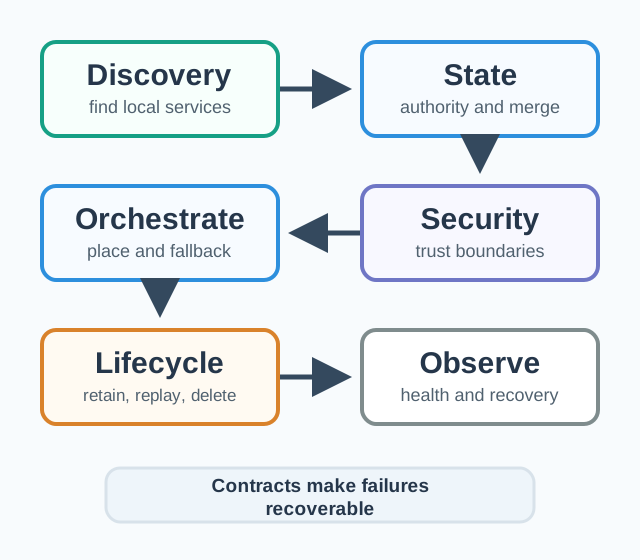
In the diagram Figure 9.1, Discovery answers how a node finds local services, while State identifies authority and merge rules. Security marks trust boundaries; Orchestrate owns placement and fallback; Lifecycle covers retain, replay, and delete; and Observe exposes health and recovery. The closing label, Contracts make failures recoverable, connects the map to the chapter’s production claim: each concern needs an owner and a failure contract, not simply a tier name.
9.4.1 Discovery
Devices find local services, remember usable paths, and fail over without depending on a remote lookup for every reconnection.
9.4.3 Security Boundary
Identity, certificates, secrets, update signatures, and audit logs are scoped so one compromised tier does not silently compromise every tier.
9.4.4 Orchestration
Workloads run where their timing, data locality, resource, privacy, and failure-mode requirements are best met.
9.4.5 Data Lifecycle
Raw evidence, summaries, events, and archives have defined retention, replay, privacy, and deletion rules.
9.4.6 Observability
Health signals show local behavior, queue pressure, version drift, retries, drops, and recovery status across the fleet.
9.5 Service Discovery and Failover
This section: Service Discovery and Failover — Discovery is the way devices find the services they need.
Discovery is the way devices find the services they need. In a simple lab, a device may connect to one known gateway address. In production, gateways are replaced, networks are segmented, sites lose cloud connectivity, and maintenance windows happen while devices are still running.
9.5.1 Local Discovery
Use a local mechanism for devices to find nearby gateways or services inside the site boundary. Examples include mDNS/DNS-SD, locally managed DNS, static site configuration, or a gateway advertisement channel.
9.5.2 Operational Registry
Use an inventory or service registry for fleet visibility, ownership, certificate state, gateway health, and site assignment. The registry should not be the only thing a device needs during a local reconnect.
9.5.3 Last-Known-Good Path
Devices should remember a recently valid local path and its certificate identity. Cached paths need expiry and validation so stale addresses do not become silent misroutes.
9.5.4 Pre-Provisioned Failover
Critical devices should know backup gateways, trust anchors, and promotion rules before a failure. Failover should not depend on manual configuration during the incident.
9.6 State Authority and Consistency
This section: State Authority and Consistency — Network partitions are normal in distributed IoT.
Network partitions are normal in distributed IoT. A site may keep operating while the cloud view is stale. The important question is not whether divergence can happen; it is which state may diverge, who may change it, and how the system reconciles afterward.
Inspect Figure 9.2 before continuing. A disconnected site can operate safely only if each kind of state has a declared writer and reconnect rule. Figure 9.2 compares the authority patterns that prevent an outage from turning into silent last-writer-wins behaviour.
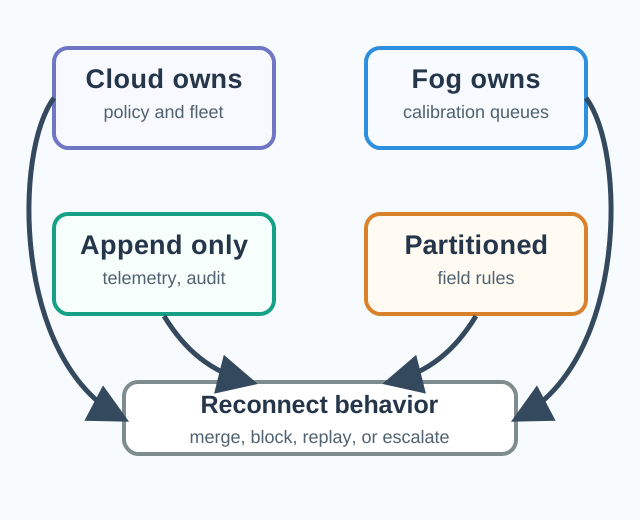
In the diagram Figure 9.2, Cloud owns policy and fleet state, while Fog owns calibration queues that need site continuity. Append only telemetry and audit records avoid destructive conflict, and Partitioned field rules divide responsibility explicitly. The bottom line—merge, block, replay, or escalate—is the required reconnect decision for each class. This turns consistency from a vague platform promise into a record of permitted changes and recovery behaviour.
9.6.4 Append-Only Telemetry
Use for observations that are recorded rather than edited. Conflict handling is mostly about ordering, deduplication, late arrival, and retention.
9.7 Security and Trust Boundaries
This section: Security and Trust Boundaries — Each tier should protect itself and limit the damage if another tier is compromised.
Each tier should protect itself and limit the damage if another tier is compromised. Security-in-depth is not a slogan here; it is a placement requirement. A fog node that aggregates data may need to read payloads, store local evidence, run local rules, and accept management updates. That makes it useful and sensitive at the same time.
9.7.1 Edge Controls
- Secure boot or firmware integrity checks.
- Device identity and certificate lifecycle.
- Signed updates with rollback protection.
- Minimal local secrets and scoped permissions.
- Tamper and clock-drift signals where available.
9.7.2 Fog Controls
- Mutual authentication with devices and cloud.
- Local authorization and network segmentation.
- Secret storage appropriate to the hardware.
- Audit logs for operator changes and policy updates.
- Rate limits, backpressure, and quarantine behavior.
9.7.3 Cloud Controls
- Fleet identity governance and revocation.
- Policy versioning and staged rollout.
- Long-term audit, retention, and incident review.
- Cross-site anomaly detection.
- Recovery workflows and privileged access control.
9.8 Orchestration and Placement Fallback
This section: Orchestration and Placement Fallback — Advanced orchestration is not just “run containers at the edge.” It is a decision process that assigns workloads to the tier that can satisfy timing, data locality, privacy, resource, and recovery needs.
Advanced orchestration is not just “run containers at the edge.” It is a decision process that assigns workloads to the tier that can satisfy timing, data locality, privacy, resource, and recovery needs. Some workloads can move; others should remain fixed because their safety or evidence requirements depend on local placement.
Need Name the decision the workload makes and the consequence of delay or outage.
Inputs Identify where data is produced, how large it is, and whether it may leave the site.
Resources Check compute, memory, storage, accelerator, power, and maintenance limits.
Placement Choose edge, fog, cloud, or duplicated placement based on constraints.
Fallback Define degraded behavior when the chosen tier is overloaded, offline, or behind on updates.
Measure Observe latency, queue depth, restart rate, model version, and policy version in the field.
9.8.1 Peer Overlays as Fog Building Blocks
Some fog designs borrow the old peer-to-peer lesson: a large system can spread load by letting many edge participants exchange pieces of work, cache state, or distribute content instead of forcing every transfer through one central server. BitTorrent-style swarms, tree overlays, and multi-tree overlays are useful analogies because they make the tradeoff visible. They can improve scale and resilience, but they also introduce churn, neighbor choice, duplicate traffic, trust questions, and evidence that must be observable when a peer disappears.
Use a peer overlay only when the deployment record names the owner of membership, the admission rule, the data each peer may hold, the fallback route when the overlay fragments, and the measurement that proves the overlay is helping. A firmware cache among gateways, a local model-update mirror, or a site-to-site evidence replication path may be reasonable. A safety command path, credential update, or audit ledger usually needs stronger authority than an opportunistic swarm can provide.
9.8.2 Client-Driven Control Loops
Client-driven fog control moves part of the control and configuration loop toward clients, gateways, or near-user edge devices. That can reduce cloud dependence and react faster to local congestion, but it changes who is allowed to infer network state. A client may estimate congestion from delay, round-trip time, duplicate acknowledgements, packet loss, queue growth, or local radio measurements. Those signals are useful only when the design records their sampling window, expiry, hysteresis, and the action they are allowed to trigger.
The review question is not “can the client detect congestion?” It is “what can this client safely change after detecting it?” Reducing a report rate, choosing a less congested local path, switching to a cached result, or delaying a noncritical upload may be safe. Reassigning site authority, changing another device’s configuration, or hiding a persistent outage from operators is not. Client-driven control should therefore publish local evidence upward when connectivity returns, so cloud and operations records can see which decisions were made under local authority.
9.8.3 Decentralised RAT Selection: Stability Is Not Efficiency
A device with more than one radio access technology can choose the path that appears to offer the best useful throughput. The choice is coupled to everyone else’s choice: moving to a Wi-Fi access point or cellular cell changes its load, which changes the payoff seen by the next device. One useful model treats each device as a player, the available RATs as strategies, and predicted throughput as the payoff. A stable assignment is a Nash equilibrium when no single device expects to improve by switching alone.
The throughput model must match the shared medium. In one class of network, a user’s result depends on the rates of all attached users; a slow participant can change airtime consumption for the group. In another, capacity is divided mainly by the number of attached users. When every candidate RAT follows the same class, repeated improvement choices can converge under suitable assumptions. Mixing the classes is harder: one user’s apparently beneficial move can change another user’s incentive and create an endless improvement path.
Hysteresis makes the client less reactive. Require the predicted improvement to exceed a margin for a persistence window, optionally randomise the switch among eligible clients, and retain a larger margin when crossing between media with different sharing rules. This reduces ping-pong handovers, but a larger margin also creates more stable assignments that may be farther from the system-wide best result. Faster convergence, fewer switches, battery cost, fairness, and total throughput therefore belong in the same parameter study.
Equilibrium is not proof of a good allocation. Compare the decentralised outcome with a feasible system optimum and report the efficiency loss, the worst-served group, and the distribution of outcomes rather than only an average. A controller can be stable while leaving capacity unused or concentrating poor service on devices whose alternative RAT is weak. The result also depends on assumptions: throughput estimates may be noisy, radios may interfere, network assistance may exist, and a device may use more than one interface. Test inference error, stale load observations, join/leave events, and re-convergence instead of treating perfect measurements as a deployment property.
For example, a gateway that can use building Wi-Fi or cellular should not switch on one optimistic probe. It can estimate deliverable throughput on both paths, wait until the improvement survives several observations, include switch energy and session disruption in the decision, and publish why it moved. The network operator can then compare local choices with fairness and capacity objectives and adjust policy without taking every decision away from the edge.
9.9 Observability, Updates, and Governance
This section: Observability, Updates, and Governance — Advanced systems fail quietly unless they report the right local signals.
Advanced systems fail quietly unless they report the right local signals. A cloud dashboard may show “last seen” while a gateway is overloaded, a queue is growing, a model is stale, or a policy rollback has only reached part of the fleet.
Discovery health Track discovery latency, fallback use, gateway identity mismatch, and failed registration attempts.
State health Track active authority, conflict count, merge policy, rejected writes, and late-arriving updates.
Security health Track certificate expiry, revocation status, failed mutual authentication, update signature failures, and privileged local actions.
Workload health Track placement, restart count, resource pressure, local queue depth, dropped records, and backpressure state.
Version health Track firmware, container image, model, schema, policy, and configuration versions independently.
Recovery health Track replay progress, deduplication results, rollback status, and whether the site is still in degraded mode.
9.10 Decision Record
This section: Decision Record
Record the discovery chain, fallback paths, state classes, authority model, merge rules, security trust boundaries, key and certificate ownership, workload placement, degraded behavior, local evidence retention, observability signals, rollout method, rollback trigger, and field tests that prove the design survives partition, restart, overload, and recovery.
9.11 Fleet Operations and Edge Autonomy
This section: Fleet Operations and Edge Autonomy — One edge device is a programming problem; a fleet is an operations problem.
One edge device is a programming problem; a fleet is an operations problem. At scale, the design must deploy, update, monitor, and recover many constrained nodes that are intermittently connected and often unreachable by a technician. Containers help because they package a workload and its dependencies as one repeatable artifact. Lightweight Kubernetes distributions can help on capable fog nodes because they add health checks, restart behavior, declarative rollout, and staged updates without assuming a datacenter-class server.
The decision is not “Kubernetes everywhere.” A tiny sensor may only need signed firmware and a rollback slot. A fog node running several services may justify K3s, KubeEdge, MicroK8s, k0s, or another small-footprint runtime if the operational value is greater than the memory, storage, update, and support cost. The advanced contract must also define what happens when the control link is down. A cloud-managed edge node should keep approved local workloads running, expose local health, buffer summaries within retention limits, and reconcile state when coordination resumes.
| Runtime choice | What it buys | Edge constraint to check |
|---|---|---|
| Containers | Repeatable workload packaging and rollback by artifact version. | Image size, local storage, update bandwidth, and secret handling. |
| K3s or similar lightweight Kubernetes | Kubernetes-style deployments, health checks, restart policy, and rolling updates on smaller nodes. | RAM, CPU headroom, local operator skill, and whether the node hosts enough services to justify orchestration. |
| KubeEdge-style cloud-edge coordination | Local autonomy when disconnected, with later reconciliation to the cloud control plane. | Cached state authority, offline policy limits, and conflict handling after reconnect. |
| Signed firmware update | Simpler lifecycle for small edge devices that do not host multiple services. | Rollback slot, power-loss recovery, staged rollout, and device identity. |
Advanced autonomy is a reconciliation problem. The cloud ledger records desired state: approved workload versions, policy versions, access rules, and rollout rings. The edge or fog ledger records observed state: what is actually running, which policy was used, which messages were accepted, what failed, and what remains queued. After reconnect, some differences can auto-heal, such as a missed noncritical upload. Others must be blocked or escalated, such as a stale safety policy, a revoked certificate still in use, or a model version that skipped a required validation ring.
-
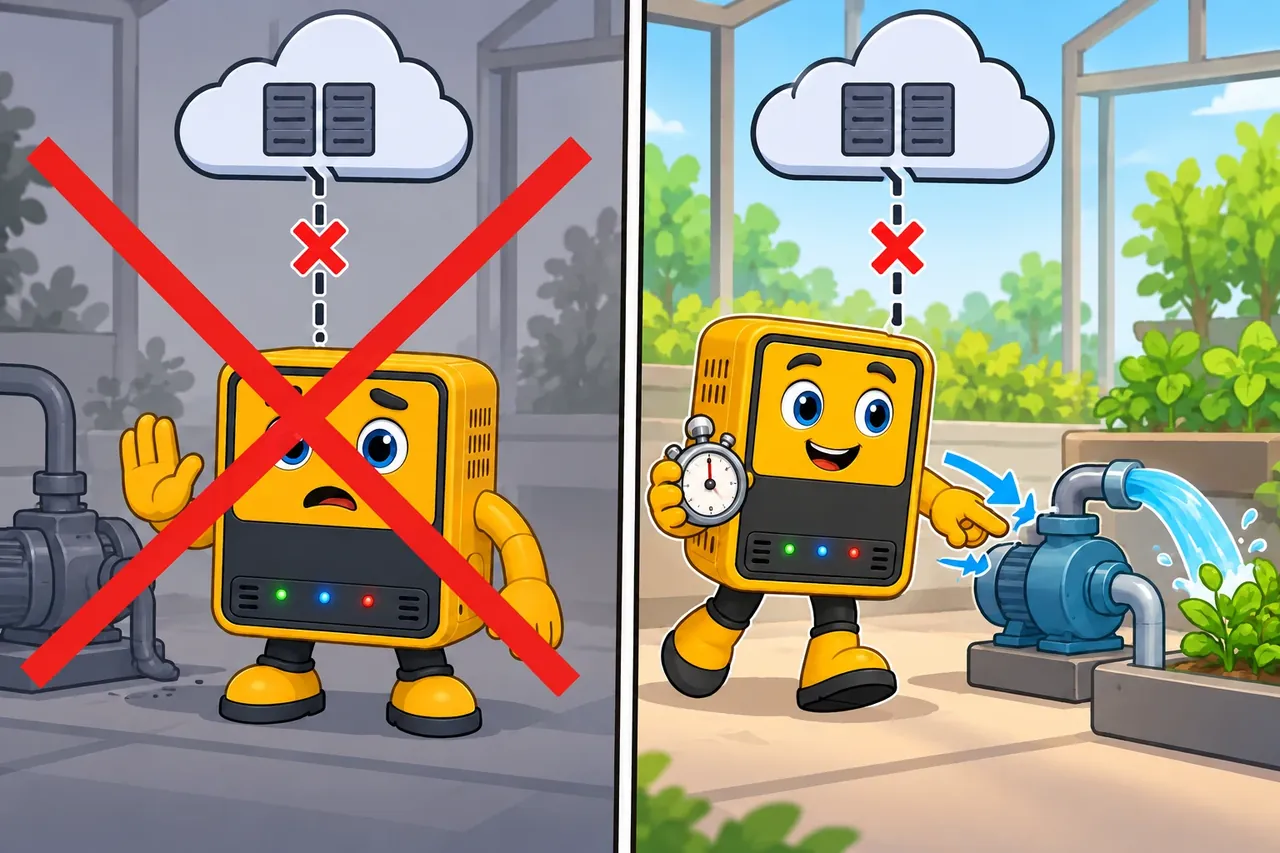
Wrong idea: stop every local task when the cloud link drops. It fails because bounded local operation is what keeps an edge site useful during a break.
9.12 Common Pitfalls
This section: Common Pitfalls
Fog nodes have local responsibilities, local failure modes, and local physical context. Do not copy cloud assumptions about infinite connectivity, centralized control, or remote-only operations.
A registry is useful for operations, inventory, and governance. A local device should still have a way to reconnect to a valid local service during cloud isolation.
Last-write-wins, cloud-wins, fog-wins, manual review, and append-only records each fit different semantics. A single universal rule eventually loses important information.
Fog nodes often decrypt, aggregate, cache, and make local decisions. That makes them sensitive assets, not neutral cables.
Edge and fog deployments need staged rollout, version visibility, rollback triggers, and a way to recover nodes that missed intermediate versions.
The cloud view can be stale during the exact incident you need to understand. Capture local health, queues, retries, and recovery status at the site.
9.13 Reference Path
This section: Reference Path
Use standards and platform documentation to ground implementation details after the advanced contracts are defined:
- RFC 6762: Multicast DNS: local name resolution behavior used by mDNS.
- RFC 6763: DNS-Based Service Discovery: DNS-SD service instance naming and discovery model.
- OASIS MQTT Version 5.0 specification: publish/subscribe, session, acknowledgement, and reliability behavior.
- Kubernetes documentation: orchestration concepts that may apply to capable fog or edge clusters.
- KubeEdge documentation: Kubernetes-native edge computing patterns and cloud-edge coordination.
- AWS IoT Greengrass documentation: cloud-managed local components and edge runtime patterns.
- Azure IoT Edge documentation: edge modules, runtime, deployment, and offline behavior.
- NIST SP 500-325, Fog Computing Conceptual Model: fog computing terminology and conceptual placement.
9.14 Summary
This section: Summary
- Advanced edge-fog-cloud design is about production contracts, not extra layers.
- Discovery needs local operation, cached valid paths, and operational visibility.
- State must be classified by authority, merge behavior, safety impact, and audit requirements.
- Fog nodes are sensitive trust boundaries when they decrypt, aggregate, cache, or decide.
- Orchestration must include fallback behavior for outages, overload, and version drift.
- Observability must show local health and recovery status, not only cloud dashboard state.
9.15 What’s Next
This section: What’s Next
- Edge-Fog-Cloud Architecture: Revisit the baseline three-tier structure with the advanced contracts in mind.
- Edge-Fog-Cloud Devices and Integration: Connect advanced runtime concerns to device and gateway integration choices.
- Edge-Fog-Cloud Summary: Review the full series and consolidate the major design decisions.
- Edge/Fog Decision Framework: Use constraints and tradeoffs to choose placement.
- Edge/Fog Pitfalls: Review common mistakes before implementation.
9.16 Key Takeaway
This section: Key Takeaway — Advanced edge-fog-cloud systems depend on orchestration, lifecycle management, security, observability, and data governance.
Advanced edge-fog-cloud systems depend on orchestration, lifecycle management, security, observability, and data governance. Placement choices must be revisited as workloads, fleets, and failure modes change.
Find help
3 reviewed answers.
Where should I start in a module?
Open the module page from the sidebar to see its chapters in order. Use the module map to return to a topic you need.
Modules and pathsReviewed
What can I try when a project does not work?
Check the symptom, then work through the diagnostic steps. Keep the error message and the smallest example that reproduces it.
When you are stuckReviewed
How do interactive examples work?
Use the interactive guide to check how examples and simulations work before changing your project.
Interactive examples guideReviewed