28 IoT Privacy: Consent Controls and Minimization
More
Depth: Practitioner
Progress saves as you read. Mark sections complete as you go; your progress appears in the sidebar.
28.1 Start With the Decision
This section: Start With the Decision — A consent screen is weak if the device ignores the choice.
A consent screen is weak if the device ignores the choice. Consent flags must change collection, sharing, and deletion in the live system.
28.2 Route Overview
This section: Route Overview — This is part 2 of 2.
This is part 2 of 2. Review IoT Privacy: Purpose and Data Boundaries for the preceding evidence.
28.3 Learning Objectives
This section: Learning Objectives
- Turn user consent into enforceable system states.
- Apply minimization and withdrawal rules to device data.
28.4 Chapter Roadmap
This section: Chapter Roadmap
- Enforceable Consent Flags
- Checkpoint: Consent State
- GDPR and Privacy Regulations for IoT
- Consent Mechanisms for IoT
- Checkpoint: Consent Mechanics
- Data Minimization Principles
- Deep dive: Putting Numbers to It
- Checkpoint: Minimization
- Continue to Part 2
28.5 Enforceable Consent Flags
This section: Enforceable Consent Flags — Implementation should not rely on copy alone.
Implementation should not rely on copy alone. Model consent with fields such as user id, device id, household or organization id, role, purpose id, consent version, granted_at, withdrawn_at, retention_until, data category, collection gate, processor or integration id, and source of the user's action. Services can then block collection, upload, analysis, sharing, support access, or model training when the consent state does not allow it.
Use real enforcement points. Firmware can disable raw microphone upload when only local wake-word detection is allowed. A gateway can aggregate occupancy before publishing an MQTT topic. A mobile app can respect Android or iOS permission state before starting background location. A cloud job can apply TTL deletion, revoke OAuth scopes, remove APNs/FCM notification tokens, delete device-shadow history, and mark export or erasure requests complete only after downstream processors respond.
- Device gate: firmware config, local processing mode, recording indicator, mute switch, sampling rate, and upload queue policy.
- Cloud gate: API authorization, role-based access control, retention job, export job, deletion job, support-console permission, and access log.
- Integration gate: OAuth scope, webhook subscription, partner dataset, processor deletion callback, and contract-bound purpose field.
Consent flags should be evaluated where data is created and where it is reused. If firmware records audio while a cloud service later discards it, collection still happened. If an MQTT broker publishes presence data to a retained topic after consent is withdrawn, the dashboard and downstream subscribers may continue seeing stale personal data. If a machine-learning pipeline has already copied events into a feature store, deleting the account record is not enough. The architecture needs collection gates, storage gates, processing gates, sharing gates, and retention gates.
Versioning matters because consent language and features change. Store the policy or notice version shown to the user, the UI path used to grant it, and the exact purpose ids enabled. When a firmware update adds person detection, a new analytics partner, or a longer retention period, the system should know whether existing consent covers the change or whether the user must make a new choice. Auditors and support teams should be able to reconstruct why data existed at a given time.
Withdrawal should propagate as a workflow, not a boolean flip. The app can mark the purpose withdrawn immediately, firmware can receive a new config, upload queues can be purged, API scopes can be revoked, processors can receive deletion callbacks, scheduled jobs can remove retained records, and the user can see pending versus completed deletion states. If backups or legal holds delay deletion, the dashboard should explain the timeline and limit restore paths so old data is not reintroduced silently.
Finally, privacy telemetry should avoid becoming another privacy risk. Log consent changes, enforcement denials, export requests, deletion jobs, and support access, but keep those logs minimal, access-controlled, and retention-limited. The implementation goal is a provable chain from user choice to system behavior: what was allowed, what was blocked, what was deleted, and which evidence shows the product followed the user's decision.
This section:
 Checkpoint: Consent State
- You now know how to separate required operation from optional data use.
- You now know why account owners, guests, workers, caregivers, support agents, and bystanders need different consent paths.
- You now know how purpose ids, consent versions, withdrawal workflows, and enforcement gates make consent auditable.
This section: — We have treated consent as product state.
We have treated consent as product state. The next question is how that state maps to legal duties when sensors collect personal data continuously.
28.6 GDPR and Privacy Regulations for IoT
This section: GDPR and Privacy Regulations for IoT — The General Data Protection Regulation (GDPR) establishes strict requirements for processing personal data.
The General Data Protection Regulation (GDPR) establishes strict requirements for processing personal data. IoT systems face unique challenges because they collect data continuously from sensors, often without traditional user interfaces.
28.6.1 GDPR Principles Applied to IoT
| GDPR Principle | Article | IoT Application | Example |
|---|---|---|---|
| Lawfulness | Art. 6 | Must have a lawful basis for collection | Smart meter needs an identified lawful basis for detailed usage patterns |
| Purpose Limitation | Art. 5(1)(b) | Collect for specified purposes and assess compatibility before reuse | Thermostat data cannot be reused for advertising without a compatible purpose and a lawful basis (often fresh consent) |
| Data Minimization | Art. 5(1)(c) | Collect only what’s necessary | Fitness tracker shouldn’t collect location for step counting |
| Accuracy | Art. 5(1)(d) | Keep data correct and updated | Medical IoT must maintain accurate readings |
| Storage Limitation | Art. 5(1)(e) | Don’t keep data longer than needed | Security camera footage deleted after 30 days |
| Integrity & Confidentiality | Art. 5(1)(f) | Protect against unauthorized access | Encryption for smart lock access logs |
28.6.2 IoT-Specific GDPR Challenges
IoT systems present unique challenges for GDPR compliance that don’t exist in traditional web applications:
The doorbell example in Figure 28.1 turns a broad privacy claim into review questions.
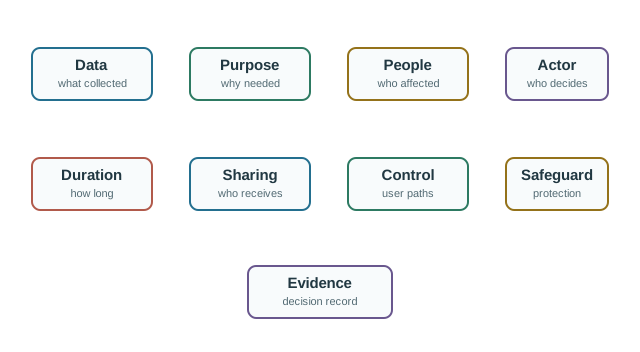
The camera records people approaching the front door for a stated security purpose. That includes delivery drivers, neighbors, and passersby, not only the homeowner who chose the device. The diagram separates what data exists and why from the actor, storage, sharing, retention, and control boundaries. Its legal notes are part of the worked scenario, not a vendor policy. Review each boundary against the actual installation and give people a clear route to understand or challenge use of their image where the product supports it.
28.7 Consent Mechanisms for IoT
This section: Consent Mechanisms for IoT — Designing consent mechanisms for IoT is challenging because traditional web consent patterns (cookie banners, checkboxes) don’t work for screenless devices or continuous data collection.
Designing consent mechanisms for IoT is challenging because traditional web consent patterns (cookie banners, checkboxes) don’t work for screenless devices or continuous data collection.
28.7.1 Consent Requirements Under GDPR
For consent to be valid under GDPR Article 7, it must be:
| Requirement | Definition | IoT Challenge |
|---|---|---|
| Freely Given | A real choice; assess any condition tying consent to service access under Article 7(4) | Devices often require data for core function |
| Specific | For defined purposes | Sensors collect multipurpose data |
| Informed | User understands what they’re consenting to | Complex data flows hard to explain |
| Unambiguous | Clear affirmative action | No screen for buttons/checkboxes |
| Withdrawable | As easy to withdraw as to grant | How do you “un-consent” to a smart speaker? |
28.7.2 IoT Consent Design Patterns
Use Figure 28.2 to connect a privacy choice to system behavior.
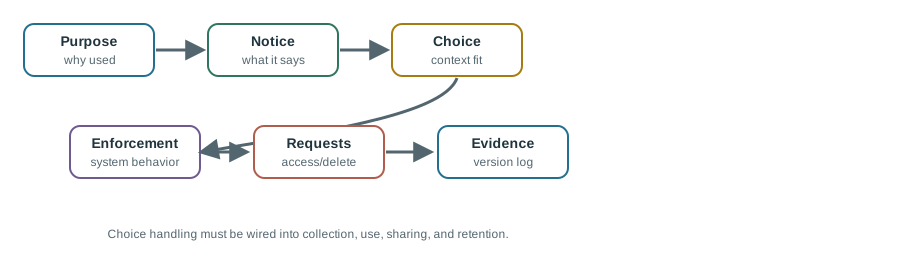
Purpose explains why the data is used, and notice tells the person what that use means. Choice must fit the situation rather than appearing as an abstract toggle. Enforcement then controls collection, use, sharing, and retention according to the recorded state. Request handling covers later access or deletion, while a version log shows which rule applied at the time. The flow is useful only if a changed choice reaches those data paths. A screen that says no while saved copies continue elsewhere would break the decision.
28.7.3 Designing Granular Consent
Instead of all-or-nothing consent, IoT systems should offer granular choices:
Read the choices by purpose before comparing implementation details. First separate the data required for the requested core function from data used for enhancement or sharing. Then check that refusing an optional purpose leaves the core service usable, that each choice can be changed later, and that enforcement follows the stored state. This keeps granular consent tied to actual collection and disclosure behavior rather than to a longer setup screen.
| Feature Category | Core Function | Optional Enhancement | Third-Party Sharing |
|---|---|---|---|
| Smart Thermostat | Temperature control (required) | Energy optimization tips | Utility company data sharing |
| Fitness Tracker | Step counting (required) | Social leaderboards | Research data contribution |
| Smart Speaker | Voice commands (required) | Personalized recommendations | Skills marketplace analytics |
Checkpoint: Consent Mechanics
- You now know why consent must be freely given, specific, informed, unambiguous, and withdrawable.
- You now know why pre-selected choices and bundled optional sharing fail the affirmative-action test.
- You now know how a consent card should name data, purpose, retention, recipient, default, refusal consequence, and change path.
The consent interface is only one control surface. The next step is to ask whether the product can collect less data before it asks for permission.
28.8 Data Minimization Principles
This section: Data Minimization Principles — Data minimization is a core Privacy by Design principle requiring IoT systems to collect only the data necessary for their specified purpose.
Data minimization is a core Privacy by Design principle requiring IoT systems to collect only the data necessary for their specified purpose.
28.8.1 The Data Minimization Hierarchy
Use Figure 28.3 to decide which fields should never pass from collection into the retained record.
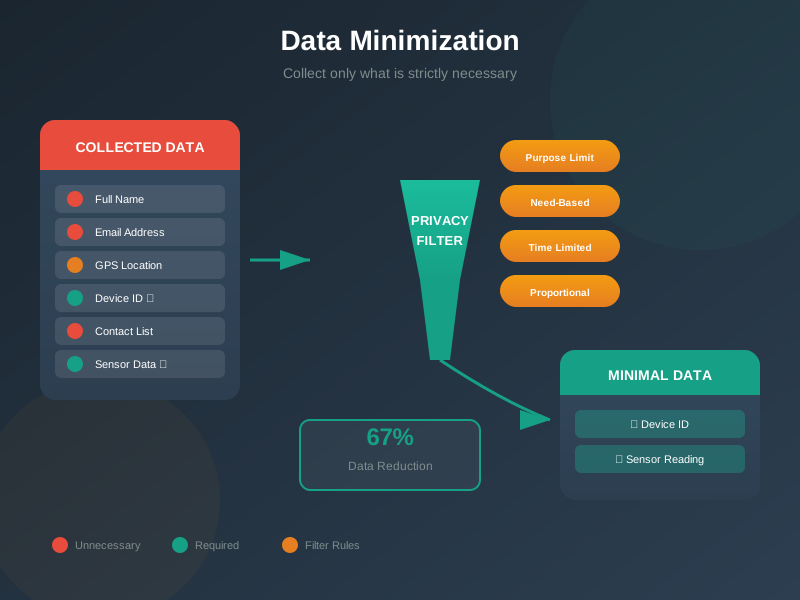
Start with the collected fields, then separate what the named purpose actually requires from what is merely available. The filter belongs as early as possible, before unnecessary values spread into logs, analytics, backups, or support tools. The retained set should be smaller and should carry a deletion or aggregation rule. This is stronger than hiding a field in the interface: the unwanted detail is not available for a later use. Revisit the boundary when the purpose changes rather than quietly expanding the original consent.
28.8.2 Practical Data Minimization Examples
| IoT Device | Over-Collection | Minimized Collection | Rationale |
|---|---|---|---|
| Smart Thermostat | Minute-by-minute temp + occupancy + location | Hourly temperature averages | Hourly sufficient for optimization |
| Fitness Tracker | GPS coordinates every second | Route summary (start/end, distance) | Full GPS reveals home/work locations |
| Smart Speaker | All audio recorded and uploaded | Local wake word detection, upload only commands | Most audio is ambient noise |
| Security Camera | 24/7 cloud recording | Local storage, motion-triggered cloud backup | Continuous recording captures unnecessary footage |
Storage cost of over-collection: Treat these numbers as scenario defaults to replace with your product’s bitrate, retention, and storage quote. A smart doorbell recording 1080p video 24/7 at an assumed 3 Mbps generates (decimal/SI convention throughout: 1 GB = 1,000 MB = 1,000,000,000 bytes, matching standard Mbps and cloud-storage-billing usage). With an assumed $0.023/GB storage price, annual cost is per device. With motion-triggered recording at an assumed 30 minutes active per day, cost drops to .
GDPR fine ceiling illustration: Article 83 has a lower tier of up to 2% of worldwide annual turnover or €10M and a higher tier of up to 4% or €20M, whichever is higher within the applicable tier. (Article 83; EDPB) For a hypothetical €500M company, the higher-tier statutory ceiling is ; this is a hypothetical ceiling, not expected liability. The calculator uses a planning-budget assumption for legal, UX, and engineering work; replace it with a real estimate rather than treating it as a benchmark.
Consent adoption scenario: Use abandonment sliders as a sensitivity model. If all-or-nothing consent caused 67% abandonment in your own test and granular consent reduced it to 23%, then a company shipping 50,000 units/year at $200 margin would model revenue at risk. Without product telemetry or usability data, these are assumptions, not evidence.
Re-identification risk model: Location plus timestamp can be highly identifying, especially when combined with outside information such as home, work, school, or public posts. A fitness tracker collecting GPS every 10 seconds generates points per day. Before calling that data anonymous, test whether aggregation, suppression, differential privacy, or a threshold such as -anonymity is strong enough for the release context.
Consent withdrawal friction: If consent requires 2 clicks but withdrawal requires 8 clicks, the design conflicts with the “as easy to withdraw as to grant” principle. The calculator uses an assumed per-click completion loss to show why teams should measure withdrawal completion, not just whether a withdrawal control technically exists.
28.8.3 Interactive Privacy Economics Calculator
28.8.4 Edge Processing for Data Minimization
Processing data on the device (at the edge) before transmission is a powerful data minimization technique:
Evaluate the processing locations from raw observation to transmitted result. Cloud processing exposes the broadest record because raw input leaves the device; edge processing can retain the raw stream locally and release a bounded result; federated learning exchanges model updates but still needs leakage controls. The narrative connection is minimization: choose the narrowest transferable artifact that supports the declared purpose, and document any residual inference or recovery risk.
| Processing Location | Data Transmitted | Privacy Level | Example |
|---|---|---|---|
| Cloud Processing | All raw sensor data | Low | Upload all audio to cloud for analysis |
| Edge Processing | Only results/summaries | High | Detect wake word locally, upload only command |
| Federated Learning | Model updates only | Very High | Train ML locally, share only gradients |
Checkpoint: Minimization
- You now know how to reduce collection by signal, precision, transmission, access, retention, and reuse.
- You now know why high-frequency readings, raw audio, raw video, location traces, and model updates can expose behavior beyond the stated feature.
- You now know how edge processing, federated learning safeguards, aggregation, suppression, and deletion windows support consent promises.
Minimization reduces avoidable collection. The next question is what happens when the user asks to inspect, move, correct, restrict, or delete data that still exists.
28.9 Continue to Part 2
This section: Continue to Part 2 — Continue with IoT Privacy: User Rights and Privacy by Design.
Continue with IoT Privacy: User Rights and Privacy by Design.
28.10 Continue Your Route
This section: Continue Your Route — This is the last part of this chapter.
This is the last part of this chapter. Return to IoT Privacy: Purpose and Data Boundaries. See ux-design module index.
Find help
3 reviewed answers.
Where should I start in a module?
Open the module page from the sidebar to see its chapters in order. Use the module map to return to a topic you need.
Modules and pathsReviewed
What can I try when a project does not work?
Check the symptom, then work through the diagnostic steps. Keep the error message and the smallest example that reproduces it.
When you are stuckReviewed
How do interactive examples work?
Use the interactive guide to check how examples and simulations work before changing your project.
Interactive examples guideReviewed