Electronics and Circuits Module Guide
More
Depth: Practitioner
Progress saves as you read. Mark sections complete as you go; your progress appears in the sidebar.
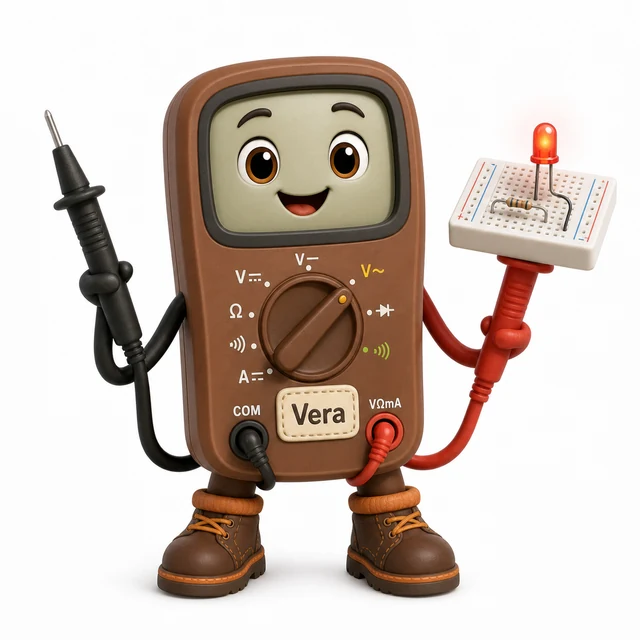
Follow Voltage Vera as a small board must power its lamp, switch, and sensor safely under real changes.

This board powers a lamp, switch, and sensor.

Trace power from the source to each load.

Check what each part can safely bear.

Test loose wires, heat, and a weak supply.
Start With the Module
This section: Start With the Module — This guide maps the current learning path for Electronics & Circuits.
This guide maps the current learning path for Electronics & Circuits. The module contains 35 chapters, linked below in the order learners can study them.
Chapters by Part
This section: Chapters by Part
Electricity Basics
Electronics Basics
- 8 Electronics: Power and Transistor Switching
- 9 Electronics: Controller Design and Review
- 10 Electronics for IoT: Signals and Calculators
- 11 Electronics for IoT: Power and Switching
- 12 Electronics Materials: Conductors to Components
- 13 Component Architecture: Capacitors and Selection
- 14 Components in Systems: Passive and Active Contracts
- 15 Semiconductors: Doping and Diode Behaviour
- 16 Semiconductors: Fabrication and Switching Devices
- 17 Diode Clamp and Recovery Contracts
- 18 Transistor Selection
- 19 GPIO Output Stage Contracts
Interface Contracts
Analog & Digital
- 23 Analog vs. Digital Signals
- 24 Binary Number Systems
- 25 ADC Fundamentals: Conversion and Resolution
- 26 ADC Fundamentals: Architectures and Interfaces
- 27 ADC Architecture and Resolution
- 28 Sampling and Aliasing: Nyquist and Filters
- 29 Sampling Design: Product Scenarios
- 30 Analog-Digital Boundaries: Signal Contracts
- 31 Aliasing and Anti-Alias Filter Contracts
- 32 DAC and PWM: Output Foundations
- 33 DAC and PWM: Loads, Filters, and Code
- 34 DAC and PWM: Actuator Selection and Validation
- 35 ADC and DAC: Conversion Calculations
- 36 ADC and DAC: Interactive Design Calculators
Choose a Starting Point
This section: Choose a Starting Point — If this subject is new, follow the parts and chapters in the order shown above.
If this subject is new, follow the parts and chapters in the order shown above. If you already have a specific design or troubleshooting question, use the relevant part heading and open the direct chapter link whose title matches that question.
Use the sidebar and site search for supporting material; use this chapter map as your main route through the module.
How to Use This Material
This section: How to Use This Material
- Start with the first chapter in the relevant part when the topic is unfamiliar.
- Use direct chapter links for study plans, lab preparation, and review evidence.
Find help
3 reviewed answers.
Where should I start in a module?
Open the module page from the sidebar to see its chapters in order. Use the module map to return to a topic you need.
Modules and pathsReviewed
What can I try when a project does not work?
Check the symptom, then work through the diagnostic steps. Keep the error message and the smallest example that reproduces it.
When you are stuckReviewed
How do interactive examples work?
Use the interactive guide to check how examples and simulations work before changing your project.
Interactive examples guideReviewed