23 Analog vs. Digital Signals
More
Depth: Practitioner
Progress saves as you read. Mark sections complete as you go; your progress appears in the sidebar.
23.1 Start Simple
This section: Start Simple — Picture a water tank sensor that produces a changing voltage while a controller decides when to stop a pump.
Follow One Sensor Value Through the Board
Picture a water tank sensor that produces a changing voltage while a controller decides when to stop a pump. A neat number on a screen can still be wrong if the input range, output drive, or timing does not match the real circuit.
Follow the wire from the tank probe to the controller and pump. Watch how an orderly screen value can hide a bad sensor-to-action path.
-
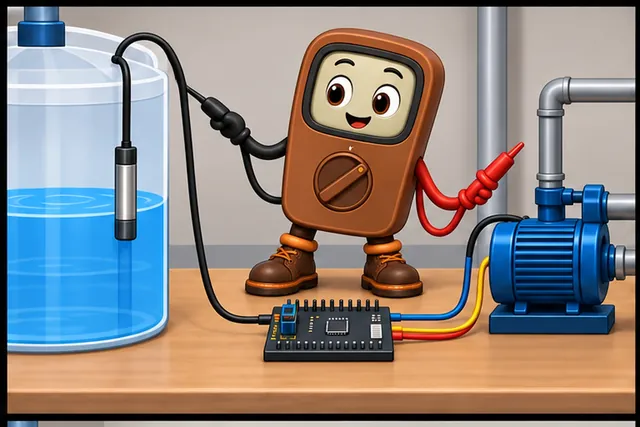
A tank sensor sends a changing voltage to a pump controller.
-
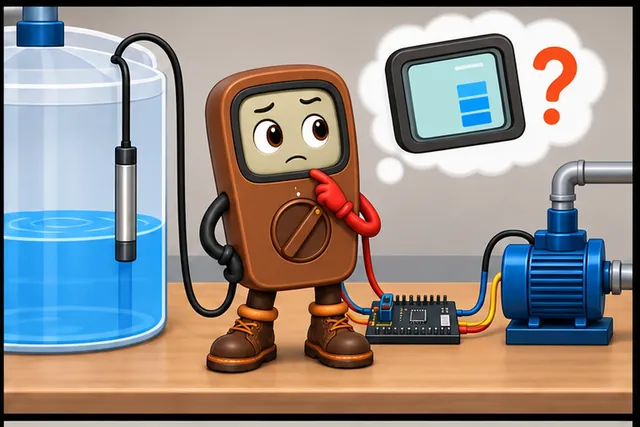
A neat screen value may hide bad range, drive, or timing.
-
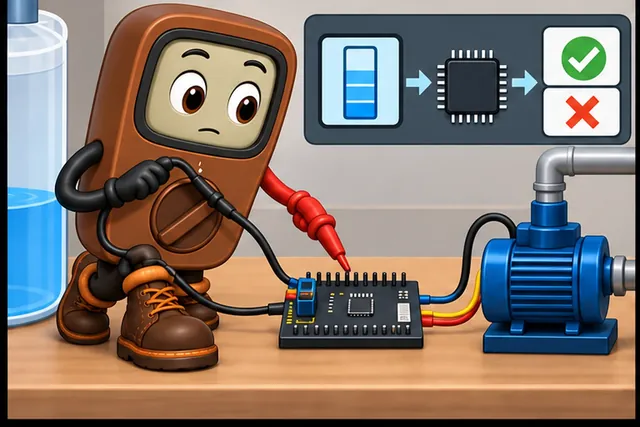
Test empty, middle, full, noise, lost sensor, and restart.
-
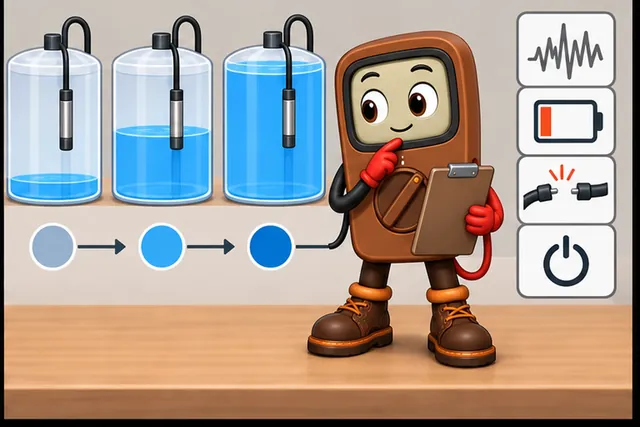
Stop the pump safely when the reading cannot be trusted.
The first panel puts the probe, board, and pump in one loop. The next shows a neat display that leaves the true tank state in doubt. The third checks the probe signal against the board input. The last compares low, middle, and full levels and asks what to do with noise, a lost sensor, and restart. The terms below name the parts of that path.
A microcontroller means the small computer on the board. An analog-to-digital converter means a circuit that turns a voltage into a number; it is called an ADC. A digital-to-analog converter (DAC) means a circuit that turns a number into a voltage or current. Pulse-width modulation means control made by changing how long a signal stays on; it is called PWM. An actuator means a part that creates a physical action.
Test an empty, middle, and full tank. Then add noise, lower the supply, disconnect the sensor, and restart the controller. Keep the raw reading, the converted value, the decision, and the final pump state in one trace.
This runway does not choose component values or prove electrical safety. The deeper sections explain signal types, conversion limits, timing, output drive, and the evidence needed for a real circuit.
Imagine a temperature sensor producing a smooth voltage while the microcontroller stores only numbers. Analog electronics carries the changing physical signal; digital electronics names selected states so software can compare and transmit them. Start by finding where the signal crosses from continuous behavior into a sampled value.
23.2 Learning Objectives
This section: Learning Objectives
- Explain the difference between analog and digital signals and why conversion between them is necessary in IoT systems
- Describe how ADC and DAC circuits operate, including resolution, quantization error, and common architectures
- Apply the Nyquist-Shannon sampling theorem to determine appropriate sampling rates for real-world sensor signals
- Calculate ADC/DAC conversion values using standard formulas for temperature, distance, and motor control applications
- Compare PWM and true DAC output methods and select the appropriate technique for a given actuator control scenario
23.3 Overview
This section: Overview — Every IoT device that reads a sensor or drives an actuator must cross the analog-digital boundary.
Every IoT device that reads a sensor or drives an actuator must cross the analog-digital boundary. This five-chapter sequence takes you from binary representation, to ADC behavior, to sampling constraints, to output generation, and finally to worked design calculations. The goal is to help you choose the right converter settings and verify whether an interface is precise enough for the job.
Analog and digital are like the difference between a slide (smooth) and stairs (steps)!
Temperature Terry feels temperatures that go smoothly from cold to hot - like 20.1, 20.2, 20.3 degrees. But the microcontroller only understands step numbers like 20, 21, 22. ADC Andy translates between them! The more steps Andy uses, the more precise the translation becomes.
23.4 Prerequisites
This section: Prerequisites
Before starting this series, ensure familiarity with:
- Electricity Fundamentals: Voltage, current, and basic circuit analysis
- Electronics Fundamentals: Semiconductors and component basics
- Sensor Fundamentals: Sensor output types
23.5 Chapter Series
This section: Chapter Series
This topic is divided into five focused chapters for easier learning:
23.5.1 1. Binary Number Systems
Binary Number Systems (~2,500 words)
Learn the foundation of digital electronics:
- Analog vs digital signals
- Binary (base-2) number system
- Powers of 2 and ADC resolution
- Floating point numbers and IEEE 754
- Why you should never compare floats with
==
23.5.2 2. ADC Fundamentals
ADC Fundamentals (~3,500 words)
Understand how analog-to-digital converters work:
- ADC architecture and operation
- Successive Approximation Register (SAR) ADCs
- Resolution and quantization error
- Interface challenges (1/f noise, thermal noise)
- Microcontroller ADC specifications (Arduino, ESP32, STM32)
23.5.3 3. Nyquist Sampling Theory
Nyquist Sampling Theory (~2,500 words)
Master the critical sampling rate theorem:
- Nyquist-Shannon sampling theorem
- Aliasing and why undersampling fails
- Anti-aliasing filter design
- Sampling rate vs power consumption tradeoffs
- Interactive aliasing demonstration
23.5.4 4. DAC and PWM Output
DAC and PWM Output (~3,000 words)
Generate analog outputs from digital systems:
- DAC operation and formulas
- R-2R ladder architecture
- True DAC vs PWM comparison
- PWM as pseudo-analog output
- RC filter design for PWM smoothing
- Arduino and ESP32 implementation
- Hands-on labs with code examples
23.5.5 5. ADC/DAC Worked Examples
ADC/DAC Worked Examples (~3,500 words)
Integrate the full sequence in realistic calculations:
- ADC conversion formula and calculations
- Temperature sensor (LM35) interfacing
- Quantization error analysis
- Nyquist calculations for audio and vibration
- Soil moisture sensor optimization (ESP32)
- Ultrasonic distance measurement timing
- DAC motor speed control
- LED dimming with gamma correction
23.6 Learning Path
This section: Learning Path — Recommended Order: Follow chapters 1-5 in sequence.
Study the series in this order because each chapter answers the next practical design question:
- Binary Number Systems: What do the numbers inside a microcontroller actually mean?
- ADC Fundamentals: How does a real sensor voltage become one of those numbers?
- Nyquist Sampling Theory: How fast must you sample so the number stream still represents the real signal?
- DAC and PWM Output: How do digital decisions turn back into LED brightness, motor speed, or audio output?
- ADC/DAC Worked Examples: How do you combine all of the earlier ideas in a complete IoT design?
Recommended Order: Follow chapters 1-5 in sequence. The worked-examples chapter belongs at the end because it assumes you already understand binary representation, ADC limits, Nyquist sampling, and DAC/PWM output.
Quick Reference: If you already know the theory, jump directly to Worked Examples and return to the earlier chapters only when a formula or design choice is unclear.
23.7 How To Use This Book
This section: How To Use This Book
- Start with Binary Number Systems if you need to get comfortable with what ADC output values actually mean.
- Read ADC Fundamentals before Nyquist Sampling Theory; sampling decisions only make sense once conversion resolution and quantization are clear.
- Read DAC and PWM Output before the worked examples if your main interest is actuator or control output.
- Treat ADC/DAC Worked Examples as the integration chapter where all the earlier concepts are combined in realistic engineering calculations.
ADC Resolution determines measurement precision. Consider a temperature sensor outputting 0-1V for 0-100°C range:
10-bit ADC (Arduino Uno):
12-bit ADC (ESP32):
The 12-bit ADC provides 4× better temperature resolution — crucial for precision applications like laboratory environmental monitoring or medical devices where 0.1°C accuracy is required.
Nyquist sampling: To digitize a 60 Hz power line signal for smart meter applications:
In practice, use 5× oversampling: Hz to avoid aliasing from harmonics.
23.8 Key Concepts Summary
This section: Key Concepts Summary — Read these conclusions as one connected engineering argument: ADC: Converts analog voltage to a digital value.
Read these conclusions as one connected engineering argument: ADC: Converts analog voltage to a digital value. Formula idea: scale the input voltage by the reference voltage, then multiply by the maximum code. DAC: Converts a digital value back to analog voltage. Formula idea: scale the digital code by the reference voltage to recover the output level. Resolution: The number of bits sets how many distinct levels you can represent. Formula: levels = 2^n. Nyquist rate: The minimum safe sampling rate is at least twice the highest signal frequency. Formula: sampling rate >= 2 x highest frequency. Quantization error: ADCs introduce unavoidable rounding uncertainty because they map continuous voltages into discrete steps. Rule of thumb: about +/- 0.5 LSB. PWM: A digital signal can behave like an analog output when the load responds to the average duty cycle. Formula idea: average voltage equals high voltage times duty cycle.
This multi-chapter example ties together binary, ADC, sampling, and DAC concepts.
Scenario: Design a predictive maintenance system that monitors machine vibration to detect bearing failures.
Requirements:
- Detect vibrations from 10 Hz (normal operation) to 5 kHz (bearing defects)
- Amplitude range: 0.1g to 10g (acceleration)
- Accuracy: ±0.01g to catch early-stage failures
- Output: Visual alert via LED brightness (proportional to vibration level)
Step 1: Sensor and ADC Selection (Chapter 2: ADC Fundamentals)
Accelerometer (ADXL1002, single-axis MEMS vibration sensor) outputs analog voltage:
- Sensitivity: about 26 mV/g @ 3.3 V supply (40 mV/g is specified at 5 V)
- Range: ±50g → output centered at 1.65V (mid-supply)
- Output around 0 g: about 1.65 V; at ±25 g and 3.3 V supply, about 0.99–2.31 V before offsets and tolerances.
To achieve ±0.01g accuracy:
- Voltage per 0.01 g at 3.3 V supply ≈ 0.264 mV.
- A 10 g span covers ≈264 mV and 1,000 desired 0.01 g increments, but converter bit depth must also cover the larger biased input range.
- For an ideal 3.3 V full-scale model, 3.3 V/0.264 mV = 12,500 steps; at least 14 bits are needed for one code per 0.01 g, before noise and accuracy errors.
Decision: A 12-bit ideal 3.3 V converter has 3.3 V / 4096 ≈ 0.806 mV per code, coarser than the ADXL1002’s ≈0.264 mV change per 0.01 g at 3.3 V. The ESP32 ADC’s actual transfer depends on attenuation and calibration; ±0.01 g accuracy is not established without a validated signal chain.
Step 2: Sampling Rate Calculation (Chapter 3: Nyquist Sampling)
Maximum vibration frequency: 5 kHz (bearing defect signature)
Nyquist theorem: f_sample ≥ 2 × f_max
- Minimum theoretical: 2 × 5 kHz = 10 kHz
- Practical with anti-aliasing: 2.5× oversampling = 12.5 kHz
ESP32 ADC can sample at 83 kHz maximum → 12.5 kHz is well within capability.
Sampling period = 1 / 12,500 Hz = 80 µs per sample
Step 3: Binary Representation (Chapter 1: Binary Fundamentals)
ESP32 12-bit ADC outputs 0-4095:
- For +2.0 g: output ≈ 1.65 V + 2×0.0264 V = 1.7028 V.
- An actual ESP32 raw code must be calibrated for its configured attenuation. In a separate ideal 3.3 V/12-bit endpoint model, floor(1.7028/3.3×4095)=2113 = 100001000001₂.
Step 4: PWM Output for LED Alert (Chapter 5: DAC and PWM)
Map vibration amplitude to LED brightness:
- 0-1g → Dim (PWM duty cycle 10%)
- 1-5g → Medium (PWM duty cycle 50%)
- 5-10g → Bright (PWM duty cycle 100%)
For 2.0 g reading (sensor output ≈ 1.7028 V):
- Normalized vibration = 2.0g / 10g = 0.2 (20% of full scale)
- PWM duty cycle = 10% + (0.2 x 90%) = 28% duty cycle
- PWM value (8-bit) = 0.28 x 255 = 71 (send to
ledcWrite())
Step 5: Complete Code Implementation
// ESP32 Vibration Monitor -- ADC to PWM LED Alert
#define ACCEL_PIN  34    // ADC1 input
#define LED_PIN    25    // PWM output
#define PWM_CH     0
const float V_BIAS = 1.65f, SENS = 0.0264f; // nominal values at 3.3 V; calibrate

void setup() {
  analogReadResolution(12);
  analogSetPinAttenuation(ACCEL_PIN, ADC_11db);
  ledcSetup(PWM_CH, 5000, 8);        // 5 kHz, 8-bit
  ledcAttachPin(LED_PIN, PWM_CH);
}

void loop() {
  float v = analogReadMilliVolts(ACCEL_PIN) / 1000.0f;
  float g = abs((v - V_BIAS) / SENS); // acceleration in g
  int pwm = constrain((int)(25 + (g / 10.0) * 230), 0, 255);
  ledcWrite(PWM_CH, pwm);
  delayMicroseconds(80);              // 80 us delay plus loop work; measure or timer-control the actual sample rate
}
Step 6: Verification Against Requirements
- Frequency range 10 Hz - 5 kHz: 12.5 kHz would be 2.5x the 5 kHz signal frequency (1.25x the 10 kHz Nyquist rate). Achieved: not demonstrated: the sample clock and anti-alias filter need verification, and the ADXL1002’s 5% bandwidth is 4.7 kHz, below the 5 kHz endpoint.
- Amplitude range 0.1g - 10g: ±50g accelerometer range (ADXL1002). Achieved: yes.
- Accuracy ±0.01 g: In an ideal 3.3 V/12-bit model, 0.806 mV per code / 26.4 mV/g ≈ 0.0305 g per code (±0.0153 g at best for midpoint reconstruction). Achieved: no; include sensor and ADC errors in a tested accuracy budget.
- LED brightness output: PWM from 0-100% proportional to vibration level. Achieved: yes.
Key Integration Points:
- Binary (Ch1): ADC output is binary number requiring correct interpretation
- ADC (Ch2): nominal 12-bit resolution alone does not establish ±0.01 g accuracy; calibrate and test the full chain.
- Nyquist (Ch3): a measured sample rate above 10 kS/s plus an analog anti-alias filter is needed to capture 5 kHz content without folding higher frequencies into the band.
- PWM (Ch5): LED dimming via PWM provides visual feedback without true DAC
This example demonstrates how all chapters work together in a complete IoT sensing and actuation system!
23.9 ADC/DAC Concept Map
This section: ADC/DAC Concept Map — Key Insight: Every analog sensor signal follows the same path: Physical phenomenon → Analog voltage → ADC sampling (Nyquist) → Binary representation (bits) → Digital processing → DAC or PWM → Analog output.
- Binary (Ch1) -> Digital representation: Requires number systems and base-2 thinking. Applied when you interpret ADC output values or transmit readings digitally.
- Bits and resolution -> Precision limits: Requires binary and powers of two. Applied when you choose ADC resolution and estimate quantization error.
- ADC (Ch2) -> Sensor digitization: Requires both binary and voltage concepts. Applied when reading temperature, pressure, light, and other analog sensors.
- Quantization -> Measurement error: Requires understanding resolution and step size. Applied when checking whether a sensor system is accurate enough for its job.
- Sampling rate (Ch3) -> Signal capture: Requires Nyquist theorem and frequency concepts. Applied in audio, vibration, and other faster-changing signals.
- Aliasing -> Signal corruption: Requires sampling and frequency understanding. Applied when designing anti-aliasing filters and validating ADC designs.
- DAC (Ch5) -> Analog output: Requires binary and voltage conversion. Applied in audio output and analog control signals.
- PWM (Ch5) -> Pseudo-analog output: Requires duty-cycle and frequency understanding. Applied in LED dimming, motor speed control, and servo interfaces.
- SPI/I2C -> ADC communication: Requires digital protocol basics. Applied when you connect external ADC chips such as ADS1115 and MCP3008.
Key Insight: Every analog sensor signal follows the same path: Physical phenomenon → Analog voltage → ADC sampling (Nyquist) → Binary representation (bits) → Digital processing → DAC or PWM → Analog output. The resolution (bits) determines precision, and the sampling rate (Hz) determines the maximum detectable frequency.
23.10 Analog-Digital Boundaries
This section: Analog-Digital Boundaries — This overview introduces the ADC/DAC/PWM path.
This overview introduces the ADC/DAC/PWM path. The deeper review contract now lives in Analog-Digital Signal Boundary Contracts, which separates amplitude quantization from time sampling, explains why digitizing near the sensor improves noise robustness, and names the threshold/regeneration mechanism that keeps downstream digital values stable.
This section:
When designing an IoT sensor interface, three numbers determine success: the ADC resolution (bits) sets your measurement precision, the sampling rate (Hz) determines the fastest signal you can capture, and the output method (true DAC vs PWM) controls how your system drives actuators. Master these three parameters and you can confidently specify hardware for any sensing or control application.
This section:
Common Pitfalls
This section: Common Pitfalls
Digital circuits generate high-frequency switching noise on the ground plane. Routing analog sensor signals over or near the digital ground plane couples this noise into ADC readings. In mixed-signal PCB designs, use separate analog (AGND) and digital (DGND) ground planes connected at a single star point near the ADC’s power supply pin.
Long wire lengths, capacitive loads, and inductive coupling that are acceptable in low-speed digital circuits destroy the performance of analog signal chains. Analog signal traces must be kept short (<5 cm where possible), isolated from digital traces, and guarded with ground pour to minimize capacitive coupling.
GPIO outputs from 3.3 V microcontrollers (ESP32, STM32) do not reliably drive 5 V logic inputs that require VIH > 3.5 V. Conversely, 5 V outputs connected to 3.3 V inputs can permanently damage 3.3 V ICs. Always verify voltage level compatibility from the datasheet and add level shifters or voltage dividers where needed.
The ADC’s reference voltage directly sets the full-scale range. Noise on the reference voltage (from sharing it with noisy digital power) appears directly in the ADC output. Use a dedicated low-noise voltage reference for precision ADC applications, or at minimum add a 10 uF + 100 nF decoupling network on the VREF pin.
23.11 What’s Next?
This section: What’s Next?
After completing this series, continue building your IoT skills with these topics:
| Next Topic | Description |
|---|---|
| Sensor Interfacing and Processing | Apply ADC/DAC knowledge to connect and calibrate real IoT sensors |
| Sensor Labs | Hands-on practice wiring ADC circuits and reading sensor data on ESP32 |
| Networking Basics | Transmit your digitized sensor data over IoT communication networks |
| SPI Communication | Interface external ADC chips (MCP3008, ADS1115) via SPI bus |
| I2C Communication | Connect precision I2C ADCs and DACs to microcontrollers |
23.12 See Also
This section: See Also — Follow these connections in order: SPI Communication - Common interface for external ADC chips like MCP3008; I2C Communication - Interface for precision ADCs like ADS1115.
Related Electronics Topics:
Follow these connections in order: Electricity Introduction - Voltage and current fundamentals underlying all ADC/DAC circuits; Electronics: Doping & Diodes - Semiconductor physics that makes ADC/DAC circuits possible; Sensor Interfacing and Processing - Practical ADC connections for real IoT sensors.
Communication Protocols:
Follow these connections in order: SPI Communication - Common interface for external ADC chips like MCP3008; I2C Communication - Interface for precision ADCs like ADS1115.
External Resources:
Follow these connections in order: TI Precision Labs - ADC - Industry-standard ADC training series; Microchip AVR ADC Application Note - Practical ADC design techniques; Analog Devices: Understanding SAR ADCs - Deep dive into successive approximation ADCs.
Start Learning: Binary Number Systems →
Find help
3 reviewed answers.
Where should I start in a module?
Open the module page from the sidebar to see its chapters in order. Use the module map to return to a topic you need.
Modules and pathsReviewed
What can I try when a project does not work?
Check the symptom, then work through the diagnostic steps. Keep the error message and the smallest example that reproduces it.
When you are stuckReviewed
How do interactive examples work?
Use the interactive guide to check how examples and simulations work before changing your project.
Interactive examples guideReviewed